
Bookkeeping Services in Los Angeles, CA:
The LA Books Baseline
California's 13.3% top rate, the $800 franchise minimum and LLC gross-receipts fee, the 9.75% sales tax, the LA City business tax, AB 5 records, and loan-out-corporation books — the six things your LA books must do before tax season or a raise, delivered remotely the way 80% of our local clients already work.

Bookkeeping services in Los Angeleshave to carry more than clean deposits and reconciled cards. A Los Angeles business lives inside California's highest-in-the-nation income tax, a separate LA City gross-receipts business tax, a 9.75% sales-and-use rate, an $800 minimum franchise tax with an LLC gross-receipts fee stacked on top, and the AB 5 worker-classification test that governs the 1099s half the city runs on. The books either document all of that on purpose — or they leave you exposed the moment a return, an audit, or a raise puts them under a light.
This guide lays out the framework we use for every LA client — the LA Books Baseline, the six things your books must do before tax season or a capital raise — then works through the LA-specific pieces most bookkeepers miss: entertainment and creator income, loan-out corporations, the AB 5 record trail, multi-entity structures, the city tax, real-estate and short-term-rental books, and how far behind is too far. All of it delivered remotely.
By Jason Anderson — Co-Founder, 406 Consulting Group. Big-firm-trained accountant and Six Sigma practitioner who builds clean, audit-ready, investor-grade books for creators and growing companies — designed from a whole-company view and delivered remotely to Los Angeles.
Quick Answer: Bookkeeping for a Los Angeles Business
- →LA books must survive California's tax machinery: up to 13.3% top individual rate, an $800 minimum franchise tax, and an LLC gross-receipts fee on top once revenue crosses $250K.
- →Creators and entertainers need 1099, royalty/residual, and loan-out-corporation bookkeeping — and a per-project P&L, not one blended number.
- →AB 5 means every 1099 needs a record trail that supports the ABC test — the records are your defense.
- →The LA City business tax is gross-receipts-based and separate from the 9.75% sales-and-use tax — both live in your books.
- →It's all remote — about 80% of our own local clients run the entire relationship that way.
Table of Contents
Short Answer: What Bookkeeping in Los Angeles Actually Requires
Bookkeeping services in Los Angeles require books that do three jobs at once: satisfy California's tax authorities, prove how your workers are classified under AB 5, and hold up when a lender or investor reads them. National bookkeeping advice is written for a generic business in a generic state. A Los Angeles company is not that. It sits inside the country's highest personal income tax (up to 13.3% at the top), owes an $800 minimum franchise tax whether it profits or not, may owe an LLC gross-receipts fee on top of that, collects sales tax at 9.75%, files a separate LA City business tax on gross receipts, and — if it's in entertainment, creator media, or any of the 1099-heavy industries LA is built on — has to document worker classification well enough to survive the ABC test.
In Los Angeles, tidy books and correct books are not the same thing. A bookkeeper who doesn't know California keeps neat records that are quietly wrong exactly where a state auditor, the LA Office of Finance, or an investor will look first.
So where do you start? With a standard every set of LA books should meet. We call it the LA Books Baseline.
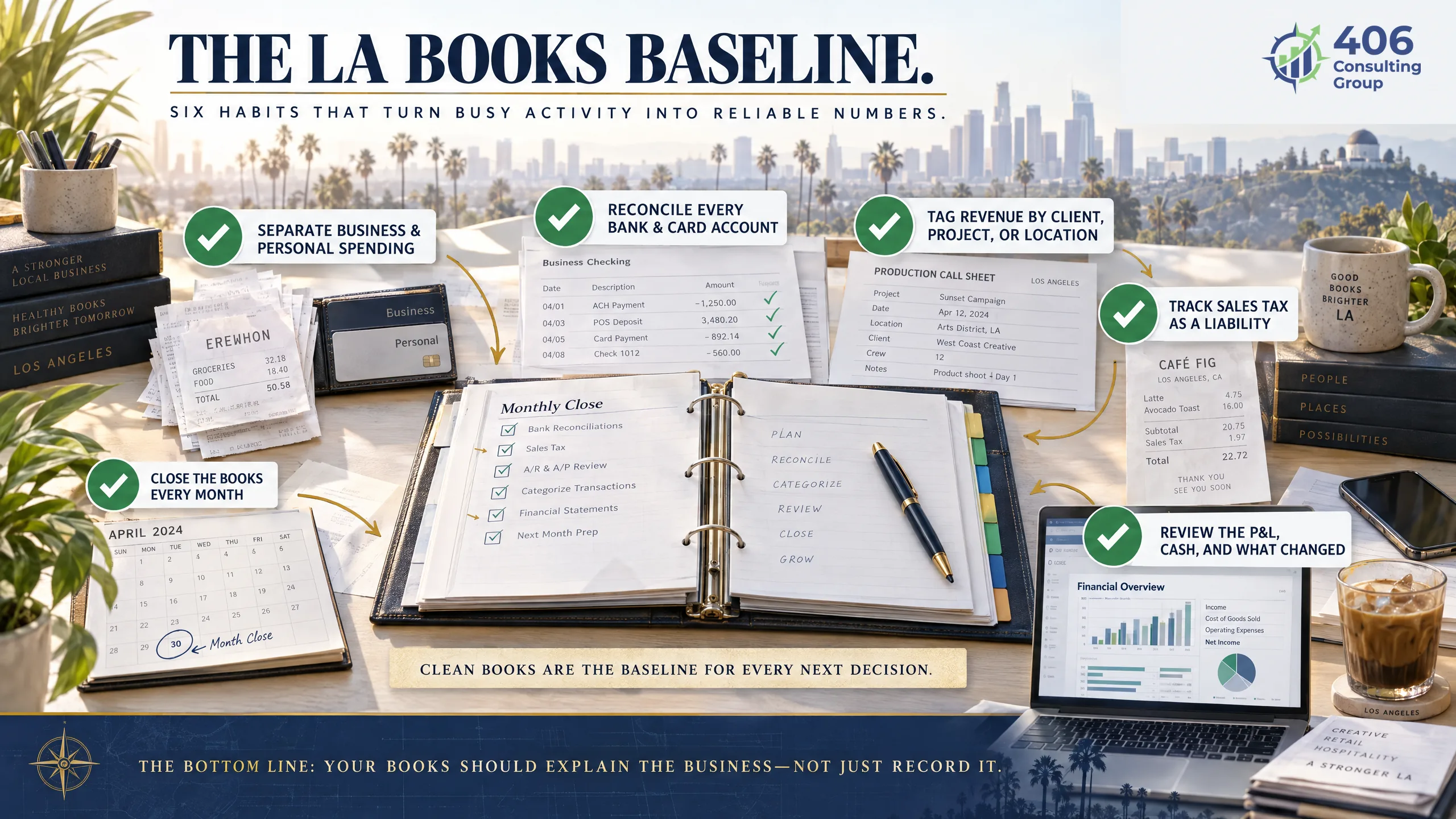
The LA Books Baseline: Six Things Before Tax Season or a Raise
The LA Books Baseline is the minimum standard a Los Angeles company's books must clear before it files a return or asks anyone for money. It's not a nice-to-have list — it's the six things that, if any one is missing, will cost you at the worst possible moment. Here they are.
Reconciled through last month
Every bank and credit-card account tied out monthly, so the numbers are trustworthy — not a year-end scramble.
Clean owner/business separation
No personal charges commingled. In California, blurred lines threaten liability protection and muddy every tax position.
1099 trail that supports AB 5
Contracts, invoices, and classification notes for every 1099 — the records that answer the ABC test if it's ever asked.
Revenue tagged by project/source
Per-project P&L for agencies and creators; royalties, residuals, and loan-out income tracked to their source.
CA + LA tax accruals tracked
$800 franchise minimum, the LLC gross-receipts fee, sales/use at 9.75%, and the LA City business tax — visible, not surprises.
Lender/investor-ready statements
A readable P&L, a balance sheet that ties, and a clear cash picture — the way a banker or VC reads them.
The rest of this guide walks the LA-specific pieces that make or break each item on the baseline — starting with the industry that defines the city.
Entertainment & Creator Books: 1099s, Royalties, and the Loan-Out
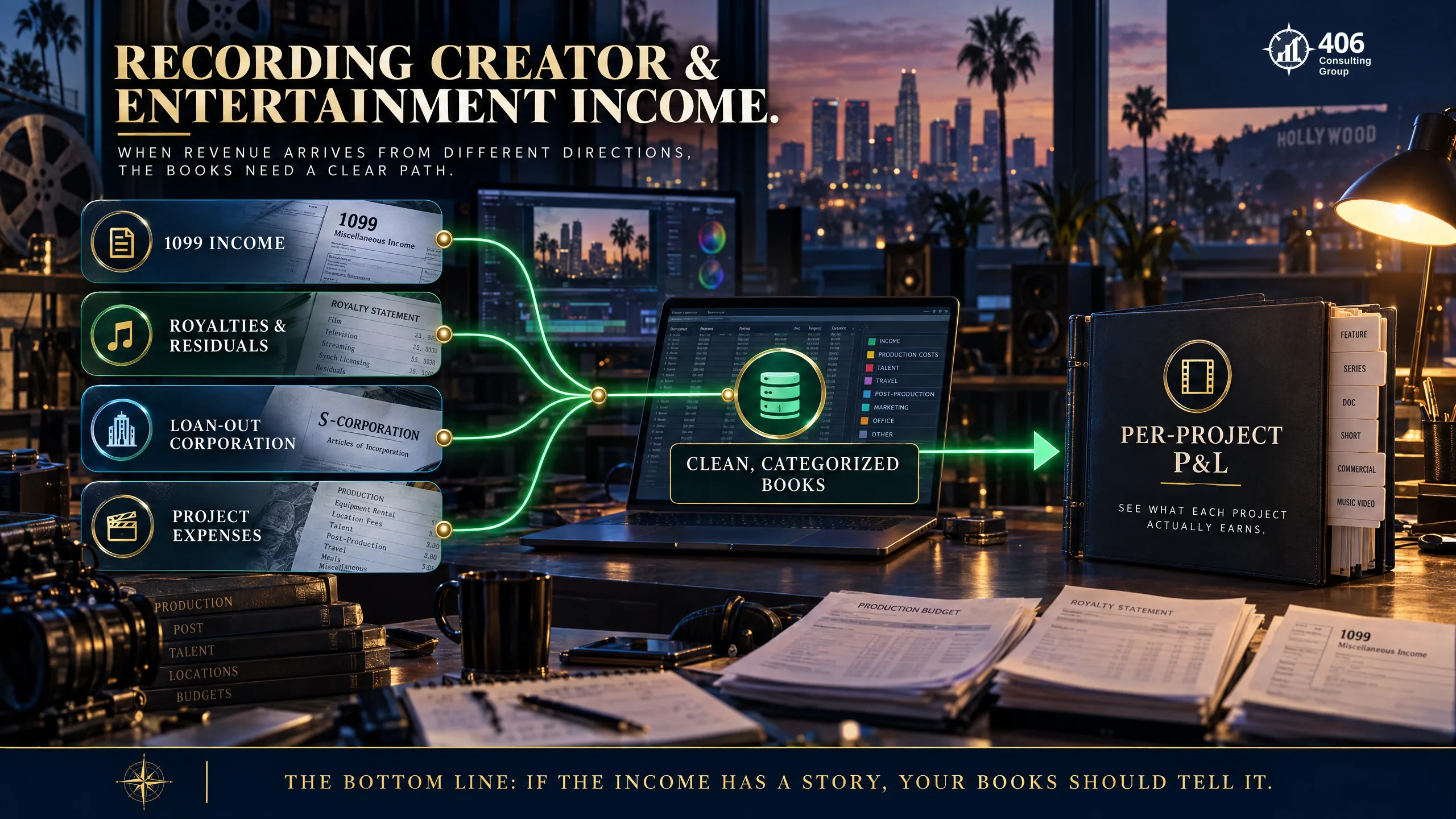
Entertainment and creator bookkeeping is different because the income arrives in pieces from many payers, on many schedules, under many contracts — and a lot of it flows through a loan-out corporation. A working actor, a YouTuber, a music producer, a production company, or a social agency doesn't get one paycheck; they get 1099s from platforms and studios, royalty and residual statements that trickle in for years, brand-deal payments, and licensing checks. If the books lump all of it into "income," nobody can see which project, channel, or client actually made money — and the tax picture becomes a guess.
The fix is structure. Every revenue stream gets tagged to its source and project, so you have a real per-project P&L: this film, this album, this channel, this brand campaign. Royalties and residuals get tracked as their own recurring streams, matched against the statements, because they keep paying long after the work is done. And 1099-NEC forms received get reconciled against your own records, so a payer's error doesn't become your audit.
The loan-out corporation — its own set of books
A loan-out corporation is an S-corp or C-corp that an entertainer or creator routes their income through — the corporation "loans out" the person's services to studios, platforms, and clients. It is a separate legal entity, so it needs its own bookkeeping, its own payroll, and a reasonable salarypaid to the owner. That means a dedicated chart of accounts, business bank accounts kept strictly apart from personal, documented shareholder distributions versus wages, and clean records of the corporation's expenses. Done right, it's a legitimate planning structure; done sloppily, the commingling undoes the benefit and invites scrutiny. Confirm your specific structure with a CPA or tax attorney.
Almost every one of these businesses pays contractors — editors, camera ops, freelancers, session players. In California, that means AB 5, and AB 5 is a records problem before it's anything else.
The AB 5 Record Trail: Documenting 1099-vs-W-2
AB 5 is the California law that decides whether a worker is an independent contractor (1099) or an employee (W-2), and it presumes employee unless you can prove otherwise. That proof runs on the ABC test: a worker is a contractor only if (A) they're free from your control and direction in how the work is done, (B) the work is outside your usual course of business, and (C)they're customarily engaged in an independently established trade or business of the same kind. All three must be true. Fail any one, and the state treats the worker as an employee — with back payroll taxes, penalties, and interest attached.
Here's where bookkeeping owns its lane: the tax and filing side of misclassification — the payroll returns, the EDD exposure, the penalty math — we cover in the LA tax services guide. What the books own is the record trailthat supports your classification in the first place. When a status is questioned, the state doesn't care what you meant — it reads what you kept.
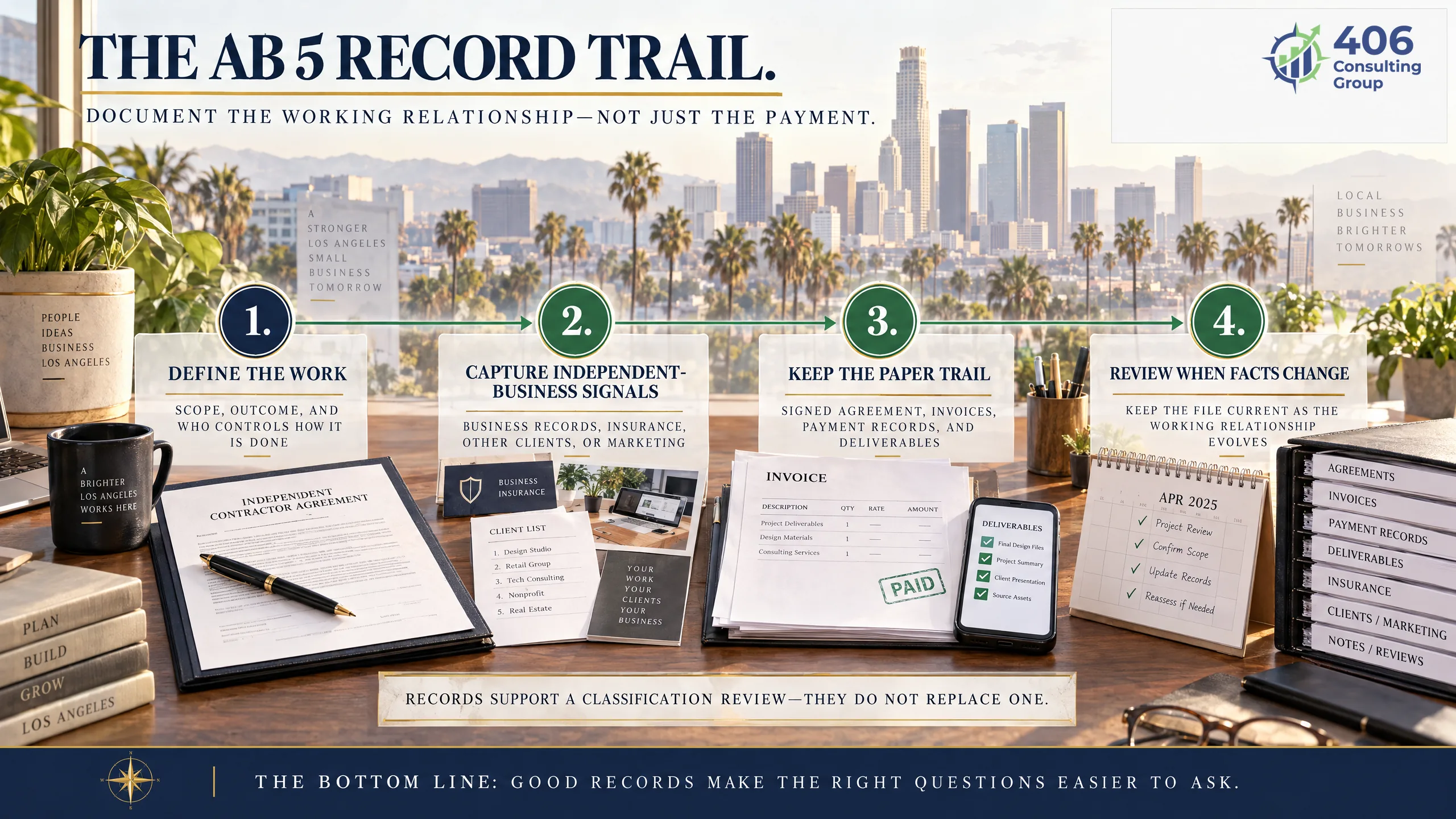
A signed contract per contractor
Scope of work, independence terms, and no-supervision language — attached in the books to the vendor record.
Their own business proof
Business license, EIN, website, or other clients — evidence of an independently established trade (prong C).
Invoices they issued to you
Contractor-generated invoices, not a payroll-style stipend, matched to payments in the ledger.
Clean, reconciled 1099-NEC filing
Accurate totals per payee, reconciled to your ledger, filed on time — the paper the IRS and EDD compare against.
Under AB 5, the burden of proof is on you. The difference between a contractor and an expensive reclassification is almost always the quality of the records — and records are exactly what bookkeeping is for.
Consult an employment attorney on specific classifications — but keep the records regardless. Many LA businesses also run more than one entity, which adds its own bookkeeping discipline.
Multi-Entity Books & the California LLC Gross-Receipts Fee
Los Angeles owners collect entities the way other people collect email subscriptions — a loan-out corp, an operating LLC, a real-estate holding LLC, a brand entity. Each one is a separate taxpayer with its own books, its own bank account, and its own California obligations. The two that catch people every year: the $800 minimum annual franchise tax that every LLC and corporation owes just to exist in California — profit or no profit — and the LLC gross-receipts feethat stacks on top of the $800 once an LLC's California revenue crosses a threshold.
That fee is based on total gross receipts, not profit, so a high-revenue, thin-margin LLC can owe it even in a break-even year. Your books need to track each entity's gross receipts through the year so the fee is an accrual you see coming, not a spring surprise.
California LLC gross-receipts fee (illustrative tiers)
Illustrative. Fee is on gross receipts, not profit, and applies to LLCs (the $800 minimum applies to LLCs and corporations). Confirm current thresholds and amounts with the California Franchise Tax Board.
California also offers the AB 150 pass-through entity (PTE) elective tax— roughly 9.3% paid at the entity level so owners can work around the federal SALT cap. Whether it helps depends on your situation, but the bookkeeping has to support it: the election, the payment timing, and the credit tracking all have to be clean, and with multiple entities that's real work.
On top of income and franchise obligations sit the taxes tied to the city itself.
LA City Business Tax + the 9.75% Sales & Use Tax
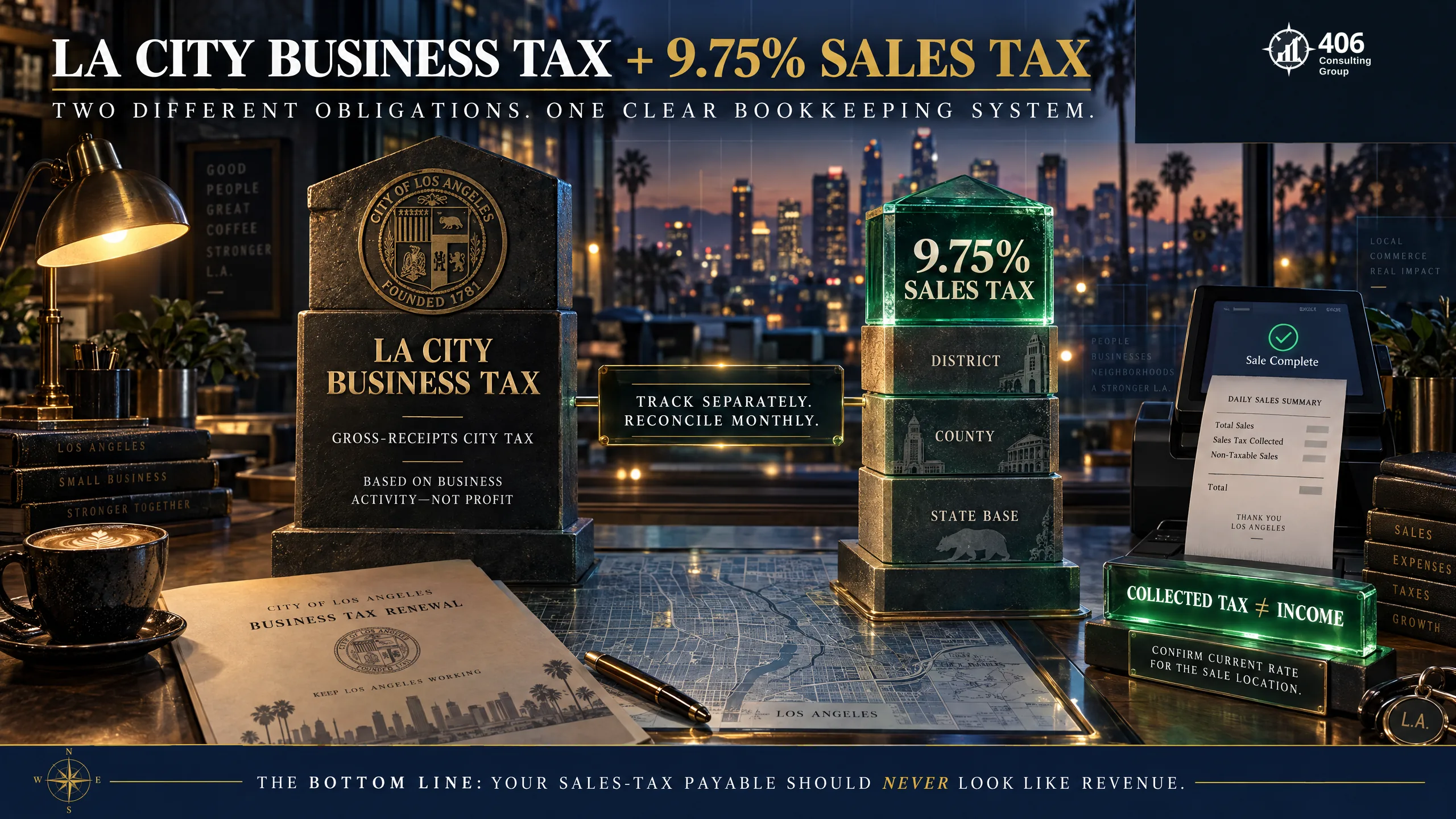
Los Angeles layers two city-level obligations on top of the state, and they are not the same thing. The first is the LA City business tax — a gross-receipts tax filed with the LA Office of Finance, where the rate depends on your business activity category (a creative agency, a retailer, and a professional-services firm can sit in different classifications at different rates). It's based on gross receipts, not profit, so your books have to total receipts cleanly by the categories the city recognizes. The second is sales and use tax: the combined rate in the City of Los Angeles is 9.75% as of April 1, 2025. You collect and remit it on taxable sales, and you owe use tax on taxable items you bought from out of state without paying California tax.
LA City business tax
Gross-receipts based, filed with the LA Office of Finance; rate varies by activity category. Register, classify correctly, renew annually.
9.75% sales & use tax
Combined City of LA rate since April 1, 2025. Collect on taxable sales, remit to the CDTFA, and track it as a liability — never as revenue.
Use tax exposure
Bought equipment or goods out of state with no CA tax charged? You likely owe use tax. Your books should flag those purchases.
Category & nexus care
Selling into other California cities or online adds district-tax and nexus questions your books need to capture correctly.
Confirm your activity classification and current rates with the LA Office of Finance and the California CDTFA. One LA sector adds its own bookkeeping wrinkle: property.
Real Estate & Short-Term-Rental Books
Real-estate and short-term-rental bookkeeping needs property-level detail, because the tax and lending decisions all happen at the property level. In a market as active as Los Angeles, owners routinely hold each property in its own LLC — which means each one needs its own books, its own $800 minimum, and its own gross-receipts-fee watch. For rentals, the ledger has to separate rental income, operating expenses, capital improvements (which are depreciated, not expensed), and mortgage principal versus interest — the split that determines the real tax picture.
Short-term rentals add another layer: transient occupancy tax (the city's hotel/lodging tax) collected from guests and remitted to the city, platform payouts (Airbnb, VRBO) reconciled against gross bookings net of platform fees, and LA's Home-Sharing Ordinanceregistration and rules. Miss the occupancy tax and you're remitting out of your own pocket later; blur the platform fees and your revenue is overstated all year.
Property books that live at the portfolio level hide the one property that's bleeding. Property-by-property books show you which door to fix — and give a lender the clean, per-property picture they require to finance the next one.
Whatever the LA business, there's a common starting condition: the books are behind. That's the fast-growth reality, and it's fixable.
Catch-Up & Cleanup: The Fast-Growth LA Reality
The most common condition we see in a new LA client isn't fraud or chaos — it's a business that grew faster than its books. A creator's side project becomes a six-figure operation in eighteen months; an agency lands three big retainers and nobody updated the ledger since spring. That's catch-up and cleanup: rebuilding months (sometimes years) of records so the numbers are trustworthy again. The good news is that it's a defined project with a defined end, not an indefinite mess.
A cleanup rebuilds the chart of accounts, reconciles every account back to actual statements, separates the personal charges that crept in, reconstructs the 1099 and AB 5 record trail, catches up unfiled sales/use and city returns, and gets each entity's franchise and gross-receipts-fee position straight. When it's done, you have a clean starting line and a monthly rhythm that keeps you there.
Behind ≠ broken
Catch-up is a project with an end date
Reconcile, separate, reconstruct the record trail, catch up the returns — then keep it clean monthly.

The reason clean books matter isn't just compliance. It's the day you need capital.
Books That Pass a Lender or a VC
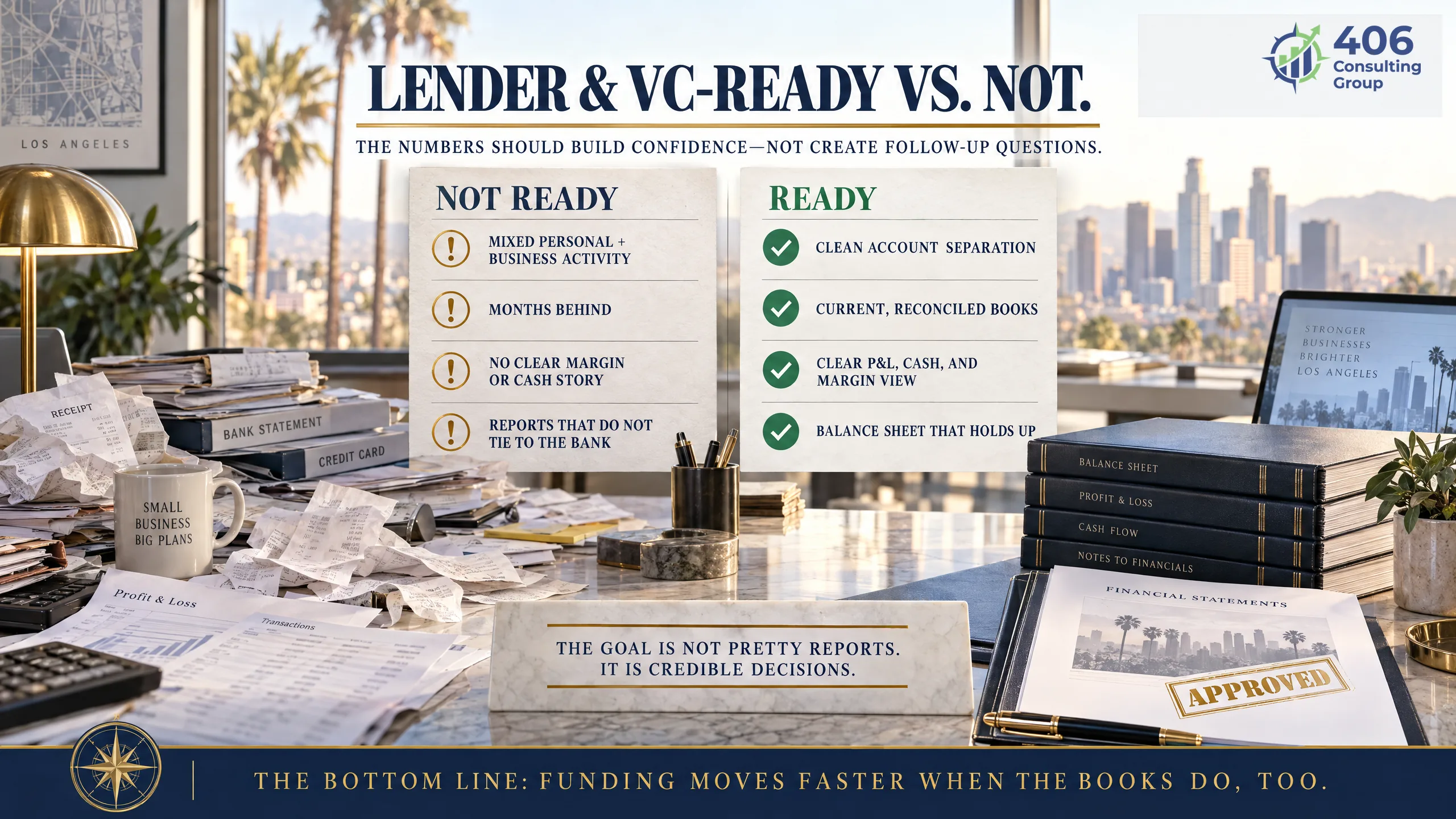
Growth in Los Angeles runs on outside money — a bank line of credit, an SBA loan, an equipment note, or a venture round for the startups and creator brands scaling fast. When you ask for it, someone reads your financials to decide, and messy books answer for you: no. Lender- and investor-grade books mean a clean separation of business and personal, a readable profit-and-loss that shows real profitability (by project, for agencies and creators), a balance sheet that ties out, and a cash picture that supports the ask.
Carrie's underwriting lens
My co-founder Carrie spent her career in commercial banking and underwriting — she has reviewed more than 300 loan filesfrom the lender's side of the desk. She'll tell you plainly: underwriters and investors don't reward hustle, they reward numbers they can trust. When the business and personal are tangled, when the P&L can't show where the money is actually made, when the balance sheet doesn't tie, the decision gets made against you before the conversation starts. We keep your books the way the person on the other side of the table reads them — so when you ask, the numbers make your case.
The full lender package — forecasts, board reporting, the metrics investors probe — is controller and CFO work, and we walk through it in the LA CFO & controller guide. Bookkeeping's job is to make sure the raw numbers underneath it are true. That takes the right tools and a real cadence.
Tools & the Monthly Close Cadence
Good LA books run on a modern cloud stack and a disciplined monthly close — the rhythm that turns bookkeeping from a year-end panic into a steady management tool. The core is cloud accounting (QuickBooks Online or Xero) with live bank and card feeds, a receipt/expense capture tool, a bill-pay and payroll platform, and — for creators and agencies — the project or class tracking that produces per-project P&Ls. For multi-entity owners, a consistent chart of accounts across entities makes the whole picture legible.
Week 1: Reconcile
Tie out every bank and card account to statements. Nothing else is trustworthy until this is done.
Week 2: Categorize & accrue
Code transactions, tag revenue by project/source, record sales/use and city-tax accruals and the franchise/fee position.
Week 3: Review & adjust
Check margins by project, catch miscodings, confirm the 1099/AB 5 trail is intact for new contractors.
Week 4: Report & decide
Deliver a clean P&L, balance sheet, and cash view — the statements you actually run the business on.

Not sure where your books sit on the maturity curve? The financial maturity assessmentmaps it in a few minutes. Here's how it all comes together in practice.
Illustrative Example: A Venice Creator Agency's 12-Month Cleanup
The following is a hypothetical, composite illustration — not a real client. Figures are realistic but invented to show how the pieces fit together.
Picture a creator agency in Venice — call it a three-person shop that produces short-form video and runs brand campaigns for consumer clients. In two years it grew from a founder's side hustle to about $1.1M in revenue. The founder ran everything through one LLC, paid a rotating cast of editors and camera ops on 1099s, and hadn't reconciled the books since the prior summer. A bank had just declined a line of credit — "come back when the financials are clean."
Starting point
9 months unreconciled
Personal and business commingled; no per-client P&L; 1099s filed but no contracts on file.
The gaps
4 exposure areas
LLC gross-receipts fee unaccrued, sales/use behind, AB 5 trail missing, city business tax unregistered.
12 months later
Clean & funded
Reconciled monthly, per-client margins visible, records that support the 1099s, line of credit approved.
The cleanup ran the playbook: reconcile nine months back to actual statements, pull the personal charges out, rebuild a chart of accounts with per-client project tracking, reconstruct contracts and invoices for each 1099 editor to support the AB 5 record trail, register and file the LA City business tax, catch up sales/use, and accrue the California LLC gross-receipts fee (at roughly $1.1M, that's the $6,000 tier plus the $800 minimum — about $6,800the founder hadn't been setting aside). On the new per-client P&L, one "flagship" client that felt important turned out to be barely breaking even after edit hours; two smaller retainers carried the margin.
Twelve months later the same bank approved the line of credit — not because the business had changed, but because the books finally showed what was already true. That's the LA Books Baseline doing its job.
None of this required anyone to be in the same room. Which raises the question we get most.
FAQ: Los Angeles Bookkeeping Questions
What's different about bookkeeping in Los Angeles?
Los Angeles books have to carry more than a typical business's. On the state side, California has the country's highest personal income tax (up to 13.3% at the top), an 8.84% corporate rate, an $800 minimum annual franchise tax for LLCs and corporations, and an LLC gross-receipts fee stacked on top once revenue crosses $250K. On the local side, there's a separate LA City business tax on gross receipts (filed with the LA Office of Finance) and a 9.75% sales-and-use rate. And LA's signature industries — entertainment, creator media, agencies — run on 1099s, which means AB 5 classification records and, often, loan-out-corporation bookkeeping. A bookkeeper who doesn't know California keeps tidy records that are quietly wrong. Confirm current figures with the California Franchise Tax Board and the LA Office of Finance.
How do I track 1099s, royalties, and loan-out income?
Structure and separation. Tag every revenue stream to its source and project so you get a real per-project P&L — this film, this channel, this brand campaign — instead of one blended 'income' number. Track royalties and residuals as their own recurring streams and match them to the statements, since they keep paying for years. Reconcile every 1099-NEC you receive against your own records so a payer's error doesn't become your audit. And if you use a loan-out corporation, it gets its own complete set of books: a dedicated chart of accounts, business bank accounts kept strictly apart from personal, payroll with a reasonable salary to the owner, and documented distributions versus wages. Confirm your structure with a CPA or tax attorney.
What records prove AB 5 classification?
AB 5 uses the ABC test, and the burden of proof is on you, so the records are your defense. For each 1099 contractor, keep a signed contract with scope-of-work and independence terms, evidence the worker runs their own established business (a business license, EIN, website, or other clients — prong C), invoices the contractor issued to you (not a payroll-style stipend), and a clean, reconciled 1099-NEC filing with accurate per-payee totals. The ABC test requires all three prongs to be true: (A) freedom from your control, (B) work outside your usual course of business, (C) an independently established trade. We own the records side; the tax and filing side of misclassification is covered in our LA tax services guide. Consult an employment attorney on specific classifications.
How does the LA City business tax work?
It's a gross-receipts tax, separate from state income tax and from sales tax, filed with the LA Office of Finance. The rate depends on your business activity category — a creative agency, a retailer, and a professional-services firm can sit in different classifications at different rates — and it's based on gross receipts, not profit, so your books have to total receipts cleanly by the categories the city recognizes. You register, classify correctly, and renew annually, with some small businesses qualifying for exemptions or thresholds. It's easy to overlook because it's neither a state nor a sales-tax filing. Confirm your classification and current rates directly with the LA Office of Finance.
How far behind on my books is too far?
There's no point of no return — catch-up is a defined project, not a lost cause. We regularly rebuild nine months or more of records: reconcile every account back to actual statements, pull out commingled personal charges, reconstruct the 1099 and AB 5 record trail, catch up unfiled sales/use and city returns, and get each entity's franchise and gross-receipts-fee position straight. The real risk of waiting isn't the bookkeeping difficulty — it's missed filings piling up penalties and interest, and a capital opportunity arriving before the books can support it. If you're behind, the best time to start is before a deadline or a lender forces the timeline for you.
Do you do bookkeeping remotely for Los Angeles clients?
Yes — entirely. About 80% of our own local clients handle the whole relationship remotely and never come into an office, because modern bookkeeping runs on secure cloud accounting, live bank feeds, and screen-share reviews. The work happens the same whether your bookkeeper is down the 405 or in Montana. What actually matters is expertise in California and LA rules — the franchise tax and LLC fee, AB 5 records, loan-out corporations, the city business tax, the 9.75% sales tax — plus responsiveness. A great remote bookkeeper who knows all of that beats an okay local one who treats your books like any other. We serve Los Angeles businesses fully remotely.
LA Books Snapshot
What a Los Angeles business faces
LA Bookkeeping
Clean, California-aware, remote.
About the Author
Jason Anderson
Co-Founder, 406 Consulting Group
Jason builds clean, audit-ready, investor-grade books for creators and growing companies — designed from a whole-company view with a Six Sigma eye for process, and delivered remotely to Los Angeles and California businesses.
Read the Full Story