
CFO & Controller Services in Los Angeles, CA:
The 7 Numbers That Run Your Business
A controller makes your numbers reliable; a CFO turns them into strategy. The LA Growth Dashboard — the seven numbers an LA owner should see every month — plus burn, production P&L, VC readiness, and AB 5 headcount cost. Big-company firepower, delivered fractionally and remotely — the way 80% of our local clients already work.

If you are searching for CFO services in Los Angeles, you have almost certainly outgrown a bookkeeper and started wondering whether the next hire is a controller, a CFO, or both. It is one of the most expensive questions a growing Los Angeles company gets wrong — because the two roles solve different problems. A controller makes your numbers reliable: the monthly close, reconciliations, and reporting you can actually trust. A CFOtakes those reliable numbers and turns them into strategy: forecasting, capital, pricing, and the handful of KPIs that decide whether you scale or stall. In a market where rent, wages, and cash burn all run higher than almost anywhere in the country, getting this pairing right is not a luxury — it is how LA companies grow on purpose instead of by accident.
This guide lays out the difference plainly, introduces The LA Growth Dashboard— the seven numbers an LA owner should see every month — and walks the finance problems that are specific to this city: burn and runway in a high-cost market, production and slate P&L, real-estate portfolio reporting, Silicon Beach fundraising, and scaling headcount under AB 5. All of it delivered fractionally and remotely.
By Jason Anderson — Co-Founder, 406 Consulting Group. Big-firm-trained accountant and Six Sigma–minded systems builder who gives growing companies controller discipline and CFO-level strategy — designed from a whole-company view and delivered remotely to Los Angeles businesses.
Quick Answer: Controller vs CFO in Los Angeles
- →A controller owns accuracy — the close, reconciliations, and reliable monthly financials. A CFO owns strategy — forecasting, cash, capital, and KPIs.
- →Most LA companies need the controller function first, then add fractional CFO firepower as growth, fundraising, or complexity demands it.
- →LA's high rent, high wages, and CA's 13.3% top individual and 8.84% corporate rates make cash burn and runway the numbers that keep owners up at night.
- →Production slates, real-estate portfolios, and Silicon Beach raises each need reporting a generic accountant does not build.
- →It is all remote — and about 80% of our own local clients run CFO-level work entirely that way.
Table of Contents
Controller vs CFO — And When an LA Business Needs Each
The short answer: a controller looks backward and makes it accurate; a CFOlooks forward and makes it strategic. A controller closes the month, reconciles every account, enforces the chart of accounts, and hands you financial statements you can trust. A CFO takes those statements and answers the questions that actually decide the business — Can we afford this hire? What is our runway? Should we raise, and at what terms? Are we pricing for the margin we think we have? In Los Angeles, where a single bad assumption about burn can cost a company its runway, both jobs matter, but they matter in order.
Most growing LA businesses need the controller function first. You cannot strategize on numbers you do not trust, and a CFO forecasting off a messy close is just guessing with a nicer title. Once the close is reliable, fractional CFO time turns those numbers into decisions. The good news is that at your stage you rarely need either role full-time — a fractional controller and a fractional CFO give you big-company discipline at a fraction of a six-figure LA salary.
Controller makes the numbers true. CFO makes them useful. Get them out of order and you are paying for strategy built on sand.

It all starts with the one thing too many LA companies skip: a real monthly close.
Controller First: The Monthly Close
The monthly close is the controller's core deliverable, and it is the foundation everything above it stands on. A real close means every bank and credit-card account reconciled, revenue and expenses recognized in the right period, accruals and prepaids handled, intercompany entries cleared, and a clean set of statements produced on a predictable date — not "sometime after the 20th when we get to it." For an LA company juggling multiple revenue lines, contractors, and vendors, a disciplined close is the difference between financials you can act on and a shoebox you reconstruct at tax time.
The deeper reporting — clean chart of accounts, transaction-level accuracy, sales-tax and payroll mechanics — is work we cover in the Los Angeles bookkeeping guide. The controller's job is to make sure that foundation actually closes each month, on time, correctly, so a CFO has something real to work with.
Close on a calendar
A fixed close date every month — so the numbers are ready when decisions are, not weeks late.
Everything reconciled
Bank, credit card, loans, and merchant accounts tied out — no plugs, no mystery balances.
Right-period revenue
Revenue and costs matched to the month they belong to, so margin is real and not a timing illusion.
Statements you trust
A P&L, balance sheet, and cash-flow view a lender, investor, or CFO can rely on without a rebuild.
Once the close is reliable, the CFO layer begins — and it begins with a dashboard.
The LA Growth Dashboard: 7 Numbers You Should See Every Month
Most owners drown in reports and starve for the few numbers that actually run the business. The fix is a one-page dashboard. Here is the set we build for Los Angeles companies — The LA Growth Dashboard— the seven numbers an owner should see every single month, each one chosen because it drives a decision in a high-cost market.
1. Cash & runway
Cash on hand and the months it buys at current burn. The single most important number in an expensive city.
2. Gross margin
Revenue minus true cost of delivery, by line. LA revenue can be large and still margin-thin.
3. Monthly burn / net cash flow
What the business consumes or generates each month — the pace against your runway.
4. Revenue vs forecast
Actual against plan, so a miss shows up in weeks, not at the fiscal year-end.
5. Labor as % of revenue
With CA wages and payroll costs, the number that quietly decides profitability.
6. AR / collections aging
Cash you have earned but not collected — working capital hiding in plain sight.
7. Pipeline / booked revenue
Contracted or committed revenue ahead — the forward view runway alone cannot give you.
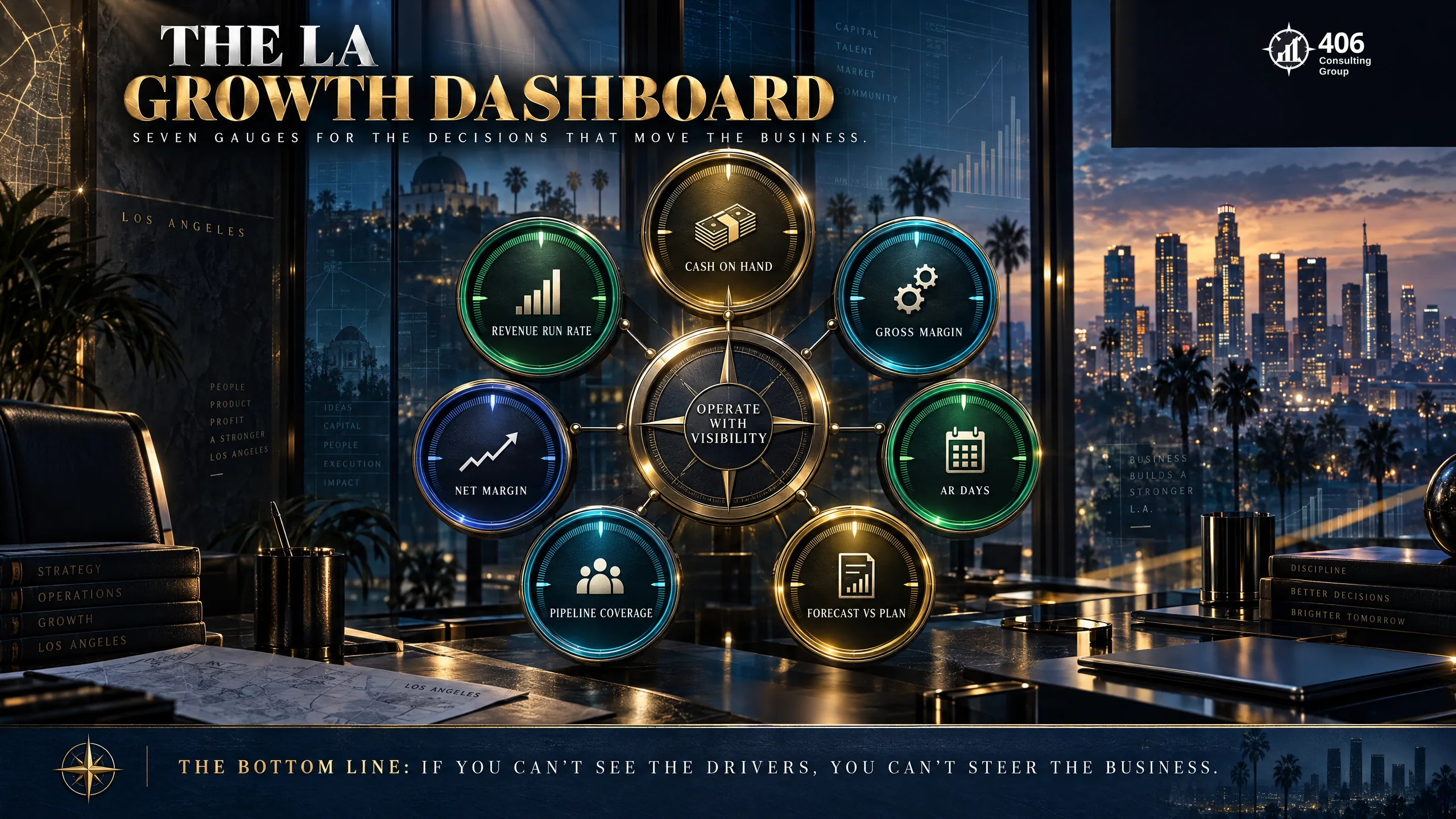
If you can only see seven numbers, see these. A CFO's job is to make sure each one is honest — and that you act on them before the market forces your hand.
Number one on that list — cash and runway — carries more weight in LA than almost anywhere else.
Cash Burn & Runway in a High-Cost Market
In Los Angeles, cash burn is not a startup buzzword — it is a survival metric for almost any growing company. Commercial rent, competitive wages, and California's tax and payroll environment mean the same headcount and footprint cost materially more here than in most markets. A CFO's first job is to make burn and runway impossible to ignore: how much cash the business consumes each month, how many months of runway that leaves, and what levers move it. That means a rolling 13-week cash forecast, not just a backward-looking P&L, so a shortfall is visible while there is still time to fix it.
California's cost stack is real and worth planning around: a 13.3% top individual rate on pass-through owners, an 8.84% corporate rate on C-corps, the $800 minimum franchise tax plus an LLC gross-receipts fee, and EDD payroll costs including SDI at 1.1% of wages with no wage cap since 2024. Rates and thresholds change, so confirm current figures with the California FTB, but the direction is clear: every dollar of runway works harder here.
13 weeks
the cash forecast horizon that catches trouble early
A rolling short-term cash view turns "we're tight" into a plan — before payroll is at risk.

For some LA companies, burn management is complicated further by how revenue actually arrives — in projects and slates.
Entertainment & Production Finance
Los Angeles is a production town, and production finance breaks the generic P&L. Whether you run a production company, a post house, a content studio, or an agency delivering campaigns, your economics live at the project and slate level, not the company level. A single blended P&L can show a healthy year while individual projects quietly bleed — over-budget shoots, under-billed change orders, and overhead spread across titles that never carried their share. A CFO builds per-project P&Ls that track budget vs actual, above- and below-the-line costs, and contribution margin per title, then rolls them into a slate view so you can see which projects fund the business and which drain it.
Project-level P&L
Budget vs actual per production, with costs tracked to the title that incurred them — not a company-wide blur.
Slate roll-up
Every active project on one page, so the winners and the money pits are both obvious.
Milestone & cash timing
Revenue and payments rarely line up with spend — a forecast maps the gaps before they bite.
Overhead allocation
Shared costs assigned honestly, so no single project looks better than it is at the others' expense.

Project-level thinking carries straight into another LA staple: real estate held across multiple entities.
Real-Estate Portfolio Reporting
LA wealth and LA business are both heavy in real estate, and real-estate owners hit a reporting wall fast. Each property or development often sits in its own LLC, and each LLC owes California's $800 minimum franchise tax plus, for LLCs, a gross-receipts fee — so a portfolio of ten entities carries real fixed cost before a single decision is made. A CFO-level function brings consolidated reporting: property-by-property performance, then a clean roll-up across the whole portfolio, with intercompany transactions eliminated so the consolidated picture is actually true. You see net operating income per property, debt service coverage, and portfolio-wide cash — the numbers a lender and a partner both ask for.
Ten properties in ten LLCs is ten sets of books and one question that matters: how is the portfolio doing? Consolidated reporting answers it — cleanly, every month.

Whether it is a property portfolio, a production slate, or a SaaS platform, the moment you seek outside capital, the bar on your financials jumps.
VC & Lender Readiness
Silicon Beach — Santa Monica, Venice, Playa Vista, and the tech corridor around them — means a lot of LA companies are raising, and whether you are courting a VC or an SBA lender, they read your financials to decide. VC-ready and lender-ready are close cousins: both want a clean separation of business and personal, a readable P&L that shows real unit economics, a balance sheet that supports the ask, and a forecastthat is defensible rather than hopeful. Investors dig into burn, gross margin, CAC and retention; lenders dig into cash flow and coverage. A CFO prepares you for both — and gets the data room in order before diligence, not during it.
This is where my co-founder Carrie's background changes the work. Carrie spent her career in commercial banking and underwriting and has reviewed more than 300 loan files — she has sat in the seat that says yes or no. We build your numbers the way the person on the other side of the table reads them, so the package makes your case instead of raising questions. We cover the lending angle in depth on our loan readiness service, and the tax structuring that investors and lenders scrutinize in the Los Angeles tax services guide.
A raise is not won in the pitch — it is won or lost in diligence, when someone trained to find holes reads your numbers. Build them to survive that read.

One line item every LA forecast has to model carefully is people — because in California, headcount is uniquely expensive and uniquely regulated.
Scaling Headcount Under AB 5 & High CA Labor Cost
In California, the decision to add a person is a financial event with a long tail. AB 5 and the ABC test sharply limit when a worker can be treated as a 1099 contractor rather than a W-2 employee — and misclassification is one of the most expensive mistakes a growing LA company can make, with back taxes and penalties that dwarf the payroll it tried to avoid. A CFO models the true, loaded cost of each hire: wages plus employer payroll taxes, EDD costs including SDI at 1.1% with no wage cap since 2024, workers' compensation, which California mandates from the very first employee, benefits, and the overhead a new seat carries. Rates shift, so verify current figures, but the lesson holds: labor as a percent of revenue is often the number that decides whether growth is profitable.
W-2 vs 1099 under AB 5
The ABC test is strict — model roles as employees unless they clearly pass, because misclassification penalties are brutal.
Loaded cost per hire
Wages are the start. Payroll tax, SDI, workers' comp, and benefits are the real number a forecast must carry.
WC from employee one
California requires workers' comp coverage as soon as you have any employee — budget it from day one.
Labor % of revenue
Watch it monthly. In a high-wage market, this ratio is where margin is won or lost.

Handling all of this well is not about one clever report — it is about how the whole company is wired together.
The Whole-Company Systems View
Here is what separates finance leadership from accounting: a real CFO designs the systems and processes that produce the numbers, and does it from a whole-company view rather than a narrow accounting lens. How does a signed deal flow into billing? How does billing connect to revenue recognition, to cash forecasting, to the dashboard? Where do the manual steps live that break every close? My own background is built on exactly this — big-firm accounting paired with a Six Sigma–minded passion for process and efficiency. The philosophy is simple: do not try to boil the ocean. Start somewhere, fix one broken hand-off, and let clean process compound.
For an LA company, this is the difference between a dashboard you trust and one you rebuild by hand every month. When sales, operations, billing, and finance are wired together deliberately, the seven numbers on your dashboard stop being a fire drill and start being a byproduct of how the company runs. That cross-departmental design — not just tidy books — is what we mean by financial leadership.
Do not boil the ocean. Fix one broken hand-off, then the next. Clean process is how good numbers become automatic instead of heroic.
To make all of this concrete, here is how it comes together for a company preparing to raise.
Illustrative Example: A Silicon Beach SaaS Prepping a Raise
Illustrative example. The company below is a hypothetical composite created to show how the numbers work — not a real or named client. Figures are realistic but invented.
Picture a Santa Monica SaaS company — call it a hypothetical "Playa Analytics." It is doing about $2.4M in annual recurring revenue, growing fast, and planning a Series A in six months. On the surface things look great. Under the hood, the close lands three weeks late, the founder cannot state runway with confidence, and gross margin is muddied because cloud-hosting and support costs are scattered across the P&L. Burn is roughly $180K a month against $1.1M in the bank— a little over six months of runway, which is exactly the wrong number to discover two weeks before you start pitching.
The controller work comes first: a disciplined close by the fifth business day, hosting and support costs pulled into true cost of revenue so gross margin reads honestly at ~78%, and clean separation of owner and business items. Then the CFO layer: a rolling 13-week cash forecast, a defensible three-year model, and a dashboard showing the seven numbers — including a runway figure the founder can finally recite. Loaded headcount cost is modeled under AB 5, so the hiring plan in the pitch survives an investor's scrutiny. When diligence comes, the data room is already built, and — reviewed through Carrie's underwriting lens — the numbers answer questions instead of raising them.
Close time
21 days → 5 days
Numbers ready before decisions, not after.
Gross margin
Muddied → ~78%
True cost of revenue, honestly stated.
Runway
Unknown → ~6 mo
A number the founder can defend in the room.
None of that required a CFO in the next office. It was delivered remotely — which is how most of this work happens now.
Local vs Remote for CFO-Level Work
It is natural to assume CFO-level work needs someone in the building. The reality settles it: around 80% of our own local clients run the entire relationship remotely — and CFO and controller work is more suited to remote delivery than almost anything else in finance, because it lives in cloud accounting, shared dashboards, forecasting models, and a standing video review. There is no shoebox to hand across a desk. A monthly strategy call over screen-share is the same call whether the CFO is in Century City or across the country.
~80%
of our local clients run CFO-level work fully remotely
They never come into the office — the dashboards, forecasts, and reviews are cloud-based, by choice.
What matters is expertise, not proximity. A great remote CFO who understands LA's cost structure — burn in a high-rent market, production and slate economics, real-estate consolidation, Silicon Beach fundraising, and AB 5 headcount cost — beats an okay local one who treats your business like any other. A hire-quality full-time CFO in Los Angeles can run well into the six figures; a fractional controller-plus-CFO gives you the same discipline and strategy for a fraction of that, delivered remotely. Start by finding out where your finances stand with our financial maturity assessment, then let's talk.
Whatever stage you are at, the questions below are the ones LA owners ask us most.
FAQ: LA CFO & Controller Questions
Controller vs CFO — what's the difference?
A controller owns accuracy and a CFO owns strategy. The controller runs the monthly close, reconciles every account, enforces the chart of accounts, and produces financial statements you can trust — they make the numbers true. A CFO takes those reliable numbers and turns them into decisions: forecasting, cash and runway management, pricing, capital strategy, and the KPIs that steer the business. Most growing Los Angeles companies need the controller function solid first, because a CFO forecasting off a messy close is just guessing. At your stage you rarely need either full-time — a fractional controller plus a fractional CFO gives you both functions without a six-figure LA salary.
When can an LA business afford a fractional CFO?
Usually well before owners think. Because the role is fractional, you pay for a slice of senior expertise rather than a full-time salary that in Los Angeles can run well into the six figures. The better question is when you need one: when cash and runway decisions are keeping you up, when you're raising capital or seeking a loan, when you have multiple entities or revenue lines, or when growth has outrun your ability to see whether it's profitable. If any of those are true, a fractional CFO typically pays for itself through better cash decisions and a stronger raise. Our financial maturity assessment is a fast way to gauge where you stand.
What do LA investors and lenders want to see?
Clean, credible numbers that survive scrutiny. Both want a clear separation of business and personal finances, a readable P&L that shows real unit economics, and a balance sheet that supports the ask. Investors dig into burn, gross margin, customer acquisition cost, and retention; lenders focus on cash flow and debt-service coverage. Both want a forecast that's defensible rather than hopeful, and a data room ready before diligence starts. Because our co-founder Carrie spent her career in commercial banking and underwriting and has reviewed more than 300 loan files, we build your numbers the way the person deciding will actually read them.
How do you manage cash burn in a high-cost market?
You make burn and runway impossible to ignore and forecast them forward. In Los Angeles, high rent, competitive wages, and California's tax and payroll costs mean burn runs faster than in most markets, so we build a rolling 13-week cash forecast alongside the monthly P&L — that catches a shortfall while there's still time to act. We also pin cash, runway, monthly burn, and labor as a percent of revenue to the top of your dashboard, and model California-specific costs like the 13.3% top individual rate, the $800 minimum franchise tax, LLC fees, and EDD payroll costs including uncapped SDI. Confirm current rates with the California FTB.
Can a remote CFO run my numbers?
Yes — CFO and controller work is among the best-suited finance work for remote delivery. It lives in cloud accounting, shared dashboards, forecasting models, and a standing video review, so there's nothing to hand across a desk. About 80% of our own local clients run the entire relationship remotely and never come into the office. What matters is expertise in LA's cost structure — burn in a high-rent market, production and slate economics, real-estate consolidation, Silicon Beach fundraising, and AB 5 headcount cost — not whether your CFO is in the building. A great remote CFO who knows those beats an okay local one who doesn't.
What KPIs should I watch?
We build every Los Angeles client The LA Growth Dashboard — seven numbers to see every month: (1) cash on hand and runway, (2) gross margin by line, (3) monthly burn or net cash flow, (4) actual revenue vs forecast, (5) labor as a percent of revenue, (6) accounts-receivable and collections aging, and (7) pipeline or booked revenue ahead. Each one drives a decision in a high-cost market. If you can only watch seven numbers, watch these — and the CFO's job is to make sure each is honest and that you act on it before the market forces your hand.
When You Need Which
Controller vs CFO
LA CFO & Controller
Fractional, strategic, remote.
About the Author
Jason Anderson
Co-Founder, 406 Consulting Group
Jason pairs big-firm accounting with a Six Sigma–minded passion for process to give growing companies controller discipline and CFO-level strategy — designed from a whole-company view and delivered remotely to Los Angeles businesses.
Read the Full Story