
Trades & Construction Accounting in Los Angeles, CA:
Your Books Help License You
CSLB bonding, AB 5 subcontractor rules, mandatory workers' comp, prevailing wage, and WIP that protects your bonding line — the construction accounting an LA contractor actually needs, delivered remotely the way 80% of our local clients already work.

Construction accounting in Los Angelesis not general bookkeeping with a hard hat on. A Los Angeles contractor operates inside the most demanding regulatory stack in the country: the Contractors State License Board (CSLB) can look at your financial condition to issue and keep your license, California's AB 5 rewrites who counts as a subcontractor, workers' compensation is mandatory the moment you have a single employee, and public work drags in prevailing wage and certified payroll. Layer on some of the highest project costs in America — land, labor, permits, and seismic requirements — and the margin between a profitable job and a painful one is thin enough that only clean, job-level numbers can find it.
This guide walks the rules that make Los Angeles construction its own animal, the accounting each one demands, and how a remote firm builds books that keep your license safe, your subs classified correctly, and your bonding line open — so you can chase the big LA jobs without growing straight into a cash crisis.
By Carrie Anderson — Co-Founder, 406 Consulting Group. Former commercial banker and underwriter with 300+ loan and credit reviews behind her — she knows precisely how a surety and a bank read a contractor's financial statements, and she builds job-costed, bond-ready books for trades businesses, delivered remotely.
Quick Answer: Construction Accounting for an LA Contractor
- →CSLB licensing ties to your finances — a contractor bond (about $25,000) and, in some cases, proof of solvency. Your books help license you.
- →AB 5's ABC test presumes a worker is an employee — misclassifying subs as 1099 is one of the costliest mistakes in California construction.
- →Workers' comp is mandatory at one or more employees (roofers effectively at zero). This is the opposite of Texas — it is never optional.
- →Public works trigger prevailing wage and certified payroll; private jobs need job costing and WIP to protect margin and bonding.
- →It's all remote — about 80% of our own local clients run the entire relationship that way.
Table of Contents
Why LA Construction Accounting Is Its Own Animal
Short answer: because in Los Angeles, your accounting is regulated on four fronts at once — your license, your labor, your safety coverage, and your public-works compliance — and each one reads directly off your books. A generic bookkeeper keeps tidy records that look right and are quietly wrong where a Los Angeles contractor actually gets hurt: a sub misclassified under AB 5, a workers' comp gap on a one-person crew, a bid built on a blended margin that hides a losing job. We call the system that keeps all four fronts honest The LA Contractor's Ledger— books built so your license, your labor classification, your bonding, and your job margins are all visible in the same place.
California is also expensive in ways that punish sloppy numbers. The state carries a top individual rate around 13.3%, an 8.84% corporate rate, an $800 minimum franchise tax plus an LLC gross-receipts fee, and EDD payroll obligations including State Disability Insurance (SDI) at roughly 1.1% and now uncapped. Los Angeles City sales tax runs about 9.75%. None of that is optional, and all of it flows through the books you use to bid, borrow, and bond. Confirm current rules and rates with the appropriate California authority — they move.
In Los Angeles, your books are not just a record — they are a license application, a labor audit defense, a bonding package, and a bid tool, all at once. Build them like it.

Start where the state starts with every contractor: the license itself.
CSLB Licensing: Your Books Help License You
Short answer: in California, the Contractors State License Board (CSLB) licenses contractors, and the license is tied to your financial condition. To hold a license you generally need a contractor bond of about $25,000, a qualifying individualwho carries the required experience, and, in certain situations, documentation of your financial solvency. That is the literal sense in which your books help license you — the state and your bond's surety both want to see that the business can meet its obligations, and they learn that from your financial statements.
For most trades in Los Angeles, you simply cannot work legally without the license, and you cannot get or keep the bond without books a surety will trust. That means a clean balance sheet, working capital that is visible and real, and a profit-and-loss a bond agent can read without a translator. When the books are a mess, the bond gets harder and more expensive — and a lapse in your bond can put the license itself at risk. This is where a commercial-banking eye pays for itself: we keep your statements the way an underwriter reads them, because that is the same lens a surety uses.
Contractor bond (~$25,000)
A license bond is generally required. The surety issuing it reads your financials to price and approve it — clean books keep it cheap and easy.
Qualifying individual
A responsible managing officer or employee carries the trade experience. The license lives on top of a real, solvent business.
Financial / solvency info
CSLB can require evidence of financial condition in certain cases. Working capital and a readable balance sheet matter here.
License classification
Your class (A, B, or a C specialty) defines what you can bid. Track revenue by classification so scope and license stay aligned.

Confirm current bond amounts and financial requirements with the CSLB. Once the license is secure, the next California landmine is who is actually on your crew.
AB 5 & Subcontractor Classification
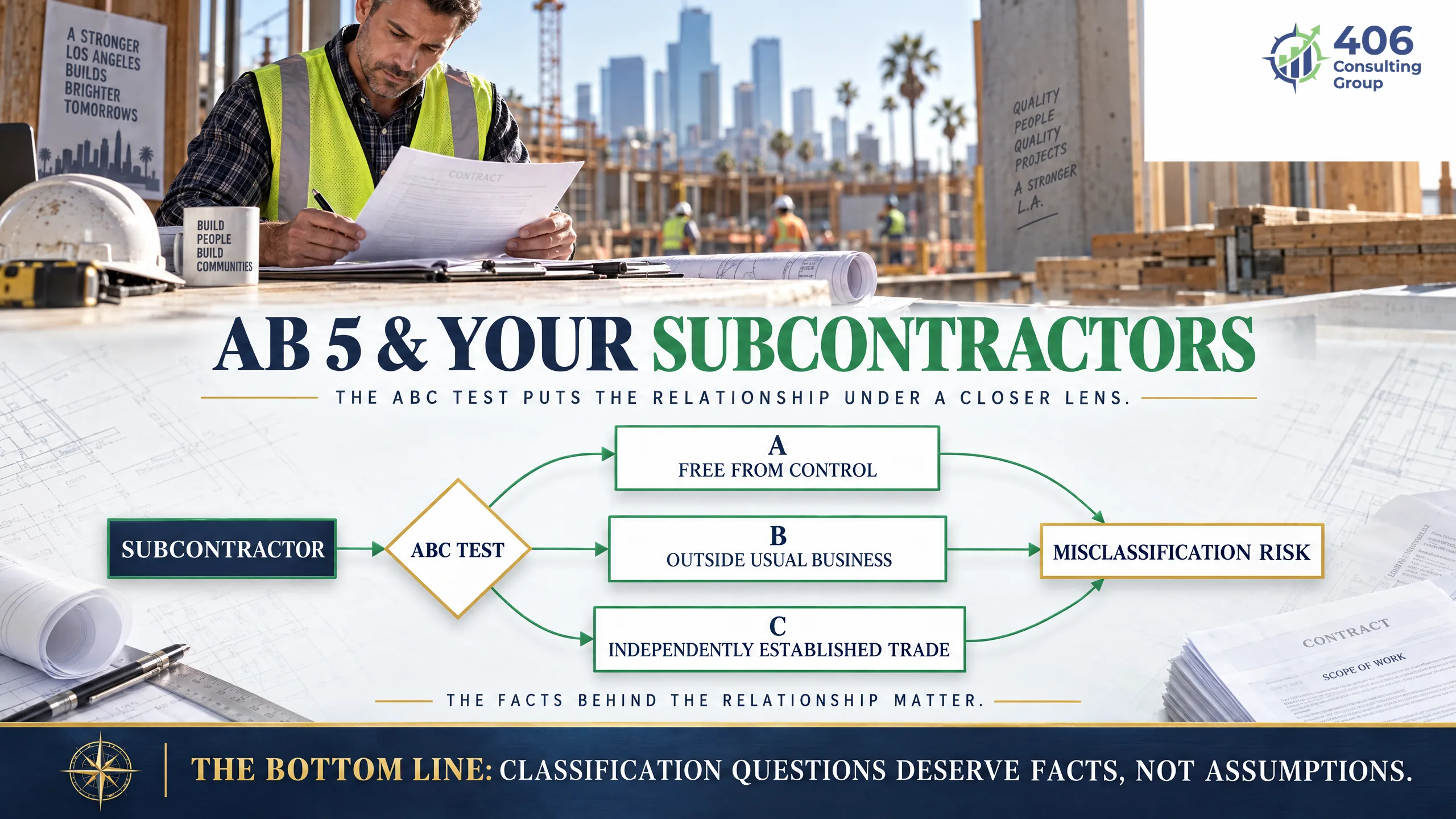
Short answer: under California's AB 5, a worker is presumed to be an employee unless the hiring business can prove all three prongs of the ABC test. Getting this wrong — paying a worker as a 1099 sub who should have been on payroll — is one of the single costliest exposures in California construction. The back taxes, penalties, unpaid workers' comp premium, and potential liability add up fast, and labor agencies actively look for it in the trades.
The ABC test says a worker is an independent contractor only if (A) they are free from the hiring business's control and direction in performing the work, (B) the work is outside the usual course of the hiring business, and (C)the worker is customarily engaged in an independently established trade or business of the same kind. Prong B is the trap for contractors: if you are a framing contractor and you hire a framer, their work is squarely inside your usual course of business, so the ABC test is hard to satisfy no matter how the handshake was framed. Construction has some specific statutory nuances for bona fide business-to-business subcontracting, but the burden is on you to prove it — so the paperwork and the books have to support the story.
In California, "he's a 1099 sub" is a claim you have to prove, not a default you get to choose. AB 5 flips the presumption to employee — and your books are the evidence.
Clean classification is also a bookkeeping job: verified licenses and insurance on every sub, real contracts, proper 1099 tracking, and a payroll structure that reflects who is truly an employee. Confirm your specific situation with an employment-law professional and the California authorities — and note how tightly this connects to the next rule.
Workers' Comp Is Mandatory at One Employee
Short answer: in California, workers' compensation is mandatory for any employer with one or more employees — and for roofing contractors it is effectively required even with no employees. This is not a gray area and it is not optional. If you come from a build-friendly state, unlearn what you know: in Texas, workers' comp is famously optional and many contractors go without it. California is the opposite. Do not treat it as a choice, and do not let anyone describe it that way.
For the books, workers' comp is not a set-and-forget line item — it is a live, audited cost tied directly to your payroll and your job classifications. Premiums are driven by class codes and payroll, and carriers run annual audits, so misclassified labor or sloppy payroll records can turn into a surprise premium bill after the fact. It also connects straight back to AB 5: every worker you misclassify as a 1099 sub is a worker whose wages were not in your comp calculation, which is exactly what an audit is built to catch.
1+ employee = required
California workers' comp is mandatory — roofers effectively at zero
The opposite of Texas, where it is optional. In California, never call it a choice.
Confirm current requirements with the California Department of Industrial Relations. Coverage is only the start — on public jobs, California also dictates what you pay.

Prevailing Wage & Certified Payroll
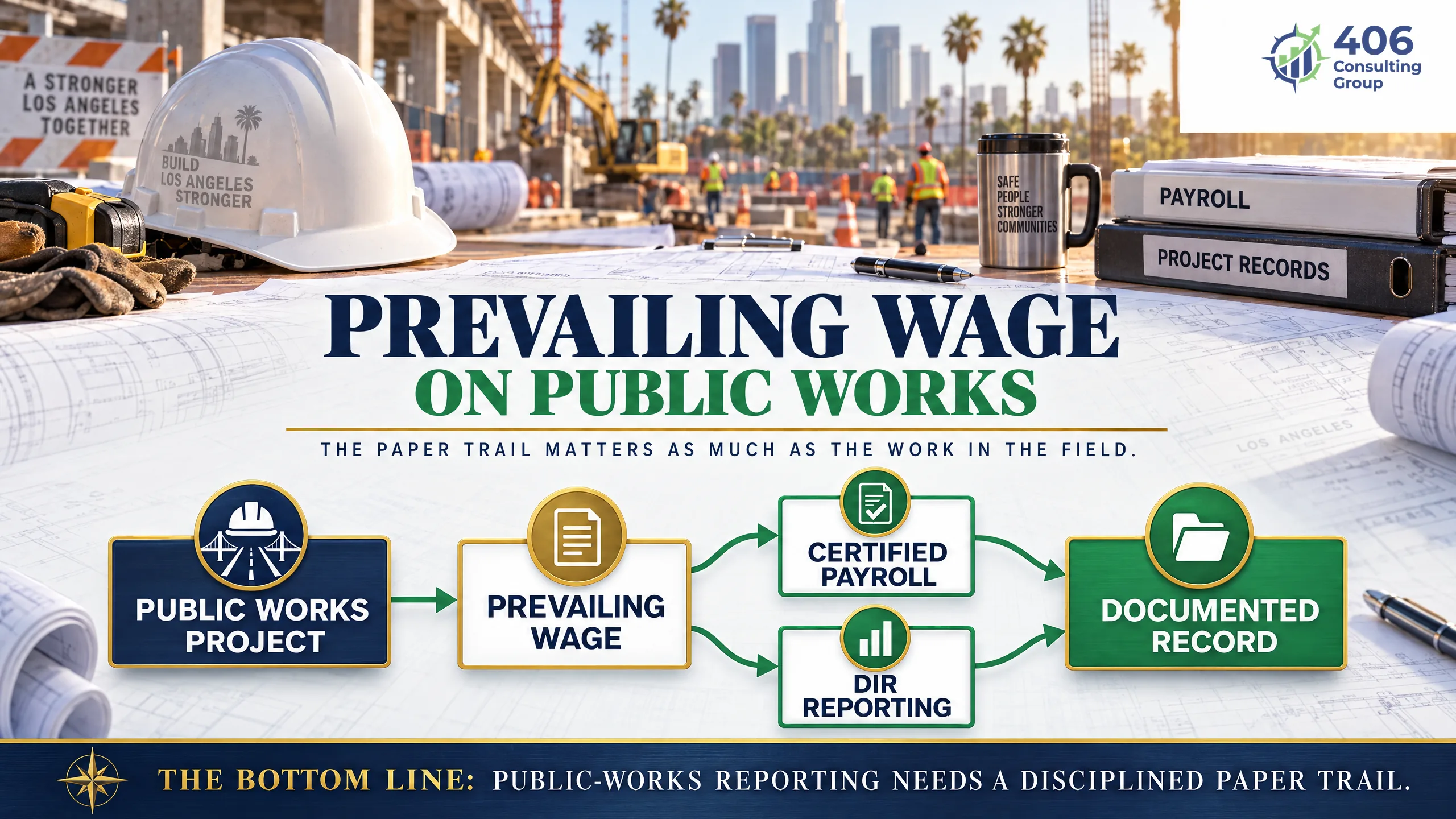
Short answer: if you take public works in California — schools, municipal buildings, transit, most government-funded construction — you generally must pay prevailing wage set by the Department of Industrial Relations (DIR) and file certified payroll reports documenting it. This is a different accounting discipline from private work: the wage rates are dictated by trade and locality, they include fringe components, and the reporting is exacting. Miss it and you face penalties, withheld payments, and debarment from future public work.
Certified payroll means your payroll system has to track hours by worker, by classification, by project, at the correct prevailing rate, and produce the certified records the DIR and the Division of Labor Standards Enforcement (DLSE) require — often through the state's electronic reporting. For a contractor running both private and public jobs, that is two payroll rhythms in one company, and the books have to keep them cleanly separated. This is precisely the kind of cross-departmental system we design from a whole-company view rather than bolting compliance on at the end.
Prevailing wage is not a suggestion you reconcile later — it is a rate and a report you must get right per worker, per classification, per job, every pay period a public project is open.
Confirm current prevailing-wage rates and reporting rules with the California DIR. Whether the job is public or private, the discipline that keeps you profitable is the same one: job costing.
Job Costing for High-Cost LA Projects
Short answer: job costingis tracking the true revenue and cost — labor, materials, subs, equipment, and overhead — of each project individually, so you can see the real margin job by job instead of trusting a single blended profit-and-loss. In Los Angeles, where labor, materials, and permitting run high and bids are tight, that visibility is the difference between a contractor who is busy and one who is actually making money. A full schedule in a high-cost market can quietly hide a losing job until it drains the account.
Good job costing also feeds everything else in this guide. It tells you which prevailing-wage jobs actually cleared their fringe-loaded labor cost, which private jobs carried the overhead, and which classification of work earns its keep. It is the foundation a controller uses to standardize your close and a CFO uses to steer the company — when you outgrow doing it yourself, a controller keeps these numbers reliable and on time. The contractor flying on one company-wide number in an expensive market is the one most likely to grow straight into a cash crisis.
Labor (fully burdened)
Wages plus workers' comp, payroll taxes, and benefits — the true cost of an hour on the job, not just the hourly rate.
Materials
Tracked to the job, including the sales/use tax you pay as the consumer of materials in California.
Subcontractors
Costed per job with verified licenses and insurance — and classified correctly under AB 5.
Overhead & equipment
Allocated so each job carries its fair share — the piece most contractors leave out and then wonder where the profit went.
Job costing tells you the margin. A WIP schedule tells you whether you are billing it at the right pace.
WIP Schedules: Over- and Under-Billing
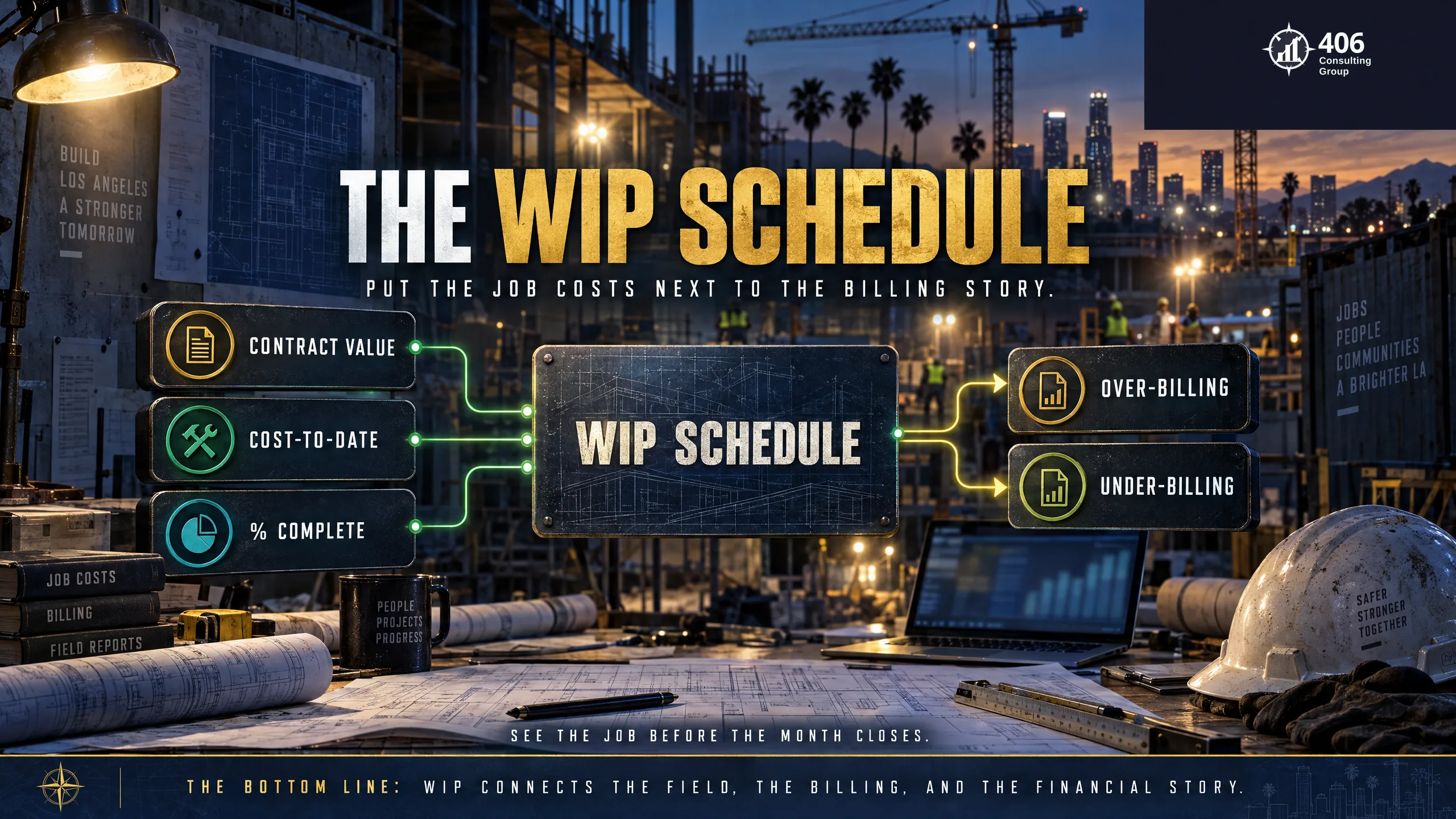
Short answer: a work-in-progress (WIP) schedule compares how much of each job you have actually completed against how much you have billed, revealing whether you are overbilled (you have invoiced ahead of the work) or underbilled(you have done work you have not billed yet). For a growing contractor, this is the single most important report a surety and a bank want to see — and the one most small contractors do not produce.
Here is why it matters beyond the accounting. Overbilling can make a flush bank balance that is really borrowed against future work — spend it and you cannot finish the job. Underbilling means you are effectively financing your customer's project out of your own pocket. Either way, a blended P&L will not tell you; only the WIP schedule will. And because Carrie's background is underwriting, she can tell you exactly what a surety does with it: a clean WIP schedule that shows controlled billing and real backlog is what unlocks a higher bonding line, which is what lets you bid the bigger Los Angeles jobs. Messy or missing WIP caps how large you are allowed to grow.
Your bonding capacity is set by numbers a surety trusts. A clean WIP schedule is how you prove you can handle a bigger job — and it is often the ceiling on how large you get to build.
One more cost most contractors get backwards in California: how tax applies to your materials.
Contractor as Consumer of Materials
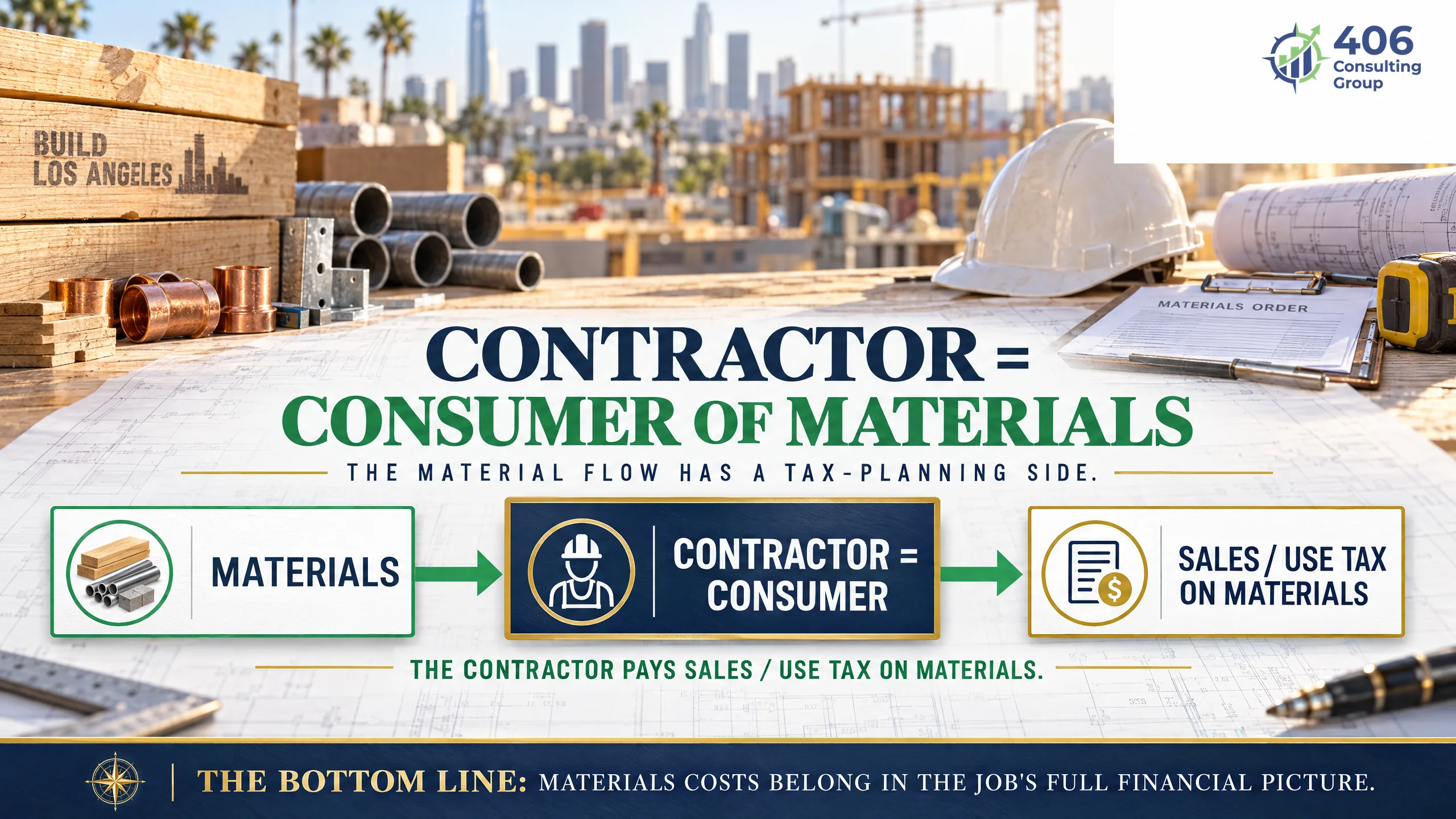
Short answer: in California, for a real-property improvement, the contractor is generally treated as the consumer of the materials they install. That means you generally pay sales tax on the materials when you buy them — you do not charge your customer sales tax on the finished improvement the way a retailer charges tax on a product. If you buy materials from out of state without California tax, you generally owe use tax on them instead. This is the reverse of how a lot of owners assume it works, and it changes how you bid and how you book the cost.
Practically, that tax is a real part of your material cost and belongs in your job costing, not tucked into overhead after the fact. If you fail to account for it on out-of-state or online material buys, the use-tax liability catches up with you. The rules have nuances — fixtures can be treated differently from materials, and some arrangements shift the analysis — so this is an area to confirm with the CDTFA or your tax professional rather than assume. Los Angeles City's combined sales-tax rate around 9.75% makes getting this right worth real money on a material-heavy job.
You are the consumer of your materials in California — you pay the tax at purchase and build it into the bid. Out-of-state buys do not escape it; they just move it to use tax.
Confirm current treatment with the California CDTFA. Materials are one cost driver — in Los Angeles, permits and seismic rules are another.
Permitting & Seismic Cost Drivers
Short answer: building in Los Angeles costs more and takes longer than in most of the country because of the permitting process and California's seismic building requirements — and both of those show up in your numbers as time, cost, and risk that have to be planned for, not absorbed by surprise. Plan reviews, inspections, energy-code compliance, and seismic engineering all add cost and, just as importantly, schedule— and in construction, a stalled schedule is a cash-flow event.
For the books, this means two things. First, permitting and compliance costs belong in your job costing so a bid reflects the real Los Angeles cost of getting a project through the city, not a generic estimate. Second, the schedule risk belongs in your cash-flow planning: when a permit or inspection delays a draw, you still have to make payroll and pay suppliers. Contractors who plan for that with a real cash forecast keep bidding; the ones who do not end up borrowing at the worst possible moment.
Plan review & permits
City review and permit fees add cost and time — build both into the bid and the cash-flow plan, not the hope column.
Seismic engineering
California's seismic requirements can mean added structural work and engineering — a real cost line on LA projects.
Inspections & schedule
Inspection milestones gate your draws. A delayed inspection is a delayed payment, which is a cash-flow problem.
Energy & code compliance
California's energy code adds scope. Cost it into the job rather than eating it as overhead.
Confirm current permitting and building requirements with the City and County of Los Angeles and the relevant California authority. Schedule risk leads straight into how and when you actually get paid.
Retainage & Draw Schedules
Short answer: retainage is the portion of each payment — often around 5 to 10% — that the owner or general contractor holds back until the job is complete, and a draw schedule is the agreed sequence of progress payments across a project. Both are central to construction cash flow, and both have to be tracked precisely, because the money you have earned and the money you have actually collected are two very different numbers on a long Los Angeles job.
Retainage receivable is real money you have earned but cannot spend yet — and if it is not tracked as its own line, it is easy to forget to collect at closeout. Draw schedules have to line up with your actual costs so you are not spending payroll faster than the draws come in. This is where job costing, WIP, and cash forecasting come together: your WIP tells you what you have earned, your draw schedule tells you what you can bill, and your retainage tracking tells you what is still owed. Get those aligned and you stop financing your customers by accident.
Earned is not collected. Retainage and draw schedules are the gap between the two — and on a long LA job, that gap is exactly where contractors run out of cash while still "profitable" on paper.
To make all of this concrete, here is how it comes together for one hypothetical Los Angeles contractor.
Illustrative Example: An LA Drywall Sub
The following is a hypothetical, composite illustration — not a real client — with round numbers chosen to show the mechanics. Picture a Los Angeles drywall subcontractor, call the business "Westside Drywall," run by an owner who is great at the work and has been growing fast on referrals from a few general contractors. Revenue is around $2.4 million, the schedule is full, and the bank account still feels tight. The owner cannot understand why being this busy does not feel like making money.
Two problems surface when the books get rebuilt the right way. First, three of the crew had been paid as 1099 subs when, under the AB 5 ABC test, they were clearly employees — same trade, inside the usual course of business, under the company's direction. That exposure gets fixed by moving them onto payroll, with workers' comp coverage that should have been there all along. It costs more per hour on paper, but it ends a liability that could have dwarfed the savings. Second, there was no WIP schedule: on two big jobs the business was badly overbilled, so the comfortable bank balance was really the general contractors' money for work not yet done.
Before: blended P&L
One company-wide number, 1099 crew, no WIP. Busy, but cash-tight and quietly carrying a classification liability.
After: The LA Contractor's Ledger
Job-costed margins, crew correctly on payroll with comp, and a clean WIP schedule the surety can read.
The fix on labor
Three misclassified subs moved to payroll — higher stated labor cost, but the AB 5 and comp exposure is gone.
The fix on cash
WIP reveals the overbilling. Billing gets paced to real completion, and the bonding line rises on trustworthy numbers.
Within a couple of quarters the picture changes: the owner can see which general contractors' jobs actually earn a real margin, the crew is classified correctly, and — because the WIP schedule now tells a clean story — the surety raises the bonding line, letting Westside bid a larger project it could not have touched before. Same trade skill, same owner. The difference is a ledger built for Los Angeles construction. (Again, illustrative figures — your numbers will differ.)
Local vs. Remote for LA Contractors
Short answer: you do not need a construction accountant with a Los Angeles office — you need one who knows California construction cold. It is natural to assume a Los Angeles contractor needs a local bookkeeper who can drive to the jobsite, but the work of construction accounting happens in the numbers, not on the site. Job costing, WIP, certified payroll, and bonding packages are built from your data, reviewed on a screen-share, and delivered on a monthly rhythm — none of it requires proximity.
Here is the reality that settles it: about 80% of our own local clients handle the entire relationship remotelyand never come into the office. People who could drop by choose secure cloud accounting, live bank feeds, and screen-share reviews instead, because that is simply how modern construction accounting works best. A great remote firm that understands CSLB bonding, the AB 5 ABC test, mandatory workers' comp, certified payroll, and how a surety reads a WIP schedule beats an okay local bookkeeper who treats your construction books like any other small business.
~80%
of our local clients are fully remote
They never come into the office — the relationship is cloud-based, by choice.
What matters is expertise, not a zip code. We serve Los Angeles and California contractors entirely remotely, and we design your construction accounting from a whole-company view — license, labor, bonding, and margin in one system — so the numbers connect to how the business actually runs. Take the financial maturity assessment to see where your books stand, learn more about how we serve construction businesses, or just talk to 406 Consulting Group.
FAQ: LA Construction Accounting
What makes LA construction accounting different?
Los Angeles construction is regulated on several fronts at once, and each one reads off your books. The CSLB ties your license to your financial condition and a contractor bond; AB 5 presumes your workers are employees unless you can prove the ABC test; workers' compensation is mandatory the moment you have one employee; and public works require prevailing wage and certified payroll. On top of that, LA carries some of the highest project costs in the country — labor, materials, permitting, and seismic requirements — so job costing and WIP are what keep a busy contractor actually profitable. A generic bookkeeper who doesn't know California keeps records that look right but are wrong where it costs you. Confirm current rules with the relevant California authority.
How does CSLB use my financials?
The Contractors State License Board licenses California contractors, and the license is connected to your financial condition. You generally need a contractor bond of about $25,000, a qualifying individual with the required experience, and in certain cases documentation of your financial solvency. The surety that issues your bond reads your financial statements to approve and price it, so clean, readable books keep the bond affordable and the license secure. A lapse in the bond can put the license itself at risk. Because our background is commercial banking and underwriting, we keep your statements the way a surety and a bank read them. Confirm current bond amounts and requirements with the CSLB.
What is AB 5 and how does it affect subs?
AB 5 is the California law that presumes a worker is an employee unless the hiring business can prove all three prongs of the ABC test: (A) the worker is free from control and direction, (B) the work is outside the usual course of the hiring business, and (C) the worker is customarily engaged in an independently established trade of the same kind. Prong B is the trap for contractors — if you hire a worker to do the trade you sell, their work is inside your usual course of business, so classifying them as a 1099 sub is hard to defend. Misclassification is one of the costliest exposures in California construction, bringing back taxes, penalties, and unpaid workers' comp premium. Confirm your situation with an employment-law professional.
Do I need workers' comp with one employee in California?
Yes. In California, workers' compensation is mandatory for any employer with one or more employees, and for roofing contractors it is effectively required even with no employees. It is not optional. If you're used to a state like Texas, where workers' comp is optional and many contractors go without it, California is the opposite — do not treat it as a choice or let anyone describe it that way. Premiums are driven by your payroll and job class codes and are audited annually, so accurate payroll records and correct worker classification directly affect what you pay. Confirm current requirements with the California Department of Industrial Relations.
Do I owe prevailing wage?
If you take public works in California — government-funded construction like schools, municipal buildings, and transit — you generally must pay prevailing wage set by the Department of Industrial Relations and file certified payroll reports documenting it. Prevailing wage includes fringe components and is dictated by trade and locality, and the certified payroll reporting through the DIR and DLSE is exacting. Penalties for getting it wrong include withheld payments and debarment from future public work. Private jobs don't carry prevailing wage, but if you run both public and private work you're effectively running two payroll rhythms that your books must keep separate. Confirm current rates and rules with the California DIR.
Do contractors charge sales tax in California?
Generally, no — not the way a retailer does. For a real-property improvement, California treats the contractor as the consumer of the materials installed, so you generally pay sales tax on those materials when you buy them rather than charging your customer sales tax on the finished improvement. If you buy materials out of state without California tax, you generally owe use tax on them instead. There are nuances — fixtures can be treated differently from materials, and some arrangements change the analysis — so this is an area to confirm with the CDTFA or your tax professional. Either way, that tax is a real material cost that belongs in your job costing and your bid.
Can you handle my construction books remotely?
Yes. We provide full-service remote construction accounting for Los Angeles and California contractors — job costing, WIP schedules, certified payroll support, sales and use tax on materials, bonding-ready financials, and clean worker classification built in. The work happens in your data and is reviewed on screen-shares, so it runs the same whether we're in the office next door or across the country. About 80% of our own local clients already handle everything remotely and never come in. What matters is expertise in California's rules — CSLB bonding, AB 5, mandatory workers' comp, prevailing wage — plus how a surety reads your numbers, and our commercial-banking background means we build your books with that whole picture in view.
LA Contractor Snapshot
What an LA contractor faces
LA Construction Accounting
Job-costed, bond-ready, remote.
About the Author
Carrie Anderson
Co-Founder, 406 Consulting Group
Carrie is a former commercial banker and underwriter with 300+ loan and credit reviews behind her. She knows exactly how a surety and a bank read a contractor's financials, and she builds job-costed, bond-ready construction books — delivered remotely to Los Angeles and California contractors.
Read the Full StoryLos Angeles Series