
Accounting for Small Business in Miami, FL:
The Four Functions You Need, and When
Miami accounting isn't one job — it's four: clean books, compliant tax, controller visibility, and CFO strategy. No state income tax doesn't mean no complexity in an international city with a Miami-Dade tax stack and a foreign-owner record trail. The Biscayne Financial Stack, delivered remotely — the way 80% of our local clients already work.

Accounting for a small business in Miami isn't one job — it's four, layered on top of each other. Miami is a bilingual, international, cash-fast city: real estate and condos, hospitality and short-term rentals, trades feeding a permanent construction cycle, and a wave of professional-services firms and foreign owners routing money through Brickell. Florida makes part of it feel easy with no state income tax. But "no income tax" quietly convinces owners the books are simple, and in Miami they almost never are — there's still a corporate tax on one entity type, a county surtax stacked on sales tax, a payroll tax by another name, and a foreign-ownership record trail that carries a five-figure penalty if you get it wrong.
This is the hub guide. It maps the whole picture — what a Miami business actually has to get right, and the four functions that carry you from a shoebox to a dashboard — then points you to the deeper articles for each layer. We call the local read on it the Biscayne Financial Stack.
By 406 Consulting Group — a Montana-based, remote-first accounting firm. Our team pairs a commercial-banking and underwriting background (300+ loan reviews) with big-firm tax and Six Sigma systems work, and we build clean, lender-ready financials for Miami and Florida businesses — delivered remotely.
Quick Answer: Accounting for a Miami Small Business
- →Small-business accounting in Miami is really four functions — clean books, compliant tax, controller visibility, and CFO strategy — not just "doing the books."
- →No state income tax on individuals or pass-throughs — but Florida taxes C-corporations at 5.5% and stacks a county surtax on sales tax.
- →Miami is an international city: foreign owners, multi-currency activity, and a Form 5472 record trail change how the books must be kept from day one.
- →The Miami-Dade tax stack — ~7% sales tax, reemployment tax (RT-6), and documentary stamp tax — runs quietly under every transaction.
- →It's all remote — and about 80% of our own local clients run the entire relationship that way.
Table of Contents
What Miami Small-Business Accounting Requires
Accounting for small business in Miami requires four things working together:books that are clean and current, tax that is compliant and planned (federal-first, because Florida has no personal income tax), controller-level visibility so you can read your numbers monthly, and CFO strategy so the numbers drive decisions. Most owners buy only the first — a bookkeeper — and then wonder why they still feel blind. In a market as fast and as international as Miami, that gap is where money leaks out.
The reason it matters more here than in a sleepy metro is volume and variety. A single Miami small business might collect Miami-Dade sales tax, run tipped hospitality payroll, hold a foreign partner, buy real estate that triggers documentary stamp tax, and invoice clients in another currency — all in the same quarter. Each of those touches a different layer of the stack. Get the layers in order and it's manageable. Skip one and the whole thing wobbles.
Miami small-business accounting isn't "the books." It's four functions — clean books, compliant tax, controller visibility, CFO strategy — and knowing which one you actually need next.
Start with the myth that trips up almost everyone who moves a business here.
"No Income Tax" Is Not "No Complexity"
Florida has no personal or pass-through income tax — but that shifts the work, it doesn't remove it. Because there's no state income tax to plan around, all of your real tax strategy is federal-first. That has one big consequence Miami owners miss: the S-corporation election is a purely federal play here. There is no Florida pass-through-entity (PTE) election and no state-level SALT-cap workaround to chase, because there's no state income tax to work around in the first place. The only entity Florida taxes on income is the C-corporation, at 5.5%.
No personal income tax
No tax on individuals or pass-through owners. Tax planning is federal — which is exactly why the S-corp decision is a federal one.
5.5% C-corp income tax
Florida DOES tax C-corporations at 5.5% — the one entity type that owes state income tax. It shapes the structure question.
No FL PTE / SALT workaround
There's no Florida pass-through election and no state SALT-cap play to make — nothing to elect against a tax that doesn't exist.
Federal is where it's won
Reasonable salary, entity choice, retirement, depreciation, OBBBA changes — the leverage is all on the federal return.
So the complexity doesn't vanish — it moves. It moves to the corporate tax, to the county sales-tax stack, to payroll, and, in Miami more than almost anywhere, to who owns the business.
Miami Is an International City — That Changes Your Books
Miami runs on international money, and that reshapes the books before you file a single return. A huge share of Miami small businesses have a foreign owner, a foreign partner, or customers and vendors abroad. The most common trap: a foreign-owned single-member LLC. It may owe no U.S. income tax and still be required to file a pro forma Form 1120 with a Form 5472 attached — and the penalty for failing to file starts at $25,000. That is not a tax bill; it's a paperwork bill, and it's entirely avoidable with the right records.
A foreign-owned Miami LLC can owe zero tax and still face a $25,000 penalty — for not filing a form. In an international city, the record trail is the risk, not the rate.
Your job at the hub level is the framing: keep the records right so the filing is easy. That means clean documentation of every related-party transaction between the U.S. entity and its foreign owner, multi-currency bookkeepingthat records the correct exchange rate on the date of each transaction, and ITIN/EIN identifiers set up before money starts moving. The filing detail lives in the tax article — here, the point is that in Miami the books have to be built for an audience that spans borders.
We cover the day-to-day mechanics in the Miami bookkeeping guide and the return-level detail in the Miami tax services guide. Confirm your specific filing obligations with a tax professional or IRS.gov.

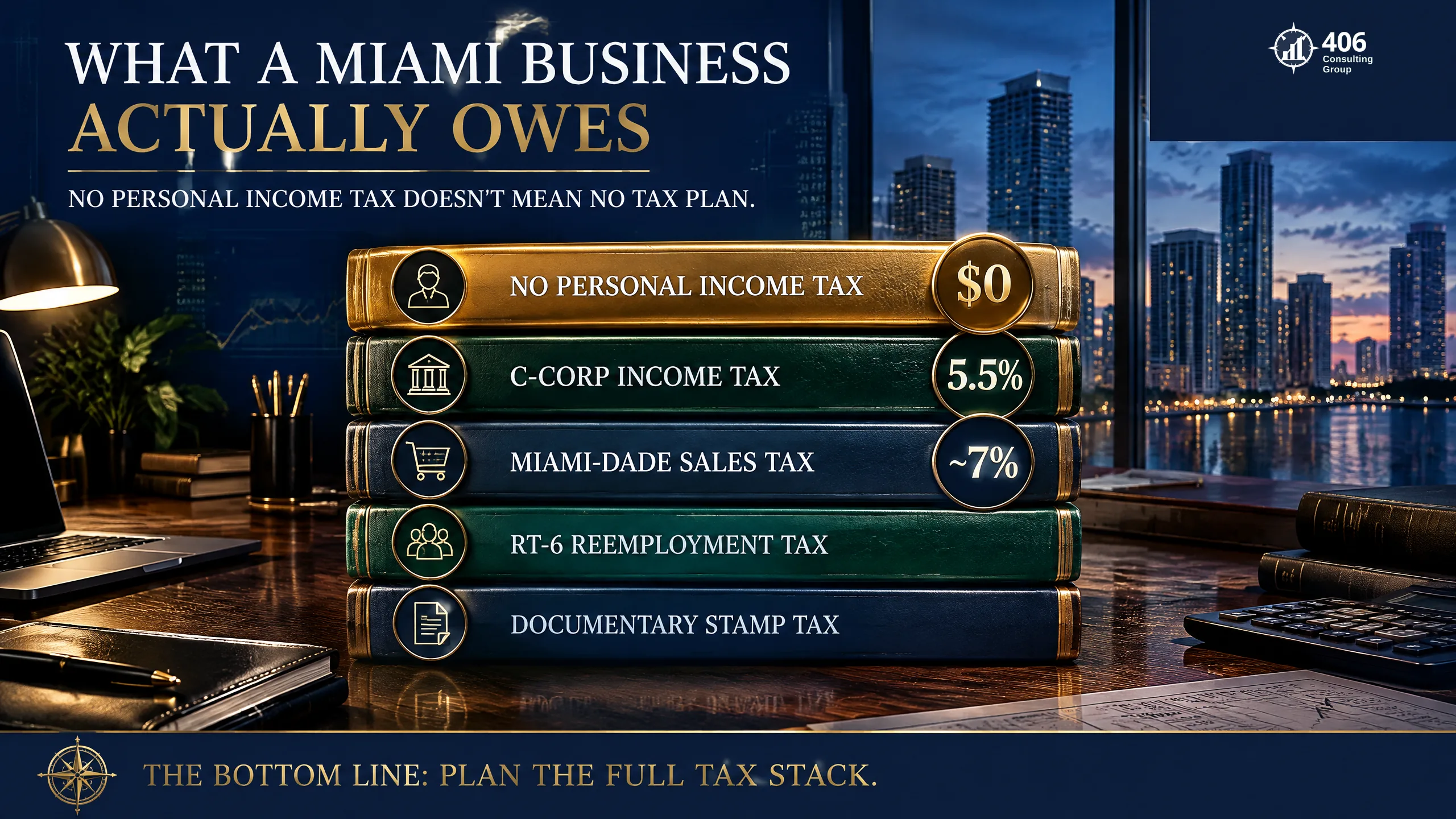
The Miami-Dade Tax Stack
Even with no income tax, a Miami business runs three ongoing tax obligations under every transaction.None of them is optional, and each one lives in a different corner of the books. Miss the plumbing and you get penalty notices even in the "tax-free" state.
~7% sales tax
6% Florida state sales tax plus a ~1% Miami-Dade discretionary surtax — roughly 7% combined. Use tax applies to untaxed out-of-state purchases.
Reemployment tax (RT-6)
Florida's name for state unemployment tax, filed on Form RT-6. No state income-tax withholding to run — but this one you do.
Documentary stamp tax
A transaction tax on deeds and on written obligations to pay money (notes, mortgages). Miami-Dade applies its own rate mechanics on real-estate transfers — a real cost in this market.
5.5% C-corp income tax
Only if you're a C-corp. Pass-throughs skip it — which is why entity choice is a genuine Florida decision.
A Miami-Dade quirk worth flagging: the county has its own documentary stamp tax mechanics on real-estate transfers that differ from the rest of Florida, which matters the moment a business buys, sells, or refinances property here — and Miami businesses do that constantly.
Confirm current rates and the county surtax with the Florida Department of Revenueand Miami-Dade County. These are the surprises that catch owners who assumed "no income tax" meant no tax at all.
The Biscayne Financial Stack
The Biscayne Financial Stack is our local read on 406's Financial Maturity Ladder: four layers a Miami business grows through, in order.You don't skip levels — each one rests on the one beneath it. Clean books make compliant tax possible. Compliant tax makes controller visibility trustworthy. Controller visibility makes CFO strategy real. Try to buy strategy on top of messy books and you're decorating a house with no foundation.
Layer 1
Clean Books
The foundation: accurate, current, reconciled records you can actually trust. Bookkeeping.
Layer 2
Compliant Tax
Federal-first planning, Miami-Dade sales tax, RT-6, foreign-owner filings — done right and on time.
Layer 3
Controller Visibility
A real monthly close, KPIs, and cash forecasting so you can read the business every month.
Layer 4
CFO Strategy
Numbers driving decisions — pricing, financing, expansion, and buy/build calls, with a seat at the table.
4
layers, built in order — never skipped
Each layer only works when the one beneath it is solid. Most Miami owners are stuck one layer lower than they think.
Not sure which layer you're actually on? That's exactly what the financial maturity assessmentis for. Let's walk the four layers.

Layer 1 — Clean Books (Bookkeeping)
Everything else rests on books that are accurate, current, and reconciled. A clean chart of accounts built for your business, monthly bank and credit-card reconciliations, a firm line between owner and business money, and a real monthly close — that's the layer. In Miami, it also means multi-currency handlingwhen money crosses borders and clean records for foreign-owner transactions, so the tax layer above it isn't built on guesswork.
Skip these and Florida's tax-friendly reputation won't save you — clean foundations are what keep an international city's complexity from quietly compounding. We go deep on the day-to-day in the Miami bookkeeping guide, and you can see the scope of the work on our bookkeeping services page.
Layer 2 — Compliant Tax
With clean books underneath, tax becomes planning instead of scrambling.In Miami that means federal-first strategy (entity choice, reasonable salary, retirement, depreciation, OBBBA changes), Miami-Dade sales-tax and use-tax compliance, RT-6 reemployment tax, and — for the international businesses this city is full of — the Form 5472 / pro forma 1120 record trail handled before it becomes a $25,000 problem.
In a no-income-tax state, tax planning isn't about the state return — it's about the federal one, and about not tripping the compliance wires that carry the biggest penalties.
The full detail — including foreign-owner filings — lives in the Miami tax services guide and on our tax planning services page.
Layer 3 — Controller Visibility
A controller turns accurate books into a monthly instrument panel.This is where a Miami business stops looking backward at tax season and starts reading itself in real time: a disciplined monthly close, the handful of KPIs that actually matter for your model, cash-flow forecasting, and margin visibility — by property, by project, by location. It's the layer most owners jump straight past, and it's the one that turns a busy business into a profitable one.

We cover the controller function in depth in the Miami CFO & controller guide, and you can see the scope on our controller services page.
Layer 4 — CFO Strategy
At the top of the stack, the numbers start making decisions with you.A CFO takes trustworthy books, clean tax, and real visibility and turns them into strategy: pricing and margin decisions, financing and capital structure, expansion and new-location math, and the buy-versus-build calls that shape the next five years. Because our team's background is commercial banking and underwriting — 300+ loan reviews — we bring the lender's view to the table, so when you go for capital in a growth market like Miami, the numbers already say yes.
A CFO isn't a bigger bookkeeper. It's the difference between recording what happened and deciding what happens next — with a banker's eye on the numbers.
The strategic layer is covered in the same Miami CFO & controller guide, with scope on our CFO services page.
Industry Snapshots
The stack is universal, but the details change by industry.Here's how the four layers land for the businesses that define Miami's economy.
Real estate & condos
Documentary stamp tax on transfers, entity-per-property structures, HOA and association accounting, and foreign-owner reporting — this is where Miami's international money and the tax stack collide.
Hospitality & short-term rentals
Tipped payroll, tourist development (bed) taxes, seasonal staffing, and per-property P&Ls. Sales-tax and surtax discipline is non-negotiable.
Trades & construction
Job costing, work-in-progress, retainage, and 1099s in a metro that never stops building. The busy contractor and the profitable one are rarely the same one.
Professional services
Brickell law, consulting, finance, and agencies — often with foreign clients and multi-currency invoicing. Clean books and reasonable-salary planning drive the value.
Building in Miami? The trades get their own deep dive in the Miami construction accounting guide.

Local vs. Remote in Miami
It's natural to assume a Miami business needs a Miami accountant down the street. Here's the reality that settles it: around 80% of our own local clients handle the entire relationship remotely— they never come into the office. The owners who could drop by our office are the ones who don't: in a city that runs on cross-border deals and multi-currency payments, they'd rather have a secure portal and a scheduled screen-share than a commute down Brickell Avenue. Cloud accounting, live bank feeds, and a steady monthly rhythm are simply how the work gets done well now.
~80%
of our local clients are fully remote
They never come into the office — the relationship is cloud-based, by choice.
What matters is expertise, not a Brickell zip code. A great remote provider who knows Florida's corporate tax, the Miami-Dade surtax, reemployment tax, and the foreign-owner record trail beats an okay local one who treats your books like any other. For a client base as global as Miami's, remote isn't a compromise — it's the native way the work already runs.

A Brickell Firm, Shoebox to Dashboard
Here's a composite of what we regularly see — an illustrative example, not a real client. Picture a Brickell professional-services firm: eight people, about $1.4M in revenue, a couple of foreign clients paying in euros, and a founder doing the books in a spreadsheet and a folder of receipts. Profitable on paper, blind in practice.
Layer 1 — Clean books
Moved off the spreadsheet to cloud accounting with multi-currency handling. Found ~$18,000/yr of duplicated software and un-invoiced work hiding in the receipt folder.
Layer 2 — Compliant tax
Set up the S-corp election (a purely federal move here), fixed reasonable-salary comp, and locked down the foreign-client record trail before any 5472 exposure.
Layer 3 — Controller
A real monthly close and utilization/margin KPIs. The founder finally saw which service line actually made money — and which one was a break-even hobby.
Layer 4 — CFO
Repriced the low-margin line, modeled a second-office hire, and walked into the bank with lender-ready numbers instead of a shoebox.
~$18K
of leakage surfaced in Layer 1 alone
Illustrative composite — figures are representative, not a specific client's results.
Same firm, same city, same market. The only thing that changed was climbing the stack in order — and it turned a blind spreadsheet into a dashboard the founder actually runs the company from.

FAQ: Miami Accounting Questions
Do I need a Miami-based accountant?
No — and most Miami businesses that assume they do are surprised at how we already work. Around 80% of our own local clients handle everything remotely and never come into the office. Modern accounting runs on cloud software, live bank feeds, and screen-share reviews, so the work happens the same whether your accountant is in Miami or across the country. What matters is expertise in the rules that actually apply here — Florida's corporate tax, the Miami-Dade surtax, reemployment tax, documentary stamp tax, and the foreign-owner record trail — plus responsiveness. A great remote provider who knows Florida beats an okay local one who doesn't.
Is there really no Florida income tax on my business?
There's no Florida personal or pass-through income tax, so sole proprietors, partnerships, and S-corporations generally owe no state income tax. But Florida does levy a 5.5% corporate income tax on C-corporations — the one entity type taxed on income at the state level. Because there's no state income tax on pass-throughs, there's also no Florida pass-through-entity (PTE) election or state SALT-cap workaround to pursue; the S-corp election is a purely federal decision here. So 'no income tax' is true for most small businesses, but your entity choice still determines whether the business owes any Florida income tax at all. Confirm your situation with the Florida Department of Revenue or a tax professional.
What taxes does my Miami business owe?
Even with no personal income tax, a Miami business typically deals with several: sales tax of about 7% (6% Florida state plus roughly a 1% Miami-Dade discretionary surtax) with use tax on untaxed out-of-state purchases; reemployment tax on payroll (Florida's unemployment tax, filed on Form RT-6); documentary stamp tax on deeds and on written obligations to pay money, with Miami-Dade applying its own mechanics on real-estate transfers; and, if you're organized as a C-corporation, the 5.5% corporate income tax. Foreign-owned entities may also have federal information-reporting obligations. Confirm current rates with the Florida Department of Revenue and Miami-Dade County.
I have a foreign owner or partner — what changes?
A lot, and mostly on the record-keeping and information-reporting side rather than the tax rate. The classic example is a foreign-owned single-member LLC, which may owe no U.S. income tax yet is still required to file a pro forma Form 1120 with a Form 5472 attached — and the penalty for failing to file starts at $25,000. You'll also want multi-currency bookkeeping that captures the correct exchange rate on the date of each transaction, clean documentation of every related-party transaction, and the right ITIN/EIN identifiers set up before money moves. The filing detail is covered in our Miami tax services guide; the key at the accounting level is keeping the records right so the filing is straightforward. Confirm your obligations with a tax professional or IRS.gov.
How much does small-business accounting cost in Miami?
It depends on which layers you need and how complex the business is — transaction volume, number of entities and locations, whether you need job costing or multi-currency handling, and whether foreign-owner reporting is in play. A straightforward service business buying clean bookkeeping costs far less than a real-estate group with property-level entities or a hospitality business with tipped, seasonal staff needing controller-level reporting. The better way to judge it is return: clean books and planned tax pay for themselves through fewer costly mistakes, better decisions, and financials a lender will actually fund. The most expensive option is usually the cheapest provider who mishandles the surtax, reemployment tax, or a foreign-owner filing.
Can you work with me remotely?
Yes — we're a remote-first firm and we serve Miami and Florida businesses entirely remotely, across all four layers of the stack: clean bookkeeping, compliant federal-first tax, controller-level monthly reporting, and CFO strategy. Our team pairs a commercial-banking and underwriting background with big-firm tax and systems experience, so we keep your books the way a lender reads them and design your financial systems from a whole-company view. The vast majority of our clients — including local ones — never step into an office.
Miami Tax Snapshot
What a Miami business faces
Miami Accounting
Clean, Florida-aware, remote.
About the Author
406 Consulting Group
Remote-first accounting & advisory
Our team pairs a commercial-banking and underwriting background (300+ loan reviews) with big-firm tax and Six Sigma systems work — building clean, lender-ready financials for Miami and Florida businesses, delivered remotely from a whole-company view.
Read the Full Story