
CFO & Controller Services in Miami, FL:
The 7 Numbers That Drive Growth
A controller makes your numbers reliable; a CFO makes them point forward. For Miami real estate, hospitality, and construction — multi-currency cash flow, portfolio reporting, bonding, and lender-ready financials — here's which one you need, when, and the Growth Dashboard that ties it together. Delivered remotely, the way 80% of our local clients already work.
Miami runs on capital, seasons, and cross-border money in a way few American markets do. A real estate group is juggling entity-level and property-level performance; a hospitality operator lives and dies by prime cost through a tourism calendar; a contractor needs financials a surety will stand behind. Underneath all of it are two very different jobs that owners routinely blur together: the controller, who makes the numbers reliable, and the CFO, who makes the numbers point forward. Getting CFO services in Miamiright starts with knowing which one you actually need — and when.
This guide draws the controller-versus-CFO line plainly, lays out a Miami-specific framework we call the Growth Dashboard, and walks the money situations that make South Florida distinct — multi-currency cash flow, real estate portfolios, hospitality consolidation, bonding, lending, and foreign-investor reporting — all delivered remotely.
By Jason Anderson — Co-Founder, 406 Consulting Group. Big-firm-trained accountant and Six Sigma systems builder who designs forward-looking financial reporting from a whole-company view and delivers it remotely to Miami and Florida businesses.
Quick Answer: Controller vs CFO for a Miami Business
- →A controller owns reliable, on-time numbers — the monthly close, reconciliations, reporting, and job costing. A CFO owns what those numbers mean next — forecasting, capital, growth, and KPIs.
- →Most Miami businesses need the controller function first; you can't forecast on numbers you don't trust.
- →The Miami Growth Dashboard is the 7 numbers a real estate, hospitality, or construction owner should see every month.
- →Florida charges no personal income tax but a 5.5% C-corp tax, reemployment tax (RT-6), and ~7% Miami-Dade sales tax — and sits in the toughest property-insurance market in the country, a real forecasting line.
- →It's all remote — about 80% of our own local clients run the entire relationship that way.
Table of Contents
Controller vs CFO — And When a Miami Business Needs Each
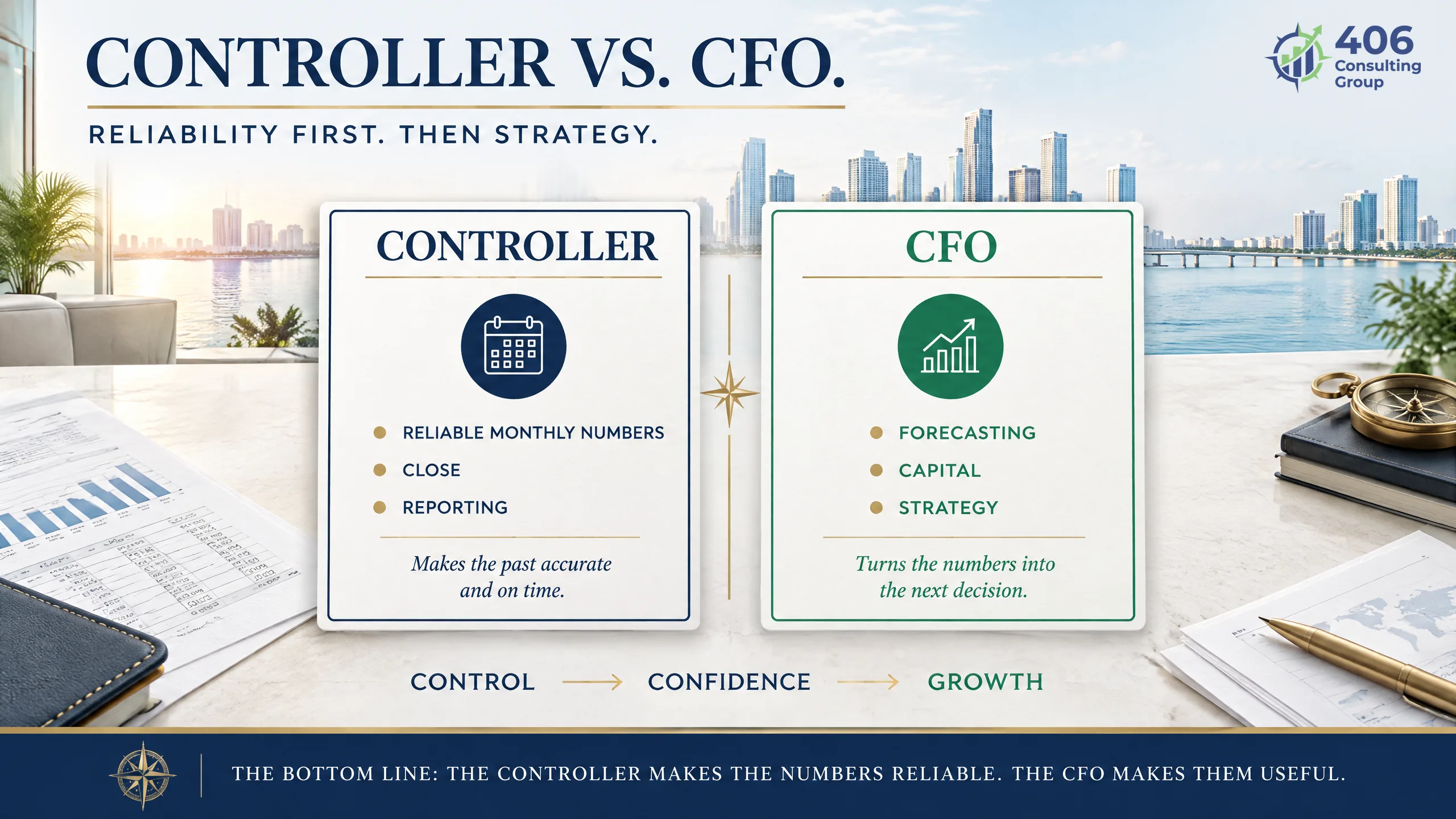
The short answer: a controller produces reliable, on-time financials, and a CFOuses them to steer the business forward. A Miami owner who can't close the books cleanly needs a controller; one who closes cleanly but can't answer "can we afford the next property, and how do we fund it?" needs a CFO. Most fast-growing companies in South Florida need the controller function solidly in place first, then layer CFO strategy on top as the stakes rise.
Think of it as backward-looking accuracy versus forward-looking strategy. The controller owns the monthly close, bank and credit-card reconciliations, financial reporting, and job costing — the machinery that makes every number trustworthy. The CFOowns forecasting, capital structure, growth planning, lender and investor relationships, and the KPIs that tell you whether the plan is working. You don't staff either as a $200K full-time hire when you're a three-property operator; you rent the exact level you need, which is why fractional and remote delivery fits Miami owners so well.
Controller = reliable numbers
Monthly close, reconciliations, clean reporting, and job costing — the numbers are on time and you can trust them.
CFO = forward strategy
Forecasting, cash and capital planning, growth modeling, lender/investor relationships, and the KPIs that steer decisions.
Sequence matters
You cannot forecast on numbers you don't trust. Get the controller function solid first, then add CFO strategy as decisions get bigger.
Rent the right level
Fractional and remote delivery lets a Miami owner buy the exact amount of controller and CFO horsepower the business needs today.
Because the CFO's work is only as good as the data underneath it, everything starts with the controller and the monthly close.
Controller First: The Monthly Close That Makes Everything Else Possible
The controller function is the foundation: a disciplined monthly closethat turns raw activity into statements you can actually decide on. That means reconciled bank and credit-card accounts, revenue and expenses recorded in the right period, intercompany and owner activity cleaned up, and reports out within days of month-end — not a scramble in March when the tax return is due. In a portfolio business, the close also rolls property-level and location-level numbers up to a company-wide view without losing the detail.
A CFO forecast built on an unreconciled ledger is just a confident guess. The close is what makes the strategy real — and it's the controller's job to deliver it on a calendar, every month.
The mechanics of clean books — chart of accounts, reconciliations, and Florida-specific compliance like reemployment tax and the Miami-Dade surtax — live in our Miami bookkeeping guide and small-business accounting guide. Once the close is reliable, the CFO layer earns its keep — starting with the numbers you watch.
The Miami Growth Dashboard — The 7 Numbers to Watch
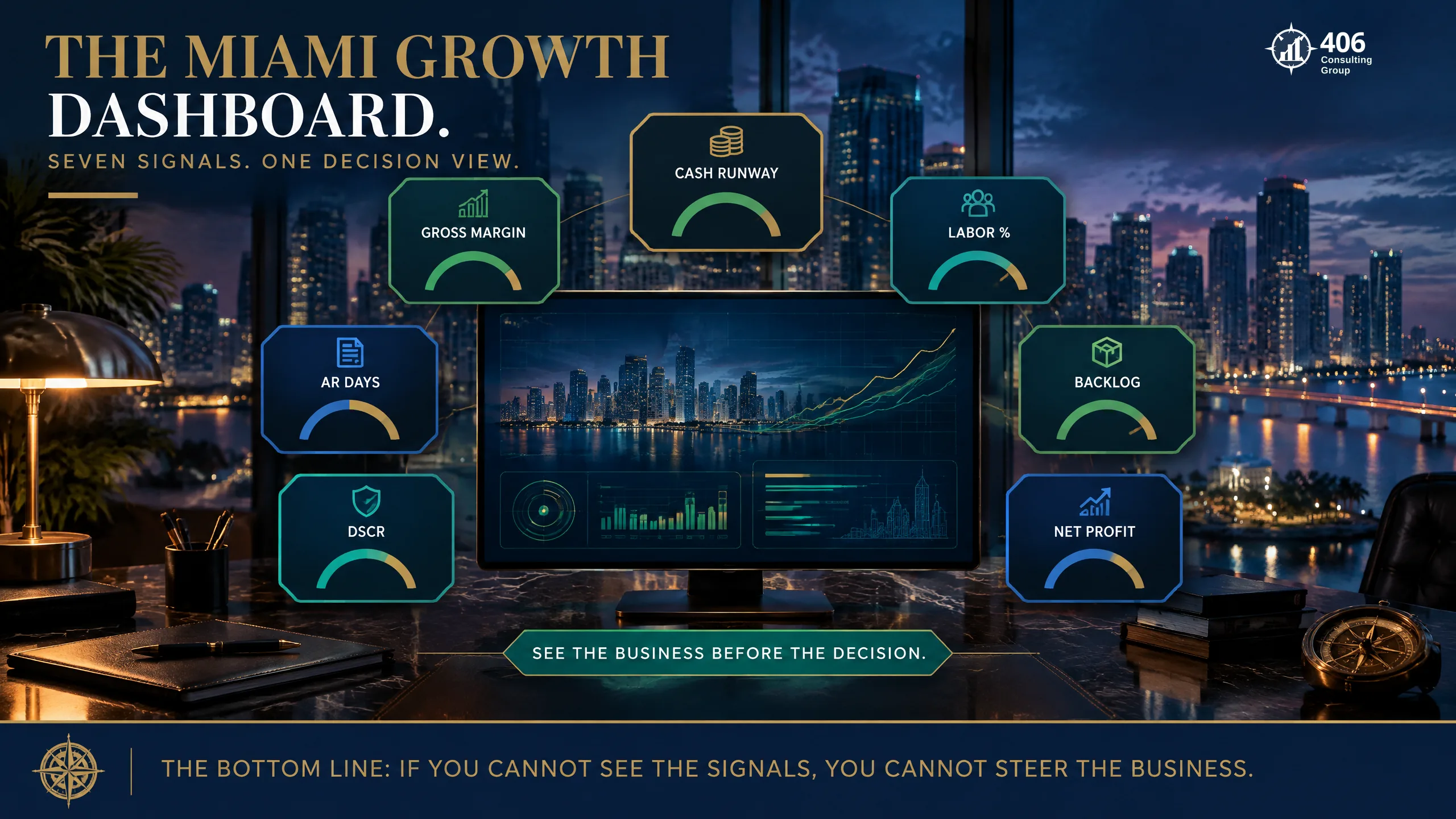
The Miami Growth Dashboardis our framework for the seven numbers a Miami owner in real estate, hospitality, or construction should see every single month — not once a year at tax time. Most owners drown in a 40-line P&L and still can't answer the questions that matter. The Dashboard cuts through it: a handful of metrics that, watched together, tell you whether the business is actually getting stronger.
1. Operating cash position & runway
Cash on hand and how many months it covers — the single number a seasonal, capital-heavy Miami business can never guess at.
2. Gross margin by unit
Margin by property, location, or job — not a blended company average that hides your winners and your losers.
3. Prime cost (hospitality) / job margin (construction)
Cost of goods plus labor as a share of revenue for restaurants; true job profit for contractors — the core operating dial.
4. Fixed-cost coverage incl. insurance
Can recurring revenue cover rent, debt service, and Florida's outsized property-insurance premiums? Insurance is a top line here, not overhead.
5. Debt service coverage ratio (DSCR)
Cash flow relative to loan payments — the exact ratio a lender or surety will compute before they say yes.
6. Days cash & receivables/deposits aging
How fast money comes in versus goes out, including guest deposits and tenant receivables across the season.
7. Rolling 13-week & 12-month forecast
Where cash and profit are heading — the forward view that turns the other six numbers into decisions.
The Dashboard adapts to the business, but two Miami realities shape almost every version of it: cash that moves across currencies, and a calendar that swings with tourism.
Cash Flow Across Currencies and Seasons
Miami cash flow is harder than a generic business's for two reasons: money often arrives in more than one currency, and it arrives on a tourism calendar. A CFO's job is to smooth both. On the currency side — Latin American buyers, foreign-owned entities, cross-border vendors — the books have to record transactions in a functional currency, handle exchange-rate gains and losses cleanly, and avoid letting a strong-dollar swing quietly erode a margin you thought you had. On the seasonality side, a hotel or restaurant that earns most of its money from roughly November through April has to fund a slow summer without a fire drill.
The businesses that survive a slow Miami summer are the ones that planned for it in the busy winter. That's a forecast, not a hunch — and it's squarely CFO work.
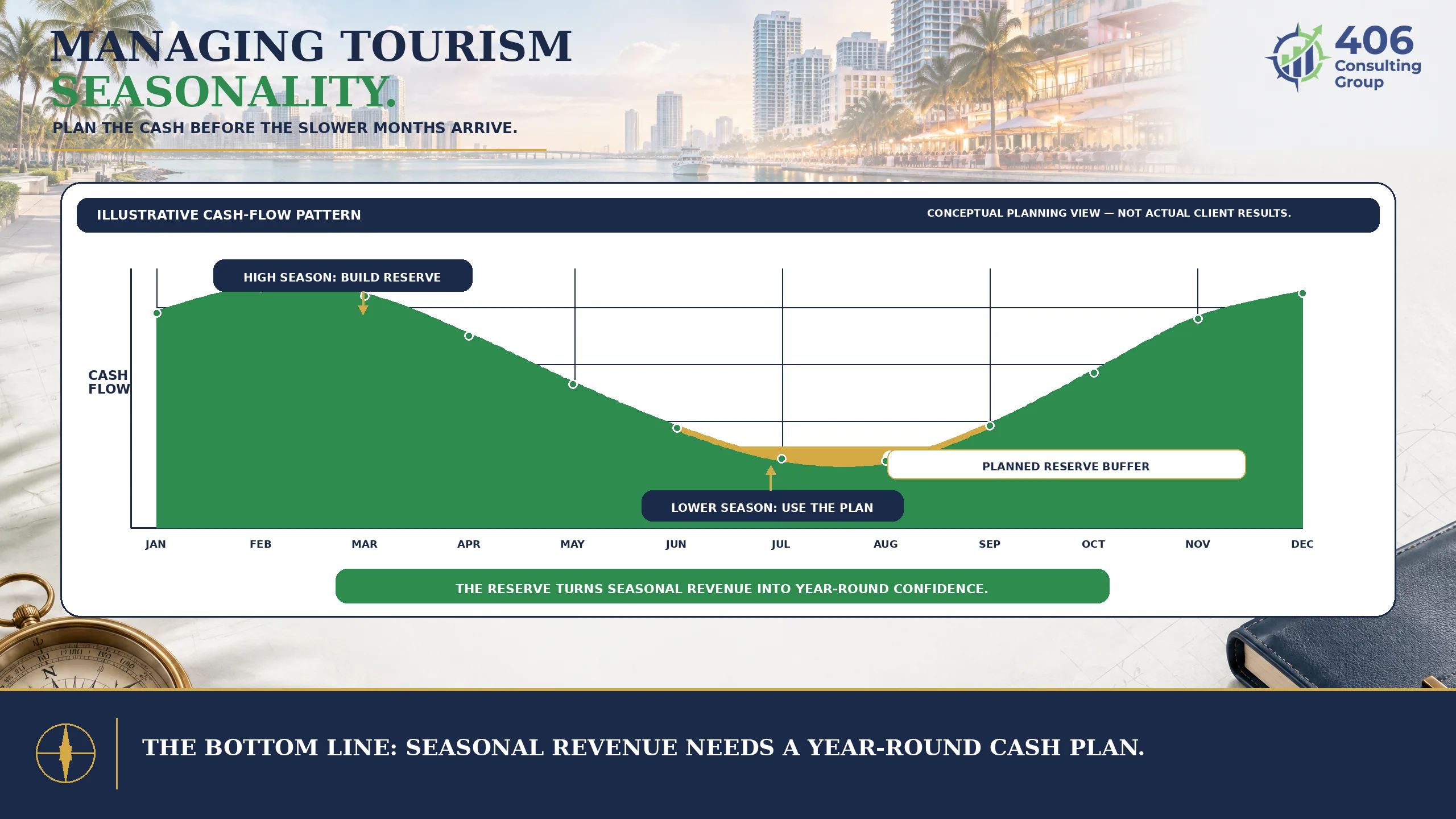
A rolling 13-week cash forecast, tied to the season and to expected foreign receipts, turns "we're fine" into a number you can defend. That same forecasting discipline is what makes portfolio reporting work — starting with real estate.
Real Estate Portfolios — Entity-Level and Property-Level Reporting
Real estate is where Miami owners most often lose the plot, because a portfolio has to be read two ways at once: property by property and entity by entity. Each building or project usually sits in its own LLC, with its own loan, its own insurance, and its own operating profile — and yet the owner needs a consolidated view of the whole portfolio to make capital decisions. A controller keeps each entity's books clean and reconciled; a CFO rolls them into a portfolio picture that shows which properties carry the group and which quietly drain it.
Property level
NOI, occupancy, cost per unit, and debt service — how each individual asset is really performing.
Entity level
Each LLC's own P&L, balance sheet, loan covenants, and insurance — clean enough to hand a lender.
Portfolio level
Consolidated cash, equity, and coverage across the whole group — the view that drives buy/sell/refinance calls.

Insurance deserves its own callout here: in the toughest property-insurance market in the country, premiums can move a property from profitable to underwater between renewals, so the forecast has to treat insurance as a strategic, volatile line — not a fixed footnote. Hospitality portfolios add their own operating dial.
Hospitality — Prime Cost, Labor %, and Multi-Location Consolidation
For Miami restaurants, bars, and hotels, the number that decides survival is prime cost — cost of goods sold plus total labor, as a percentage of revenue. Watch it weekly, not just monthly, because a few points of drift in food cost or labor is the difference between a good year and a closed door. As an operator adds locations, the CFO's job shifts to consolidation: comparing labor %, prime cost, and margin location by location on one page, so the strong store's numbers don't mask the weak one's.
In hospitality, a blended company P&L is where problems hide. Location-by-location prime cost and labor % is where they get found — while you can still fix them.

Reliable location-level numbers do more than run the business day to day — they're also what a surety or a lender will demand the moment you want to grow. That's where the underwriting lens comes in.
Bonding Readiness — The Surety's View of Your Financials
For Miami contractors, bonding capacity is set at the company level, and a surety underwrites your financial statements the way a bank underwrites a loan — only stricter. They read working capital, equity, and the quality of your work-in-progress schedule to decide how much bonded work you can take on. Weak or messy company financials cap your bonding line, which caps the size of jobs you can bid, which caps growth. A CFO who understands that math keeps the balance sheet and WIP in the shape a surety rewards.
A surety isn't betting on your next job — it's betting on your balance sheet. Working capital and equity are the story, and they're a story you write months in advance.
This is where Carrie's background changes the conversation. As a former commercial banker and underwriter who reviewed 300+ loans, she reads your financials the way the surety's analyst will — before they do. We tighten working capital, clean up the balance sheet, and make sure equity tells the right story, so your bonding line reflects the company you actually are.

The job-level mechanics behind that WIP schedule — percentage-of-completion, retainage, change orders, and Miami's High-Velocity Hurricane Zone requirements — live in our Miami construction accounting guide. Here we own the company-level statements the surety underwrites — the same statements a lender wants.
Lender-Ready Financials — What a Miami Bank Actually Wants
When a Miami owner asks for capital — a line of credit, an acquisition loan, or an SBA 7(a) loan — the lender decides from the financials, not the pitch. What they want is unglamorous and specific: a clean separation of business and personal (and of each entity), a readable P&L that shows true profitability, and a supportive balance sheetwith a debt service coverage ratio that clears their threshold. Messy or commingled books answer the question for them — no.
Clean separation
Business, personal, and each entity clearly delineated — no commingling for an analyst to untangle or distrust.
Readable P&L
Real, sustainable profitability the lender can follow at a glance — with add-backs documented, not improvised.
Supportive balance sheet
Working capital and a DSCR that clear the bank's threshold, plus a forecast that shows the loan gets repaid.

Because Carrie sat on the other side of that desk, we build the package the way the credit committee reads it — and we go deeper in our loan readiness service. For Miami, one more group of stakeholders reads your numbers with fresh eyes: foreign investors.
Foreign Investors & Reporting Expectations
Miami is a landing pad for foreign capital, and foreign investors expect a level of reporting that many domestic small businesses never build. They want consistent, timely statements they can read from another country and another accounting culture, clear entity structures for their ownership, transparent handling of distributions and capital accounts, and financials that hold up if the investment ever gets audited or sold. A CFO makes the business legible to that audience: standardized reporting, a documented close calendar, and a clean trail behind every number.
Foreign investors don't fund confusion. Legible, consistent financials are the price of admission for cross-border capital — and they're a CFO's deliverable, not an afterthought.
Cross-border ownership also raises federal and international tax-filing obligations that sit alongside this reporting; those are covered in our Miami tax services guideand should be coordinated with a qualified tax professional. Making all of these audiences — investors, lenders, sureties — see one coherent business is a systems problem, and that's our home turf.
The Whole-Company Systems View
Here's what separates real CFO work from a spreadsheet with nicer fonts: we design financial systems from a whole-company, cross-departmental view— not a narrow accounting lens. The way a Miami hotel books deposits touches revenue recognition, cash forecasting, and the labor schedule; the way a real estate group handles intercompany loans touches every entity's balance sheet and its lender covenants. When those connections aren't designed on purpose, the numbers fight each other, and the monthly close becomes an argument instead of a report.
My own background is process and efficiency — big-firm accounting plus Six Sigma, made practical for owner-operated businesses. The philosophy is simple: don't boil the ocean. Start with the one workflow causing the most pain, make it repeatable, and let clean data flow downstream into the Dashboard, the forecast, and the lender package. Good systems are why the numbers arrive on time, agree with each other, and mean something.
Why the systems view pays off in Miami
A restaurant group's deposit handling, a builder's WIP entries, and a portfolio's intercompany loans all feed the same statements. Designed together, they produce one clean version of the truth for owners, lenders, sureties, and foreign investors — instead of four reconciliations that never quite match.
To see how this comes together, walk through a hypothetical Miami operator preparing to grow.
Illustrative Example — A 3-Property Hospitality Group Prepping for a Growth Loan
The following is a hypothetical, composite example for illustration only — not a real client, and the figures are round numbers chosen to make the mechanics clear. Picture a Miami hospitality group: three boutique properties (two restaurants and a small hotel), each in its own LLC, roughly $9M in combined annual revenue, and an owner who wants a $2M acquisition loan to add a fourth location.
Starting point
One blended P&L, a close that lands 6 weeks late, prime cost tracked by gut, and insurance buried in overhead. The bank asks for statements the owner can't produce cleanly.
Controller fix
A disciplined monthly close per entity, reconciled accounts, and prime cost reported weekly by location. Numbers now land by day 8 — and they agree with each other.
CFO layer
A consolidated portfolio view, a 12-month forecast, and a Growth Dashboard showing DSCR near ~1.35x after the new property's projected cash flow — above a typical lender threshold.
The ask
A lender-ready package: clean entity separation, readable P&Ls, a supportive consolidated balance sheet, and a forecast that shows the $2M is repaid comfortably through the season.
Nothing about the business changed except the quality of its numbers — and that's exactly what moved the loan from a slow maybe to a clean yes. (Illustrative figures; actual results depend on the business and the lender.)
The owner in that example never once sat across a desk from us. Which raises the question Miami owners always ask.
Local vs Remote for CFO-Level Work
Owners assume CFO-level work needs someone in the room. It doesn't — and the proof is in how our own clients choose to work: around 80% of our local clients run the entire relationship remotely and never come into an office. Forecasting, portfolio consolidation, lender prep, and the monthly Dashboard review all happen over secure cloud accounting, live bank feeds, and scheduled video reviews. When your neighbors are already running CFO-level work over a screen, being across the country from Miami stops being a drawback and starts being irrelevant.
~80%
of our local clients are fully remote
They never come into the office — forecasting, reviews, and lender prep are all cloud-based, by choice.
What actually decides CFO value is expertise, not proximity. A great remote CFO who understands multi-currency cash flow, real estate and hospitality portfolios, bonding, and how a Miami lender reads a balance sheet beats an okay local one who treats your business like any other. We run finance for Miami and Florida businesses entirely remotely — multi-currency portfolios, seasonal cash, lender and surety prep — and we build the reporting from a whole-company view so every number ties back to how the business actually operates. Not sure whether you need a controller, a CFO, or both? Start with our financial maturity assessment, then talk to 406.
FAQ: Miami CFO & Controller Questions
Controller vs CFO — what's the difference?
A controller owns reliable, on-time numbers: the monthly close, bank and credit-card reconciliations, financial reporting, and job costing. Their focus is backward-looking accuracy — making sure what happened is recorded correctly and produced on a calendar. A CFO owns forward-looking strategy: forecasting, cash and capital planning, growth modeling, lender and investor relationships, and the KPIs that steer decisions. In short, the controller makes the numbers trustworthy and the CFO makes them point forward. Most Miami businesses need the controller function solid first, because you can't forecast on numbers you don't trust, then layer CFO strategy on as decisions get bigger.
When can I afford a fractional CFO?
The point of fractional and remote delivery is that you don't hire a $200K+ full-time executive to get CFO-level thinking — you rent the exact level you need. As a rough guide, owners often start adding CFO help when they're managing multiple entities or locations, seeking a significant loan or bonding line, taking on investors, or simply making decisions big enough that a wrong call is expensive. If you can't confidently answer 'can we afford the next property, and how do we fund it?' you're likely ready for at least fractional CFO support. A good first step is a maturity assessment to see whether you need controller work, CFO work, or both.
What financials does a Miami lender want?
A lender decides from your financials, not your pitch. They want a clean separation of business and personal (and of each entity, if you run several), a readable profit-and-loss that shows true, sustainable profitability with any add-backs documented, and a supportive balance sheet with a debt service coverage ratio that clears their threshold — plus a forecast showing the loan gets repaid. Commingled or messy books answer the question for them, and the answer is no. Because our co-founder Carrie spent years as a commercial banker and underwriter reviewing 300+ loans, we build the package the way a credit committee actually reads it.
How do you handle multi-currency cash flow?
Miami money often arrives in more than one currency — from Latin American buyers, foreign-owned entities, or cross-border vendors. We record transactions in a functional currency, handle exchange-rate gains and losses cleanly so a strong-dollar swing doesn't quietly erode your margin, and build expected foreign receipts into a rolling cash forecast. The goal is that currency movement is visible and planned for, not a surprise at month-end. Any related federal or international tax-filing obligations should be coordinated with a qualified tax professional; confirm current rules with the appropriate authorities.
Can a remote CFO really run my numbers?
Yes — and it's how most of our clients prefer it. Around 80% of our own local clients run the entire relationship remotely and never come into an office. Forecasting, portfolio consolidation, lender preparation, and the monthly KPI review all happen over secure cloud accounting, live bank feeds, and scheduled video reviews. What decides the value of CFO work is expertise, not proximity: a great remote CFO who understands multi-currency cash flow, real estate and hospitality portfolios, bonding, and how a Miami lender reads a balance sheet beats an okay local one who doesn't.
What KPIs should I watch?
We use a framework called the Miami Growth Dashboard — seven numbers a real estate, hospitality, or construction owner should see every month: (1) operating cash position and runway; (2) gross margin by unit (property, location, or job) rather than a blended average; (3) prime cost for hospitality or job margin for construction; (4) fixed-cost coverage including Florida's outsized property-insurance premiums; (5) debt service coverage ratio; (6) days cash and receivables/deposits aging; and (7) a rolling 13-week and 12-month forecast. Watched together, these tell you whether the business is actually getting stronger — not just busier.
When You Need Which
Controller vs CFO at a glance
Miami CFO & Controller
Forward-looking, remote.
About the Author
Jason Anderson
Co-Founder, 406 Consulting Group
Jason is a big-firm-trained accountant and Six Sigma systems builder who designs forward-looking financial reporting from a whole-company view — delivered remotely to Miami and Florida businesses in real estate, hospitality, and construction.
Read the Full Story