
Tax Services in Miami, FL:
Federal-First in a No-Income-Tax City
Florida has no personal income tax — so in Miami every dollar of planning is federal and transactional: the S-corp election, FIRPTA on foreign real-estate sales, Form 5472 for foreign-owned LLCs, and the Miami-Dade documentary stamp quirk. The cross-border planning that actually moves the needle, delivered remotely.

Miami runs on movement — capital, people, and property flowing in from Latin America, the Northeast, and everywhere in between. It is the gateway city, and its tax picture reflects that: Florida has no personal income tax, so for a Miami business or investor there is no state return to file on your earnings. But that single fact fools a lot of people. When there is no state income tax to plan around, every dollar of real leverage sits at the federal level and inside the transactionsthemselves — the entity you choose, the way you sell a property, the forms a foreign owner must file, and the county taxes that quietly attach to every deed. In Miami, tax planning is not about the state. It is about getting the federal and cross-border pieces exactly right.
This guide walks the Federal-First Tax Blueprint — Miami Edition: what to plan when the state takes nothing, and the international layers — FIRPTA, foreign-owned filings, inbound investors, and Miami-Dade's own documentary stamp quirk — that make Miami tax work unlike anywhere else in the country. All delivered remotely.
By Carrie Anderson — Co-Founder, 406 Consulting Group. Former commercial banker and underwriter (300+ loan reviews) who reads tax structure the way a lender does — because how you're taxed shapes how you borrow, sell, and grow. Delivered remotely to Miami and Florida clients.
Quick Answer: Tax Planning for a Miami Business or Investor
- →No Florida personal income tax and no pass-through income tax — so the real leverage is federal: entity choice, the S-corp election, timing, and depreciation.
- →Only C-corporations owe Florida income tax, at 5.5%. There is no Florida PTE or SALT workaround — there is no state income tax to work around.
- →Sell US real estate as a foreign person and FIRPTA requires the buyer to withhold 15% of the amount realized — unless you plan for it.
- →Own a US LLC from abroad and you likely owe a Form 5472 + pro forma 1120 — a $25,000 penalty if you miss it.
- →It's all remote — about 80% of our own local clients run the entire relationship that way.
Table of Contents
What Tax Planning Looks Like in a No-Income-Tax City
Tax services in Miami are not about filing a state return — there isn't one on your income. For a Miami business owner or investor, tax planning means federal strategy plus transaction-level structure: choosing the right entity, electing S-corp status when the math works, timing income and deductions, and — uniquely for Miami — handling the cross-border rules that come with a city where a huge share of capital and property is foreign-owned. When the state takes nothing off the top, the mistakes that cost real money are almost always federal or transactional.
That is the heart of the Federal-First Tax Blueprint — Miami Edition. In a high-tax state, a big part of planning is minimizing what the state grabs. In Miami, there is nothing to minimize at the state level, so the entire effort moves to the federal return and to the moment of each transaction — the sale of a condo, the setup of a US entity by a foreign owner, the deed that records at the county. Get those right and you keep far more than a state-tax dodge ever would have saved.
"No income tax" does not mean "no planning." It means every dollar of planning is federal or transactional — and in Miami, often cross-border. That is where the money is won or lost.
Start with where the leverage actually lives.
Federal-First: Where the Real Leverage Is
With no state income tax, your tax outcome is decided almost entirely by three federal levers: entity structure, the S-corp election, and timing. Florida taxes only C-corporations, at 5.5% — every other structure (sole proprietor, partnership, S-corp) pays no Florida income tax at all. So the entity question in Miami is really a federal question with a small Florida footnote: how do you want the IRS to treat this business, and does organizing as a C-corp trigger that one 5.5% state tax on purpose or by accident?
Entity structure
Sole prop, partnership, S-corp, C-corp — the choice is federal-driven. Only the C-corp owes Florida's 5.5% income tax on top of federal.
S-corp election
In a no-income-tax state, the S-corp play is 100% about federal self-employment tax savings. No state benefit either way.
Timing
Accelerate or defer income and deductions across tax years to manage federal brackets, QBI, and one-time events like a property sale.
Depreciation
Bonus depreciation, Section 179, and cost segregation on real estate are pure federal wins — and Miami is a real-estate town.

The most common federal lever a profitable Miami business reaches for first is the S-corp election.
The S-Corp Election in Florida Is Purely Federal
An S-corp election in Florida is a purely federal move — there is no state income tax for it to affect, so 100% of the benefit is federal self-employment tax savings. The mechanism: as a sole proprietor or single-member LLC, your entire net profit is subject to self-employment tax (roughly 15.3% up to the Social Security wage base, then 2.9%+ above it). Elect S-corp status and you split that profit into a reasonable salary (which carries payroll tax) and distributions(which do not). Done right, that can save thousands a year — but only if the salary is genuinely reasonable, which the IRS scrutinizes.
Reasonable-salary math, simplified
$120K
net profit
$70K
reasonable salary
~$7.6K
est. SE-tax saved
Illustrative only. The ~$50K taken as distribution skips the ~15.3% self-employment tax. Your salary must be defensible; confirm your numbers with a tax professional.

Run your own numbers with our S-Corp Calculator, then let us pressure-test the salary. There is no Florida PTE or SALT workaround to layer on top — there is no state income tax to work around — so in Miami the election stands or falls on the federal math alone. Where Miami really diverges from the rest of the country is the international layer, starting with FIRPTA.
FIRPTA: Foreign Sellers of US Real Estate
FIRPTA is the federal rule that makes the buyer withhold 15% of the amount realized(usually the sale price) when a foreign person sells a US real property interest — and in a market where foreign owners hold a huge share of the condos, it comes up constantly. FIRPTA stands for the Foreign Investment in Real Property Tax Act. It exists because the IRS cannot easily chase a seller who lives abroad, so it collects at the closing table instead. The withholding is a prepayment against the seller's actual US tax on the gain — not an extra tax — but if you do nothing, 15% of the gross price is held back and remitted to the IRS regardless of your real gain.
Standard rate: 15%
The buyer must withhold 15% of the amount realized on a foreign person's disposition of a US real property interest, and remit it to the IRS (Forms 8288 / 8288-A).
$300K personal-use exception: 0%
If the price is $300,000 or less AND the buyer intends to use it as a residence, withholding can be zero. The buyer's intent and signed affidavit drive this.
$300K–$1M personal-use: 10%
For a residence the buyer will use, priced above $300,000 but not over $1,000,000, the rate can drop to 10% instead of 15%.
Withholding certificate (Form 8288-B)
Apply BEFORE closing and the IRS can reduce withholding to match the seller's actual expected tax — often far less than 15% of the gross price.
FIRPTA is not a penalty — it is a prepayment. But 15% of a gross Miami sale price can be far more than the tax you actually owe, and getting that cash back can take a year. The fix is a withholding certificate filed before closing.
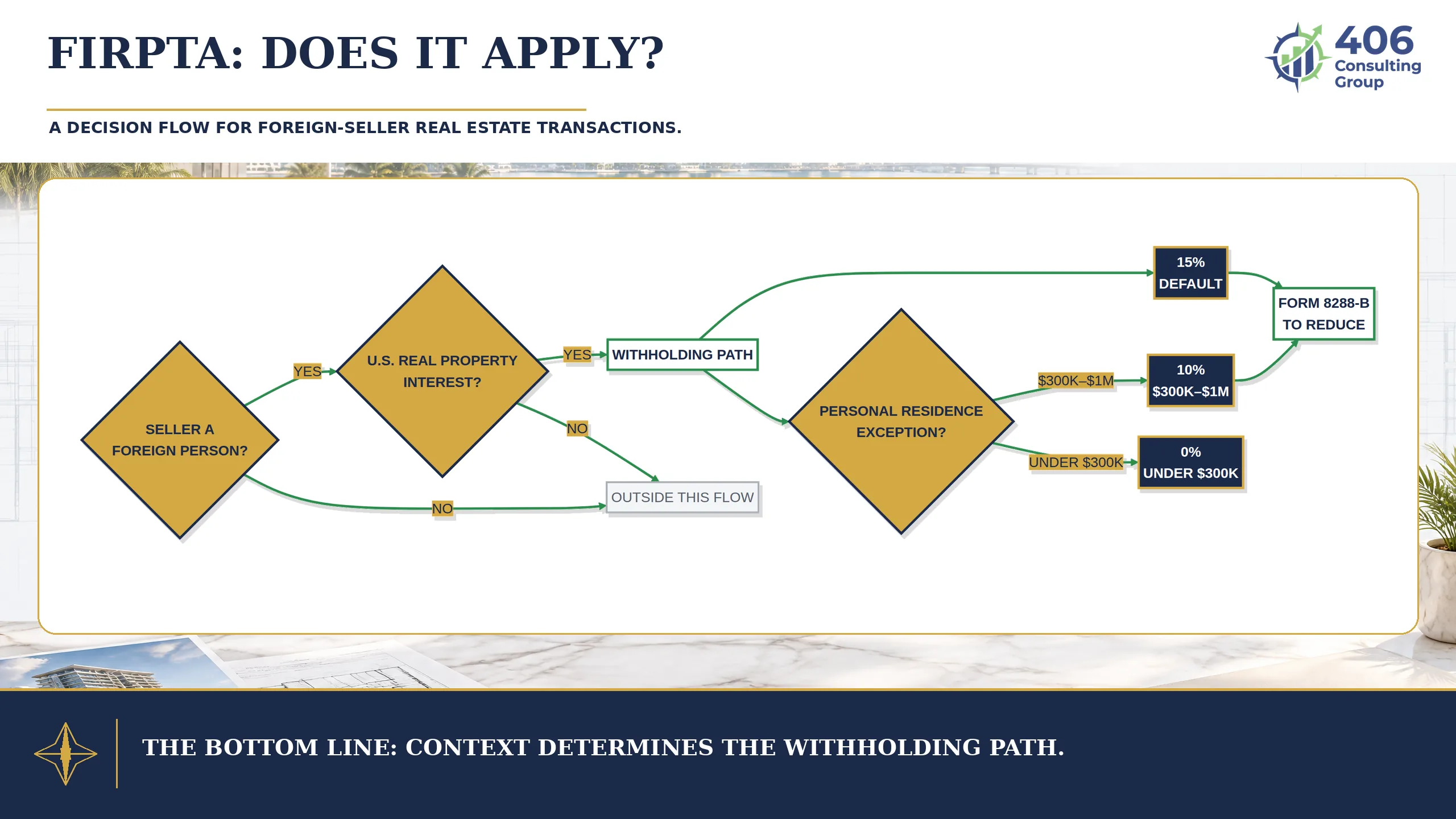
Confirm current thresholds and rates with the IRS FIRPTA guidance— the planning window is before the deal closes, not after. The other cross-border trap catches foreign owners the moment they set up a US entity.
Foreign-Owned Entities: Form 5472 & the $25,000 Penalty
If you are a foreign person who owns a US single-member LLC, the IRS treats that "disregarded" LLC as a domestic corporation for reporting purposes, which means you must file Form 5472 attached to a pro forma Form 1120 every year — and missing it carries a $25,000 penalty. This trips up an enormous number of inbound Miami investors, because a single-member LLC normally files nothing of its own (its activity just flows onto the owner's return). But when the owner is foreign, that shortcut disappears. The LLC itself has to file, reporting the "reportable transactions" between it and its foreign owner — capital contributions, distributions, loans, and the like.
What a foreign-owned US LLC typically files
Penalty: $25,000 for failure to file (or filing incomplete/late), with additional amounts if it continues after IRS notice. This is per year, per entity.
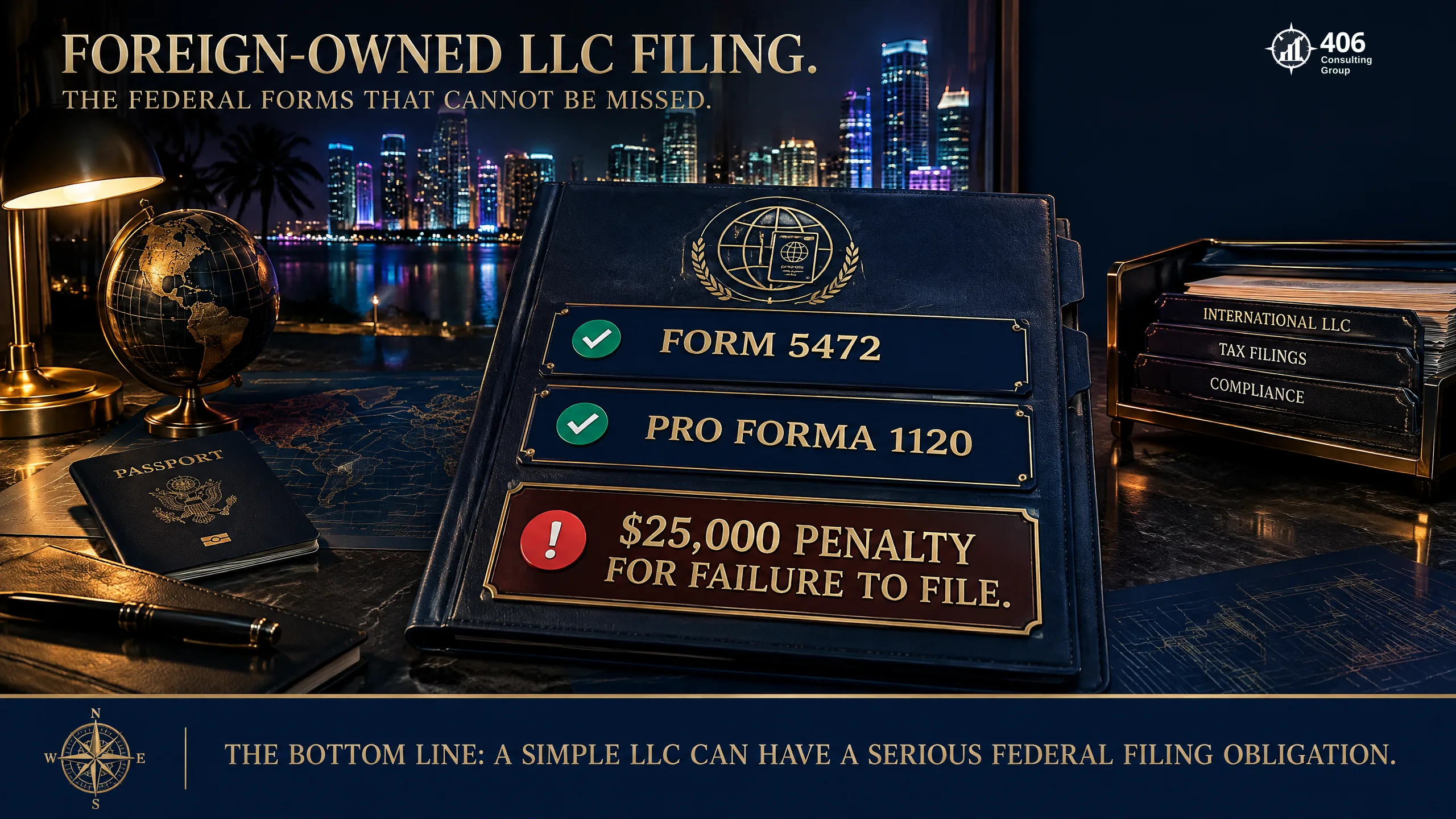
We own the filing and penalty side of this. The records trail behind it — a clean, defensible ledger of every contribution, distribution, and intercompany loan so the 5472 is actually accurate — is the job of your books; see our Miami bookkeeping guide. To file any of this, a foreign owner first needs a US taxpayer number.
ITINs & Inbound Investors
An ITIN— Individual Taxpayer Identification Number — is the IRS number a foreign person uses when they have a US tax obligation but are not eligible for a Social Security number, and for a Miami inbound investor it is usually the first practical step. You need one to file a US return reporting rental income, to claim back over-withheld FIRPTA money, to be listed correctly on entity filings, and generally to be a real taxpayer in the eyes of the IRS. Without it, refunds stall and filings get rejected.
For an inbound investor, the sequence matters: ITIN first, then the entity and EIN, then the filings. Sort the identity numbers early and every downstream step — FIRPTA refunds, 5472s, rental returns — gets dramatically smoother.
This is exactly the kind of cross-border sequencing where a lender's eye helps: if you plan to finance US property, the bank will want to see clean tax identity and clean filings before it lends. We build that from day one. With the federal and identity layers set, one more Miami-specific tax attaches to almost every property deal — and it is a county quirk.
Documentary Stamp Tax: The Miami-Dade Quirk
Florida's documentary stamp tax is a transaction tax on deeds and on written obligations to pay money — and Miami-Dade County is the one county that runs its own rates, so the math is genuinely different here than anywhere else in the state. Statewide, the tax on deeds is $0.70 per $100 of consideration. But in Miami-Dade the deed rate is $0.60 per $100, with an added $0.45 per $100 surtax that applies to real property other than a single-family residence. On promissory notes and other written obligations, the rate is $0.35 per $100 statewide, including Miami-Dade.
Documentary stamp tax — at a glance
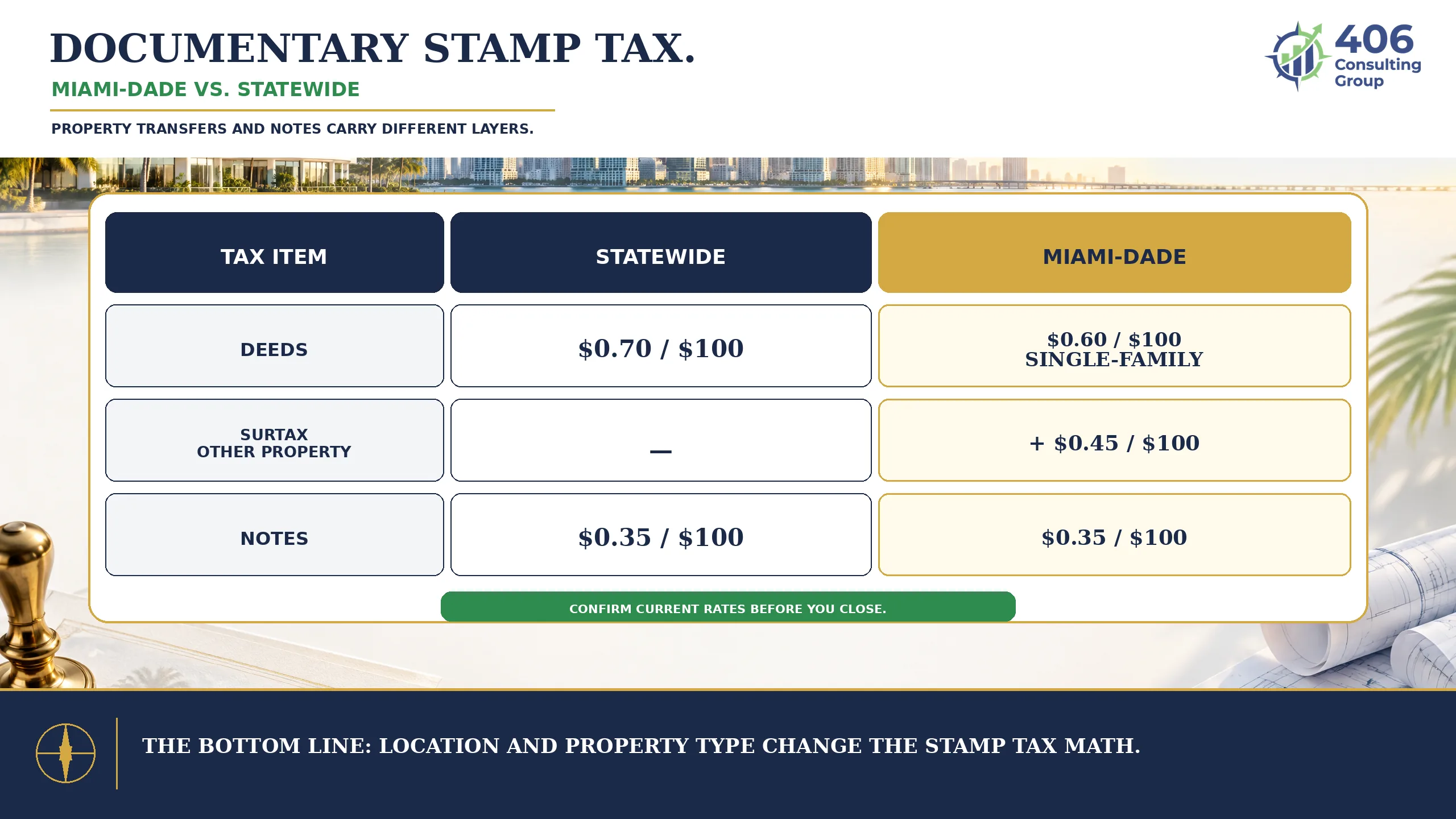
These rates change and the single-family versus other-property distinction has real dollar consequences on a commercial deal, so confirm current rates with the Miami-Dade County Clerk and the Florida Department of Revenue before you close. Alongside the deed taxes sits the tax a Miami business handles every single month.
Sales & Use Tax at ~7% in Miami-Dade
A Miami business collecting sales tax charges the Florida state rate of 6% plus the Miami-Dade discretionary surtax, for a combined rate of about 7% — and the piece owners miss is use tax, which they owe themselves on untaxed purchases. Sales tax is straightforward when you sell taxable goods to a Miami customer: you collect the combined rate and remit it. Use tax is the mirror image — when you buy something for the business from an out-of-state or online vendor who did not charge Florida tax, you owe that same rate directly to the state. It is the most commonly overlooked liability in the state, and the one auditors look for first.
Who collects
A Miami seller of taxable goods or services collects ~7% (6% state + Miami-Dade surtax) from the customer and remits it to the Florida DOR.
Who owes use tax
The buyer. Purchase equipment or supplies from an out-of-state vendor with no Florida tax charged, and you self-assess and remit the use tax.
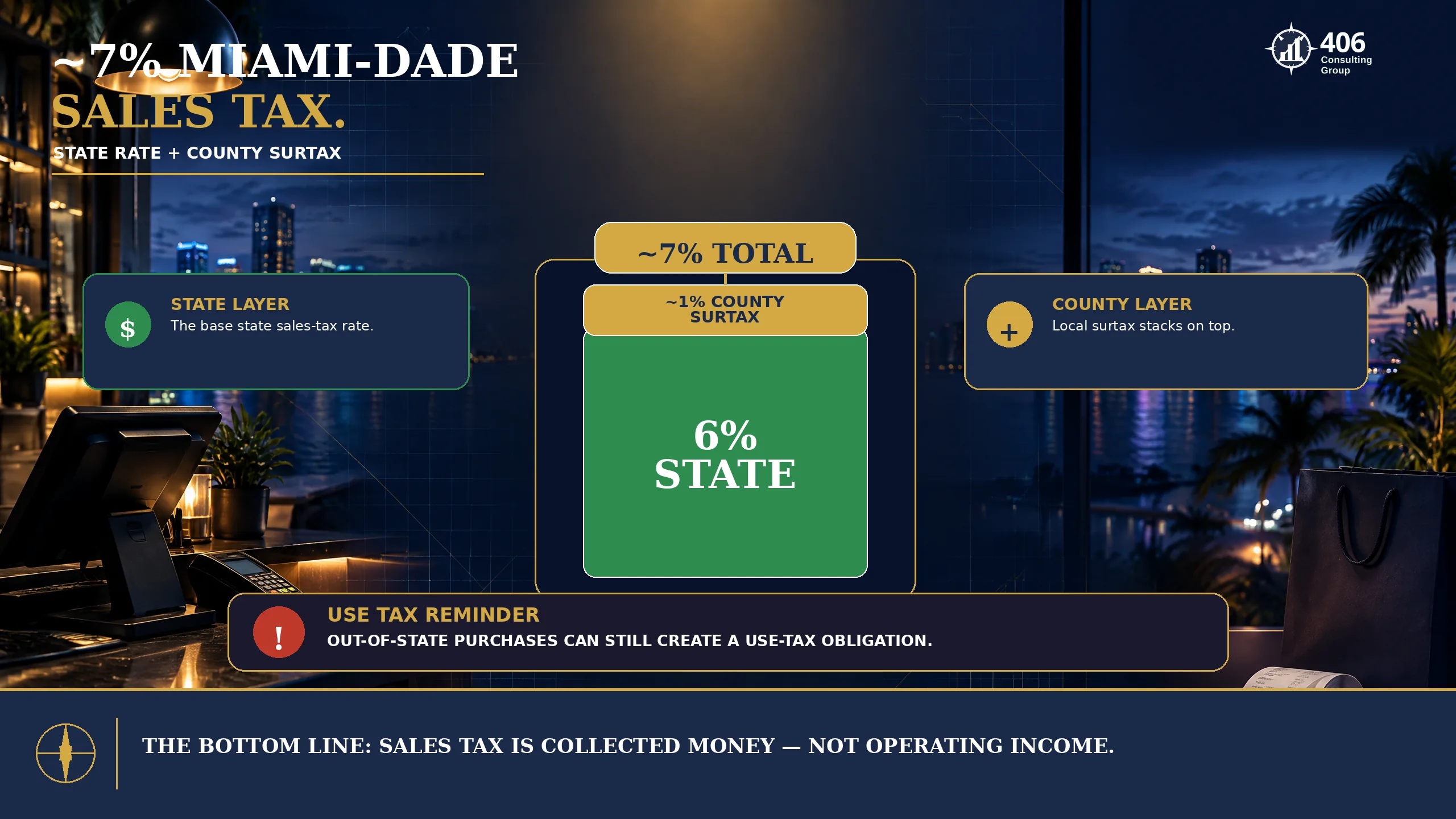
The surtax base has caps and category rules, so confirm the current combined rate with the Florida Department of Revenue. One more Florida tax rides on payroll — under a name most owners have never heard.
RT-6 Reemployment Tax
Florida has no state income-tax withholding to run on payroll, but it does have a state unemployment tax — it just calls it reemployment tax, filed on Form RT-6. If you have employees in Miami, this is the one payroll tax that is genuinely a Florida obligation rather than a federal one. It is an employer-paid tax on a capped amount of each employee's wages, at a rate that starts at a new-employer default and then adjusts based on your claims experience over time. Because there is no state withholding to distract from it, RT-6 is the easiest Florida payroll obligation to forget — and the one a new employer relocating from an income-tax state does not expect.
No state income-tax withholding does not mean no state payroll tax. RT-6 reemployment tax is the Florida obligation that comes with your first employee — register and file it from the start.
Confirm current wage bases and rates with the Florida Department of Revenue. With payroll covered, the biggest planning opportunities in Miami tend to live inside real estate.
Real Estate & Short-Term-Rental Tax Angles
Miami is a real-estate town, so for many owners the biggest federal levers are the ones that attach to property: depreciation, cost segregation, and depreciation recapture. Depreciation lets you deduct the cost of a building (not the land) over time, sheltering rental income. Cost segregation is a study that reclassifies parts of a property — fixtures, flooring, landscaping — into shorter recovery periods so you can front-load those deductions, sometimes dramatically, in the early years. The trade-off arrives at sale: recapture taxes back a portion of the depreciation you claimed, which is exactly why the sale needs to be planned, not stumbled into.
Depreciation
Deduct the building's cost over its recovery period to shelter rental income each year.
Cost segregation
A study that accelerates deductions by reclassifying components into shorter-life categories.
Recapture
At sale, part of prior depreciation is taxed back — plan the exit so it doesn't surprise you.
Short-term rentals add their own layer — the tourist development tax collected on stays, plus the question of whether the activity rises to a trade or business for federal purposes. For a foreign owner, all of this collides with FIRPTA at the moment of sale, which is where the pieces come together in a real example.
Illustrative Example: A Foreign Investor Sells a Miami Condo
The clearest way to see the Federal-First Blueprint at work is to walk a sale from start to finish. The following is a hypothetical, composite examplewith illustrative figures — not a real client — built to show how FIRPTA plays out when it is handled correctly versus when it is ignored.
The setup (hypothetical)
A foreign investor bought a Brickell condo years ago for $600,000 and now sells it for $900,000. Her actual taxable gain is roughly $300,000, and her actual US federal tax on that gain is far less than the gross withholding would be.
If she does nothing
- →Buyer withholds 15% of $900,000 = $135,000 at closing.
- →Her actual tax on the ~$300K gain is a fraction of that.
- →The overwithheld cash is tied up until she files a US return and waits for a refund — often a year or more.
If she plans ahead
- →She has an ITIN in hand before the deal.
- →We file a Form 8288-B withholding certificate before closing, matching withholding to her real expected tax.
- →Far less cash is held back, and her return cleanly reconciles the sale — no year-long wait for a large refund.
Same sale, same gain, same tax — wildly different cash flow. The difference is entirely in the planning done before the closing table. Figures are illustrative; every deal turns on its own facts.
The lesson generalizes: in a no-income-tax city, the wins come from getting the federal and transactional timing right, on purpose, ahead of time. That is a cadence, not a once-a-year scramble.
Proactive vs Reactive: The Annual Planning Cadence
Reactive tax work is filing a return in the spring to report what already happened; proactive tax work is a year-round cadence that changes the outcome before the year closes — and in a no-income-tax city, proactive is where nearly all the savings live. Because there is no state return to optimize, the calendar is built around federal moves and transaction timing: the entity and salary review, mid-year projections, the property and depreciation decisions, and — for anyone selling US real estate — the FIRPTA certificate that has to be filed before, not after, the closing.
A federal-first Miami cadence
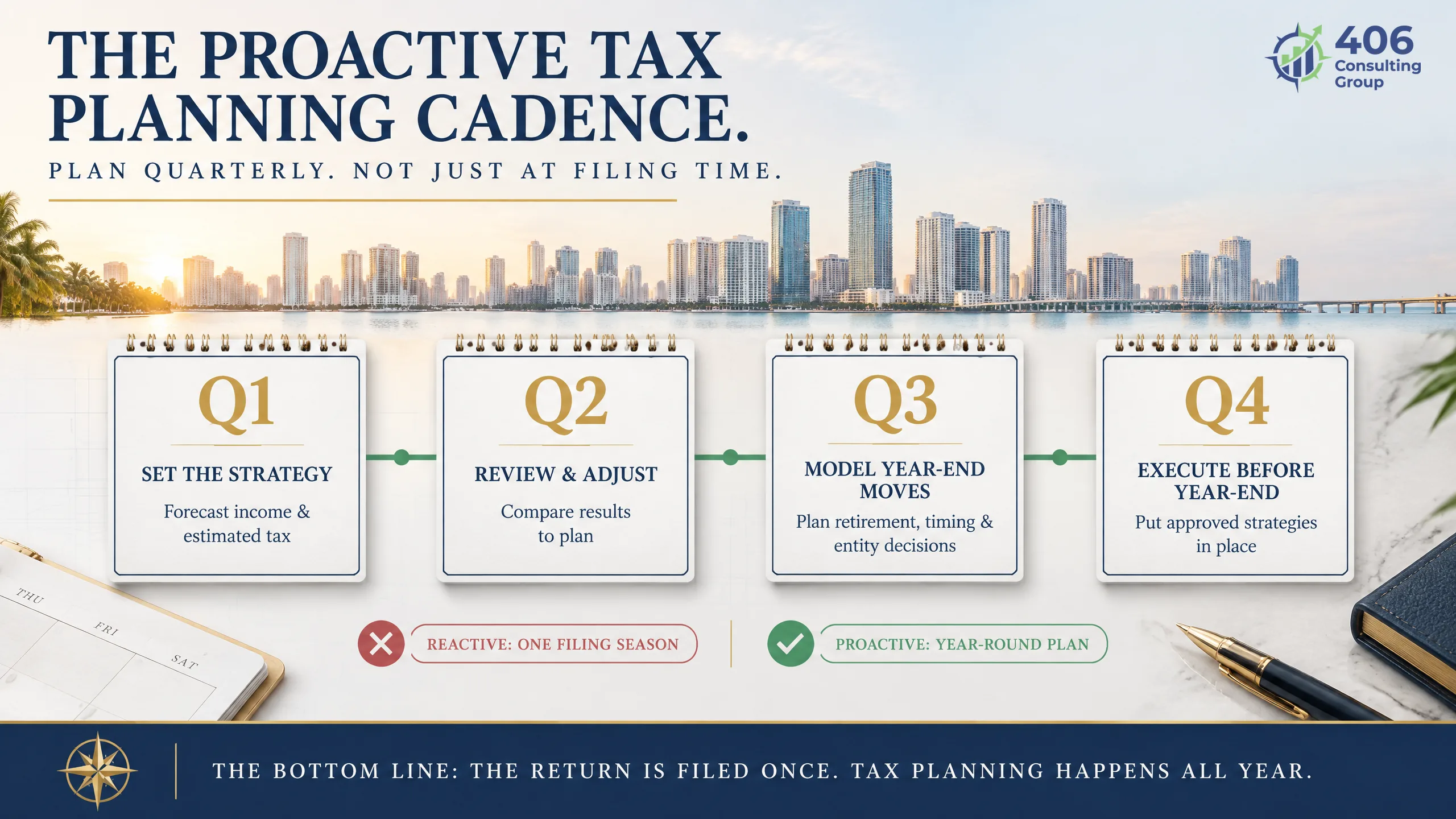
This is where working with a firm that also understands lending pays off: the same clean, proactive structure that lowers your tax is what a bank reads when you go to borrow. Explore our tax planning, tax preparation, and fractional CFO services — or just talk to us. And yes, all of it is remote.
FAQ: Miami Tax Questions
Is there any Florida state income tax for my business?
For most small businesses, no. Florida has no personal income tax and no tax on pass-through entities, so sole proprietors, partnerships, and S-corporations owe no Florida income tax at all. The one exception is the C-corporation, which pays Florida's 5.5% corporate income tax on top of federal tax. That is why entity choice is a real tax decision in Miami even though the state takes nothing from most owners. And because there is no state income tax, there is no Florida PTE or SALT-cap workaround — there is nothing at the state level to work around. Confirm your situation with the Florida Department of Revenue or a tax professional.
What is FIRPTA and does it apply to me?
FIRPTA is a federal law that requires the buyer to withhold tax when a foreign person sells a US real property interest — generally 15% of the amount realized (usually the sale price). It applies to you if you are a foreign person selling US real estate, which is extremely common in Miami. The withholding is a prepayment against your actual US tax on the gain, not an extra tax, but 15% of a gross sale price is often far more than you truly owe. Exceptions can reduce it: a residence priced at $300,000 or less that the buyer will use can be 0%, and $300,000 to $1,000,000 for buyer personal use can be 10%. Filing a Form 8288-B withholding certificate before closing can reduce the withholding to your real expected tax. Confirm current rules with the IRS FIRPTA guidance.
I own a US LLC from abroad — what must I file?
If you are a foreign person who owns a US single-member LLC, the IRS treats that disregarded entity as a domestic corporation for reporting, so the LLC must file Form 5472 attached to a pro forma Form 1120 every year, and it needs its own EIN to do so. Form 5472 discloses reportable transactions between the LLC and you as the foreign owner — capital contributions, distributions, and loans. Failure to file, or filing late or incomplete, carries a $25,000 penalty per year, per entity. This surprises many inbound investors because a US-owned single-member LLC normally files nothing separately. We handle the filing; clean books make the 5472 accurate. Confirm requirements with the IRS Form 5472 instructions.
Should I elect S-corp in Florida?
Possibly — but the decision is purely federal in Florida, because there is no state income tax for it to affect. The entire benefit is federal self-employment tax savings: an S-corp lets you split profit into a reasonable salary (subject to payroll tax) and distributions (not subject to self-employment tax). If your net profit is high enough that the savings exceed the added payroll and compliance cost, and you can pay yourself a genuinely reasonable salary, it can save thousands a year. If profit is modest, the costs may outweigh the benefit. Run the numbers with our S-Corp Calculator and have the salary pressure-tested before you elect.
What is Miami-Dade documentary stamp tax?
Documentary stamp tax is a Florida transaction tax on deeds and on written obligations to pay money, and Miami-Dade County uses its own rates. On deeds, the statewide rate is $0.70 per $100 of consideration, but in Miami-Dade the rate is $0.60 per $100, plus a $0.45 per $100 surtax on real property other than a single-family residence. On promissory notes and other written obligations, the rate is $0.35 per $100. The single-family versus other-property distinction can meaningfully change the cost on a commercial deal, so confirm current rates with the Miami-Dade County Clerk and the Florida Department of Revenue before you close.
What sales tax rate applies in Miami?
A Miami business generally charges about 7% — Florida's 6% state sales tax plus the Miami-Dade discretionary surtax — on taxable sales, and remits it to the Florida Department of Revenue. Just as important is use tax: when you buy equipment or supplies for the business from an out-of-state or online vendor who did not charge Florida tax, you owe the same rate directly to the state by self-assessing it. Use tax is the most commonly overlooked liability and a frequent audit target. The surtax has category rules and caps, so confirm the current combined rate with the Florida Department of Revenue.
Can you handle my taxes remotely?
Yes — we serve Miami and Florida clients entirely remotely, and about 80% of our own local clients run the whole relationship that way and never come into an office. Modern tax work runs on secure document portals, e-signature, screen-share reviews, and e-filing, so distance changes nothing about the quality of the work. What matters is expertise — federal strategy, the S-corp math, FIRPTA, Form 5472 for foreign owners, and Florida's own taxes — not proximity. A great remote tax advisor who knows Miami's cross-border realities beats an okay local one who treats your return like any other.
Miami Tax Snapshot
Federal-first, cross-border
Miami Tax Planning
Federal-first, remote.
About the Author
Carrie Anderson
Co-Founder, 406 Consulting Group
Carrie spent her career in commercial banking and underwriting — 300+ loan reviews — and reads tax structure the way a lender does. She helps Miami and Florida clients get the federal and cross-border pieces right, delivered remotely.
Read the Full Story