
Construction Accounting in Miami, FL:
The HVHZ Contractor's Ledger
Miami-Dade builds inside the strictest wind code in the US — and HVHZ premiums, high-rise coastal work, larger bonding, and foreign-financed projects all land on your books. Job costing, WIP schedules, and bonding-ready financials for Miami contractors, delivered remotely — the way 80% of our local clients already work.

Construction accounting in Miami is not general contractor bookkeeping with a palm tree on it. Miami-Dade sits inside the High-Velocity Hurricane Zone (HVHZ)— the strictest wind and impact code in the United States — and that single fact reshapes your material costs, your labor hours, your inspection schedule, and ultimately the margin on every job. Layer on high-rise and coastal work, larger bonding requirements, and a steady flow of foreign-financed condo projects, and a Miami contractor's books have to carry weight that a generic ledger simply can't.
This guide lays out The HVHZ Contractor's Ledger— build-cost control tuned to Miami-Dade's code, its coast, and its capital needs — and shows how to keep books that a surety, a lender, and the state licensing board will all trust. It's written for the contractor who is done guessing at profit.
By Carrie Anderson — Co-Founder, 406 Consulting Group. Former commercial banker and underwriter who reviewed 300+ loans — she knows exactly how a surety and a bank read a contractor's financial statements, and builds books that pass that read the first time.
Quick Answer: Construction Accounting in Miami
- →HVHZ — the strictest wind/impact code in the US, covering Miami-Dade and Broward — drives higher material, labor, and inspection costs that must be job-costed, not buried in overhead.
- →WIP schedules (work-in-progress) show over- and under-billing on long jobs — and sureties and lenders won't bond or fund you without them.
- →Workers' comp is mandatory at one employee in construction in Florida (non-construction is four) — officer exemptions are limited.
- →The contractor is the consumer of materials on real-property improvements — you generally pay sales/use tax on materials rather than charging the customer.
- →It's all remote — and about 80% of our own local clients run the entire relationship that way.
Table of Contents
Why Miami Construction Accounting Is Its Own Animal
Construction accounting in Miami is different because the code, the coast, and the capital are all different. Miami-Dade builds inside the strictest wind code in the country, much of the work is high-rise and waterfront, the bonds are bigger, and a real slice of the money comes from outside the US. National contractor advice — and even advice tuned to the rest of Florida — misses all of it.
Start with the tax backdrop, because it is genuinely friendly and that lulls people. Florida has no personal income tax. There's no state income-tax withholding to run and, for a pass-through, no state income tax at all — tax planning is a federal game. But "friendly" is not "nonexistent": Florida taxes C-corporations at 5.5%, runs a payroll tax it calls reemployment tax (RT-6), and combined sales tax in Miami-Dade lands around 7%. There's no state prevailing wage — only federal Davis-Bacon rates on federal-funded jobs. What makes a Miami contractor's books hard isn't the tax rate; it's the cost structure the code and the coast impose, and whether your ledger can prove profit on a job that runs eighteen months.
In Miami, the hard part of construction accounting isn't the tax bill — it's proving true margin on long, coastal, code-heavy jobs, and proving it to the surety and lender who decide whether you get the next one.
Everything downstream — job costing, WIP, bonding — starts with the one thing that makes Miami-Dade unlike anywhere else: HVHZ.
HVHZ: The Strictest Wind Code in the US
HVHZ stands for High-Velocity Hurricane Zone — a section of the Florida Building Code that applies only to Miami-Dade and Broward counties and is the toughest wind and impact standard in the United States. It exists because Hurricane Andrew flattened South Florida in 1992, and it means that products, assemblies, and installation methods that pass everywhere else may not be legal here.
For your books, HVHZ is a cost driver, not a footnote. Windows and doors must be impact-rated and carry a Miami-Dade Notice of Acceptance (NOA); roofing, cladding, and connectors face missile-impact and pressure testing; and jobs draw more inspectionsat more stages. Every one of those shows up as higher material cost, more skilled labor hours, longer schedules, and inspection fees — and if you don't code them to the job, your margin looks fine on paper right up until it isn't.
Impact-rated products
Windows, doors, and glazing need Miami-Dade NOA approval. Impact assemblies cost materially more than standard product used elsewhere in Florida.
Missile & pressure testing
Roofing, cladding, and connectors face large-missile and cyclic-pressure testing. Approved assemblies are pricier and specify installation.
Extra inspections
More inspection points at more stages means more fees and more schedule risk — carrying cost that belongs on the job, not in overhead.
Skilled-labor premium
Correct HVHZ installation takes trained crews and more hours. Labor per unit runs higher than a comparable non-HVHZ job.
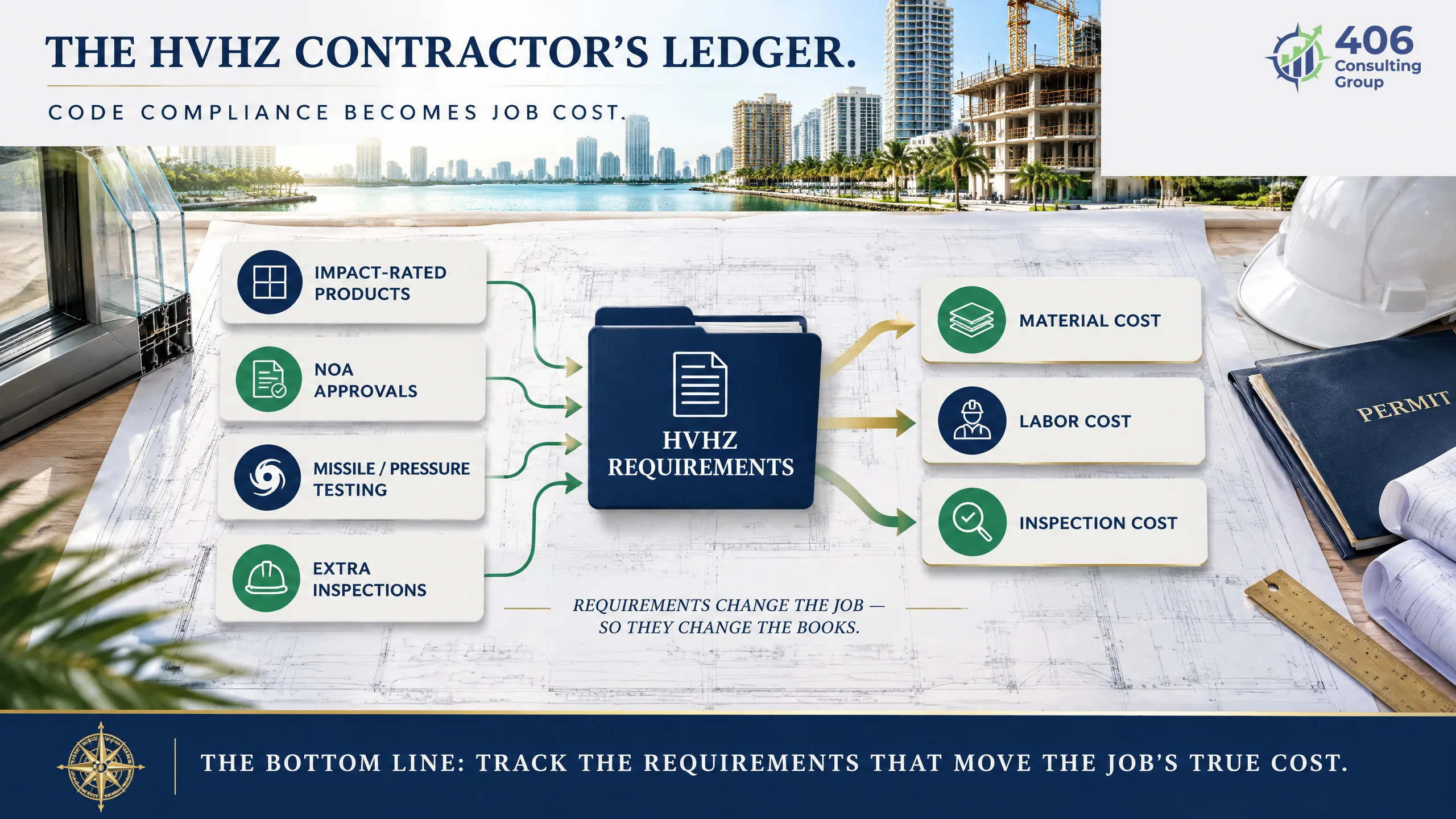
Confirm current requirements with the Florida DBPRand the Miami-Dade product-approval process — they change. The accounting takeaway is fixed: HVHZ premiums have to land on the job that incurred them, which is what job costing is for.
Job Costing for High-Rise & Coastal Work
Job costing means tracking the true cost and margin of each project separately — not trusting one blended company P&L. On Miami high-rise and coastal work, it is the difference between a busy contractor and a profitable one, because the jobs are long, the phases are many, and the HVHZ premiums hide easily.
A real Miami job-cost system separates labor, materials, subs, equipment, and other for each phase, captures change orders the moment they happen (coastal and code conditions generate them), and tags the HVHZ line items so you can see what the code is actually costing you. On a tower, a mispriced impact-glazing package or an under-scoped inspection sequence can quietly erase the profit on the whole job. You only catch it in time if the numbers live at the job level while you can still act.
A full schedule is not a profitable one. On a coastal high-rise, the only number that tells you the truth in time to act is the job-level margin — company-wide, you find out when it's too late.

Job costing tells you where a job stands on cost. To tell whether you've billed ahead of or behind that work, you need a WIP schedule.
WIP Schedules: Over & Under Billing
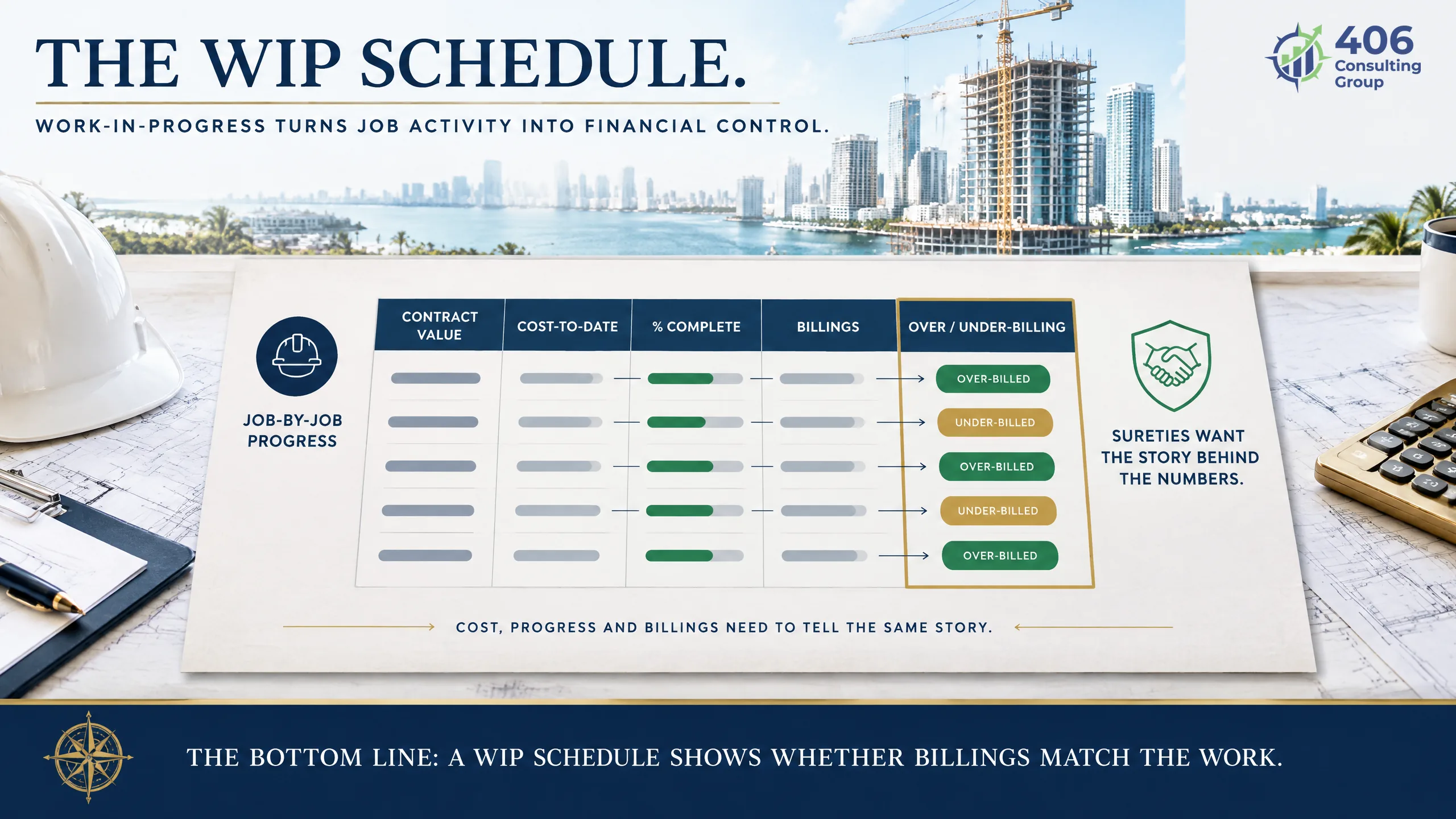
A WIP schedule — work-in-progress — is the report that compares how much of a job you've actually completed against how much you've billed for it. In plain terms: if you've done 60% of the work but billed 70%, you're overbilled (you're holding the customer's money and future revenue is smaller than it looks); if you've done 60% but billed 45%, you're underbilled(you've financed the job out of your own pocket and there's revenue you haven't claimed).
On short jobs it barely matters. On the long, phased jobs that define Miami construction, it's everything — and it's the first schedule a surety or lenderasks for. It tells them whether your reported profit is real, whether you're quietly borrowing against future billings to cover today's payroll, and whether you can carry the next job. A contractor without a clean WIP schedule looks, to a bonding company, like a contractor who doesn't know where they stand — because they don't.
Overbilled
Billed ahead of work completed. Cash looks great now, but future revenue is smaller than it appears — spend it like profit and you run dry before the job ends.
Underbilled
Work completed ahead of billing. You're financing the job yourself and sitting on unclaimed revenue — a fixable cash-flow and reporting problem once it's visible.
Percentage complete
Cost-to-date divided by estimated total cost drives recognized revenue. Bad estimates make the whole schedule lie, so estimates must stay current.
Why bonders want it
A clean WIP proves your profit is real and your backlog is fundable. It's the single most important schedule in a surety or lender file.
A WIP schedule is where bonding starts — so it's worth understanding exactly how a surety reads the rest of your financials.
Bonding & the Surety's View of Your Financials
A surety bond is the bonding company's promise that if you don't finish the job, they'll cover it — so before they issue one, they underwrite you like a lender, and often harder. On Miami's bigger public and private jobs, your bonding capacity decides which work you can even bid. And bonding capacity is set almost entirely by what your financial statements say about you.
Here's the part I lived on the other side of the table. As a former commercial banker and underwriter who reviewed more than 300 loans, I read financials the way a surety does: working capital first, then the WIP schedule, then the quality of the statements themselves. A surety wants to see strong working capital and net worth, a clean WIP with no ugly surprises, profit fade they can explain, and statements prepared to a standard they trust. Contractors lose capacity not because the business is bad, but because the books can't prove it's good. We keep your books so that the story your numbers tell is the true one — and the strong one.
A surety isn't bonding your work — they're bonding your financial statements. In Miami, the quality of your books is the ceiling on the size of job you're allowed to chase.

Bonding capacity is a company-level financial-leadership question, not just a bookkeeping one. When you're ready to manage it deliberately, that's the work in our Miami CFO & controller guide. The same financial credibility drives the next hurdle: your license.
DBPR Licensing: Your Books Help License You
In Florida, contractor licensing runs through the DBPR (Department of Business and Professional Regulation) and its Construction Industry Licensing Board (CILB) — and qualifying for a license requires proof of financial responsibility. In other words, your books help license you. Weak or messy financials don't just cost you a loan; they can cost you the credential you need to work.
There are two broad paths. A Certified license is issued at the state level and lets you work anywhere in Florida. A Registeredlicense is tied to specific local jurisdictions. Either way, qualifying typically means a credit review, financial statements, and in some cases a demonstrated net worth or a bond — scaled to the size of work you want to do. A contractor whose books are clean and current sails through; one who scrambles to reconstruct a year of financials at renewal time pays for it in stress, cost, and sometimes a smaller license than the business deserves.

Confirm current license classes and financial-responsibility thresholds with the Florida DBPR. One requirement that catches new construction employers hard is workers' comp.
Workers' Comp Is Mandatory at One Employee
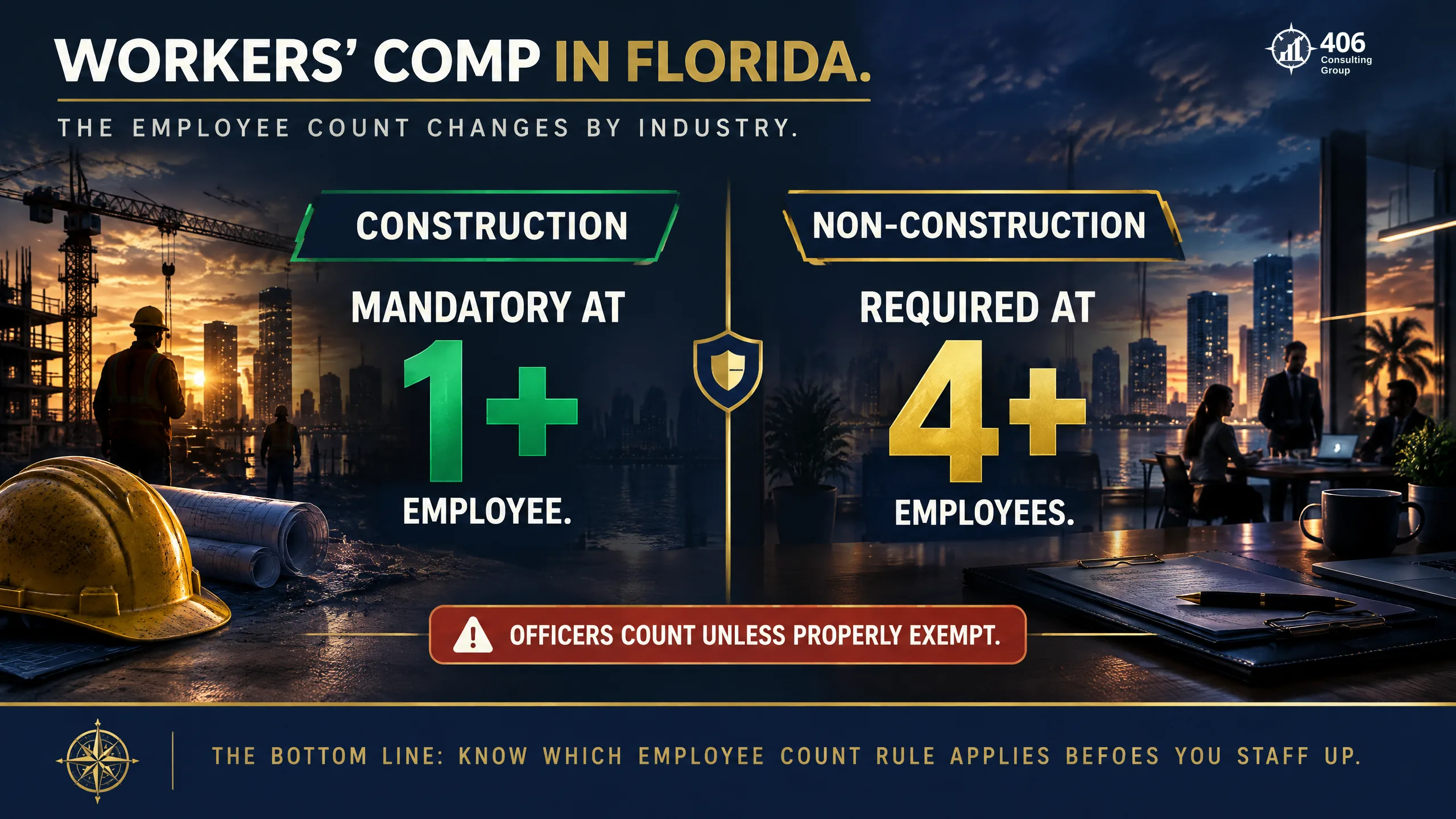
In Florida construction, workers' compensation is mandatory as soon as you have one employee. That is not the general rule — non-construction businesses generally aren't required to carry it until they hit four employees— but construction is singled out because the work is dangerous. If you run a crew, you carry comp. Full stop.
Two traps catch Miami contractors. First, corporate officers are counted as employees unless they file a valid exemption — and exemptions are limited; you cannot simply exempt everyone and call your crew uninsured. Second, if you use subcontractors who don't carry their own coverage, that exposure can roll up to you. This is a Florida rule worth being precise about: it is the opposite of Texas, where comp is largely optional. If you've worked or read across state lines, unlearn the Texas version here.
Construction in Florida: one employee triggers mandatory workers' comp — not four. Officers count unless properly exempt, and uninsured subs can become your liability. Do not treat it as optional; that's a Texas rule, not a Florida one.
Confirm your obligations and any officer exemptions with the Florida Division of Workers' Compensation. The next thing owners misread is how sales tax works on the materials they buy.
Contractor as Consumer of Materials
For real-property improvements, Florida generally treats the contractor as the consumer of the materials — which means you pay sales or use tax on what you buy, and you do notcharge the customer sales tax on the improvement itself. This trips up owners who assume they should be adding sales tax to every invoice. On a typical construction contract that becomes part of the real property, you don't — the tax was already paid upstream, by you, on the materials.
The nuances matter. If you buy materials out of state or online and no Florida sales tax was collected, you owe use tax on them — a line contractors routinely forget until an audit finds it. And the rules differ for retail sale plus installation arrangements (selling tangible items and installing them) versus true real-property improvement contracts; those can flip who owes what. Getting the contract type and the tax treatment aligned is a bookkeeping decision with real dollars attached.
Real-property improvement
You're the consumer: pay tax on materials when you buy them, don't charge the customer sales tax on the finished improvement. The common construction case.
Use tax on out-of-state buys
Bought materials online or across a state line with no Florida tax collected? You owe use tax. Audits find this fast — accrue it as you go.
Retail sale + installation
Selling and installing tangible items can be taxed differently than a real-property contract. The contract's structure decides the treatment.
~7% Miami-Dade rate
Combined state-plus-surtax is around 7% in Miami-Dade. Confirm the current surtax before you price a job or accrue use tax.

Confirm current rules with the Florida Department of Revenue. Once materials are handled, the other cash-flow lever on big Miami jobs is how and when you get paid.
Retainage & Draw Schedules on Large Miami Projects
On large Miami projects, you don't get paid all at once and you don't get paid in full as you go. Retainage is the slice — often around 5–10% — that the owner or GC holds back from each payment until the job is substantially or fully complete. Draw schedules govern when you can bill and get paid against completed milestones. Both are cash-flow realities that a WIP schedule and clean job costing let you actually plan around.
The danger is that retainage is real profit you've earned but can't touch yet — and on a long tower job, retained amounts across several jobs can add up to more cash than a subcontractor has in the bank. If your books don't track retainage receivable separately, you can be profitable on paper and unable to make payroll. We track it as its own line so you always know how much of your money is parked in someone else's account, and when it's due to come home.
Retainage is profit you've earned but can't spend yet. Track it as its own line, or you'll be profitable on paper and short on payroll — the classic way a growing Miami sub gets caught.
Draw and retainage cycles get more complicated still when the money funding the project comes from outside the country — a Miami specialty.
Foreign-Financed Projects & Cross-Border Pay Apps
Miami is a global city, and a real share of its condo and commercial development is financed from outside the US. For a contractor, that changes the rhythm and paperwork of getting paid: pay applications may route through foreign owners, offshore entities, or international lenders, funds can move on a different calendar than a domestic draw, and the documentation standard for each payment is often higher and more formal.
The accounting implications are practical. Payment timing can be less predictable, so your cash forecasting has to be tighter. Pay applications and lien-waiver documentation have to be airtight because the party paying may be reviewing from another country and another legal culture. And if any part of your arrangement is denominated in another currency, that's a risk to track rather than ignore. None of it is exotic once your books are built for it — but a generic ledger that assumes a simple domestic draw will leave you chasing payments you thought were coming.
Payment timing
Cross-border draws can move on a different calendar than domestic ones. Forecast conservatively and don't spend against a draw until it clears.
Documentation standard
Foreign owners and lenders often demand more formal pay-app and lien-waiver packages. Clean, complete documentation gets you paid faster.
Currency exposure
If any piece is denominated in another currency, treat the FX movement as a risk to track — not a rounding error to ignore.
Entity complexity
Offshore ownership structures can add reporting and compliance questions. Flag them early with your tax advisor rather than at year end.
Put it all together — HVHZ, job costing, WIP, bonding, retainage, cross-border pay — and here's what it looks like for a real-sized Miami subcontractor trying to grow.
Example: A Condo Sub Scaling $2M to $8M
Here is an illustrative, composite example— a hypothetical built from patterns we see, not a real named client, with figures chosen to make the mechanics clear.
Picture a Miami-Dade condo subcontractor — call the owner Maria — doing about $2M a yearin impact-window and glazing work on mid-rise buildings. The books are a single blended P&L. Maria feels busy and assumes she's profitable, but she can't say which jobs make money, her workers' comp classification hasn't been reviewed since she added a crew, and when a GC asks for a WIP schedule to consider her for a larger tower, she doesn't have one. Her surety caps her at small single bonds. She's stuck at $2M not because the work isn't there, but because her financials won't let her reach for it.
$2M
Starting revenue, blended books
Busy, assumes profitable, no job-level margin, no WIP, small bonding capacity.
WIP + job costing
The fix
Per-job margin, HVHZ premiums tracked, retainage broken out, clean WIP the surety can read.
$8M
Where it goes
Bigger bonds, tower-scale bids, comp classification right, cash planned around draws and retainage.
Now rebuild the books. Every job gets its own cost tracking, with HVHZ material and inspection premiums coded to the job that incurred them, so Maria sees that her high-rise glazing jobs actually out-earn her mid-rise ones. Retainage receivable gets its own line, so she stops mistaking held-back profit for a cash shortfall. A monthly WIP schedule shows exactly where she's over- and underbilled. Her workers' comp classifications and officer status get reviewed and corrected. When the surety sees strong working capital, a clean WIP, and statements they trust, the bonding capacity opens up — and Maria can credibly bid tower work at $8M. Same contractor, same trade. The only thing that changed is that the books can finally prove what she's worth.
The jump from $2M to $8M wasn't more hustle — it was books a surety could underwrite. In Miami construction, your financial statements are the size of the job you're allowed to chase.
Local vs Remote for Contractors
It's natural to assume a Miami contractor needs a Miami accountant down the street. The reality that settles it: around 80% of our own local clients handle the entire relationship remotely— they never come into the office. People who could drop by choose screen-shares and a document portal instead, because construction accounting runs on cloud software, live bank feeds, and photos of receipts from the field — not on someone sitting near your jobsite.
~80%
of our local clients are fully remote
They never come into the office — the relationship is cloud-based, by choice.
What matters is expertise, not proximity. A great remote accountant who knows HVHZ cost drivers, construction WIP, Florida's one-employee comp rule, and how a surety reads your statements beats an okay local one who treats your books like any other small business. We keep the books for Miami and Florida contractors entirely remotely — HVHZ job costs, WIP, retainage, and bonding schedules — and we design them from a whole-company view so each job's true margin is visible while you can still act on it. Curious where you stand? Start with our financial maturity assessment, or read how we build company-level financial leadership for growing Miami contractors.
FAQ: Miami Construction Accounting
What makes Miami construction accounting different?
Miami-Dade sits inside the High-Velocity Hurricane Zone (HVHZ) — the strictest wind and impact code in the US — which raises material, labor, and inspection costs that must be job-costed rather than buried in overhead. Add high-rise and coastal work, larger bonding requirements, foreign-financed projects with cross-border pay applications, and Florida's construction-specific rules (workers' comp mandatory at one employee, contractor as consumer of materials), and a Miami contractor's books have to do far more than a generic ledger. Florida's tax side is friendly — no personal income tax, 5.5% only on C-corps, reemployment tax on payroll, roughly 7% sales tax in Miami-Dade — but the cost structure the code and coast impose is what makes the accounting hard. Confirm current rules with the Florida DBPR and Department of Revenue.
What is a WIP schedule and why do bonders want it?
A WIP (work-in-progress) schedule compares how much of each job you've actually completed against how much you've billed, so you can see whether you're overbilled (billed ahead of the work) or underbilled (worked ahead of billing). On the long, phased jobs common in Miami, it's the single most important report you produce. Sureties and lenders demand it because it tells them whether your reported profit is real, whether you're quietly borrowing against future billings to cover today's costs, and whether you can carry the next job. A contractor without a clean WIP schedule looks unbondable — because they can't prove where they stand.
Do I need workers' comp with one employee in Florida?
In construction, yes — Florida requires workers' compensation as soon as you have one employee, unlike non-construction businesses, which generally aren't required to carry it until four. Corporate officers are counted as employees unless they file a valid exemption, and exemptions are limited, so you can't simply exempt everyone. Uninsured subcontractors' exposure can also roll up to you. This is the opposite of Texas, where comp is largely optional, so don't apply an out-of-state rule here. Confirm your obligations and any officer exemptions with the Florida Division of Workers' Compensation.
How does DBPR use my financials?
Florida contractor licensing runs through the DBPR and its Construction Industry Licensing Board, and qualifying requires proof of financial responsibility — meaning your books help license you. Depending on the license class, that can include a credit review, financial statements, and sometimes a demonstrated net worth or a bond, scaled to the size of work you want to do. A Certified license is issued at the state level and works anywhere in Florida; a Registered license is tied to specific local jurisdictions. Clean, current books make qualifying and renewal straightforward; scrambling to reconstruct financials can cost you time, money, or a smaller license than the business deserves. Confirm current thresholds with the Florida DBPR.
Do contractors charge sales tax in Florida?
Generally, no — for real-property improvements, Florida treats the contractor as the consumer of the materials, so you pay sales or use tax when you buy materials and you don't charge the customer sales tax on the finished improvement. If you buy materials out of state or online with no Florida tax collected, you owe use tax on them — a line contractors routinely miss until an audit finds it. Retail-sale-plus-installation arrangements can be taxed differently than true real-property contracts, so the contract structure matters. Combined sales tax in Miami-Dade is around 7%. Confirm current rules with the Florida Department of Revenue.
What is HVHZ and why does it raise costs?
HVHZ stands for High-Velocity Hurricane Zone — a section of the Florida Building Code that applies only to Miami-Dade and Broward counties and is the strictest wind and impact standard in the US, created after Hurricane Andrew. It requires impact-rated windows and doors carrying Miami-Dade Notice of Acceptance approvals, missile-impact and pressure testing on roofing and cladding, and more inspections at more stages. Each of those raises material costs, skilled-labor hours, schedule length, and inspection fees. For your books, the key is coding those HVHZ premiums to the specific job that incurred them, so your margins are accurate — confirm current product-approval requirements with the Florida DBPR and Miami-Dade.
Can you handle my construction books remotely?
Yes — we serve Miami and Florida contractors entirely remotely, and about 80% of our own local clients never come into the office. Construction accounting runs on cloud software, live bank feeds, and photos of field receipts, so job costing, WIP schedules, retainage tracking, payroll and workers' comp coordination, sales and use tax, and bonding-ready statements all happen the same whether we're next door or across the country. What matters is expertise — HVHZ cost drivers, construction WIP, Florida's one-employee comp rule, and how a surety reads your financials — and our commercial-banking background means we keep your books the way a surety and lender actually read them.
Miami Contractor Snapshot
What a Miami builder faces
Miami Construction Accounting
Job-costed, bonding-ready, remote.
About the Author
Carrie Anderson
Co-Founder, 406 Consulting Group
Carrie is a former commercial banker and underwriter who reviewed 300+ loans. She reads a contractor's financials the way a surety and lender do — and builds Miami contractors' books to pass that read the first time, delivered remotely.
Read the Full Story