
Accounting for Provo Businesses:
The Utah County Playbook
Provo is e-commerce and bootstrapped-founder country on Utah's flat-tax base — accounting here has demands a generic approach can't meet. Here's the whole playbook: bookkeeping, tax, and financial leadership, and how they fit together.

Provo and Utah County are startup country — one of the youngest, most entrepreneurial places in the nation, thick with e-commerce and direct-to-consumer brands, software startups, agencies, and first-time founders. Most of these businesses are bootstrapped, fast-moving, and profitable-or-aiming-to-be, sitting on Utah's low, flat-tax base. That combination makes the accounting more specialized than a generic approach can handle — and it's a different animal from the venture-heavy scene up in Salt Lake.
This is the whole playbook — the one-page map of how accounting works for a Provo business, and where to go deeper on each piece. Bookkeeping, tax, and financial leadership each get their own detailed guide; this ties them together for an owner who wants to see how the e-commerce, tax, and multi-state pieces fit into one clear picture.
By Carrie Anderson — Co-Founder, 406 Consulting Group. Commercial banking and underwriting background — 300+ loan reviews — advising e-commerce, tech, and profitable small businesses across the Mountain West.
Quick Answer: Accounting for a Provo Business
- →E-commerce books: inventory, COGS, multi-channel reconciliation, and margin by product.
- →Utah's two taxes: a low flat income tax (~4.5%) plus ~7.25% sales tax in Utah County — planning cuts both.
- →Profitable-owner levers: the S-corp, the QBI deduction, and the Utah pass-through election.
- →Selling nationwide means multi-state sales-tax nexus you have to map and manage.
- →All of it remote — most of our local clients never come into the office.
Table of Contents
Why Utah County Accounting Is Different
Most accounting advice assumes a simple business selling a service in one place. A lot of Provo doesn't fit. An e-commerce brand tracks inventory and COGS, reconciles money across Shopify, Amazon, and Stripe, and sells to customers in every state. A bootstrapped founder is often profitable and pass-through, which opens up the S-corp and QBI levers. And Utah's income tax means planning pays off on two returns, not one. Different demands, and a generic setup meets none of them well.
The four pillars are the same as any business — bookkeeping, tax, financial leadership, and the system underneath — but in Provo each takes an e-commerce-and-bootstrapped shape. This guide maps all four and points to the deep dives, so you can see how the pieces fit before diving into any one.

Start anywhere below — the big idea is that an e-commerce, bootstrapped, multi-state business on a two-tax base rewards accounting built for exactly that.
The Utah Tax Picture
Here's the whole state tax picture for a typical Provo business, at a glance:
| Tax | Utah reality |
|---|---|
| State income tax | Low flat rate (~4.5%) — so planning cuts both the Utah and federal bill |
| Sales & use tax | ~7.25% combined in Provo (Utah County); use tax on untaxed purchases |
| Gross-receipts / B&O | None |
| Selling nationwide | Economic nexus can create sales-tax duties in many states |
| County | Utah County |

Because Utah has an income tax, proactive planning is worth more here than in a no-income-tax state. The full playbook is in the Provo tax guide.
E-Commerce Bookkeeping
For the product side of Provo, the books have to speak e-commerce. That means tracking inventory as an asset and recognizing COGS only as you sell — not expensing stock when you buy it, which makes profit swing wildly. It means reconciling every channel, because Shopify, Amazon, Stripe, and PayPal pay out net of fees, so the deposit isn't your sales. And it means knowing your true margin by product once COGS, fees, and shipping are loaded in. Get these right and you finally know what actually makes money.
Miss them and a top-line P&L can look great while individual products lose money and cash quietly disappears into inventory. It's a genuinely different discipline from generic bookkeeping — and the foundation everything else is built on.
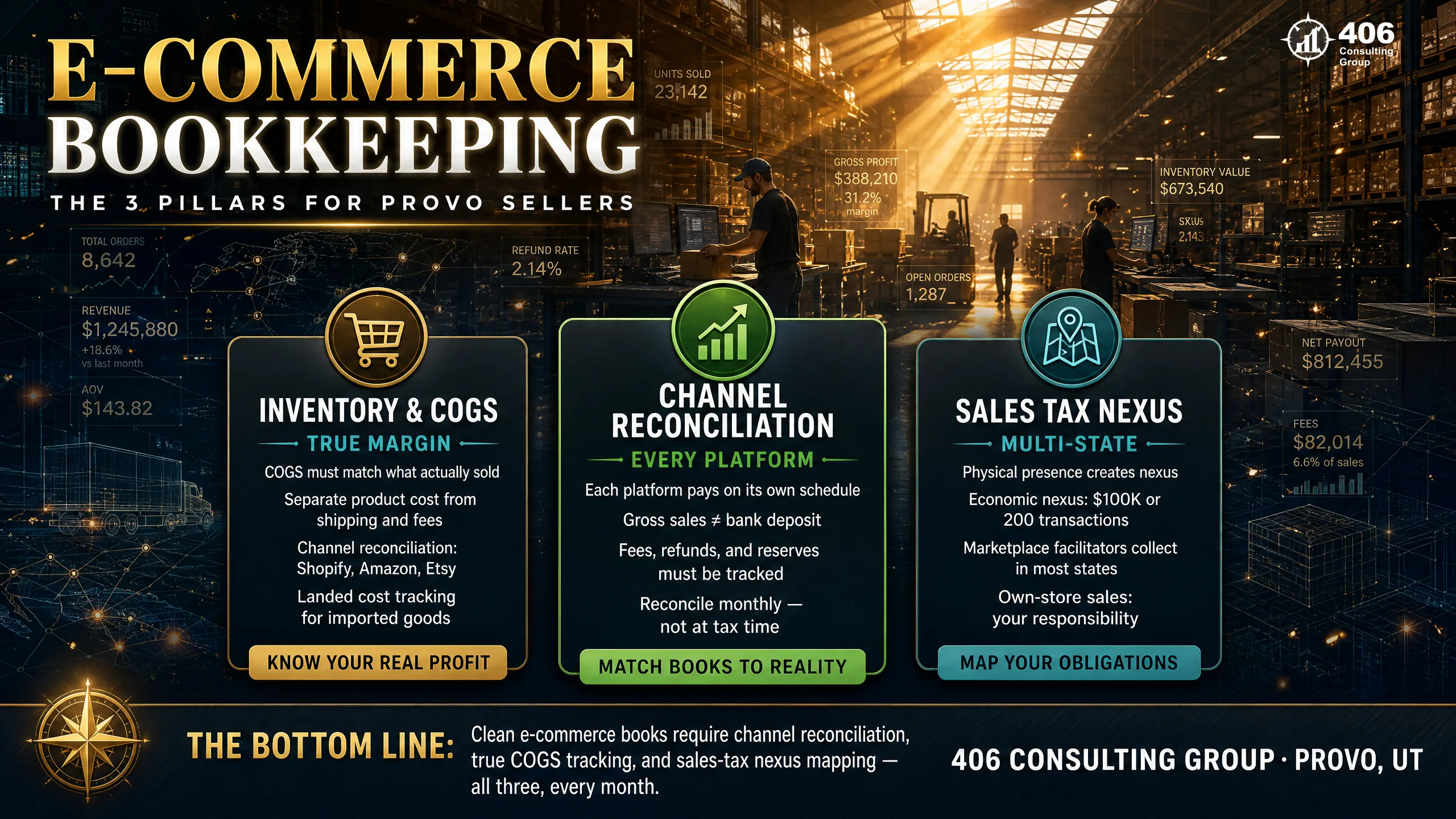
The full mechanics are in the Provo bookkeeping guide.
The Profitable-Owner Tax Playbook
Because Provo's brands are often profitable pass-throughs, the tax levers here are the ones that cut tax on real, distributed profit. The S-corp election can save thousands in self-employment tax once profit is high enough. The QBI deduction can let a pass-through owner deduct up to 20% of qualified business income. Retirement plans shelter big amounts, and the Utah pass-through election can work around the federal SALT cap. And because Utah has an income tax, each of these usually saves on both returns.
For a product business there are two more: the tax rules around inventory (which affect when your deductions land), and cleaning up any sales-tax nexus you've built up selling nationwide. It's a genuinely different playbook from the pre-profit, credit-chasing venture world — and for a profitable owner, it's worth real money.
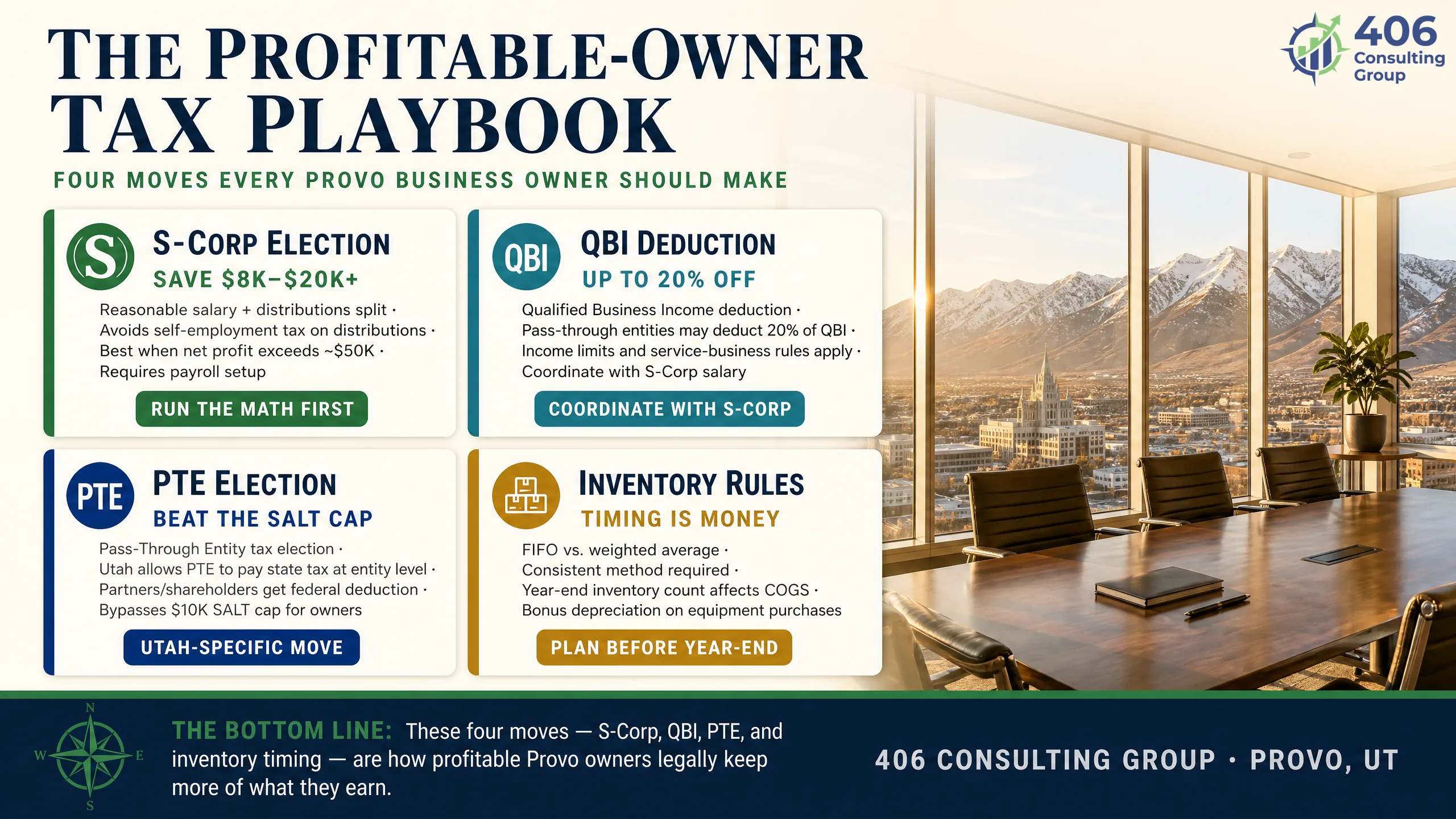
The full detail — hedged and worth real money — is in the Provo tax guide.
When You Need More Than a Bookkeeper
As a Provo brand grows, clean books stop being enough — you need the numbers to tell you which products make money after ad spend, how much inventory you can afford, and how to build a business worth selling. That's the step up to financial leadership: a controller who keeps inventory, COGS, and channel reconciliation reliable, and a CFO who turns them into contribution margin, a cash plan for inventory, and acquisition readiness.
The classic e-commerce trigger is cash: revenue is up, profit is real, and yet there's never enough cash because it's all locked in inventory. You don't need a six-figure hire to solve it — fractional leadership scales the controller-and-CFO thinking to your stage.

What each role delivers and what it costs is in the Provo CFO & controller guide. And for a deep look at which products actually make money, see our flagship on unit economics.
Selling Nationwide: Multi-State Sales Tax
A Provo brand selling online reaches customers in all fifty states — and that creates economic nexus, an obligation to collect and remit sales tax in states once you cross their thresholds. Marketplace facilitators like Amazon often collect on sales made through them, but your own Shopify store is usually your responsibility. These obligations build silently as you grow, and are most expensive when discovered late — at an audit, or during due diligence when you try to sell.
The answer is to map where you actually have nexus, register where you should going forward, and address any past exposure proactively (tools like voluntary disclosure agreements can help). It's very manageable with the right setup — and exactly what a single-state generic approach misses. We cover the mechanics in the bookkeeping and tax guides.
Accounting by Provo Segment
Provo's economy is led by e-commerce and startups, with agencies, services, and construction around them — and each asks something different of the books.
| Segment | Accounting priorities |
|---|---|
| E-commerce & DTC brands | Inventory, COGS, channel reconciliation, multi-state sales tax, ad spend, exit readiness |
| Software & tech startups | Deferred revenue, burn & runway, R&D, multi-state — see the SLC guides |
| Agencies & creators | Project/client profitability, 1099s, receivables, retainers |
| Construction & trades | Job costing, WIP, subs/1099s, equipment |
| Retail, services & healthcare | Sales tax, receivables, payroll, inventory or utilization |
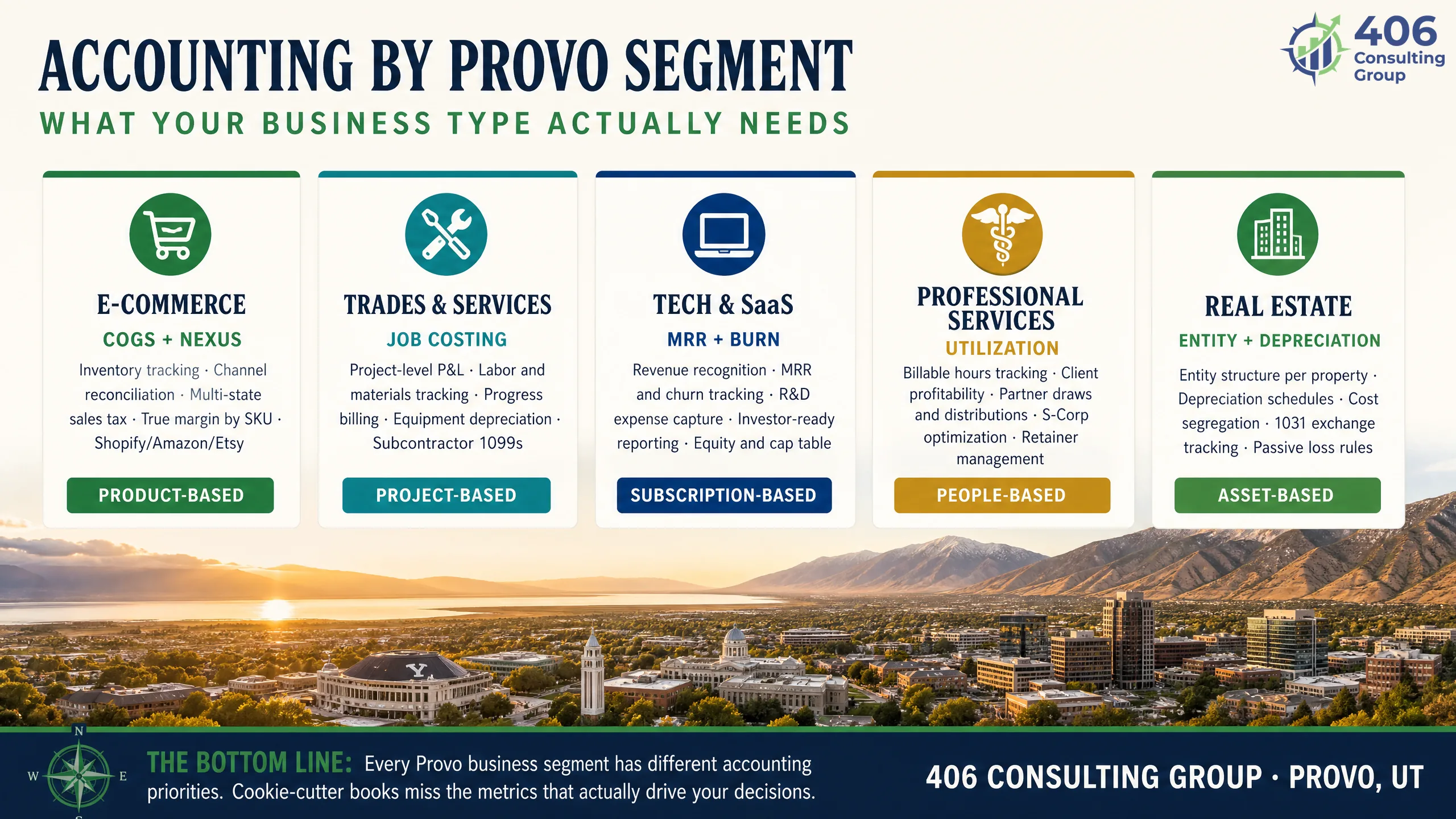
Different details, same backbone: inventory and channels reconciled, taxes handled, and profit readable for the Utah and federal returns.
Building the Right Accounting System
What separates accounting that just keeps you compliant from accounting that helps you run and grow is the system underneath it. An e-commerce, multi-state business on a two-tax base especially rewards a system designed around the whole operation — how inventory flows and becomes COGS, how each channel reconciles, how sales-tax obligations spread across states, how profit maps to both returns — because the numbers are only useful if they mirror how the business actually runs.
Built right, one system carries inventory and margin, channel reconciliation, multi-state sales tax, and clean Utah and federal reporting — and every month is fast and clear, and a future sale starts from clean books. Built as a generic template, it hides the very things a Provo brand needs to see.

That whole-company perspective is our core differentiator — the difference between books that are merely compliant and books that are genuinely useful.
Local vs. a Great Remote Partner
Accounting for a Provo business is knowledge work — inventory and COGS, multi-channel reconciliation, the S-corp and QBI, multi-state sales tax. What matters is whether your partner knows e-commerce and profitable-pass-through accounting, not whether they're on University Avenue — and an online brand is already run from a laptop. A great remote firm that understands this market beats a local generalist who doesn't, every time.
It's also how the work already happens. Roughly 70–80% of our own local clients never come into the office; everything runs on secure cloud accounting, connected platform feeds, and regular calls. So whether you're in Provo, Orem, or running your brand from anywhere while you sell nationwide, you get the same full-service support — and our multi-state experience is a real advantage.
Distance isn't the variable. Knowing your model is.
How to Get Started
Getting your Provo accounting right is three steps.
Build the books for e-commerce
Inventory and COGS set up correctly, every channel reconciled, and sales tax structured by state.
Capture the profitable-owner levers
The S-corp with QBI, inventory tax treatment, the Utah pass-through election, and retirement — mapped to your numbers.
Add leadership & stay multi-state clean
Controller and CFO for margin, inventory cash, and exit readiness — and nexus mapped as you scale.
Not sure which layer you need? Our Financial Maturity Assessment maps it out in about eight minutes.
FAQ: Provo Accounting
What makes accounting for a Provo business different?
Provo is e-commerce and bootstrapped-founder country, on Utah's flat-tax base. An e-commerce brand needs inventory and COGS tracking, multi-channel reconciliation, margin by product, and multi-state sales tax. A profitable, pass-through owner has access to levers like the S-corp and the QBI deduction. And Utah's income tax means planning pays off on both the state and federal return. A generic, single-model, single-state approach handles none of it well, which is why Provo businesses benefit from accounting built for their model and this market.
What taxes does a Provo, Utah business pay?
Utah has a low flat state income tax (about 4.5% in recent years — confirm the current rate), a combined sales tax around 7.25% in Provo/Utah County with a companion use tax, and no gross-receipts or B&O tax. If you sell nationwide, economic-nexus rules can require collecting and remitting sales tax in other states too. You also handle federal income tax and payroll, Utah unemployment insurance, and workers' compensation through a competitive private market. Because Utah has an income tax, planning helps on both returns.
What are the biggest tax levers for a profitable Provo brand?
For a profitable pass-through, the S-corp election (which can save thousands in self-employment tax) and the QBI deduction (up to 20% of qualified business income) are usually the biggest, along with retirement plans and the Utah pass-through election that works around the federal SALT cap. For a product business, the tax rules around inventory and cleaning up multi-state sales-tax nexus also matter. It's a different playbook from the pre-profit venture world, and it's covered in the Provo tax guide.
Do I need e-commerce-specific accounting for my online brand?
Yes. E-commerce accounting centers on inventory (an asset until sold, then COGS), multi-channel reconciliation (platforms pay out net of fees, so the deposit isn't your sales), true margin by product after fees and shipping, and multi-state sales tax. Without these, a top-line P&L can look healthy while individual products lose money and cash disappears into inventory. It's a genuinely different discipline from generic small-business bookkeeping, and it's the foundation for every decision downstream.
Can 406 Consulting Group handle everything remotely for a Provo business?
Yes — bookkeeping, tax, and CFO/controller work all run well remotely through secure cloud accounting, connected platform feeds, and regular calls, and an online brand is already run from a laptop. What matters is deep knowledge of your model — e-commerce inventory and margin, profitable-pass-through tax, multi-state sales tax — plus multi-state fluency for a brand selling nationwide, not office proximity. Roughly 70–80% of our own local clients never come into the office either, so you get the same full-service support whether you're in Provo or anywhere in the region.
The Provo Series
Accounting — Provo, UT
The Whole Utah County Playbook, Handled.
406 Consulting Group gives Provo e-commerce, startup, and small businesses full-service accounting — inventory and margin, the profitable-owner tax playbook, financial leadership, and multi-state clarity — delivered remotely.
The Provo Series
Hub & the three deep-dive guides
Provo Business Accounting
The whole playbook, handled remotely.
About the Author
Carrie Anderson
Co-Founder, 406 Consulting Group
Commercial banking and underwriting background — 300+ loan reviews — advising e-commerce, tech, and profitable small businesses across the Mountain West. Carrie helps Provo owners turn an e-commerce, bootstrapped, multi-state business on a two-tax base into a durable advantage.
Read the Full Story