
Expert Bookkeeping Solutions for
Great Falls, MT Companies
Great Falls businesses lose thousands to bad bookkeeping. Professional bookkeeping delivers clean books, tax savings, and growth-ready financials for Montana companies.

Professional bookkeeping services in Great Falls, MT are the difference between a business that runs on real financial data and one that runs on guesswork. Great Falls businesses — from Malmstrom defense contractors and Benefis-adjacent healthcare practices to agricultural suppliers, energy sector companies, and 10th Avenue South retailers — are losing real money every year to bad books. Not because they made a bad decision. Because they never had the financial infrastructure to see the decision clearly.
This guide covers what professional bookkeeping actually delivers (and what it doesn't), the five-pillar Financial Clarity Blueprint that gives Great Falls businesses the foundation to grow, what DIY bookkeeping actually costs, and what to expect when you make the switch to a professional system.
Table of Contents
Why Great Falls Businesses Need Professional Bookkeeping Now
Great Falls is Montana's third-largest city and one of its most economically diverse — a combination that creates financial complexity most small business owners underestimate. The city's mix of federal defense contracting (Malmstrom Air Force Base, home of the 341st Missile Wing), a dominant regional healthcare anchor in Benefis Health System, north-central Montana's agricultural supply chain, energy production, and a robust retail and service sector means Great Falls businesses operate across very different tax situations, cash flow cycles, and compliance requirements.
$400K+
The complexity threshold
Below this, QuickBooks and part-time help often work. Above it, financial complexity consistently outpaces DIY systems.
8–12 hrs
Owner time lost monthly to bookkeeping
Time spent entering transactions, reconciling, chasing receipts — time that costs $600–$900/month at a $75/hr owner rate.
$2K–$8K
Average tax error cost
From miscategorization, missed deductions, and wrong entity structure decisions made without current financial data.
The most common pattern in Great Falls: a business owner handles their own books or uses a part-time bookkeeper until a trigger event — a loan application, a tax surprise, a growth decision they can't make confidently — reveals that the financial foundation isn't there. Professional bookkeeping is most valuable before that trigger. But it's never too late to build the right system.
The short answer:Professional bookkeeping isn't an expense — it's the infrastructure that makes every other financial decision more accurate and every dollar you spend on tax prep, advisory, and financing more effective. Without clean books underneath, everything above it underperforms.
What Professional Bookkeeping Actually Delivers
A professional bookkeeper records, reconciles, and reports your financial transactions accurately and on time. The short answer: they maintain the financial record of your business so that you, your tax preparer, your lender, and your financial advisor always have accurate, current data to work from. What they don't do is replace your accountant, make strategic recommendations, or prepare your tax return — those are different roles.
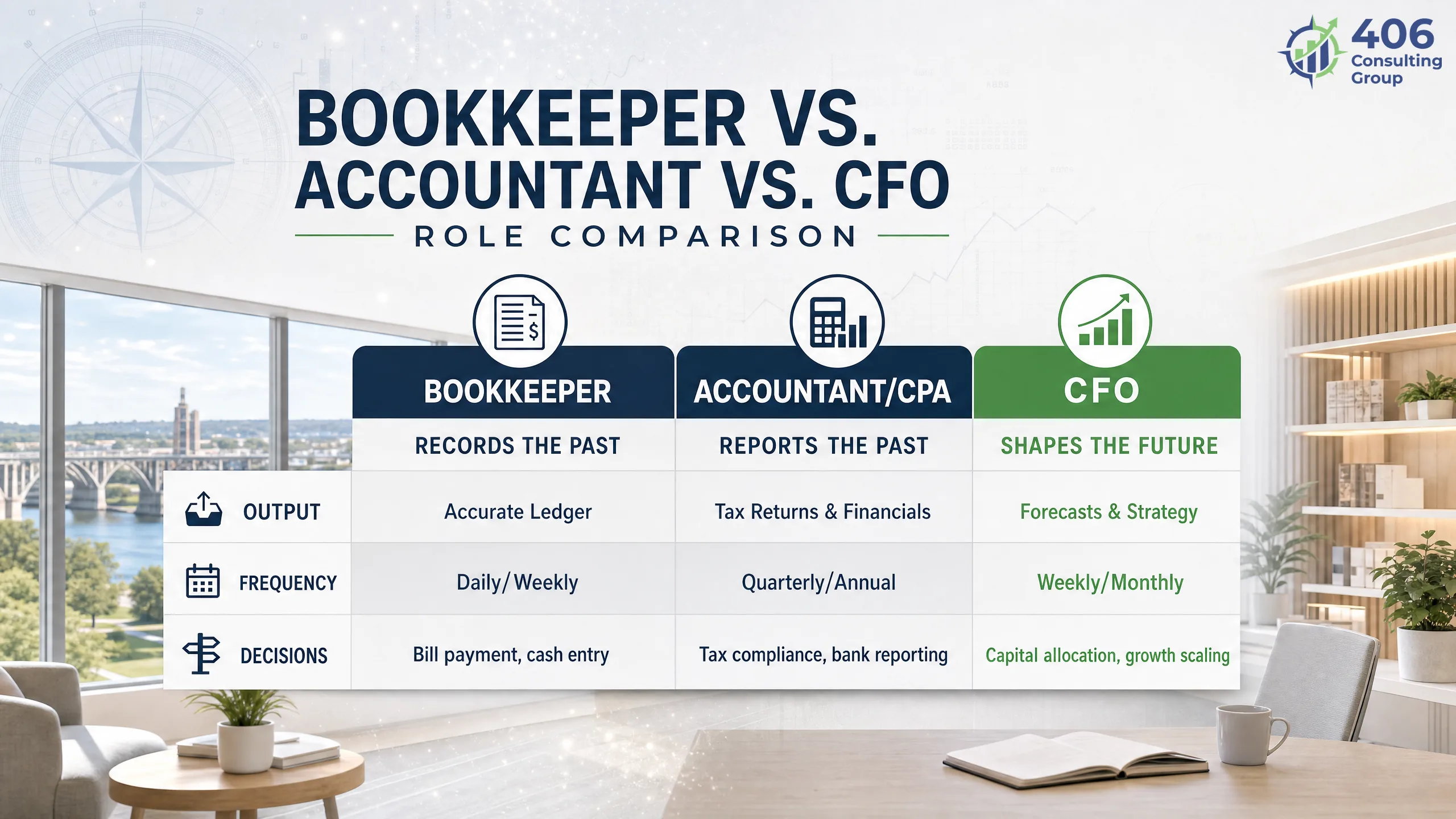
Bookkeeper
RoleDelivers
- Monthly transaction entry and categorization
- Bank and credit card reconciliation
- Accounts receivable and payable tracking
- Payroll processing coordination
- Monthly financial reports
Does not
Make strategic decisions, prepare tax returns, provide financial advice
Accountant / CPA
RoleDelivers
- Tax return preparation and filing
- Compiled or reviewed financial statements
- Entity structure recommendations
- Tax planning (when engaged for it)
- Audit support
Does not
Maintain monthly books, run payroll, provide ongoing financial oversight
CFO / Advisor
RoleDelivers
- Cash flow forecasting
- Capital and financing strategy
- Management reporting and KPIs
- Growth and exit planning
- Tax optimization coordination
Does not
Do bookkeeping, prepare returns — works from clean books the bookkeeper maintains
Why this matters for Great Falls businesses:Most financial advisory underperforms when layered onto poor bookkeeping. Your tax preparer can only work with the data they receive. Your lender evaluates the financials you submit. When the bookkeeping is clean, every other financial service you pay for becomes more effective. That's the foundational argument for getting it right first.
The Financial Clarity Blueprint: 5 Pillars for Great Falls Businesses
The Financial Clarity Blueprint is the five-pillar system that defines what complete, professional bookkeeping looks like for a Great Falls small business. Each pillar depends on the one before it. You cannot have cash visibility without an accurate ledger. You cannot coordinate tax strategy without tax-ready reporting. You cannot produce growth reporting without the four pillars beneath it. The system only works when all five are running.

Accurate Ledger
Every transaction entered, categorized correctly, and reconciled to bank and credit card statements monthly. Not quarterly. Not at tax time. Monthly.
Cash Visibility
Accounts receivable aging, accounts payable schedule, and cash position updated monthly. The answer to 'how much do I have and what's coming in?' available without calling the bank.
Tax Readiness
Books maintained throughout the year so that tax prep is a 2-week event in February, not a 3-month scramble. Every deduction captured as it happens, not reconstructed from memory.
Payroll & Compliance
Payroll processed on time, payroll taxes deposited correctly, W-2s and 1099s filed accurately. Montana-specific requirements handled without surprises at quarter-end.
Growth Reporting
Monthly management package: P&L by service line or product, gross margin tracked, KPIs reviewed. The reporting that enables actual business decisions rather than gut-feel guesses.
Pillar 1: Accurate Ledger — The Foundation Everything Else Runs On
An accurate ledger means every transaction entered correctly, every account reconciled monthly, and your chart of accounts structured for your specific business — not for a generic QuickBooks template. It is the most basic pillar and the one most often done poorly.
Common ledger problems in Great Falls businesses
Problems- Transactions miscategorized — meals as office supplies, subcontractor payments as payroll, owner draws as salary
- Reconciliation skipped for months and then done in a batch — errors compound and become invisible
- Chart of accounts built from a generic template — no service-line or job-level breakdown
- Prior year entries never cleaned up — books carry errors forward indefinitely
- Personal and business transactions mixed — the single most costly bookkeeping error
What a clean ledger enables
Outcomes- Tax preparer works from accurate data — no reconstruction, no surprises, no amended returns
- Lender receives financials that match tax returns — no reconciliation gap that delays loan approval
- Owner sees real P&L each month — decisions made from data, not intuition
- Audit risk reduced significantly — clean books are the best audit defense
- Financial history available for sale or partnership transactions — buyers want 3 years of clean books
Pillar 2: Cash Visibility — Knowing What You Have Before the Statement Arrives
Cash visibility means knowing your current cash position, what's owed to you, what you owe, and what's coming in and out over the next 30–60 days — without calling the bank or waiting for a monthly statement. For Great Falls businesses with seasonal revenue (agriculture-adjacent suppliers, hospitality, construction), cash visibility isn't optional — it's the difference between planning for the slow season and being surprised by it.
Accounts Receivable Aging
Monthly deliverableA current AR aging report shows every outstanding invoice by age: 0–30 days, 31–60 days, 61–90 days, 90+ days. For most Great Falls service businesses, 15–25% of outstanding receivables are in the 60+ day bucket — meaning cash that was earned weeks ago is sitting in a client's account instead of yours. A professional bookkeeper tracks this monthly and flags it. DIY bookkeeping rarely does.
Flag invoices over 30 days for follow-up before they become a collection problem
Accounts Payable Schedule
Monthly deliverableWhen are your vendor payments, loan payments, lease obligations, and payroll tax deposits due this month? A complete AP schedule means you're never caught short because three large payments landed in the same week. This is especially relevant for Great Falls businesses with federal contract payment cycles — which often run 30–60 days after invoice.
Sequence payments against expected collections to protect operating cash
30-Day Cash Projection
Monthly deliverableStarting from today's bank balance, add expected collections (from AR aging and confirmed payments), subtract committed outflows (payroll, vendor payments, loan service, rent). The result is your 30-day cash runway. For businesses with $500K–$3M in revenue, this number should be calculated monthly — not discovered when a payment bounces.
Make hiring, purchasing, and distribution decisions from projected cash — not current balance
Pillar 3: Tax Readiness — Year-Round Coordination Beats March Scramble
Tax-ready bookkeeping means your books are maintained throughout the year in a format that makes tax preparation fast, accurate, and complete — not reconstructed from a shoebox of receipts in February. For Great Falls businesses, this means Montana Department of Revenue compliance alongside federal requirements, quarterly estimated payments made on time, and every deductible expense captured as it happens.

Q1 (Jan–Mar)
Key dates- January: W-2s to employees by Jan 31
- January: 1099-NEC to contractors by Jan 31
- January: Q4 payroll tax return (Form 941)
- February: Year-end close finalized
- March: Provide clean trial balance to tax preparer
- March 15: S-Corp and partnership returns due
Q2 (Apr–Jun)
Key dates- April 15: Individual and C-Corp returns due (or extension)
- April 15: Q1 estimated tax payment due
- April: Q1 payroll tax return (Form 941)
- May–June: Mid-year tax position review
- June 15: Q2 estimated tax payment (self-employed)
- Ongoing: Review deductible purchases before they're forgotten
Q3 (Jul–Sep)
Key dates- July: Q2 payroll tax return (Form 941)
- September 15: Q3 estimated tax payment due
- September: Review year-to-date income vs. prior year
- September: Retirement contribution planning begins
- Q3 review: Catch bookkeeping errors before year-end
- Start Q4 tax planning with current-year data
Q4 (Oct–Dec)
Key dates- October: Q3 payroll tax return (Form 941)
- October–November: Equipment purchases — evaluate Section 179
- November: Retirement plan contributions finalized
- December 15: Corporation estimated tax due (if applicable)
- December 31: Last day for most deductible business purchases
- December: Year-end owner distribution strategy
Jason's 10+ years of tax preparation experience:The most expensive tax mistakes Great Falls businesses make aren't tax law errors — they're bookkeeping failures. Expenses that were deductible but not captured. Equipment purchases where the wrong depreciation method was chosen. Retirement contributions calculated from estimated income instead of actual. Every one of these costs real money and could have been avoided with current-year books and a proactive conversation in October, not a panicked one in March.
Pillar 4: Payroll & Compliance — Montana Requirements That Catch Businesses Off Guard
Payroll is the most compliance-dense function in small business accounting. For Great Falls businesses, that means federal payroll tax deposits, Montana income tax withholding, Montana unemployment insurance contributions, workers' compensation coverage, and contractor classification — each with its own deadlines, rates, and filing requirements. Getting any one wrong triggers penalties that accumulate fast.
Federal Payroll Tax Deposits (Form 941)
High — automated penalties, no grace periodFICA (Social Security + Medicare) and federal income tax withholding deposited on a semi-weekly or monthly schedule based on deposit liability. The IRS failure-to-deposit penalty runs 2–15% of the unpaid amount. For a Great Falls business with $30,000/month in payroll, a late deposit costs $600–$4,500 — per incident.
Montana Income Tax Withholding
Medium — state audit risk for non-complianceMontana requires withholding on wages paid to Montana employees. Quarterly returns (Form MW-3) and annual reconciliation (Form REC) filed with the Montana Department of Revenue. Rates range from 1–6.75% on a progressive schedule. Multi-state employees (common for businesses serving federal clients across state lines) require allocation analysis.
Montana Unemployment Insurance (UI)
Medium — rate increases from improper classificationMontana UI tax is paid by employers on the first $40,500 of wages per employee per year (2024 taxable wage base). Rates vary by employer experience rating — new employers pay a standard rate. Quarterly reporting required. Great Falls seasonal businesses (construction, agricultural supply) often struggle with UI timing — employees laid off seasonally create UI claims that affect the following year's rate.
Workers' Compensation Classification
High — audit liability for misclassificationMontana requires workers' comp coverage for all employees. The classification code assigned to each employee determines the premium rate — and misclassification (putting a roofer in an office worker code, for example) is the most common audit trigger. For Great Falls contractors with Malmstrom or Benefis project work, certificate of insurance requirements add an additional compliance layer.
1099 Contractor vs. W-2 Employee
Very high — back taxes, penalties, and interest on reclassificationThe IRS and Montana DOR apply a behavioral control + financial control + relationship test to determine whether a worker is an employee or independent contractor. Misclassifying an employee as a contractor avoids payroll taxes in the short term and creates a substantial back-tax liability when discovered — plus penalties. Great Falls construction and healthcare staffing businesses are frequent targets.
Pillar 5: Growth Reporting — When Bookkeeping Becomes a Business Tool
Growth reporting is the fifth pillar — where professional bookkeeping transitions from compliance function to business intelligence. When the four prior pillars are running, the monthly close produces a management reporting package that makes real decisions possible: which service lines are growing or shrinking, where margin is compressing, when to hire, and whether the business is actually as profitable as it feels.
Revenue by Service Line or Product
Which offerings generate margin, which consume it
A Great Falls plumbing contractor discovers residential service calls run at 48% gross margin while new construction runs at 31% — and decides to shift capacity toward service work.
Gross Margin Trend
Is the business becoming more or less profitable over time?
A healthcare practice sees gross margin compress from 62% to 54% over 8 months — identifying a billing reimbursement rate change that wasn't visible in revenue alone.
Labor Efficiency Ratio
Revenue generated per dollar of labor cost
An agricultural supply company realizes its delivery route labor costs rose 18% while delivery revenue rose only 9% — compressing margin on a growing revenue line.
Client/Customer Concentration
What percentage of revenue comes from the top 3 clients?
A Great Falls defense contractor discovers 71% of revenue comes from a single Malmstrom prime contractor — a concentration risk that surfaces in the monthly report before a contract renewal negotiation.
Great Falls Industry Spotlights: Bookkeeping by Sector
Great Falls' economic diversity means bookkeeping priorities differ significantly by industry. What a defense contractor needs from its bookkeeping system is fundamentally different from what an agricultural supplier or a healthcare practice needs.
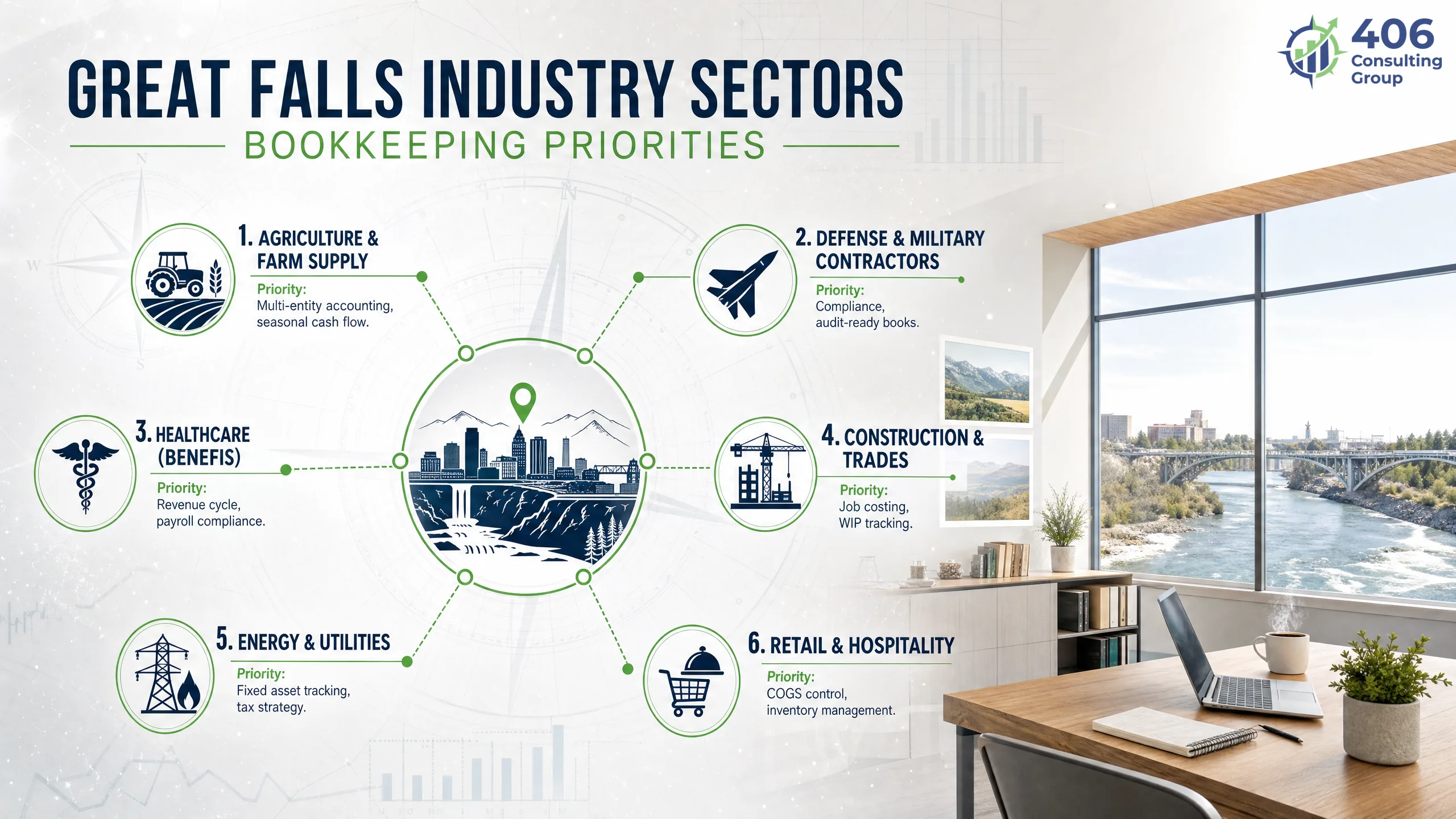
Defense & Military Contractors
GF sectorMalmstrom AFB (341st Missile Wing)
- 1Federal Acquisition Regulation (FAR) compliant cost accounting
- 2Separate cost pools for direct, indirect, and G&A expenses
- 3Labor distribution tracking by contract and task order
- 4Certificate of insurance management for base access contracts
- 5Subcontractor payment compliance (prompt payment rules)
Agriculture & Farm Supply
GF sectorNorth-central Montana agriculture hub
- 1Seasonal revenue cycle management — cash preservation through winter months
- 2Commodity price timing and inventory valuation (FIFO/LIFO)
- 3Equipment depreciation strategy — Section 179 and bonus depreciation
- 4Ag exemptions on Montana sales tax (machinery, fuel, feed)
- 5Cash vs. accrual election and its multi-year tax implications
Healthcare & Medical Practices
GF sectorBenefis Health System adjacent
- 1Insurance reimbursement tracking — billed vs. collected and contractual allowance
- 2Provider compensation by production vs. base — RVU-based tracking
- 3Multi-entity structure management (professional corp + management entity)
- 4HIPAA-compliant financial record retention
- 5Medicare/Medicaid cost report support
Construction & Trades
GF sectorResidential, commercial, federal project work
- 1Job costing by project — labor, materials, subcontractor by job
- 2WIP schedule and percentage-of-completion revenue recognition
- 3Retainage tracking — amounts withheld by GC or owner
- 4Bonding capacity management — balance sheet ratios for surety
- 5Seasonal cash flow — winter slow season cash preservation
Energy & Utilities
GF sectorHydroelectric, natural gas, refining support
- 1Project-based cost accounting for capital projects
- 2Regulatory compliance financial reporting (Montana PSC)
- 3Depletion calculations for extractive operations
- 4Equipment and asset lifecycle tracking
- 5Multi-entity structure for operating vs. holding entities
Retail & Hospitality
GF sector10th Avenue South corridor
- 1Inventory management and COGS accuracy
- 2Point-of-sale integration with QuickBooks or Xero
- 3Sales tax compliance — Montana has no general sales tax but specific use taxes apply
- 4Seasonal staffing payroll management
- 5Prime cost tracking for food and beverage operations
The Real Cost of DIY Bookkeeping for Great Falls Businesses
DIY bookkeeping feels like a cost savings. The actual math tells a different story. When you add up the owner time, the tax errors from bad categorization, the missed deductions, and the decisions made without accurate data, DIY bookkeeping typically costs Great Falls businesses $15,000–$40,000 per year — far more than professional bookkeeping costs. Here's the breakdown.
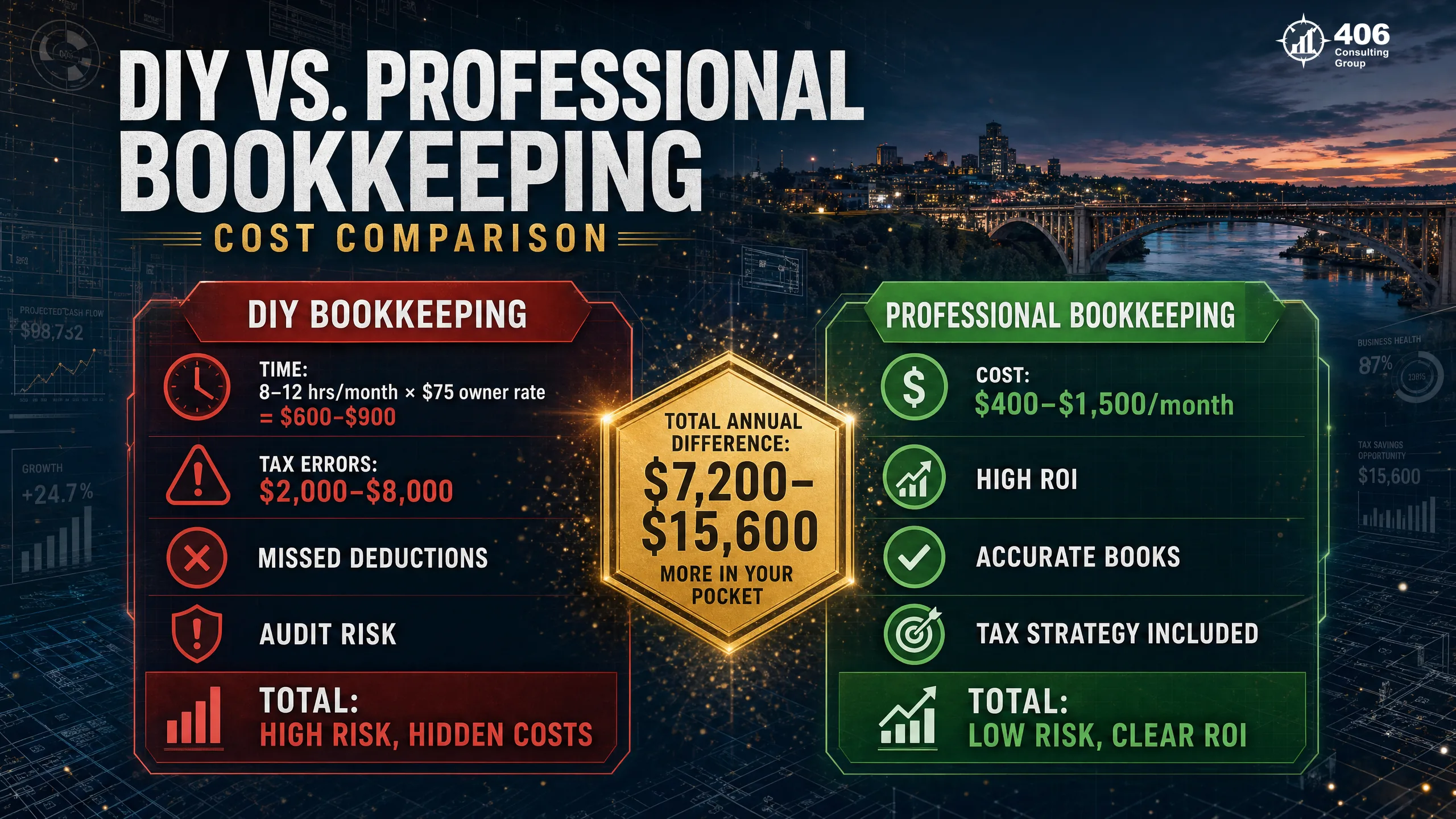
$7,200–$10,800/yr
Owner time cost
8–12 hours/month × $75/hr opportunity costEvery hour you spend entering transactions, chasing receipts, and reconciling accounts is an hour not spent selling, delivering, or managing your business. At a conservative $75/hr opportunity cost — well below what most Great Falls business owners' time is actually worth — monthly bookkeeping done by an owner costs $600–$900/month, or $7,200–$10,800 annually.
$2,000–$8,000/yr
Tax errors from miscategorization
Overpaid taxes from wrong expense categoriesA vehicle expense entered as a personal expense, a business meal entered as groceries, a home office deduction never claimed because the books don't support it. These errors aren't malicious — they're the natural result of a non-accountant making categorization decisions under time pressure. The IRS sees them as overpaid taxes. Your tax preparer can only work with what they receive.
$1,500–$6,000/yr
Missed deductions
Deductible expenses not captured or poorly documentedMileage not logged, home office square footage not calculated, equipment purchases expensed incorrectly, business meals without proper documentation. These aren't exotic deductions — they're standard business expenses that don't make it into the books. A professional bookkeeper captures them as they happen, not retroactively.
$5,000–$20,000+
Bad decisions from bad data
Hiring, pricing, and investment decisions without accurate margin dataA Great Falls service business prices a contract using intuition instead of real margin data. They win the contract and discover mid-project they're losing money on it. A retail business expands to a second location before the first is actually profitable — a fact that would have been visible in a monthly management report. These decisions happen constantly when the numbers aren't clear.
$500–$2,000/yr
Tax preparer cost inflation
Higher CPA fees for messy books that require reconstructionMost Montana CPA firms charge hourly rates of $175–$350/hr. Bookkeeping cleanup — reconstructing a year of transactions, reconciling unreconciled accounts, explaining unclear entries — is billed at those rates. A tax return that takes 4 hours from clean books takes 12–20 hours from messy ones. The difference comes out of your pocket every March.
Total DIY cost range: $16,200–$46,800/year. Professional bookkeeping for a Great Falls business in the $500K–$3M revenue range typically costs $5,400–$18,000/year. The math is not close. The ROI on professional bookkeeping is among the highest of any business investment a Great Falls owner can make.
Virtual vs. Local Bookkeeping for Great Falls Businesses
Great Falls businesses increasingly choose virtual bookkeeping over local providers — not because local is worse, but because the best bookkeeping firms in Montana often serve the entire state remotely, and the tools that make virtual bookkeeping possible (cloud accounting software, document portals, video calls) have made proximity largely irrelevant for this service.
Consider how our own book of business actually runs: 70 to 80 percent of the clients we would count as local never visit the office. Their monthly close, reconciliations, and reporting all move through cloud accounting, a shared document portal, and a regular video check-in. For a Great Falls business, that means the choice is not really local versus remote — it is the same modern workflow every one of our clients already uses, whether they are down the block or four hours away.
| Factor | Virtual Bookkeeping | Local Bookkeeping |
|---|---|---|
| Talent pool | Statewide and national — best expertise available regardless of location | Limited to Great Falls metro — smaller pool for specialized industries |
| Pricing | Competitive — overhead efficiencies passed to client | Varies — local firms often have higher fixed costs |
| Turnaround | 48–72 hours for most deliverables via cloud workflow | Depends on scheduling — can be faster or slower |
| Software | Cloud-first: QuickBooks Online, Xero, Gusto — real-time access for owner | Mixed — some still desktop-based with delayed access |
| Local tax knowledge | Montana-knowledgeable firms serve the state regardless of city | Strong local knowledge — advantage for complex state-specific issues |
| In-person meetings | Video calls for monthly reviews — no commute required | In-person available — preferred by some owners |
| Integration | API-connected to payroll, banking, and point-of-sale systems | Varies — manual data entry still common at smaller local firms |
| Scalability | Services scale with business — no provider change needed as revenue grows | May need to change providers as complexity increases |
The bottom line for Great Falls businesses: What matters most is the quality of the bookkeeper, the software they use, and whether they have experience in your industry — not whether their office is on 10th Avenue South or somewhere else in Montana. 406 Consulting Group serves Great Falls businesses remotely with the same system, turnaround, and team that serves clients in Billings, Missoula, Bozeman, and Kalispell.
Pricing & What to Expect in Your First 60 Days
Professional bookkeeping for Great Falls businesses typically runs $400–$2,500 per month, depending on transaction volume, service scope, payroll, and whether catch-up work is needed. Here's what drives the range — and what you should expect to receive at each tier.

Foundation
$400–$700/moUp to $750K revenue, simple service business
- Monthly transaction entry and categorization
- Bank and credit card reconciliation (up to 3 accounts)
- Monthly P&L and balance sheet
- Year-end close and trial balance for tax preparer
- Annual 1099 preparation
Professional
$700–$1,500/mo$750K–$3M revenue, growing business
- Everything in Foundation
- Accounts receivable and payable management
- Payroll processing (up to 10 employees)
- Monthly management package with KPIs
- Quarterly tax coordination with your CPA
- Industry-specific reporting (job costing, service-line P&L)
Controller
$1,500–$2,500+/mo$3M+ revenue, complex operations
- Everything in Professional
- Full management reporting package
- Multi-entity or multi-location bookkeeping
- Payroll for 10+ employees with complex classifications
- Budget-to-actual variance reporting
- Lender and bonding package preparation
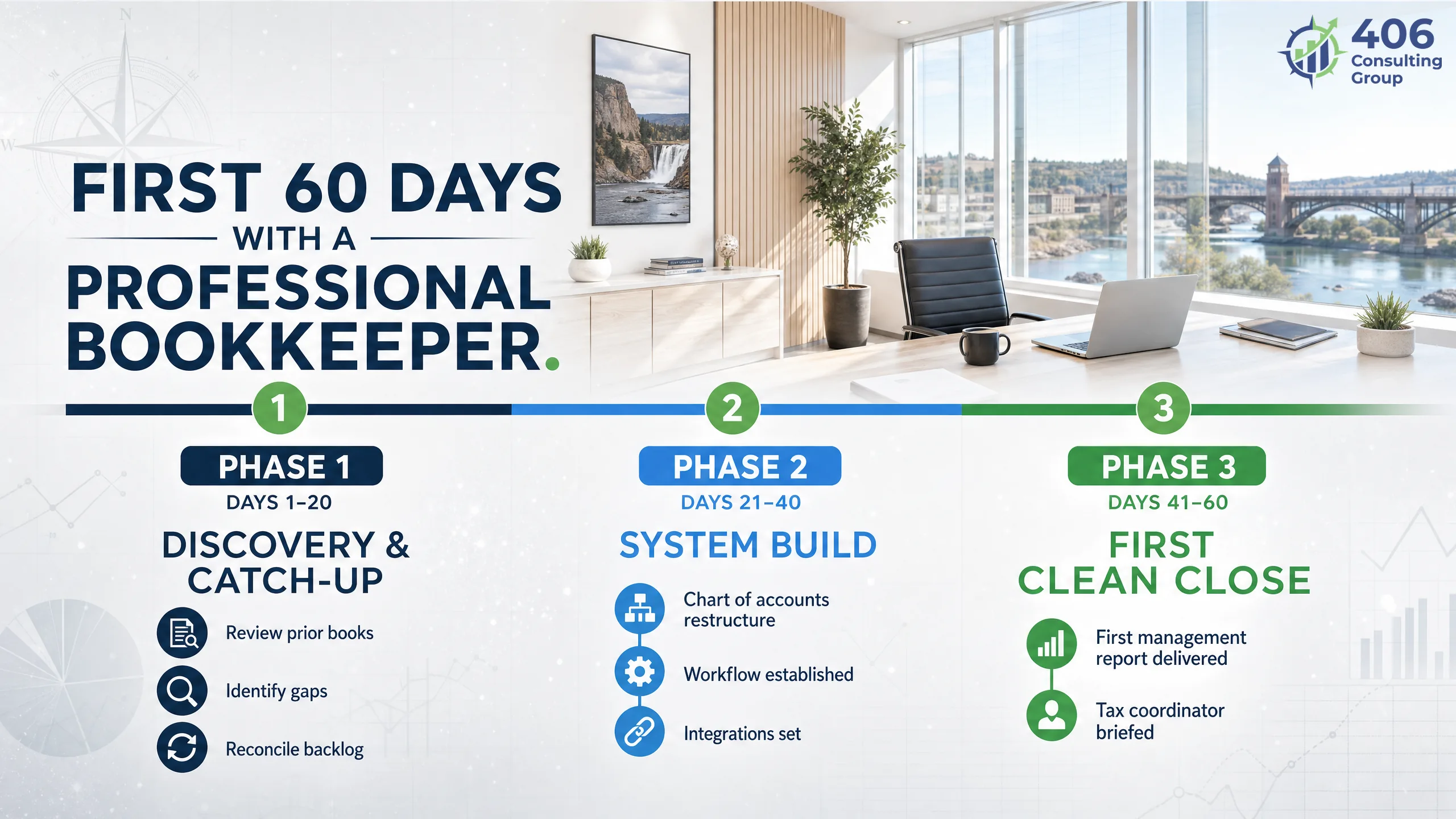
What the first 60 days look like at 406:
Days 1–20: Discovery & Catch-Up
- Review prior books for errors, gaps, and miscategorizations
- Identify catch-up work needed (we quote this separately from ongoing)
- Set up or reorganize chart of accounts for your specific business
- Connect bank feeds, credit cards, and payroll to accounting software
- Prior year trial balance provided to tax preparer if needed
Days 21–40: System Build
- First clean month reconciled under new system
- Payroll workflow established and tested
- AR and AP processes set up with aging reports
- Management reporting template built for your KPIs
- First review call with owner — 45 minutes, monthly cadence established
Days 41–60: First Clean Close
- First full management reporting package delivered
- Tax readiness memo sent to your CPA or tax preparer
- Any outstanding compliance gaps identified and addressed
- Q1 estimated tax payment calculated if applicable
- Second monthly review call — system running, questions answered
Frequently Asked Questions
What does professional bookkeeping cost in Great Falls, MT?
Professional bookkeeping in Great Falls, MT costs $400–$2,500 per month, depending on business size and scope. A simple service business under $750K in revenue typically falls in the $400–$700/month range. A growing business with $1M–$3M in revenue, multiple accounts, and payroll typically runs $700–$1,500/month. Catch-up work (cleaning up prior-period books) is typically quoted separately as a one-time project.
What's the difference between a bookkeeper and an accountant?
A bookkeeper records and reconciles your financial transactions every month — maintaining the ongoing financial record of your business. An accountant (or CPA) prepares your tax return, provides compiled financials, and offers tax and entity advice — typically engaged annually or for specific projects. Most Great Falls businesses need both: a bookkeeper maintaining clean monthly books, and a CPA or tax preparer using those books to file returns and provide tax guidance. One does not replace the other.
Do I need a bookkeeper if I already have QuickBooks?
QuickBooks is a tool, not a bookkeeper. The software can connect to your bank and categorize transactions automatically, but it cannot verify that those categorizations are correct, reconcile accounts, identify errors, or produce a management report that's actually useful. Most QuickBooks self-managed books we review have significant categorization errors, uncategorized transactions, and unreconciled accounts — sometimes going back years. The software is valuable. Professional oversight of it is what makes it accurate.
How do I know if my books are clean?
Four quick checks: (1) Are all your bank and credit card accounts reconciled to the statement each month — not just compared to the bank feed? (2) Are there zero uncategorized or 'ask my accountant' transactions? (3) Does your P&L match your tax return within a reasonable variance? (4) Can you produce an accounts receivable aging report right now that's current to this week? If any of these fail, your books need professional attention before you can make confident financial decisions from them.
Can a bookkeeper help me get a business loan?
Yes — indirectly but significantly. Lenders require financial statements that are current, internally consistent, and match your tax returns. Clean, professionally maintained books produce financials that meet this standard without revision. Lenders at First Interstate, Stockman, Glacier, and the Montana SBDC regularly see loan applications delayed or declined because the applicant's financials are inconsistent or incomplete. A professional bookkeeper doesn't guarantee loan approval — but bad books are a reliable way to slow the process down or get declined despite being creditworthy.
How long does it take to catch up on messy books?
Catch-up bookkeeping for a Great Falls business typically takes 2–6 weeks depending on how far back the books need to go and how disorganized they are. A business that's 6 months behind with reasonable documentation can usually be caught up in 2–3 weeks. A business that's 18 months behind with missing records, mixed personal/business transactions, and multiple uncategorized accounts may take 6–8 weeks. We quote catch-up work as a flat project fee before starting so there are no surprises.
External Resources
Great Falls, MT
Professional Bookkeeping for Great Falls Businesses
406 Consulting Group brings the Financial Clarity Blueprint to Great Falls businesses — clean books, tax-ready reporting, cash visibility, and growth reporting built on a foundation that actually works. No surprises. No scramble.
The Financial Clarity Blueprint
5 pillars — each depends on the one before
Accurate Ledger
Monthly reconciliation, clean categorization
Cash Visibility
AR aging, AP schedule, 30-day projection
Tax Readiness
Year-round, every deduction captured
Payroll & Compliance
Montana requirements, correct filings
Growth Reporting
Management package with KPIs
Great Falls Pricing Guide
Foundation
Under $750K revenue
Professional
$750K–$3M revenue
Controller
$3M+ or multi-entity
Related Guides