
Bookkeeping Services in Bigfork, MT:
A Local Guide for a Seasonal Lake Town
Bigfork runs on a season. Between the lake rentals, the galleries, and the summer crowds, most businesses make their year in a few months — which makes lodging taxes and seasonal cash flow the whole game. Here's the local guide, from a Flathead Valley firm.

Bigfork runs on a season. The galleries, the summer playhouse, the golf, the restaurants, the vacation rentals on Flathead Lake — most of them earn the bulk of their year in a few busy months, then hold their breath through a long, quiet off-season. It's a beautiful way to make a living, and it's also a bookkeeping challenge that catches a lot of owners off guard.
Bookkeeping services in Bigfork, MT have to be built around that reality: heavy seasonality, Montana's lodging taxes on the many vacation rentals, and the cash-flow discipline it takes to carry a business from one summer to the next. Montana has no sales tax, and — unlike nearby Whitefish — Bigfork hasn't enacted a resort tax, so the local picture is simpler in some ways. But the seasonality and the vacation-rental rules make good books more important here, not less.
This is a local guide from a local firm. We're based right here in the Flathead Valley, so this isn't theory — it's the seasonal cash swings, the lodging taxes, and the tourism-economy realities we help Bigfork businesses handle. We'll cover what professional bookkeeping delivers, the Bigfork-specific things your books must handle, how to manage cash across the seasons, and how to keep your financial house in order in a town that lives and breathes summer.
By Carrie Anderson — Co-Founder, 406 Consulting Group, a Flathead Valley firm. Banking, underwriting, and tax background applied to businesses right here in Bigfork and around Flathead Lake.
Quick Answer: What's Different About Bigfork Bookkeeping
- →No sales tax, no resort tax: Montana has no general sales tax, and Bigfork hasn't enacted a resort tax (unlike Whitefish).
- →Lodging tax still applies: Montana's 8% lodging tax hits short-term and vacation rentals — a big deal on Flathead Lake.
- →Seasonality is the main challenge: most Bigfork businesses earn in summer and must carry a long off-season.
- →Collected tax is a liability: lodging tax you collect is money you hold and remit, not revenue to spend.
- →Local knowledge helps: a Flathead firm knows the seasons, the lake-rental rules, and the tourism economy firsthand.
Table of Contents
What Professional Bookkeeping Actually Delivers
The short answer: professional bookkeeping delivers accurate, current financial records that keep you compliant, show you the truth about your business, and make tax time painless. In a seasonal town like Bigfork, it also delivers the one thing that gets owners through the winter — a clear view of your cash.
Compliance you can trust
Lodging taxes filed and remitted correctly, clean income tax records, and 1099s on time — the things that quietly generate penalties when they slip.
Books that reconcile
Every account tied to the bank and reconciled monthly, so when you look at a number, you can believe it.
Reports you can use
A profit-and-loss and balance sheet you can actually read — the basis for real decisions.
Off-season readiness
A clear cash picture so you know, in July, that you can cover January — the difference between calm and panic in a seasonal business.
The Bigfork Difference: A Seasonal Tourism Economy
The short answer: Bigfork's economy is small, seasonal, and tourism-driven — arts, hospitality, retail, golf, and vacation rentals clustered on Flathead Lake — and that shapes everything about how a business here should keep its books. The tax picture is simpler than some resort towns, but the seasonality makes financial discipline essential.
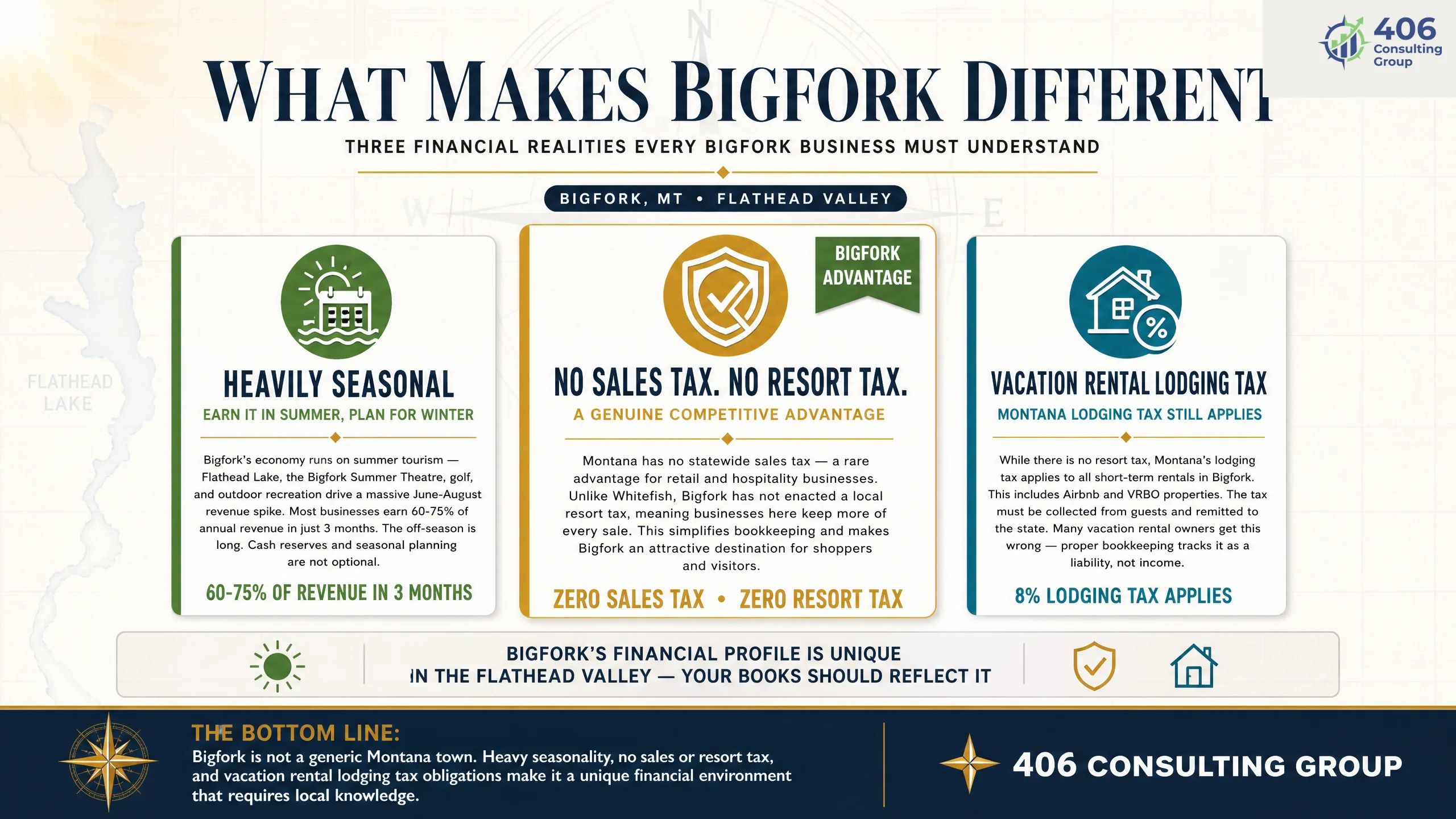
A quick word on taxes, because it's a common source of confusion. Montana has no general sales tax. And while some Montana resort towns levy a local resort tax — Whitefish charges 3% — Bigfork is unincorporated and has not enacted one. So a Bigfork shop or restaurant isn't collecting a sales or resort tax on most sales. What does apply is Montana's lodging tax on short-term stays, which matters enormously here because of the vacation-rental market on the lake. We cover that next.
The real story in Bigfork isn't a special tax — it's the calendar. When a large share of your revenue arrives in a few summer months, your books have to do more than record the past; they have to help you plan the whole year. That's the theme running through everything below.
Montana Lodging Tax on Vacation Rentals (8%)
The short answer: if you rent lodging in Bigfork for stays under 30 days — a lake cabin, a vacation home, any short-term rental — Montana charges an 8% lodging tax (a 4% lodging facility use tax plus a 4% lodging sales tax) on the full amount you charge the guest. Given how much of Bigfork's economy is vacation rentals, this is the tax that matters most here.
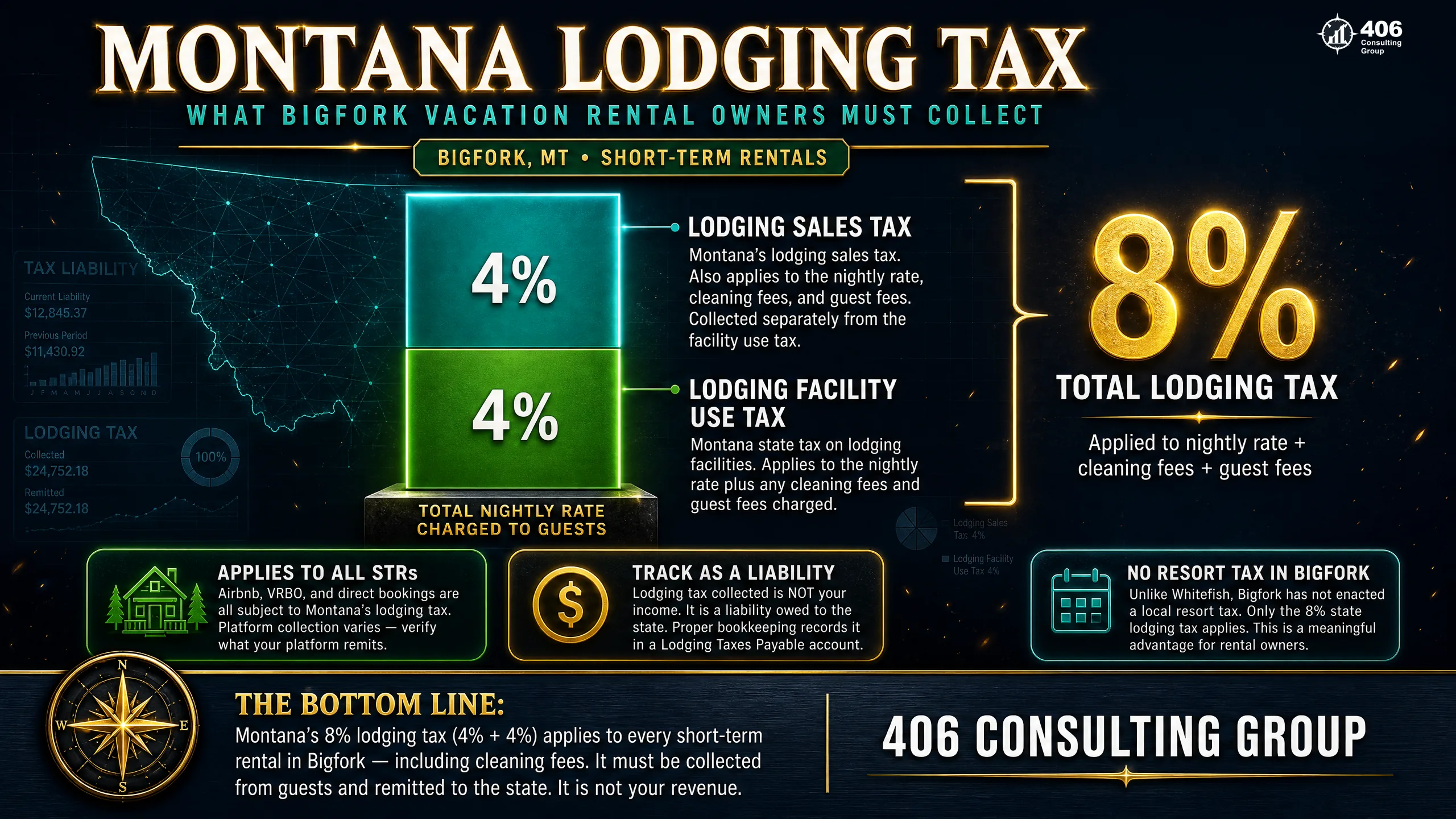
| Tax on a Bigfork short-term stay | Rate | Goes to |
|---|---|---|
| Montana Lodging Facility Use Tax | 4% | State of Montana |
| Montana Lodging Sales Tax | 4% | State of Montana |
| Local resort tax | None in Bigfork | N/A (not enacted) |
| Total | ~8% | Collected from the guest |
The lodging tax applies to the full charge — nightly rate plus cleaning fees, pet fees, and similar charges that are part of the stay. Booking platforms like Airbnb and VRBO generally collect and remit the state lodging taxes on reservations they facilitate, but you still need to account for it correctly and confirm what's being handled for you versus what remains your responsibility.
Rules and platform behavior change. Confirm what applies to your property with the Montana Department of Revenue, and make sure your books reflect the taxes you (versus the platform) are actually remitting.
Bookkeeping for Bigfork's Businesses
The short answer: Bigfork's economy is built on arts, hospitality, retail, and vacation rentals — and each has bookkeeping wrinkles worth knowing. The common thread is inventory and seasonality; the differences are in the details.
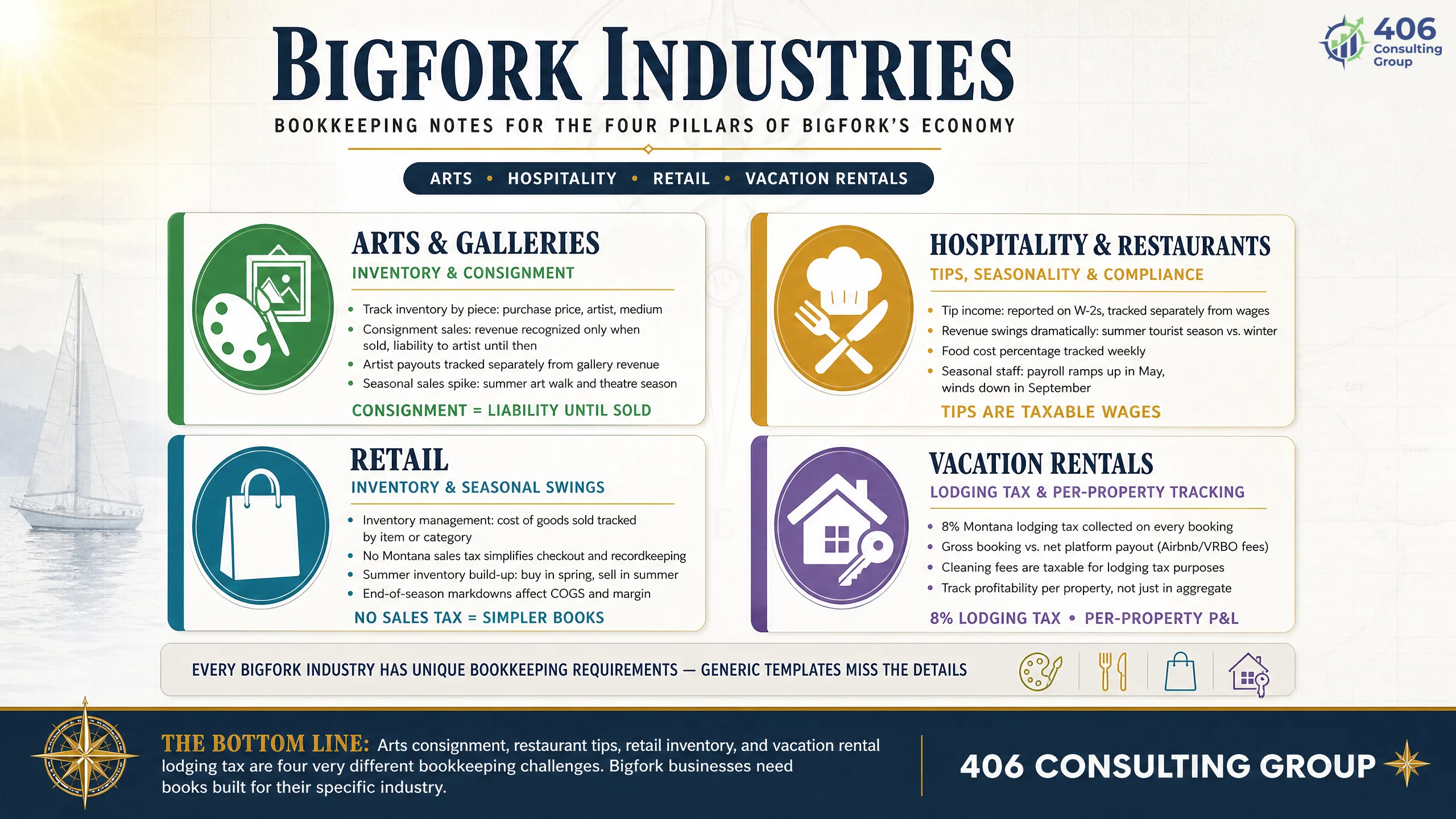
Arts & galleries
Consignment tracking, inventory of artwork, and sales that cluster around events and the summer season. Consignment especially needs clean records — you're holding and selling others' work.
Hospitality & restaurants
Tips, food-and-beverage inventory, and dramatic seasonal swings. A restaurant that's slammed in July and quiet in January needs books that plan for both.
Retail & shops
Inventory management and seasonal buying — ordering ahead of summer, then managing through the slow months without tying up cash you'll need.
Vacation rentals
Lodging tax, platform income vs. net payouts, and per-property profitability. The biggest and most tax-touched part of Bigfork's visitor economy.
Seasonal Cash Flow: Surviving the Off-Season
The short answer: this is the heart of Bigfork bookkeeping. When you earn most of your money in a few summer months, the whole game is banking enough in the peak to carry the long off-season — and books that only record the past won't get you through February.

Take a seasonal Bigfork business — say a downtown gallery-and-retail shop doing about $900,000 a year, with the large majority of it earned between June and September. The summer feels flush; the winter feels frightening. The businesses that thrive aren't the ones with the best summer — they're the ones that plan for the winter while the cash is coming in.
See the pattern
Clean monthly books reveal your true seasonal curve, so you know exactly how much the summer has to fund.
Bank the reserve
Set aside operating cash — and the lodging and income taxes you owe — during the peak to carry the off-season.
Forecast the winter
A simple rolling cash forecast turns 'I hope we make it to spring' into a number you can plan around.
The trap: spending peak-season cash as if it's all profit — when part of it is lodging and income tax you owe, and part of it has to stretch across the off-season. Books that separate what you owe and what you must reserve from what you can actually spend are what prevent the February scramble.
Bookkeeping for Short-Term & Vacation Rentals
The short answer: vacation rentals are a huge part of Bigfork's economy and carry the most bookkeeping complexity — platform payouts that don't match gross bookings, lodging tax to separate out, and sharp seasonality. Clean books here are the difference between a rental that clearly makes money and one that's a mystery.
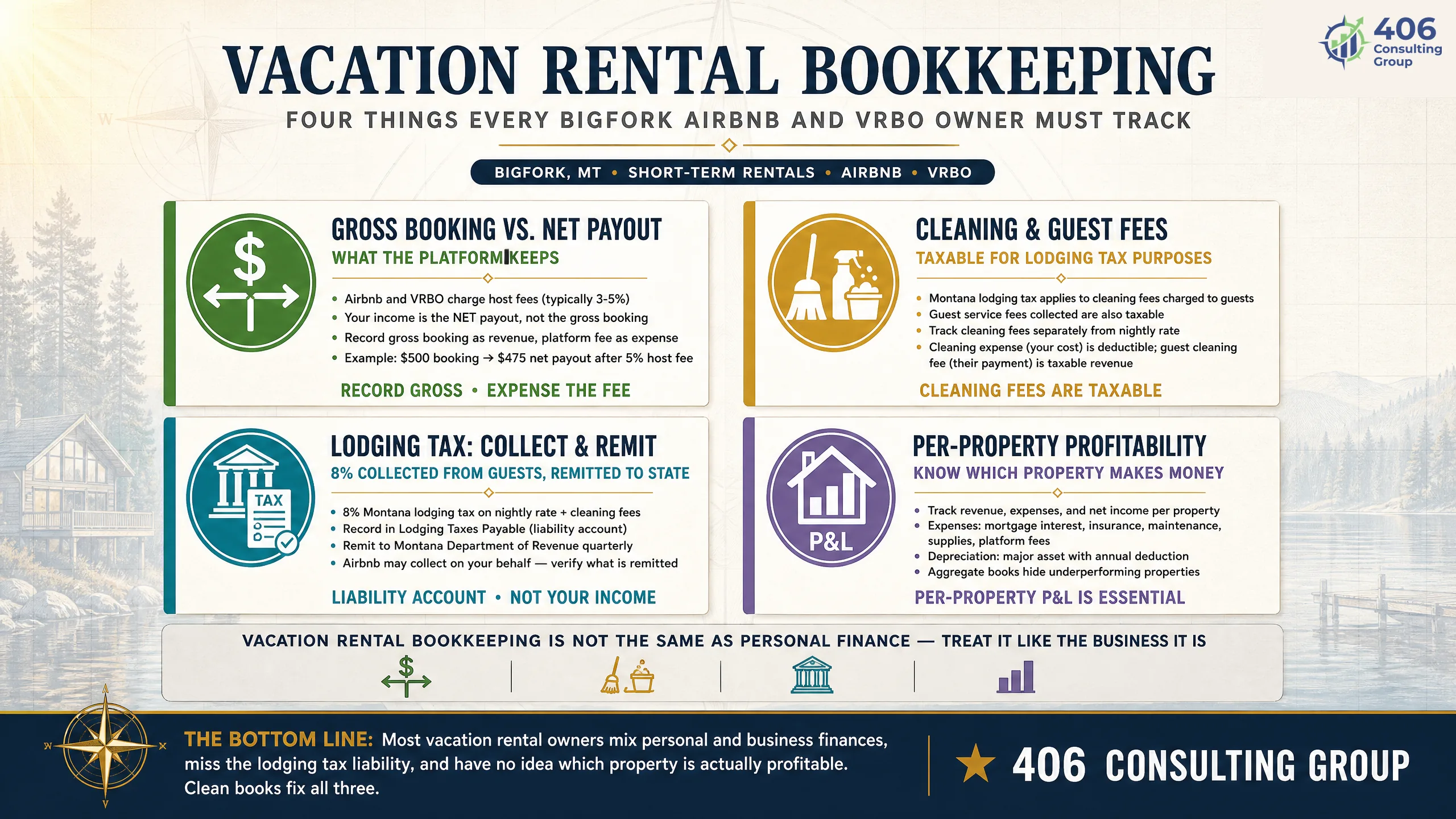
Record the gross, not just the payout
Airbnb and VRBO deposit a net payout — after their service fees and sometimes after taxes they've collected. Your books need to capture the gross booking, the platform fees, and the taxes separately, not just the net deposit. Recording only the payout understates your revenue and expenses and makes the taxes impossible to reconcile.
Lodging tax is a liability
The lodging tax a guest pays is never your revenue — whether you or the platform remit it. Booking it as income overstates the business and sets up a cash problem when remittance is due.
Track profit by property
If you run more than one lake rental, track revenue and costs by property so you can see which actually makes money after cleaning, management, maintenance, and taxes. It's the vacation-rental version of job costing.
The Chart of Accounts a Bigfork Business Needs
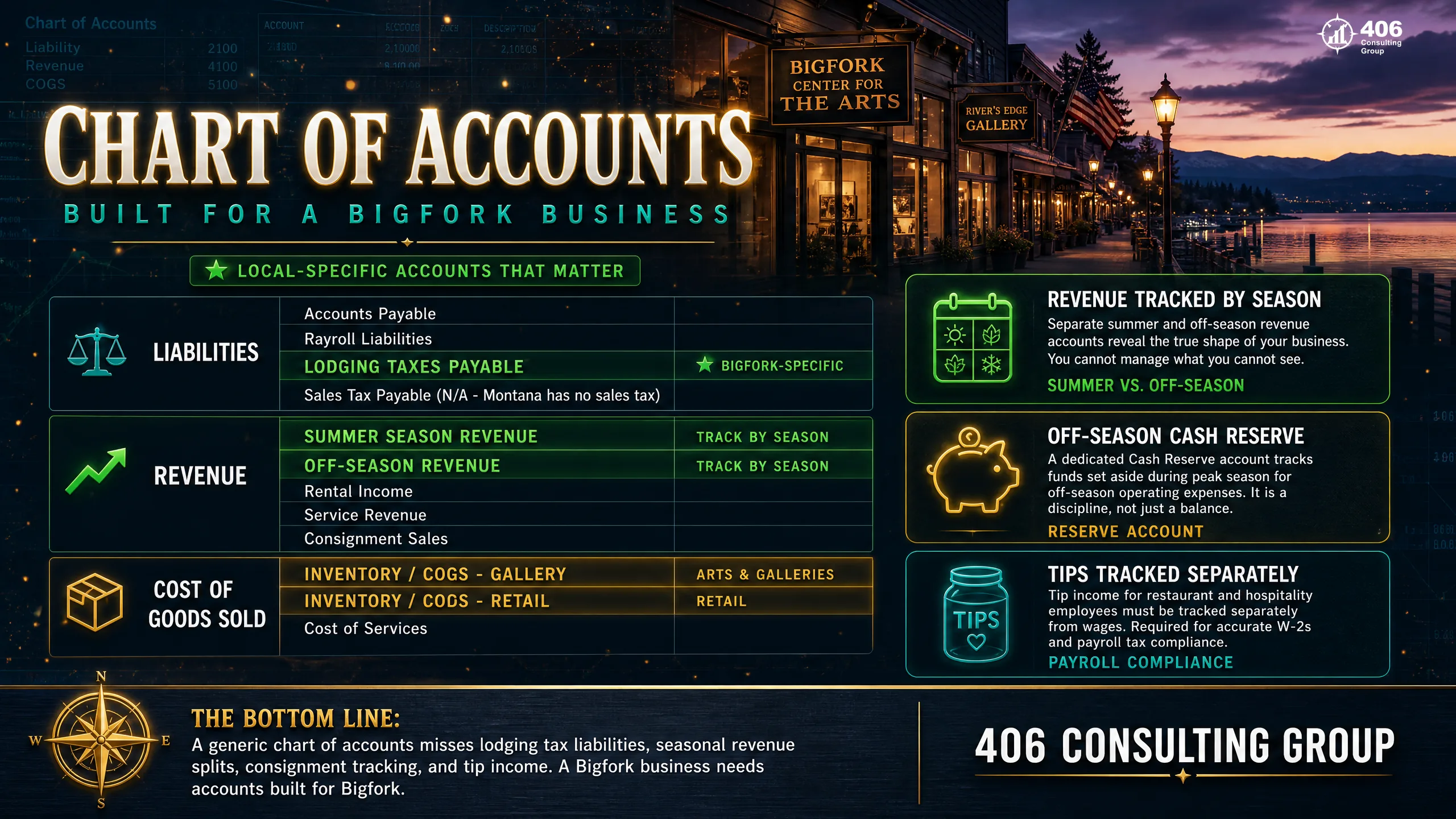
The short answer: the default chart of accounts in your software isn't built for a seasonal lake-town business. A Bigfork business needs a few additions — lodging tax handled as a liability, revenue tracked by season, and a tracked cash reserve — so the books produce the right numbers and support off-season planning automatically.
Revenue
Sales / Service Revenue
Tracked by season to reveal your real curve
Lodging Revenue
Short-term stays — subject to Montana lodging tax
Consignment / Gallery Sales
For arts businesses — track what's yours vs. held
Tax liabilities — not income
Lodging Taxes Payable
Montana 8% on short-term stays, held and remitted
Income Tax Set-Aside
Accrue during the peak so it's never a surprise
Payroll Liabilities
Withholdings and payroll taxes owed
Cost of sales
Inventory / COGS
For retail and galleries; watch seasonal buying
Food & Beverage COGS
For restaurants and bars
Property / Cleaning Costs
For vacation rentals, by unit
Operating & seasonal
Payroll & Tips
Separate tips; heavy seasonal swings in staffing
Platform Fees
Airbnb/VRBO service fees
Cash Reserve (tracked)
The buffer that carries the off-season
What Bad Bookkeeping Actually Costs
The short answer: in a seasonal Bigfork business, bad bookkeeping costs you in lodging tax penalties, spent money you owed the state, off-season cash crises, and decisions made on numbers that were never right. The leaks are quiet, but in a business that has to make the whole year on a few months, they hurt.
Lodging tax penalties
Late or incorrect lodging tax remittances generate penalties and interest — worse when collected tax was booked as income and spent.
Spending tax money by accident
Treating collected lodging tax as revenue is the classic mistake: it feels like yours until the remittance comes due and it isn't there.
Off-season cash crises
Without seasonal planning, the winter catches owners flat — no reserve, taxes still due, and a long wait until summer.
Missed deductions
A bookkeeper who doesn't know your business or Montana's rules leaves legitimate deductions on the table year after year.
Decisions on bad numbers
The biggest hidden cost: pricing, buying, and staffing decisions made on books that don't reflect reality.
The Seasonal Books Framework
Here's the setup we build for a Bigfork business so the books handle the seasonal, tourism-driven reality automatically instead of leaving it to chance. Five layers, in order — and a foundation ready to grow into controller and CFO support as the business scales.
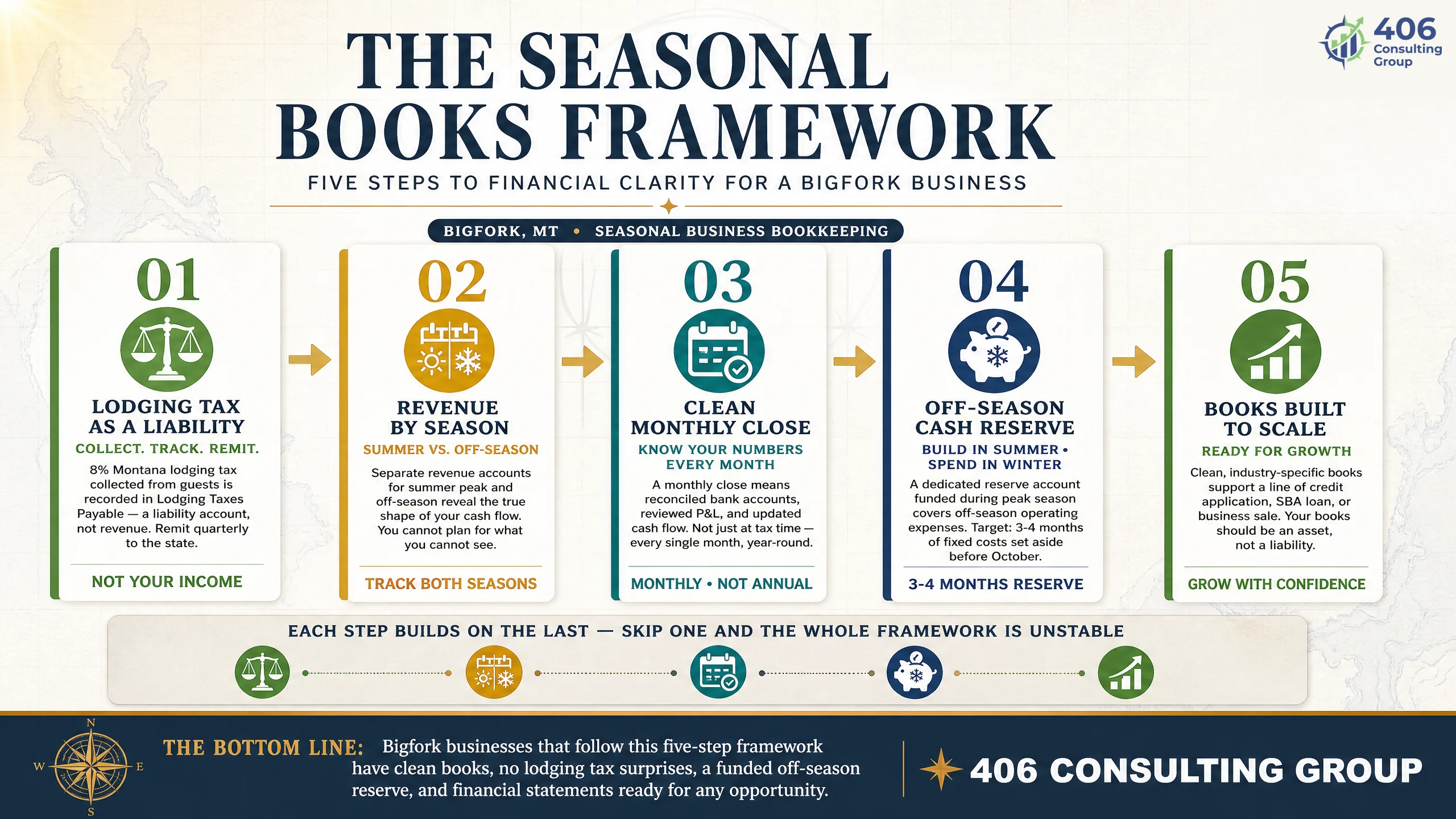
Lodging tax tracked as a liability
Collected lodging tax parked in a liability account, so the money is there when it's due to the state.
Revenue tracked by season
Books that reveal your true seasonal curve, so you know exactly how much the peak has to fund.
A clean monthly close
Books reconciled to the bank every month — current reality, not a year-old guess.
An off-season reserve & forecast
A tracked cash reserve and a rolling forecast built around the summer-peak, winter-trough pattern.
Books built to scale
A structure and rhythm that grows with the business — ready for controller or CFO support as you expand.
Why Work With a Local Flathead Valley Firm
The short answer: for a Bigfork business, working with a local Flathead Valley firm means working with people who already know the summer-peak seasonality, the Montana lodging rules for lake rentals, and the tourism economy firsthand — not a distant provider learning your market on your dime.

We know the seasons
We build cash forecasts around the summer-peak, off-season rhythm because we live the same calendar you do.
We know the lake-rental rules
Montana's lodging tax and vacation-rental realities are part of the monthly work we do for Flathead Lake businesses.
We know the market
The tourism, the arts economy, the visitor swings — the context your numbers live in.
We're part of the community
A local firm is invested in the same place you are, not managing your books from far away.
When you choose a bookkeeper, the questions that matter are simple: do they understand Montana's lodging tax and seasonal cash flow, do they keep collected taxes out of your revenue, and will they close your books every month? We do — see our bookkeeping services, our nearby Whitefish and Kalispell guides, and estimate your scope with our bookkeeping estimator.
Frequently Asked Questions: Bigfork Bookkeeping
Does Bigfork have a resort tax or sales tax?
No on both. Montana has no general statewide sales tax, and Bigfork — which is unincorporated — has not enacted a local resort tax, unlike some Montana resort towns such as Whitefish (which charges 3%). So a typical Bigfork retail shop or restaurant isn't collecting a sales or resort tax on most sales. What does apply is Montana's lodging tax on short-term stays, which is significant in Bigfork because of the large vacation-rental market on Flathead Lake. Always confirm current local rules, since resort-tax eligibility and rates can change.
Does my Bigfork vacation rental owe Montana lodging tax?
Yes. If you rent lodging for stays under 30 days — a lake home, cabin, or any short-term rental — Montana imposes an 8% lodging tax (a 4% lodging facility use tax plus a 4% lodging sales tax) on the full amount charged the guest, including cleaning and similar fees that are part of the stay. Booking platforms like Airbnb and VRBO generally collect and remit the state lodging taxes on reservations they facilitate, but you should account for it correctly in your books and confirm which obligations remain yours. Verify specifics with the Montana Department of Revenue.
How do seasonal Bigfork businesses manage cash flow?
By planning across the whole year rather than reacting month to month. Most Bigfork businesses earn the bulk of their revenue in the summer and have to carry a long off-season, while taxes come due regardless. The key moves: keep a clean monthly close so you can see your real seasonal pattern, set aside operating cash and the taxes you owe during the peak, build a cash reserve to cover the off-season, and run a simple rolling cash forecast so the slow months are planned for, not survived. Separating what you owe and must reserve from what you can spend is what prevents an off-season crisis.
How do I handle bookkeeping for a short-term rental in Bigfork?
Record the gross booking, the platform's service fees, and the lodging taxes separately — not just the net payout that lands in your bank. Treat lodging tax as a liability (it's never your revenue), whether you or the platform remit it. If you run more than one property, track revenue and costs by property so you can see which actually makes money after cleaning, management, maintenance, and taxes. And plan for Bigfork's heavy seasonality. Done right, your books show true per-property profitability and keep you compliant with Montana's lodging taxes.
How much do bookkeeping services cost in Bigfork, MT?
Cost depends on your transaction volume, number of accounts, complexity (lodging tax, multiple properties, seasonality), and how clean your books are to start. Most small business bookkeeping is priced as a flat monthly fee based on scope. The most useful comparison isn't price alone — it's price against what bad bookkeeping quietly costs in lodging tax penalties, missed deductions, and off-season cash crises. A scope-based estimate is the fastest way to see where your business would land.
Do I need a local bookkeeper in Bigfork?
You need a bookkeeper who understands Montana's rules and Bigfork's seasonal, tourism-driven economy — and a local Flathead Valley firm brings that knowledge firsthand. Being local means we already understand the summer-peak seasonality, the lodging tax on lake rentals, and the tourism swings your business rides, rather than learning your market as we go. We're part of the same community, invested in the same place.
Does 406 Consulting Group provide bookkeeping services in Bigfork, MT?
Yes. 406 Consulting Group is a Flathead Valley firm providing bookkeeping, controller, payroll, and tax services to businesses in Bigfork and around Flathead Lake. Because we're local, we know the summer-peak seasonality, Montana's lodging taxes for vacation rentals, and the tourism-and-arts economy firsthand — we set up books that track lodging tax as a liability, reveal your seasonal curve, close every month, and support the off-season planning a seasonal business needs. Contact us for a scope-based quote.
Official Resources
Related Tools & Resources
Local Bookkeeping — Bigfork, MT
Make the Summer. Survive the Winter. Know Your Numbers.
406 Consulting Group is a Flathead Valley firm that keeps the books for Bigfork businesses the local way — lodging taxes handled, seasonal cash flow planned, and books built to carry you from one summer to the next. Let's get your books working for you.
Bigfork Tax Quick Reference
Verify current rules with the DOR
The Seasonal Books Framework
Seasonal Business in Bigfork?
Local books built for the calendar.
About the Author
Carrie Anderson
Co-Founder, 406 Consulting Group
A Flathead Valley local with a background in commercial banking, underwriting, and tax strategy. Carrie helps Bigfork and Flathead Lake businesses keep clean, compliant books through the lodging taxes, the seasons, and the tourism swings — with the perspective of someone who knows the valley firsthand.
Read the Full Story