
From Bookkeeping to CFO:
The Complete Financial Guide for Whitefish, MT Businesses
Your financial needs evolve as you grow — bookkeeping, payroll, tax prep, tax planning, controller, then CFO. Here's the complete guide to every service a Whitefish business needs, when it needs it, and why one local partner that grows with you beats piecing it together.

Every Whitefish business needs a different kind of financial help depending on where it is in its life. The coffee shop in its first year needs clean books and a tax return. The construction company running eight projects needs job costing and cash forecasting. The hospitality group opening its third location needs financing and a real CFO. Same town, wildly different needs — and most owners piece those needs together from whoever they can find, one problem at a time.
There's a better way to think about it. Your financial needs don't change randomly — they evolve in a predictable order as you grow: bookkeeping, then payroll, then tax preparation, then tax planning, then a controller, then a CFO. The businesses that thrive are the ones that add the right layer at the right time, ideally with one partner who already knows their numbers and grows with them. This guide walks through that whole evolution — every financial service a Whitefish business needs, when it needs it, and why having it under one local roof beats stitching it together.
Consider this the map of the whole journey. We go deeper on specific pieces in our companion guides — bookkeeping for Whitefish businesses and CFO & controller services for scaling Whitefish companies — but this is the one that shows how it all fits together, from your first set of books to a full finance function.
By 406 Consulting Group — a Flathead Valley firm providing bookkeeping, payroll, tax, controller, and CFO services to Whitefish businesses across every stage of growth.
Quick Answer: The Financial Services a Whitefish Business Needs
- →Bookkeeping — the foundation; clean, current books every business needs from day one.
- →Payroll — once you hire, run it right and stay compliant.
- →Tax prep & tax planning — filing it right, then proactively lowering the bill (the big miss for most).
- →Controller — reliable monthly reporting and profitability as you grow.
- →CFO & advisory — cash forecasting, financing, and growth strategy at scale.
- →One integrated partner that evolves with you beats piecing it together from disconnected providers.
Table of Contents
The Financial Evolution: Why Your Needs Change as You Grow
The short answer: a business's financial needs evolve in a predictable sequence — from basic bookkeeping to full CFO-level strategy — and the key to getting it right is adding each layer at the right time, not too early and not too late. We call this the Financial Evolution.
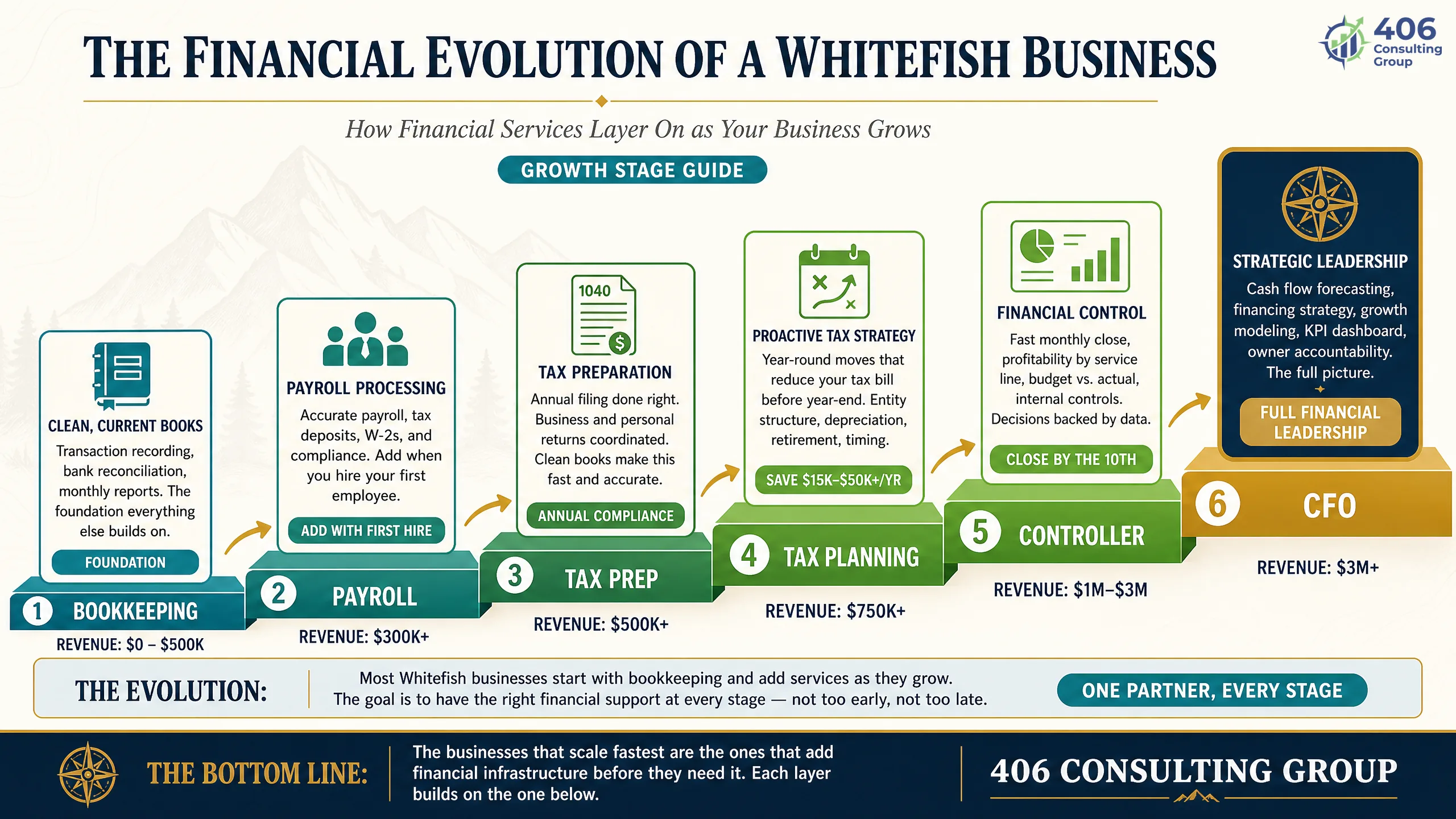
Picture a Whitefish business across its first decade. At $300,000 in revenue, it needs clean books and a tax return — that's it. Add a few employees and it needs payroll. Cross $1 million and tax planning starts saving real money while a controller keeps the growing numbers reliable. Push past $2–3 million with multiple locations or projects, and a CFO becomes the difference between chaotic growth and managed growth. Each stage doesn't replace the last — it builds on it. The books feed the tax work; the tax work informs the planning; the reliable reporting powers the strategy.
The two ways this goes wrong
Owners either add layers too late — scaling on shoebox books, discovering the tax bill in April, making million-dollar decisions on gut — or they bolt on disconnected providers who don't share data or talk to each other. The Financial Evolution done right avoids both: the right service at the right time, from a partner who carries your whole financial picture forward as you grow.
Foundation: Bookkeeping
The short answer: bookkeeping is the foundation everything else is built on — accurate, current records of every dollar in and out. Without it, tax filing is a guess, planning is impossible, and no controller or CFO can help you, because they'd be building on sand.
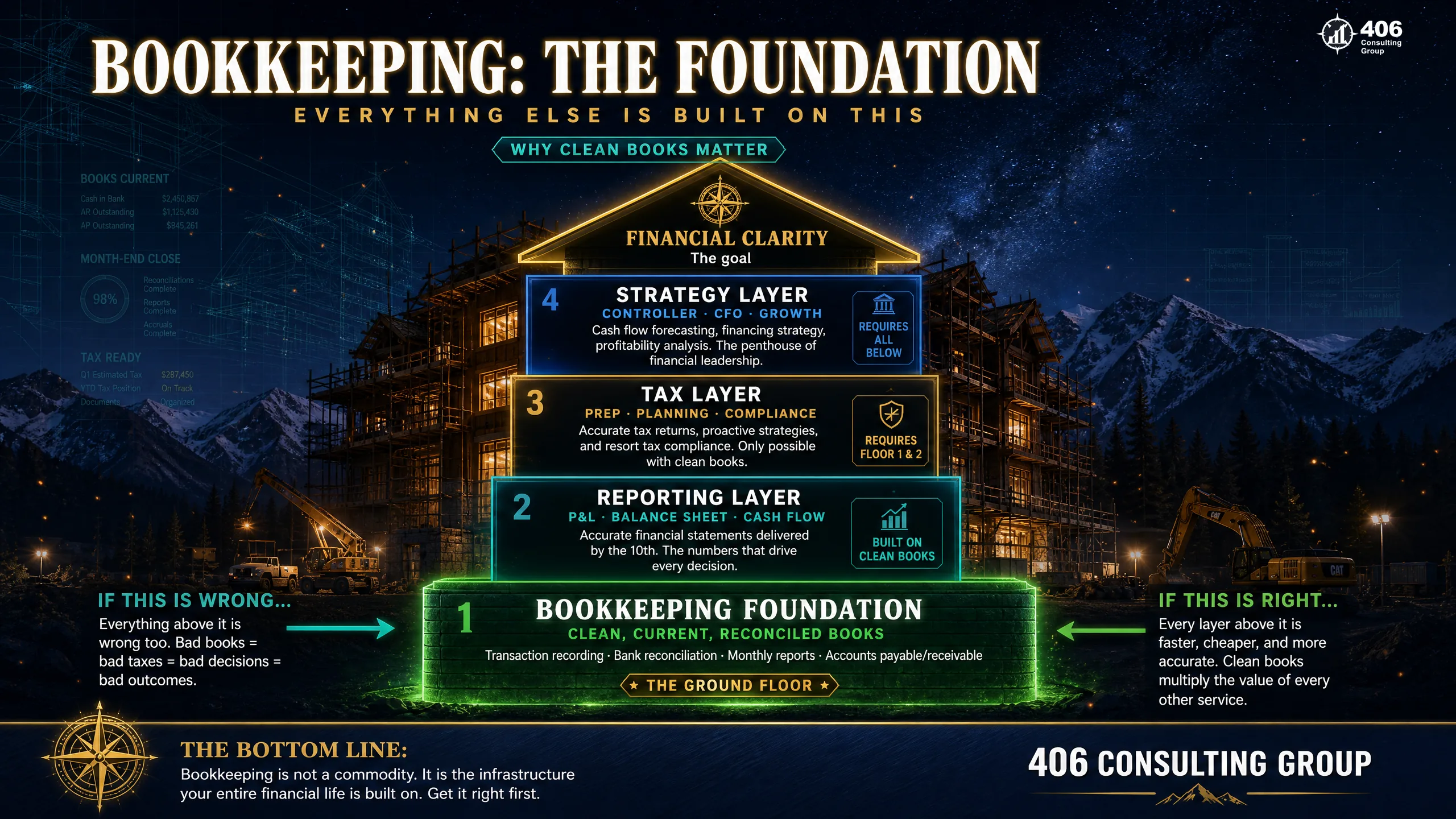
Good bookkeeping keeps your accounts reconciled to the bank every month, categorizes transactions correctly, and produces a profit-and-loss and balance sheet you can actually read. In Whitefish specifically, it also means handling the resort tax and lodging taxes correctly — treating collected tax as a liability, not revenue — which trips up generic setups constantly. Every business needs this from day one, and it never goes away; it just gets more sophisticated as you grow.
This is the layer most businesses underinvest in — and it's the one everything depends on. We go deep on it in our Whitefish bookkeeping guide, including the resort tax and seasonal cash handling. Explore our bookkeeping services.
Payroll: When You Add a Team
The short answer: the moment you hire your first employee, payroll becomes a compliance obligation with real penalties attached — withholdings, deposits, filings, and reporting that have to be right and on time. It's the next layer most Whitefish businesses add as they grow.
Payroll is more than cutting checks. It's calculating and remitting federal and Montana withholdings, making timely tax deposits, filing quarterly returns, issuing W-2s, and handling the tip reporting and seasonal swings that come with Whitefish's hospitality and service businesses. Get it wrong and the penalties stack up fast — payroll tax mistakes are among the most expensive a small business can make. Done right, it's invisible: everyone gets paid correctly, and the filings just happen.
Because payroll flows straight into your books and your tax picture, it's far cleaner handled by the same partner that keeps your books — no reconciling two systems that don't talk. See our payroll services.
Tax Preparation: Filing It Right
The short answer: tax preparation is filing your returns accurately and on time — the compliance floor every business has to meet. It's necessary and important, but on its own it's backward-looking: it reports what already happened and doesn't lower next year's bill.
Good tax prep is more than plugging numbers into software. It's making sure your entity is filing correctly, catching every legitimate deduction, handling Montana's rules, and coordinating your business and personal returns. For most Whitefish small businesses, profit flows through to the owner's personal return, so the two have to work together. Clean books (the foundation) make tax prep fast and accurate — which is exactly why the two belong together.
But here's the thing: tax prep alone leaves money on the table, because by the time you're filing, the year is over and most opportunities to save are gone. That's where planning comes in. See our tax preparation services.
Tax Planning: From Reactive to Proactive
The short answer: tax planning is the proactive, forward-looking work that actually lowers your tax bill — decisions made before year-end, not after. It's the single most overlooked, highest-value financial service for a growing business, and it's completely different from tax preparation.
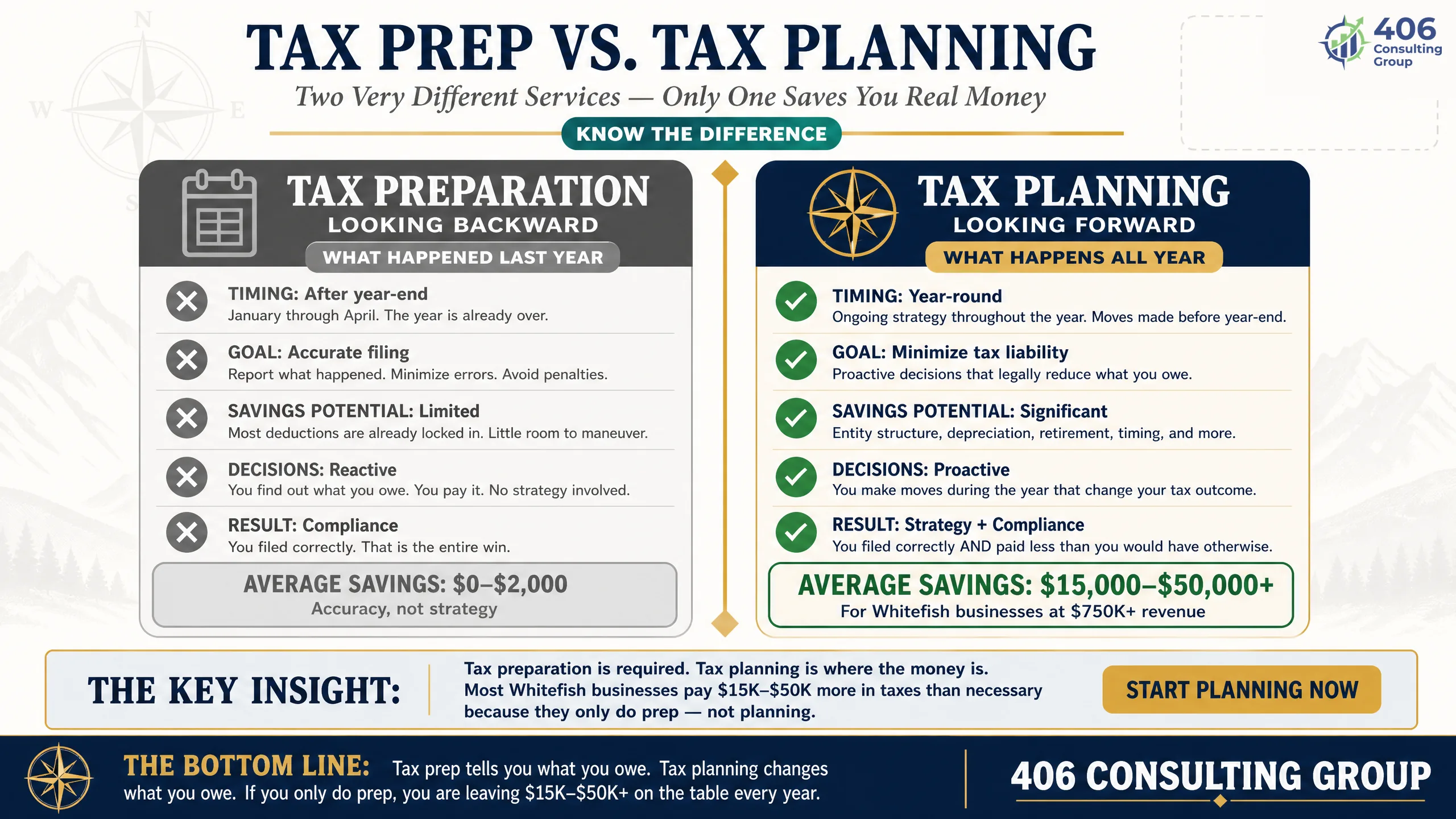
Tax prep asks "what do I owe on what already happened?" Tax planning asks "what can I do now to owe less next April?" That includes choosing the right entity structure (an S-corp election alone can save a profitable owner thousands a year), timing income and expenses, maximizing retirement contributions, planning equipment purchases and depreciation, and structuring owner compensation. These moves have deadlines — most must happen before December 31, or before you file an election — so they only work if someone is looking ahead.
Why planning needs the rest of the stack
Real tax planning is only possible when your books are clean and current — you can't plan around numbers you don't trust. That's the power of the evolution working together: the bookkeeping produces reliable numbers, the controller keeps them current, and the tax planner uses them to make moves before the window closes. Piece those apart across three providers and the planning either doesn't happen or happens too late.
A business that only does tax prep is leaving the planning savings on the table every single year. See our tax planning services.
Controller: Reliable Numbers You Can Run On
The short answer: a controller owns your monthly close and reporting — making the numbers accurate, timely, and trustworthy, and showing you which parts of the business actually make money. It's the layer you add when bookkeeping alone can't keep up with growth.
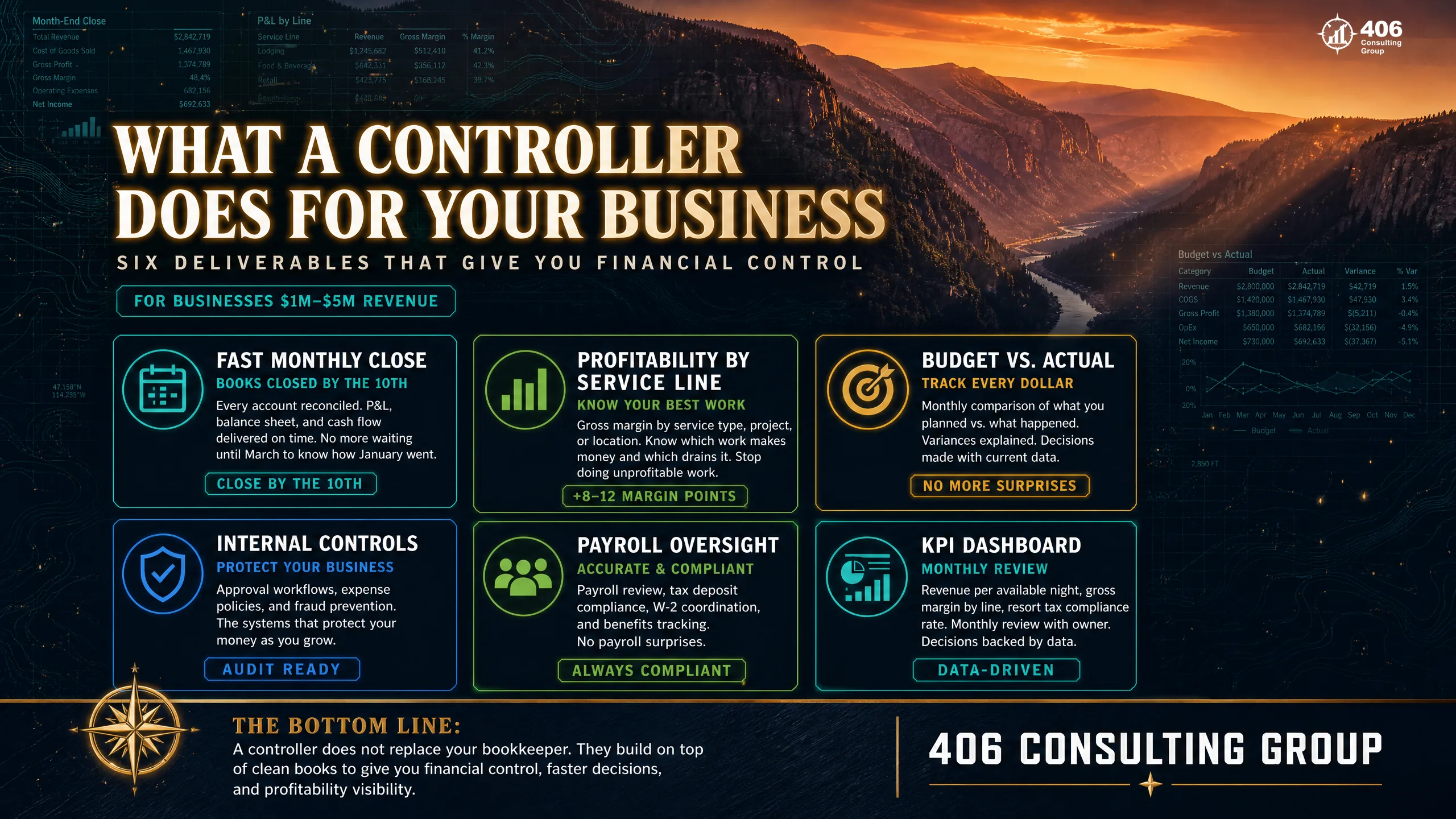
Where a bookkeeper records transactions, a controller closes the month on a schedule, catches errors, builds profitability reporting by location or project, tracks budget versus actual, and puts internal controls in place as your team grows. For a Whitefish business scaling through the boom, this is what turns "we had a good year" into "we know exactly which locations and jobs drove it." It's the reliable reporting layer that a CFO's strategy depends on.
We cover the controller (and CFO) layer in depth for scaling Whitefish businesses in our CFO & controller guide. Explore our controller services.
CFO & Advisory: Strategy, Cash, and Growth
The short answer: a CFO uses your reliable numbers to drive decisions — cash flow forecasting, margin and pricing strategy, financing, and growth planning. It's the top of the evolution, and for most Whitefish businesses it comes in fractional form: senior strategy a few days a month, without a full-time executive salary.
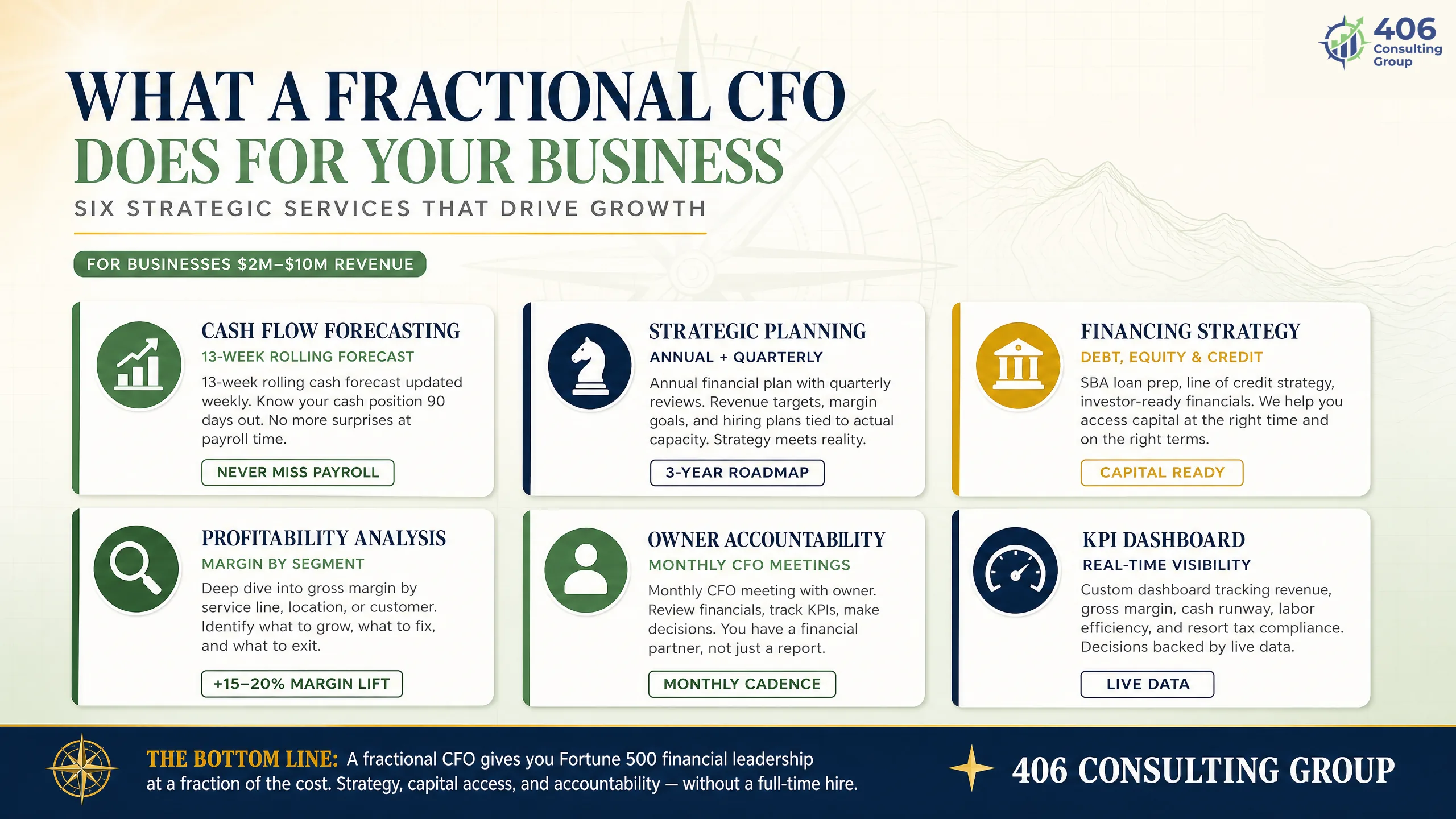
A CFO builds the rolling cash flow forecast that gets a seasonal Whitefish business through its shoulder months, analyzes which work is worth chasing, prepares the lender package that funds a second location or a building purchase, and models the big decisions before you make them. Where the controller answers "are the numbers right?", the CFO answers "what should we do about them?" It's the layer that turns good financial information into better business decisions.
The clearest returns are usually cash and financing — see how the profit-vs-cash gap plays out in why a profitable business can still be cash-poor. Explore our CFO & advisory services.
The Whitefish Layer: Resort Tax, Seasonality & the Boom
The short answer: Whitefish's resort economy touches every one of these services — the resort and lodging taxes shape your bookkeeping, the ski-and-summer seasonality shapes your cash strategy, and the growth boom shapes your financing. A financial partner who doesn't know this market is guessing at things a local one already knows.

Resort & lodging taxes → bookkeeping
Whitefish's 3% resort tax and Montana's 8% lodging taxes have to be tracked as liabilities and filed correctly — a core bookkeeping discipline here that generic setups miss.
Dual-peak seasonality → cash strategy
Ski season and summer highs with slow shoulder seasons make cash forecasting essential — a controller and CFO function tuned to the local calendar.
The growth boom → financing
Rapid growth and rising costs mean financing decisions — expansions, property, equipment — where CFO-built lender packages and local bank relationships pay off.
High-end clientele → pricing & polish
A wealthy, demanding market rewards businesses that price well and present professionally — which starts with knowing your true margins.
The Integrated Advantage: One Partner That Evolves With You
The short answer: having bookkeeping, payroll, tax, controller, and CFO under one roof beats piecing them together from separate providers — because the whole point of the evolution is that each layer builds on the last, and that only works when they share the same data, the same partner, and the same picture of your business.
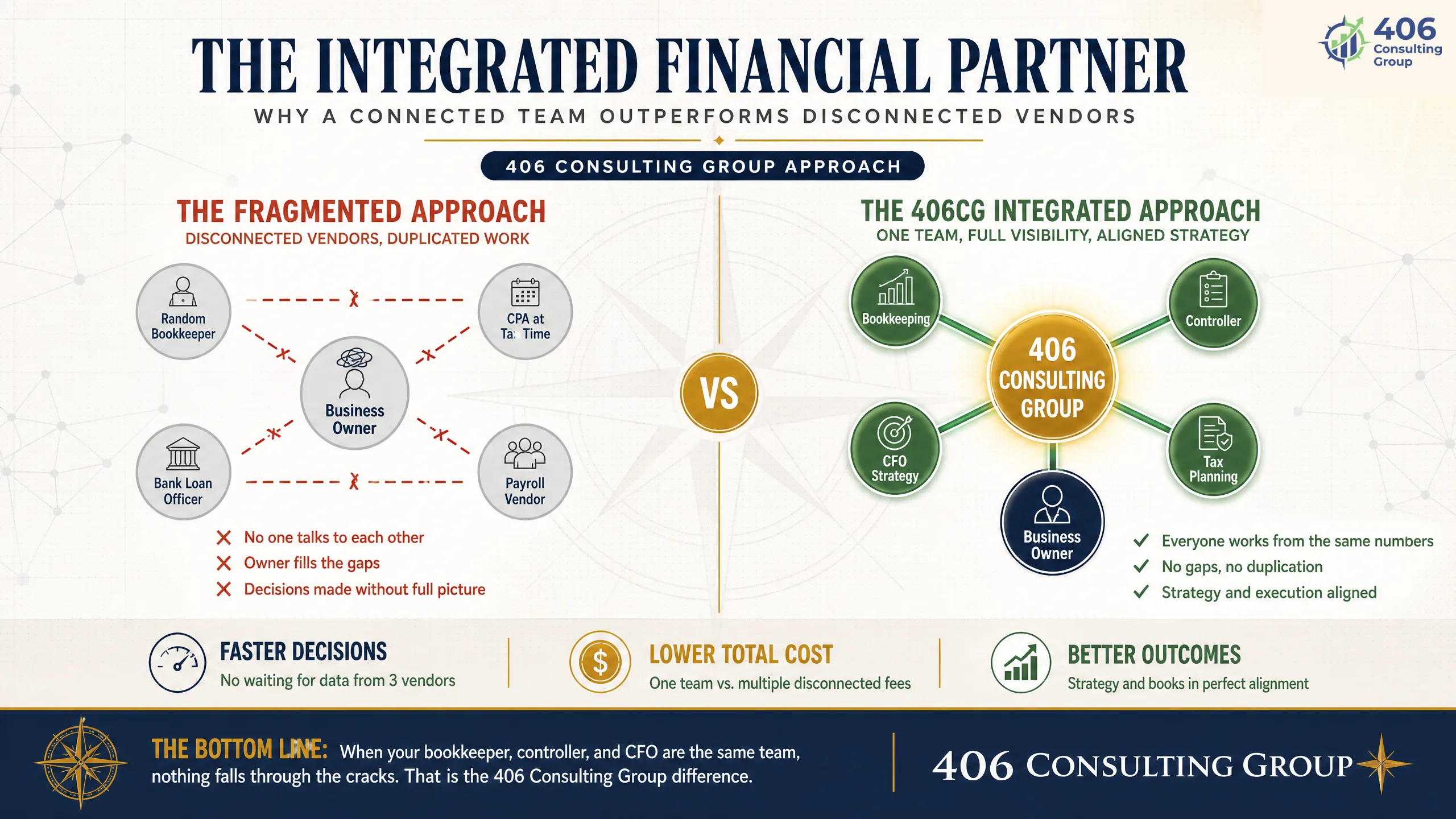
Piecing it together
- A bookkeeper, a separate CPA, and a separate advisor who don't talk
- Data re-entered and reconciled across systems that don't match
- Tax planning that never happens because no one owns the whole picture
- You're the go-between, chasing each provider for what the others need
- Gaps and finger-pointing when something falls through the cracks
One integrated partner
- Books, payroll, tax, and strategy share one set of numbers
- Tax planning flows naturally from books that are already clean
- The right layer gets added at the right time, proactively
- One relationship that already knows your business
- Accountability in one place — nothing falls between providers
This is the real argument for a full-service partner: not convenience, but effectiveness. When the same firm keeps your books, runs your payroll, files and plans your taxes, and provides your controller and CFO support, the evolution actually works — each layer strengthens the next instead of sitting in a silo.
Your Financial Evolution Roadmap
The short answer: here's roughly which services to add at which stage of growth. Every business is different — complexity matters more than revenue alone — but this is the typical path a Whitefish business follows.

Get clean books from day one and file accurately. Add payroll the moment you hire.
With a team and steady profit, payroll compliance and a first look at entity structure (S-corp) start paying off.
Proactive tax planning saves real money, and a controller keeps the growing numbers reliable with profitability by segment.
Cash forecasting, financing, and growth strategy become essential — usually fractional until well past $15M.
Not sure which stage you're in or what to add next? Our free financial maturity assessment takes about eight minutes and maps you to the right next layer.
How We Work — Local in the Flathead Valley
The short answer: 406 Consulting Group is a Flathead Valley firm that provides the full range of financial services in Whitefish, MT under one roof — so you get one local partner who knows your market and grows the financial function with you, layer by layer.
Being local matters here. We know the Whitefish resort tax and Montana lodging taxes because we handle them every month. We build cash forecasts around the ski-and-summer rhythm because we live the same calendar. We know the local banks you'll finance growth through. And because we provide the full stack — bookkeeping, payroll, tax prep, tax planning, controller, and CFO — we can start you wherever you are today and add each layer exactly when your growth calls for it, without ever handing you off to a stranger.
Whether you need a small business accountant in Whitefish for the first time or a full finance function for a scaling operation, the starting point is the same: a conversation about where your business is and where it's headed. Talk to us, or take the financial maturity assessment to see your next step.
Frequently Asked Questions: Financial Services in Whitefish, MT
What financial services does a Whitefish business need?
It depends on your stage. Every business needs bookkeeping (clean, current records) and tax preparation from the start. Once you hire, you need payroll. As you grow past about $1 million, proactive tax planning starts saving real money and a controller keeps your reporting reliable. Past roughly $3 million — especially with multiple locations, projects, or properties — a CFO adds cash forecasting, financing, and growth strategy. In Whitefish specifically, all of these have to account for the resort tax, lodging taxes, and seasonality. The ideal is one partner who provides the whole range and adds each layer as you need it.
When should I move from a bookkeeper to a controller to a CFO?
Move from bookkeeping to a controller when growth outpaces your monthly close — books are late, you can't trust the numbers, or you can't tell which locations or projects make money (often around $1M–$5M). Add a CFO when your numbers are reliable but you need cash flow forecasting, financing for expansion, or help with big growth decisions (often $1.5M–$15M). You don't replace the lower layers — a CFO builds on a controller, who builds on solid bookkeeping. If your books aren't clean yet, start there.
What's the difference between tax prep and tax planning?
Tax preparation is filing your returns accurately and on time — it's backward-looking compliance that reports what already happened. Tax planning is proactive, forward-looking work done before year-end to legally lower your bill: choosing the right entity structure (an S-corp election can save a profitable owner thousands a year), timing income and expenses, maximizing retirement contributions, and planning equipment purchases. Prep is required; planning is where the savings are. Most businesses only do prep and leave the planning savings on the table every year. The two work best together, built on clean books.
Should I use one firm for bookkeeping, tax, and CFO, or separate providers?
One integrated partner is usually far more effective. The financial functions build on each other — tax planning depends on clean books, CFO strategy depends on reliable controller reporting — and that only works well when they share the same data and the same view of your business. Piecing it together across a bookkeeper, a separate CPA, and a separate advisor who don't talk creates gaps, duplicated work, and planning that never happens because no one owns the whole picture. A full-service partner adds the right layer at the right time and keeps everything connected.
How much do full-service accounting services cost in Whitefish?
It depends on which layers you need and your complexity. Bookkeeping is typically a flat monthly fee based on scope; payroll scales with headcount; tax prep is usually annual; tax planning and controller/CFO services are monthly engagements. A startup might need only bookkeeping and a tax return, while a scaling business might invest in the full stack. The right way to think about cost isn't the fee alone — it's the fee against what you save and gain: lower taxes from planning, recovered margin from real reporting, and better decisions from CFO strategy. A scope-based conversation is the fastest way to see where you'd land.
Do you work with seasonal and resort-economy businesses?
Yes — it's core to what we do in Whitefish. Resort-economy businesses (hospitality, short-term rentals, restaurants, retail, and the trades serving the growth) have specific needs: resort and lodging tax handling, dual-peak seasonal cash flow, and the reporting to manage multiple locations or properties. As a Flathead Valley firm, we build books and forecasts around the ski-and-summer rhythm and the local tax rules because we know them firsthand.
Does 406 Consulting Group provide financial services in Whitefish, MT?
Yes. 406 Consulting Group is a Flathead Valley firm providing the full range of financial services to Whitefish businesses — bookkeeping, payroll, tax preparation, tax planning, controller, and fractional CFO and advisory. Because we're local and full-service, we know the resort tax, lodging taxes, seasonality, and growth economy firsthand, and we can meet your business wherever it is today and add each layer as you grow — all under one roof, with one relationship. Contact us to talk about where your business is and what it needs next.
Official Resources
Related Tools & Resources
Full-Service Financial Partner — Whitefish, MT
One Local Partner for Every Stage of Your Growth.
406 Consulting Group gives Whitefish businesses the whole financial evolution under one roof — bookkeeping, payroll, tax prep and planning, controller, and CFO — from a local Flathead Valley firm that knows your market. Start wherever you are; we'll grow the rest with you.
The Financial Evolution
Services by stage
Under ~$500K
Bookkeeping + tax prep
~$500K–$1M
+ Payroll
~$1M–$3M
+ Tax planning + Controller
~$3M+
+ CFO & advisory
Full-Service, One Partner
One Partner, Every Stage
Local, full-service, in the Flathead.
About 406 Consulting Group
A Flathead Valley firm providing the full range of financial services — bookkeeping, payroll, tax preparation and planning, controller, and fractional CFO — to Whitefish businesses at every stage of growth. Local, full-service, and built to grow with you.
Read the Full Story