
CFO & Controller Services for Whitefish, MT:
Scaling Through the Boom
Whitefish businesses are growing faster than almost anywhere in Montana — and fast growth is exactly when the finances break. Here's how a controller and a CFO help you scale through the boom without losing control of the numbers, from a local Flathead Valley firm.

Growth is a good problem — until it isn't. Whitefish businesses are scaling faster than almost anywhere in Montana right now, riding a boom of new residents, wealthy second-home owners, and year-round visitors. Revenue is up, the team is bigger, and there's more work than ever. And somewhere in the middle of all that, a lot of owners quietly lose their grip on the numbers.
That's the moment CFO and controller services in Whitefish, MT matter most. Once a Whitefish company is growing fast — multiple locations, projects, or properties; seasonal cash swings; and financing decisions on the table — clean bookkeeping alone isn't enough. You need someone owning the monthly close and someone owning the financial strategy. The good news: you can get both without a full-time executive salary, from a firm that's right here in the Flathead Valley.
This guide is about scaling through the boom without the finances becoming the thing that breaks. We'll cover the quick difference between a controller and a CFO, why fast growth overwhelms a Whitefish business, the five growth challenges these roles solve, what it costs, and why local matters here. If your books are already clean and you're wondering what's next, this is that next step — building on our Whitefish bookkeeping guide.
By Jason Anderson — Co-Founder, 406 Consulting Group, a Flathead Valley firm. Operational finance background at BP; helps Whitefish businesses scale without losing control of the numbers.
Quick Answer: Controller & CFO for a Scaling Whitefish Business
- →Controller owns the monthly close, job/location costing, and controls — the reliable numbers.
- →CFO owns the strategy — cash forecasting through the seasons, financing the next move, and growth planning.
- →Fast growth is the trigger: a boom strains books, hides which locations make money, and stresses cash.
- →Fractional gives you both roles for ~$4,000–$8,000/month — a fraction of full-time salaries.
- →Local matters here: a Flathead firm knows the resort/lodging taxes, the seasons, and the local banks.
Table of Contents
Controller vs. CFO: The 30-Second Difference
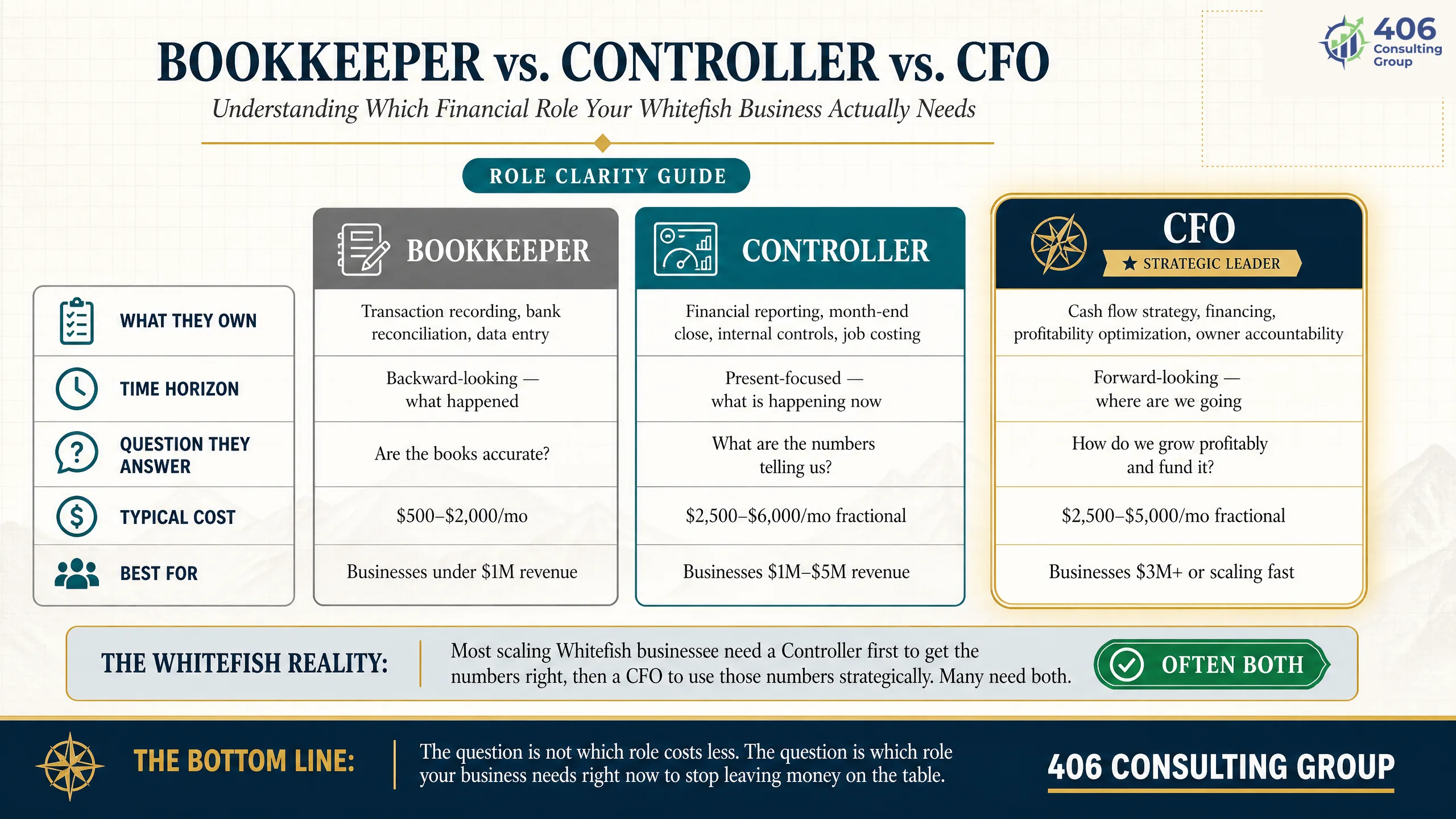
The short answer: a controller makes your numbers accurate and on time; a CFO uses those numbers to make better decisions about cash, margin, and growth. A bookkeeper records what happened, a controller makes it reliable, and a CFO decides what to do about it. A scaling business eventually needs all three.
| Bookkeeper | Controller | CFO | |
|---|---|---|---|
| Owns | Transactions | The monthly close | Financial strategy |
| Time horizon | Yesterday | Last month | Next 1–3 years |
| Answers | What did we spend? | Are the numbers right? | What should we do next? |
If you want the full "which role do I need first, and when" breakdown — with the Financial Leadership Ladder mapped to revenue and complexity — we cover it in depth in our controller-vs-CFO guide. This article focuses on something more specific: what these roles do for a Whitefish business scaling through a boom.
Why Fast Growth Breaks Whitefish Businesses
The short answer: rapid growth overwhelms the informal financial habits that worked when a business was small — and Whitefish's boom makes it happen faster than most owners expect. More revenue means more transactions, more staff, more complexity, and bigger decisions, all at once. The finances hit a ceiling the owner can't push through alone.
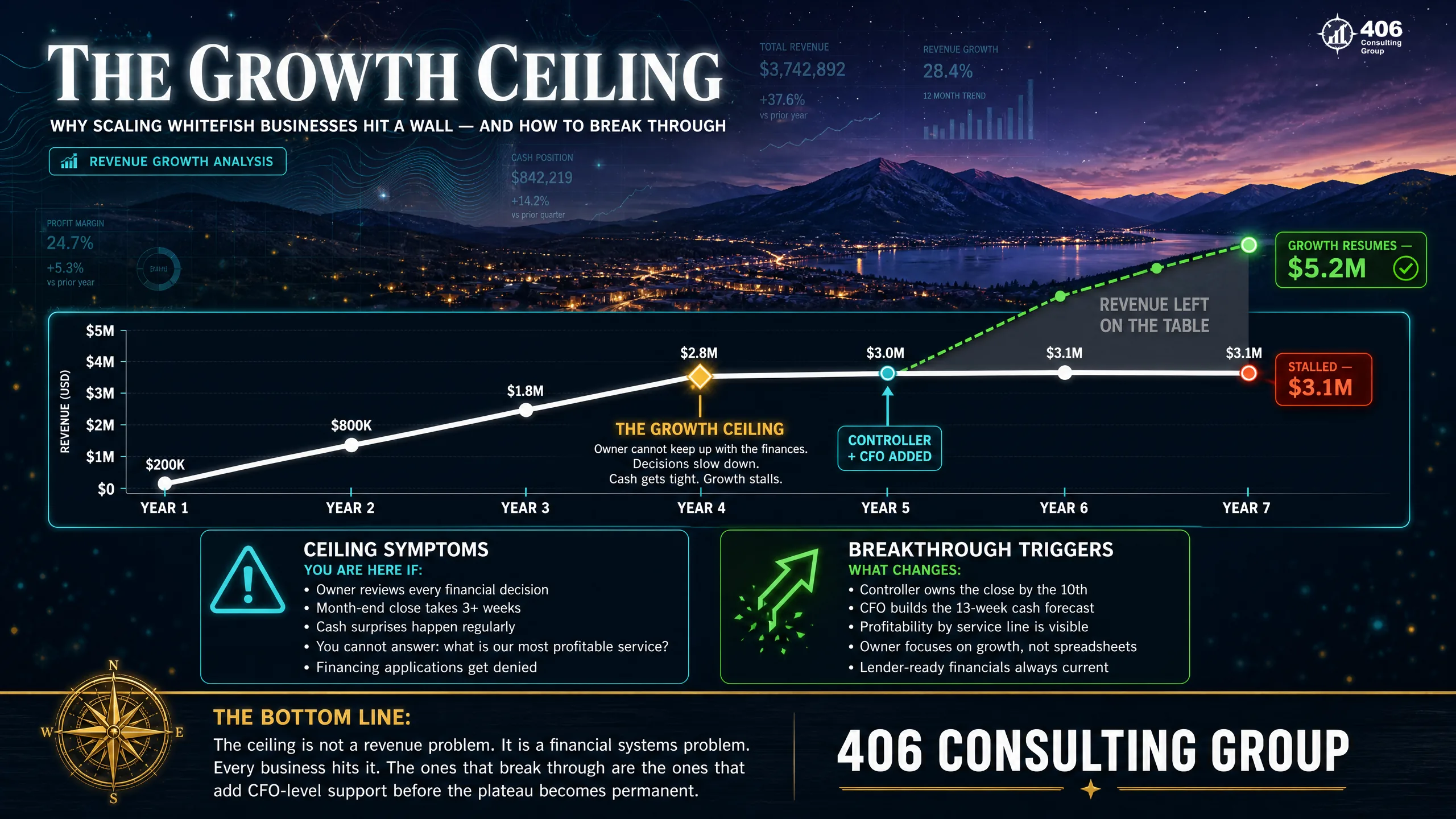
Picture a Whitefish business that's scaled to about $3.5 million — maybe a hospitality group with a couple of locations, or a construction company running several high-end projects for the new-money influx. When it was a single location or one job at a time, the owner could hold the whole financial picture in their head. At $3.5M across multiple locations or projects, that's impossible. The books fall behind, nobody can say which location or job actually makes money, cash gets tight in the shoulder seasons despite a strong year, and a financing opportunity shows up that the business isn't ready to pursue.
The boom makes it worse — and better
Worse, because Whitefish businesses are scaling faster than the owner's systems can keep up, and the market's high costs and high expectations leave little margin for financial blind spots. Better, because the opportunity is real and lasting — if you build the financial infrastructure to capture it. That's what a controller and CFO do: turn a chaotic boom into managed, profitable growth.
The Growth-Ready Finance Framework
The short answer: a boom creates five predictable financial challenges, and each one is solved by either a controller or a CFO. Map your pain to the challenge, and you'll know exactly which role your Whitefish business needs — and usually it's both, working together.
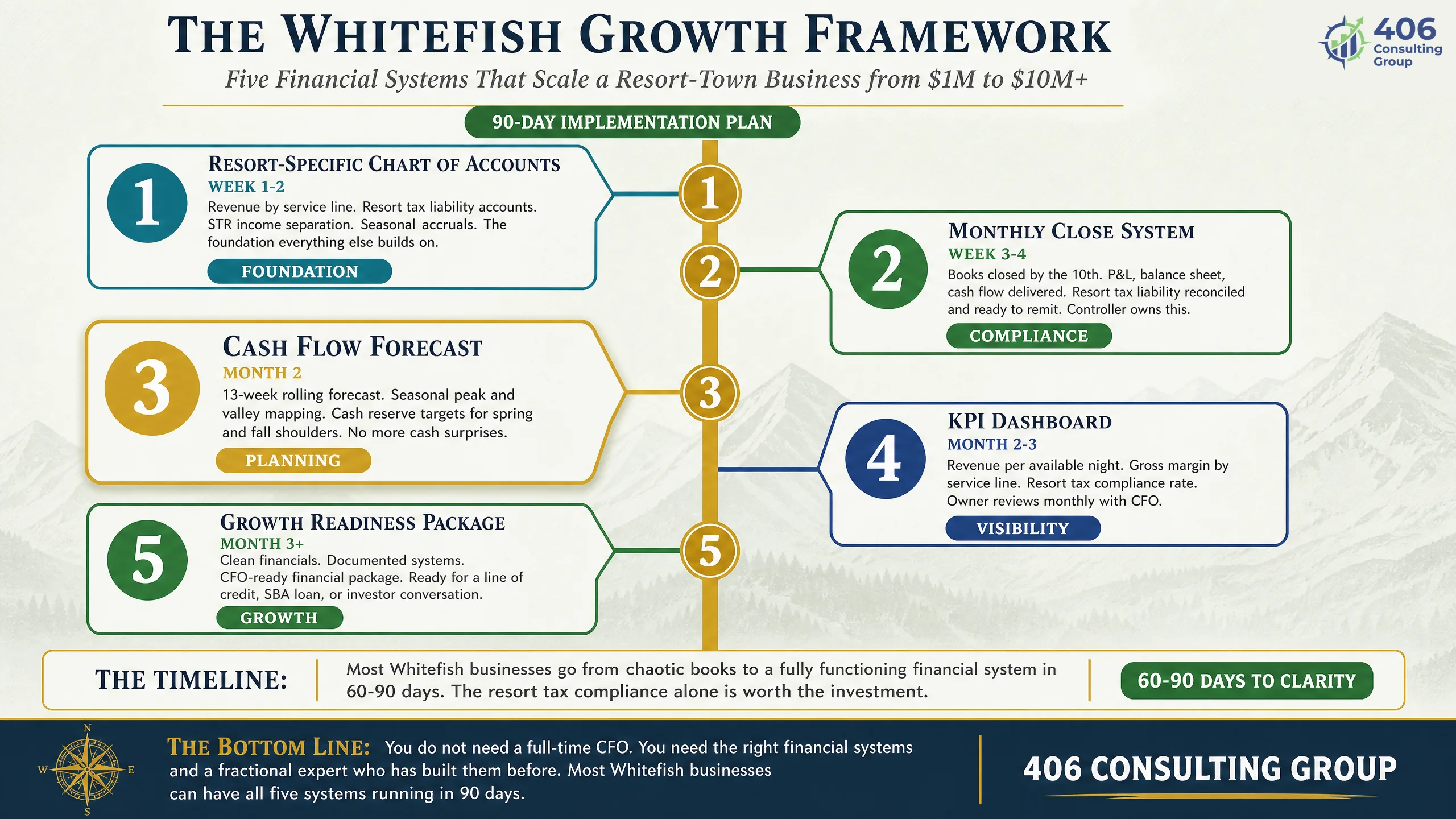
Books that can't keep up
ControllerGrowth outpaces the monthly close; the numbers are late and shaky.
Not knowing what makes money
ControllerTotal profit hides which location, property, or project actually earns.
Seasonal cash & tax swings
CFOSki-and-summer peaks and shoulder-season troughs, plus resort and lodging taxes to set aside.
Financing the next move
CFOA second location, a building, or equipment — and the lender package to fund it.
The owner is the bottleneck
Controller + CFOEvery financial decision routes through the owner; the business can't scale past them.
Challenge 1: Books That Can't Keep Up → Controller
The short answer: as a Whitefish business grows, the monthly close falls behind, and decisions get made on stale or shaky numbers. A controller owns a fast, reliable close — books reconciled and reported within days of month-end — so you're always working from current reality.
When you're small, "the books" can be a weekend catch-up. At $3.5M with multiple locations and dozens of staff, that breaks down fast — transactions pile up, reconciliations slip, and you're looking at October's numbers in December. A controller closes the month on a schedule, catches errors, puts basic internal controls in place as headcount grows, and produces a reporting package you can actually run the business from. It's the reliable foundation every other financial decision depends on.
This is the layer directly above bookkeeping. If your books aren't clean and current yet, that's the place to start — see our Whitefish bookkeeping guide — because a controller builds on a solid bookkeeping foundation, and a CFO builds on a solid controller foundation.
Challenge 2: Not Knowing What Makes Money → Controller
The short answer: a single total-profit number hides which location, property, or project actually makes money — and in a multi-site, multi-project Whitefish business, that blindness is expensive. A controller builds profitability tracking by segment so you can see exactly where you earn and where you leak.
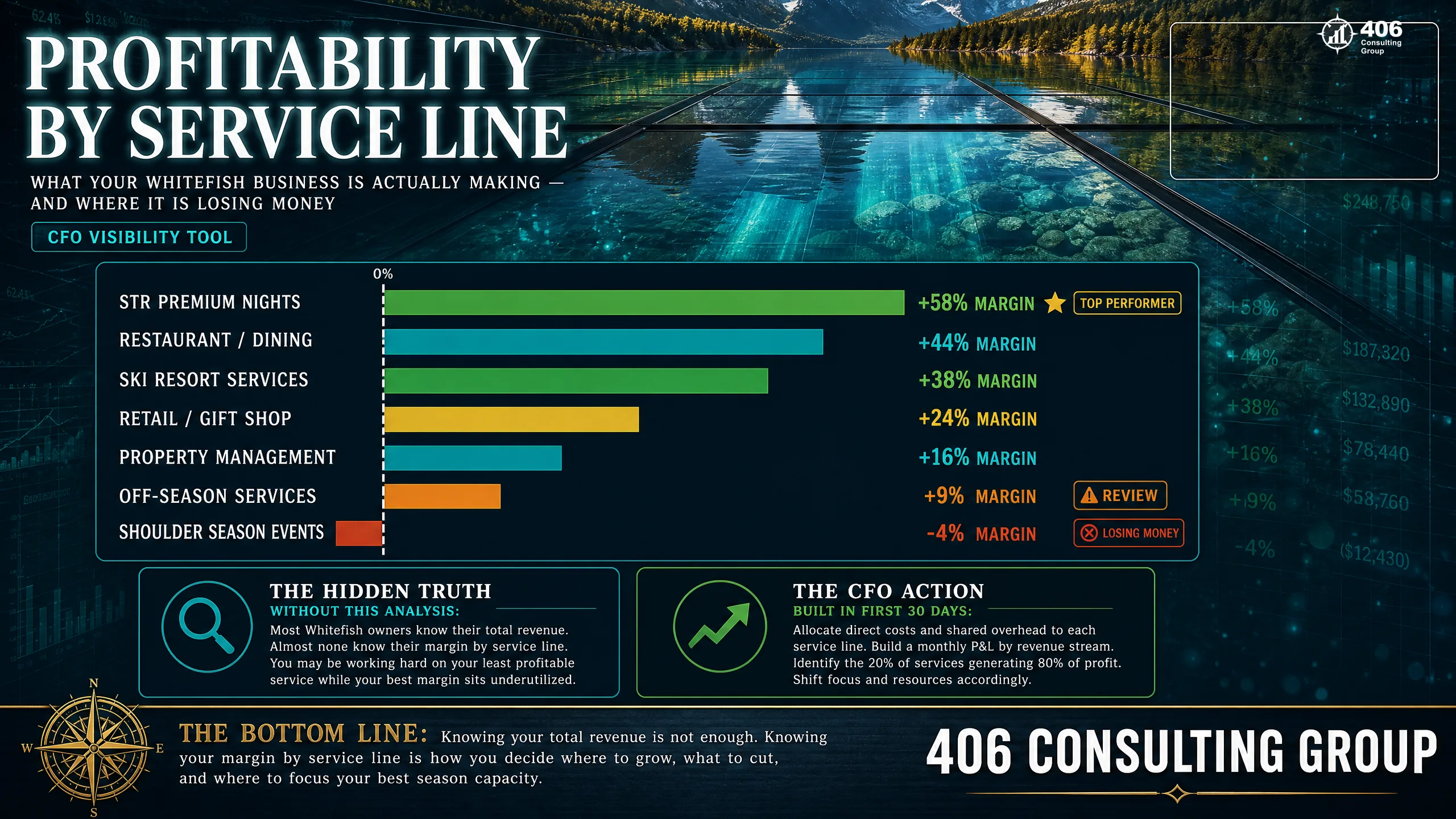
What "by segment" means depends on your business: a hospitality group needs profit by location; a short-term-rental operator needs it by property; a construction company needs job costing by project. In every case, the company can be profitable overall while one location, property, or job quietly runs at a loss, subsidized by the winners. Until you break it down, you keep pouring your best people and cash into work that doesn't pay.
The scaling Whitefish company, before & after
Before: three locations (or projects), all assumed to be "doing fine." After: segment-level profitability showed one location running a 4% margin while another ran 28% — the business had been feeding its strongest crew into its weakest performer. Reallocating toward the high-margin work added an estimated $110,000 to annual profit, with no new revenue required.
The money was already in the business. It just couldn't be seen without the right reporting. (Illustrative figures.)
Challenge 3: Seasonal Cash & Tax Swings → CFO
The short answer: Whitefish's dual-peak seasonality — ski season and summer, with slow shoulder months — makes cash flow genuinely hard, especially with resort and lodging taxes to set aside. A CFO builds a rolling forecast so you bank reserves in the peaks and glide through the valleys.
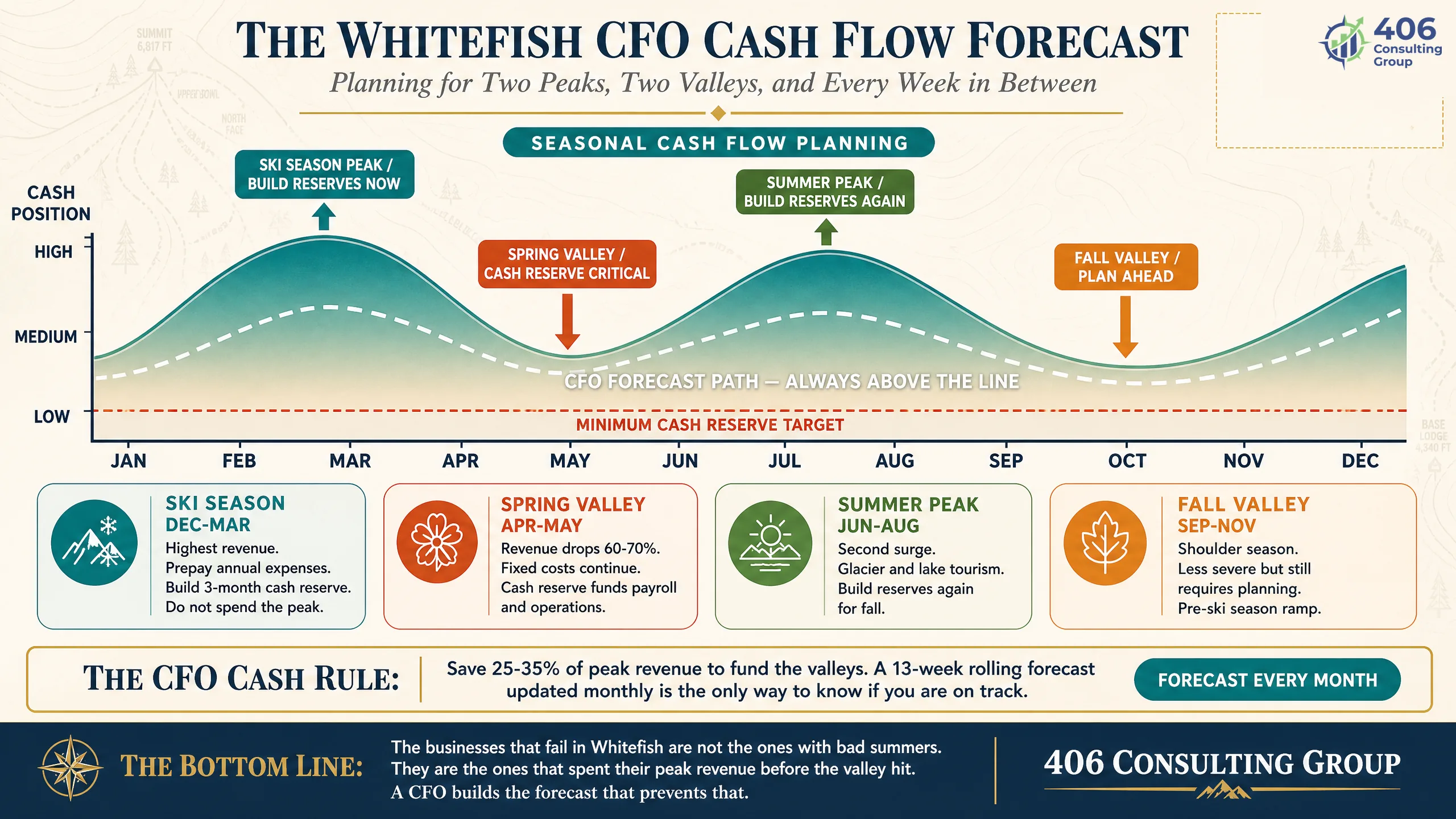
A growing Whitefish business earns in bursts and spends year-round. Add in the resort tax, the lodging taxes, and income tax — all of which come due regardless of the season — and a strong year can still produce a spring cash crisis if nobody planned for it. A CFO builds a rolling 13-week cash flow forecast that shows the shoulder-season squeeze weeks ahead, confirms the reserve will carry it, and keeps the taxes you owe separated from the cash you keep. The profit-versus-cash gap is its own trap; we break it down in why a profitable business can still be cash-poor.
Done right, seasonality stops being a source of stress and becomes something you manage on purpose — you know in January what August will fund, and you never spend the city's resort tax by accident.
Challenge 4: Financing the Next Move → CFO
The short answer: growth in Whitefish means capital decisions — a second location, buying your building instead of leasing in a rising market, new equipment — and a CFO makes your business fundable for them. Most businesses that get turned down had a lender-package problem, not a business problem.
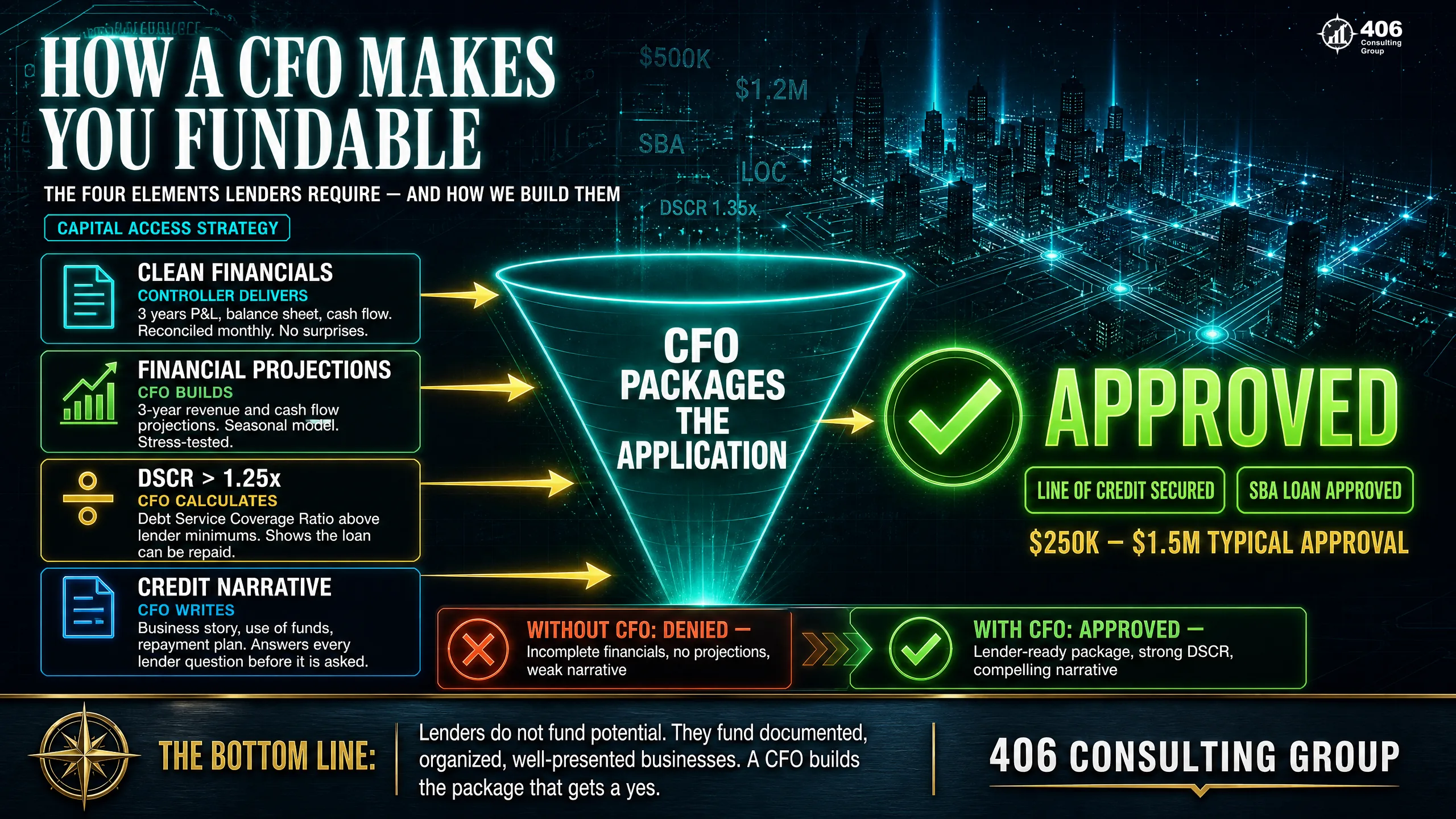
In a boomtown, the businesses that win are often the ones that can move on an opportunity — lock in a location, buy the property before prices climb again, add capacity ahead of demand. That takes financing, and financing takes preparation: clean financial statements, a multi-year projection, a debt-service-coverage calculation, and a narrative a lender believes. A CFO builds that package and manages the banking relationship. With a background on the lending side of the desk, we know exactly what a Montana bank wants to see — and what turns an application into an easy yes.
This is one of the clearest returns on a CFO: the difference between a stalled expansion and a funded one is usually just how the numbers are prepared and presented. See our CFO services for what that looks like in practice.
Challenge 5: The Owner Is the Bottleneck → Controller + CFO
The short answer: when every financial decision and number routes through the owner, the business can't scale past them — and it's fragile and hard to sell. A controller and CFO together install the systems and rhythm that let the finances run without the owner holding it all in their head.
This is the challenge that quietly caps growth. If you're the only one who understands the numbers, you're the ceiling — every decision waits on you, and you can't step back without the whole thing wobbling. A controller builds a repeatable monthly close and reporting rhythm; a CFO builds the forecasting and decision framework the leadership team can run from. The result is a business that runs on systems, not on the owner's memory — which is exactly what makes it durable, scalable, and, when the time comes, sellable for full value.
In a boom, this matters double: the owners who capture the opportunity are the ones who can delegate the finances and focus on growth, instead of being buried in spreadsheets while the market moves.
Fractional vs. Full-Time: The Cost Math
The short answer: for a Whitefish business under roughly $15M in revenue, fractional wins the math — you get senior controller and CFO expertise for a monthly retainer that's a fraction of full-time salaries, because you pay for the hours you actually need.
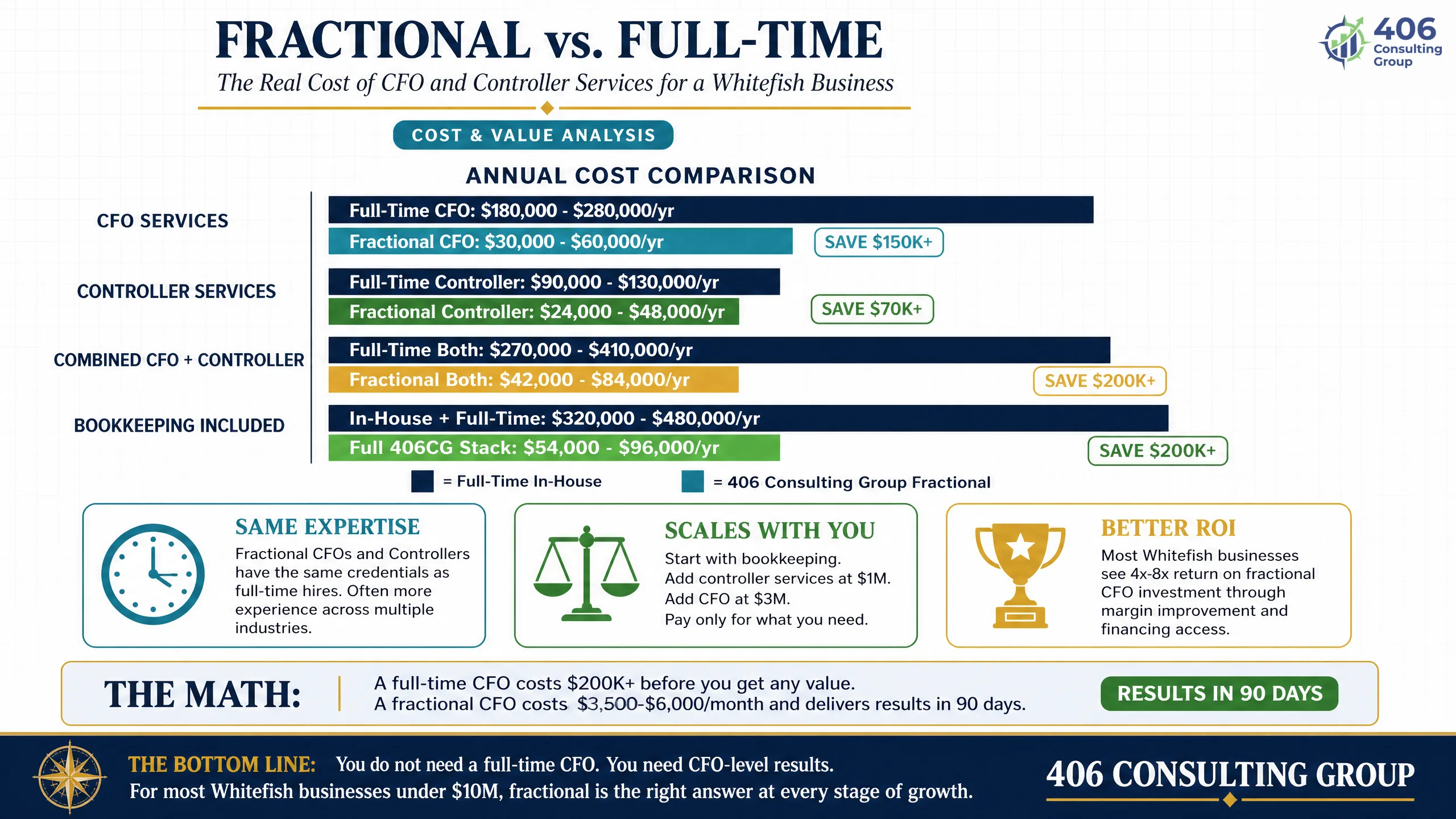
| Role | Full-time (salary + benefits) | Fractional (monthly retainer) |
|---|---|---|
| Controller | $85K–$120K salary + ~25% benefits | ~$2,500–$6,000 / month |
| CFO | $150K–$300K+ salary + ~25% benefits | ~$2,500–$5,000 / month |
| Both, coordinated | $235K–$420K+ all-in | ~$4,000–$8,000 / month |
The $3.5M Whitefish company's decision
A full-time controller in Montana would cost this business roughly $110,000 in salary plus about $28,000 in benefits and payroll taxes — call it $138,000 all-in — for capability it needs maybe two or three days a week. A fractional controller-plus-CFO engagement runs it about $6,000 a month, or $72,000 a year, for both roles and the hours it actually uses.
Roughly half the cost of one full-time hire — and it delivers the reliable close AND the growth strategy, not just one seat. Full-time only wins once volume keeps a senior person busy 40 hours a week, which for most Whitefish businesses is well past $15M. Run your own numbers with our financial maturity assessment. (Illustrative figures.)
Why a Local Flathead Valley Firm
The short answer: for a scaling Whitefish business, a local Flathead Valley firm brings context you can't get from a distant provider — we know the resort and lodging taxes, the ski-and-summer cash rhythm, the local banks you'll finance growth through, and the boom you're riding, because we're in it too.

We know the local taxes
The Whitefish resort tax and Montana lodging taxes aren't footnotes to us — they're part of the monthly reality we manage for valley businesses.
We know the seasons
We build cash forecasts around the ski-and-summer rhythm because we live the same calendar you do.
We know the local lenders
Financing growth means working with banks we already understand — which makes your lender package stronger.
We're in the boom with you
A local firm sees the growth, the wealth influx, and the market pressures firsthand — not from three states away.
How to Get Started
The short answer: start by figuring out which rung you're on — clean books first, then a controller for reliable reporting, then a CFO for strategy — and add the layer your growth is demanding. Here's the sequence.
Make sure the books are solid
A controller and CFO build on clean, current bookkeeping. If that's not in place yet, start there — it's the foundation.
Add the controller layer
Get a fast monthly close, segment-level profitability, and internal controls — reliable numbers you can scale on.
Add CFO strategy
Layer on seasonal cash forecasting, financing readiness, and growth planning — the decisions that move the business forward.
Run the monthly rhythm
Books closed, reporting delivered, forecast updated, and a monthly strategy conversation — a few focused days a month.
Reassess as you grow
As the business scales, the level of support scales with it. Review the engagement annually so it fits where you are.
Not sure which layer you need? The free financial maturity assessment takes about eight minutes and points you to the right next step — and our controller and CFO services pages show exactly what each engagement includes.
Frequently Asked Questions: CFO & Controller Services in Whitefish, MT
What's the difference between a controller and a CFO?
A controller owns the accounting function — closing the books accurately and on time, segment-level profitability (by location, property, or project), reporting, and internal controls. Their focus is making the numbers right. A CFO owns the finance function — using those reliable numbers to forecast cash, plan for seasonality, secure financing, and guide growth decisions. Their focus is deciding what to do next. A scaling business needs both: the controller produces trustworthy numbers, and the CFO turns them into strategy.
Does my growing Whitefish business need a controller or a CFO?
Start with a controller if your books close late or you can't trust the numbers, or if you can't tell which location, property, or project makes money — you need reliable reporting first. Add a CFO when your numbers are solid but you need seasonal cash forecasting, financing for expansion, or growth strategy. Most Whitefish businesses scaling through the boom benefit from both, fractionally. If your bookkeeping itself isn't clean and current yet, that's the place to start, because a controller builds on good bookkeeping and a CFO builds on a good controller.
How much do CFO and controller services cost in Whitefish, MT?
Fractional pricing in Montana typically runs about $2,500–$6,000 per month for a controller and about $2,500–$5,000 per month for a fractional CFO, depending on complexity, number of locations or entities, and scope. A coordinated engagement covering both often runs roughly $4,000–$8,000 per month. Compare that to full-time salaries — $85K–$120K for a controller and $150K–$300K+ for a CFO, plus roughly 25% in benefits — and fractional is dramatically more cost-effective until a business reaches the scale (generally $15M+) that keeps a full-time hire busy 40 hours a week.
What is a fractional CFO?
A fractional CFO is an experienced chief financial officer who works with your business part-time, on a monthly retainer, instead of as a full-time employee. You get senior-level financial strategy — cash flow forecasting, profitability analysis, financing, and growth planning — for the hours you actually need, typically a few days a month. For a growing Whitefish business that needs CFO-level thinking but can't justify a six-figure salary, the fractional model delivers the expertise without the full-time cost.
How do I manage cash flow in a seasonal Whitefish business?
Plan across the whole year instead of reacting month to month. Whitefish businesses typically earn in two peaks — ski season and summer — with slow spring and fall shoulder seasons, while resort tax, lodging tax, and income tax come due regardless. The key moves: keep a clean monthly close so you can see your real seasonal pattern, build a rolling 13-week cash flow forecast so the shoulder months are planned for, set aside cash and the taxes you owe during the busy seasons, and keep collected taxes separated from your operating cash. This is core CFO work and the single best defense against a slow-season crunch.
When should a Whitefish business hire a controller or CFO?
The clearest triggers: your books close late or you can't trust them (controller), you can't tell which location or project makes money (controller), cash gets tight in the shoulder seasons despite a strong year (CFO), a financing opportunity or expansion is on the table (CFO), or you're the only person who understands the finances and it's capping growth (both). Practically, most Whitefish businesses are ready for controller support in the $1M–$5M range and CFO support once the numbers are reliable and growth decisions are frequent — often $1.5M–$15M.
Does 406 Consulting Group provide CFO and controller services in Whitefish, MT?
Yes. 406 Consulting Group is a Flathead Valley firm providing fractional CFO, controller, bookkeeping, payroll, and tax services to businesses in Whitefish and across the valley. Because we're local, we know the resort and lodging taxes, the ski-and-summer seasonality, and the local banks firsthand — we deliver a fast monthly close, segment-level profitability, seasonal cash forecasting, and lender-ready financials, coordinated so the controller foundation and CFO strategy work together. Contact us to talk through where your business is and what a fractional engagement would look like.
Helpful Resources
Related Tools & Resources
CFO & Controller — Whitefish, MT
Scale the Boom — Without Losing Control of the Numbers.
406 Consulting Group gives growing Whitefish businesses the controller foundation and the CFO strategy — a fast monthly close, profitability by location, seasonal cash forecasting, and lender-ready financials — from a local Flathead Valley firm that knows your market. Let's build the finance function your growth needs.
CFO & Controller Quick Reference
Whitefish, MT
The Growth-Ready Finance Framework
5 challenges → which role
Scaling in Whitefish?
Get controller + CFO help, locally.
About the Author
Jason Anderson
Co-Founder, 406 Consulting Group
A Flathead Valley local with an operational finance background at BP. Jason helps Whitefish businesses scale through the boom without losing control of the numbers — building the controller foundation and CFO strategy that turn fast growth into managed, profitable growth.
Read the Full Story