
Bookkeeping Services in Whitefish, MT:
A Local Guide for a Booming Resort Town
Whitefish is booming — and the bookkeeping is trickier than most owners realize. The 3% resort tax, Montana's 8% lodging taxes, and double-peak seasonality all have to be handled right. Here's the local guide, from a Flathead Valley firm.

Whitefish is booming. The wealth moving into the Flathead Valley has turned a mountain town into one of Montana's hottest markets — new restaurants and shops, a surge in short-term rentals, high-end custom homes going up, and trades and service businesses working flat out to keep pace. It's a great time to own a business in Whitefish. It's also a time when the bookkeeping quietly gets more complicated than most owners realize.
Bookkeeping services in Whitefish, MT have to handle things a generic setup misses: the city's 3% resort tax, Montana's 8% lodging taxes on short-term stays, and the double-peak seasonality of a town that lives off ski season and summer. Get those wrong and you're either out of compliance, sitting on money you owe the city and state, or flying blind through your slow months. Get them right and you can actually enjoy the growth instead of being buried by it.
This is a local guide from a local firm. We're based right here in the Flathead Valley, so this isn't theory — it's the resort tax, the lodging taxes, the seasonal swings, and the growth realities we help Whitefish businesses handle every month. We'll cover what professional bookkeeping delivers, the Whitefish-specific taxes your books must track, how to manage cash across the seasons, and how to keep your financial house in order while the town grows up around you.
By Carrie Anderson — Co-Founder, 406 Consulting Group, a Flathead Valley firm. Background in commercial banking, underwriting, and tax strategy, applied to businesses right here in Whitefish and across the valley.
Quick Answer: What's Different About Whitefish Bookkeeping
- →Whitefish has a 3% resort tax on lodging, dining, alcohol, ski goods, and luxury retail — collected by businesses and remitted to the city.
- →Montana adds 8% lodging tax on stays under 30 days — so a Whitefish short-term rental collects about 11% total.
- →These taxes are liabilities, not income — money you hold and remit, not revenue to spend.
- →Seasonality is double-peaked — ski season and summer, with slow shoulder seasons that require cash planning.
- →Rapid growth strains the books — scaling fast means your bookkeeping has to keep up or you lose the thread.
Table of Contents
What Professional Bookkeeping Actually Delivers
The short answer: professional bookkeeping delivers accurate, current financial records that keep you compliant with Whitefish and Montana tax rules, tell you the truth about your business, and make tax time and financing painless. In a fast-growing town, it's also what keeps growth from outrunning your ability to manage it.
Compliance you can trust
Resort tax and lodging taxes filed and remitted correctly and on time, plus clean income tax records — the things that quietly generate penalties when they slip.
Books that reconcile
Every account tied to the bank and reconciled monthly, so when you look at a number, you can believe it.
Reports you can use
A profit-and-loss and balance sheet you can actually read — the basis for real decisions as you grow.
Year-round readiness
Clean books mean tax season is a handoff, a loan or expansion is backed by numbers, and you always know where you stand.
The Whitefish Difference: Resort Tax in a Growth Economy
The short answer: Whitefish bookkeeping is different because of three things at once — a local 3% resort tax most Montana towns don't have, Montana's lodging taxes on the booming short-term-rental market, and a growth-and-seasonality combination that makes cash management genuinely tricky. Miss any of them and the books stop telling the truth.
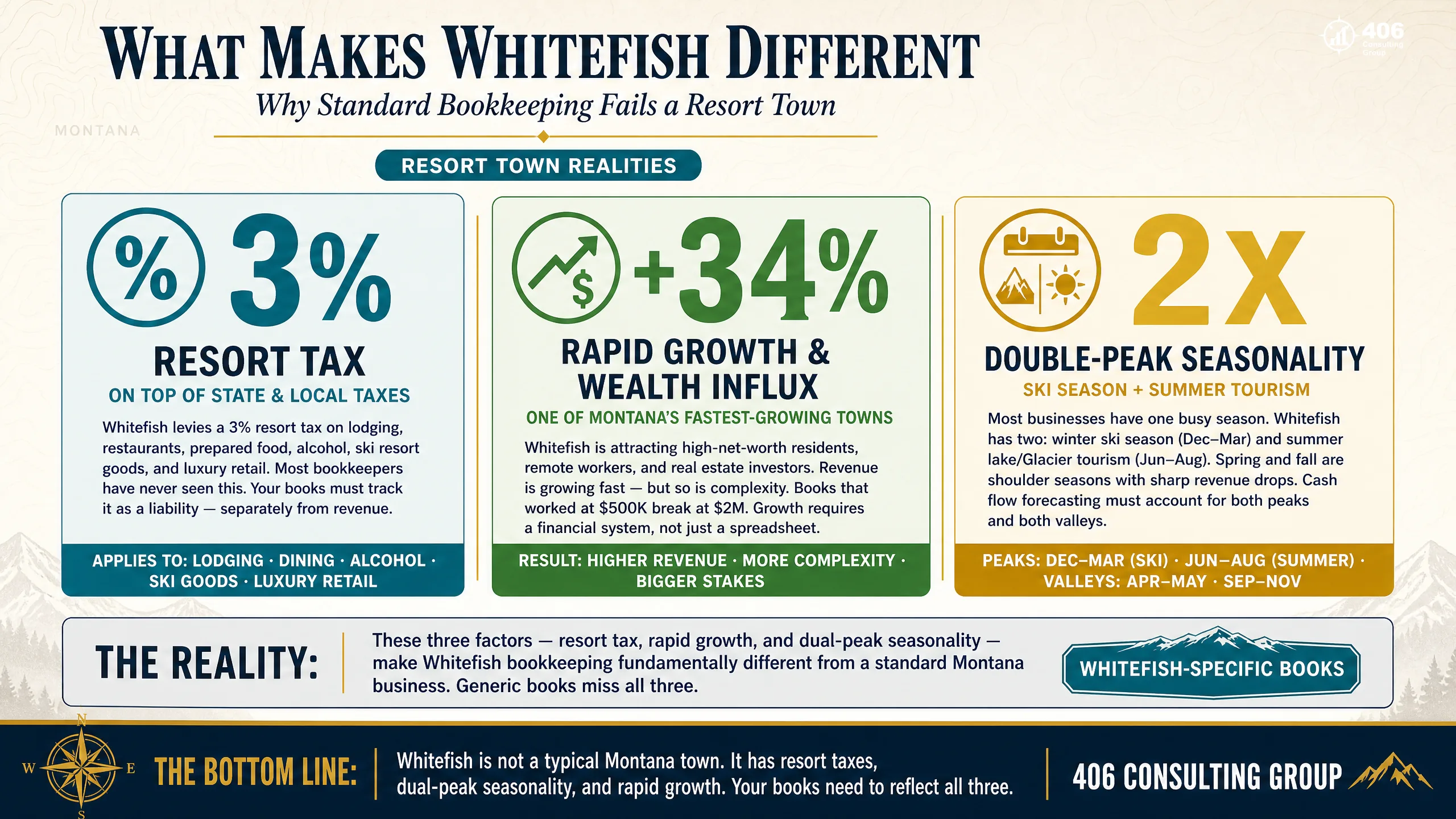
Montana famously has no general sales tax — which lulls a lot of owners into thinking there's no sales-type tax to worry about. In Whitefish, that's wrong. As a designated resort community, Whitefish levies its own resort tax on the things a resort town sells: lodging, meals, drinks, and luxuries. Layer on Montana's lodging taxes for anyone renting to visitors, and a Whitefish hospitality business is collecting and remitting more tax than a business almost anywhere else in the state — it's just local and targeted rather than a broad statewide sales tax.
Add the growth. Whitefish businesses are scaling fast in a high-demand, high-cost, high-expectation market — with wealthy customers and second-home owners who expect polish. That growth is exciting, but it strains the books: more transactions, more staff, more complexity, and less room for the "shoebox" approach that worked when the business was small.
The Whitefish Resort Tax: What It Is and How to Track It
The short answer: the Whitefish resort tax is a 3% local tax on the retail sale of lodging, prepared food and restaurant meals, alcoholic beverages, ski resort goods and services, and defined luxury items. If you sell any of those, you collect the 3%, hold it as a liability, and remit it to the City of Whitefish. It does not apply to necessities.
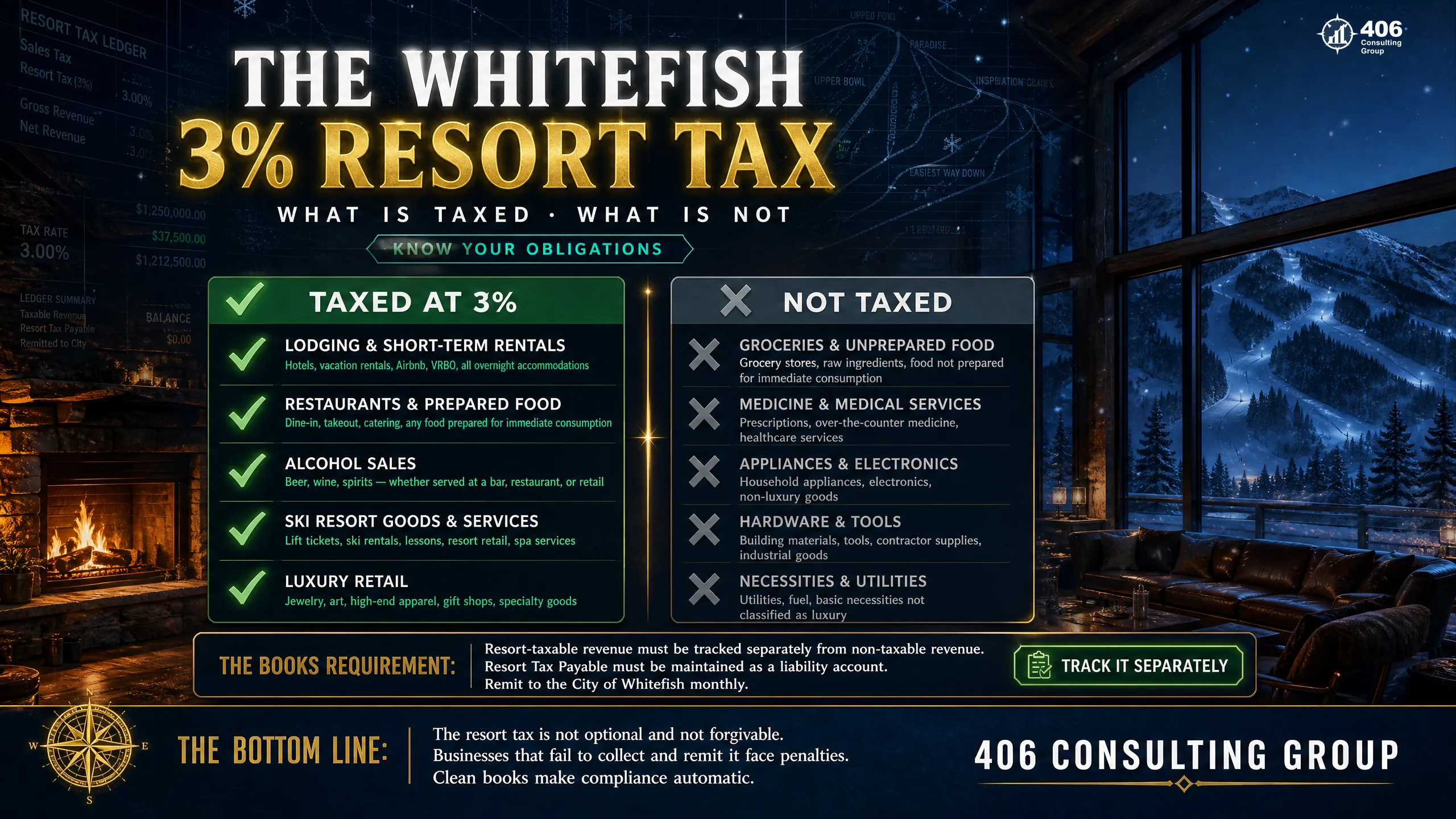
Subject to the 3% resort tax
- Lodging (hotels, motels, short-term rentals)
- Restaurants & prepared food
- Alcoholic beverages
- Ski resort goods and services
- Defined luxury / non-essential retail items
Not subject to resort tax
- Unprepared food / groceries
- Medicine, medical supplies and services
- Appliances
- Hardware, supplies, and tools
- Other necessities of life
The Whitefish restaurant, in numbers
Take a Whitefish restaurant-and-retail business doing about $1.4M a year. Its prepared food, drinks, and luxury retail are resort-taxable; a few grocery-type or necessity items are not. On, say, $1.3M of taxable sales, that's roughly $39,000 of resort tax collected over the year — money that belongs to the City of Whitefish, not the business.
The bookkeeping key: that $39,000 is a liability, not revenue. Booked as income, it inflates the business's sales, and the cash gets spent — so when the monthly resort tax remittance is due, the money's gone. This is the single most common resort-tax mistake. (Illustrative figures.)
Because some of what you sell is taxable and some isn't, your books have to separate resort-taxable from non-taxable sales — the same discipline that lets you file the return accurately and prove it if the city ever asks. Verify current rules and rates with the City of Whitefish.
Montana Lodging Taxes (8%)
The short answer: on top of the resort tax, Montana charges an 8% lodging tax on short-term stays (under 30 days) — a 4% lodging facility use tax plus a 4% lodging sales tax. For a Whitefish short-term rental, that stacks with the 3% resort tax for roughly 11% in total taxes on the stay.
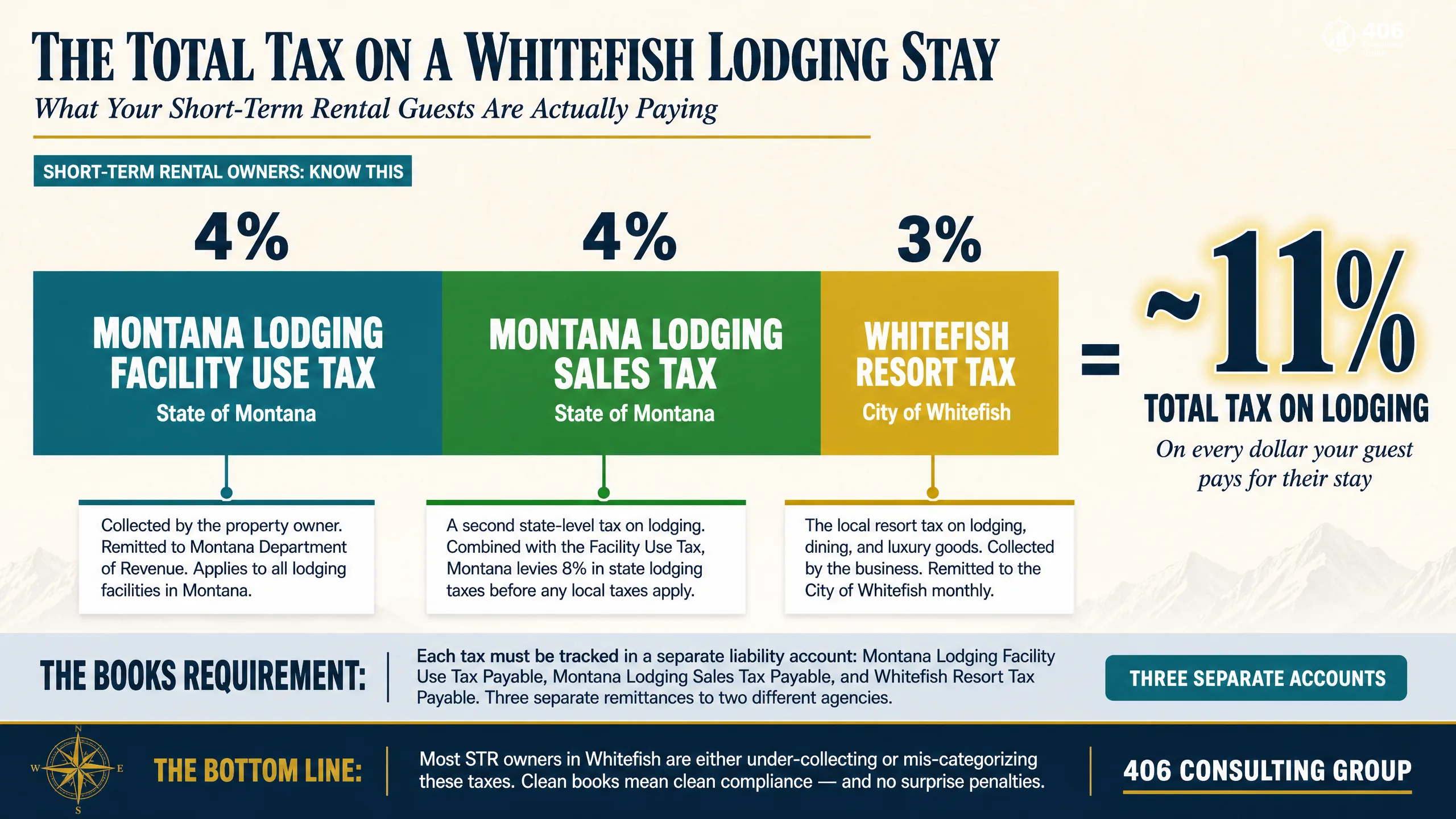
| Tax on a Whitefish short-term stay | Rate | Goes to |
|---|---|---|
| Montana Lodging Facility Use Tax | 4% | State of Montana |
| Montana Lodging Sales Tax | 4% | State of Montana |
| Whitefish Resort Tax | 3% | City of Whitefish |
| Total | ~11% | Collected from the guest |
Montana's lodging taxes apply to the full amount charged the guest — the nightly rate plus cleaning fees, pet fees, and similar charges that are part of the stay. Booking platforms like Airbnb and VRBO generally collect and remit the state lodging taxes on reservations they facilitate, but you still need to account for it correctly, and you can't assume a platform is handling every local obligation. This is exactly where a bookkeeper who knows Montana and Whitefish earns their fee.
Rules and rates change, and platform collection can vary by tax and by year. Confirm what applies to your property with the Montana Department of Revenue and the City of Whitefish — and make sure your books reflect what you (versus the platform) are actually remitting.
Bookkeeping for Short-Term Rentals & Hospitality
The short answer: short-term rentals and hospitality are the heart of Whitefish's visitor economy, and they carry the most bookkeeping complexity — platform payouts that don't match gross bookings, taxes to separate out, and heavy seasonality. Clean books here are the difference between a profitable rental and a confusing one, and solid vacation rental accounting turns scattered platform payouts into a clear picture of per-property profit.
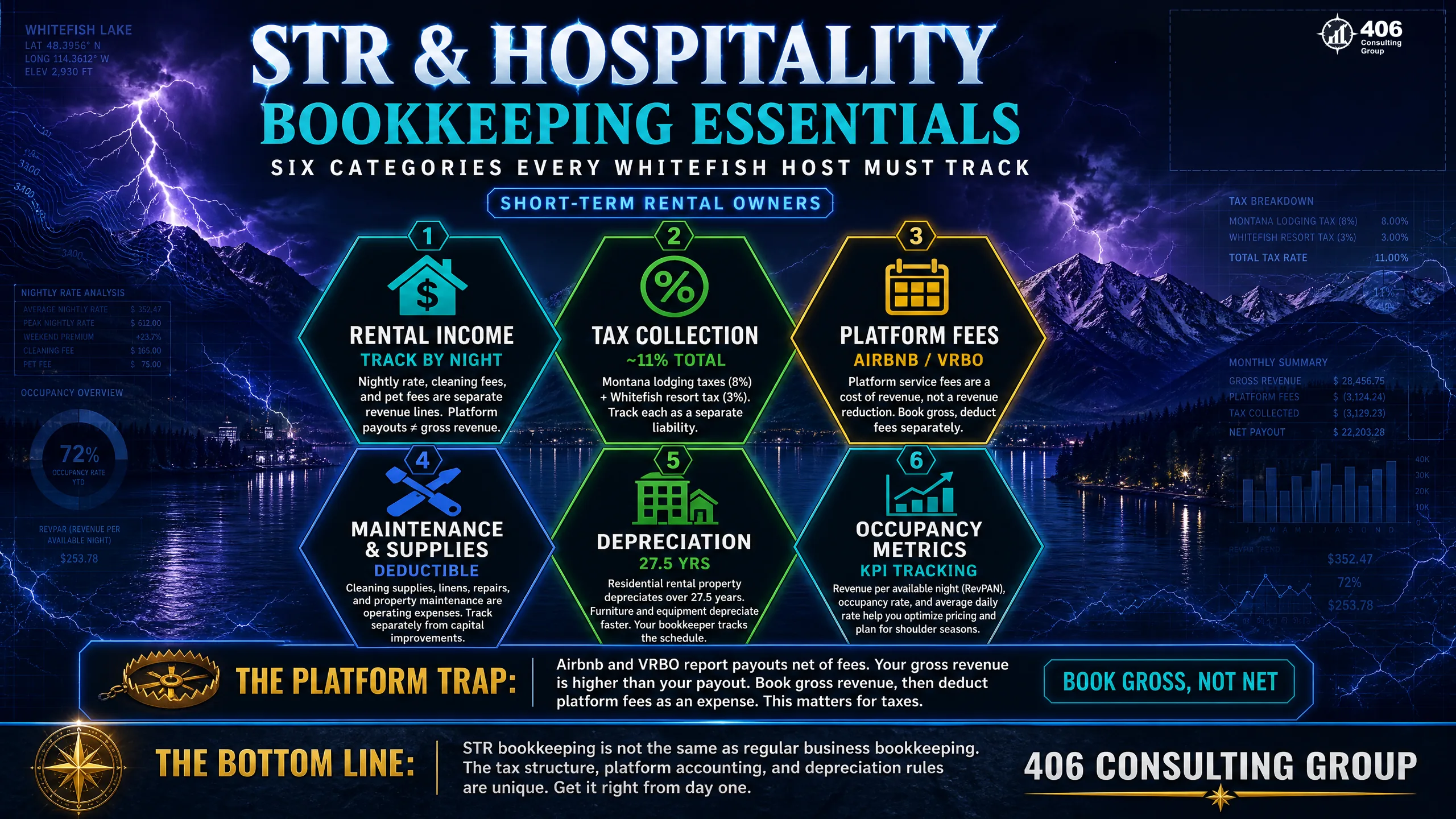
Gross bookings vs. what hits your bank
Airbnb and VRBO deposit a net payout — after their service fees, and sometimes after taxes they've collected and remitted. Your books need to record the gross booking, the platform fees, and the taxes correctly, not just the net deposit. Recording only the payout understates both your revenue and your expenses and makes the taxes impossible to reconcile.
Taxes are pass-through, not income
The lodging and resort taxes a guest pays are never your revenue — whether you or the platform remit them. Books that treat collected tax as income overstate the business and set up a cash problem when remittance is due.
Track occupancy and cost per property
If you run more than one unit, track revenue and costs by property so you can see which actually makes money after cleaning, management, maintenance, and taxes. It's the short-term-rental version of job costing.
Restaurants, bars, and retail shops share the same core disciplines — separating taxable from non-taxable sales, treating collected tax as a liability, and tracking tips and inventory. Get the structure right once and every month gets easier.
Seasonal Cash Flow in a Resort Town
The short answer: Whitefish runs on two busy seasons — winter ski season and summer — with slow shoulder seasons in between. Books that only record the past won't get you through April and October; you need to plan cash across the whole year, banking reserves in the peaks to carry the valleys.
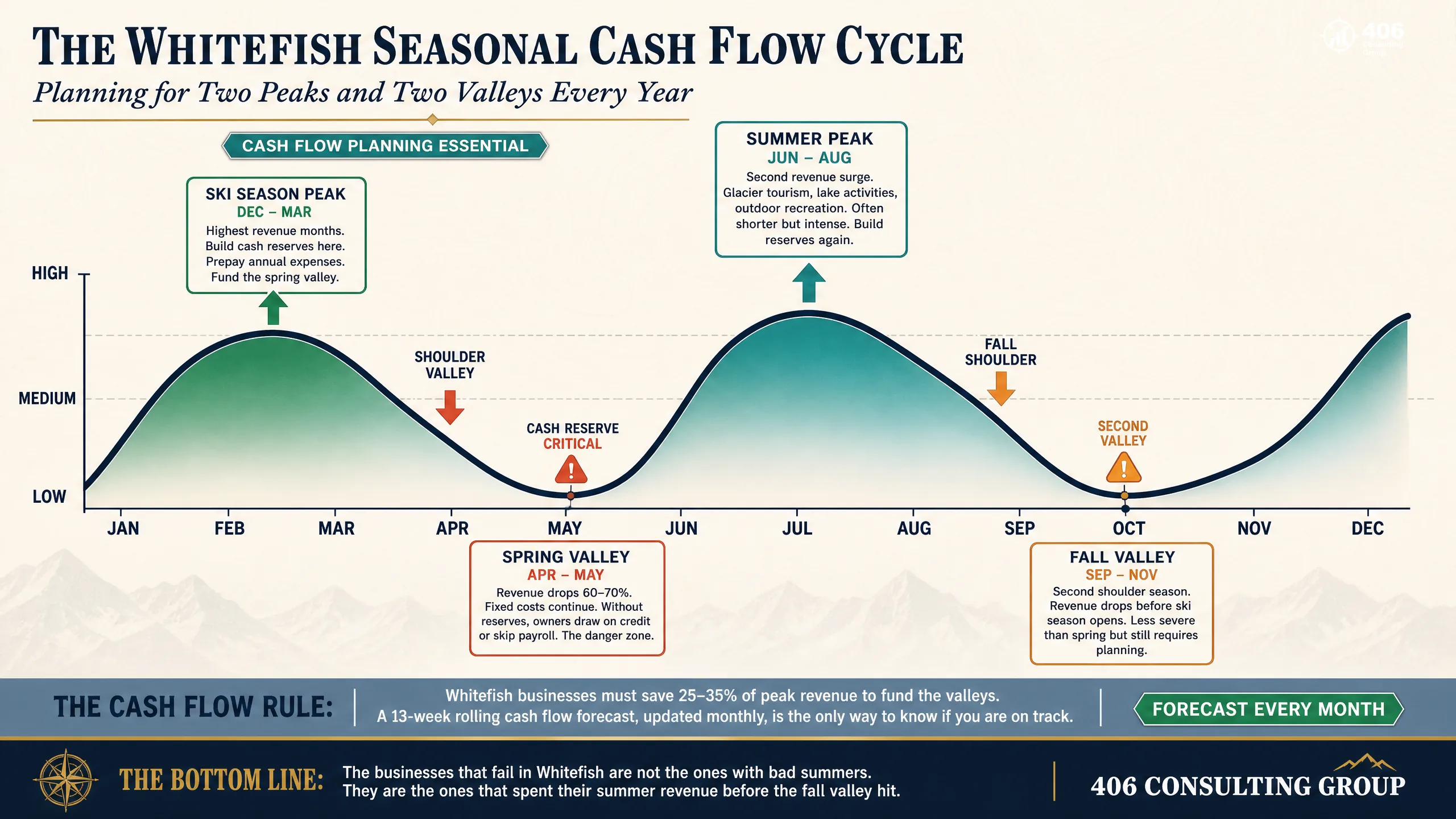
A Whitefish business might earn the bulk of its year in two bursts — the ski months and the summer tourist season — while spring and fall go quiet. That's fine if the books help you see it and plan for it. It's a problem if every shoulder season feels like a surprise and you're scrambling to cover payroll and the tax remittances that come due regardless of how slow business is.
See the two peaks
Clean monthly books reveal your real seasonal pattern, so you know which months fund which.
Reserve in the peaks
Set aside cash — plus the resort and lodging taxes you owe — during the busy seasons to carry the slow ones.
Forecast the shoulders
A simple rolling cash forecast turns 'I hope we're okay in April' into a number you can plan around.
The trap: spending peak-season cash as if it's all yours — when part of it is resort tax, lodging tax, and income tax you owe, and part of it has to carry you through the shoulder months. Books that separate what you owe from what you keep are what prevent the slow-season scramble.
Bookkeeping for the Growth Economy
The short answer: Whitefish's rapid growth and wealth influx are a huge opportunity — and a stress test for your books. Scaling fast means more transactions, more staff, bigger jobs, and higher-end clients, and the informal bookkeeping that worked at $400K breaks down at $1.5M. Growth is exactly when clean books matter most.
The money moving into the valley is fueling a construction and service boom — high-end custom homes, second homes, and the trades and vendors who serve them. For those businesses, growth ties up cash in materials, payroll, and receivables before the revenue collects, so the books have to track it carefully. If you're a contractor chasing this high-end work, the financial readiness that wins and survives it is its own discipline — we cover it in our guide on getting developer-ready for luxury projects.
What growth demands from your books
The Chart of Accounts a Whitefish Business Needs
The short answer: the default chart of accounts in your accounting software wasn't built for a resort town. A Whitefish business needs a few local additions — revenue split by resort-taxable vs. not, and resort and lodging taxes handled as liabilities — so the books produce the right numbers automatically.

Revenue — split for resort tax
Resort-Taxable Sales
Dining, alcohol, lodging, luxury retail (3% applies)
Non-Taxable Sales
Groceries/necessities and exempt items
Lodging Revenue
Short-term stays — subject to lodging + resort tax
Tax liabilities — not income
Resort Tax Payable
Collected for the City of Whitefish
Lodging Taxes Payable
Montana 8% on short-term stays
Income Tax Set-Aside
Accrue so it's never a surprise
Cost of sales
Food & Beverage COGS
For restaurants and bars
Inventory / Retail COGS
For shops
Property / Cleaning Costs
For short-term rentals, by unit
Operating & seasonal
Payroll & Tips
Separate tips; heavy seasonal swings
Platform Fees
Airbnb/VRBO service fees
Cash Reserve (tracked)
The buffer that carries the shoulder seasons
What Bad Bookkeeping Actually Costs
The short answer: in Whitefish, bad bookkeeping costs you in resort and lodging tax penalties, spent money you owed the city and state, missed deductions, and decisions made on numbers that were never right. In a fast, seasonal, high-tax-touch economy, the leaks add up quickly.
Resort & lodging tax penalties
Late or incorrect remittances to the city and state generate penalties and interest — worse when collected tax was booked as income and spent before it was due.
Spending tax money by accident
Treating collected resort and lodging tax as revenue is the classic resort-town mistake: the money feels like yours until the remittance comes due and it isn't there.
Shoulder-season cash crises
Without seasonal planning, the slow months catch owners flat — scrambling for payroll while taxes still come due.
Growth outrunning the books
Scaling fast on informal books means you lose visibility exactly when the stakes are highest — and can't tell which parts of the growth actually pay.
Decisions on bad numbers
The biggest hidden cost: pricing, hiring, and expansion decisions based on books that don't reflect reality.
The Resort-Town Books Framework
Here's the setup we build for a Whitefish business so the books handle the resort economy automatically instead of leaving it to chance. Five layers, in order.
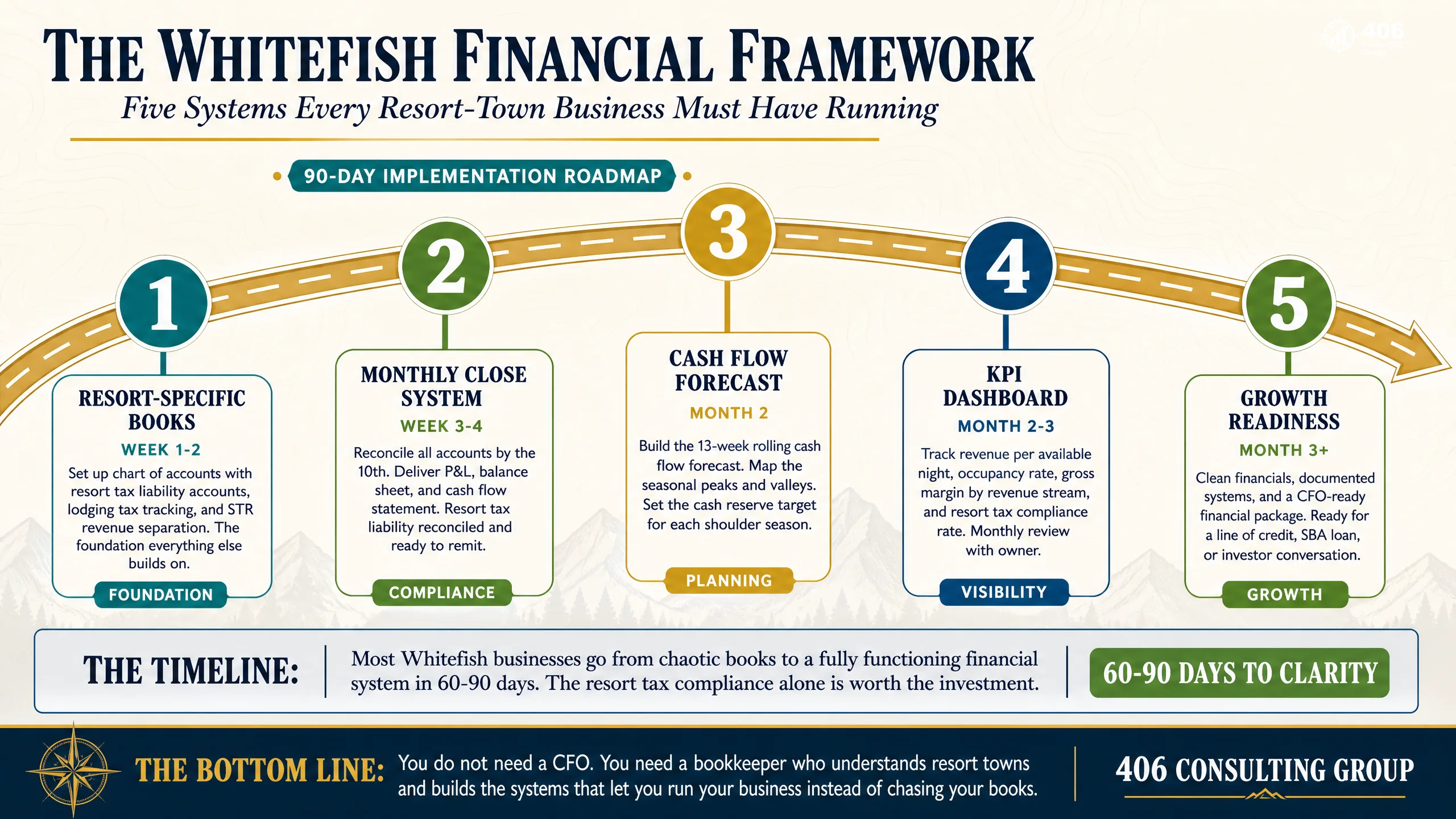
Revenue split by resort-taxable vs. not
Taxable dining, lodging, alcohol, and luxury sales tracked separately from exempt items — so the resort tax return is right and provable.
Resort & lodging taxes as liabilities
Collected resort and lodging taxes parked in liability accounts, so the money is there when it's due to the city and state.
A clean monthly close
Books reconciled to the bank every month — the difference between current reality and a year-old guess, and essential as you grow.
A dual-peak seasonal forecast
A rolling cash-flow forecast built around ski and summer peaks and the shoulder-season valleys between them.
Books built to scale
A structure and rhythm that grows with the business — ready for controller or CFO support when Whitefish's growth calls for it.
Why Work With a Local Flathead Valley Firm
The short answer: for a Whitefish business, working with a local Flathead Valley firm means working with people who already know the resort tax, the ski-and-summer rhythm, the local banks, and the growth pressures firsthand — not a distant provider learning your market on your dime. Here, local knowledge is the specialized expertise.
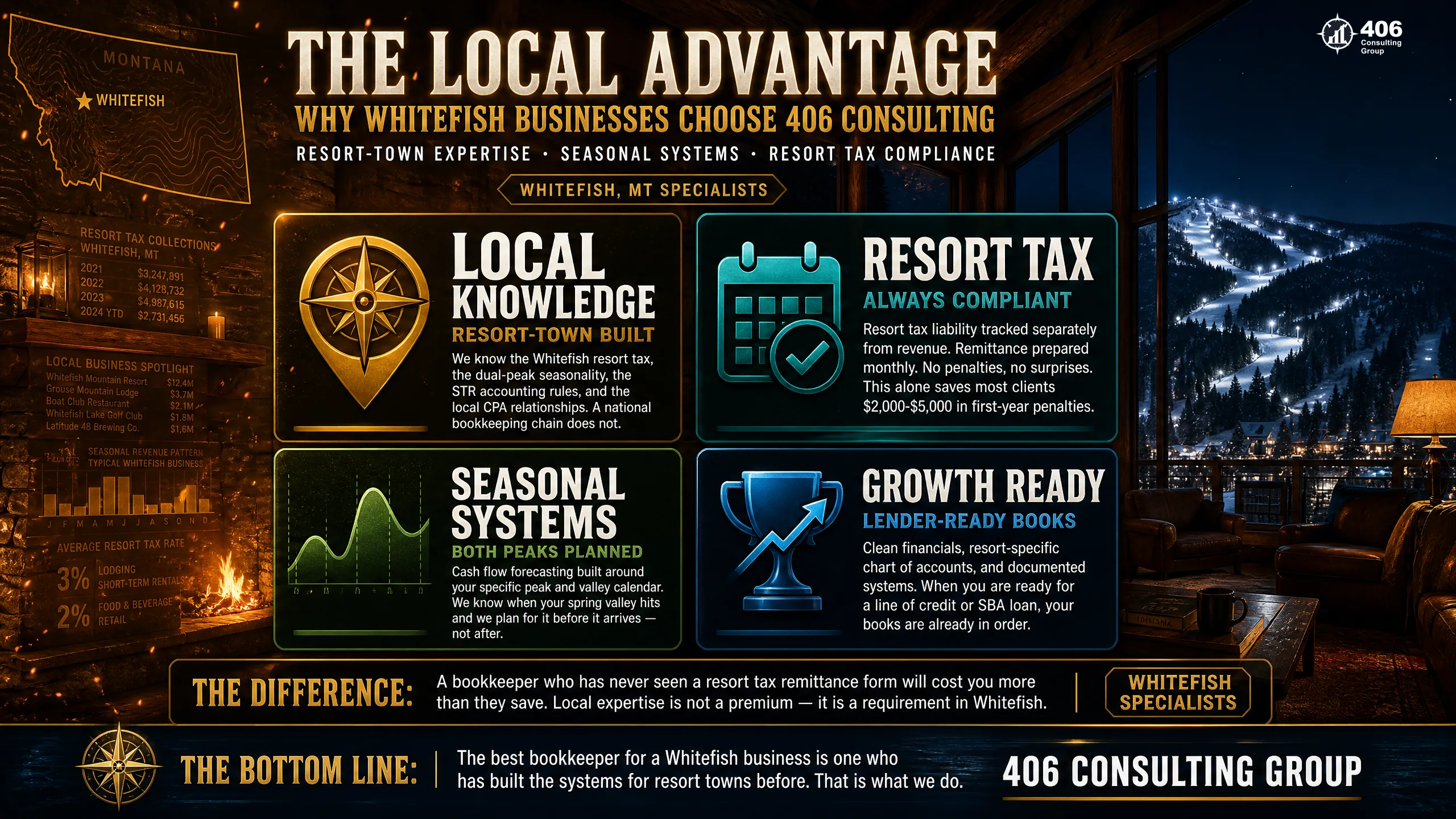
We know the resort tax cold
It's not a footnote we looked up — it's a monthly reality for the Whitefish businesses we work with.
We know the seasons
We understand the ski-and-summer cash rhythm because we live it in the same valley you do.
We know the market
The growth, the wealth influx, the high-end clientele, the local lenders — the context your numbers live in.
We're part of the community
A local firm is invested in the same place you are, not managing your books from three states away.
When you choose a Whitefish accountant or bookkeeper, the questions that matter are simple: do they understand the Whitefish resort tax and Montana lodging taxes, do they keep collected taxes out of your revenue, will they close your books every month, and can they grow with you? We do all four — see our bookkeeping services and our nearby Kalispell bookkeeping guide, and estimate your scope with our bookkeeping estimator.
Frequently Asked Questions: Whitefish Bookkeeping
Does Whitefish have a resort tax?
Yes. As a designated resort community, the City of Whitefish levies a 3% resort tax on the retail sale of lodging, restaurant and prepared food, alcoholic beverages, ski resort goods and services, and defined luxury items. Businesses that sell those goods and services collect the 3% from customers, hold it as a liability, and remit it to the city. The tax does not apply to necessities such as unprepared food (groceries), medicine and medical services, appliances, and hardware or tools. Montana has no general statewide sales tax, so this local resort tax surprises owners who assume there's no sales-type tax to collect.
What is the Whitefish resort tax and what does it apply to?
The Whitefish resort tax is a 3% local tax on 'luxury' or non-essential goods and services typical of a resort town: lodging, restaurants and prepared food, alcoholic beverages, ski resort goods and services, and defined luxury retail items. It does not apply to necessities of life — unprepared food, medicine and medical supplies, appliances, hardware, supplies, and tools. Because a single business often sells both taxable and non-taxable items, your bookkeeping needs to separate resort-taxable sales from exempt sales to file accurately. Confirm current rules and rates with the City of Whitefish.
Does my Whitefish business owe Montana lodging tax?
If you rent lodging for stays under 30 days — a hotel, motel, or short-term rental — yes. Montana imposes an 8% lodging tax (a 4% lodging facility use tax plus a 4% lodging sales tax) on the full amount charged the guest, including cleaning and similar fees that are part of the stay. In Whitefish, the 3% resort tax stacks on top, for roughly 11% total. Booking platforms like Airbnb and VRBO generally collect and remit the state lodging taxes on reservations they facilitate, but you still need to account for it correctly and confirm which local obligations remain yours. Verify specifics with the Montana Department of Revenue.
How do I handle bookkeeping for a short-term rental in Whitefish?
Record the gross booking, the platform's service fees, and the taxes separately — not just the net payout that lands in your bank. Treat lodging and resort taxes as liabilities (they're never your revenue), whether you or the platform remit them. Track revenue and costs by property if you have more than one unit, so you can see which actually makes money after cleaning, management, maintenance, and taxes. And plan for Whitefish's seasonality. Done right, your books show true per-property profitability and keep you compliant with both Montana and city taxes.
How much do bookkeeping services cost in Whitefish, MT?
Cost depends on your transaction volume, number of accounts, complexity (resort tax, lodging tax, multiple properties or locations), and how clean your books are to start. Most small business bookkeeping is priced as a flat monthly fee based on scope. The most useful comparison isn't price alone — it's price against what bad bookkeeping quietly costs in resort and lodging tax penalties, missed deductions, and decisions made on bad numbers. A scope-based estimate is the fastest way to see where your business would land.
How do seasonal Whitefish businesses manage cash flow?
By planning across the whole year rather than reacting month to month. Whitefish businesses typically earn in two peaks — ski season and summer — with slow spring and fall shoulder seasons. The key moves: keep a clean monthly close so you can see your real seasonal pattern, set aside cash and the taxes you owe during the busy seasons to carry the slow ones, and run a simple rolling cash flow forecast so the shoulder months are planned for, not survived. Separating the money you owe (resort, lodging, and income taxes) from the money you keep is what prevents the slow-season scramble.
Does 406 Consulting Group provide bookkeeping services in Whitefish, MT?
Yes. 406 Consulting Group is a Flathead Valley firm providing bookkeeping, controller, payroll, and tax services to businesses in Whitefish and across the valley. Because we're local, we know the Whitefish resort tax, Montana lodging taxes, the ski-and-summer seasonality, and the growth economy firsthand — we set up books that track resort-taxable sales correctly, treat collected taxes as liabilities, close every month, and scale as your business grows. Contact us for a scope-based quote and a conversation about your Whitefish business.
Official Resources
Related Tools & Resources
Local Bookkeeping — Whitefish, MT
Grow With Confidence — On Books That Know Whitefish.
406 Consulting Group is a Flathead Valley firm that keeps the books for Whitefish businesses the local way — resort tax and lodging taxes handled correctly, seasonal cash flow planned, and books built to scale with the boom. Let's make sure your growth is on a solid foundation.
Whitefish Tax Quick Reference
Verify current rates with the city / DOR
The Resort-Town Books Framework
Whitefish Business Growing Fast?
Local books built for the boom.
About the Author
Carrie Anderson
Co-Founder, 406 Consulting Group
A Flathead Valley local with a background in commercial banking, underwriting, and tax strategy. Carrie helps Whitefish businesses keep clean, compliant books through the resort tax, the seasons, and the growth — with the perspective of someone who knows the valley firsthand.
Read the Full Story