
Discovery Land Is Building on Flathead Lake.
Here's How Montana Contractors Win the Work.
Discovery Land's Flathead Lake Club — 1,700 acres, 359 lots, five phases — is one of the biggest high-end builds the Flathead Valley has seen. But luxury developers vet subs hard: your financials are your résumé. Here's how to get developer-ready and win the work.

Discovery Land Company is building on Flathead Lake. Their new community, the Flathead Lake Club, covers 1,700 acres just south of Lakeside — 359 residential lots, two private golf courses, a marina, and a build-out that runs in five phases starting in 2026. For contractors and subcontractors across the Flathead Valley, this is one of the largest high-end construction opportunities the area has seen in years.
Here is the part most local trades haven't thought through yet. A developer like Discovery Land — the same company behind the Yellowstone Club in Big Sky and Iron Horse in Whitefish — does not hand work to whoever shows up with a truck and a bid. They build for celebrities, executives, and ultra-high-net-worth families who expect flawless execution. Before a subcontractor ever gets to bid, they get vetted: insurance, bonding, financial statements, references, and a work-in-progress schedule. The disorganized shop is screened out before the conversation even starts.
Which means the contractors who win this work aren't necessarily the ones with the best trucks or the lowest price. They're the ones who look like a real, stable operation on paper — because at this level, your financials are your résumé. This guide covers exactly what "developer-ready" means, the seven things a luxury developer prequalifies subs on, the cash-flow trap that sinks small contractors on big jobs, and how doing this right can open doors for years.
By Carrie Anderson — Co-Founder, 406 Consulting Group. Background in commercial banking and underwriting — 300+ loan reviews, including construction lending and bonding-related financials — plus small business advisory across Montana's Flathead Valley.
Quick Answer: How to Win Work on a Development Like This
- →Get prequalified first: Luxury developers vet subs on financials, insurance, bonding, references, and a WIP schedule before you can bid.
- →Your books are your résumé: Clean, current financial statements signal you're a stable operation that will finish the job.
- →Plan for the cash-flow gap: Long draw cycles plus 5–10% retainage mean you float payroll and materials for months.
- →Bonding capacity matters: It's driven by working capital, clean financials, and a WIP schedule — not just how good your work is.
- →The upside compounds: One great project opens doors to more lots, referrals, and other communities — if you're built to scale into it.
Table of Contents
What's Being Built at the Flathead Lake Club
The short version: the Flathead Lake Club is a 1,700-acre private luxury community on the west shore near Lakeside, developed by Discovery Land Company, with 359 home sites and years of construction ahead across five phases. For local trades, that's a multi-year pipeline of custom-home and infrastructure work.
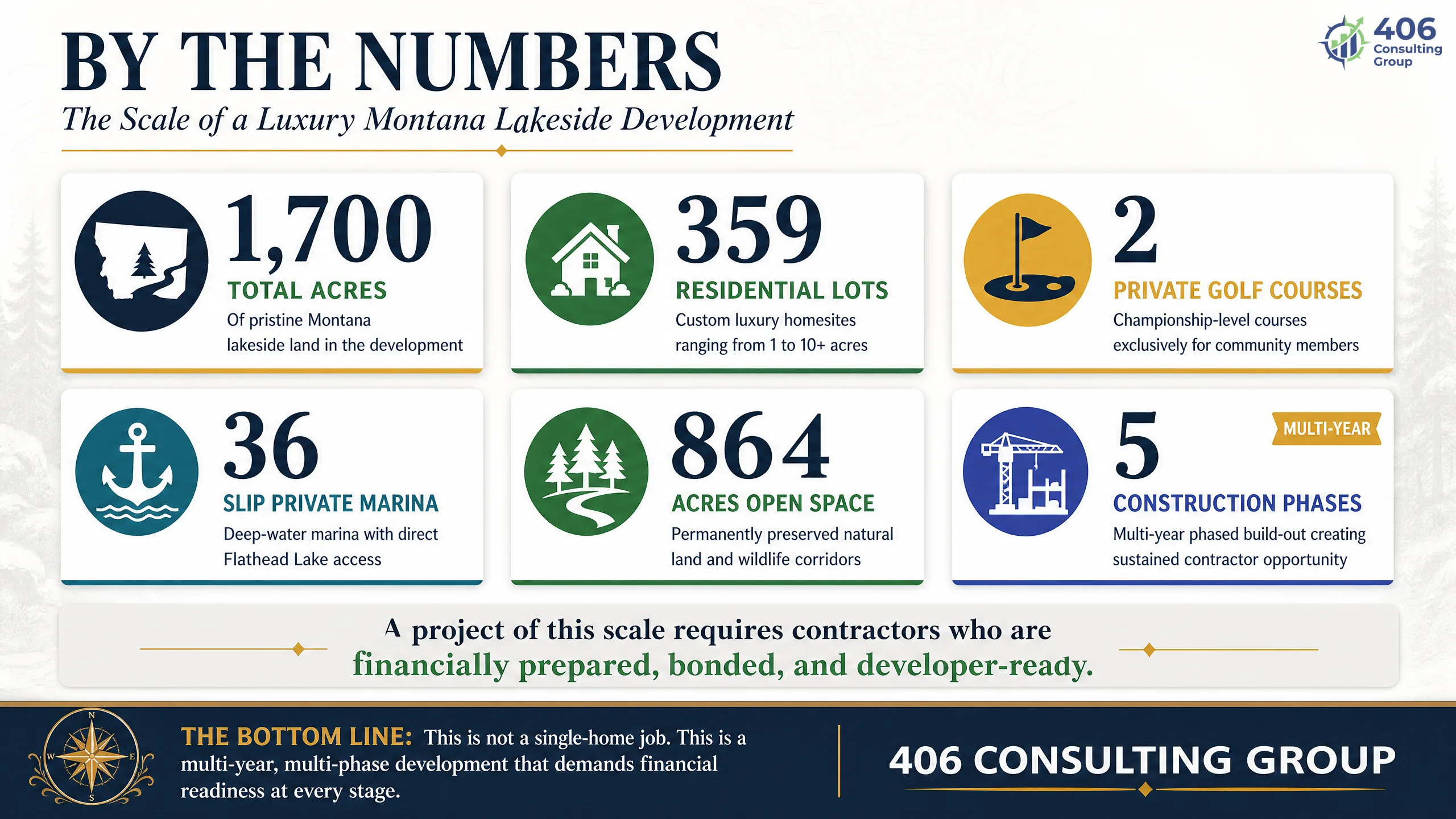
1,700
Acres on the west shore near Lakeside
359
Residential home sites
2
Private golf courses
36
Boat slips in the private marina
864
Acres of open space
5
Construction phases, starting 2026
Discovery Land Company builds and operates roughly 30 private communities around the world, and Montana already knows their work: the Yellowstone Club in Big Sky, Iron Horse in Whitefish, and Crazy Mountain Ranch in Shields Valley. The preliminary plat for the Flathead Lake Club was approved by Flathead County in August 2025, and a lakeshore dock variance was approved in early 2026 — though individual elements such as the marina have since faced legal challenges. The overall project is moving from approvals toward its phased build-out.
What this means for local trades
A phased, multi-year build of this size touches nearly every trade — site work and excavation, utilities, concrete, framing, mechanical, electrical, plumbing, finish carpentry, masonry, landscaping, and marine/dock work — plus the amenities: golf, clubhouse, spa, and restaurants. The work is there. The question isn't whether opportunities exist. It's whether your operation is positioned to be picked, and to survive the job once you win it.
Why Luxury Developers Vet Subcontractors So Hard
The short answer: because their entire brand depends on flawless delivery to demanding clients, a developer at this level cannot afford a subcontractor who runs out of cash, walks off a job, files a lien, or delivers work that has to be redone. Financial stability is their best proxy for reliability — so they screen for it hard, before you ever pick up a set of plans.
Put yourself in the developer's seat. You're building a $10 million custom home for a client who could buy the whole valley. The framing sub you hired underbid the job, ran out of working capital halfway through, and stopped showing up. Now you have a half-framed house, an angry client, and a schedule in ruins. That is the outcome a luxury developer is organized to prevent — and the way they prevent it is by never hiring that sub in the first place.
Reputation is everything
Their clients are executives, celebrities, and UHNW families who expect perfection and talk to each other. One botched project damages a brand built over decades. They select for subs who won't put that at risk.
A sub failure is their failure
If a subcontractor implodes mid-project, the developer eats the delay, the cost overrun, and the client's anger. They underwrite that risk up front by checking your financial staying power.
Liens and disputes are poison
An unpaid sub who files a mechanic's lien on a luxury lot creates a legal and PR mess. Developers favor subs who pay their own vendors on time — which requires cash flow.
They plan for the long haul
A five-phase, multi-year build means they want subs who'll still be standing in year four. A shaky balance sheet signals you might not be.
The Developer-Ready Standard
The short answer to "what do I need to have in place?" is the Developer-Ready Standard — the seven financial and operational pillars a luxury developer prequalifies subcontractors on. These aren't Discovery Land's published rules; they're the industry-standard bar that developers of this caliber hold subs to, drawn from how high-end construction actually works. Get all seven in order and you don't just get to bid — you become the sub they call back.
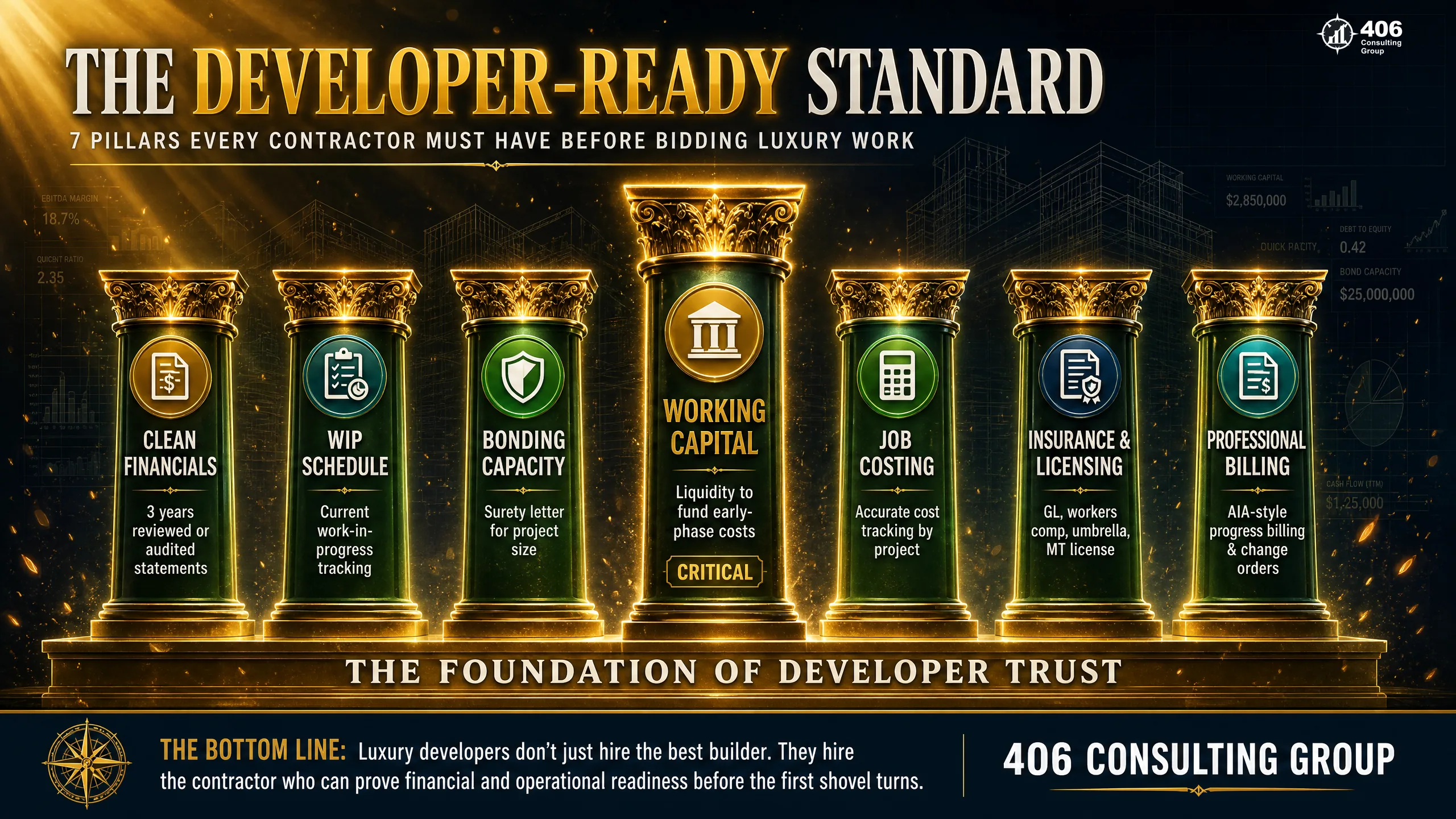
Clean, current financial statements
A profit-and-loss and balance sheet that are accurate, recent, and professionally prepared — not a shoebox reconciled at tax time.
A work-in-progress (WIP) schedule
The document that shows what you have under contract, how far along each job is, and whether you're over- or under-billed. It's the single most important report in construction finance.
Bonding capacity
The ability to obtain performance and payment bonds — driven by your working capital and financial strength, not just your craftsmanship.
Working capital and cash flow
Enough cash — or access to it through a line of credit — to float payroll and materials across long draw cycles and retainage.
Job costing and change-order discipline
The ability to know your true cost on each job in real time, and to document changes so scope creep doesn't eat your margin.
Insurance, licensing, and compliance
Proper general liability, workers' comp, and auto coverage; Montana contractor registration; and clean worker classification.
Professional, progress-based billing
Organized, schedule-of-values billing (AIA-style) that matches how large projects pay — not a handwritten invoice at the end.
Financials & WIP: The First Thing They'll Ask For
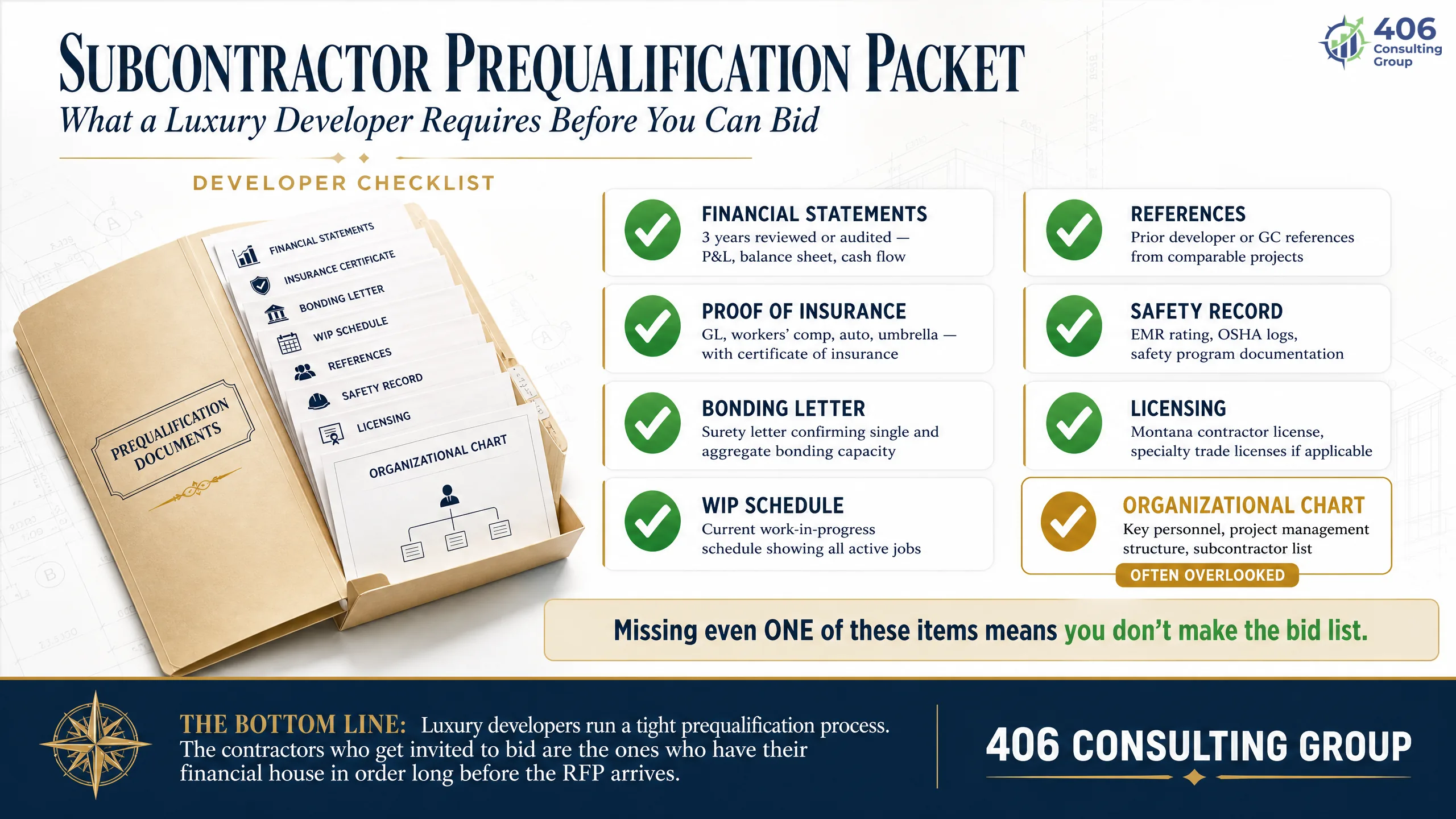
The short answer: before you bid, expect to hand over financial statements and a work-in-progress schedule. If you can't produce them — or if what you produce is a mess — you're done before you started. This is the single most common reason a capable Flathead Valley contractor loses out to a less-skilled competitor who simply had their paperwork together.
Define the key term first. A WIP schedule (work-in-progress) is the report that lists every job you have under contract and shows, for each one: the contract value, costs incurred so far, estimated cost to complete, percent complete, and how much you've billed versus how much you've earned. That last part — over-billing or under-billing — tells a developer (and a banker, and a bonding agent) whether you actually understand your own jobs. A contractor who can't produce a clean WIP looks like a contractor who doesn't know where they stand.
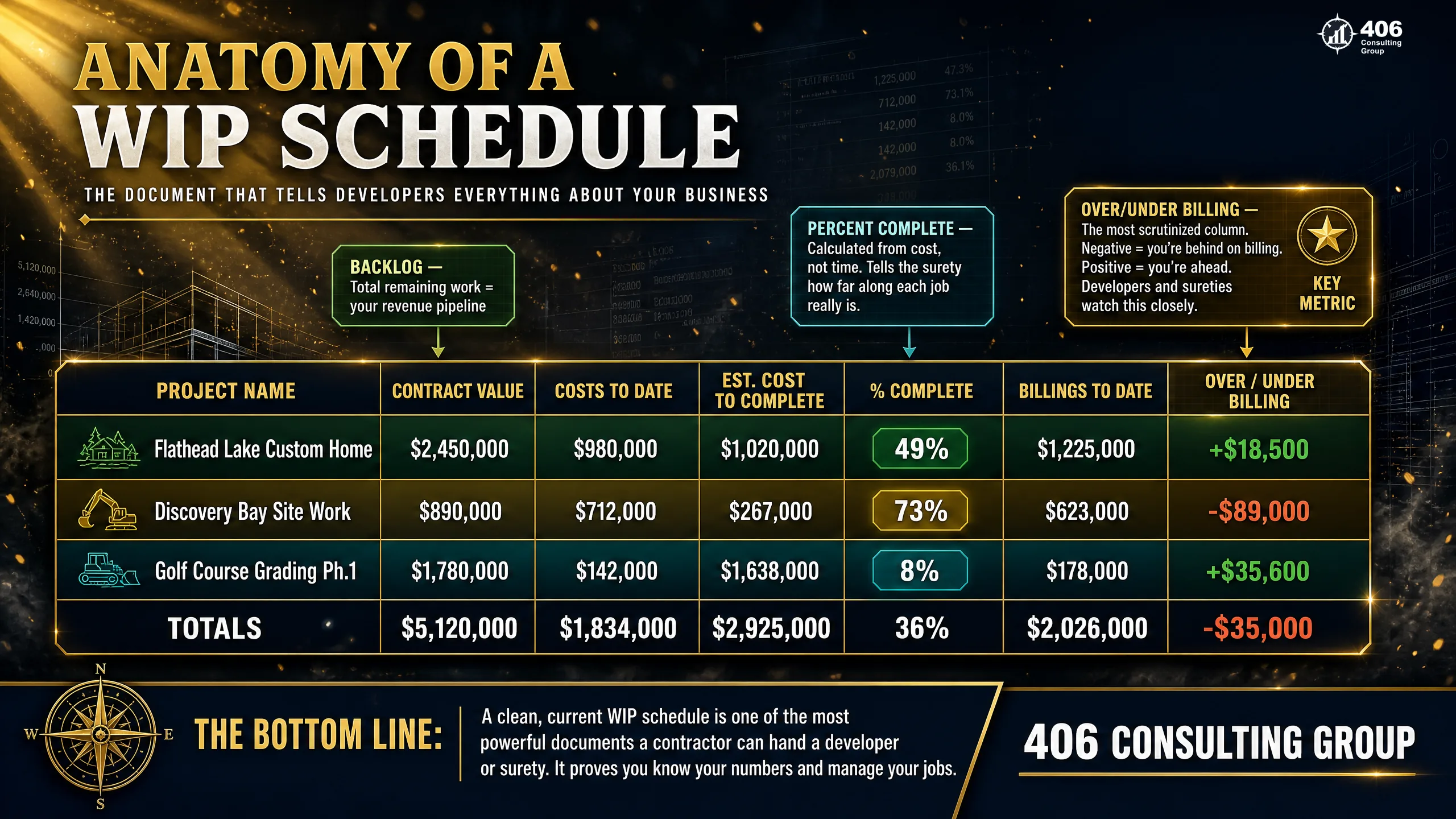
What our Flathead Valley example looks like
Take a Flathead Valley site-work and excavation contractor doing about $3M a year with 18 employees. Solid crews, great reputation, wins plenty of residential work. But the books close two months late and there's no WIP schedule — the owner tracks jobs in his head and a spreadsheet. To bid Flathead Lake Club work, that has to change first. Getting a monthly close and a real WIP schedule in place isn't just paperwork; it's the price of admission. We build exactly this for contractors through WIP and job costing systems and construction accounting.
Bonding & Working Capital: Can You Carry the Job?
The short answer: large projects often require performance and payment bonds, and your bonding capacity is driven far more by your financial strength than by your skill in the field. Two contractors can do identical-quality work and have wildly different bonding capacity — because one has clean financials and working capital, and the other doesn't.
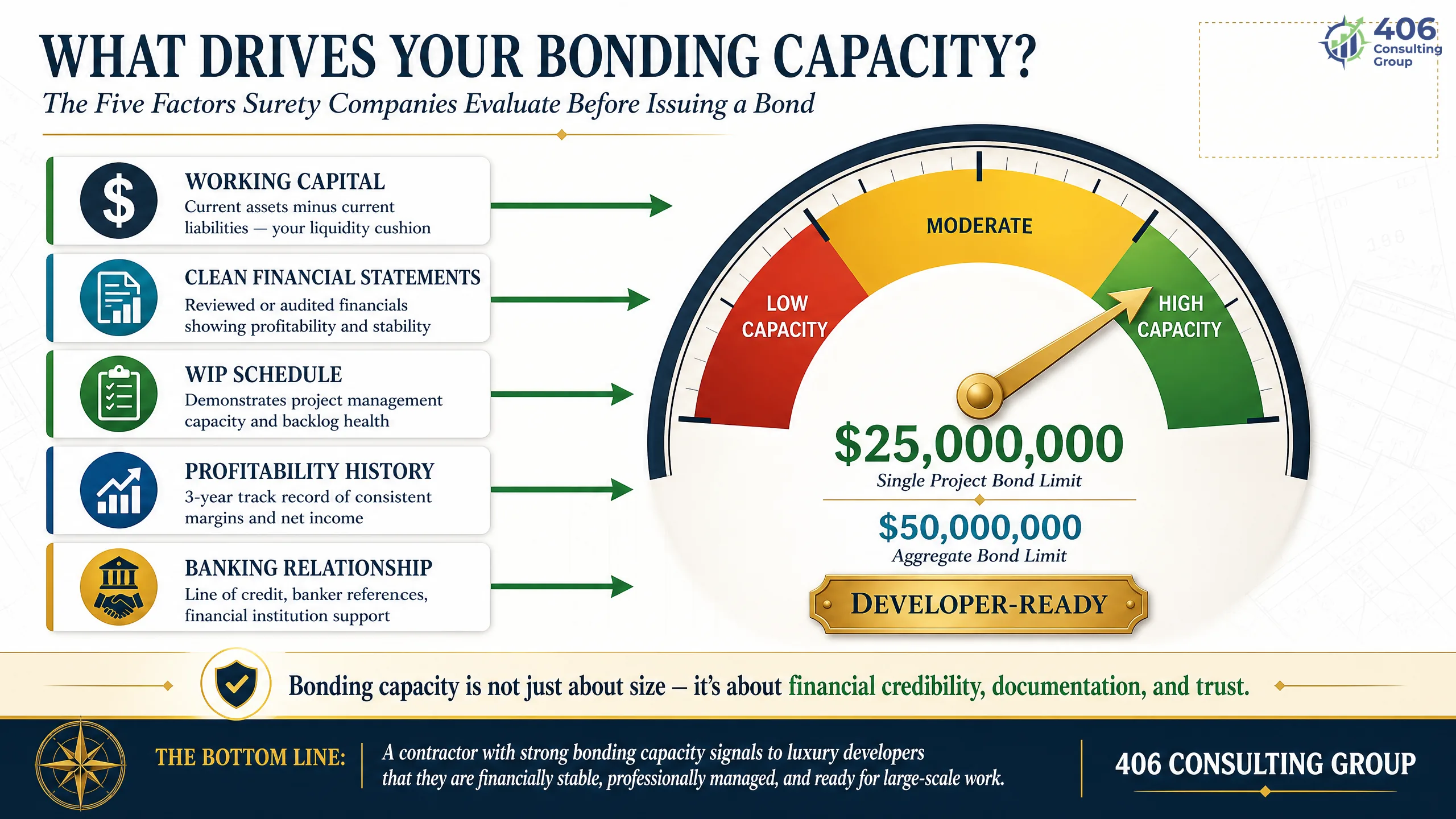
A surety bond is a guarantee from a bonding company that you'll complete the job (performance bond) and pay your own subs and suppliers (payment bond). The surety is essentially underwriting you the way a bank underwrites a loan — and they look at the same things: working capital, clean financial statements, a WIP schedule, profitability history, and your banking relationship. Having reviewed hundreds of these files from the lending side, I can tell you the contractors who get bonded easily are the ones whose numbers tell a clear, credible story.
What raises your bonding capacity
What caps it
Building bonding capacity is a financial project, and it's one we run with contractors directly through loan and bonding readiness. What lenders and sureties look for overlaps almost entirely — see what banks actually look at for a commercial loan.
Cash Flow, Draw Schedules & Retainage: The Trap That Kills Small Contractors
The short answer: on a big job you spend money for weeks or months before you get paid, and a slice of every payment — retainage — is held back until the very end. Winning the job is the easy part. Surviving the cash-flow gap is what separates the contractors who profit from the ones who go under mid-project.
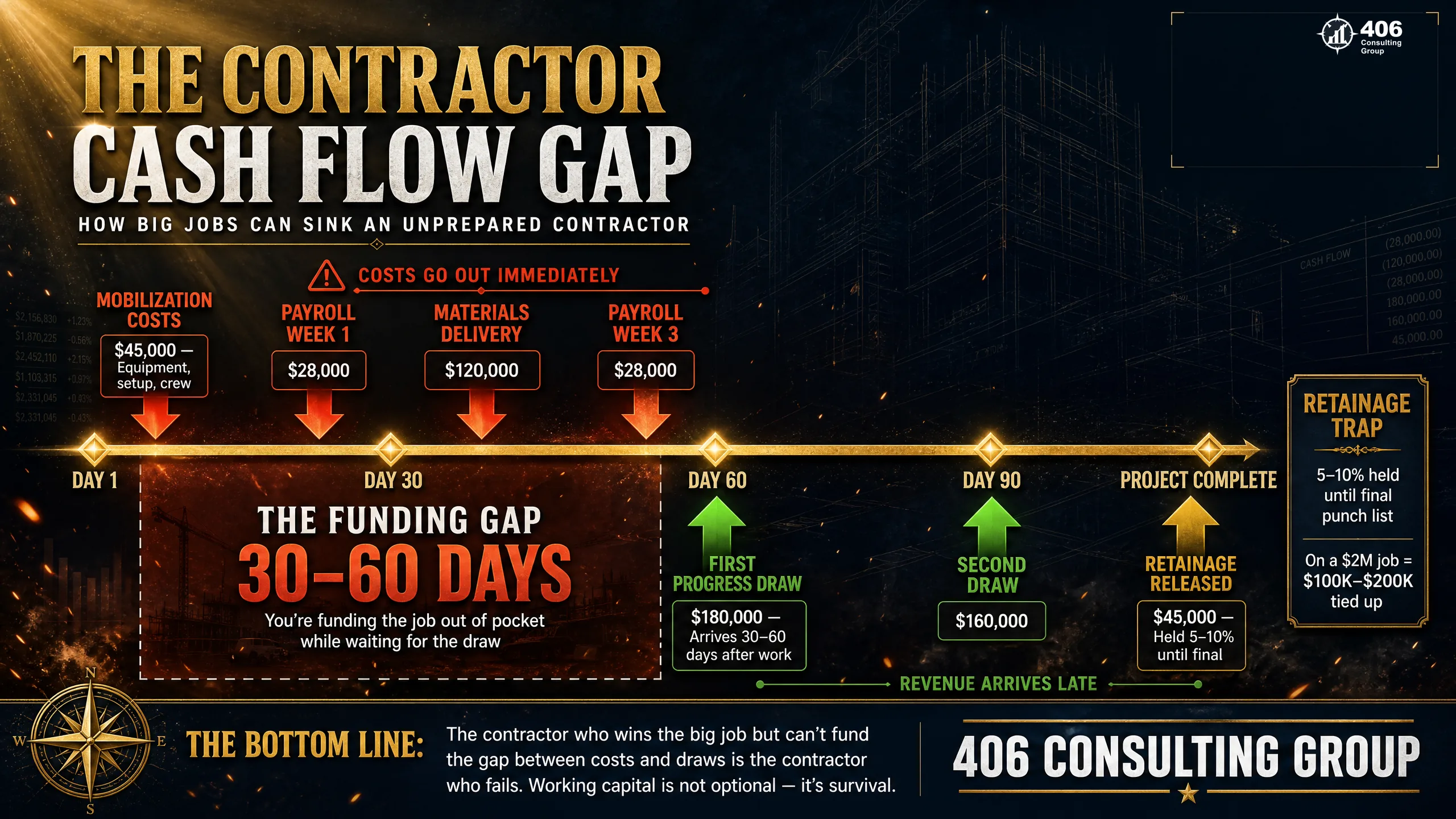
Define retainage: it's the portion of each progress payment — commonly 5% to 10% — that the developer holds back on every invoice until the project is substantially complete. So even when you bill and get paid, you're only collecting 90–95 cents on the dollar until the end. On a $1M scope with 10% retainage, that's $100,000 you don't see for months. Meanwhile you've already paid the crews and the suppliers.
The gap, in real numbers
Say the Flathead Valley excavation contractor lands a $600,000 site-work scope. In the first 45 days he spends roughly $180,000 on labor, fuel, equipment, and materials. His first progress draw — for work completed — doesn't get approved and paid for another 30–45 days after that. And 10% of it is held as retainage. So he's out roughly $180,000 in cash before the first meaningful payment lands, and he stays behind the curve for months.
Without a cash reserve or a line of credit sized for that gap, a profitable job becomes a solvency crisis. The contractor who planned for it finances the gap and books the profit. The one who didn't misses payroll and damages the very relationship that could have made his business.
How to close the gap before it opens
A rolling 13-week cash flow forecast shows you the crunch before it arrives; a line of credit sized to your draw cycle bridges it; and disciplined, on-time progress billing shortens it. This is core CFO work — we build the forecast and the lender package together through fractional CFO services.
Job Costing & Change Orders: Protecting Your Margin on Custom Work
The short answer: custom luxury work changes constantly, and if you're not costing each job in real time and documenting every change order, scope creep will quietly eat your entire profit. High-end clients ask for changes — better materials, new details, "can we also..." — and each one costs you money you won't recover unless it's captured in writing.
Real-time job costing
Knowing your actual labor, material, and equipment cost on each job as it happens — not three months later at tax time. On custom work where every home is different, the estimate you bid and the cost you incur can diverge fast. Real-time job costing catches it while you can still do something about it, and tells you which kinds of work actually make you money.
Change-order discipline
A written change order for every scope change, priced and approved before the work is done. This is where small contractors bleed margin on demanding clients — they do the extra work to keep the client happy, never document it, and eat the cost. On a luxury project with constant changes, change-order discipline is the difference between a profitable job and a break-even one.
The margin math
If our excavation contractor bids a $600,000 scope at a 15% margin ($90,000) and absorbs $40,000 of undocumented changes over the job, he just cut his profit nearly in half — on a job he executed perfectly. The work wasn't the problem. The paperwork was. Real-time job costing plus change-order discipline is what protects the margin you earned.
Insurance, Licensing & Compliance: Table Stakes
The short answer: these are the non-negotiables. You won't win the work without them, but having them doesn't win the work either — they're the price of getting in the door. Miss one and you're disqualified instantly, no matter how good your bid is.
General liability insurance
Adequate coverage limits, with the developer named as additional insured. Expect them to request a certificate of insurance before you set foot on site.
Workers' compensation
Montana requires workers' comp for employees. On a project this visible, coverage will be verified — and an independent-contractor workaround won't survive scrutiny.
Montana contractor registration
Construction contractors in Montana must register with the Department of Labor & Industry. It's basic, but developers check it.
Proper worker classification
Misclassifying employees as 1099 contractors is a common and costly mistake. On a vetted project, it's a red flag that can cost you the job and trigger state penalties.
Auto and umbrella coverage
Commercial auto for your vehicles and equipment, and often an umbrella policy for the higher liability limits large projects require.
Lien-law compliance
Understanding Montana's mechanic's lien process and preliminary notice requirements protects your right to get paid — and signals you're a professional operation.
The Bigger Prize: How One Great Project Opens Doors
The short answer: the real value of doing this work well isn't just the job itself — it's what comes after. Perform on a project like the Flathead Lake Club and you earn a reference that travels farther than almost anything else in construction. Perform poorly and that travels too.
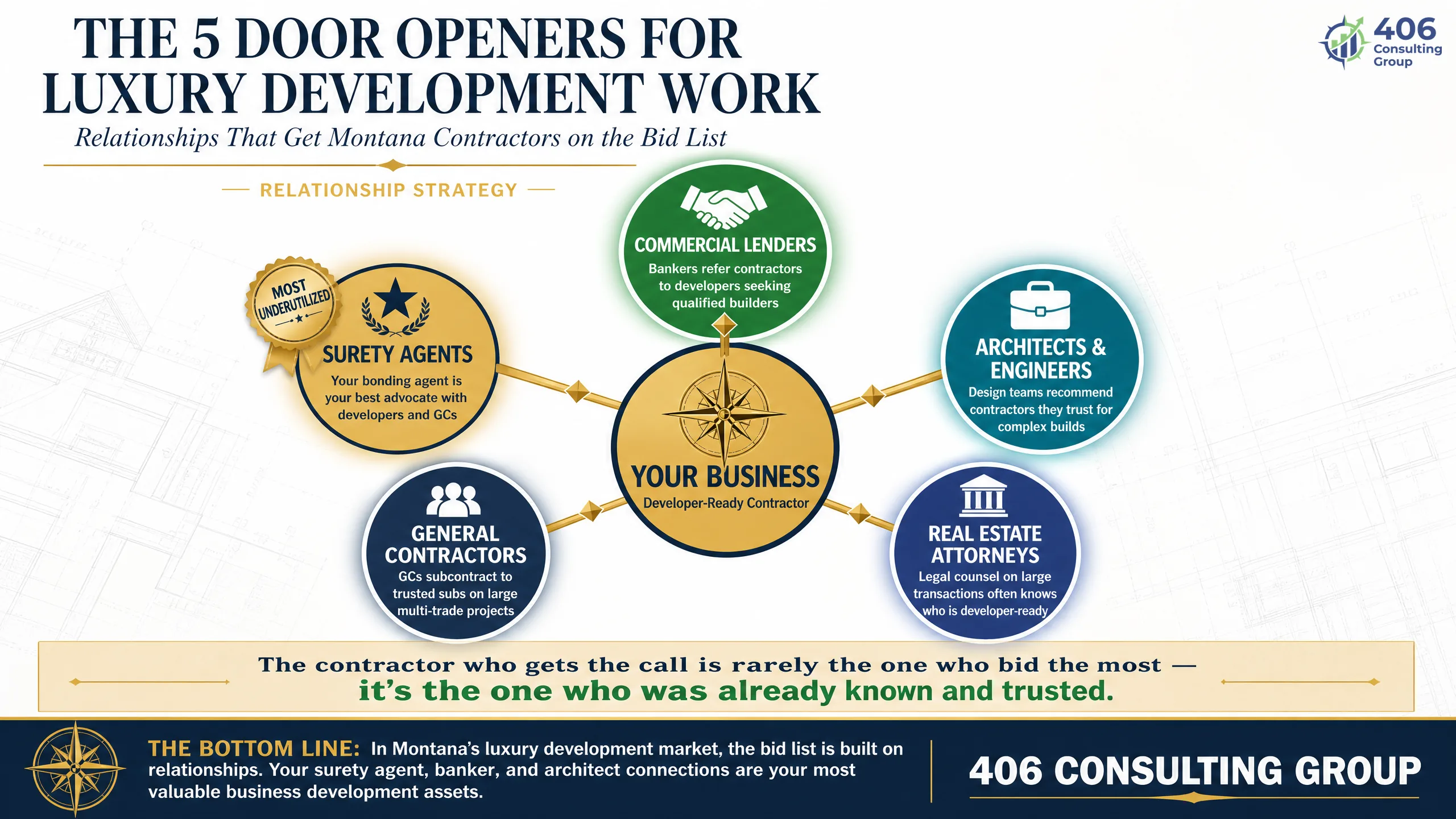
More work in the same community
359 lots means the developer and their construction managers need reliable subs again and again. Prove yourself on one home and you're on the short list for the next — for years.
Referrals from the developer
Discovery Land's construction managers work across roughly 30 communities. A sub who makes their life easy is a sub they remember — and mention.
Ultra-high-net-worth networks
The homeowners talk to each other. A contractor who delivers for one wealthy client gets recommended to the next — and these are clients who build second and third homes.
A credential that raises your whole business
"We did site work at the Flathead Lake Club" changes how every future client and lender sees you. It's proof you operate at the highest level.
But here's the catch: to capitalize on the doors that open, your business has to be able to absorb more and bigger work without falling apart. That means the financial infrastructure — forecasting, hiring capacity, systems — to scale up on purpose. The opportunity is only as big as your ability to handle it.
The Risk of the Marquee Job — and How to De-Risk It
The short answer: the big prestigious job that looks like the best thing that ever happened to your business is also the thing most likely to sink it — if you're not ready. Every year, contractors chase a marquee project, over-extend, and end up worse off than before they won it. Here's how it goes wrong, and how to prevent each failure.
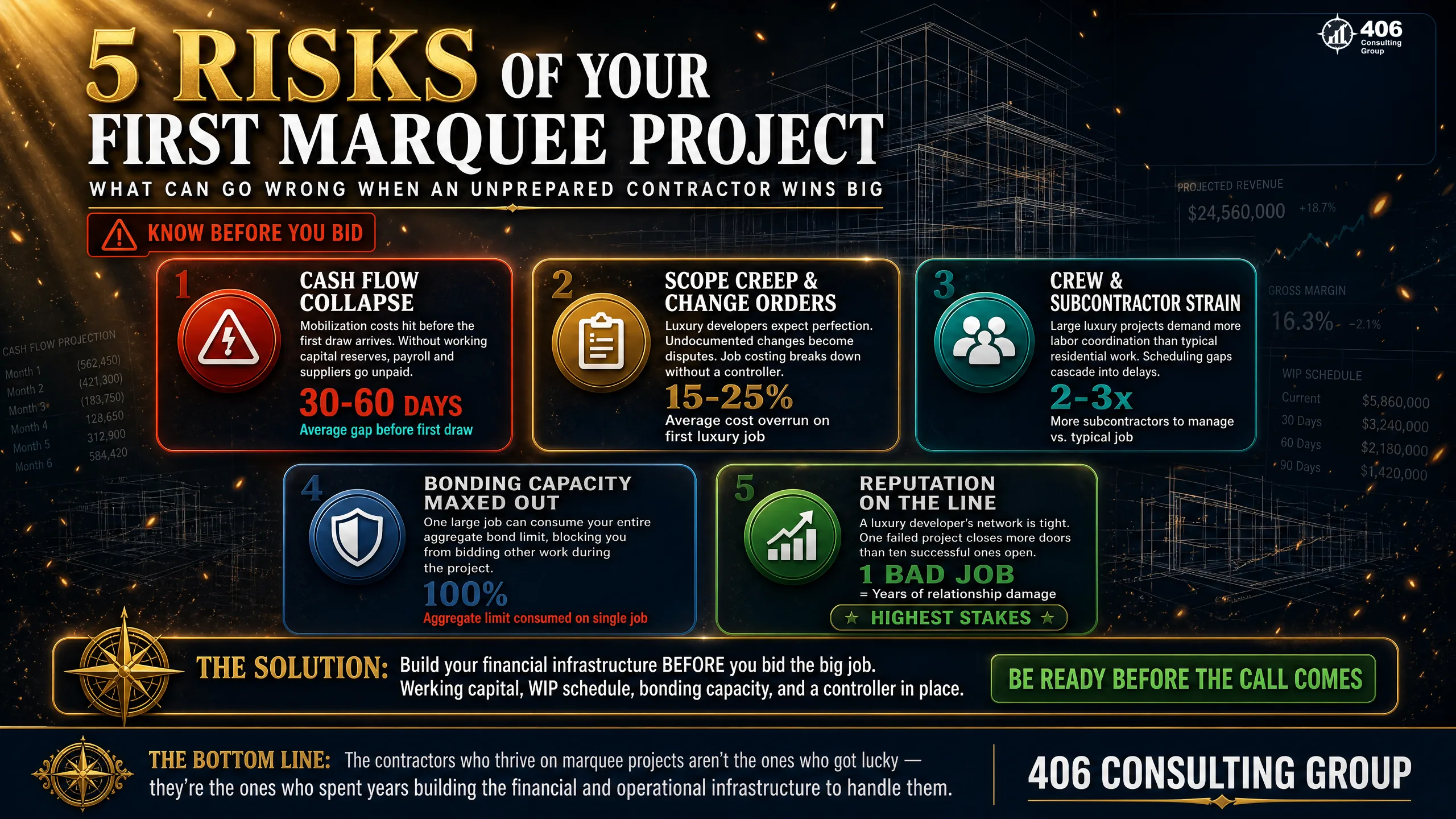
The risk
Underbidding complex custom work
How to de-risk it
Estimate off real job-cost data from similar work, and build in contingency for the complexity of luxury finishes — don't bid it like a standard build.
The risk
The cash-flow crunch from draws and retainage
How to de-risk it
Model the gap in advance and secure a line of credit sized to it before you start, not when you're already behind.
The risk
Scope creep with no change orders
How to de-risk it
Require a written, priced change order for every change. Protect the margin instead of eating the extras to keep the client happy.
The risk
Over-leverage and concentration
How to de-risk it
Don't let one job become so large it takes the whole company down if it slips. Keep the marquee job a healthy share of revenue, not all of it.
The risk
Thin margins with no cushion
How to de-risk it
Price for the real cost of performing at this level — insurance, bonding, back-office, and the cost of capital — not just direct job cost.
None of this means don't chase the work. It means chase it with your eyes open and your financial house in order. The contractors who win at this game treat the marquee job as a managed risk, not a lottery ticket.
How to Get Developer-Ready
Here's the sequence we run with a Flathead Valley contractor who wants to be positioned for work like this. Start now — the subs who get picked will have had this in place before the bidding heats up, not after.
Get your books current and clean
A fast monthly close and accurate financial statements. This is the foundation for everything a developer, banker, or surety will ask to see.
Stand up a WIP schedule and job costing
Real-time cost tracking by job and a WIP schedule you can hand over on request. This is the report that proves you know your business.
Build bonding and credit capacity
Work with a surety and a bank before you need them, using clean financials and a WIP schedule to establish the capacity you'll draw on.
Model your cash flow for a big job
Build a rolling 13-week forecast and secure a line of credit sized to the draw-and-retainage gap, so a big win doesn't become a cash crisis.
Tighten compliance and billing
Confirm insurance, contractor registration, and worker classification are airtight, and move to professional progress-based billing.
Structure to scale
Make sure your entity structure, tax plan, and systems can absorb a jump in revenue — so the doors that open become growth, not chaos.
This is precisely the work 406 Consulting Group does for Montana contractors — construction accounting, WIP and job costing, bonding and loan readiness, and cash flow forecasting, all coordinated. If the Flathead Lake Club or any large project is on your radar, the time to get developer-ready is before the bid, not after. Start with our construction services or talk to us directly.
Frequently Asked Questions: Building for Discovery Land
What is the Flathead Lake Club and who is building it?
The Flathead Lake Club is a private luxury community being developed by Discovery Land Company on roughly 1,700 acres just south of Lakeside, Montana, on the west shore of Flathead Lake. Plans include 359 residential lots, two private golf courses, a marina, a clubhouse, a spa, restaurants, and hundreds of acres of open space. Flathead County approved the preliminary plat in August 2025, and construction is planned in five phases beginning in 2026. Discovery Land Company is also behind other Montana communities, including the Yellowstone Club in Big Sky, Iron Horse in Whitefish, and Crazy Mountain Ranch in Shields Valley.
How do I become a subcontractor on a Discovery Land project?
Developers at this level prequalify subcontractors before allowing them to bid. In practice that means being able to present clean, current financial statements, proof of insurance, bonding capacity, references, a safety record, and a work-in-progress (WIP) schedule. The contractors who get selected have their financial and operational house in order before the bidding starts. If your books are late or you can't produce a WIP schedule, getting those in place is the first step — it's the price of admission, not an optional nicety.
What financial documents do luxury developers require from subcontractors?
Typically: recent profit-and-loss statements and a balance sheet, a work-in-progress (WIP) schedule showing your jobs and their status, proof of insurance (general liability, workers' compensation, commercial auto, often umbrella), a bonding letter or evidence of bonding capacity, references, and evidence of proper licensing and contractor registration. The financial statements and WIP schedule are the ones most small contractors can't readily produce — and the ones that most often determine whether you're taken seriously.
What is retainage and how does it affect contractor cash flow?
Retainage is the portion of each progress payment — commonly 5% to 10% — that the owner or developer holds back on every invoice until the project is substantially complete. It means that even when you bill and get paid, you only collect 90–95 cents on the dollar until the end of the job. Combined with the normal 30–60 day lag between doing the work and getting paid, retainage creates a cash-flow gap: you fund payroll and materials for weeks or months before the money catches up. Contractors who don't plan for this gap can run out of cash on a job that's actually profitable.
Do I need bonding to work on a large development?
Large projects frequently require performance and payment bonds, and even when a specific bond isn't required, demonstrating bonding capacity signals financial strength. Your bonding capacity is underwritten much like a loan — sureties look at your working capital, financial statements, WIP schedule, profitability, and banking relationship. Two contractors doing identical-quality work can have very different bonding capacity based purely on their financials. Building that capacity is a financial project you can start well before you need it.
Can one project like this really lead to more business?
Yes — that's often the biggest long-term value. A large community with hundreds of lots needs reliable subcontractors repeatedly over a multi-year build, so performing well positions you for the next home and the next phase. Beyond that, a developer that operates communities across the country will remember subs who make their projects run smoothly, and the ultra-high-net-worth homeowners refer contractors within their own networks. The credential itself also raises how future clients and lenders view your business. The condition is that you have to be built to absorb more and bigger work without your operation breaking.
How does 406 Consulting Group help contractors get developer-ready?
406 Consulting Group provides construction accounting, WIP and job costing systems, bonding and loan readiness, cash flow forecasting, and fractional CFO and controller services for contractors across Montana's Flathead Valley and beyond. We get your books current, build the WIP schedule and job costing a developer or surety will ask for, model the cash flow gap on a big job, and help structure your business to scale into the opportunities that follow. Carrie Anderson's commercial lending and underwriting background and Jason Anderson's operational finance experience are both directly relevant to getting a contractor bonded, financed, and ready to compete for work like the Flathead Lake Club. Contact us to start.
Sources & Official Resources
Related Tools & Resources
Construction Finance — Flathead Valley
Get Developer-Ready Before the Bid — Not After.
406 Consulting Group gets Flathead Valley contractors ready to win and survive high-end work — clean books, a WIP schedule, bonding and loan readiness, and cash flow built for draw cycles and retainage. If the Flathead Lake Club or any big project is on your radar, let's get your operation ready to compete.
Flathead Lake Club at a Glance
Discovery Land Company · Lakeside, MT
The Developer-Ready Standard
7 pillars subs are vetted on
Chasing Big Project Work?
Get bonding-ready and cash-flow-ready first.
About the Author
Carrie Anderson
Co-Founder, 406 Consulting Group
Background in commercial banking and underwriting — 300+ loan reviews, including construction lending and the financials behind bonding decisions. Carrie helps Flathead Valley contractors get financed, bonded, and ready to compete for the region's biggest projects.
Read the Full Story