
CFO & Controller Services for Belgrade, MT:
Financial Leadership for a Growing Contractor Economy
Belgrade's contractors are scaling fast — and hitting a wall that isn't about the work: which jobs make money, where cash stands, and every bid running through the owner. Here's how a controller and a CFO close that gap, from a Montana firm that knows construction.

Belgrade's construction and trades businesses are growing fast — riding the Gallatin Valley boom, building the housing and commercial space a fast-arriving population needs. But somewhere between one crew and several, a lot of contractors hit a wall that has nothing to do with the work: they can't tell which jobs make money, cash is tight even in a busy year, and every bid and every decision still runs through the owner. That's not a jobsite problem. It's a financial-leadership gap.
CFO and controller services in Belgrade, MT are built to close that gap. A controller makes your numbers reliable — a real monthly close, job costing, and the WIP schedule a contractor lives on. A fractional CFO uses those numbers to manage cash across draw schedules, secure financing and bonding, and steer growth. Together they're what turn a busy, growing contractor into a business that scales on purpose instead of by luck.
This guide covers what each role does for a construction or trades business, when you need them, what they cost, and how a local Montana firm delivers it. It builds on our Belgrade bookkeeping guide — the layer beneath this one — so if your books aren't clean yet, start there.
By Carrie Anderson — Co-Founder, 406 Consulting Group. Commercial banking and underwriting background (300+ loan reviews, including construction lending and bonding financials) plus advisory work with Montana contractors and trades.
Quick Answer: Controller & CFO for a Growing Contractor
- →Controller: owns the monthly close, job costing, and the WIP schedule — reliable numbers you can bid and manage from.
- →CFO: owns cash flow across draws and retainage, financing and bonding, and bidding/margin strategy.
- →Growth is the trigger: more crews and bigger jobs strain a contractor's books and cash fast.
- →Fractional gives you both roles for ~$4,000–$8,000/month — a fraction of full-time salaries.
- →Delivered remotely across Montana, by a firm that knows construction and the Gallatin Valley.
Table of Contents
Controller vs. CFO: The 30-Second Difference
The short answer: a controller makes your numbers accurate and on time; a CFO uses those numbers to make better decisions about cash, margin, financing, and growth. A bookkeeper records what happened, a controller makes it reliable, and a CFO decides what to do about it — and a growing contractor eventually needs all three.
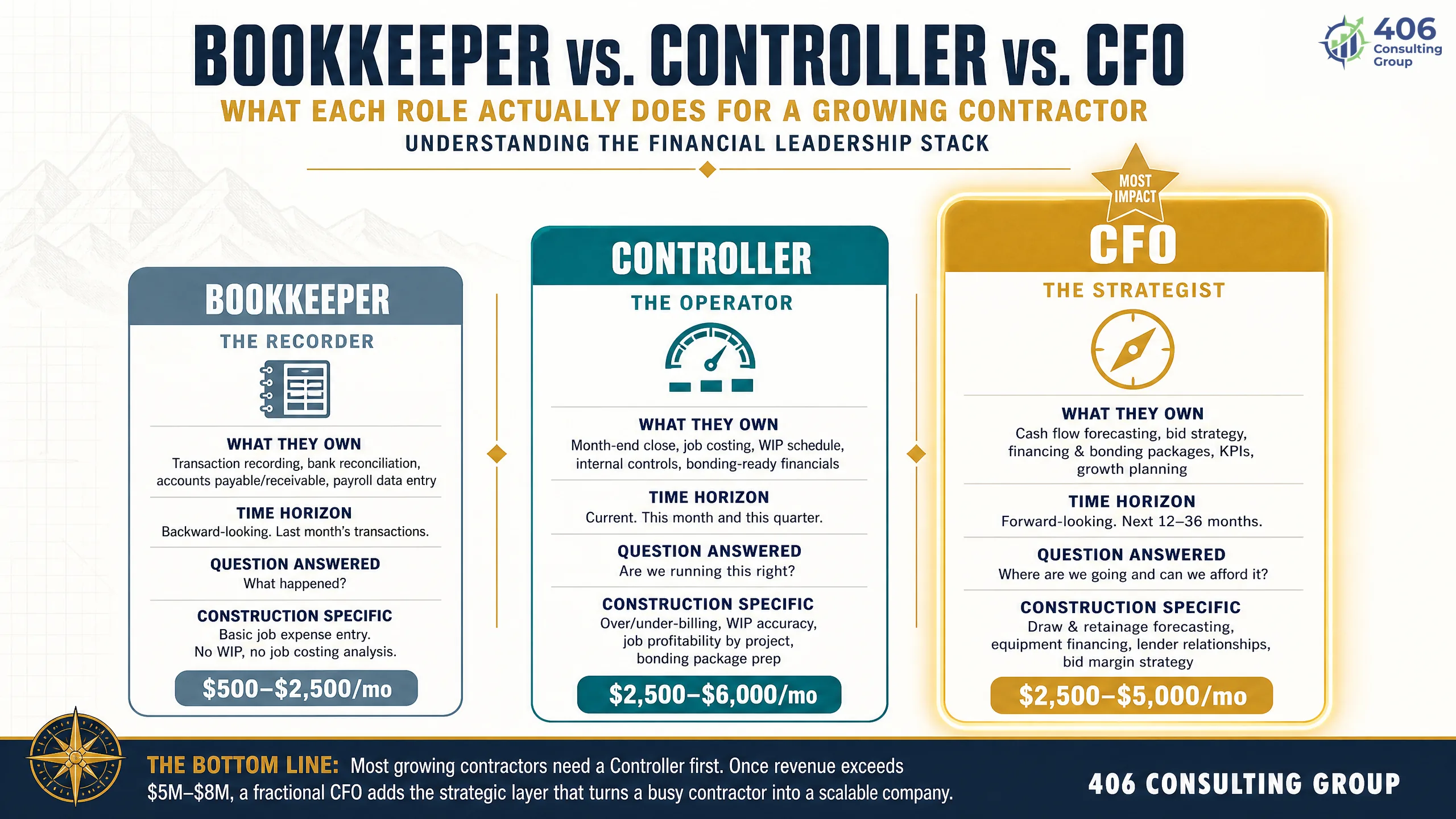
| Bookkeeper | Controller | CFO | |
|---|---|---|---|
| Owns | Transactions | The close & job costing | Financial strategy |
| Time horizon | Yesterday | Last month | Next 1–3 years |
| Answers | What did we spend? | Which jobs made money? | What should we do next? |
Want the full "which role, and when" breakdown with a revenue-and-complexity ladder? We go deep in our controller-vs-CFO guide. This article is about what these roles do specifically for a growing Belgrade contractor or trades business.
Why Belgrade's Growing Contractors Hit the Ceiling
The short answer: a contractor's finances hit a wall when growth outpaces the owner's ability to run them by feel — too many jobs, too many crews, and decisions too expensive to get wrong. In Belgrade's construction boom, that ceiling arrives fast, and pushing through it takes real reporting and cash management, not just more work.
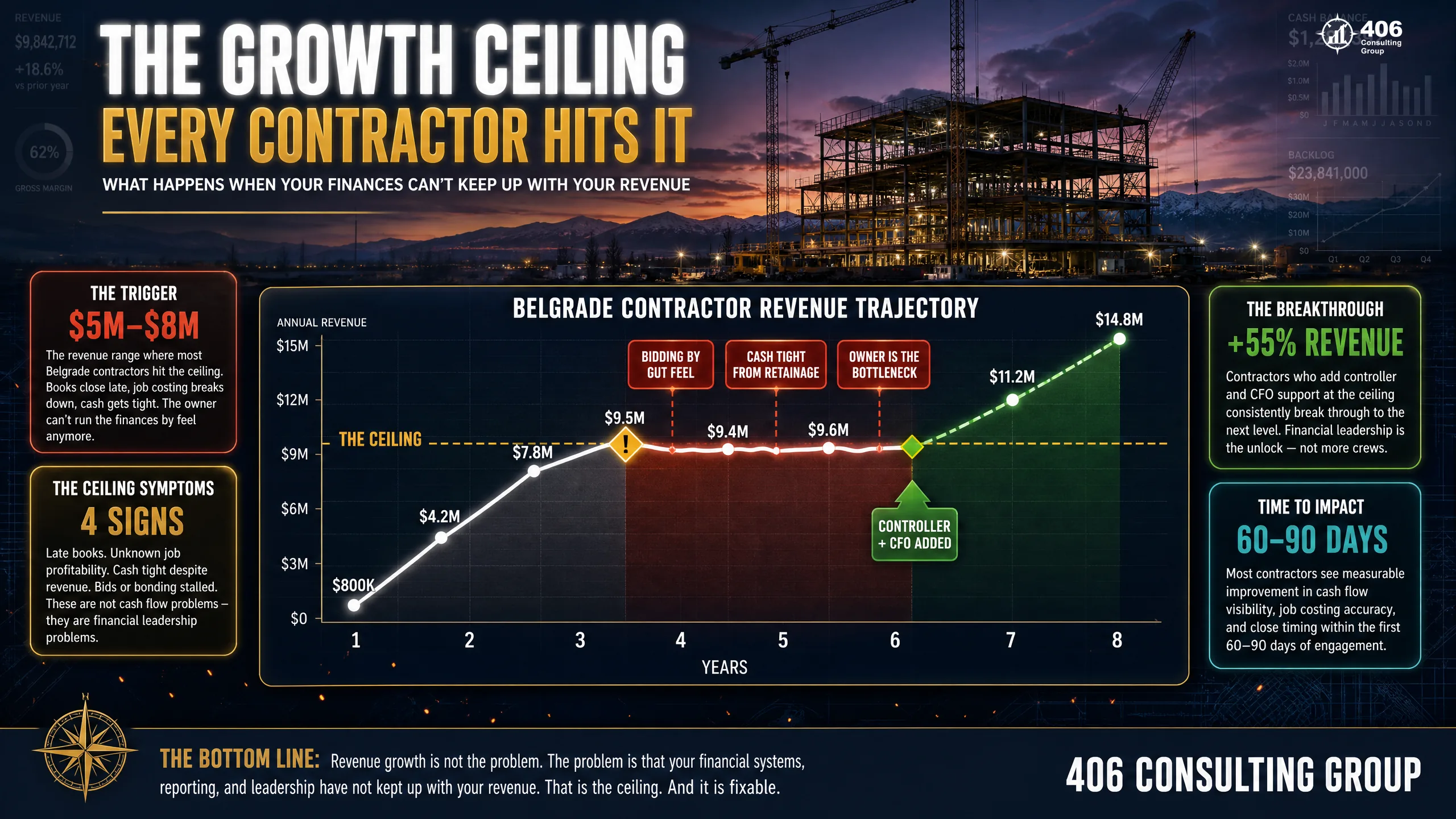
Picture a Belgrade contractor that's scaled to about $3M — several crews, a shop, and a handful of jobs running at once. When it was one crew, the owner could hold the whole picture in their head: what each job cost, what was bid, where cash stood. At $3M across multiple jobs, that's impossible. The books fall behind, nobody can say which jobs actually made money, cash gets tight because draws lag and retainage piles up, and a bonding or financing opportunity shows up that the business isn't ready to pursue. Every one of those is a financial-leadership gap, not a construction problem.
The dangerous instinct
Believing more work will fix it. In construction, more jobs at this stage amplify the chaos and deepen the cash gap — you front more payroll and materials before you collect. The fix isn't volume; it's the reporting and cash discipline that let you grow on purpose.
The Build-Ready Finance Framework
The short answer: a growing contractor needs five financial layers, built in order — clean books and job costing, WIP and controller reporting, cash-flow forecasting around draws and retainage, bonding and financing readiness, and CFO growth strategy. That's the Build-Ready Finance Framework, and it's how a Belgrade contractor scales without the wheels coming off.
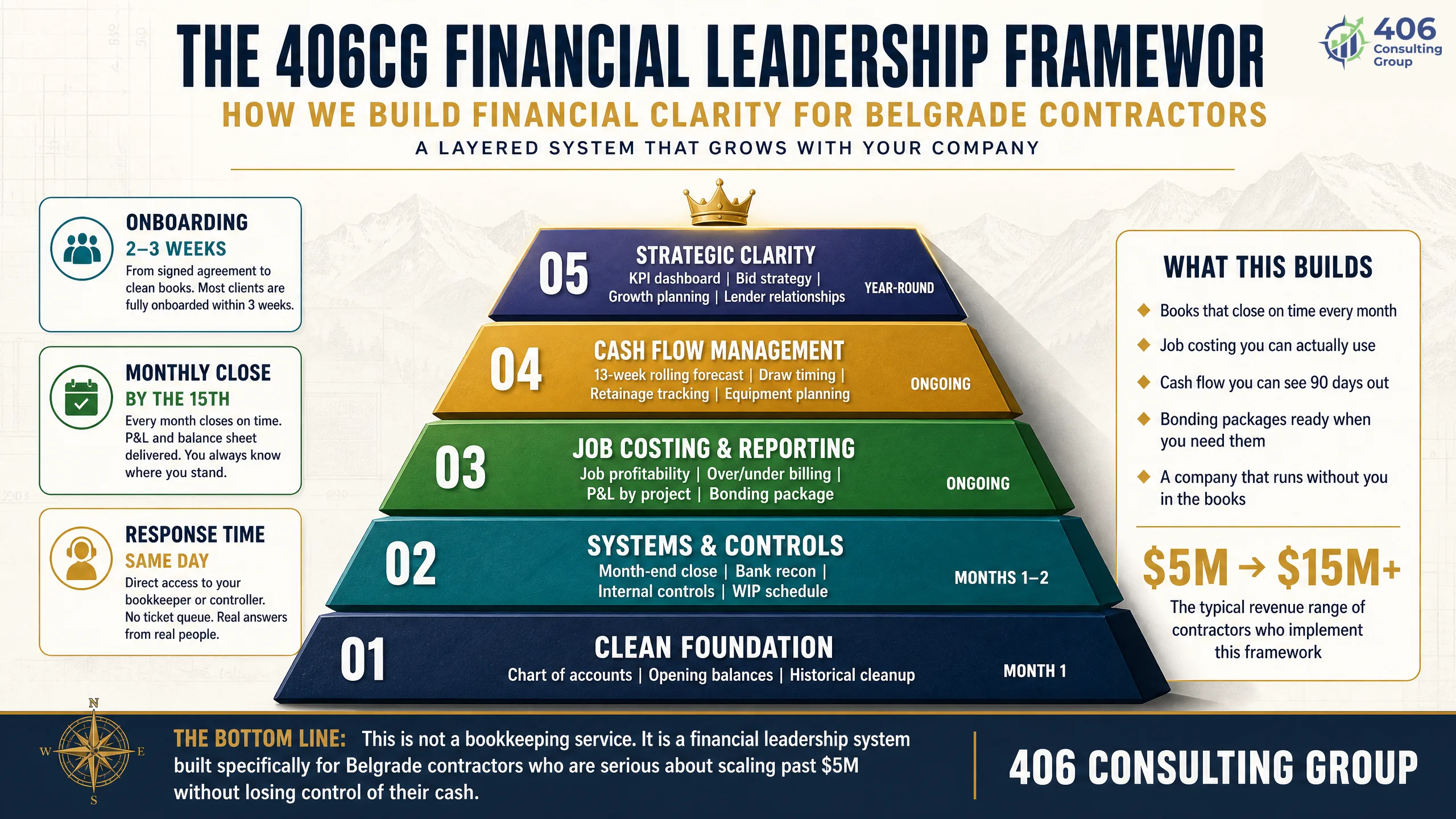
Clean books & job costing
Accurate, current books with cost captured by job — the foundation everything else builds on. Without it, you're bidding and managing blind.
WIP & controller reporting
A work-in-progress schedule and a reliable monthly close, so you know true job profitability and over/under-billing — the numbers bankers and sureties ask for first.
Cash-flow forecasting
A rolling forecast built around your draw schedules and retainage, so growth doesn't drain you dry.
Bonding & financing readiness
Financials structured to build bonding capacity and get a lender to yes — so you can take on bigger work and fund equipment.
CFO growth strategy
Bidding and margin strategy, capital decisions, and a plan for scaling — turning reliable numbers into better decisions.
What a Controller Delivers for a Contractor
The short answer: a controller delivers reliable, on-time financials plus the job costing and WIP schedule a contractor lives on — so you know which jobs make money, where each stands, and that your numbers will hold up to a bank or bonding company. It's the layer that turns "we had a good year" into "we know exactly which jobs drove it."

A fast monthly close
Books reconciled and closed within days of month-end, so you're managing on current reality, not a quarter-old guess.
Job costing
Cost captured by job and phase, so you can see true margin and bid the next job from real numbers.
The WIP schedule
Work-in-progress reporting showing percent complete and over/under-billing — the report sureties and banks want first.
Bonding-ready, controlled books
Clean financials and internal controls that build bonding capacity and protect the business as headcount grows.
WIP and job costing are the heartbeat of a construction controller — we go deep in WIP and job costing for contractors. Explore our controller services.
What a Fractional CFO Delivers
The short answer: a fractional CFO uses the controller's reliable numbers to manage cash across draw schedules and retainage, secure financing and bonding, sharpen bidding and margins, and plan growth — the decisions that determine whether a contractor scales profitably or stalls.
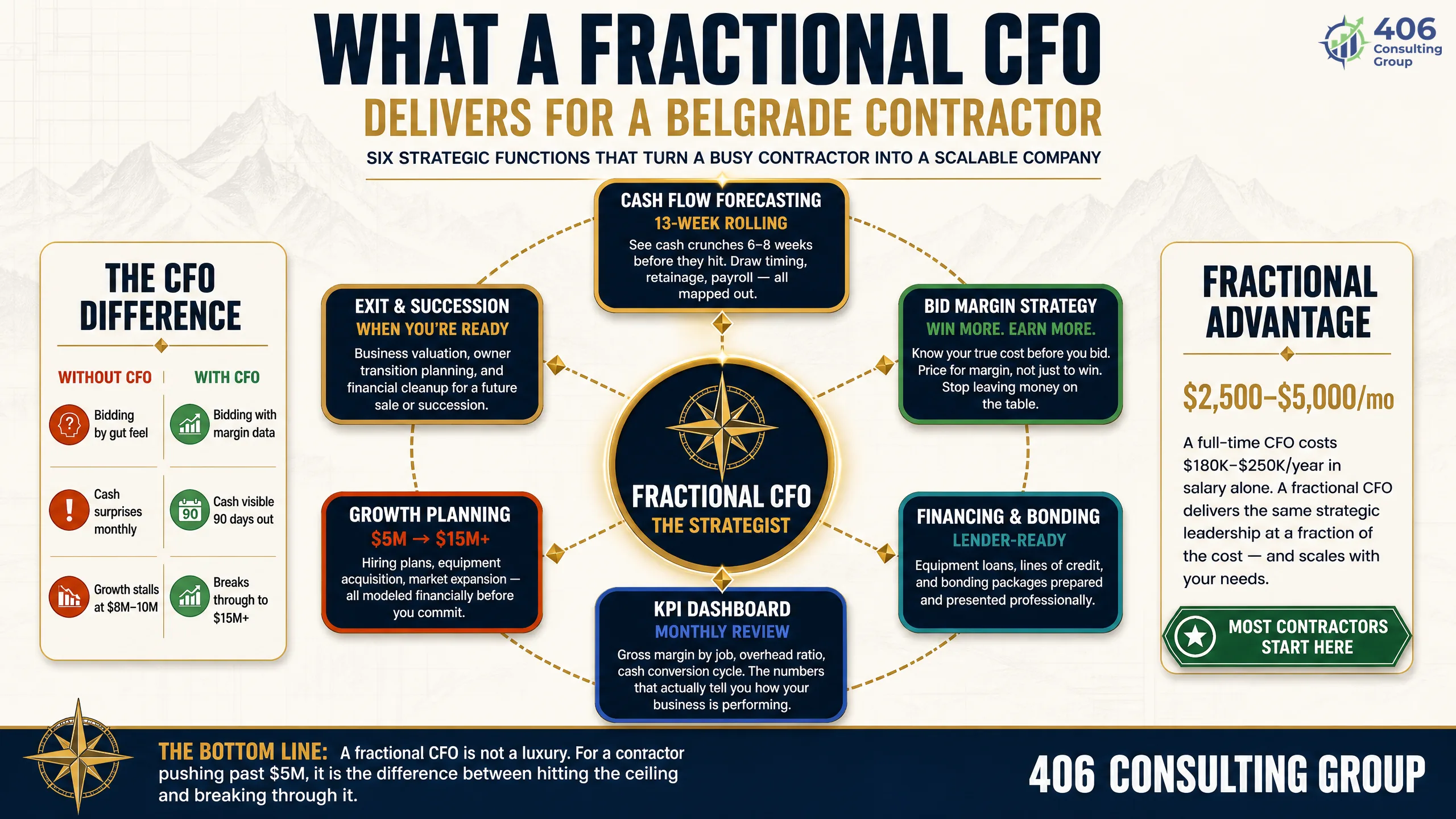
Cash flow across draws & retainage
A rolling forecast that accounts for the gap between fronting payroll/materials and collecting on draws — the #1 thing that sinks growing contractors.
Financing & bonding
Building the lender and surety packages that fund equipment, bigger jobs, and growth — where a banking background pays off directly.
Bidding & margin strategy
Turning job-cost data into smarter bids and a healthier mix of work — chasing the jobs that actually pay.
Growth & capital decisions
Modeling the big moves — new equipment, more crews, a second yard — before you commit, so growth is a decision, not a gamble.
The clearest ROI is usually cash and financing — see how the profit-vs-cash gap plays out in why a profitable business can be cash-poor. Explore our CFO services.
Signs It's Time
The short answer: if you can't tell which jobs make money, your books close late, cash is tight despite a full schedule, or a bid or bonding request stalled — it's time. Here are the clearest triggers for a Belgrade contractor.

Time to add a controller or CFO if…
Counting three or more? That's the signal. The free financial maturity assessment will point you to the right next layer.
Fractional vs. Full-Time: The Cost Math
The short answer: for a Belgrade contractor under roughly $15M in revenue, fractional wins the math — you get senior controller and CFO expertise for a monthly retainer that's a fraction of full-time salaries, because you pay for the hours you actually need.
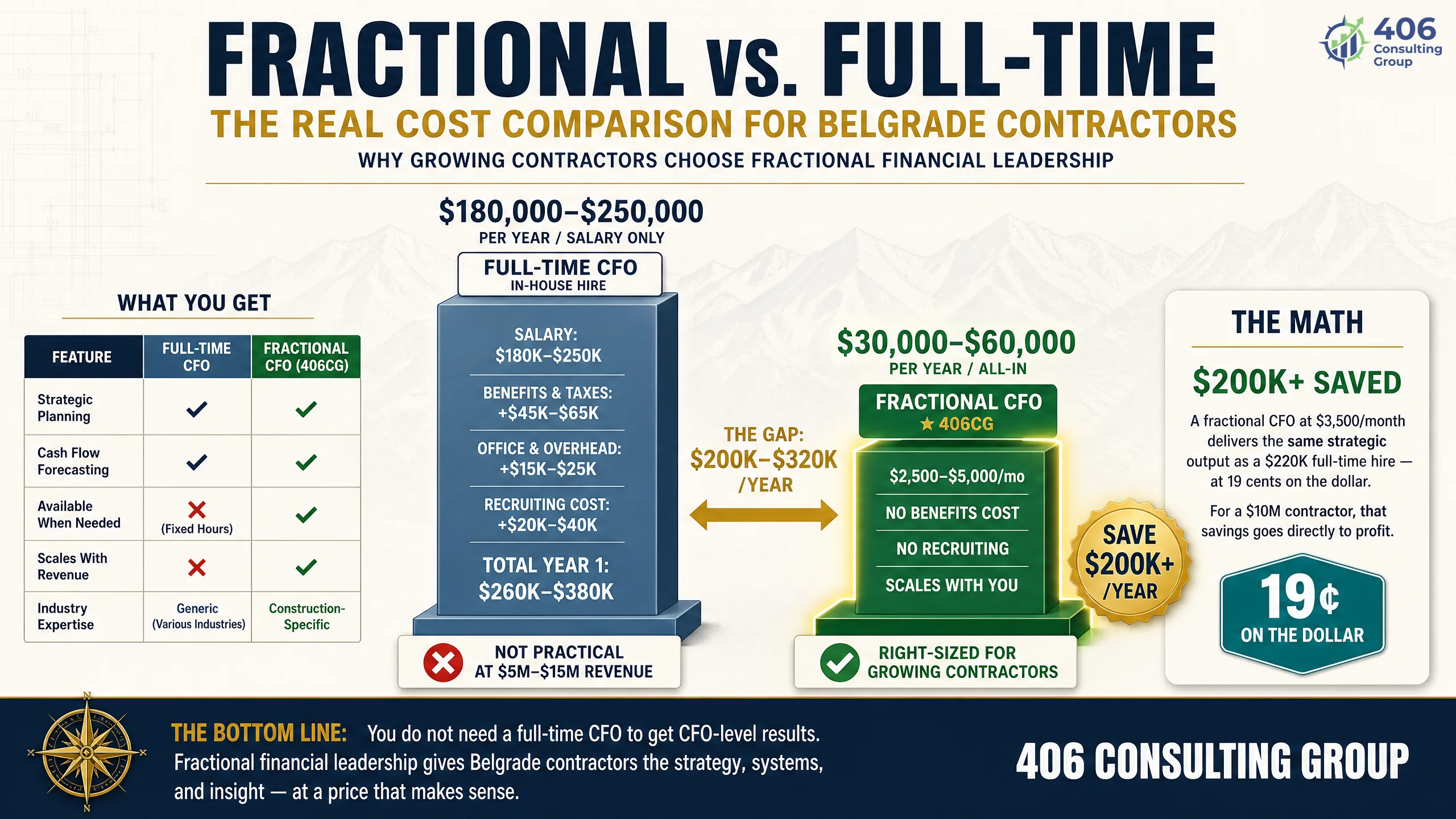
| Role | Full-time (salary + benefits) | Fractional (monthly retainer) |
|---|---|---|
| Controller | $85K–$120K salary + ~25% benefits | ~$2,500–$6,000 / month |
| CFO | $150K–$300K+ salary + ~25% benefits | ~$2,500–$5,000 / month |
| Both, coordinated | $235K–$420K+ all-in | ~$4,000–$8,000 / month |
The $3M Belgrade contractor's decision
A full-time controller in Montana runs roughly $110,000 in salary plus about $28,000 in benefits — call it $138,000 all-in — for capability a $3M contractor needs maybe two or three days a week. A fractional controller-plus-CFO engagement runs about $6,000 a month, or $72,000 a year, for both roles and the hours it actually uses.
Roughly half the cost of one full-time hire — and it delivers the reliable WIP-driven close AND the cash and financing strategy, not just one seat. Full-time only wins once volume keeps a senior person busy 40 hours a week, well past $15M for most contractors. (Illustrative figures.)
Serving Belgrade & the Gallatin Valley
The short answer: 406 Consulting Group is a Montana firm that provides controller and CFO services to Belgrade contractors and trades — we know the Gallatin Valley's construction boom, the local banks and bonding companies, and the realities of building here, and we deliver it remotely through secure cloud accounting so you get the expertise without needing anyone in your office.
To be concrete about what remote actually means here: even 70 to 80 percent of the clients close enough to drop by never do. The reliable WIP-driven close, the reporting package, cash forecasting, and lender and bonding prep all run over secure cloud accounting and a standing call rhythm. For a Belgrade contractor, remote isn't second best — it's the standard, and whether your yard is in Belgrade, elsewhere in the Gallatin Valley, or clear across Montana changes nothing about the controller and CFO work you receive.

We know construction
Job costing, WIP, retainage, bonding — the financial disciplines a contractor actually runs on, not generic accounting.
We know the Gallatin Valley
The boom, the pace, the local banks and sureties you'll finance and bond through — context a distant firm doesn't have.
We work remotely, seamlessly
Secure cloud accounting, a document portal, and monthly video reviews — the full controller/CFO function without an in-office hire.
We scale with you
Start with a controller foundation and add CFO strategy as you grow — one partner across the whole Build-Ready framework.
How to Get Started
The short answer: start by making sure the books and job costing are solid, then add the controller reporting your growth demands, then CFO strategy for cash, financing, and bidding. Build the layers in order, and add the level of support your stage actually needs.
Not sure which layer you need? The free financial maturity assessment takes about eight minutes and points to your next step. If your books aren't clean yet, start with Belgrade bookkeeping; when you're ready to build the plan, let's talk.
Frequently Asked Questions: CFO & Controller Services in Belgrade, MT
What's the difference between a controller and a CFO for a contractor?
A controller owns the accounting function — a fast monthly close, job costing, the work-in-progress (WIP) schedule, and internal controls. Their focus is making the numbers right and knowing which jobs make money. A CFO owns the finance function — using those reliable numbers to forecast cash across draw schedules and retainage, secure financing and bonding, sharpen bidding and margins, and plan growth. A growing contractor needs both: the controller produces trustworthy job-level numbers, and the CFO turns them into strategy.
Does my growing Belgrade contractor business need a controller or a CFO?
Start with a controller if your books close late, you can't tell which jobs make money, or you can't produce a WIP schedule — you need reliable job-level reporting first. Add a CFO when the numbers are solid but you need cash forecasting around draws and retainage, financing or bonding for bigger work, or growth strategy. Most contractors scaling through the Gallatin Valley boom benefit from both, fractionally. If your bookkeeping isn't clean yet, that's the place to start, because a controller builds on good books and a CFO builds on a good controller.
How much do CFO and controller services cost in Belgrade, MT?
Fractional pricing in Montana typically runs about $2,500–$6,000 per month for a controller and about $2,500–$5,000 per month for a fractional CFO, depending on complexity, number of jobs and entities, and scope. A coordinated engagement covering both often runs roughly $4,000–$8,000 per month. Compare that to full-time salaries — $85K–$120K for a controller and $150K–$300K+ for a CFO, plus roughly 25% in benefits — and fractional is dramatically more cost-effective until a contractor reaches the scale (generally $15M+) that keeps a full-time hire busy 40 hours a week.
Why is WIP and job costing so important for a contractor?
Because a contractor can look busy and profitable overall while individual jobs quietly lose money — and only job costing reveals it. Job costing captures the true cost of each job so you know its real margin and can bid the next one accurately. The work-in-progress (WIP) schedule shows how far along each job is and whether you're over- or under-billed, which is essential for accurate financials and is the first thing a bank or bonding company asks to see. Generic bookkeeping that only reports by period tells you none of this.
How do I manage cash flow with draws and retainage?
Plan for the gap. Contractors pay crews and buy materials well before they collect, and retainage (commonly 5–10%) is held back until a job is substantially complete — so even profitable jobs create a cash gap that grows as you grow. A CFO builds a rolling cash flow forecast around your specific draw and retainage timing, keeps a reserve, and sets up a line of credit before you need it. It's the single best defense against the 'busy but broke' trap that catches growing contractors.
When should a Belgrade contractor hire a controller or CFO?
The clearest triggers: your books close late or you can't trust them (controller), you can't tell which jobs make money or produce a WIP schedule (controller), cash is tight despite a full schedule because of draws and retainage (CFO), a bid, bonding, or financing request stalled (CFO), or you're the only one who bids, runs, and accounts for everything (both). Practically, most contractors are ready for controller support in the $1M–$5M range and CFO support once the numbers are reliable and growth decisions are frequent — often $1.5M–$15M.
Does 406 Consulting Group provide CFO and controller services in Belgrade, MT?
Yes. 406 Consulting Group provides fractional CFO, controller, bookkeeping, payroll, and tax services to contractors and trades businesses in Belgrade, the Gallatin Valley, and across Montana. We specialize in construction finance — job costing, WIP, bonding readiness, cash flow around draws and retainage — and we work remotely through secure cloud accounting, so you get construction-savvy financial leadership without needing anyone in your office. Carrie Anderson's commercial banking and underwriting background and Jason Anderson's operational finance experience are both directly relevant. Contact us to talk through where your business is and what a fractional engagement would look like.
Helpful Resources
Related Tools & Resources
CFO & Controller — Belgrade, MT
Know Your Job Margins. Manage the Cash. Build to Scale.
406 Consulting Group gives growing Belgrade contractors the controller foundation and CFO strategy — job costing, WIP, cash flow around draws and retainage, and bonding-ready financials — from a Montana firm that knows construction. Let's build the finance function your growth needs.
Contractor Finance Quick Reference
Belgrade, MT
The Build-Ready Finance Framework
Contractor Scaling in Belgrade?
Job costing, WIP, cash & bonding, handled.
About the Author
Carrie Anderson
Co-Founder, 406 Consulting Group
Commercial banking and underwriting background — 300+ loan reviews, including construction lending and the financials behind bonding. Carrie helps Gallatin Valley contractors get the job costing, cash discipline, and financing readiness to scale.
Read the Full Story