
How to Start and Grow a Framing Business
Into a Company That Runs Without You
Every framing business starts with a good carpenter and a truck. Whether it becomes a real company — one that runs, grows, and could sell without you — comes down to two things framing lives on: the bid and the job cost. Here's the blueprint, stage by stage. Part 2 of our Trades Growth Blueprint series.
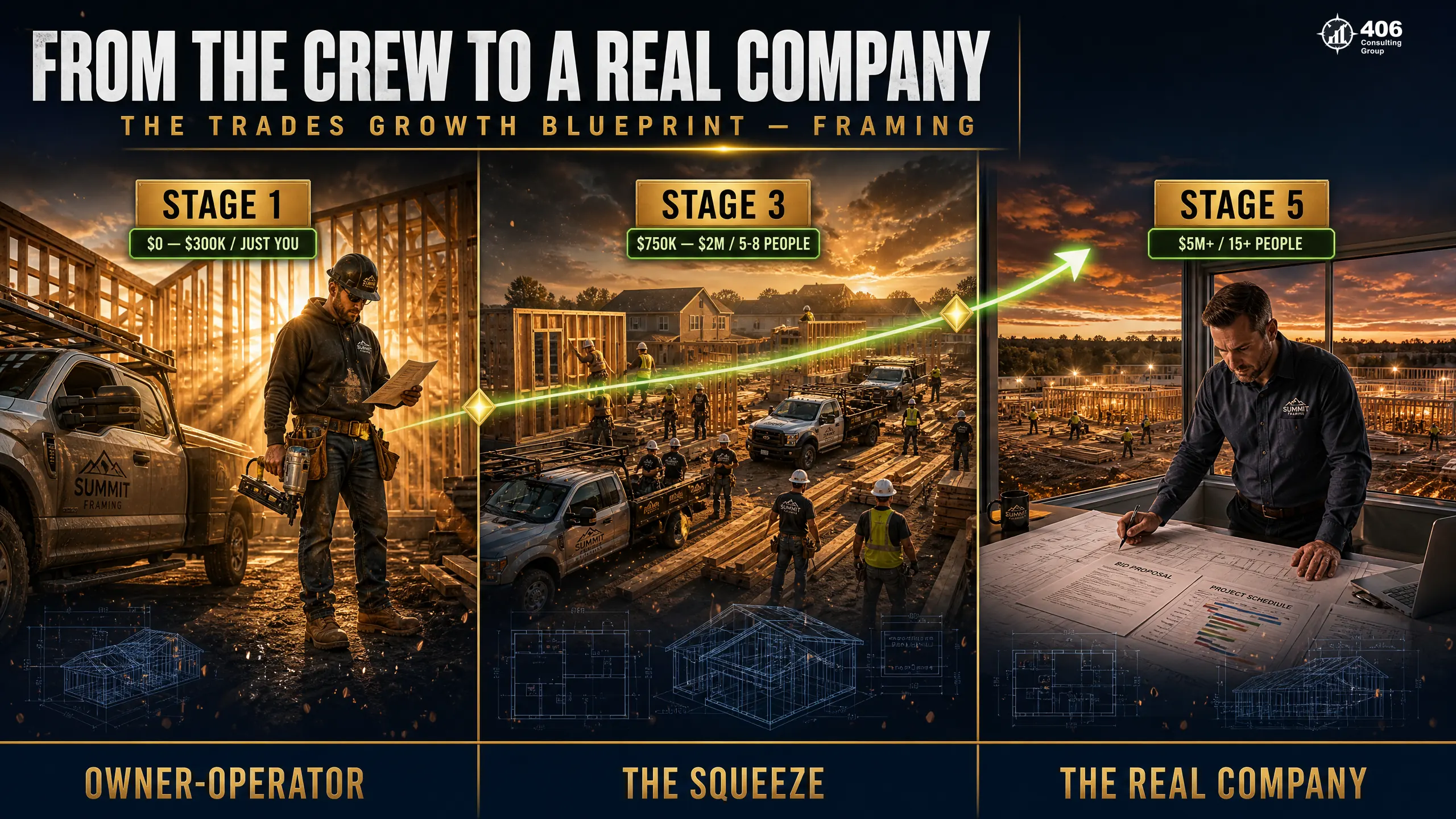
The Trades Growth Blueprint · Part 2: Framing
A framing business almost always starts with a good lead carpenter, a truck full of tools, and a general contractor willing to give them a shot on a job. From there, two very different futures are possible. One is a capable framer who spends twenty years running a crew, bidding by feel, and hoping the good jobs cover the bad ones. The other is a real company — multiple crews, predictable margins, and an operation that runs whether or not the owner is on site. This is how to grow a framing business toward the second one.
Framing is different from a service trade. You're a subcontractor: your customers are GCs, your revenue comes job by job, and your fortunes rise and fall on two things above all — bidding accurately and controlling labor. That makes job costing and cash management make-or-break in a way they simply aren't for a business built on service calls. The blueprint is the same five stages we use across trades, but the framing version lives and dies on the bid.
This is Part 2 of our Trades Growth Blueprint series — the same playbook we ran for plumbing in Part 1, now built for framing. We'll walk the five stages, the do's and don'ts at each, the order to take the many hats off the owner, and where the right financial partner turns "busy and hoping" into "growing on purpose."
By Jason Anderson — Co-Founder, 406 Consulting Group. Operational finance background at BP. Helps Montana construction and trades businesses grow from a crew of one into companies that run without them.
Quick Answer: The 5 Stages (Framing)
- 1.Owner-Operator: lead framer + a helper, subbing for GCs, wearing every hat.
- 2.First Crew: add framers and a lead; start job costing; outsource the books early.
- 3.The Squeeze: multiple crews and jobs, owner bidding and running everything; cash tight from draws and retainage.
- 4.Crews & Systems: foremen, a dedicated estimator, WIP reporting, bonding readiness.
- 5.The Real Company: runs multiple crews and GC relationships without the owner.
Table of Contents
The Blueprint at a Glance
The short answer: a framing business grows through five stages, and the whole job of the owner is to work themselves out of roles — shedding hats and building systems — so the company depends on crews and processes instead of on one person's hands and one person's bidding instinct. For framing specifically, the two things that must get systematized are the bid and the job cost.
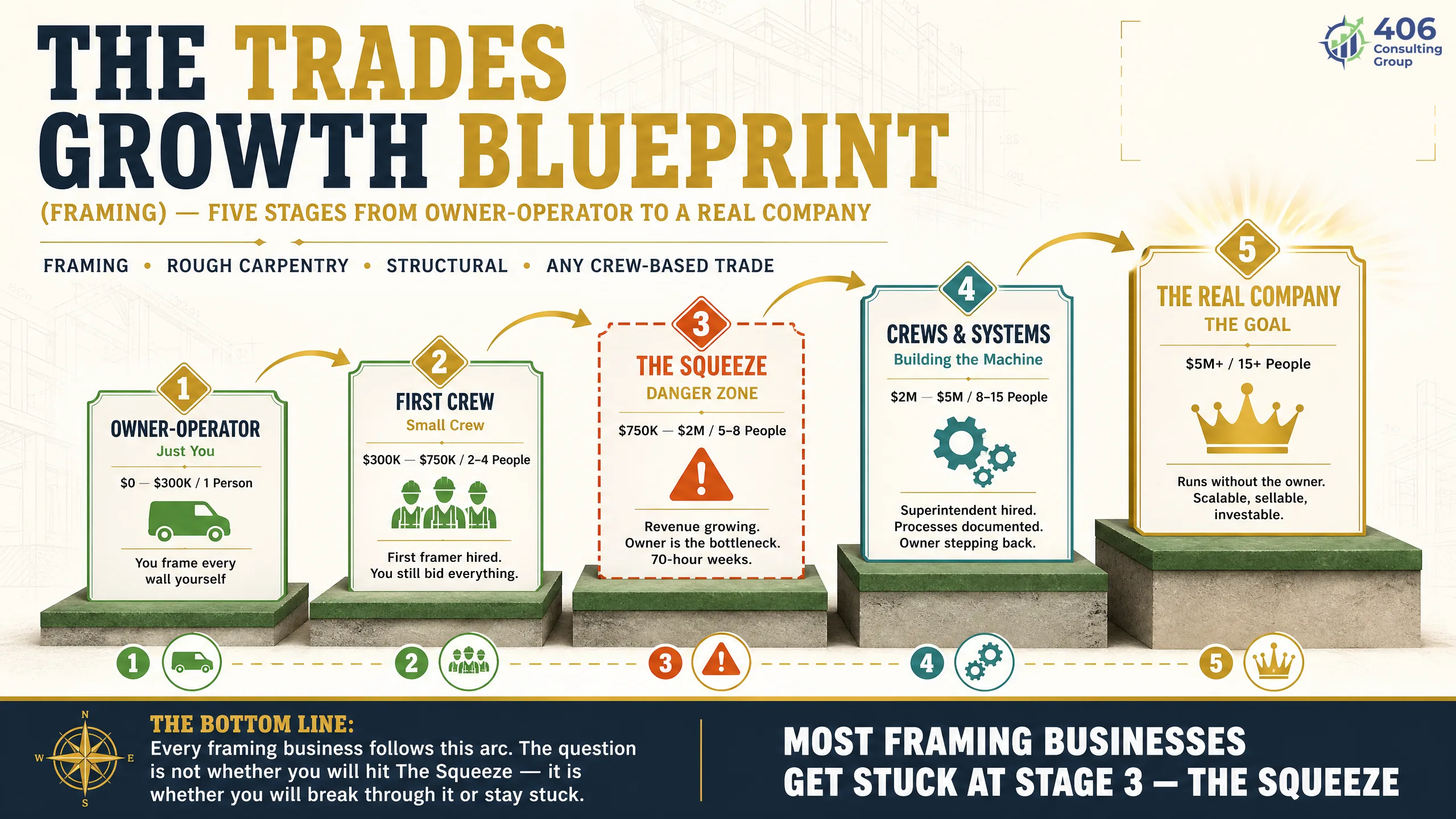
Notice what defines the stages: not revenue, but dependence. A one-crew framer and a five-crew company can look similar on a tax return and run completely differently. What changes across the stages is who bids the work, who runs the crews, and whether the numbers are known before the job ends or discovered after. Moving all of that out of the owner's head is the entire game.
The framing-specific truth that runs through every stage: you make your money on the bid and keep it with job costing. A framing business that can't bid accurately and can't see labor cost against the estimate in real time is gambling on every job — and no amount of growth fixes a business that's guessing.
Stage 1 — The Owner-Operator
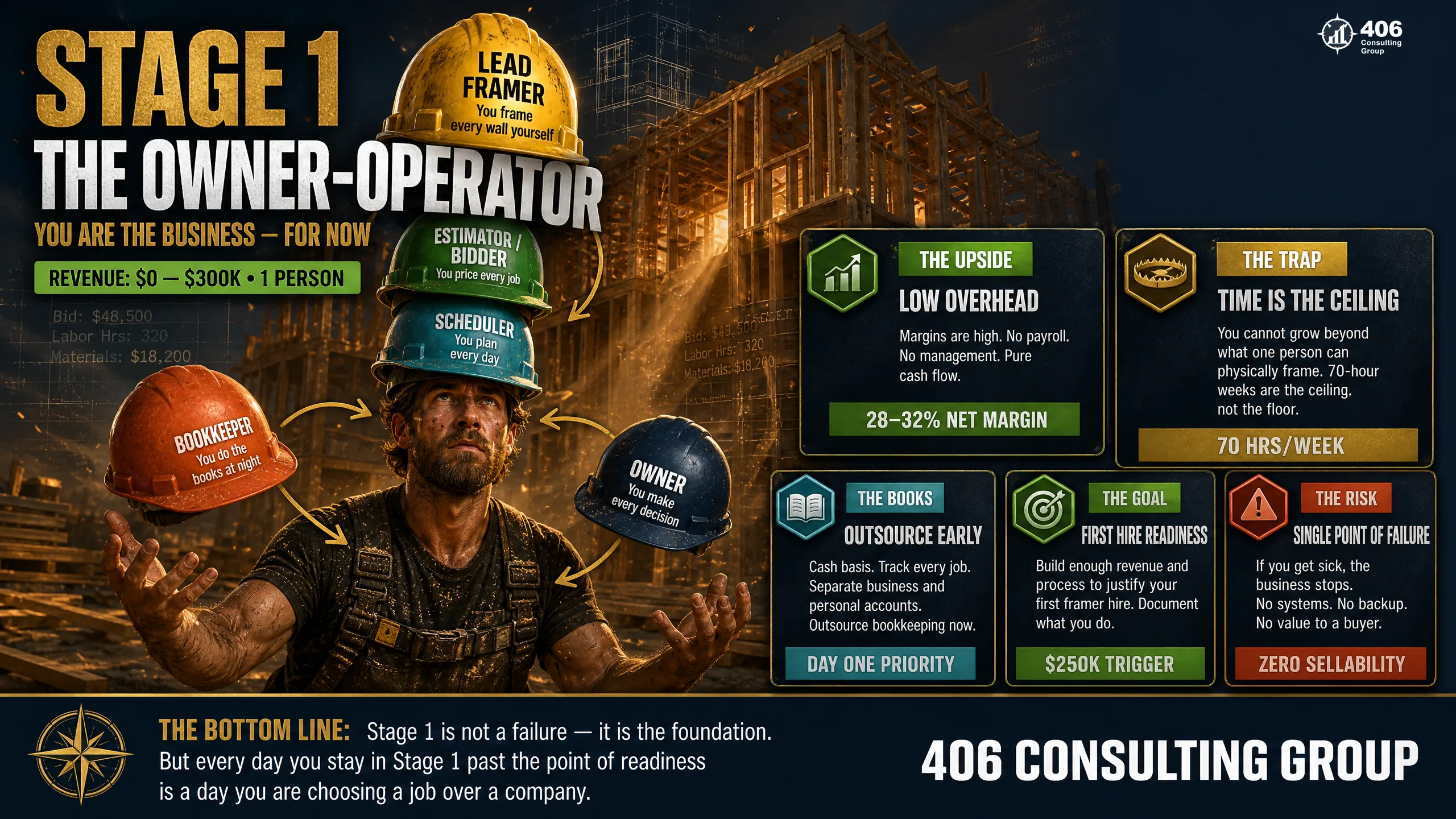
The short answer: at the start you're the lead framer, the estimator, the scheduler, the bookkeeper, and the boss — swinging a hammer all day and bidding jobs at night. That's normal. The goal at Stage 1 isn't to stop wearing hats; it's to build the foundation — especially around bidding and job costing — so you can start taking them off.
Do
- Get licensed, registered, insured, and set up your entity right
- Separate business banking from personal from day one
- Set up real bookkeeping and job costing immediately — even at one crew
- Build your bids off real labor and material costs, not gut feel
- Track actual cost against every bid so you learn what your numbers really are
Don't
- Bid by gut and hope the good jobs cover the bad ones
- Run the business out of your personal account
- Chase every job at any price just to stay busy
- Ignore what labor actually cost versus what you bid
- Skip insurance, licensing, or workers' comp to save a few dollars
The trap of Stage 1: confusing being busy with being profitable. A framer can run flat-out all season, bidding by feel, and finish the year with nothing to show for it — because a few underbid jobs quietly ate the profit from the good ones. Without job costing, you never even find out which was which. Fixing that at one crew is what makes five crews survivable.
Stage 2 — The First Crew
The short answer: you take on more work than you can frame alone, so you build a crew — more framers and, soon, a lead who can run the job when you're not there. This is your first hat coming off. Done right, it multiplies you; done wrong, it just multiplies the payroll and the mistakes.
Do
- Train a lead who can run a crew to your standard
- Set up payroll properly — withholdings, workers' comp, the right class codes
- Track labor cost by job so you can see production rates and margin
- Outsource the bookkeeping early — it's the cheapest, highest-leverage hat to shed
- Look at an S-corp election once profit justifies it (tax planning)
Don't
- Grow the crew without knowing your true labor cost per job
- Pay cash under the table — in construction it's an existential risk
- Misclassify workers' comp codes (a costly, common framing mistake)
- Keep doing the books yourself at midnight after a full day framing
- Assume a new framer will just match your quality without training
Shed the bookkeeping first — even though your instinct is to hang onto it. Doing your own books after a day of framing is the lowest-value, highest-cost way to spend your evening, and it usually means your job-cost numbers are late and unreliable exactly when you need them to bid the next job. Hand it off early and you get your nights back and clean numbers. More on the hat order in Section 7.
Stage 3 — The Squeeze
The short answer: this is the make-or-break stage. You've got two or three crews and several jobs running, revenue is up, and you're the bottleneck for all of it — bidding every job, running the schedule, chasing materials, and still doing the money at night. And despite good revenue, cash is tight, because draw schedules and retainage mean you're paying crews weeks before you collect.
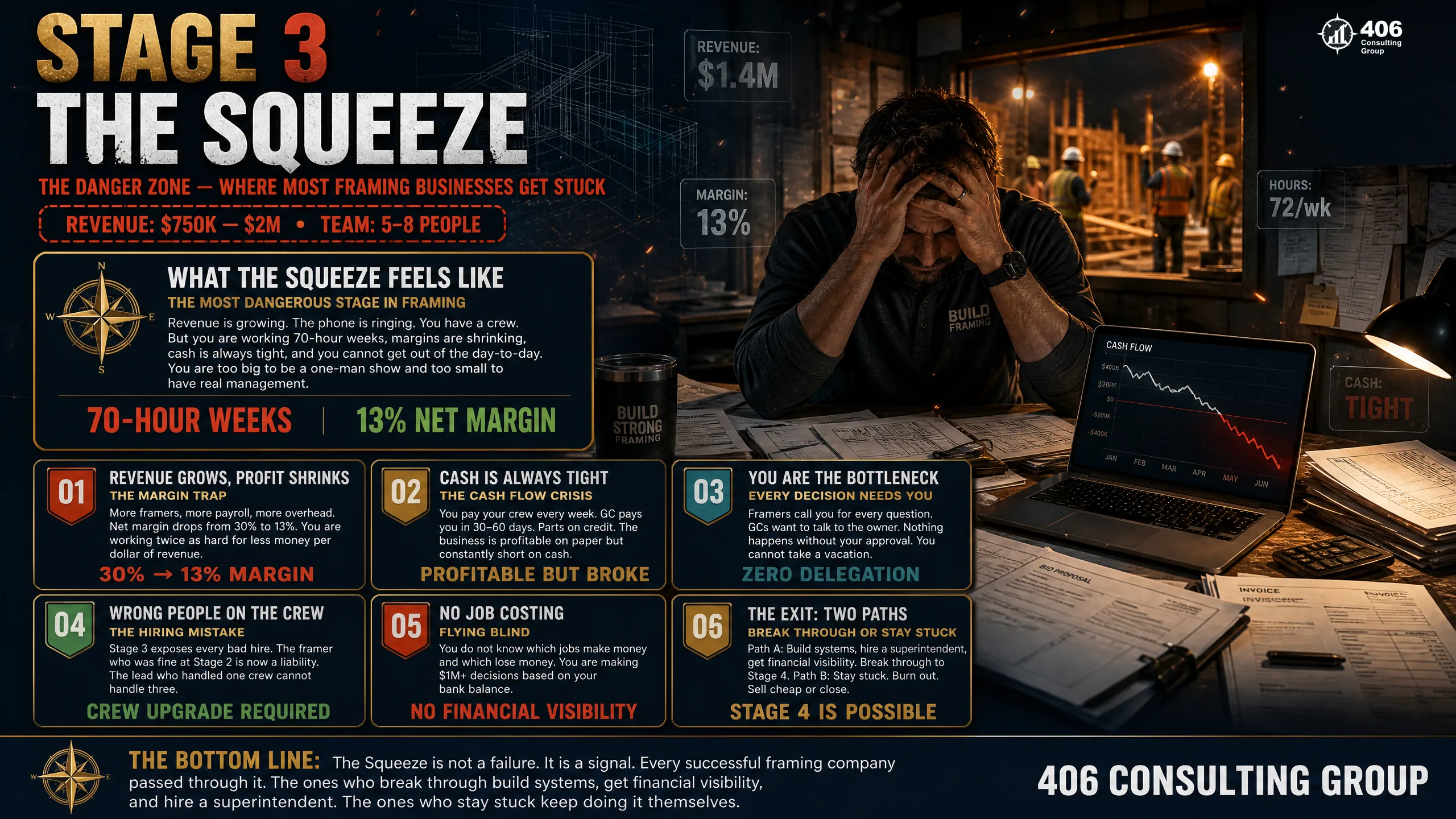
The Squeeze is brutal in framing because two problems hit at once: the owner is the bottleneck on every bid and every crew, and the cash gap is real money. You front payroll and materials, then wait on a draw, and a slice of every payment is held back as retainage until the job's done. More work at this stage amplifies both problems — it doesn't fix them. This is the same cash-gap trap we break down for contractors in getting developer-ready and why a profitable business can be cash-poor.
Do
- Get controller-level financials and a real WIP schedule
- Build a cash flow forecast around your draw and retainage timing
- Start handing bidding and crew-running to trusted, trained people
- Line up a bank relationship and credit before you're desperate for it
Don't
- Take on more jobs as the fix — it deepens the cash gap
- Fly blind on WIP and over/under-billing
- Be the only person who can bid a job
- Let retainage and slow draws catch you without a reserve or credit line
Stage 4 — Building Crews & Systems
The short answer: this is where you deliberately build the company — foremen or superintendents who run crews, a dedicated estimator, and the systems and reporting that let the business bid, build, and bill without the owner touching every piece. The money side grows up from bookkeeping to controller-level WIP reporting, and bonding capacity starts to matter.
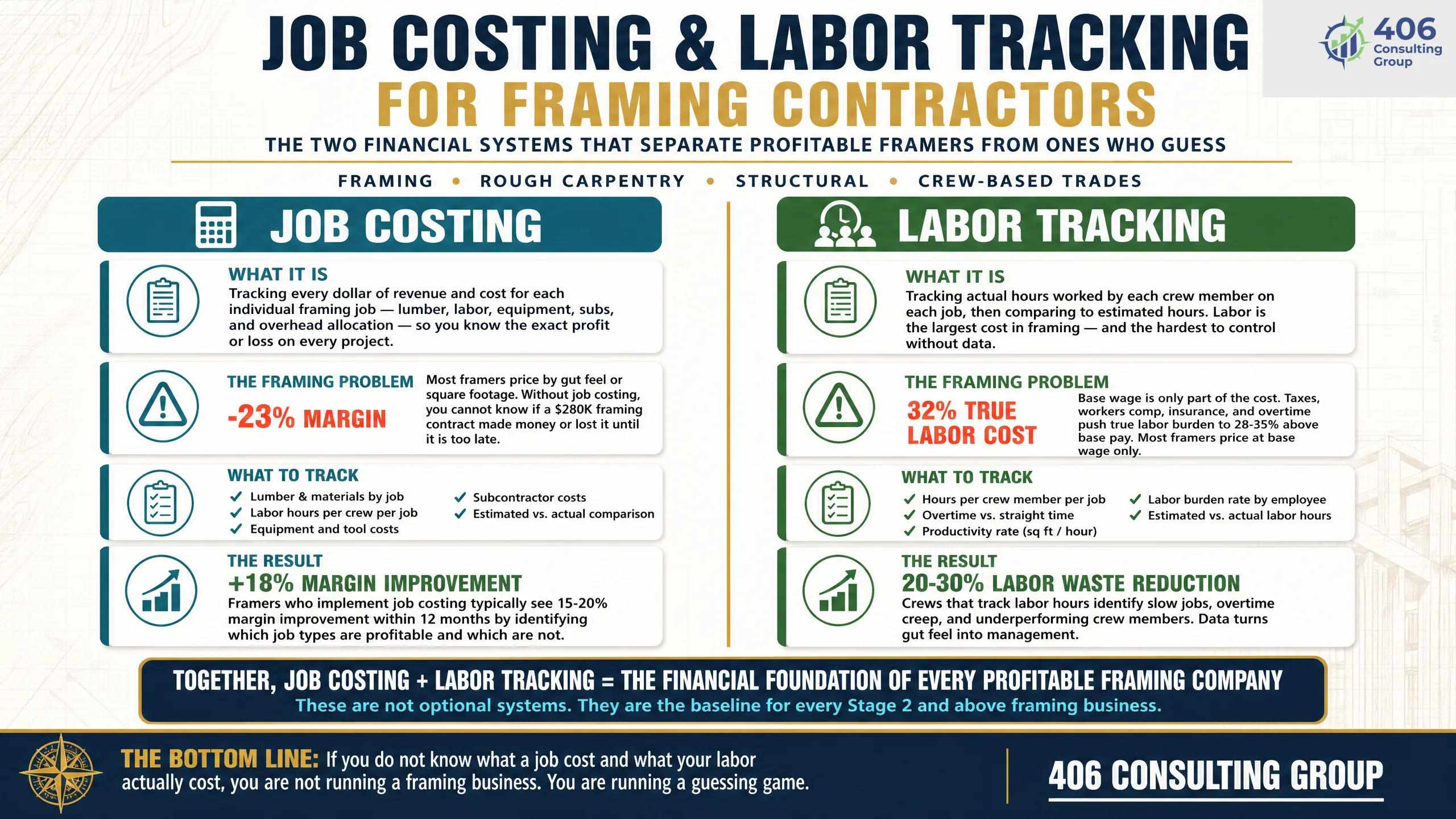
Stage 4 is where a framing business becomes an organization. You promote or hire crew leads and a superintendent, bring on an estimator so bids don't bottleneck at you, and put in scheduling and job-tracking systems. Critically, you move to real WIP reporting — bid versus actual on labor for every job, production rates, and over/under-billing — so you manage with facts. This is also where clean, credible financials start unlocking bigger work and bonding.
Do
- Hire/promote superintendents who replace you on the crews
- Bring on an estimator and systematize the bidding process
- Move up to controller-level WIP reporting and job costing
- Build the financials that support bonding and bigger jobs
Don't
- Keep every bid dependent on you personally
- Add crews without the reporting to see if they're profitable
- Skip documenting how bids and jobs should be run
- Stay the only one who understands the numbers
WIP and job costing are the heartbeat of a framing company at this stage — our guide to WIP and job costing for contractors goes deep, and it's often the moment to move from a bookkeeper to a controller.
Stage 5 — The Real Company
The short answer: at Stage 5 the framing business runs without you. Superintendents run the crews, an estimator bids the work, systems keep it consistent, and you work ON the company — GC relationships, strategy, and growth. The trucks carry your name, but the business doesn't need your hands or even your daily presence. That's a company that could keep going, and be sold, without you.
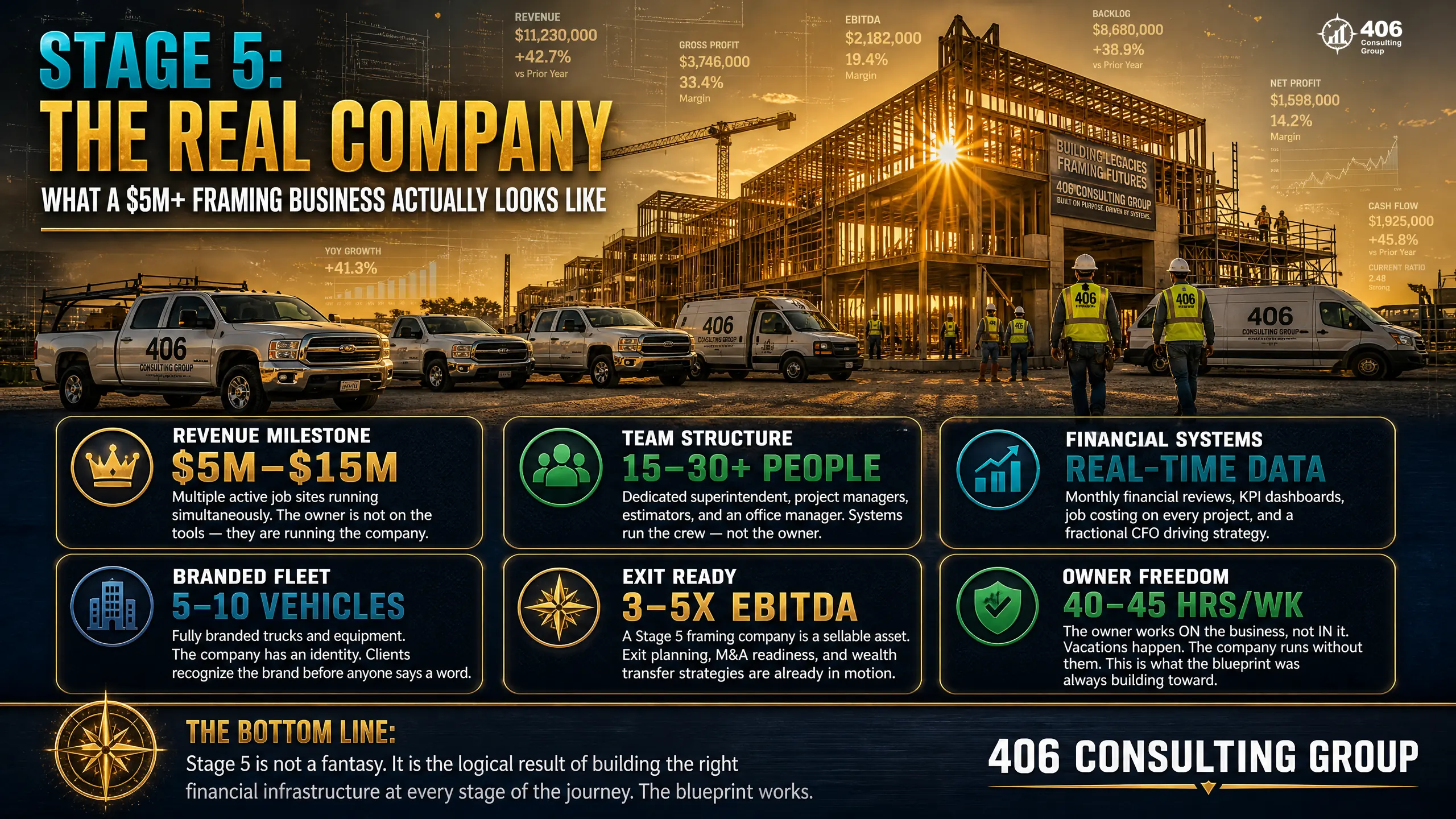
By now the financial function is CFO-level — cash flow forecasting across multiple jobs, margin and bidding strategy, financing and bonding for bigger work, and the numbers behind every major decision — usually fractional long before a framing company could justify a full-time CFO. The owner's remaining role is the valuable one: relationships, reputation, and where the company goes next.
The two tests of a real company
You've arrived when two answers come easily. First: if you stepped off the job sites for a month, would the crews keep framing and the bids keep going out? Second: if you wanted to sell, is there a company to sell — with systems, a team, and a track record — or does it all leave with you? A Stage 5 framing business passes both. It doesn't have to be huge; it has to be durable, profitable, and yours to step back from.
That durability is also what makes a sale or succession possible — see the numbers side of succession planning.
The Owner's Hats: What to Take Off, and When
The short answer: growing a framing business is the process of taking hats off the owner in the right order. You start wearing all of them; you finish wearing one. The framing twist is that the estimator hat is the hardest and most dangerous to hand off — because in framing, a bad bid is the loss.
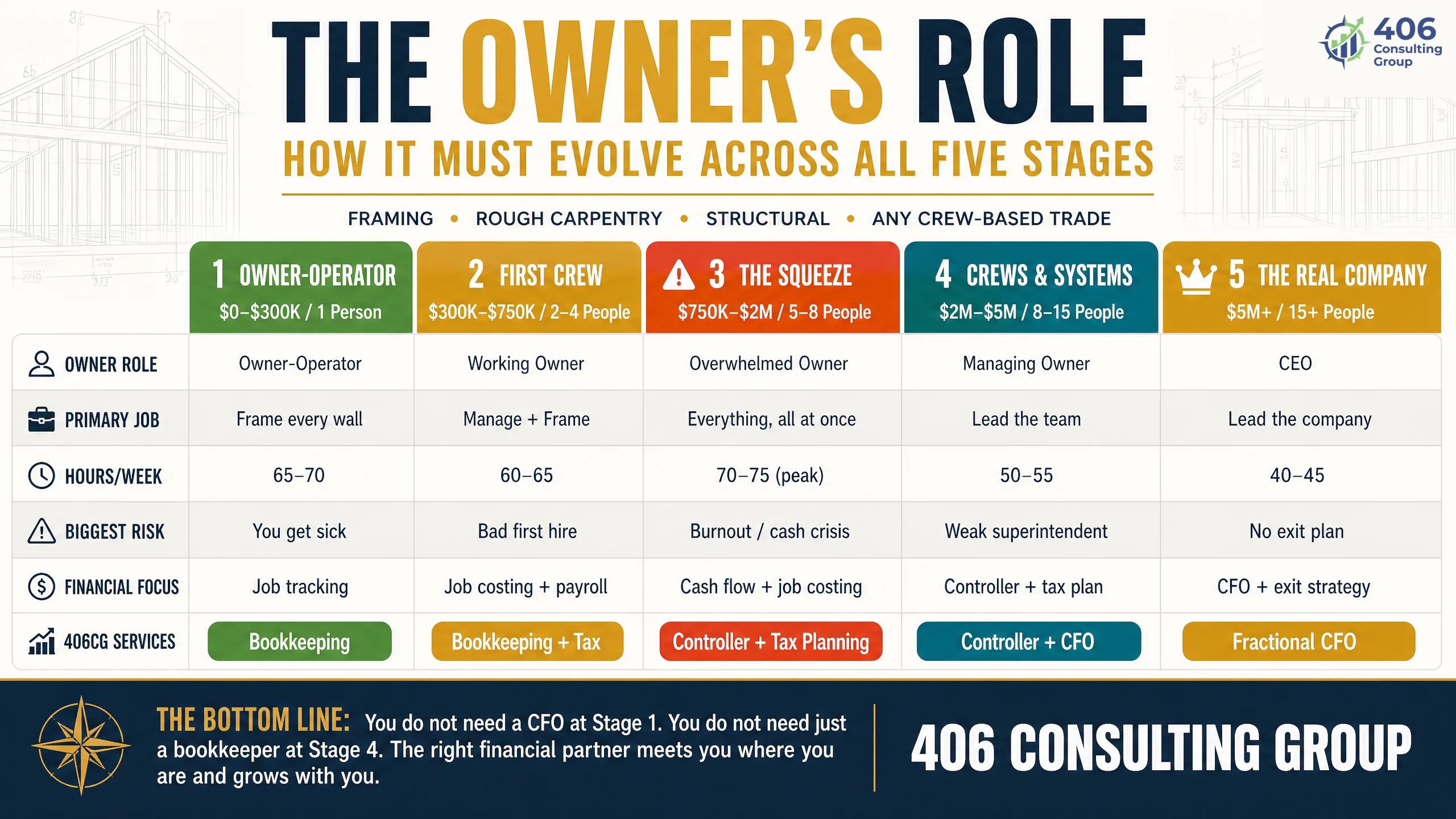
The Lead Carpenter
Stage 2Stop being the only one who can run the crew. Training a lead buys back the hours you need to build everything else — and proves the work can be done to your standard without your hands.
The Bookkeeper
Stage 2 (early!)One of the first to shed — cheap to hand off, and it gives you the clean job-cost numbers you need to bid well. Doing your own books after framing all day is the worst trade of your time there is.
The Scheduler
Stage 2–3Coordinating crews, materials, and GC timelines eats your day. A scheduler or ops coordinator (and scheduling software) hands it off and makes it more reliable.
The Estimator / Bidder
Stage 4The hardest hat in framing to let go — bids feel too high-stakes to trust anyone else with. But a documented estimating process and a trained estimator remove the biggest bottleneck and the biggest single-person risk in the business.
The Superintendent / Operator
Stage 4–5Someone who runs the crews and the jobs day to day is what finally frees the owner from being the hub every crew and every problem routes through.
The CFO / Strategist
Stage 5The last hat, often partly kept by the owner. But the heavy lifting — forecasting, bonding, financing, financial strategy — comes from a fractional CFO long before you'd hire one full-time.
What Kills Framing Businesses
The short answer: framing businesses rarely fail because the crews can't frame — they fail on the bid, the cash, and the dependence on one person. Here are the killers to watch for at every stage.
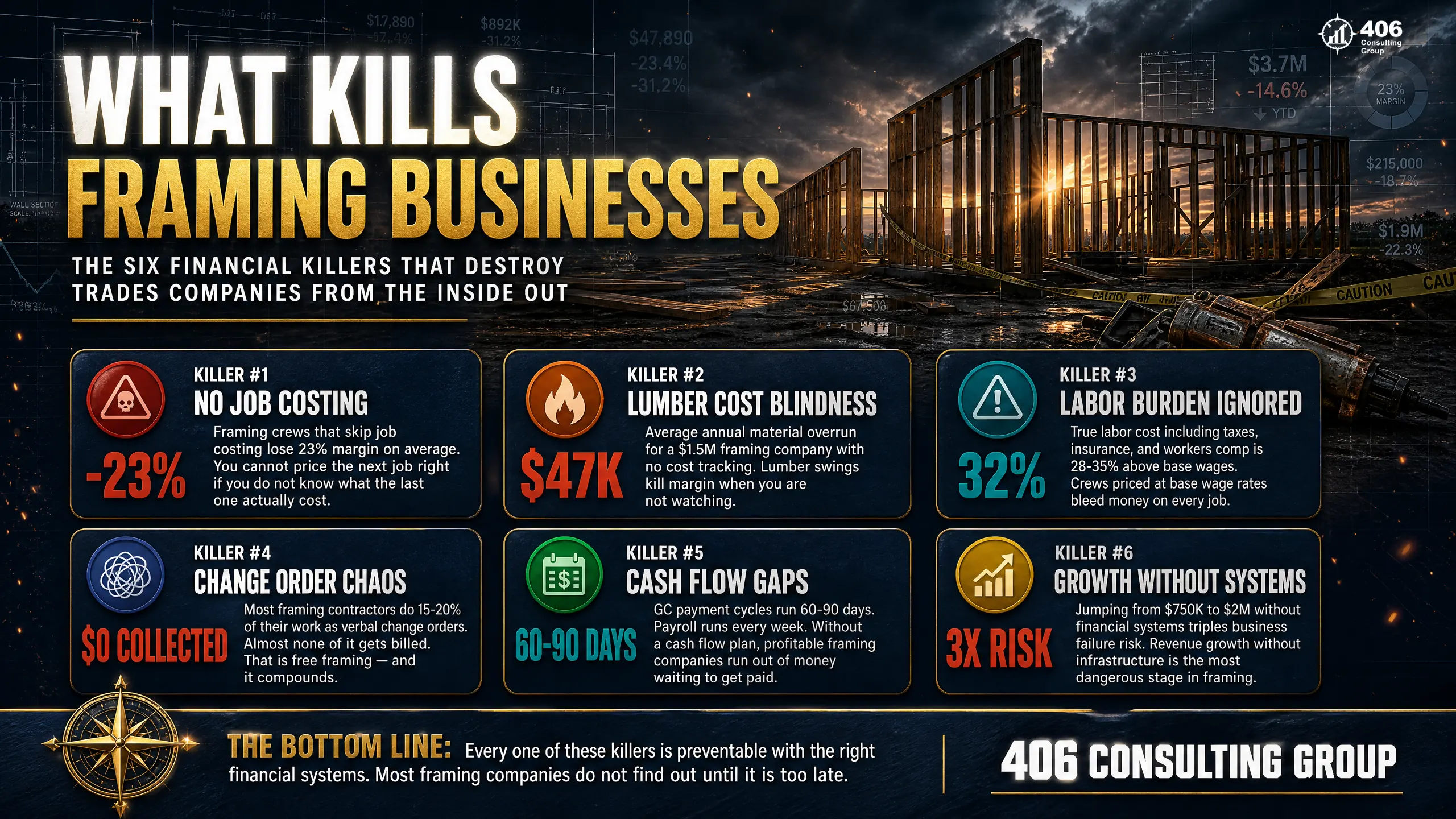
Underbidding labor
Framing is labor-intensive, and labor is the variable that blows up bids. Miss your production rate and a job you thought was profitable loses money — every time you repeat the bad estimate.
No job costing
Without bid-vs-actual by job, you never learn which work makes money. You keep chasing the jobs that feel good and lose on the ones that don't — blind the whole time.
Retainage & draw cash gaps
Fronting payroll and materials while waiting on draws — with retainage held back — sinks profitable framers who didn't plan the cash. Growth makes the gap bigger.
Weather & seasonality
Montana framing is seasonal and weather-exposed. A business that doesn't bank the busy months to carry the slow, frozen ones gets caught every winter.
Crew turnover & key-person risk
If only the owner can bid or only one lead can run a crew, every departure is a crisis. Systematized bidding and trained leads reduce the risk.
Growing broke
Taking on more and bigger jobs without the cash, reporting, and systems to support them is how a fast-growing framer ends up insolvent in a good year.
Where a Partner Like 406 Comes In
The short answer: nearly every "do" in this blueprint is about the numbers and systems behind the framing — job costing, WIP, cash, bidding, bonding — and that's exactly where the right partner speeds up the journey. We meet a framing business at its stage and add the financial layer it needs, so the owner can keep shedding hats with confidence instead of guessing.
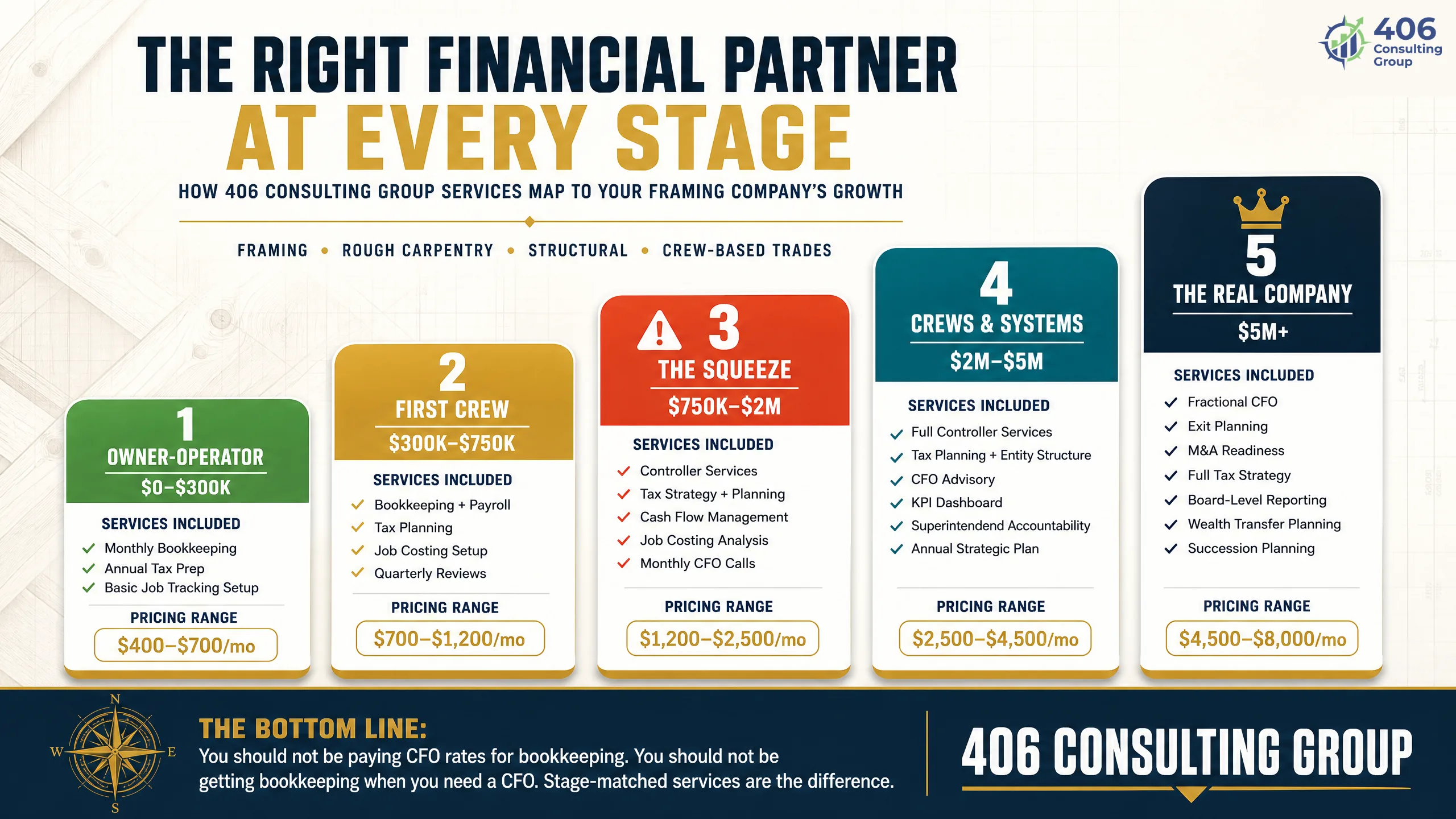
| Stage | What we bring |
|---|---|
| 1 — Owner-Operator | Bookkeeping and job costing from day one, entity setup, bids built on real costs |
| 2 — First Crew | Payroll (and workers' comp codes) done right, labor job costing, tax planning |
| 3 — The Squeeze | Controller-level WIP reporting and a cash flow forecast for draws and retainage |
| 4 — Crews & Systems | Whole-company systems, WIP and bid-vs-actual reporting, bonding readiness |
| 5 — Real Company | Fractional CFO, financing and growth strategy, exit/succession readiness |
Our difference: we don't look at your systems through an accounting lens
Most firms would build you systems that make the books easier. Because of our business background, we look at how a system affects the whole company — the crews in the field, the estimator, the schedulers, your GC relationships — and design what's best for the entire operation, then make the financials support it. A job-tracking or bidding system that only satisfies accounting is one your crews will work around. That whole-company view is what makes the systems actually stick — and it's why we can help a framing business climb the stages, not just keep its books.
See our business systems, CFO, and construction accounting services.
Your Next Step
The short answer: figure out honestly which stage you're in, then do the one or two things that move you to the next — usually shedding the next hat and putting real job costing and cash visibility underneath it. A framing company gets built one deliberate stage at a time, and it almost always starts with finally trusting your numbers.
Whether you're a framer weighing your first hire or an owner stuck in the Squeeze wondering why a busy season didn't leave you any richer, the path is the same shape: take the next hat off, put a system and clean numbers under it, and repeat. Bid better, cost every job, plan the cash, and build the crews and systems that outlast any one person. That's how a framing business becomes a company.
Not sure which stage you're in or what to fix next? Our free financial maturity assessment takes about eight minutes and points to your next move. When you're ready to build the plan, let's talk. And if you missed it, Part 1 of the series covers the same blueprint for plumbing businesses — with more trades to come.
Frequently Asked Questions: Growing a Framing Business
How do I grow a framing business beyond just myself and a crew?
By taking the hats off your head in the right order and building systems and people underneath each one. Growth isn't just more jobs — it's moving the bidding, the crew-running, and the numbers out of your head and into trained people and reliable processes. The path runs through five stages: owner-operator, first crew, the 'squeeze' where you're the bottleneck, building crews and systems, and finally a real company that runs without you. In framing specifically, the two things that must get systematized are accurate bidding and job costing on labor.
Why is my framing business busy but not profitable?
Almost always because of the bid and the job cost. Framing is labor-intensive, so if you bid by feel and don't track actual labor against the estimate, a few underbid jobs quietly eat the profit from the good ones — and without job costing you never learn which was which. The other common culprit is 'growing broke': fronting payroll and materials while waiting on draws, with retainage held back, so a profitable-on-paper year runs out of cash. The fix is real job costing (so you bid and price right) plus a cash flow forecast built around your draw and retainage timing.
What should I outsource first in a framing business?
Bookkeeping — earlier than most owners do. Doing your own books after a full day of framing is the lowest-value, highest-cost use of your time, and it usually leaves your job-cost numbers late and unreliable exactly when you need them to bid the next job. Outsourcing the books early frees your evenings and gives you clean numbers to bid and manage on. Payroll is close behind once you have a crew — and getting workers' comp class codes right matters a lot in construction.
When should a framing business hire its first crew member?
When you consistently have more profitable work than you can frame yourself and your numbers show you can cover a loaded employee with margin to spare — not just when you're slammed. Before you hire, know your true labor cost and production rates so you can price work that includes the new framer's fully loaded cost (wage plus taxes, workers' comp, and overhead). Train a lead who can run the crew to your standard, or you'll just be trading framing hours for supervising hours.
How do I handle cash flow with retainage and draw schedules?
Plan for the gap before it opens. In framing you pay crews and buy materials well before you collect, and retainage (commonly 5–10%) is held back until the job is substantially complete — so even profitable jobs create a cash gap. Build a rolling cash flow forecast around your specific draw and retainage timing, keep a cash reserve, and set up a line of credit before you need it to bridge the gap. This is core CFO/controller work and the single best defense against 'growing broke.'
How do I build a framing business that can run without me?
Remove yourself as the single point of failure, stage by stage. Systematize the bidding so it doesn't depend on your gut, train crew leads and a superintendent who run jobs to your standard, document how work gets bid and built, and put in WIP and job-cost reporting so decisions don't depend on your memory. Add a dedicated estimator to remove the biggest bottleneck. Do this and the crews keep framing and the bids keep going out whether you're on site or not — which is also what makes the business worth selling.
How does 406 Consulting Group help framing and construction businesses grow?
We meet a framing business at its stage and add the financial and systems layer it needs — bookkeeping and job costing early, then payroll and tax planning, then controller-level WIP reporting and cash forecasting for draws and retainage, then fractional CFO, bonding readiness, and growth strategy. And we don't design systems from an accounting-only view: because of our business background, we look at how a change affects the whole company — the field crews, the estimator, scheduling, and your GC relationships — and build the best-fit solution for the entire operation. That whole-company perspective helps an owner actually shed the hats and build a framing company that runs without them. Contact us to talk about your business and its next stage.
Helpful Resources
Related Tools & Resources
Growth & Advisory · Trades Growth Blueprint
Build a Framing Company — Not Just a Crew.
406 Consulting Group helps framing and construction businesses grow from crew-of-one to a real company that runs without them — the job costing, WIP, cash strategy, systems, and CFO leadership each stage needs, designed for the whole company, not just the books. Let's figure out your next stage.
The 5 Stages
The Trades Growth Blueprint
The Owner's Hats
The order to take them off
Our Difference
We design systems for the whole company — field crews, estimating, scheduling, GC relationships — not just the books. That's what makes them stick.
The Series
Trades Growth Blueprint
Ready for the Next Stage?
Build a company, not a crew.
About the Author
Jason Anderson
Co-Founder, 406 Consulting Group
Operational finance background at BP. Jason helps Montana construction and trades businesses grow from a crew of one into companies that run on systems and a team — with the job costing, WIP, and cash strategy framing lives and dies on.
Read the Full Story