
How to Start and Grow a Plumbing Business
Into a Company That Runs Without You
Almost every plumbing business starts with one plumber and a van. Whether it becomes a real company — one that runs, grows, and could sell without you — comes down to building it on purpose. Here's the blueprint: the 5 stages, the hats to shed, and what to do at each. Part 1 of our Trades Growth Blueprint series.
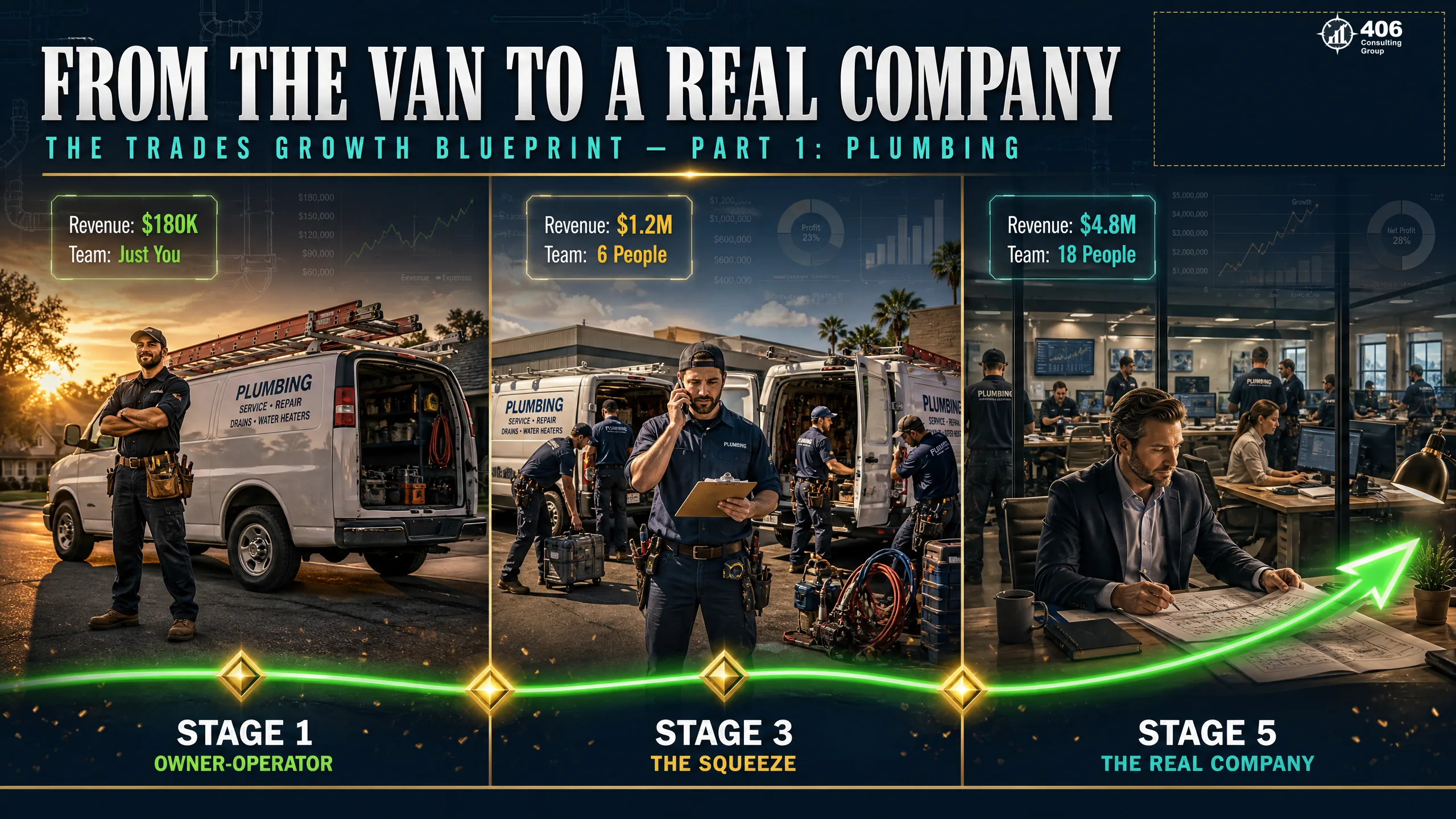
The Trades Growth Blueprint · Part 1: Plumbing
Almost every plumbing business starts the same way: one licensed plumber, a van, and the courage to go out on their own. What happens over the next ten years is what separates a person who bought themselves a job from someone who built a real company — one that runs, and grows, and could even be sold without them. The difference isn't luck or even skill with a wrench. It's whether the owner builds the business on purpose, stage by stage.
This is the blueprint for how to grow a plumbing business into something more than a job. We'll walk it from the first day as an owner-operator all the way to a real company that doesn't depend on any one person — the five stages it moves through, what to do (and what not to do) at each, and the order to take the many hats off the owner's head. It doesn't have to become a hundred-million-dollar company. The goal is simpler and harder: a business that isn't you.
We're using plumbing because it's the classic "truck-to-company" story, but the blueprint is the same for framing, HVAC, electrical, excavation, or any trade — this is Part 1 of a series that runs the same playbook through different industries. If you've read our piece on why resistance to change kills growth, think of this as the constructive sequel: that one named the problem; this one is how you build the opposite from day one.
By Carrie Anderson — Co-Founder, 406 Consulting Group. Background in commercial banking and underwriting — 300+ loan reviews — plus advisory work with Montana trades businesses. I've seen up close which ones grow into real companies and which stay stuck as a job.
Quick Answer: The 5 Stages
- 1.Owner-Operator: one plumber, a van, wearing every hat. Build the foundation right.
- 2.First Hires: add a tech and admin; start systems; outsource the books early.
- 3.The Squeeze: busy but chaotic, owner is the bottleneck. The make-or-break stage.
- 4.Team & Systems: managers, processes, real reporting. Owner shifts from doing to leading.
- 5.The Real Company: runs without you. Works ON the business; could sell it.
Table of Contents
The Blueprint at a Glance
The short answer: a plumbing business grows through five predictable stages, and at each one the owner's job is to work themselves out of a role — shedding hats and building systems — so the business depends less on them and more on the operation. Skip the building and you stay stuck as the business; do it stage by stage and you end up with a company.
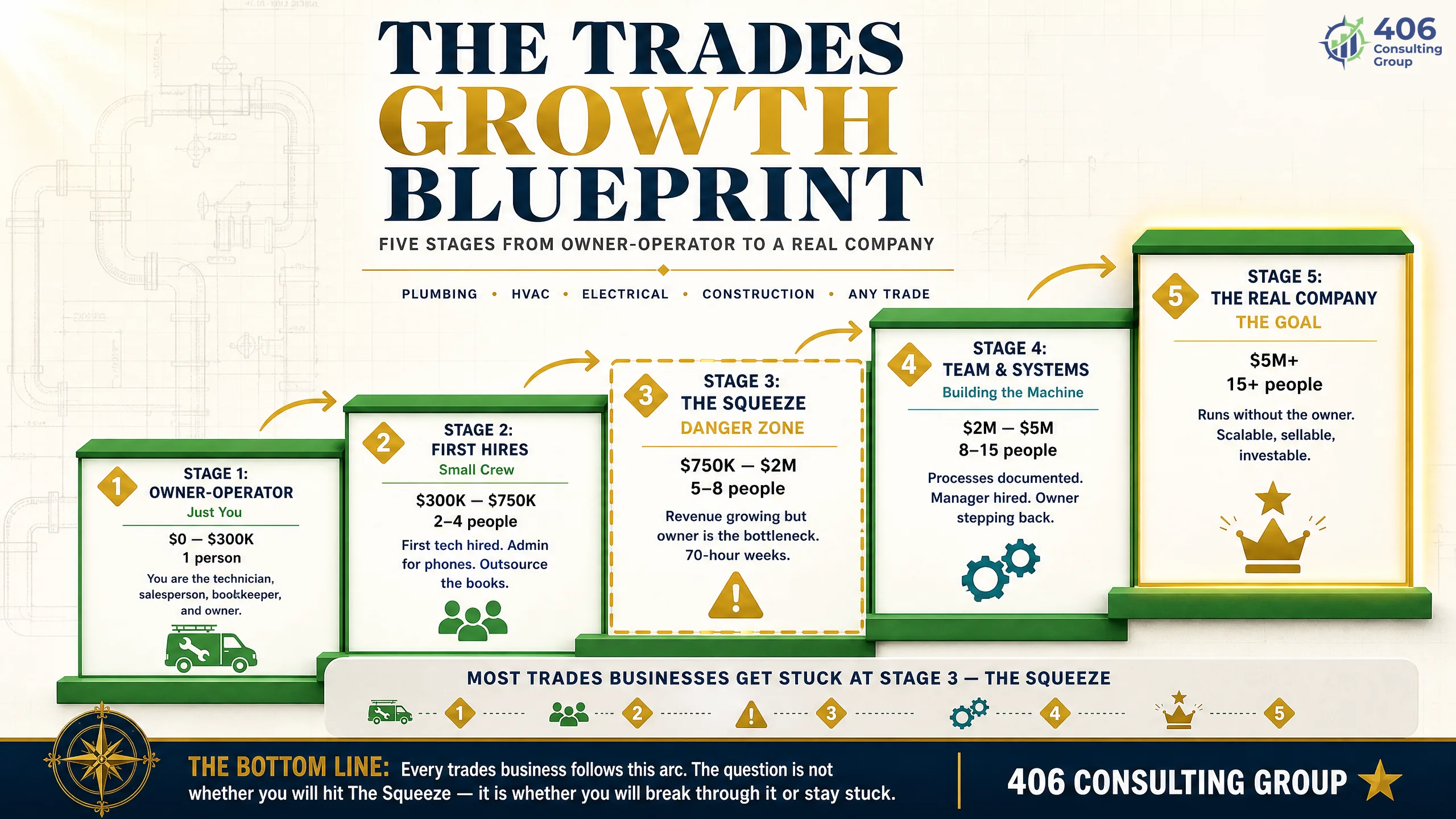
The stages aren't about revenue milestones so much as about roles and dependence. A one-van shop and a ten-van company can look similar on a tax return and be worlds apart in how they run. What changes across the stages is who does the work, who makes the decisions, and how much of it still lives in the owner's head. The whole journey is about moving that knowledge and those decisions out of one person and into a durable business.
One theme runs through every stage: build the financial foundation early. The businesses that make the jump from stage to stage are almost always the ones that could see their numbers clearly and plan with them. The ones that stall are usually flying blind — which is why the "what to do" at every stage includes getting the money side right before the wheels come off.
Stage 1 — The Owner-Operator
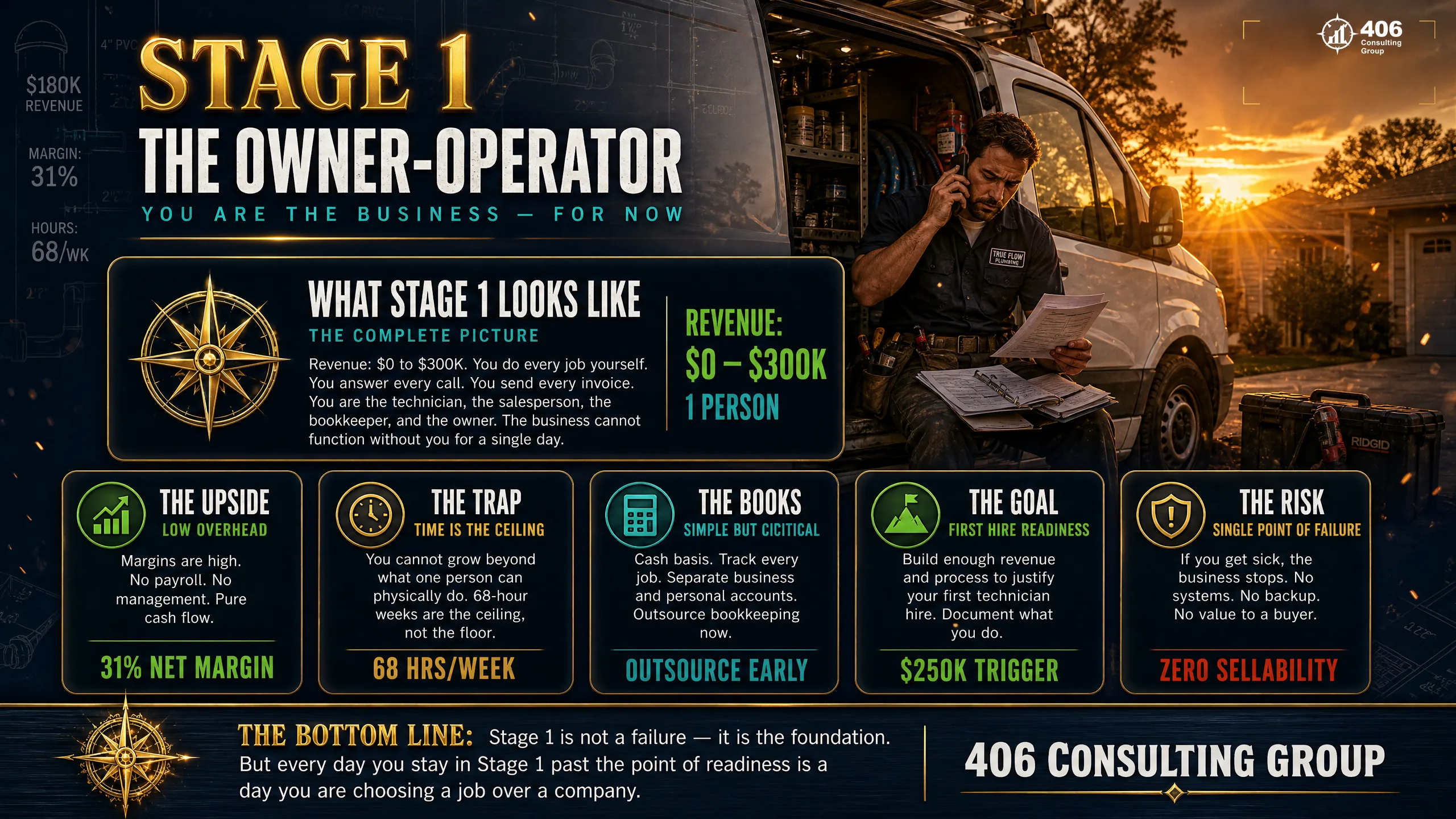
The short answer: at the start you are the business — the plumber, the salesperson, the estimator, the dispatcher, the bookkeeper, and the boss, all in one. That's normal and unavoidable. The goal at this stage isn't to stop wearing the hats; it's to build the foundation so you can start taking them off later.
Do
- Get properly licensed, registered, and insured from day one
- Open a separate business bank account — never run money through personal
- Set up real bookkeeping immediately, even at one van
- Price for your true costs and a profit — not just to beat the other guy
- Track every job so you learn what actually makes money
Don't
- Run the business out of your personal checking account
- Compete on price alone — it caps you at broke and busy
- Treat every dollar that comes in as profit (it isn't)
- Put off the books until tax time and hope it works out
- Skip insurance or licensing to save a few dollars
The trap of Stage 1: staying here forever. Plenty of great plumbers spend a whole career as a one-van owner-operator, working themselves to exhaustion and calling it a business. That's a fine life if you choose it — but it's a job, not a company, and it ends the day you stop turning wrenches. Everything that follows is about building past it.
Stage 2 — First Hires
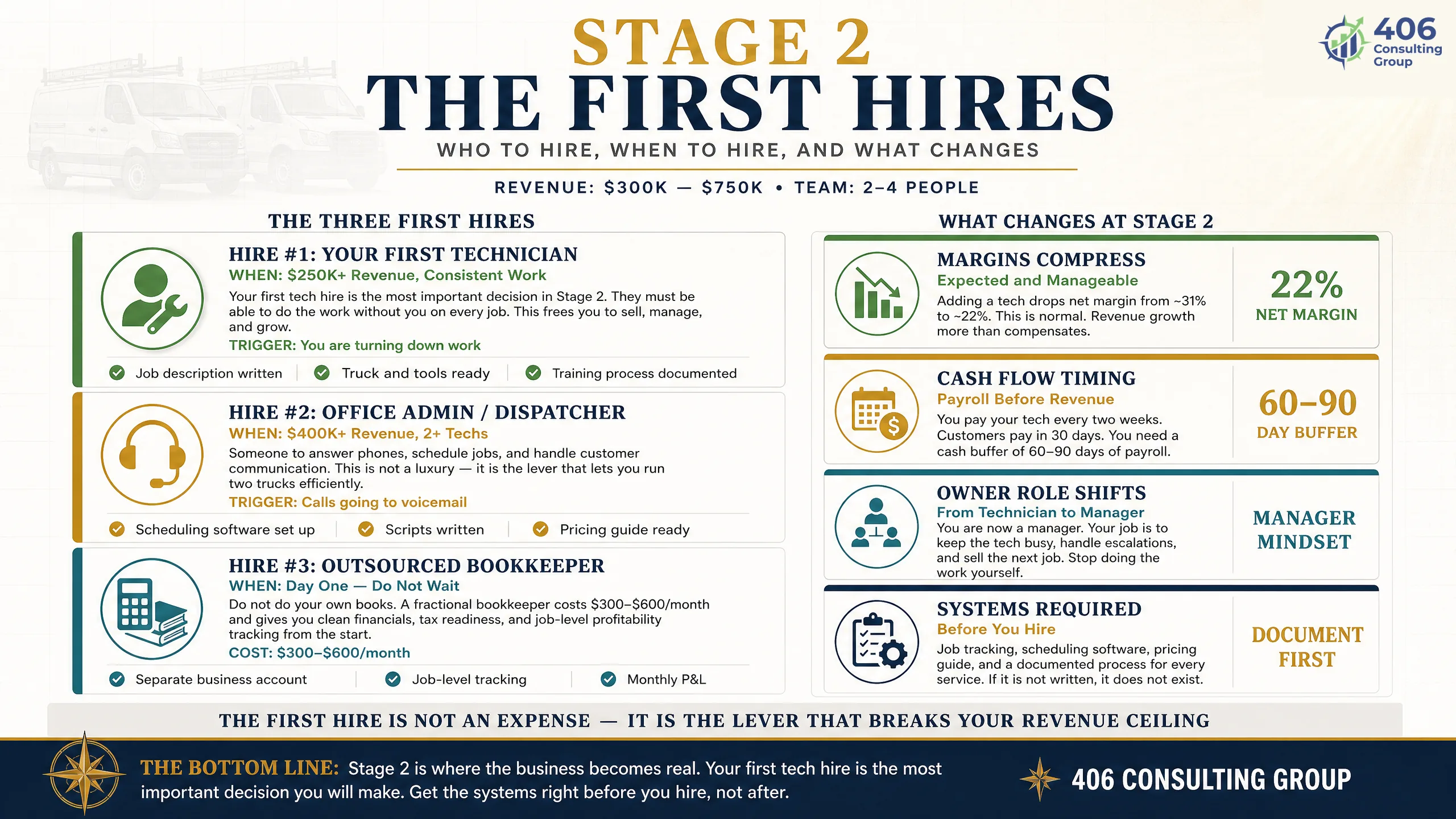
The short answer: growth means you can't do all the work yourself, so you make your first hires — usually a field tech or apprentice, and soon someone to answer the phone and schedule. This is where you take off your first hat. Done right, it multiplies you; done wrong, it just adds chaos and cost.
Do
- Document how you do the work so a new tech does it your way
- Set up payroll properly — withholdings, filings, workers' comp
- Start real job costing now, while it's still simple
- Outsource the bookkeeping early — it's the cheapest, highest-leverage hat to shed
- Look at an S-corp election once profit justifies it (tax planning)
Don't
- Hire before you've written down how the work should be done
- Pay anyone under the table — it's a time bomb
- Keep doing the books yourself at midnight
- Assume a new hire will 'just figure it out'
- Wait until an S-corp would have saved you thousands to ask about it
The first hat to shed is the bookkeeping — and most owners get this wrong by hanging onto it for years. It feels like a place to save money, but doing your own books at night is the lowest-value, highest-cost way you can spend your time. Handing it off early frees your hours and gives you clean numbers to grow on. More on the order of hats in Section 7.
Stage 3 — The Squeeze
The short answer: this is the make-or-break stage. You've got a few techs and some admin help, revenue is climbing, and everything is chaos — you're estimating, dispatching, still jumping on calls, doing the money, and working 70-hour weeks. Cash is tight even though sales are up. The Squeeze either breaks the business or forces it to grow up.

The Squeeze is where the owner becomes the bottleneck. Everything still runs through you, and now there's more of everything. The dangerous instinct here is to believe more revenue will fix it — but more revenue at this stage just amplifies the chaos and the cash crunch. It's also where a lot of profitable-looking plumbing businesses quietly run out of money, because growth eats cash and nobody's watching the gap. (That trap has its own guide: why a profitable business can still be cash-poor.)
Do
- Get real, timely financials — a controller-level monthly close
- Build a cash flow forecast so growth doesn't drain you dry
- Start delegating estimating and dispatch to trusted people
- Write down processes so the work isn't all in your head
Don't
- White-knuckle it and hope it settles down on its own
- Chase more revenue as the fix — it makes the squeeze worse
- Ignore the gap between profit and cash
- Keep every decision routed through you
Stage 4 — Building the Team & Systems
The short answer: this is where you deliberately build the company — hiring managers, installing real systems, and putting in the reporting and accountability that let the business run without you touching everything. The owner's job shifts from doing the work to leading the people and the systems that do it.
Stage 4 is where a plumbing business becomes an organization. You bring on a lead tech or field supervisor, an office manager or admin team, maybe a dedicated estimator. You put in dispatch software, a CRM, and documented processes so the work happens consistently. And you upgrade the money side from basic bookkeeping to controller-level reporting — reliable monthly numbers, job profitability, and budgets — so you're managing with facts instead of gut feel.
Do
- Hire managers who replace you in a role, not just helpers
- Systematize dispatch, estimating, and field operations
- Move up to controller-level reporting and accountability
- Define clear roles so work can actually be handed off
Don't
- Hire your bottleneck a helper instead of a real replacement
- Skip documenting — undocumented systems don't scale
- Stay the only person who understands the numbers
- Buy software and never fully adopt it
A word on systems, because it's where we see the biggest mistakes: a good system isn't designed just to make the books easier. It has to work for the field crews, the dispatchers, the customers, and the office — the whole company. Get that right and people actually use it; get it wrong and you've bought software nobody adopts. If your books are outgrowing simple bookkeeping, our guide on upgrading from a bookkeeper to a controller covers the signs.
Stage 5 — The Real Company
The short answer: at Stage 5 the business runs without you. You work ON the company — strategy, growth, key relationships — while a leadership team and real systems run the day-to-day. The trucks have your name on them, but you don't have to drive one. This is the goal: a company that could keep going, and even be sold, without the owner.

By this stage the financial function has grown up too. You have CFO-level leadership — forecasting, margin strategy, financing for growth, and the numbers to make big decisions — usually fractional long before a plumbing company can justify a full-time CFO. The owner's remaining "hat" is the one worth keeping: vision and leadership. Everything else has been handed to capable people and dependable systems.
The two tests of a real company
You've arrived when you can answer two questions calmly. First: if you took a month off, would the business run? Second: if you wanted to sell, is there a company to sell — or does it all walk out the door with you? A Stage 5 plumbing business passes both. That's not a hundred-million-dollar company; it's something better for most owners — a valuable, durable business that gives you your life back and a real asset to eventually sell.
Getting there is also what makes succession or a sale possible — see the numbers side of succession planning.
The Owner's Hats: What to Take Off, and When
The short answer: growing a plumbing business is really the process of taking hats off the owner in the right order. You start wearing all of them; you finish wearing one. Here's the sequence we coach, and why the order matters.
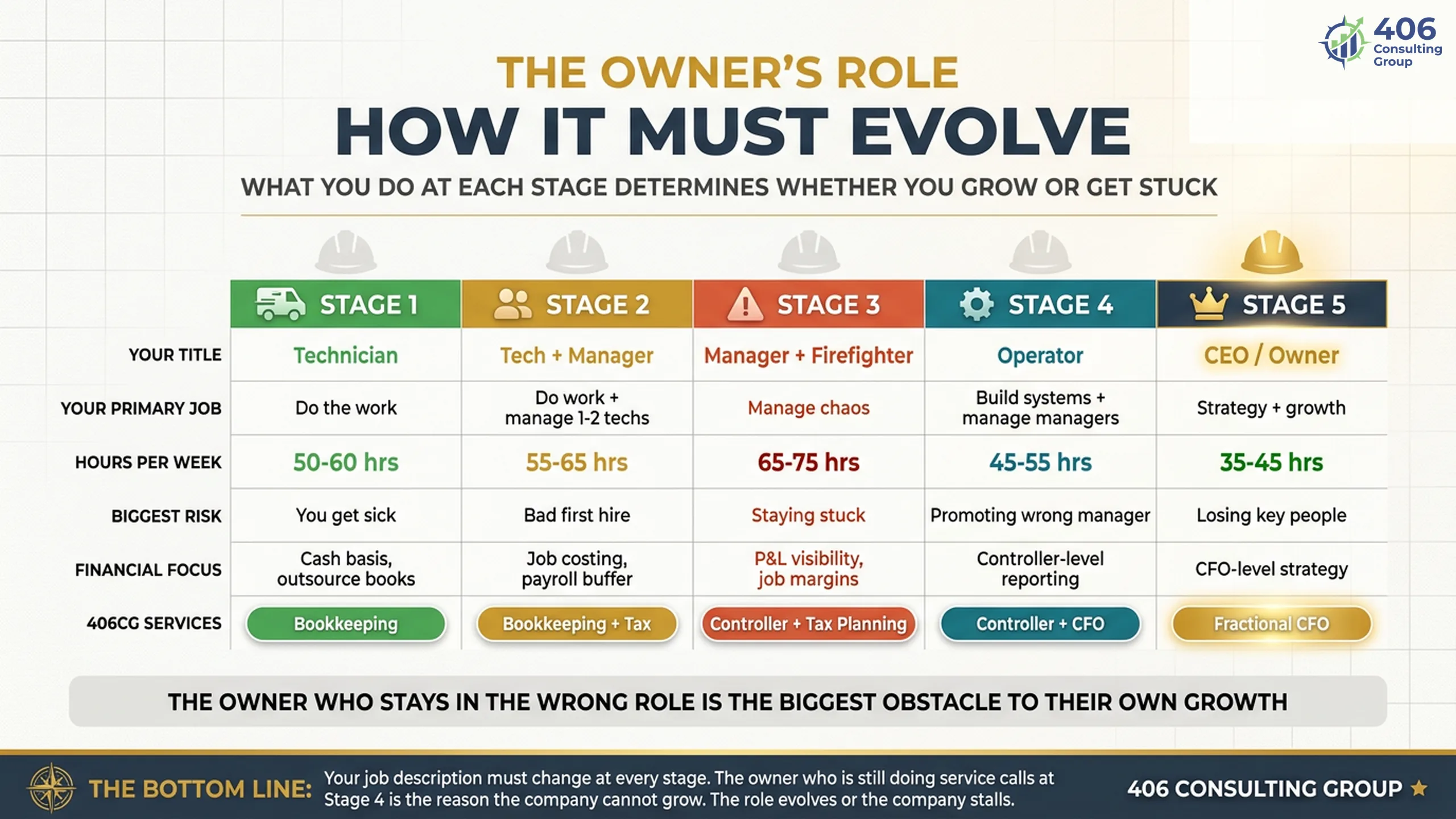
The Technician
Stage 2Stop being the only one turning wrenches. Your first tech hire buys back the hours you need to build everything else. You'll still work in the field a while — but you're no longer the only one who can.
The Bookkeeper
Stage 2 (early!)Counterintuitively, one of the first hats to shed — because it's cheap to hand off and frees the most time while giving you clean numbers. Doing your own books is the lowest-value way an owner can spend an evening.
The Dispatcher / Admin
Stage 2–3Answering phones and scheduling eats your day and doesn't need you. An admin or dispatcher (and dispatch software) hands it off and makes it more consistent than you did.
The Estimator / Salesperson
Stage 4Harder to let go, because bids feel personal and high-stakes. But a documented estimating process and a trained estimator let the business quote without you — and remove a major bottleneck.
The Manager / Operator
Stage 4–5Hiring a field supervisor or operations manager to run the day-to-day is what finally frees the owner from being the hub everything routes through.
The CFO / Strategist
Stage 5The last hat — and often kept, in part, by the owner. But the heavy lifting (forecasting, financing, financial strategy) comes from a fractional CFO long before you'd hire one full-time.
What Kills Trades Businesses at Each Stage
The short answer: most plumbing businesses that stall or fail do it for a handful of predictable, avoidable reasons — and almost all of them trace back to money and systems, not to the quality of the plumbing. Here are the killers to watch for.
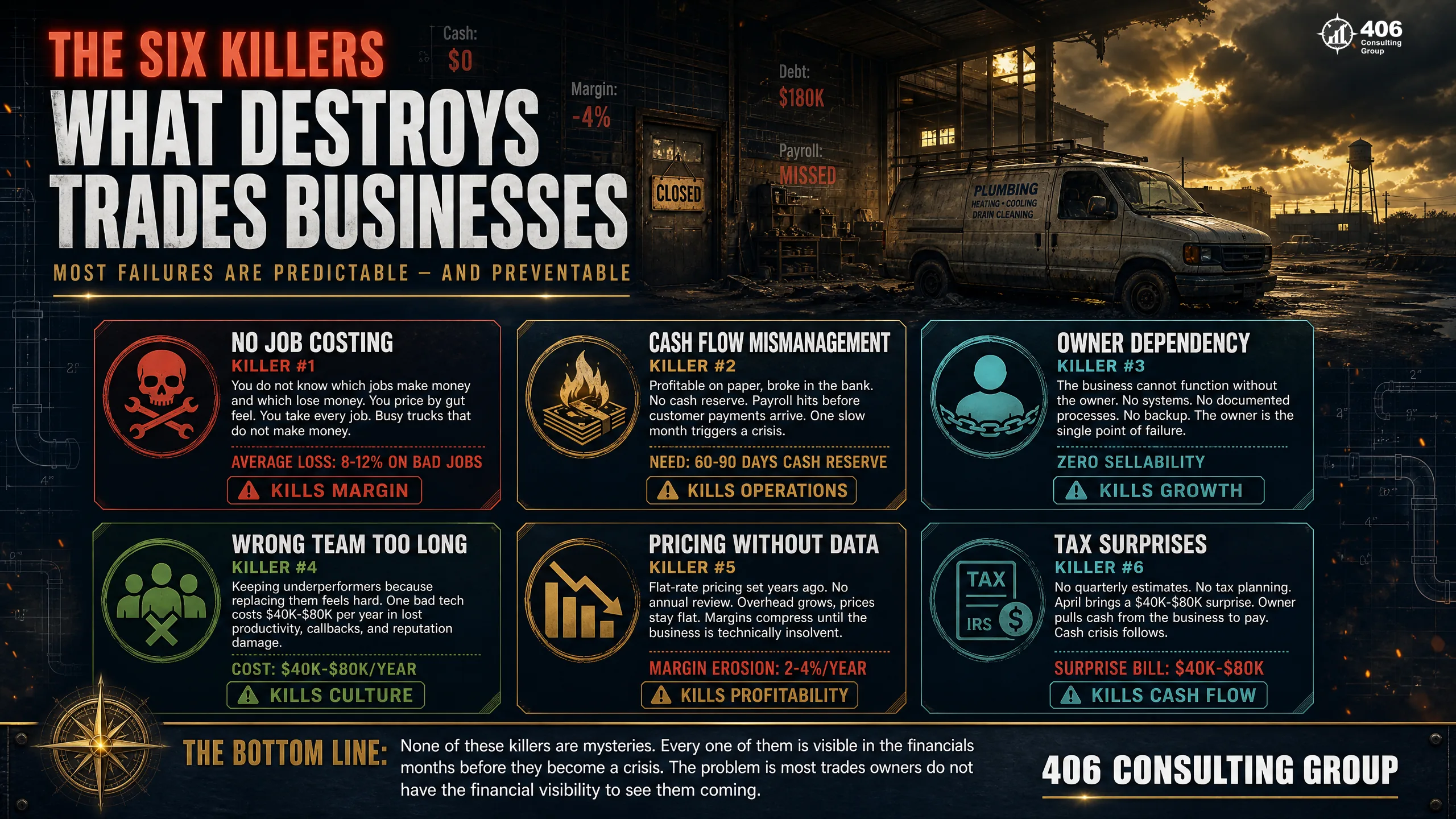
Undercharging and no job costing
Bidding to beat the other guy without knowing your true costs. You stay busy and broke because you never actually knew which jobs made money.
Growing broke
Growth eats cash — more crews, more materials, more receivables before you collect. Without a cash forecast and reserve, a good year can bankrupt you.
The owner who won't let go
Refusing to delegate or systematize caps the business at whatever one person can personally handle, and burns the owner out getting there.
Hiring helpers, not replacements
Adding people who lean on the owner instead of removing load from them. Headcount goes up, but the bottleneck stays.
No systems
When everything lives in the owner's head, nothing scales and nothing is safe. One departure or one bad month exposes it all.
Tax surprises
No planning means an April bill that wipes out the reserve — or worse, money that was owed all along and got spent.
Where a Partner Like 406 Comes In
The short answer: nearly every "do" in this blueprint touches the money and systems side — and that's exactly where the right partner accelerates the journey. We meet a plumbing business at whatever stage it's in and add the financial layer that stage needs, so the owner can keep shedding hats with confidence instead of guessing.
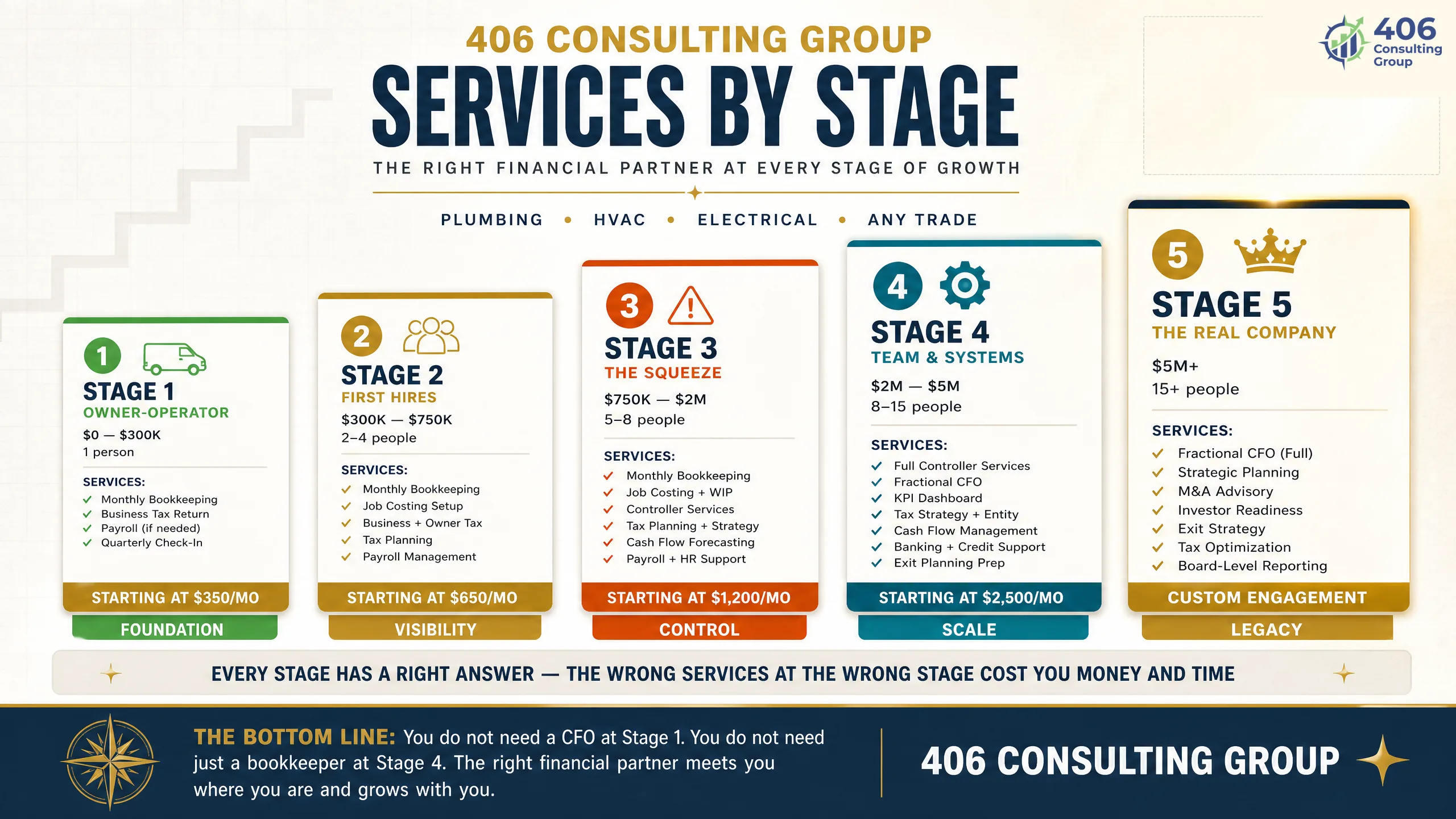
| Stage | What we bring |
|---|---|
| 1 — Owner-Operator | Bookkeeping from day one, entity/structure guidance, pricing that includes real costs |
| 2 — First Hires | Payroll done right, job costing, and tax planning (S-corp when it fits) |
| 3 — The Squeeze | Controller-level reporting and a cash flow forecast so growth doesn't sink you |
| 4 — Team & Systems | Whole-company systems design, reporting, and accountability |
| 5 — Real Company | Fractional CFO, growth strategy, and exit/succession readiness |
Our difference: we don't look at your systems through an accounting lens
Most accounting firms would help you build systems that make the books easier. Because of our business background, we look at how a change affects the whole company — the field crews, dispatch, your customers, the office — and design the solution that's best for the entire business, then make the financials support it. A dispatch or estimating system that only pleases accounting is a system your crews will route around. That whole-company view is what makes the systems actually stick — and it's why we can be instrumental in getting a plumbing business through the stages, not just keeping its books.
See our business systems, CFO, and bookkeeping services, or our specialty trades page.
Your Next Step
The short answer: figure out honestly which stage you're in, then do the one or two things that move you toward the next — usually shedding the next hat and shoring up the financial layer underneath it. You don't build a real company in a weekend; you build it one deliberate stage at a time.
Wherever you are — a plumber thinking about that first hire, or an owner stuck in the Squeeze wondering why more revenue hasn't helped — the path forward is the same shape: take the next hat off, put a system and clean numbers underneath it, and repeat. The businesses that do this become companies. The ones that don't stay jobs.
Not sure which stage you're in or what to fix next? Our free financial maturity assessment takes about eight minutes and points you to your next move. When you're ready to build the plan, let's talk. And watch for the next installments in the Trades Growth Blueprint series, running this same playbook through framing, HVAC, electrical, and more.
Frequently Asked Questions: Growing a Plumbing Business
How do I grow a plumbing business beyond just myself?
By deliberately taking the many hats off your head in the right order and building systems and a team underneath each one. Growth isn't just more jobs — it's moving the work and decisions out of your head and into people and processes. The typical path runs through five stages: owner-operator, first hires, the 'squeeze' where you're the bottleneck, building the team and systems, and finally a real company that runs without you. At each stage you shed a role (starting with the technician and, early, the bookkeeping) and add the financial and operational infrastructure that lets the business stand on its own.
What should I outsource first as my plumbing business grows?
Bookkeeping — earlier than most owners think. It feels like a place to save money by doing it yourself, but doing your own books at night is the lowest-value, highest-cost way to spend your time as an owner, and it usually means your numbers are late and unreliable right when you need them to make decisions. Handing off the books early frees your hours and gives you clean, current financials to grow on. Payroll is close behind once you hire. Both are cheap to outsource relative to what they free up.
When should a plumbing business hire its first employee?
When you have more profitable work than you can do yourself and the numbers show you can cover the cost with room to spare — not just when you're busy. Before you hire, write down how the work should be done so a new tech does it your way, set up payroll properly, and make sure your pricing actually covers a loaded employee (wage plus taxes, insurance, and overhead), not just your own time. Hiring without those foundations tends to add chaos and cost instead of capacity.
How do I build a plumbing business that can run without me?
Systematically remove yourself as the single point of failure. Document your processes so the knowledge isn't only in your head, install systems (dispatch, estimating, CRM, financial reporting) that make the work consistent, hire managers who replace you in a role rather than just help, build reliable financial visibility so decisions don't depend on your gut, and delegate real ownership of clear responsibilities. Do this stage by stage and you end up with a company that keeps running when you take a month off — and that's worth something to a buyer.
Why is my plumbing business busy but not making money?
Usually one of two reasons, often both: you're undercharging because you don't know your true job costs, and/or you're 'growing broke' — growth is eating cash through payroll, materials, and unpaid invoices faster than it comes in. The fix starts with job costing (so you know which work actually makes money and can price it right) and a cash flow forecast (so you see the crunch coming). Being busy is not the same as being profitable, and profitable on paper is not the same as having cash — those gaps are exactly where trades businesses get into trouble.
Do I need a CFO for a plumbing business?
Not a full-time one — but you'll benefit from CFO-level thinking well before you could justify hiring a full-time CFO. As you move through the later stages, cash flow forecasting, margin and pricing strategy, financing for expansion, and growth planning become the difference between scaling smoothly and stalling. A fractional CFO provides that senior financial leadership a few days a month for a fraction of a full-time salary, which fits most growing plumbing companies. Before that, a controller keeps your numbers reliable enough to run on.
How does 406 Consulting Group help trades businesses grow?
We meet a trades business at whatever stage it's in and add the financial and systems layer that stage needs — bookkeeping and entity setup early, then payroll and tax planning, then controller-level reporting and cash forecasting, then fractional CFO and growth strategy. Critically, we don't design systems from an accounting-only view: because of our business background, we look at how a change affects the whole company — field crews, dispatch, customers, and the office — and build the best-fit solution for the entire business. That whole-company perspective is what helps an owner actually shed the hats and build a company that runs without them. Contact us to talk about where your business is and what the next stage looks like.
Helpful Resources
Related Tools & Resources
Growth & Advisory · Trades Growth Blueprint
Build a Plumbing Company — Not Just a Job.
406 Consulting Group helps trades businesses grow from owner-operator to a real company that runs without them — the bookkeeping, systems, reporting, and CFO strategy each stage needs, designed for the whole company, not just the books. Let's figure out your next stage.
The 5 Stages
The Trades Growth Blueprint
The Owner's Hats
The order to take them off
Our Difference
We design systems for the whole company — field, dispatch, customers, office — not just the books. That's what makes them stick.
Ready for the Next Stage?
Build a company, not a job.
About the Author
Carrie Anderson
Co-Founder, 406 Consulting Group
Background in commercial banking and underwriting — 300+ loan reviews — plus advisory work with Montana trades businesses. Carrie has seen up close which trades companies grow into real, sellable businesses and which stay stuck as a job, and helps owners build the former.
Read the Full Story