
Industry-Specific Accounting:
Why Your Business Needs More Than Generic Bookkeeping
Construction, trucking, trades, and service businesses each have their own metrics, compliance, and cash patterns — and generic accounting misses all three. Here's what your industry actually needs, and why good financial help pays for itself.

A general bookkeeper can keep a tidy set of books for almost any business. What they usually can't do is tell a contractor which jobs are bleeding margin, keep a trucking company compliant with IFTA, or benchmark a service firm's utilization rate. Those aren't bookkeeping tasks — they're industry knowledge. And when your accountant doesn't have it, the cost shows up quietly: in overpaid taxes, missed compliance, bad bids, and decisions made on numbers that don't mean what you think they mean.
That's the case for industry-specific accounting in Montana. Construction, trucking, trades, and service businesses each have their own metrics, their own compliance rules, and their own cash-flow patterns — and generic accounting misses all three. This guide walks through what's different about the finances in each of the industries we serve, why cheap or generic help so often costs more than it saves, and what it actually takes to get your numbers working for you instead of against you.
We'll be direct about something most accountants struggle to explain and most owners struggle to see: the real value of a good bookkeeper, controller, or CFO isn't tidy books — it's the expensive mistakes they prevent, the money they surface, and the gaps a cheap generalist leaves wide open. Let's start there, then go industry by industry.
By Jason Anderson — Co-Founder, 406 Consulting Group. Operational finance background at BP; works with construction, trucking, trades, and service businesses across Montana and the Northwest.
Quick Answer: Why Industry-Specific Accounting Matters
- →Every industry is different: unique metrics, unique compliance, unique cash patterns — generic accounting misses all three.
- →Cheap is expensive: we once caught misclassified transactions a cheap bookkeeper left behind that would have cost the owner $50,000+ in taxes.
- →You can't do it all — or hire one person who can: the finance function is really 5–6 specialized roles, not one office manager.
- →Construction, trucking, trades, service each need accounting built for how they actually make money.
- →Industry expertise catches what generic bookkeeping never will — and that's what makes it pay for itself.
Table of Contents
Why Generic Accounting Fails Your Industry
The short answer: generic accounting treats every business the same, but your industry doesn't work like every business. The default chart of accounts, the standard reports, and a general bookkeeper's habits are built for an average business that doesn't exist — and they leave out the exact things that make your industry's finances work.
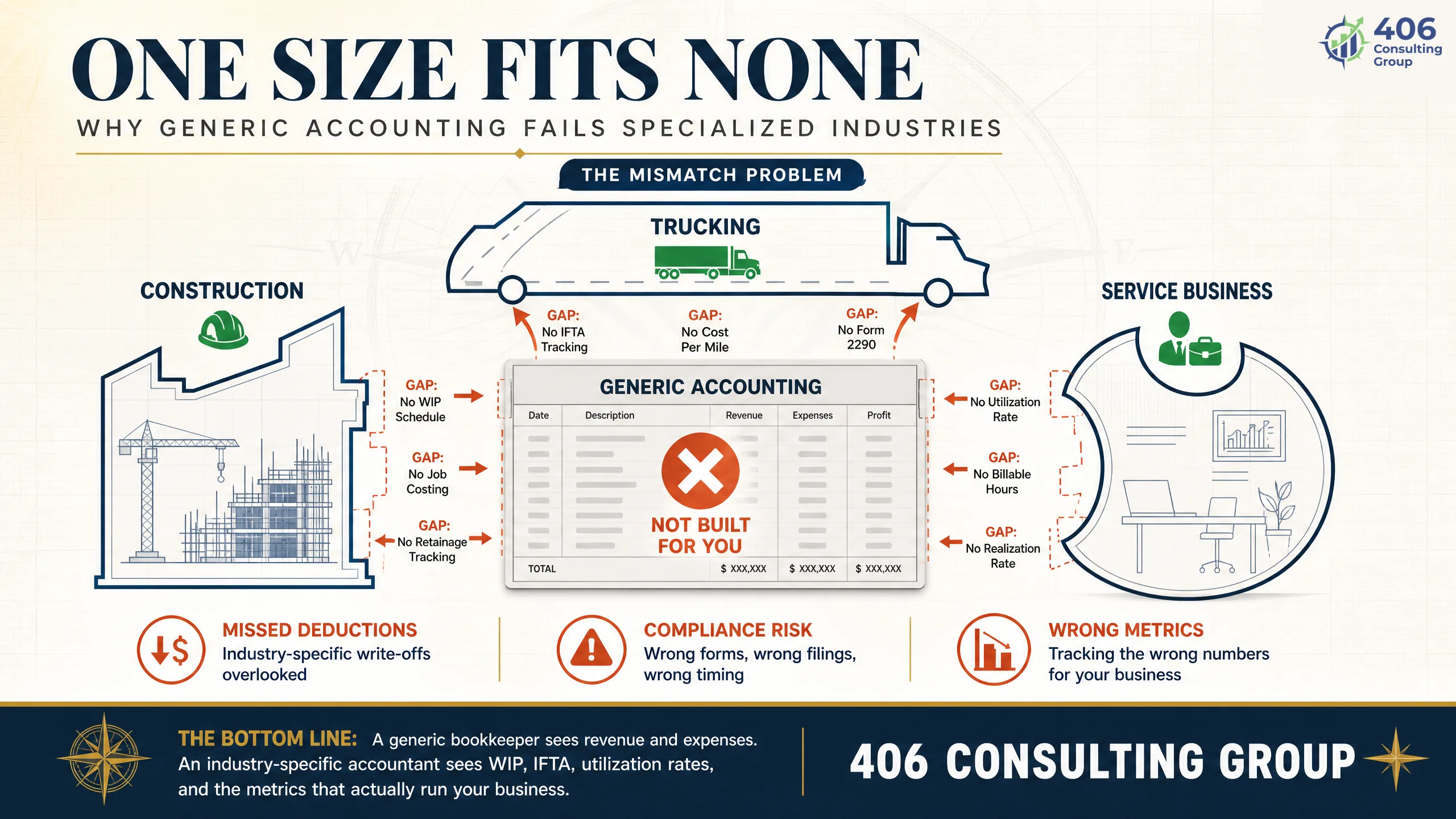
A generic setup will happily categorize your expenses and reconcile your bank account. What it won't do is track cost by job so a contractor can see which work is profitable, separate fuel by state so a carrier can file IFTA, or measure billable utilization so a service firm knows if its team is earning its keep. Those aren't nice-to-haves — they're the numbers that run the business. Miss them and you're flying blind in exactly the areas where your industry makes or loses money.
The tell is simple: if your financial reports look identical to what a coffee shop, a law firm, and a trucking company would get, they're generic — and they're not telling you what you need to know to run your business.
Why Good Financial Help Pays for Itself
The short answer: a good bookkeeper, controller, or CFO doesn't just keep tidy books — they prevent expensive mistakes, surface money you're leaving on the table, and cover specialized work no single hire can. This is the part most accountants struggle to explain and most owners struggle to see, so let's make it concrete.
Business owners rightly watch every dollar, and financial help can look like an overhead expense you could trim. But that framing misses what the help actually does. The value isn't the bookkeeping itself — anyone can categorize transactions. The value is expertise: catching the costly error, knowing the deduction, seeing the cash crunch coming, and telling you which decisions the numbers actually support.
The $50,000 that "cheap" almost cost
A business came to us after years on the cheap-bookkeeper route — the lowest monthly rate they could find. When we reviewed their books, we found transactions that had been classified incorrectly. Left uncaught, those errors would have cost the owner more than $50,000 in taxes. One proper review paid for years of quality bookkeeping many times over.
That's the thing about cheap bookkeeping: it's the most expensive kind if it's wrong. You don't see the cost on the invoice — you see it in the taxes you overpay, the deductions you miss, and the errors nobody with the right training was ever looking for.
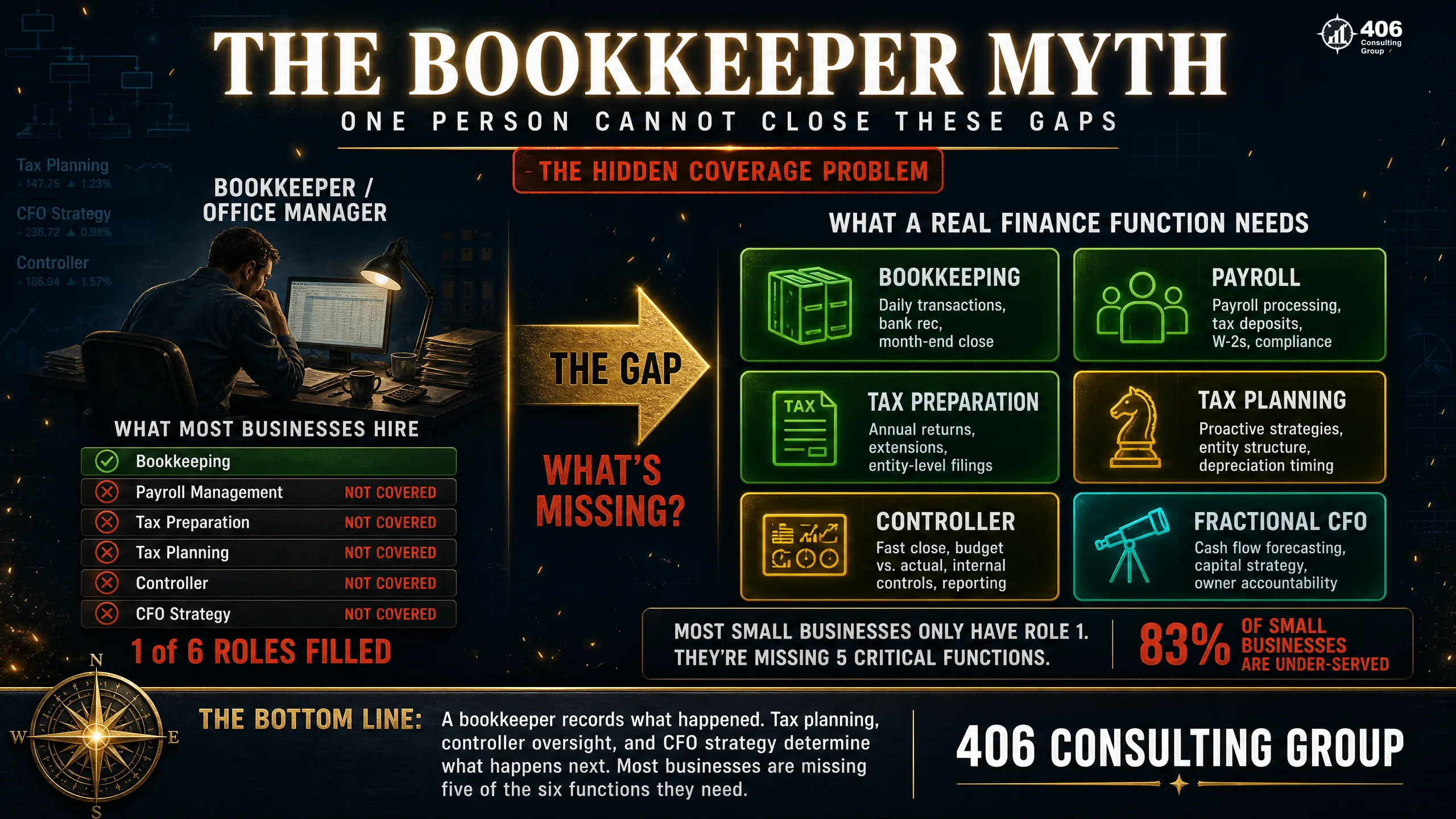
The second thing owners underestimate is that you can't do everything — and you can't hire one person who can, either. The most common version of this mistake: an owner hires a "bookkeeper slash office manager," assuming that one capable person covers the finances. Here's what they don't realize — the financial function isn't one job. It's really five or six: bookkeeping, payroll, tax preparation, tax planning, controller-level reporting, and CFO strategy. Those are different skill sets, and no single hire has all of them.
You could hire a dozen office managers and still have gaps you'd never close — nobody doing proactive tax planning, nobody forecasting cash, nobody providing the financial strategy a growing business needs. The generalist keeps the lights on and the bills paid, which feels like enough until the year you overpay taxes, miss a compliance deadline, or can't answer a lender's questions. The gaps are invisible right up until they're expensive.
Prevents costly mistakes
The misclassification, the missed deadline, the bad classification — caught before it costs you, by someone trained to look.
Surfaces hidden money
Deductions, overpaid taxes, margin leaks, and pricing errors a generalist never sees.
Covers the gaps
The specialized roles — tax planning, forecasting, strategy — that one hire can't, so nothing falls through.
The Industry Fit Framework
The short answer: three things make every industry's finances different — its metrics, its compliance, and its cash patterns. Get those three right for your specific industry and the numbers finally tell the truth. That's the Industry Fit Framework, and it's how we think about every business we take on.
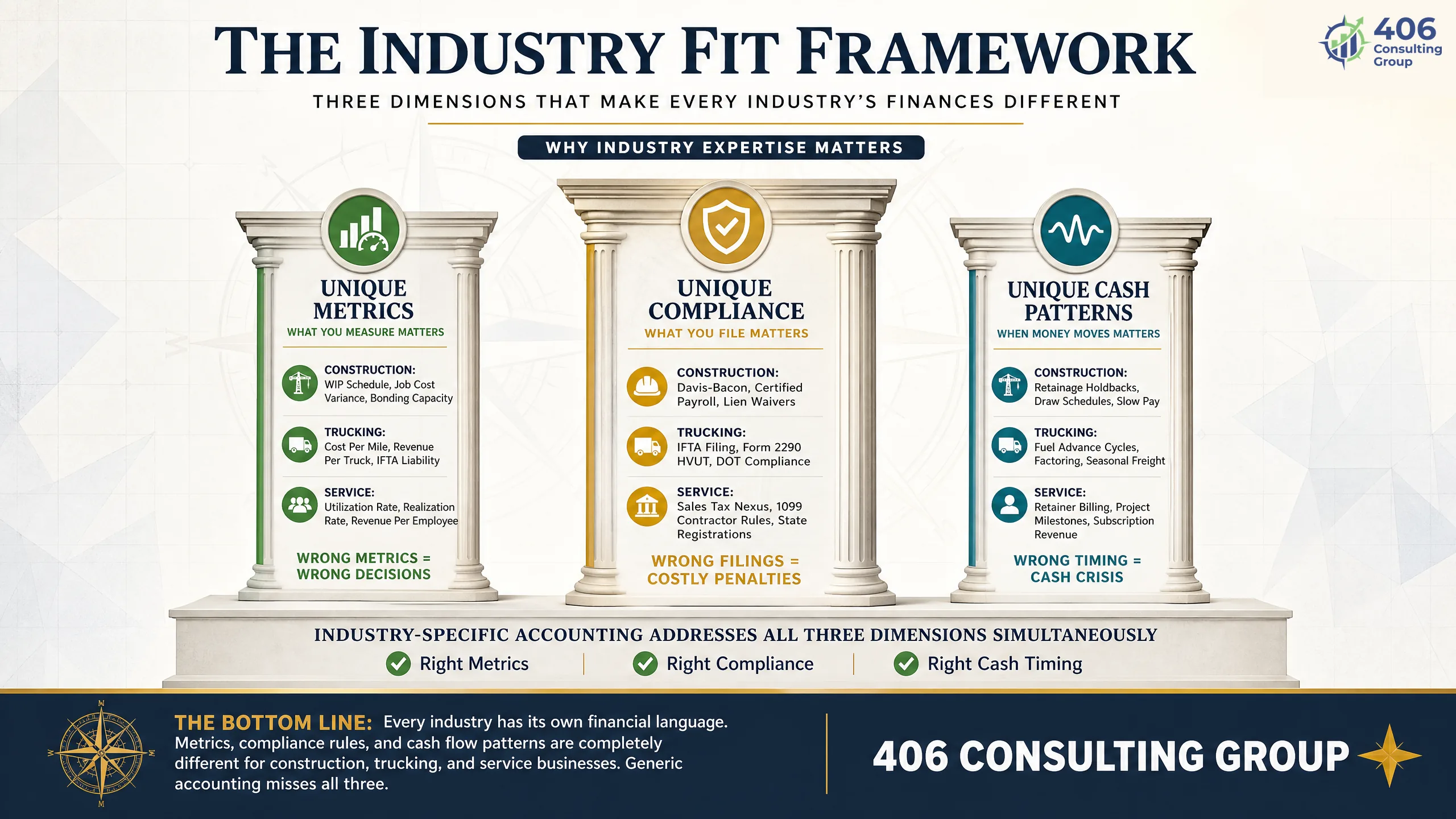
Unique metrics
Every industry lives or dies on different numbers — cost per mile for a carrier, job margin and WIP for a contractor, utilization for a service firm. Track the wrong ones and you can't manage what matters.
Unique compliance
IFTA and Form 2290 for trucking, prevailing wage and bonding for construction, sales and resort taxes for retail and hospitality. Miss an industry's specific obligations and the penalties find you.
Unique cash patterns
Retainage and long draw cycles in construction, seasonal swings in tourism, factoring in trucking. Each shapes cash flow differently, and each needs a different plan.
Construction & General Contractors
The short answer: construction accounting lives on job costing and the WIP schedule — knowing the true cost and profit of every project in real time — plus the bonding and retainage realities that generic bookkeeping ignores. Without them, a contractor can be busy and profitable-looking while quietly losing money on jobs.
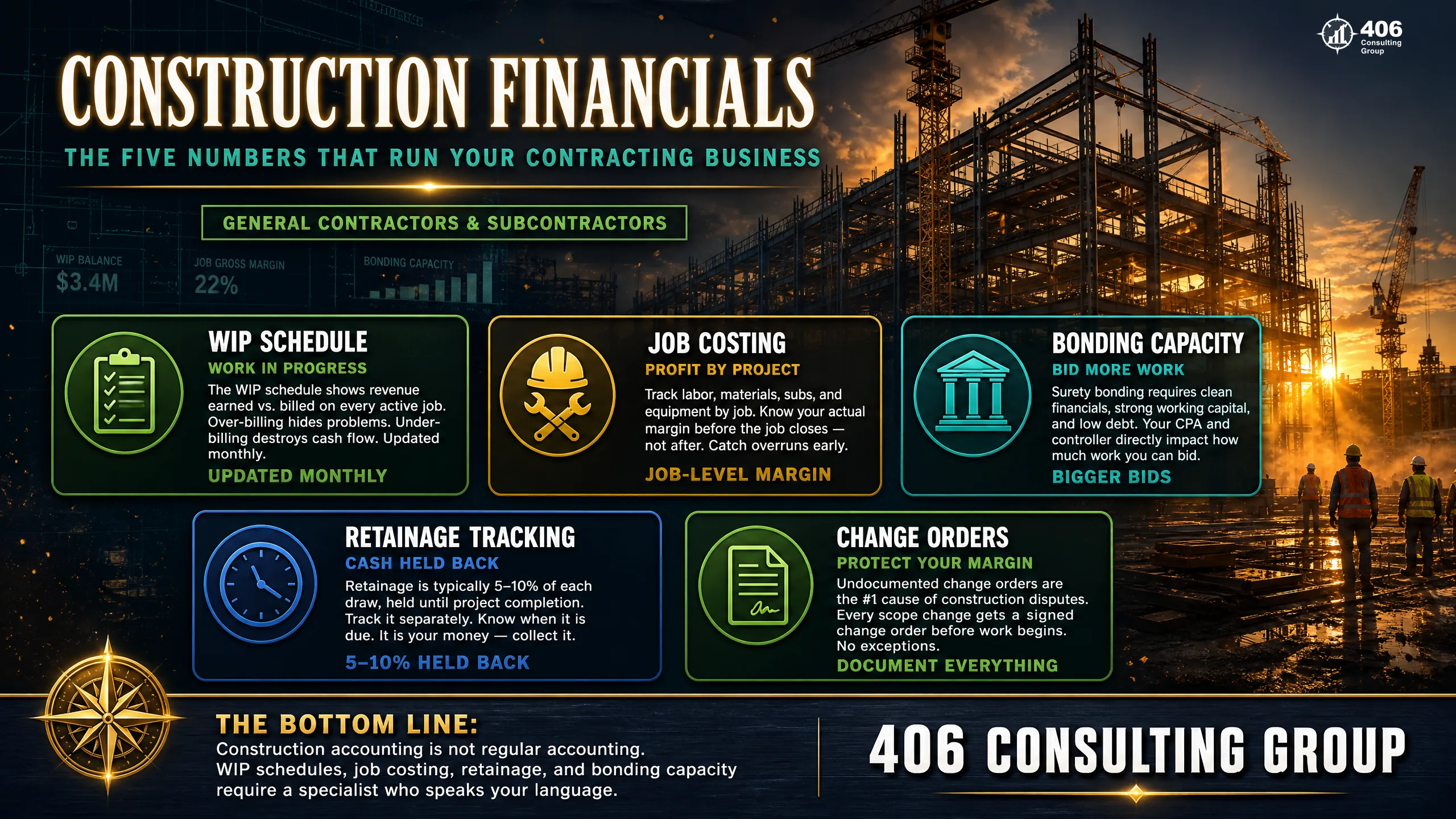
Job costing
Cost captured by job so you know which projects and types of work actually make money — the number you bid from.
WIP schedule
Work-in-progress reporting that shows over/under-billing and true project profitability — what bankers and sureties ask for first.
Bonding & working capital
Financials structured to build bonding capacity so you can take on bigger work.
Retainage & change orders
Tracking held-back payments and documenting every scope change so margin doesn't leak.
We go deep on this in our guides to WIP and job costing for contractors and getting developer-ready for luxury projects. Explore our general contractor accounting.
Specialty Trades
The short answer: specialty trades — electrical, plumbing, HVAC, mechanical, excavation — share construction's job-costing needs but add their own twists: heavy equipment, materials price swings, service-vs-project revenue, and crews to schedule and cost. The books have to separate profitable service work from break-even project work, and track equipment as the major asset it is.
A trades business often runs two business models at once — recurring service calls and larger installed projects — with very different margins. Generic bookkeeping blends them into one number and hides which one is actually carrying the company. Add equipment financing, materials inventory, and the timing gap between buying materials and getting paid, and you have a business that needs real job costing and cash-flow planning, not just a monthly reconciliation.
Equipment decisions alone move real money — we break down the math in new vs. used equipment ROI. Explore our specialty trades accounting.
Trucking & Transportation
The short answer: trucking has more industry-specific compliance and metrics than almost any small business — IFTA, Form 2290, per diem, and cost per mile — and a general bookkeeper who doesn't know them will leave a carrier out of compliance and unable to see whether a lane is even profitable.
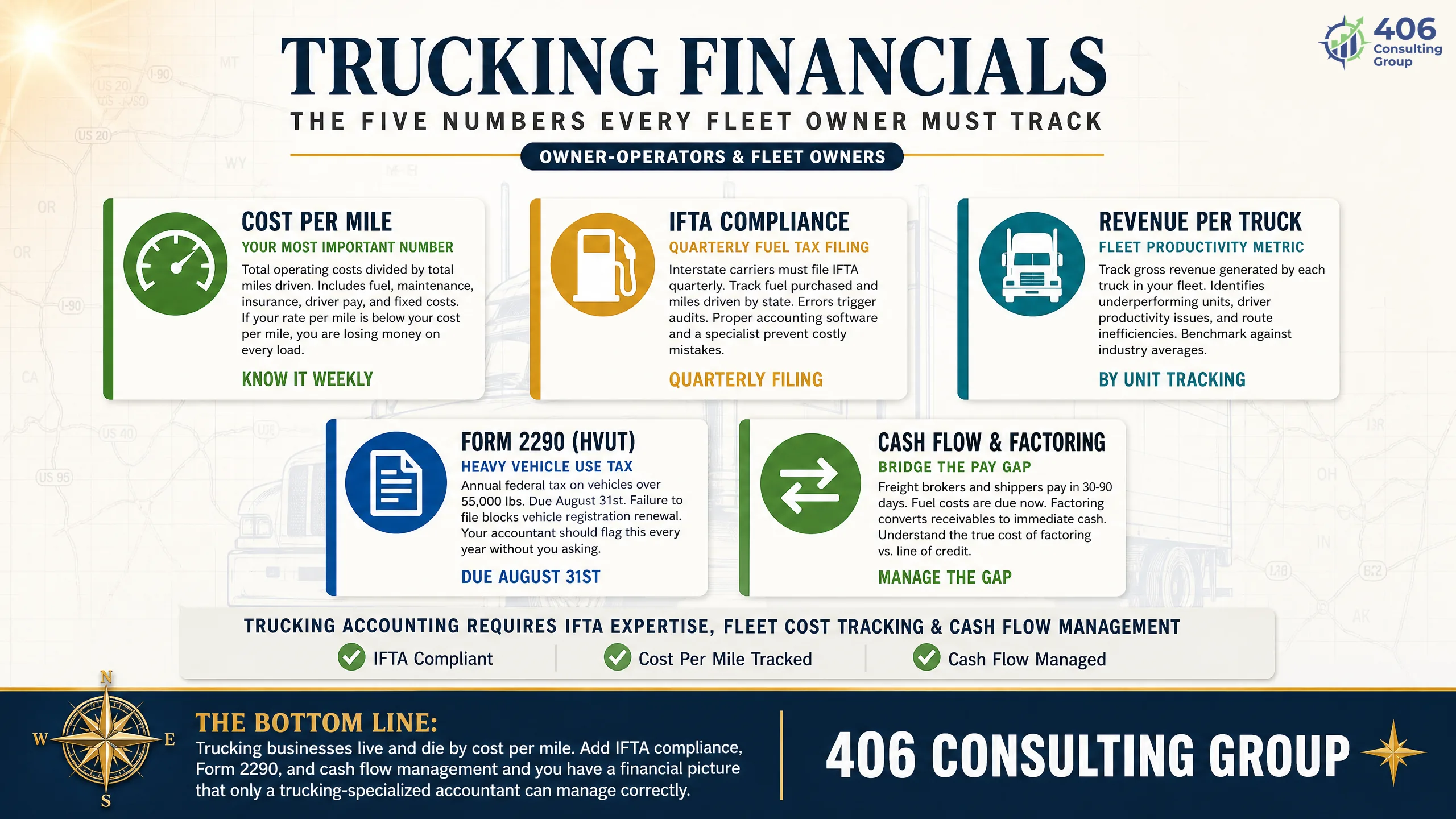
IFTA fuel tax
Quarterly fuel tax filings requiring mileage-by-state and fuel records — a compliance job general bookkeepers don't do.
Form 2290 (HVUT)
Annual heavy vehicle use tax, due August 31, with the stamped Schedule 1 needed to keep trucks plated.
Cost per mile
The number that tells you whether a lane or load actually makes money — invisible without carrier-specific tracking.
Per diem & factoring
Per diem handled right to stay tax-advantaged, and factoring booked as a financing cost, not lost revenue.
Our full guide covers it: bookkeeping for trucking companies. Explore our trucking accounting services.
Service & Professional Businesses
The short answer: service and professional businesses sell time and expertise, so their finances hinge on metrics generic accounting never tracks — utilization, realization, revenue per employee, and profitability by client or project. Payroll is usually the biggest cost, which makes those people-based metrics the whole ballgame.
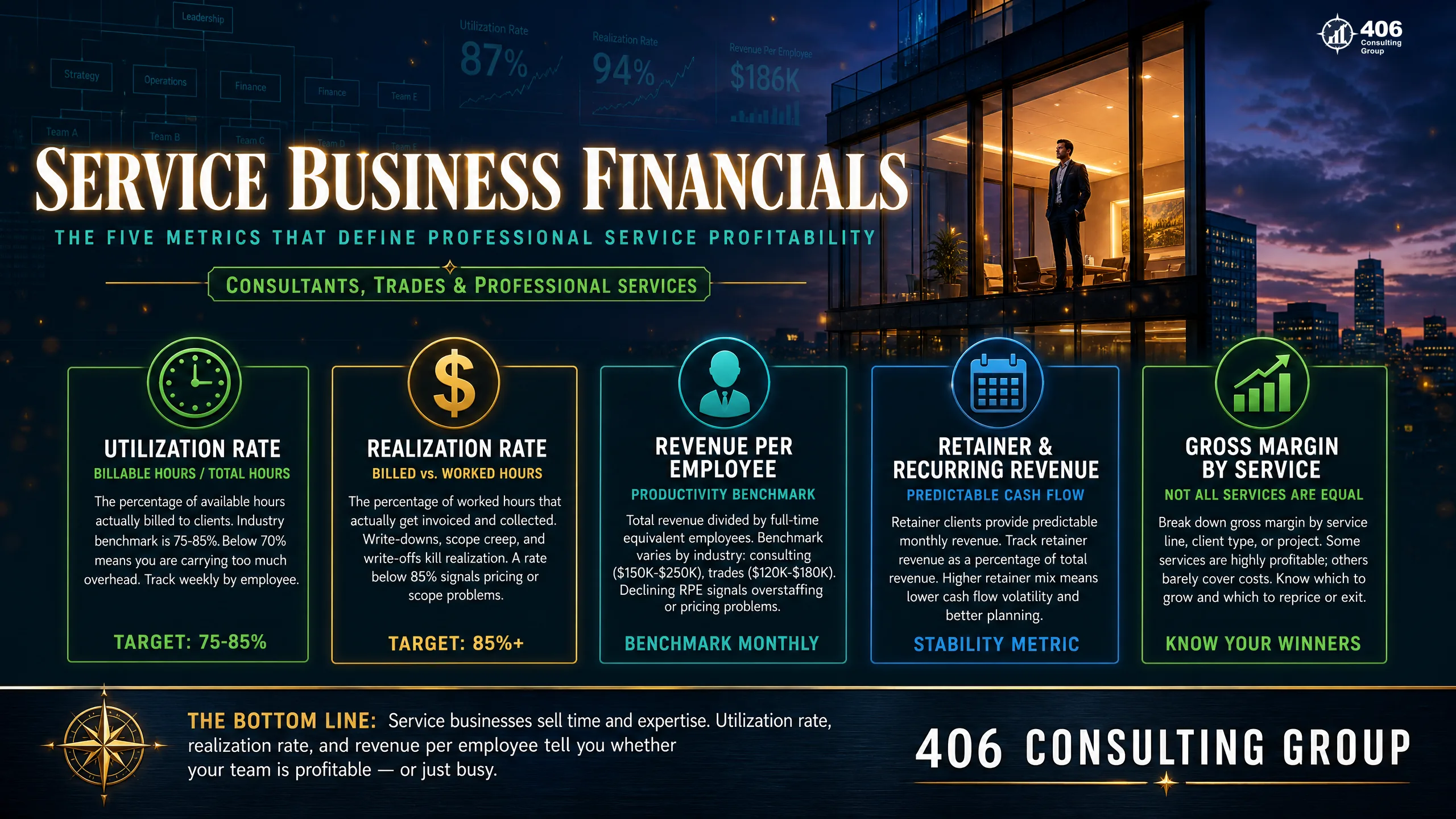
For a firm that bills for time — consulting, engineering, agencies, professional services — the questions that matter are: are our people billable enough (utilization), are we collecting what we bill (realization), and which clients and projects actually make money? A general P&L answers none of these. Industry-aware accounting builds the reporting that does, so you can price right, staff right, and fire the clients quietly costing you money.
Explore our accounting for professional & service businesses.
And More: Property Management, Hospitality & Others
The short answer: the same principle extends to every industry we serve — each has its own metrics, compliance, and cash patterns that generic accounting misses. A few more we work with regularly:
Property Management
Trust accounting, per-property profitability, owner statements, and the compliance that comes with handling other people's money.
Property management accounting →Hospitality & Tourism
Lodging and resort taxes, tips, seasonality, and per-location profitability for restaurants, lodging, and short-term rentals.
Hospitality accounting →Landscape & Seasonal Trades
Sharp seasonal swings, equipment, crews, and the cash planning that carries a business through the off-season.
Landscape accounting →Distilleries & Beverage
Excise taxes, production and inventory costing, and the specialized compliance of a regulated product.
Distillery & beverage accounting →What Every Industry Shares: The Financial Foundation
The short answer: no matter the industry, the underlying financial foundation is the same — clean bookkeeping, then payroll, then tax prep and planning, then controller-level reporting, then CFO strategy. Industry expertise shapes how each layer is built, but every business climbs the same ladder as it grows.
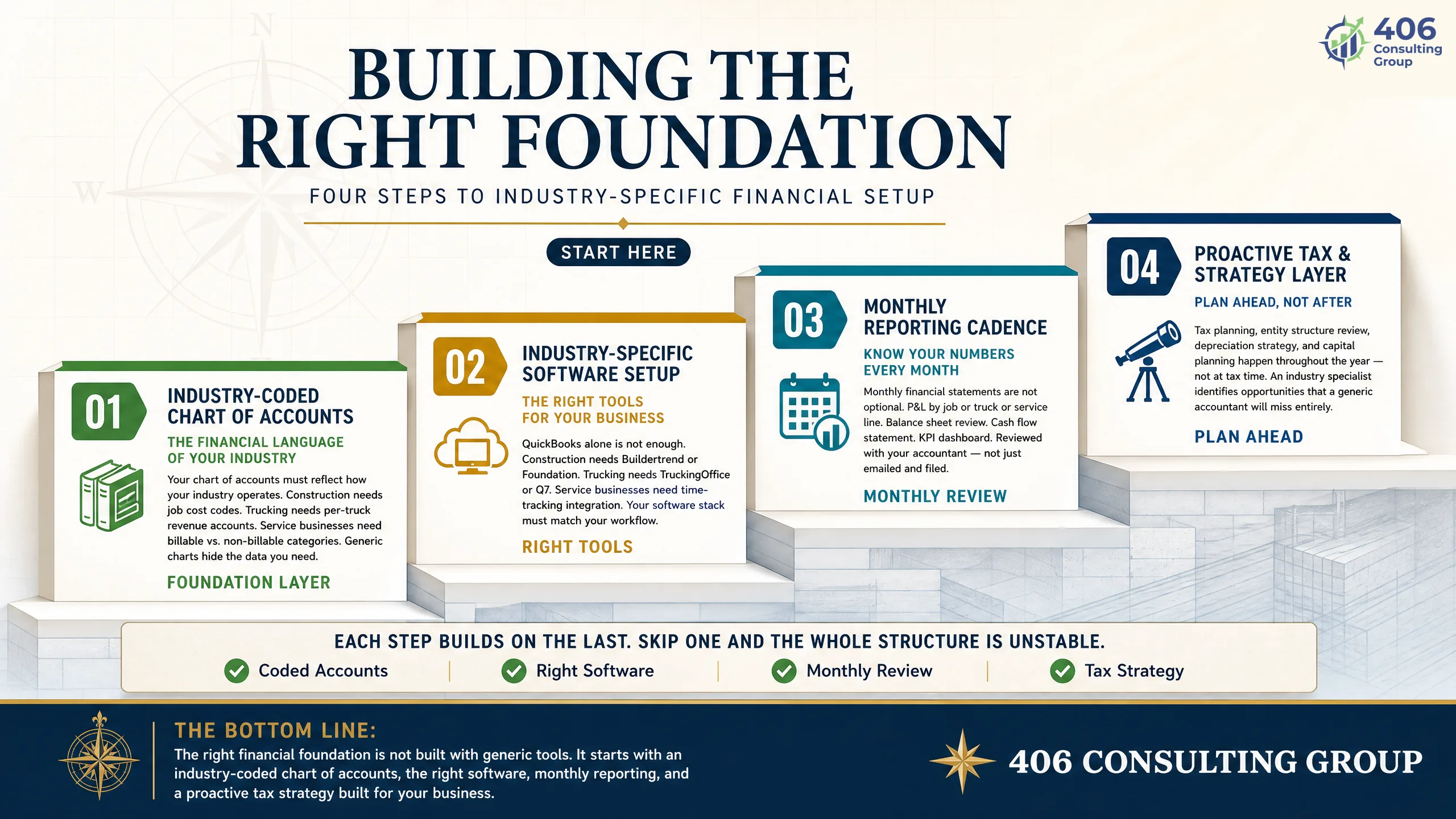
This is where the two halves of this article meet. Your industry determines the specifics — the job costing, the IFTA, the utilization. The financial foundation determines the structure — bookkeeping up through CFO. You need both: industry-aware books built on a foundation that grows with you. And because that foundation is five or six specialized roles, it's exactly why the "one office manager" approach leaves gaps — no single generalist covers the whole ladder for any industry.
If your books are solid and you're wondering what layer comes next, our free financial maturity assessment maps your business to its next step — whatever industry you're in.
Why Industry Expertise Matters
The short answer: industry expertise is what turns accounting from a cost into a return. An accountant who knows your industry catches the misclassification, knows the compliance, benchmarks the right metrics, and speaks your language — which is exactly the difference between the cheap route that cost that owner $50,000 and financial help that pays for itself.

Catches costly errors
Someone trained in your industry knows what a wrong number looks like — before it becomes a tax bill or a penalty.
Knows the compliance
IFTA, 2290, prevailing wage, resort tax, trust accounting — the industry-specific rules a generalist doesn't know exist.
Benchmarks the right metrics
Cost per mile, job margin, utilization — measured and compared to what good looks like in your industry.
Speaks your language
You shouldn't have to teach your accountant your business. Industry expertise means they already get it.
How to Get Started
The short answer: start with a conversation about your industry and where your business is today. We meet you where you are — whether that's cleaning up books a cheap provider left a mess, or building the full finance function a growing company needs — and we bring the industry knowledge to do it right.
406 Consulting Group works with construction and general contractors, specialty trades, trucking and transportation, service and professional businesses, property management, hospitality, and more — across Montana and the greater Northwest. We provide the whole financial function: bookkeeping, payroll, tax preparation and planning, controller, and fractional CFO — built for how your industry actually operates.
The businesses that get this right stop treating accounting as a cost to minimize and start treating it as expertise that pays for itself. If that's the shift you want to make, let's talk — or take the financial maturity assessment to see where your business stands.
Frequently Asked Questions: Industry-Specific Accounting
Why does my industry need specialized accounting?
Because every industry has its own metrics, compliance rules, and cash-flow patterns, and generic accounting misses all three. A contractor needs job costing and WIP; a trucking company needs IFTA and cost per mile; a service firm needs utilization and realization. A general bookkeeper will keep tidy books but won't track the numbers that actually run your business or catch the industry-specific compliance obligations that generate penalties. Industry-specific accounting builds the reporting and compliance around how your business actually makes money.
Isn't a cheap bookkeeper good enough?
Cheap bookkeeping is often the most expensive kind, because you don't see the cost on the invoice — you see it in overpaid taxes, missed deductions, and errors nobody with the right training was looking for. We once reviewed the books of a business that had used the cheapest bookkeeper it could find and discovered misclassified transactions that would have cost the owner more than $50,000 in taxes. One proper review paid for years of quality bookkeeping. The right question isn't 'what's the lowest monthly rate?' — it's 'what is bad bookkeeping quietly costing me?'
What's different about construction accounting?
Construction accounting centers on job costing and the work-in-progress (WIP) schedule — knowing the true cost and profit of every project in real time — plus bonding capacity, retainage, and change-order discipline. A contractor can look busy and profitable overall while individual jobs lose money, and only job-level costing reveals it. General bookkeeping tracks revenue and expenses by period, which tells you nothing about which jobs or types of work actually make money. WIP reporting is also the first thing a bonding company or bank asks to see.
What does a trucking company need that a general bookkeeper misses?
A lot. Trucking has industry-specific compliance most bookkeepers have never handled: IFTA (quarterly fuel tax with mileage-by-state records), Form 2290 (annual heavy vehicle use tax), and per diem rules. It also needs cost-per-mile tracking to know whether a lane or load is even profitable, and correct handling of factoring (a financing cost, not reduced revenue). A general bookkeeper who doesn't know these will leave a carrier out of compliance and unable to see its real profitability.
Do service businesses need industry-specific accounting?
Yes. Service and professional businesses sell time and expertise, so their finances depend on metrics a generic P&L never shows: utilization (are your people billable enough), realization (are you collecting what you bill), revenue per employee, and profitability by client or project. Payroll is usually the largest cost, which makes those people-based metrics decisive. Industry-aware accounting builds the reporting to price correctly, staff correctly, and identify the clients or projects quietly losing money.
Can't I just hire one bookkeeper or office manager to handle everything?
It's the most common financial mistake owners make. The finance function isn't one job — it's really five or six: bookkeeping, payroll, tax preparation, tax planning, controller-level reporting, and CFO strategy. Those are different skill sets, and no single hire has all of them. You could hire a dozen capable office managers and still have gaps no one closes — nobody doing proactive tax planning, nobody forecasting cash, nobody providing financial strategy. A generalist keeps the lights on, but the gaps stay invisible until the year they become expensive. That's why growing businesses use a firm that covers the whole function.
Does 406 Consulting Group work with my industry?
Very likely. We work with construction and general contractors, specialty trades, trucking and transportation, service and professional businesses, property management, hospitality, landscape, and beverage/distillery businesses, among others, across Montana and the greater Northwest. We provide the full financial function — bookkeeping, payroll, tax preparation and planning, controller, and fractional CFO — built around how your specific industry operates. Contact us to talk about your business and what industry-aware financial help would look like for it.
Official Resources
Related Tools & Resources
Industry-Specific Accounting — Montana
Accounting That Actually Knows Your Industry.
406 Consulting Group brings real industry expertise to construction, trucking, trades, and service businesses across Montana — the job costing, compliance, and metrics generic bookkeeping misses, plus the full finance function to grow on. Let's talk about your industry.
Industries We Serve
Accounting built for each
The Industry Fit Framework
What makes each industry different
The Cost of "Cheap"
We caught misclassified transactions a cheap bookkeeper left behind that would have cost the owner $50,000+ in taxes. Cheap bookkeeping is the most expensive kind when it's wrong.
Is Your Accounting Built for You?
Industry expertise that pays for itself.
About the Author
Jason Anderson
Co-Founder, 406 Consulting Group
Operational finance background at BP. Jason works with construction, trucking, trades, and service businesses across Montana — bringing industry-specific expertise to the numbers that actually run each kind of business.
Read the Full Story