
The Silent Growth Killer:
How Resistance to Change Stalls Small Businesses
One of the worst things that can happen to a company that wants to grow is resistance to change — an employee who won't adapt, and an owner who allows it. Here's the damage it does, real examples across industries, and how to build a company that runs without any one person.
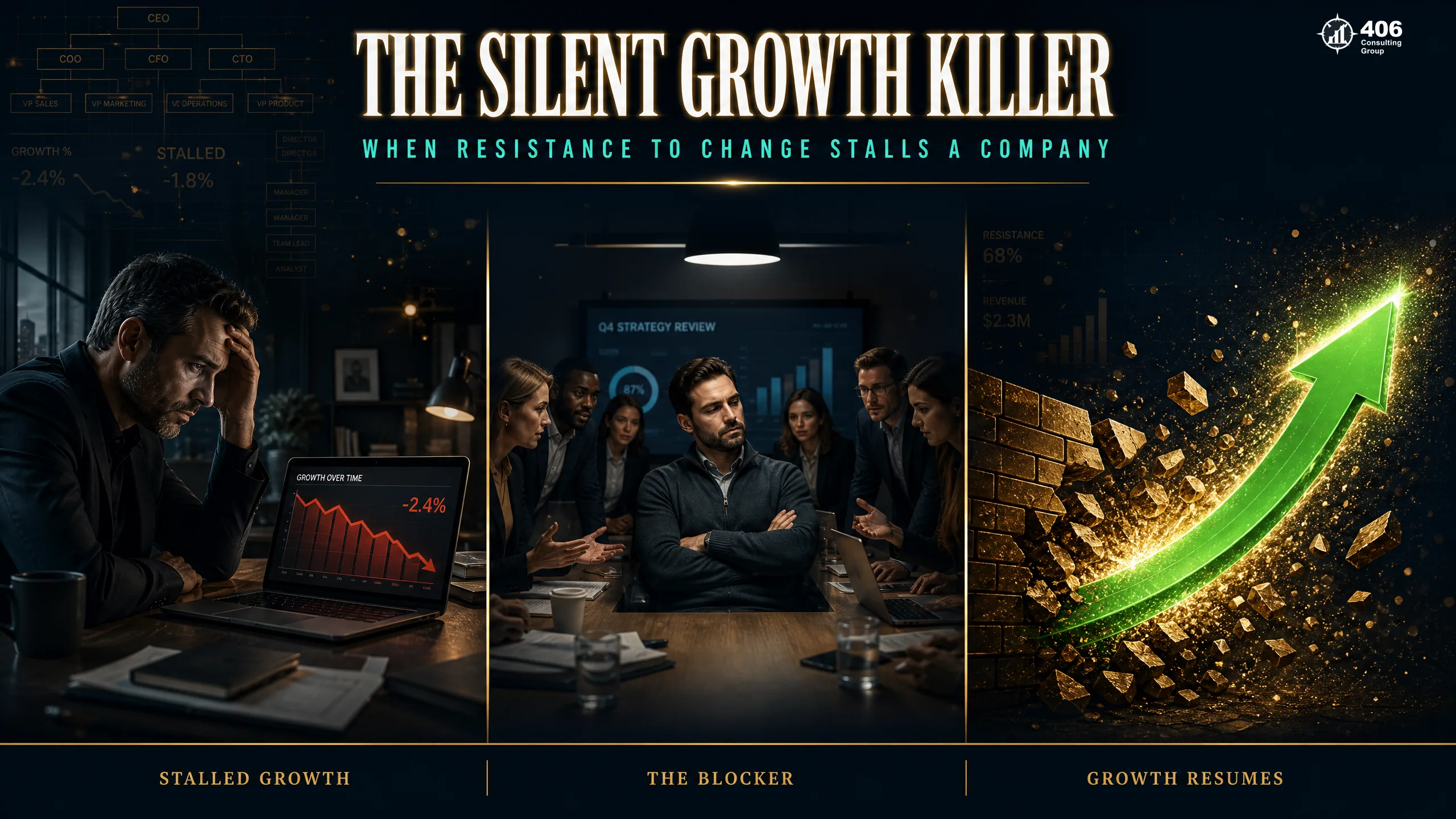
Ask most small business owners what's holding back their growth and they'll point to something external — the economy, competition, hiring, interest rates. But one of the most destructive growth killers is almost always internal, and almost never named out loud: resistance to change. An employee who won't adopt a new system. A "we've always done it this way" that never gets challenged. And an owner who, for a dozen understandable reasons, allows it to continue.
It's one of the worst things that can happen to a company that wants to grow — because it doesn't announce itself. There's no single catastrophe, just a slow ceiling that the business keeps bumping into. Initiatives stall. Good people leave. The owner stays trapped in the day-to-day. And the dream of building a real company — one that could run, and grow, and even be sold — quietly dies on the vine.
This article is about that killer: what resistance to change actually looks like, why owners tolerate it, the compounding damage it does, and — most importantly — how to break it and build a company that isn't hostage to any one person. We'll use real, anonymized examples from across industries, because this shows up differently in a construction company than it does in a trucking outfit or a professional firm. And we'll be honest about the hardest part: this is usually a leadership problem before it's an employee problem.
By Jason Anderson — Co-Founder, 406 Consulting Group. Large-scale operational finance at BP, where organizational change and cross-departmental systems were the daily work. Now helps Montana businesses build companies that don't depend on any one person.
Quick Answer: Why This Matters
- →The goal is a real company — one that survives without the owner and without any single key employee.
- →Resistance to change is the ceiling: it blocks the systems, delegation, and visibility that growth requires.
- →Owners are the multiplier: an employee resisting is a problem; an owner allowing it is what makes it fatal.
- →The costs compound — stalled initiatives, lost talent, bad data, missed opportunity, culture rot.
- →The fix is systems + accountability + outside perspective — designed for the whole company, not just the books.
Table of Contents
The Real Goal: A Company That Survives Without You
The short answer: the difference between a job and a real company is simple — a real company can survive without the owner, and without any single key employee. If the business stops when one specific person is gone, you don't own a company; you own a job that owns you. Growth is the process of removing those single points of failure, and resistance to change is what keeps them in place.
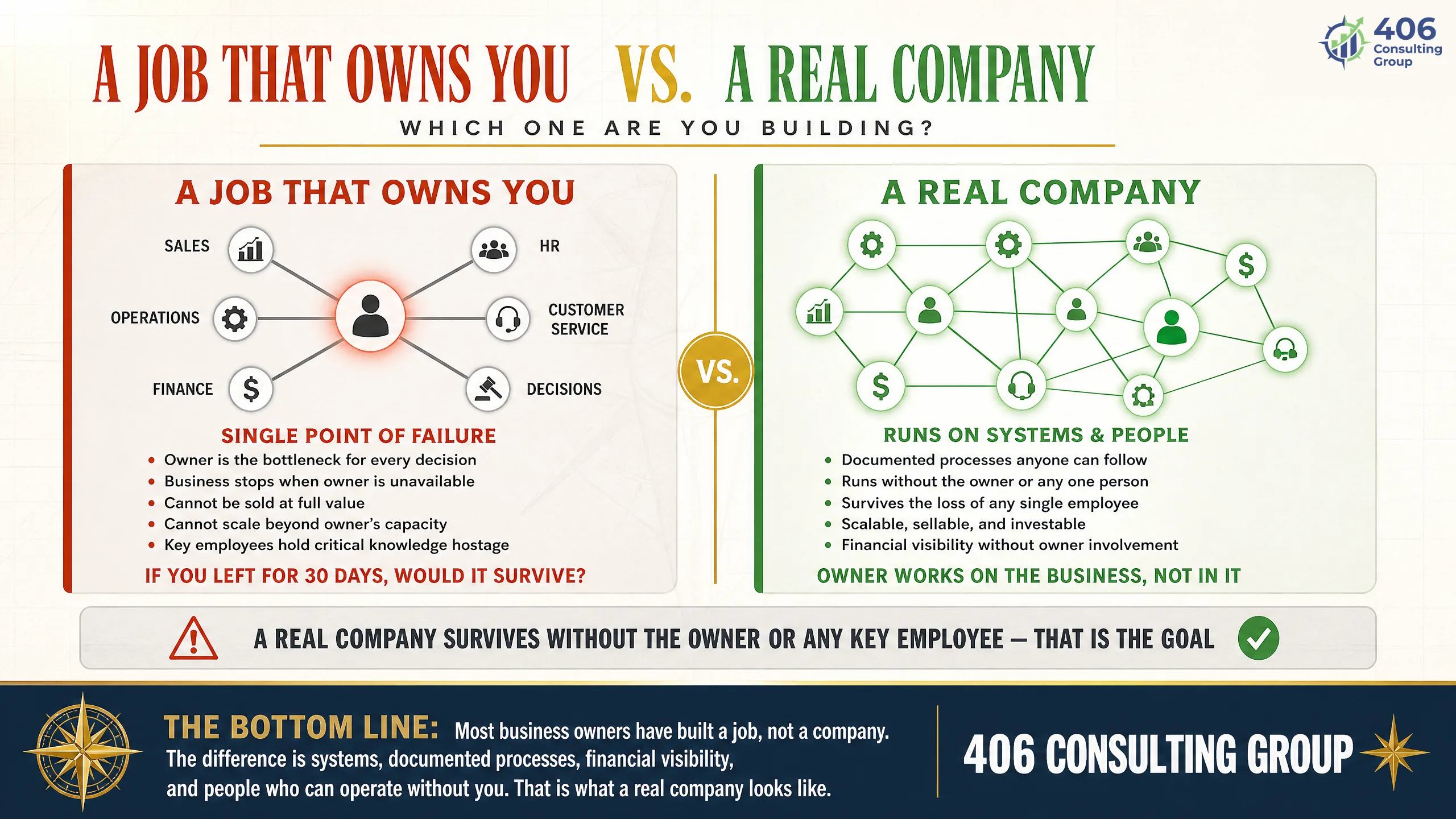
This is worth sitting with, because it reframes the whole conversation. Most owners think growth means "more" — more revenue, more customers, more trucks, more locations. But you can't add any of those durably if the business only works because of what lives in one person's head. A real company runs on systems and a team, not on heroics from the owner or an irreplaceable employee. That's what makes it able to grow — and, eventually, what makes it worth something to a buyer.
Here's the uncomfortable link: the systems and processes that make a company survivable without any one person are exactly the changes that resistance blocks. Every "we don't need software for that," every refusal to document a process, every bit of hoarded knowledge is a single point of failure being defended. Which is why resistance to change and stalled growth are the same problem wearing two faces.
What Resistance to Change Actually Looks Like
The short answer: resistance to change is rarely a dramatic "no." It's usually quiet, reasonable-sounding, and easy to tolerate — which is exactly what makes it dangerous. It shows up as friction, delay, and quiet non-compliance rather than open rebellion.
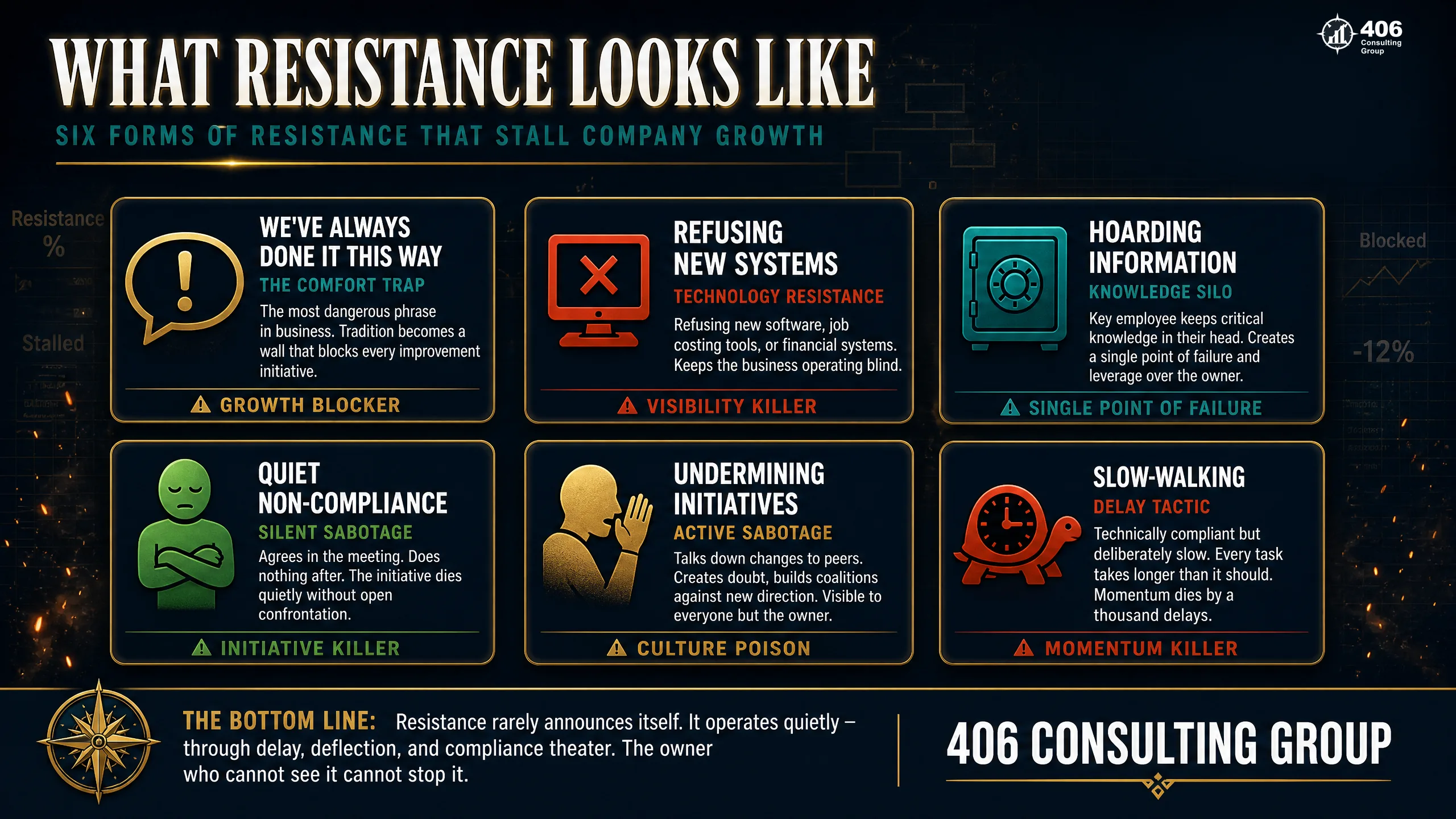
"We've always done it this way"
The phrase that has killed more good ideas than any competitor ever could. Tradition dressed up as wisdom.
Refusing new systems or software
The new tool never gets learned, never gets used, or gets quietly worked around back to the old way.
Hoarding information
Knowledge kept in one person's head — deliberately or not — so the business can't function without them.
Quiet non-compliance
Saying yes in the meeting, then doing it the old way at the desk. The initiative dies without anyone opposing it out loud.
Slow-walking
Not refusing, just... never quite getting to it. Change dies of neglect instead of opposition.
Undermining
Subtly signaling to others that the change is dumb, temporary, or unsafe — so the whole team resists together.
Two Failure Modes: Employees Who Resist & Owners Who Allow It
The short answer: there are two failure modes, and the second is the fatal one. An employee who resists change is a manageable problem. An owner who allows the resistance to stand is what turns a manageable problem into a growth-killing one. The tolerance is the multiplier.
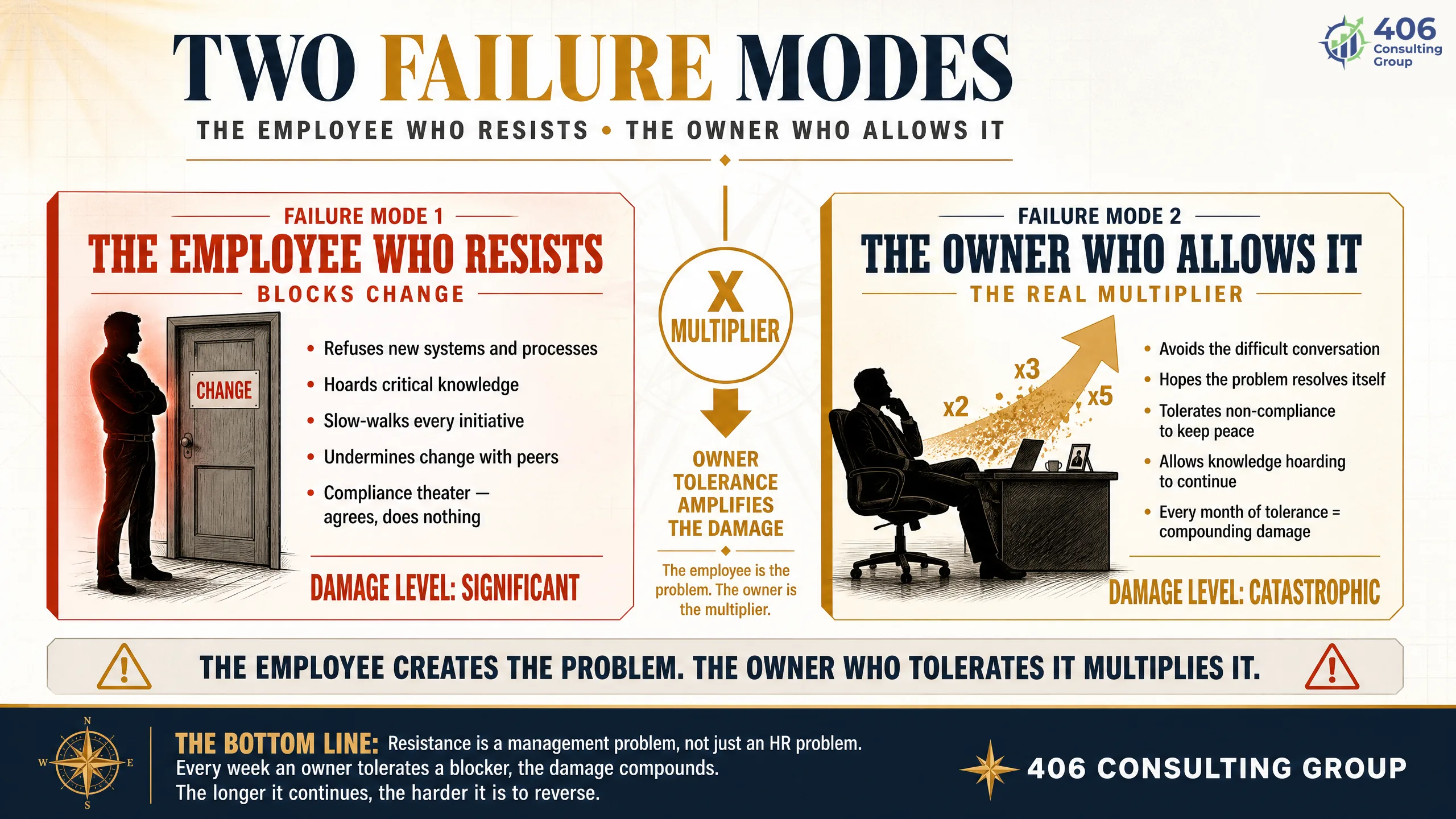
The employee who resists
Often a long-tenured, genuinely valuable person who's comfortable, protective of their role, or afraid the change exposes or replaces them. Their resistance is human and understandable — and if it were the whole problem, it would be solvable with training, clarity, and expectations.
The owner who allows it
This is the real failure. The owner avoids the conflict, values the loyalty, or — most often — depends on the resistor so heavily they feel they can't push. So the resistance stands, the change dies, and every other employee learns that change is optional here. That lesson is what kills growth.
The hard truth: when a change fails because one person resisted and the owner let it slide, that's not an employee problem. It's a leadership decision. The owner chose the comfort of the moment over the growth of the company. Naming it that way is the first step to fixing it.
The Resistance Tax: The Compounding Hidden Costs
The short answer: tolerated resistance acts like a tax on everything the business does — a Resistance Tax you pay in stalled projects, lost talent, bad data, missed opportunities, and a culture that stops trying. You never see it on a statement, but it compounds, and over a few years it's the difference between a company that scaled and one that stalled.
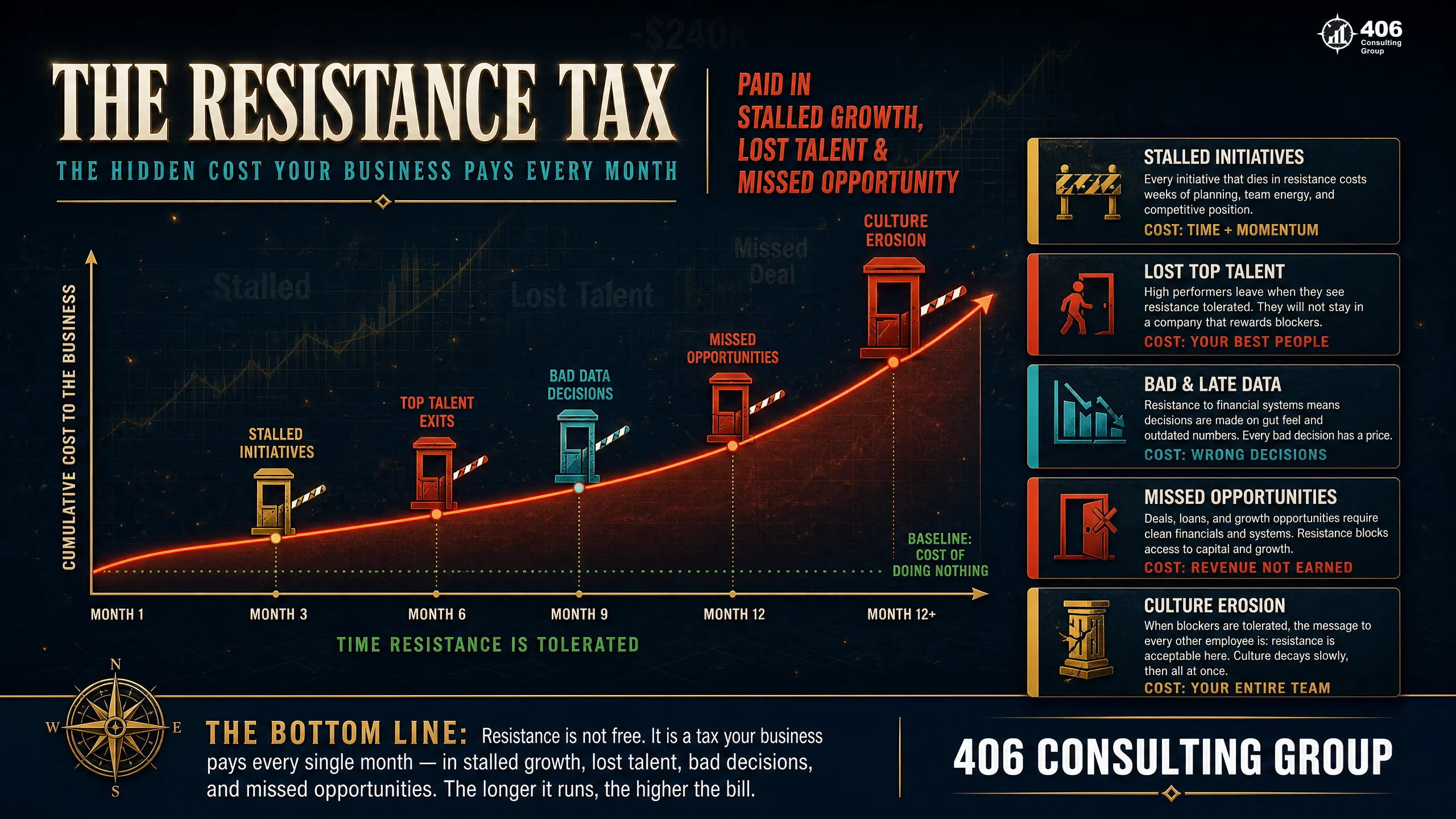
Stalled initiatives
Every improvement that dies in implementation is time, money, and momentum spent for nothing — and a signal that the next one will die too.
Lost top talent
Your best people — the ambitious ones who want to grow — leave first when they see the company won't. You're left with the ones who wanted it to stay the same.
Bad and late data
When systems don't get adopted, the numbers are wrong or weeks late. You end up making big decisions on information you can't trust.
Missed opportunities
You can't take the bigger job, the second location, or the new line of business because the operation can't scale to support it.
Culture erosion
The deepest cost. Once the team learns that change is optional and resistance wins, improvement stops being anyone's job. The company's ceiling becomes permanent.
The Indispensability Trap
The short answer: the Indispensability Trap is when one person — the owner or a key employee — becomes a single point of failure the whole business runs through, and resistance to change is often how that indispensability gets defended. A person who can't be replaced can't be promoted past, worked around, or safely lost — and a business full of irreplaceable people can't grow.
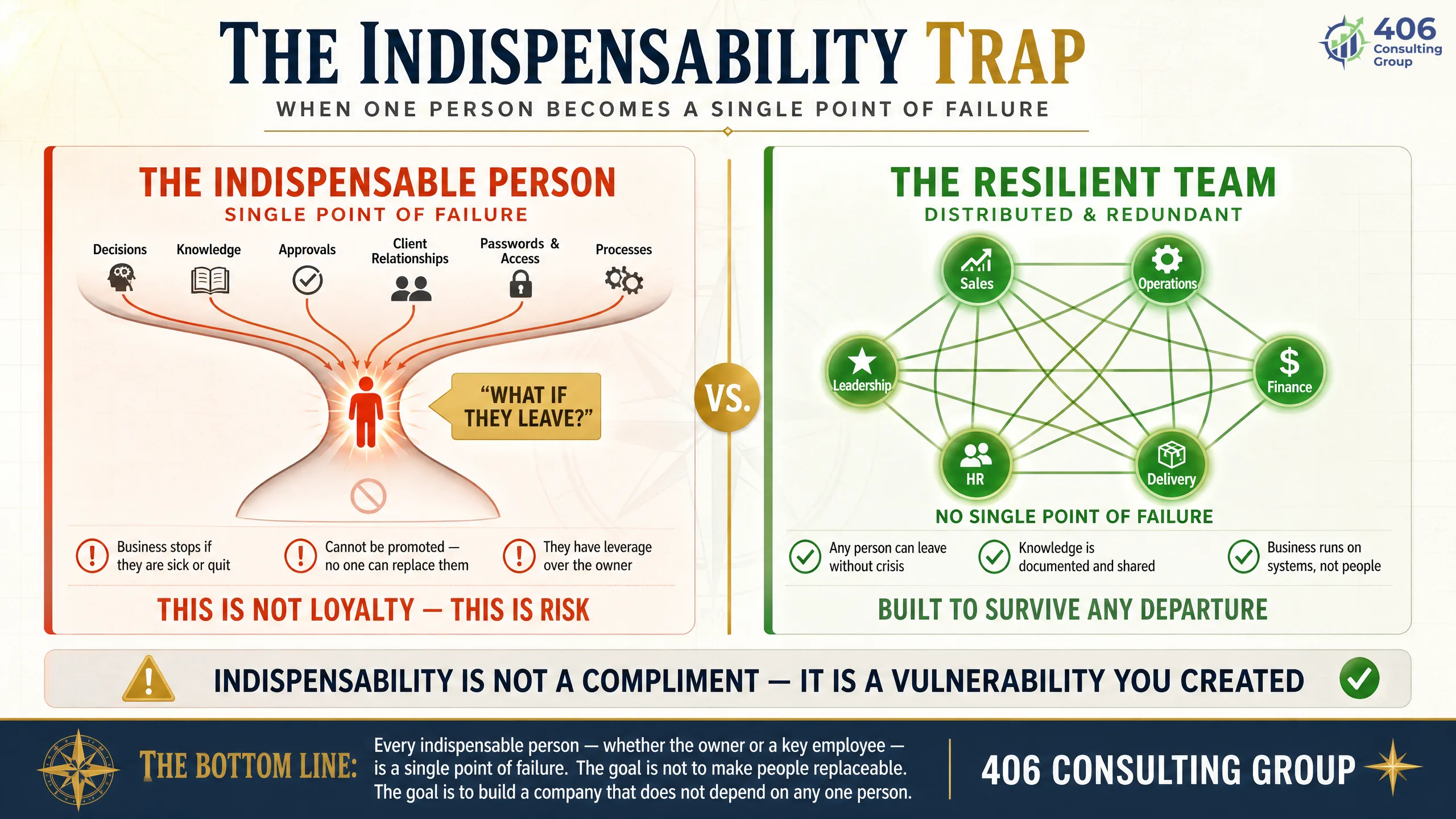
Sometimes indispensability is innocent — a person is simply the only one who ever learned how. But sometimes it's protected on purpose. If everything runs through you, you can't be let go, questioned, or changed. Resisting the system that would document your work, or the software that would make your knowledge shareable, is a way — conscious or not — of staying indispensable. And an owner who depends on that person is powerfully motivated not to rock the boat.
The test
Ask yourself two questions. First: if your most critical employee gave two weeks' notice tomorrow, what would break — and how long would it take to recover? Second: if you, the owner, were out for a month, could the business run? If either answer scares you, you have an indispensability problem — and it's almost certainly capping your growth right now, not just threatening your future.
The goal isn't to make anyone less valuable. It's to make the company more resilient — so good people can grow into bigger roles instead of being trapped guarding the one only they can do.
Real Examples Across Industries
The short answer: this pattern looks different in every industry, but the shape is always the same — a valuable person resists a needed change, the owner tolerates it, and growth quietly stalls. Here are five anonymized examples our clients tend to recognize immediately.
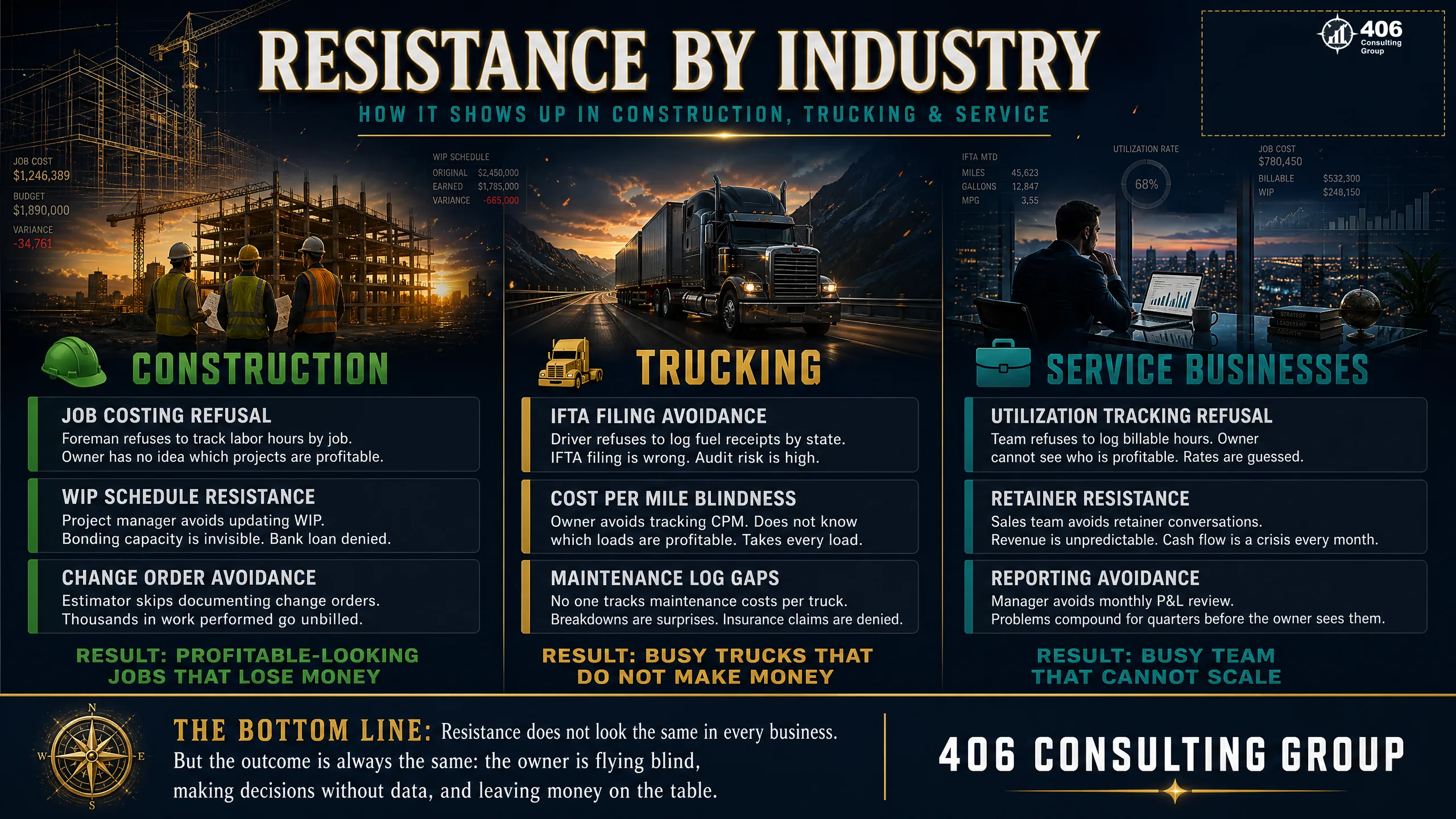
The office manager who won't adopt job costing
A 20-year office manager keeps the books the way she always has and refuses the job-costing system that would show profit by project. The owner won't push — she's loyal and "knows where everything is." The cost: the company bids blind, can't see which work makes money, and stalls at the same revenue for years. Breaking it — a system plus clear role expectations — finally made margins visible and freed the business to grow toward the profitable work.
The dispatcher who keeps it all in his head
Operations run entirely through one dispatcher who "has it all up here" and resists any system that would write it down. The business can only grow as far as one person's memory reaches — and the week he's out, everything seizes. Documenting and systemizing dispatch felt like a threat to him, but it's what let the carrier add trucks and survive his eventual departure without missing a beat.
The senior who hoards client relationships
A senior team member owns all the key client relationships and won't use the CRM or share account knowledge. The firm can't onboard new people, can't scale delivery, and is quietly hostage to one person who could walk out with half the revenue. Systematizing client knowledge reduced that risk and made real growth — and real succession — possible.
The owner who is the bottleneck
Here the resistor is the owner. He does the ordering, the schedule, the books, the hiring — and resists delegating or installing systems because "no one does it like I do." The result: he can't open a second location, because nothing runs without him. Building systems and handing off pieces was uncomfortable, but it's the only thing that made expansion possible.
Resistance to financial accountability
A shop resists new financial reporting and accountability — "the numbers are fine, trust me." No one wants the visibility because visibility means accountability. Then a margin problem that reporting would have caught early surfaces as a cash crisis. Putting real reporting and accountability in place didn't just fix the crisis; it changed how every decision got made.
How Resistance Kills Growth, Specifically
The short answer: growth requires four things — systems that scale, delegation, reliable data, and the ability to adopt better tools and methods. Resistance to change blocks all four. That's the mechanism. It's not vague; it's specific.
You can't scale without systems
Growth means doing more, consistently, without the owner touching every piece. That requires documented, repeatable systems — the exact thing resistance refuses to build.
You can't delegate what isn't systematized
You can only hand off work that's defined and repeatable. If it lives in one person's head, it can't be delegated, so the owner (or the key employee) stays the bottleneck.
You can't decide on bad data
Scaling decisions — hire, expand, borrow, buy — require reliable numbers. When the systems that produce good data aren't adopted, you're guessing at exactly the moments you can least afford to.
You can't improve if tools never stick
Every industry's tools get better. A company that can't adopt new methods slowly falls behind competitors who can — and the gap compounds every year.
Why Owners Allow It
The short answer: owners tolerate resistance for reasons that are deeply human — fear of conflict, loyalty to long-time people, and dependence on the very person resisting. Understanding why is important, because you can't fix a problem you're pretending is about something else.
Fear of conflict
Confronting a valued employee is uncomfortable, and many owners would rather absorb the cost of the resistance than have the hard conversation. The cost just doesn't show up on an invoice.
Loyalty and history
"She's been here since the beginning." Loyalty is a virtue, but when it means protecting someone from any expectation of change, it quietly becomes a growth cap the whole company pays for.
Dependence on the resistor
The most powerful reason: the owner genuinely can't afford to lose this person right now, so they can't push. That dependence is itself the indispensability trap — and it's why the fix has to reduce the dependence, not just demand compliance.
Avoidance dressed as patience
"They'll come around." Sometimes true. Often it's just avoidance with a nicer name, while months turn into years and the change never happens.
Notice the theme: most of these reasons come back to dependence. The less the business depends on any one person, the freer the owner is to lead change — which is exactly why building a resilient, systematized company and overcoming resistance are the same work.
The Growth-Ready Company Framework
The short answer: you overcome resistance and build a company that runs without any one person through five moves — document the processes, install the systems, create financial visibility and accountability, define roles and delegate, and put the right people in the right seats. Done together, they don't just defeat resistance; they make it unnecessary.
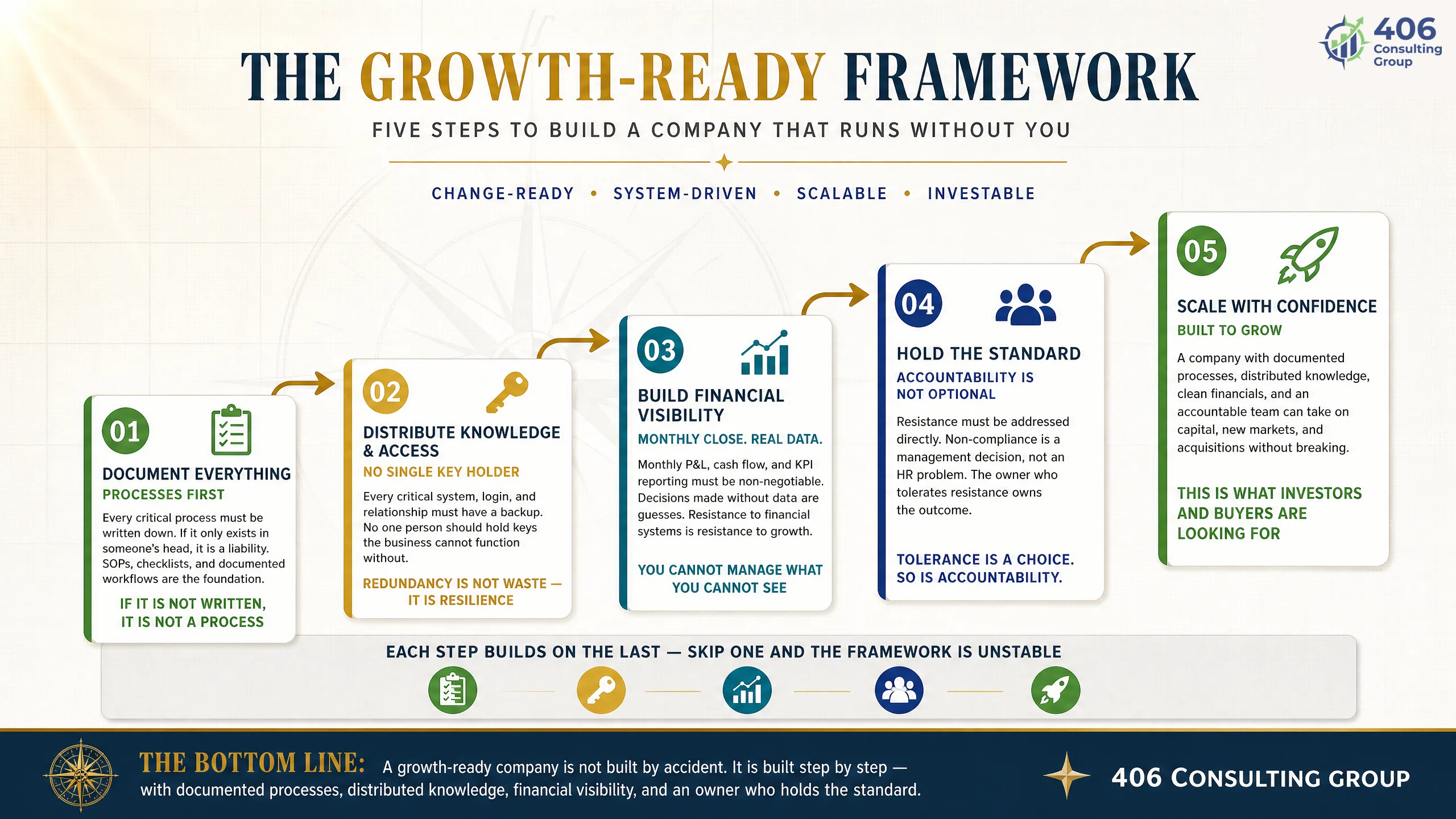
Document the processes
Get the critical knowledge out of people's heads and into written, shareable processes. This alone dissolves most indispensability — and makes the next moves possible.
Install the systems
Put the tools and workflows in place that let the work happen consistently without heroics. Systems are what you scale; heroics are what you can't.
Create financial visibility & accountability
Reliable, timely numbers everyone is accountable to. Visibility ends the "trust me" era and makes resistance to reporting untenable, because the results are now in the open.
Define roles and delegate
Clear ownership of clear responsibilities, so work can be handed off and the owner stops being the bottleneck. You can't delegate fog.
Put the right people in the right seats
Some people grow into the change; some won't. Building a growth-ready company sometimes means a hard call — but far more often it means giving good people the systems and clarity to finally succeed.
How the Right Partner Breaks the Logjam
The short answer: breaking entrenched resistance is hard from the inside, because the owner is too close, too conflicted, and too dependent. The right outside partner brings the perspective, the systems, and the accountability to break the logjam — and, crucially, designs the fix for the whole company, not just the accounting department.
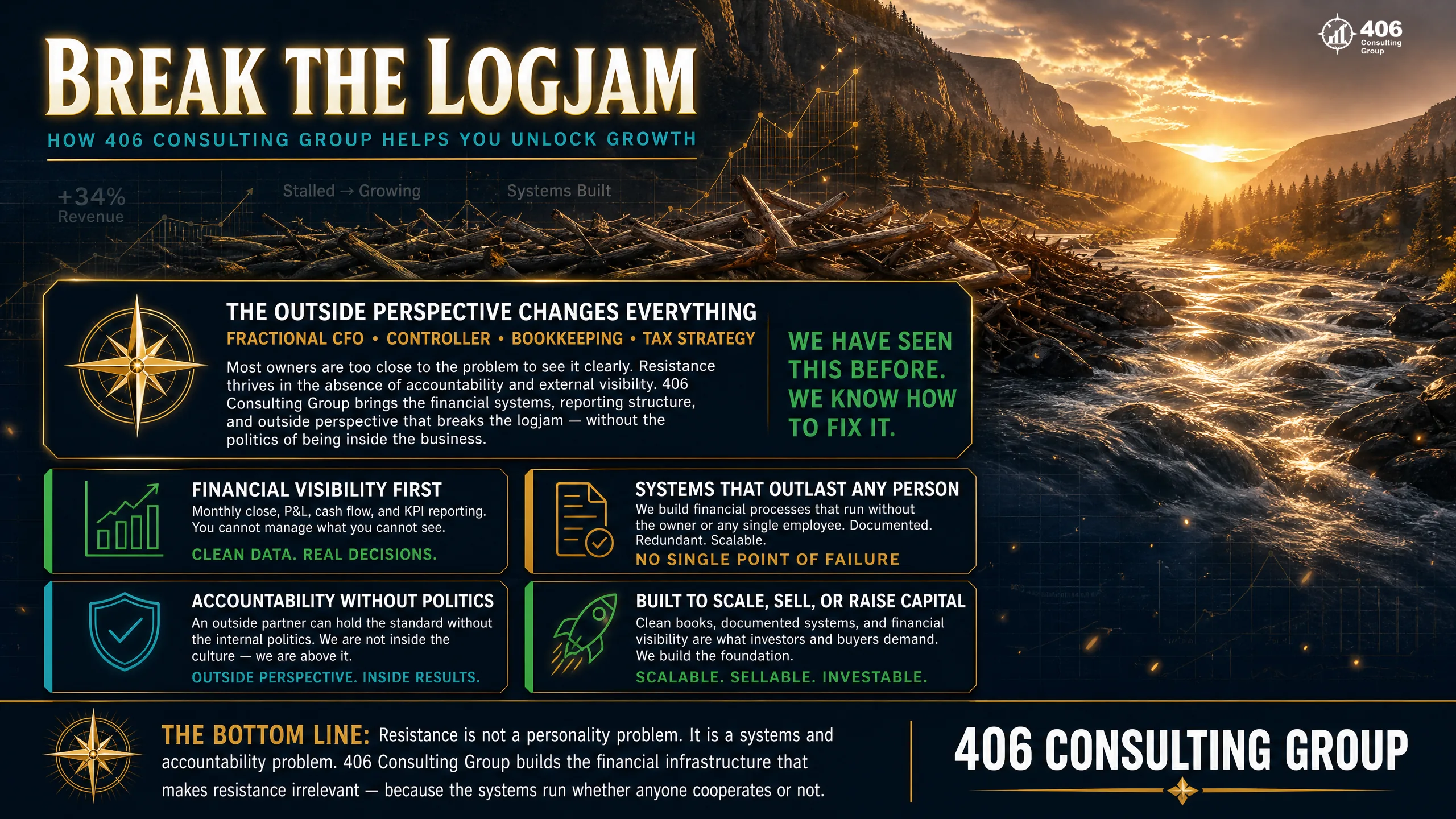
Our differentiator: we don't look at systems through an accounting lens
This is where most accounting firms fall short — they see a process only through the financial silo and optimize for the books. We come at it differently. Because of our business background, when we look at a system or process, we look at how it affects every department and the company as a whole — operations, sales, the crew, the customer experience — and we design the solution that's the best fit for the whole company, then make sure the financials support it. A change resisted in "accounting" is almost never just an accounting problem, and it can't be solved as one.
That whole-company view is what lets us build systems people will actually adopt — because they solve real problems across the business, not just create work for one department to satisfy another.
Here's what an outside partner brings that's almost impossible to generate internally:
Outside perspective
We're not caught in the history or the personalities. We can name the resistance for what it is and give the owner the cover — and the plan — to act.
Whole-company systems
We design processes and systems around how the whole business runs, so they actually get adopted and actually enable growth.
Financial visibility & accountability
Through our controller and CFO work, we install the reliable reporting and KPIs that end "trust me" and make performance visible to everyone.
A real growth plan
We turn "we want to grow" into a concrete plan — the systems, the numbers, the sequence — so change has a destination, not just a demand.
This is the heart of our advisory and business systems work, supported by controller and CFO services that supply the visibility and accountability the whole plan runs on.
Building Your Plan for Growth
The short answer: start by being honest about where the single points of failure are — including the ones that are you — then build the systems, visibility, and accountability that remove them, in a sequence the business can actually absorb. You don't have to fix everything at once; you have to start.
The businesses that break through are the ones that stop treating resistance as a personality quirk to be endured and start treating it as a growth problem to be solved. That shift — from tolerating to leading — is usually the moment a small business starts becoming a real company. It rarely happens by accident, and it rarely happens without an outside push.
If any of this described your business — an employee the whole operation depends on, a change that never sticks, a growth ceiling you keep hitting — that's the conversation to have. A good place to start is our free financial maturity assessment to see how resilient your business really is, and our guide to building a business that can run (and sell) without you. When you're ready, let's talk about the plan.
Frequently Asked Questions: Change, Resistance & Growth
Why does resistance to change hurt business growth?
Because growth requires systems that scale, delegation, reliable data, and the ability to adopt better tools — and resistance to change blocks all four. When key improvements never get implemented, the business can't do more without the owner touching every piece, can't hand off work that lives in one person's head, and makes big decisions on unreliable numbers. Over time the costs compound: stalled initiatives, lost top talent, missed opportunities, and a culture that stops trying. It rarely shows up as a single disaster — it shows up as a ceiling the business keeps hitting.
What does a business that can run without the owner look like?
It runs on documented processes and systems rather than on one person's memory or heroics. The critical knowledge is written down and shareable, roles and responsibilities are clearly defined and delegated, the numbers are reliable and visible to the team, and no single person — including the owner — is a point of failure the whole company depends on. That's the difference between owning a real company and owning a job that owns you, and it's also what makes a business durable and, eventually, sellable.
How do I deal with a key employee who resists change?
Start by reducing the dependence that gives the resistance its power — document their processes and systematize their knowledge so the business isn't hostage to them. Then set clear expectations: the change isn't optional, and explain the why, because people resist what they don't understand or feel threatened by. Give them training and a real chance to grow into it; many valued employees resist out of fear and come around when they feel secure. If someone genuinely won't adopt what the company needs to grow, that becomes a harder decision — but far more often, the fix is systems, clarity, and leadership rather than losing the person.
Why do owners tolerate resistance to change?
Usually for very human reasons: fear of confronting a valued employee, loyalty to long-time people, avoidance dressed up as patience, and — most powerfully — dependence on the very person who's resisting. When an owner feels they can't afford to lose someone, they can't push them, so the resistance stands. That dependence is itself the core problem, which is why the solution has to reduce it (through systems and documentation) rather than just demand compliance.
Can a business really survive without its owner or a key employee?
Yes — and that's the definition of a real company rather than a job. It takes deliberate work: documenting processes, installing systems, building reliable financial visibility, defining roles, and delegating. The goal isn't to make anyone less valuable; it's to make the company resilient, so good people can grow into bigger roles and the business can keep running (and growing) through any one person's absence. Businesses that never do this stay capped at what their most critical person can personally handle — and are fragile if that person leaves.
How does financial infrastructure help a business scale?
Reliable financial visibility and accountability are what let you make scaling decisions with confidence and end the "trust me" culture that resistance hides behind. Clean books, timely reporting, KPIs, and cash forecasting turn guesses into decisions — can we afford this hire, which work is profitable, will the bank say yes. Just as important, visibility creates accountability: when performance is in the open, resistance to reporting becomes untenable, and the whole team is measured against the same reliable numbers.
How does 406 Consulting Group help a business grow?
We help owners build companies that don't depend on any one person — through advisory, business systems, controller, and CFO services. Critically, we don't look at systems and processes through an accounting-only lens: because of our business background, we evaluate how a change affects every department and the company as a whole, and design the best-fit solution for the whole business, then make the financials support it. That whole-company perspective, plus outside objectivity and real financial visibility, is what breaks the resistance logjam and turns "we want to grow" into a concrete plan. Contact us to talk about where your business is stuck and what a growth plan would look like.
Helpful Resources
Related Tools & Resources
Growth & Advisory
Stop Letting Resistance Set Your Ceiling.
406 Consulting Group helps owners build companies that don't depend on any one person — with an outside perspective, whole-company systems, real financial visibility, and a concrete growth plan. If a single point of failure is capping your growth, let's build the plan to remove it.
The Core Idea
Job vs. real company
The Growth-Ready Company Framework
Our Differentiator
We don't look at systems through an accounting lens. We design for how a change affects every department and the whole company — then make the financials support it.
Hitting a Growth Ceiling?
Build a company that runs without any one person.
About the Author
Jason Anderson
Co-Founder, 406 Consulting Group
Large-scale operational finance at BP, where organizational change and cross-departmental systems were the daily work. Jason helps Montana owners break through growth ceilings by building companies that run on systems and a team — not on any one person.
Read the Full Story