
From 5 Projects to 20+.
How a Contractor Grew to $40 Million Without the Cash Falling Behind.
A real contractor, kept anonymous: how a project-manager approval and invoicing workflow, and an owner who signs once a month with every job's numbers in front of them, helped a company grow from single-digit millions to about $40 million.

Picture the owner of a growing construction company at the kitchen table on a Sunday night. A stack of vendor invoices on one side. A laptop full of PM emails on the other. Every bill needs the owner's eyes, because the owner is the only one who knows which job it belongs to and whether it's right.
At five projects, that's a long Sunday. At ten, it's every night. At twenty, it's impossible — and the things that slip through the cracks aren't small. They're charges that never get billed, costs that land on the wrong job, and cash that falls further behind the work every month.
This is the story of a contractor who got out of that chair — and grew from single-digit millions to about $40 million without the cash falling behind.
I'm Carrie Anderson, and I designed the workflow at the center of it. We're keeping the company anonymous — no name, no location, no numbers they haven't agreed to share — but everything here is real, and the approach works for any contractor who's starting to feel the same squeeze.

By Carrie Anderson
Co-Founder, 406 Consulting Group
Former corporate controller and contracted commercial loan analyst for a Montana community bank — 300+ commercial loans spread, packaged, and recommended.
Quick Answer: How Did This Contractor Grow From 5 Projects to 20+?
By taking the owner out of the day-to-day approval line without taking away their control:
- →Project managers approve and code costs to their own projects, where they know what's right.
- →We recommended and helped put the whole process in place — approvals, controls, and reporting — and our team runs the invoicing and payables, with billing and vendor costs tracked by project.
- →The owner signs once a month — with a summary report of every job's costs by vendor and phase, percent complete, and profit. The same person never approves, prints, and signs.
- →The result: fewer missed charges, clear costs by project, and cash that kept up with the work.
Table of Contents
Where They Started: Five Projects and One Approver
When we met them, they were a good contractor doing single-digit millions a year with about five projects running at a time. Good crews, good reputation, more work coming. Like most companies that size, the owner was the hub of everything — including every invoice in and every invoice out.
~5
Projects running at a time
1
Person approving every bill
0
Clear view of cost by project
That setup works — right up until it doesn't. The owner wasn't doing anything wrong. They were doing what every owner does: holding on to the money decisions because nobody else could see the whole picture. The problem is that a company can't grow past the number of invoices one person can read.
What Broke as the Projects Multiplied
As the project count climbed, the cracks showed up in the same three places I've seen in contractor after contractor:
Missed charges
Extra work and billable costs that never made it onto an invoice — because the paperwork lived in a truck, an inbox, or someone's memory.
Costs on the wrong job
Vendor bills that weren't tied to a project, so nobody could say for sure which jobs were making money.
Billing lag
Invoices went out late because they waited on the owner, and every late invoice is cash you've already spent and haven't collected.
Illustrative math, not this client's numbers:one missed $800 charge per project per month doesn't sound like much. Across 20 projects, it's $16,000 a month — $192,000 a yearof work you did and never billed. That's pure profit, gone, and it never shows up as a line on the P&L.

Missed charges are one of the quietest ways margin fades as a contractor grows — Jason walks through the rest in The Hidden Cost of Scaling a Construction Company.
What We Built: The Project-to-Invoice Workflow
Before I was a co-founder here, I was a corporate controller. A controller's whole job is making sure the right money moves at the right time with the right proof behind it. So I didn't start with software. I started with a simple question: who actually knows whether this cost is right? On a construction job, the answer is the project manager — not the owner, and not the office.
Before
- Bills arrive wherever — email, mail, the truck
- Owner reviews and approves each one
- Costs coded later, if at all
- Billable extras depend on someone remembering
After
- Every bill goes to one place
- The PM approves and codes it to the project
- Our team processes payables and invoicing
- Billing and vendor costs tracked by project
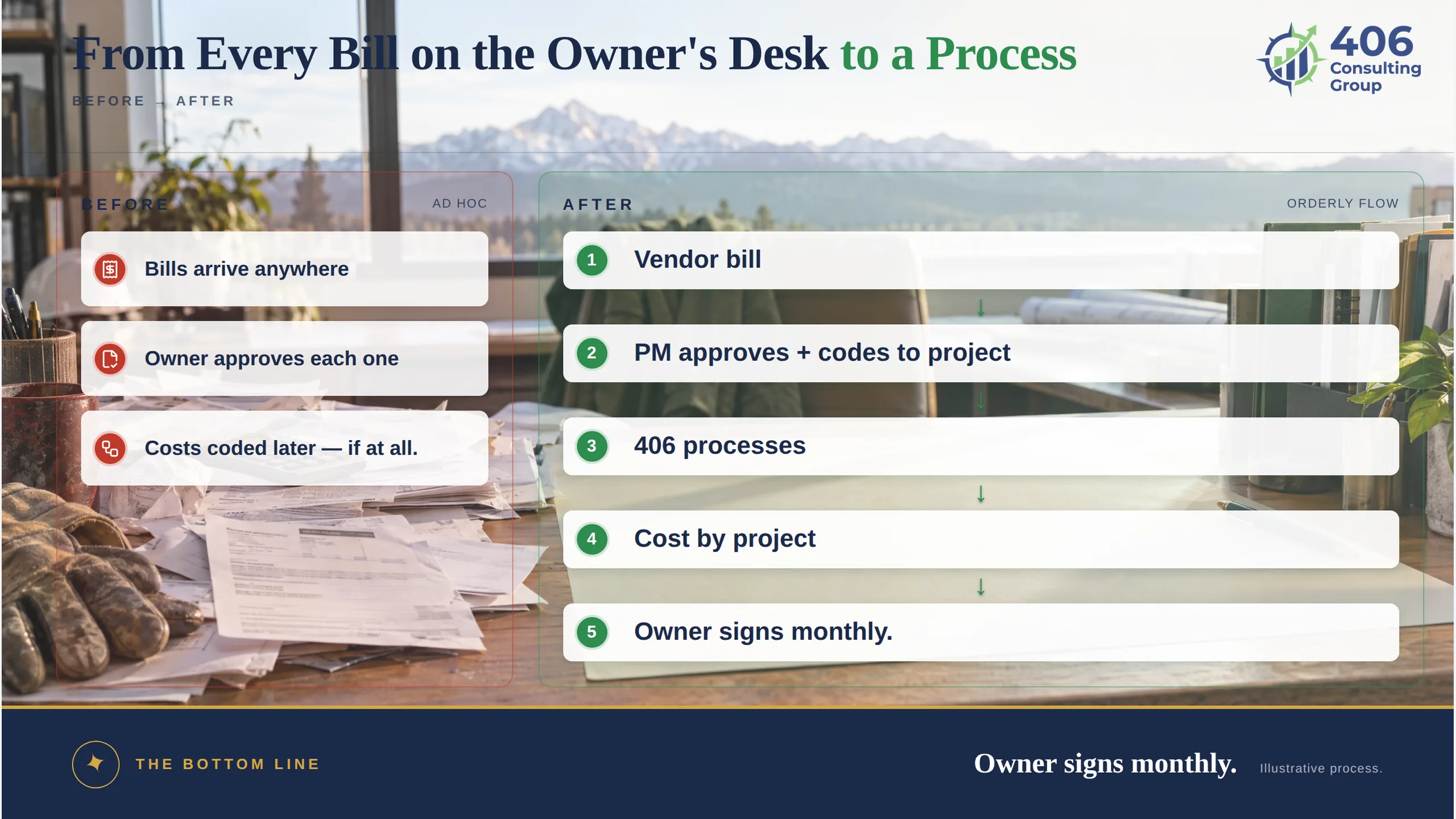
The PM is the person closest to the work, so they catch the wrong bill and the forgotten extra. Our team is closest to the books, so the invoice goes out on time and the cost lands on the right job. And because we designed the process end to end, every step hands off cleanly to the next. If billing is your bottleneck today, see the construction invoicing scramble.
The part that makes it work
4. Letting Go Without Losing Control
Every owner asks the same thing when we describe this: “If I stop approving every bill, how do I know the money's going where it should?”It's the right question. The answer is that the owner didn't give up control. The owner moved it from reading every bill to owning the controls.
Scaling is about controls, and controls are about process. The core rule is simple: the same person never approves a bill, prints the check, and signs it.
1. Approve
The project manager
Reviews the bill and its backup upstream and codes it to the project and phase.
2. Prepare & print
Our team
Processes the approved bill the same way every time and prints the check — separate hands from the approver, which is a key control for the owner.
3. Sign
The owner
Signs once a month, with a summary report of every job in front of them.

Because the backup is reviewed and approved upstream, the owner doesn't dig through a pile of invoices. Once a month they get the checks — about 300 of them — and a summary report that puts every job front and center:
What's on the owner's monthly report
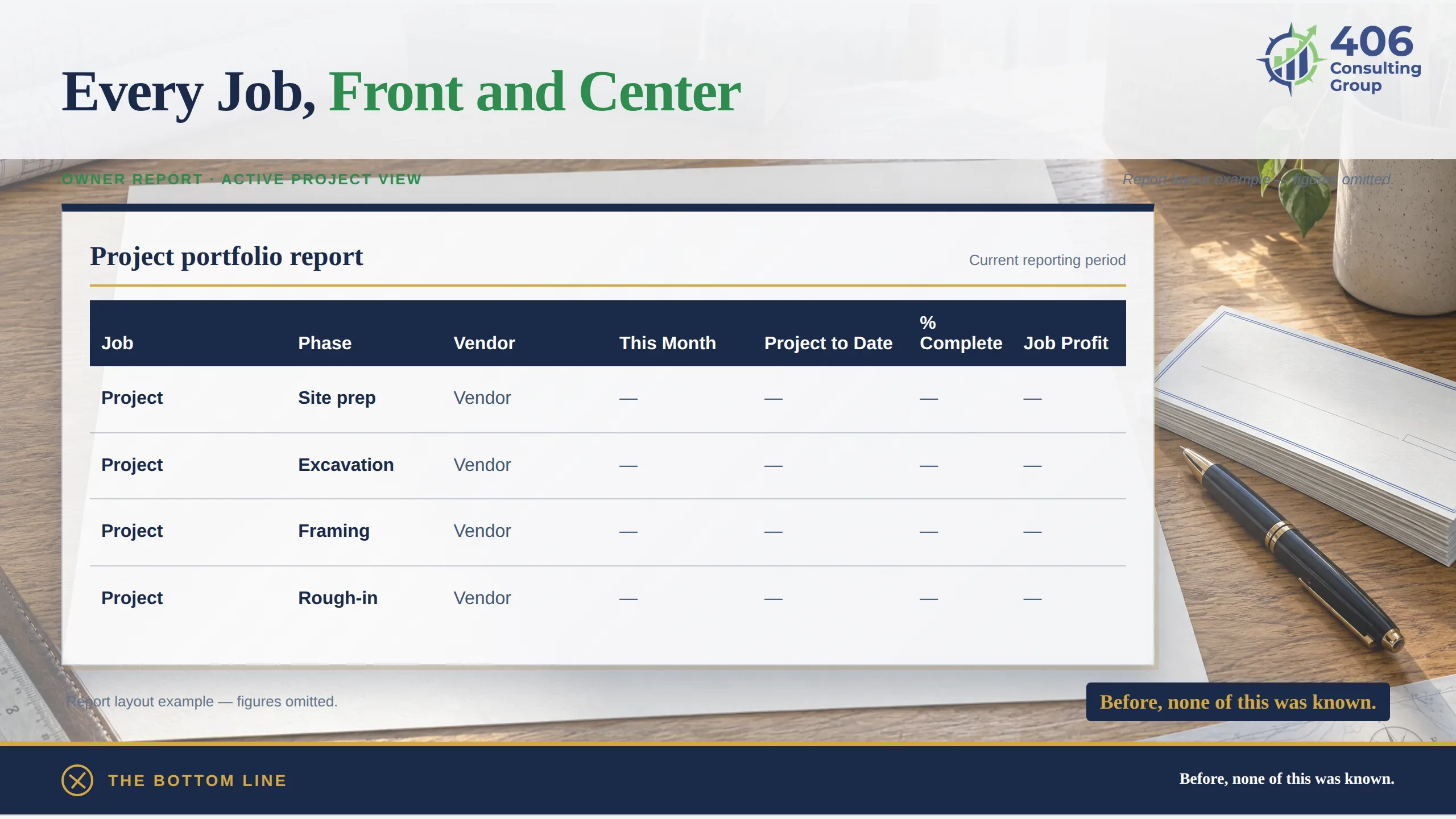
Before, none of that was known. Not the percent complete, not the profit on each job, not what each vendor had been paid, and not what a phase like framing or rough-in had cost in total.
Control isn't touching everything. Control is a process you trust, and the information to lead with. The PM approves, our team prints, the owner signs — nobody does all three — and the owner signs with the whole picture of every job in front of them.
Where we fit
We didn't just take over a task. We recommended these controls and helped put them in place across the whole process — who approves what, how bills are coded to projects and phases, how checks are prepared, and the monthly report the owner signs from. Running the payables and invoicing is the piece we do every month. The process around it is what we built together.
This is what Jason means by the advice that your goal is to become the least valuable person in your company. The owner still makes the call. They just stopped being the bottleneck for every bill in between.
What Changed: 5 Projects to 20+

Fewer missed charges
Billable work got billed, because the PM who saw it was the one who flagged it.
Costs by project
Billing and vendor costs tracked job by job, so the owner could see which work was paying.
Cash kept up
Invoices went out on time, so cash came in closer to when the work was done.
The crews and the market did the growing. The workflow is a big reason the cash kept up with the work — and why the owner could run four times as many projects without four times as many Sunday nights.
Why the Bank Liked It Too
I also work in commercial lending as a contracted loan analyst, and I've worked on more than 300 commercial loans. Here's what a workflow like this looks like from the lender's side of the desk:
Costs by project
A lender can see which jobs make money instead of taking the owner's word for it.
A cleaner WIP schedule
When costs land on the right job, the work-in-progress numbers hold up to questions.
Controls on cash out
Upstream approvals and separated duties tell a lender the money is managed, not just spent.
Less key-person risk
A business that doesn't stop when the owner is out is a safer business to lend to.
Growth on that scale takes financing, and financing goes to contractors whose numbers a lender can trust. See what a WIP schedule is and why your banker wants one, walk one big job month by month in Can You Afford a $3 Million Subcontract?, or let us get your books ready with loan readiness.
How to Start at Your Company
You don't need twenty projects to start. Don't boil the ocean — pick one step and make it stick:
One front door for bills
Every vendor bill goes to one inbox or one system. No more invoices in trucks.
PMs approve their own costs
The person who ordered it confirms it's right and which job it belongs to.
Billable extras get flagged at the source
If the PM sees extra work, it gets written down and sent for billing that week.
Track billing and cost by project
Every job gets its own running picture of what's been billed and what it's cost.
Separate the duties, then sign on a schedule
The person who approves a bill doesn't print the check, and neither of them signs it. The owner signs on a set cadence with a job-by-job summary in hand.
Not sure where your biggest gap is? Our free financial maturity assessment takes about two minutes and points you to the weakest link first.
How We Help Contractors Grow
We're a small firm based in Columbia Falls, Montana, and we work with contractors well beyond the valley. I bring the controller's seat and the lender's seat. Jason brings a decade of operations and accounting at BP. Together we build the systems that let a contractor grow without the owner — or the cash — falling behind.
What working with us looks like
Introductions & access
We meet your team and key people and get access to the systems your numbers live in.
First 30–60 days
We set your priorities for the next 30 and 60 days — for a growing contractor, often the bill-approval and invoicing workflow first — with a clear timeline of deliverables.
Beyond 60 days
We move into the steady monthly rhythm — payables, invoicing, job costing, and reporting — while working toward the long-term goals we mapped together.
See how we work with general contractors, or the support that fits your stage: controller services or bookkeeping.
FAQ: Contractor Billing and Approval Workflows
How can a construction company owner stop approving every bill?
Move approval to the people closest to the work. Project managers approve and code each cost to their project, an accounting team processes payables and invoicing, and the owner signs on a set schedule, such as once a month, with a summary report of every job in front of them. The same person never approves a bill, prints the check, and signs it. The owner keeps control through the process instead of by reading every bill.
What controls should a contractor have on payables?
At minimum: one place where every bill arrives, approval by the project manager who ordered the work, coding of every cost to a project, processing and check printing by someone other than the approver, and a final signature by a third person, usually the owner. The core rule is that no one person approves, prints, and signs. A monthly report of costs by job, vendor, and phase lets the owner review the big picture instead of every invoice.
Why do contractors miss billable charges?
Because the information about extra work lives in the field, while billing happens in the office. If the paperwork depends on someone remembering to pass it along, some of it never makes it onto an invoice. Having the project manager flag billable work at the source, and tracking billing by project, closes most of that gap.
Why track billing and vendor costs by project?
So you can see which jobs are actually making money, catch cost overruns while there is still time to act, and produce a work-in-progress schedule that holds up when a lender or surety asks questions. Costs that are not tied to a project hide both problems and profit.
Is it safe for an owner to sign checks only once a month?
It can be, when the controls are in place. In this client's workflow, the backup for every bill is reviewed and approved upstream by the project manager, our team prepares and prints the checks, and the owner signs once a month with a summary report showing every job's costs by vendor and phase, month and project-to-date, percent complete, and profit. The safety comes from separated duties and good information, not from how often the owner signs.
When should a growing contractor change its approval workflow?
When the owner becomes the bottleneck: invoices wait on the owner, billable extras slip through, or nobody can say which jobs are making money. For many contractors that happens as they move from a handful of projects at a time toward ten or more, but the right time is before it starts costing you cash.
Keep Reading
Stop Approving Every Bill
Start Owning the Controls.
We'll map how money moves through your company today and build the approval and invoicing workflow that lets you grow — with every job's numbers in front of you every time you sign.
The Story at a Glance
A real contractor, kept anonymous
Still Approving Every Bill?
Own the controls instead.
About the Author
Carrie Anderson
Co-Founder, 406 Consulting Group
Carrie is a former corporate controller and the contracted commercial loan analyst a Montana community bank relies on. She has spread, packaged, and recommended 300+ commercial loans, and she designs the approval and invoicing workflows that let growing contractors keep control without becoming the bottleneck.
Read the Full Story