
You Do $5 Million a Year.
Can You Afford a $3 Million Subcontract?
Winning the biggest job in company history is the easy part. Walk the cash month by month — payroll, slow pay, retainage, change orders, and financing — from a commercial loan analyst who sees these jobs from the lender's side.

The call comes on a Tuesday. You got it — the biggest job in the company's history. A $3 million subcontract on a high-end build, ten months of steady work. Your biggest job before this was $900,000. The crew is fired up. Your spouse is proud. You shake hands and start ordering material.
Now fast-forward to the sixth Friday. Payroll is $45,000. You've fronted two months of labor and a truckload of material. The work is going great, and the first real check from the general contractor is still seven weeks away. You're lying awake doing math on the ceiling, and you're realizing something nobody told you when you won the bid:
“We've never been this busy. And we've never been this broke.”
I've read more than 300 commercial loan files from the lender's side of the desk. A lot of the contractors in those files weren't in trouble because they did bad work. They were in trouble because they did a big job — and nobody walked the cash before they signed. The good news: this is one of the most predictable problems in business. You can see it coming months in advance, on one page, if you look.

By Carrie Anderson
Co-Founder, 406 Consulting Group
Former corporate controller and contracted commercial loan analyst for a Montana community bank — 300+ commercial loans spread, packaged, and recommended.
Quick Answer: Can You Afford a Contract Bigger Than You've Ever Done?
Not “can you do the work” — can you fund it. On a big job you pay crews and suppliers for months before the first check clears, and part of every payment is held back as retainage.
- →Walk the cash month by month before you sign: what goes out, when the GC actually pays, and how much is held back.
- →Plan for a hole of roughly 15–25% of the contract on a long job with slow pay and 10% retainage. Ours below needs about $475,000 on a $3 million job, and about $740,000 if the GC pays 30 days slower.
- →Line up the financing before you sign, not after you're short. Banks lend to a plan, not to a panic.
- →Know your margin under stress: a 3% overrun can eat a third of the profit on a 10%-margin job.
Table of Contents
The Real Enemy Isn't the Job. It's the Timing.
Here's the part that trips up good contractors: a job can be profitable and still run you out of cash.Profit is what's left when the job is done. Cash is what's in the bank on Friday. On a big job, those two numbers can be hundreds of thousands of dollars apart for most of a year.
The reason is timing. You pay out every week. You get paid on someone else's schedule.
Money out — on your schedule
- • Payroll every Friday, starting week one
- • Material deposits and supplier bills, usually within 30 days
- • Equipment, fuel, insurance, and mobilization up front
Money in — on their schedule
- • You bill once a month, after the work is done
- • The GC pays 45, 60, sometimes 90 days later
- • 5–10% of every payment is held back until the end

On a $400,000 job, that gap is a bad month. On a $3 million job, it's the whole company. The bigger the job is compared to your business, the more of your own money it swallows before it gives anything back.
Ridgeline's Cash Walk, Month by Month
Meet Ridgeline Concrete. About $5 million a year, 30 employees, a good reputation, and a solid bank relationship. They've been offered a $3 million subcontract that runs ten months. Here's how the job looks on their bid:
$3,000,000
Contract
10 months
Duration
10%
Profit margin ($300K)
10%
Retainage held
Every month Ridgeline does about $300,000 of work. It costs them about $264,000: $120,000 in labor, $114,000 in material, and $30,000 in equipment and other costs. Month one also carries $60,000 to mobilize. Labor and equipment are paid the same month. Suppliers are paid the following month. Ridgeline bills at the end of each month, and the GC pays 60 days later — minus 10% retainage, so each $300,000 bill brings in $270,000.
Now walk it:
| Month | Cash out | Cash in | Job's running cash |
|---|---|---|---|
| 1 | $210,000 | $0 | −$210,000 |
| 2PEAK | $264,000 | $0 | −$474,000 |
| 3 | $264,000 | $270,000 | −$468,000 |
| 4 – 10 | $264,000 / mo | $270,000 / mo | −$462,000 → −$426,000 |
| 11 (job done) | $114,000 | $270,000 | −$270,000 |
| 12 | $0 | $270,000 | $0 |
| 14 (retainage paid) | $0 | $300,000 | +$300,000 |
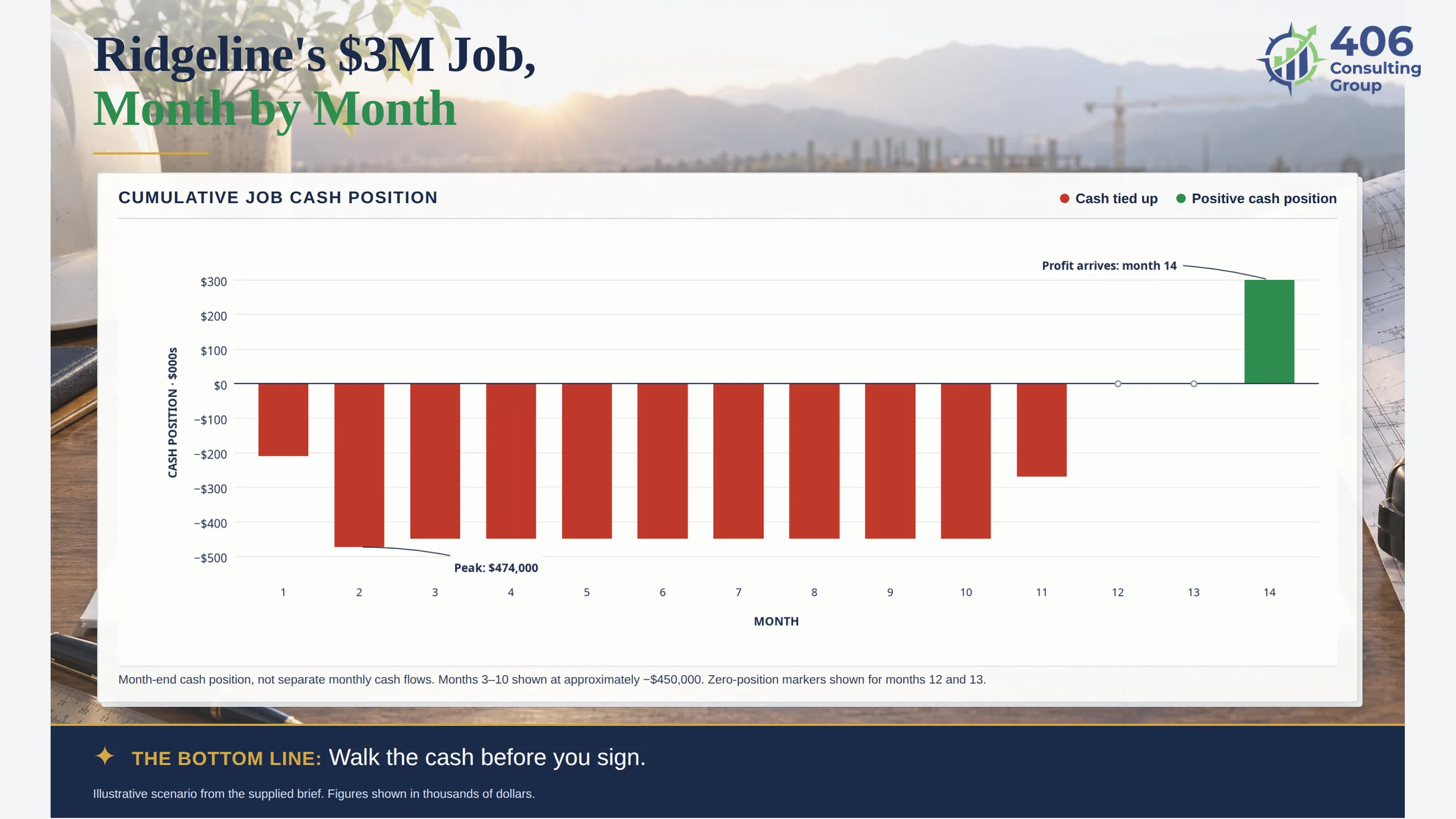
Red = how much of Ridgeline's own money is tied up in the job. It sits near $450,000 for ten straight months. The green bar in month 14 is the retainage — and the profit.
$474,000
Peak cash needed — if the GC pays on time
~$740,000
If the GC pays in 90 days instead of 60
~$800,000
Slow pay plus a 3% cost overrun
Ridgeline has about $150,000 of spare cash and a $250,000 line of credit. That's $400,000. On the bestversion of this job, they're short by month two. If the GC pays a month slower — which happens all the time when the GC is waiting on the owner — they're short by about $340,000.
And that's before their other jobs.Ridgeline's existing $5 million of work still needs its own cash. The big job doesn't get a separate bank account — it borrows from every other job in the company until it pays back.
Retainage: Your Profit, Parked in Someone Else's Account
Look at Ridgeline's walk again. The job makes $300,000 of profit. Retainage on the job is $300,000. That's not a coincidence on a 10%-margin, 10%-retainage job — the retainage is the profit.Ridgeline does ten months of work and breaks exactly even on cash. Every dollar they actually earned is sitting in the GC's account until the job is closed out.
The math nobody puts on the bid
10% margin + 10% retainage = you finance the entire job and see your profit months after the last day on site.

And “the end of the job” is often later than you think. Retainage usually waits for the GC's final acceptance — punch lists, inspections, lien waivers, sometimes the whole project, not just your scope. If you're the concrete sub on a building that takes two years, your retainage can wait two years.
Retainage is often negotiable, especially for subs with a clean track record: a lower rate (5% instead of 10%), a reduction once the job is 50% complete, or release when yourscope is accepted. Before you sign, read the payment section of the contract for three things: the retainage rate, when it's released, and whether you get paid when the GC gets paid (“pay-when-paid”) or only ifthey do (“pay-if-paid”). That last one shifts the owner's payment risk onto you. Have your attorney read it — and check your state's rules on retainage and prompt payment, which vary.
Change Orders: How Good Contractors Work for Free
On a 10%-margin job, there's not a lot of room. Ridgeline's $300,000 profit disappears fast:
−$90,000
A 3% cost overrun
A rainy month, a price jump on rebar, a crew that runs slow on a tricky pour. Nearly a third of the profit — gone.
−$40,000
$40,000 of extra work on a verbal OK
The superintendent says "go ahead, we'll paper it later." Later, the GC's project manager disputes it.
−$20,000
Unbilled small stuff
Extra trips, rework someone else caused, after-hours pours. Never written up, never billed.
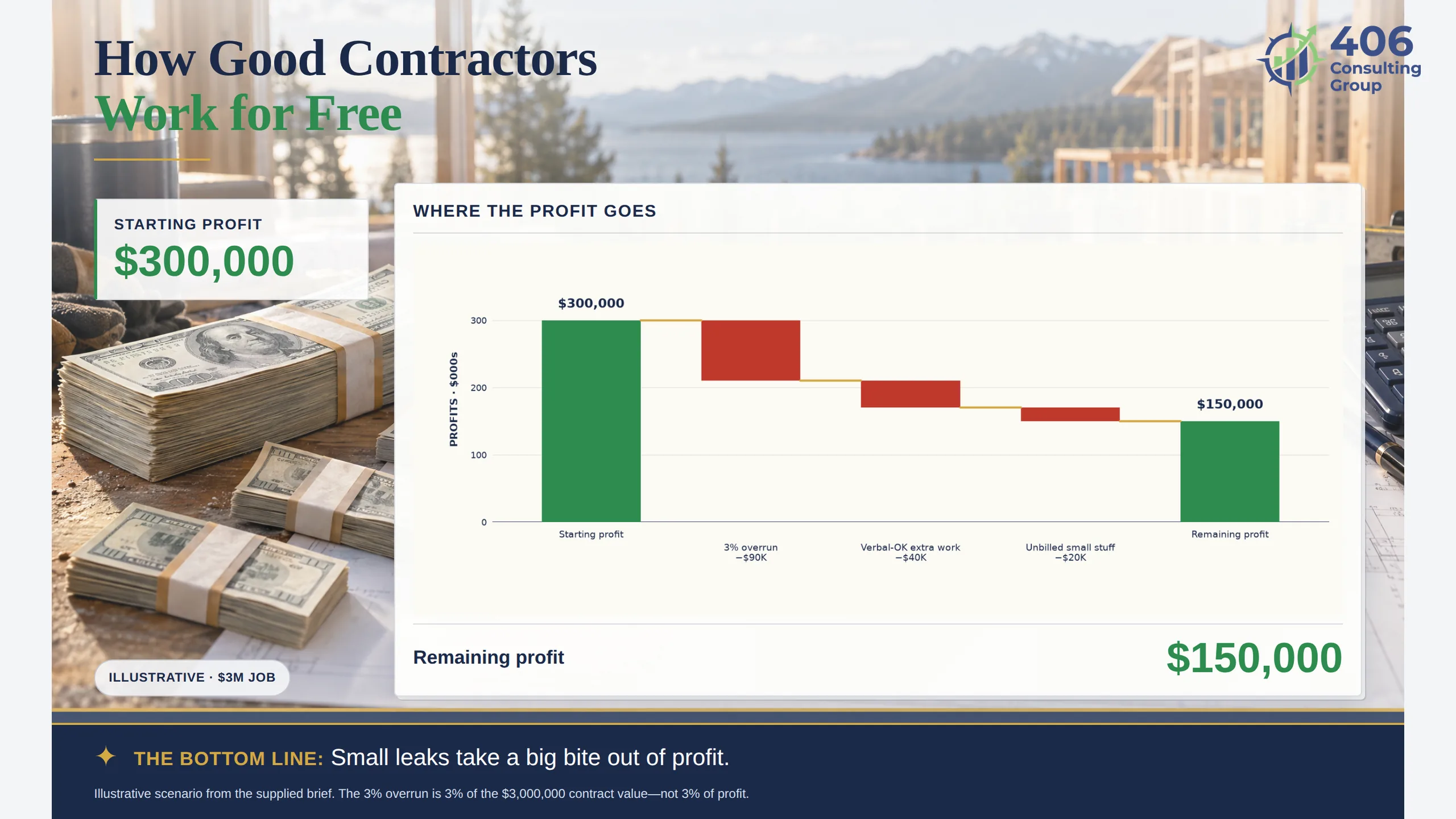
Add those up and half the profit on the biggest job in company history is gone — and none of it shows up until the job is over, because nobody was comparing costs to the budget while the job was running.
The fix isn't complicated. It's discipline: no extra work without a signed change order, and job costs compared to budget every month — with a work-in-progress (WIP) schedule that shows whether each job is making or losing money while you can still fix it. Our job costing calculator is a good place to pressure-test your numbers.
The Job You Win Can Starve the Jobs You Have
Cash isn't the only thing a big job eats. It eats people, equipment, and the owner's attention — and it eats them from your existing customers first.
Crews
Where do the extra workers come from? If you're hiring, how fast can new people work to your standard — and what happens to your labor cost while they learn?
Equipment
Can your current fleet cover this job and your others? If you need to buy or rent, that's more cash out before the first check.
Bonding
If the job needs a bond, your surety looks hard at your working capital and job history. A job far bigger than your past work may need a bigger bond line than you have.
One customer, a lot of eggs
$3 million over ten months is about $3.6 million a year. Next to Ridgeline's $5 million, one GC becomes roughly 40% of the business. If that GC slows down, so do you.
The quiet one is you. The owner who used to bid, schedule, and walk every site is now living on the big job. Your loyal customers — the ones who've paid you on time for years — start waiting. That's how a big win turns into a smaller company two years later.
From the lender's side of the desk
6. What Your Banker Is Thinking When You Call
This is the part of the story I see from the other chair. As a commercial loan analyst, I prepare the analysis a bank uses to decide on a loan. And the worst time to ask a bank for money is after you've signed the contract and you need it.
Calling in month two
“We're short on payroll and need to increase our line.” The bank hears: this owner didn't see it coming.Now they want updated financials you don't have ready, the answer takes weeks, and the terms reflect the risk.
Calling before you sign
“We've been offered a $3 million job. Here's the contract, the cash forecast, and our peak need.” The bank hears: this owner runs the business.That's a borrower they want.

What the bank will ask for
- The contract — scope, payment terms, retainage, and who the GC and owner are
- A month-by-month cash forecast for the job, like Ridgeline's walk above
- Current financials and a WIP schedule showing your other jobs are healthy
- Your receivables aging — who owes you, and how late they are
- Tax returns, and a personal financial statement from each owner
The surprise most contractors don't see coming:a receivables-based line of credit usually lends against a percentage of what you're owed — and lenders commonly exclude retainage and invoices past 90 days from that number. So the $300,000 Ridgeline is owed in retainage may not help them borrow a single dollar.
One more thing to read before you sign the bank's paperwork: a bigger line almost always comes with a personal guarantee. That means your house is backing the biggest job you've ever taken. That can be a smart bet — but make it on purpose. I cover how guarantees work in How You Sign Your Name Could Put Your Personal Assets at Risk, and how much a bank will actually lend you in How Much Can My Business Borrow? For which kind of loan fits the gap, see line of credit vs. term loan.
The Cost of Guessing
You'd never bid a $3 million job without a takeoff. You'd measure every yard of concrete and every hour of labor. But most contractors take that same job without a cash takeoff — and the cash is the part that can actually sink the company.
Walking the cash first
A few days of work
A forecast, a conversation with your banker, maybe a renegotiated retainage clause.
Guessing
The company
Missed payroll, suppliers on hold, a crew that walks, and an emergency loan on the worst terms you'll ever see.
This isn't a scare story. One of the first companies we ever worked with was a construction and trucking company we helped pull out of bankruptcy and back to health. Cash problems in this industry rarely start with bad work. They start with good work that nobody funded.
Answer these before you sign
8. Win It Before You Sign It: The Go/No-Go Checklist
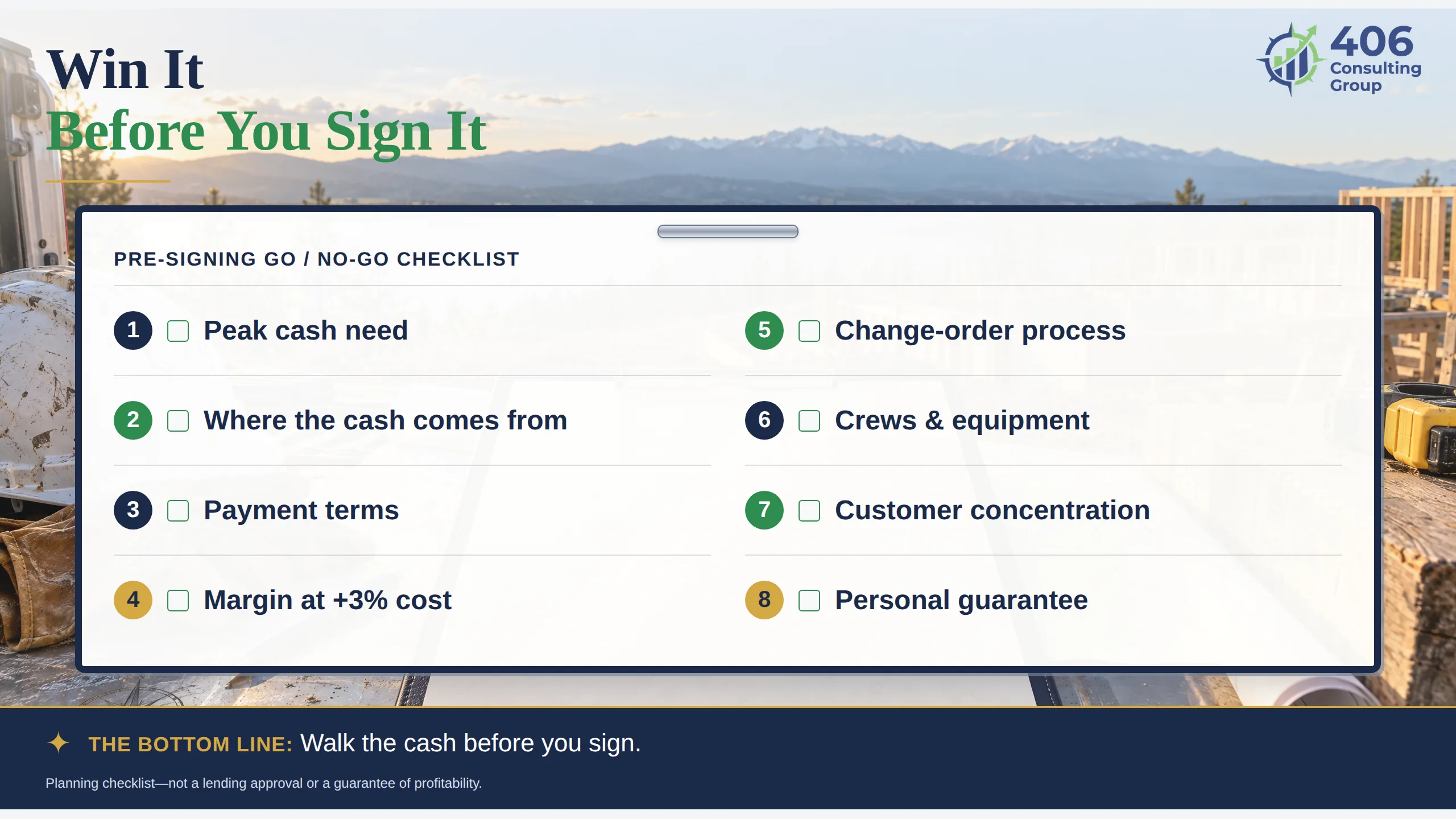
The battle is won before it's fought. If you can answer all eight of these with real numbers, you're ready. If you can't, you've found exactly what to work on before you say yes.
- 1What is our peak cash need on this job, month by month — and what is it if the GC pays 30 days slow?
- 2Where does that cash come from: the bank account, a line of credit, or both? Is the line approved today?
- 3What are the payment terms: billing date, days to pay, pay-when-paid or pay-if-paid, retainage rate, and when retainage is released?
- 4What is our margin if the job runs 3% over budget? Is it still worth doing?
- 5Is our change-order process written down — who can approve extra work, in writing, before we do it?
- 6Do we have the crews and equipment without pulling them off existing customers?
- 7How big a share of our revenue will this one customer be — and what happens if they slow down?
- 8What are we personally guaranteeing to fund it?
Not sure how many months of cash you have right now? Start with our cash flow runway calculator.
Who Can Actually Answer This for You
Most contractors already have people around the numbers. The problem is when each of them sees them:
Your bookkeeper
Records what already happened. Important — but it's the rearview mirror.
Your tax CPA
Sees the year in April. By then the job is long over.
Your bank
Sees it when you call short. That's the most expensive time to be seen.
What you need on a job this size is someone looking forward— before you sign and every month while the job runs. That's the seat we sit in. We've operated businesses, not just booked them: Jason and I both came up in the energy business at BP. I read loans the way the bank reads them, because I prepare that analysis for a bank. And we've watched this exact growth curve up close — a contractor we worked with grew from single-digit millions to about $40 million, and the billing and approval workflow we built is a big reason the cash kept up with the work.
What we do for a contractor eyeing a bigger job
What working with us looks like
Introductions & access
We meet your team and key people and get access to the systems your numbers live in.
First 30–60 days
We set your priorities for the next 30 and 60 days — for a contractor eyeing a big job, the cash forecast and bank package come first — with a clear timeline of deliverables.
Beyond 60 days
We move into the steady monthly rhythm — job costing, WIP, forecasting — while working toward the long-term goals we mapped together.
If you work in the Flathead Valley, the jobs coming to Lakeside are exactly this size. We cover what that project means for local contractors in Territory 1889: What Discovery Land's Lakeside Development Means for Flathead Valley Contractors. See also our general contractor accounting and specialty trades accounting services.
About the numbers.Ridgeline's figures are a teaching example built from common contract terms. Your job will be different — which is exactly why it's worth walking your own. Retainage, lien, and prompt-payment rules vary by state; have a construction attorney review the contract itself.
FAQ: Taking On a Bigger Job
How much cash do I need to take on a large construction contract?
Walk the job month by month: payroll, material, equipment, and mobilization going out, and payments coming in 45 to 90 days after you bill, minus retainage. On a long job with 10% retainage and 60-day pay, the peak can easily reach 15% to 25% of the contract value before the first payments catch up.
Why does a profitable job leave my business short on cash?
Because you pay crews and suppliers every week but get paid monthly, weeks or months after you bill, with part of each payment held back as retainage. Profit shows up at the end of the job; the cash gap shows up in the first month.
What is retainage in construction?
Retainage is a percentage of each progress payment, commonly 5% to 10%, that the general contractor or owner holds back until the work is complete and accepted. On a 10%-margin job with 10% retainage, the amount held back can equal your entire profit on the job.
Can I negotiate retainage on a subcontract?
Often, yes, especially with a good track record. Common asks are a lower rate, a reduction once the job is 50% complete, and release when your scope is accepted rather than at the end of the whole project. State law also limits retainage in some cases, so have an attorney review the contract.
What is the difference between pay-when-paid and pay-if-paid?
Pay-when-paid generally means the GC pays you within a reasonable time after they are paid by the owner. Pay-if-paid can mean you are only paid if the owner pays the GC, which shifts the owner's payment risk onto you. Enforceability varies by state, so read this clause carefully before you sign.
Should I get a line of credit before or after I sign a big contract?
Before. A lender who sees a signed contract, a month-by-month cash forecast, and healthy current financials is looking at a well-run borrower. Asking for more credit after you are already short takes longer, and the terms usually reflect the extra risk.
Does retainage count toward my line of credit borrowing base?
Usually not. Receivables-based lines of credit typically lend against a percentage of eligible receivables, and many lenders exclude retainage and invoices more than 90 days old. That means the money you are owed in retainage may not increase what you can borrow.
Keep Reading
Before You Sign
You Can Do the Work. Let's Make Sure You Can Afford It.
Bring us the job you're looking at. We'll walk the cash with you, show you the peak, and help you walk into the bank with a plan — before the contract is signed.
The $3M Job at a Glance
Ridgeline Concrete example
Looking at a Big Job?
Walk the cash before you sign.
About the Author
Carrie Anderson
Co-Founder, 406 Consulting Group
Carrie is a former corporate controller and the contracted commercial loan analyst a Montana community bank relies on. She has spread, packaged, and recommended 300+ commercial loans — so she sees a contractor's big job the way the lender will.
Read the Full Story