
How You Sign Your Name Could Put
Your Personal Assets at Risk
Your LLC protects you only if you sign for it the right way. Representative signatures, proper titles, what to look for in a contract, and how personal guarantees really work — from a commercial loan analyst who reads them from the lender's side.

The letter comes to your house, not the shop. It's a collection notice for a business debt — a supplier account, an equipment lease, a line of credit — and it's addressed to you personally. You set up an LLC specifically so this couldn't happen. So how did it?
Almost always, the answer is a signature. Not a fraud or a lawsuit gone wrong — a few seconds at the bottom of a page, signed the way most owners sign everything: with their own name. I've spent years reading loan files from the lender's side, and I can tell you that the documents protecting a business owner and the documents exposing them often look identical until you read the signature block and the paragraph just above it.

By Carrie Anderson
Co-Founder, 406 Consulting Group
Former corporate controller and contracted commercial loan analyst for a Montana community bank — 300+ commercial loans spread, packaged, and recommended.
Quick Answer: How to Sign Without Putting Your Personal Assets at Risk
- →Sign for the company, not yourself: company legal name, then "By:" your name, then your title.
- →Use a title that fits your entity: Member or Manager for an LLC, President for a corporation — not just "Owner."
- →Read the paragraph above the signature line. "I personally guarantee" overrides your title.
- →Make sure the contract names the company by its exact legal name, not your name or only a trade name.
- →Keep a list of every personal guarantee you've signed — and get a written release when one should end.
Table of Contents
The LLC Shield Only Works If You Use It
An LLC or corporation is a separate legal person. When it signs a contract, itowes the debt — and your house, savings, and personal accounts stay out of reach. That's the whole point of forming one.
But a company can't hold a pen. A person always signs for it, and the paperwork has to make clear which person is on the hook: the company, or the human holding the pen. When that isn't clear, the other side will argue it was you. Sometimes they win.
How you sign
Company name, "By:", and your title — or just your name.
What you sign
Whether the contract names the company, and whether it hides a guarantee.
How you operate
Separate bank accounts and clean books, or money moving back and forth.

Those three things decide whether the protection you paid for actually holds. The rest of this guide takes them one at a time.
The Right Way vs. the Wrong Way to Sign
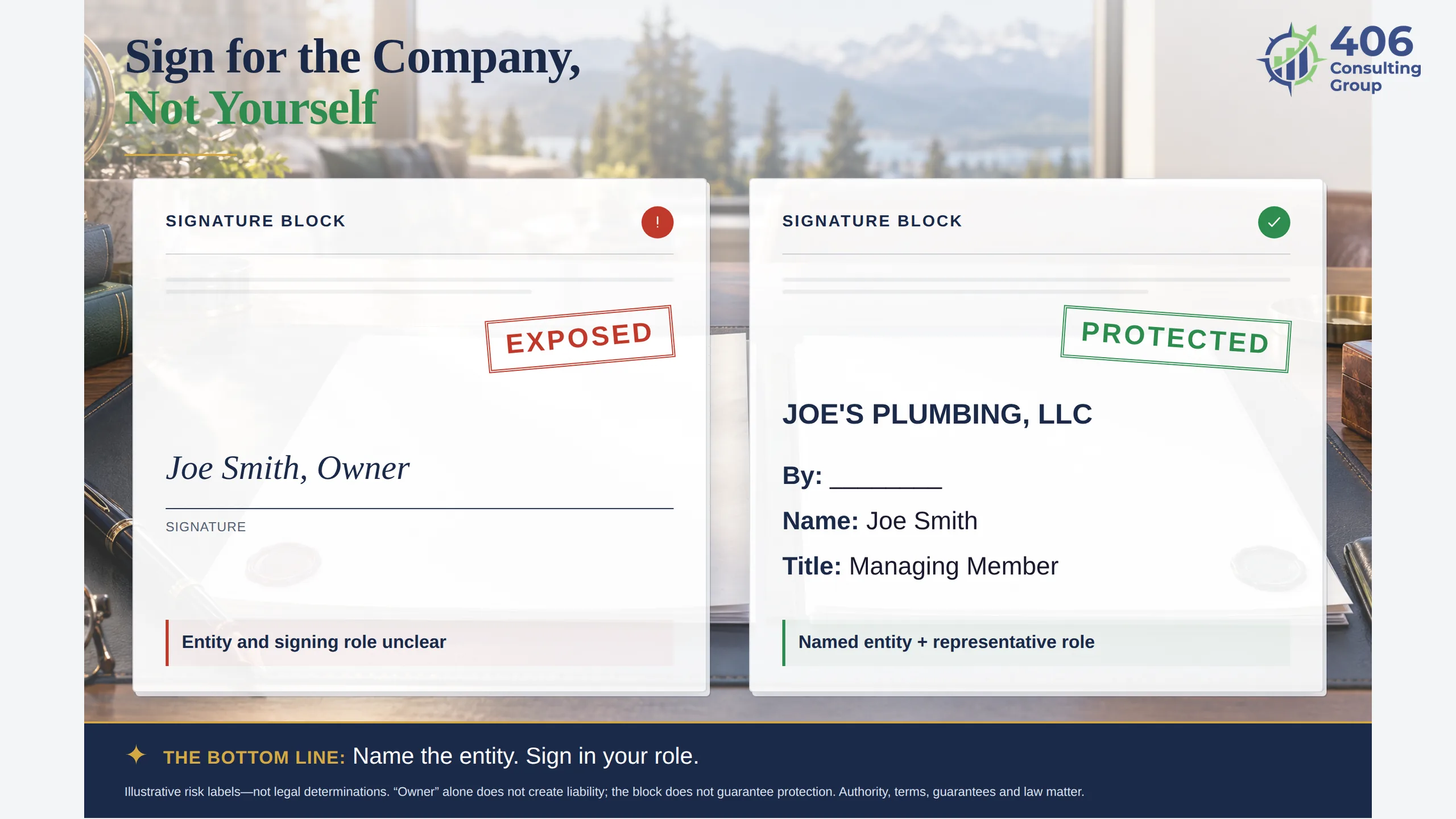
A proper signature block says three things: who is agreeing (the company), who is signing for it (you), and in what role(your title). The word "By" is what turns your signature into the company's.
Exposed
____________________
Joe Smith
____________________
Joe Smith, Owner
Nothing says Joe signed for a company. The other side can argue Joe signed for himself.
Protected
JOE'S PLUMBING, LLC
By: ____________________
Name: Joe Smith
Title: Managing Member
The company is the party. Joe is signing on its behalf, in a stated role.
E-signatures follow the same rules.Many e-sign templates only ask for your name. If there's no field for the company and your title, ask the sender to add one — or type it in the signature or a comment field before you sign.
Titles That Match Your Entity
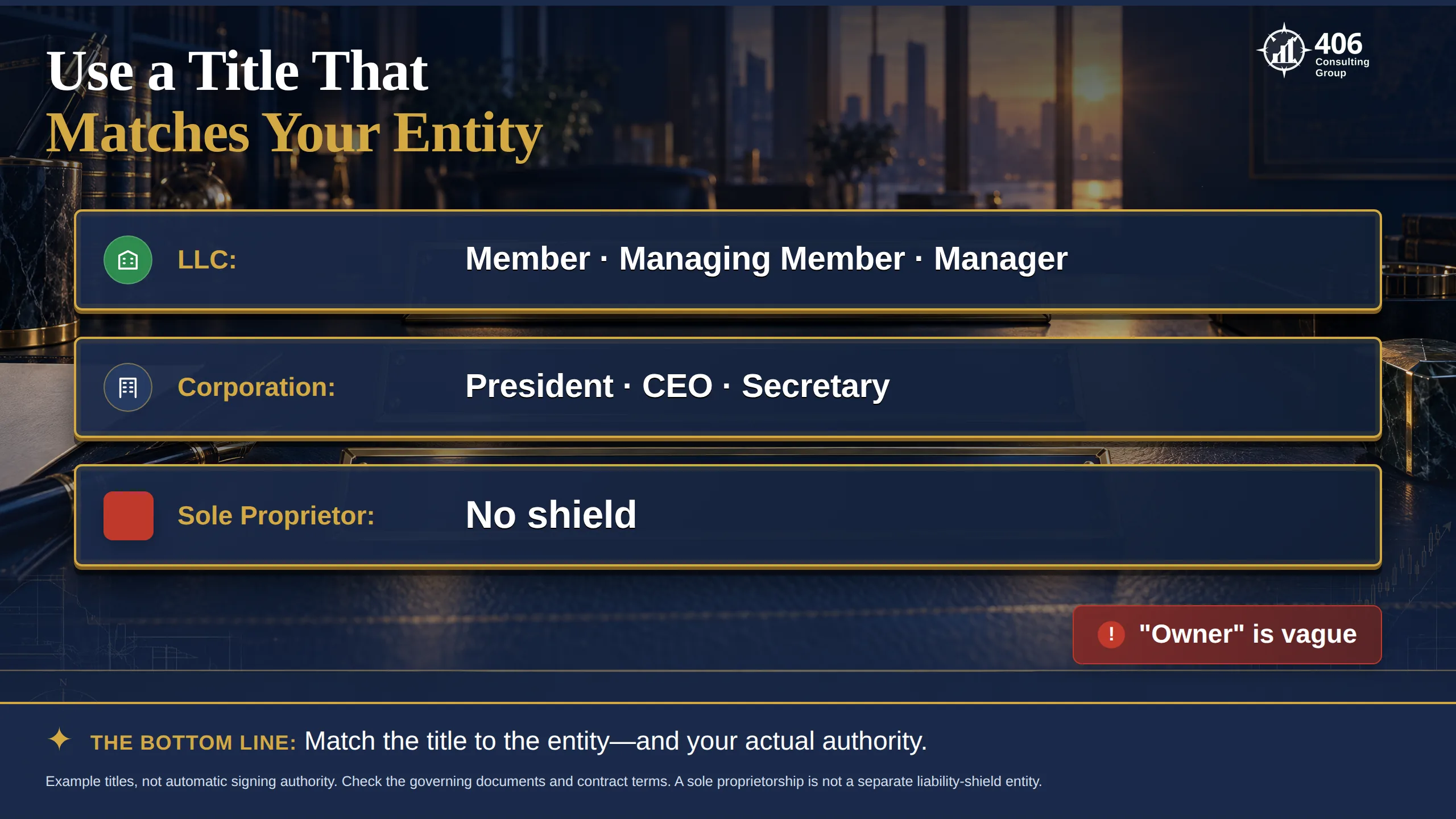
Your title should match how your company is actually set up. A title that doesn't exist in your entity, or one as vague as "Owner," gives the other side room to argue.
| Your entity | Common titles | Note |
|---|---|---|
| Member-managed LLC | Member, Managing Member | Your operating agreement may also create officer titles like President |
| Manager-managed LLC | Manager | Members who aren't managers usually can't bind the LLC |
| Corporation (incl. S-corp) | President, CEO, Secretary, Treasurer | Use the officer title your bylaws or board gave you |
| Sole proprietorship | None — you are the business | No shield to protect; consider whether an entity makes sense |
| General partnership | Partner | Partners are generally personally liable for partnership debts |
Not sure which structure fits? Our business entity guide walks through the options, and when to change your entity covers the signs it's time to move.
The Contract Body Matters as Much as the Signature
A perfect signature block can't save a contract whose first paragraph names the wrong party. Courts read the whole document, and in several states they've held owners personally liable even when the owner signed with a title — because the text of the agreement said the owner was a party.
The party line
The opening paragraph should name the company by its exact legal name, as registered with the state — "Joe's Plumbing, LLC," not "Joe Smith" and not "Joe's Pipes."
Trade names (DBAs)
If you operate under a different name, list both: "Joe's Plumbing, LLC, doing business as Joe's Pipes." A trade name alone doesn't tell anyone which legal entity is responsible.
Watch these words
"Individually," "jointly and severally," "and personally," or your name listed as a second party. Each one can make you a party in your own right.
Invoices and quotes too
Your estimates, invoices, and letterhead should carry the company's legal name. It builds a consistent record that customers and vendors deal with the company.

Personal Guarantees From the Lender's Side
Not every guarantee is a trap. For most small business loans, a personal guarantee is simply the price of admission — a lender wants to know the owner has skin in the game. The goal isn't to avoid every guarantee. It's to know exactly what you've signed and to negotiate the terms you can.
SBA loans
Usually not negotiable
SBA 7(a) loans generally require an unlimited personal guarantee from every owner of 20% or more. Plan for it rather than fight it.
Conventional bank loans
Often negotiable
With strong financials, you can often ask for a guarantee capped at a dollar amount or percentage, one that ends after a run of on-time payments, or one that's released when the loan is paid down.

Unlimited vs. limited
An unlimited guarantee covers the whole debt plus interest and collection costs. A limited guarantee is capped. Know which one you're signing.
Your spouse's signature
Under federal fair-lending rules, a lender generally can't require your spouse to guarantee your business loan if you qualify on your own. Joint ownership of collateral can change that, so ask why before a spouse signs.
Guarantees outlive your role
Sell the business or step away, and the guarantee usually stays with you until the lender releases it in writing. Make the release part of any sale or exit.
"Your leverage to negotiate a guarantee is your financials. Clean, current books are what let you ask for better terms — and get them."
That's exactly what our loan readiness work is for. See what lenders actually look for in what banks look at for a commercial loan and our lender-ready books checklist.
Signing Before the Company Exists
A common startup mistake: signing the lease, the equipment order, or the first big contract "for" an LLC that hasn't been filed yet. Under the general rule, the person who signs for a company that doesn't exist stays personally responsible — and often remains on the hook even after the company is formed, unless the other party formally releases them.
1
File the LLC or corporation with the state
2
Get the EIN and open a business bank account
3
Then sign, in the company's name
If you already signed something before formation, ask the other party to sign a short assignment or replacement agreement that moves the contract to the company and releases you.
What Quietly Erodes the Shield
Even with perfect signatures, a court can set the LLC aside — "pierce the veil" — if the company isn't really operated as separate from its owner. This is where bookkeeping and legal protection overlap, and where we see the most risk build up without anyone noticing.
Red flags
- Paying personal bills from the business account
- Business income deposited to a personal account
- No separate business bank account at all
- Owner draws with no record of what they were
- Running the company with almost no money in it
- Contracts, vehicles, or equipment in your personal name
Good habits
- Separate business bank and credit accounts
- Owner pay through payroll or documented distributions
- Monthly reconciled books that show a separate company
- Assets titled in the company's name
- Basic records: operating agreement, annual filings, key decisions
- Enough capital to cover the business's normal risks
Clean, separate books are one of the strongest pieces of evidence that your company is real. It's one of the quieter reasons we push every client toward monthly bookkeeping that keeps business and personal money apart.
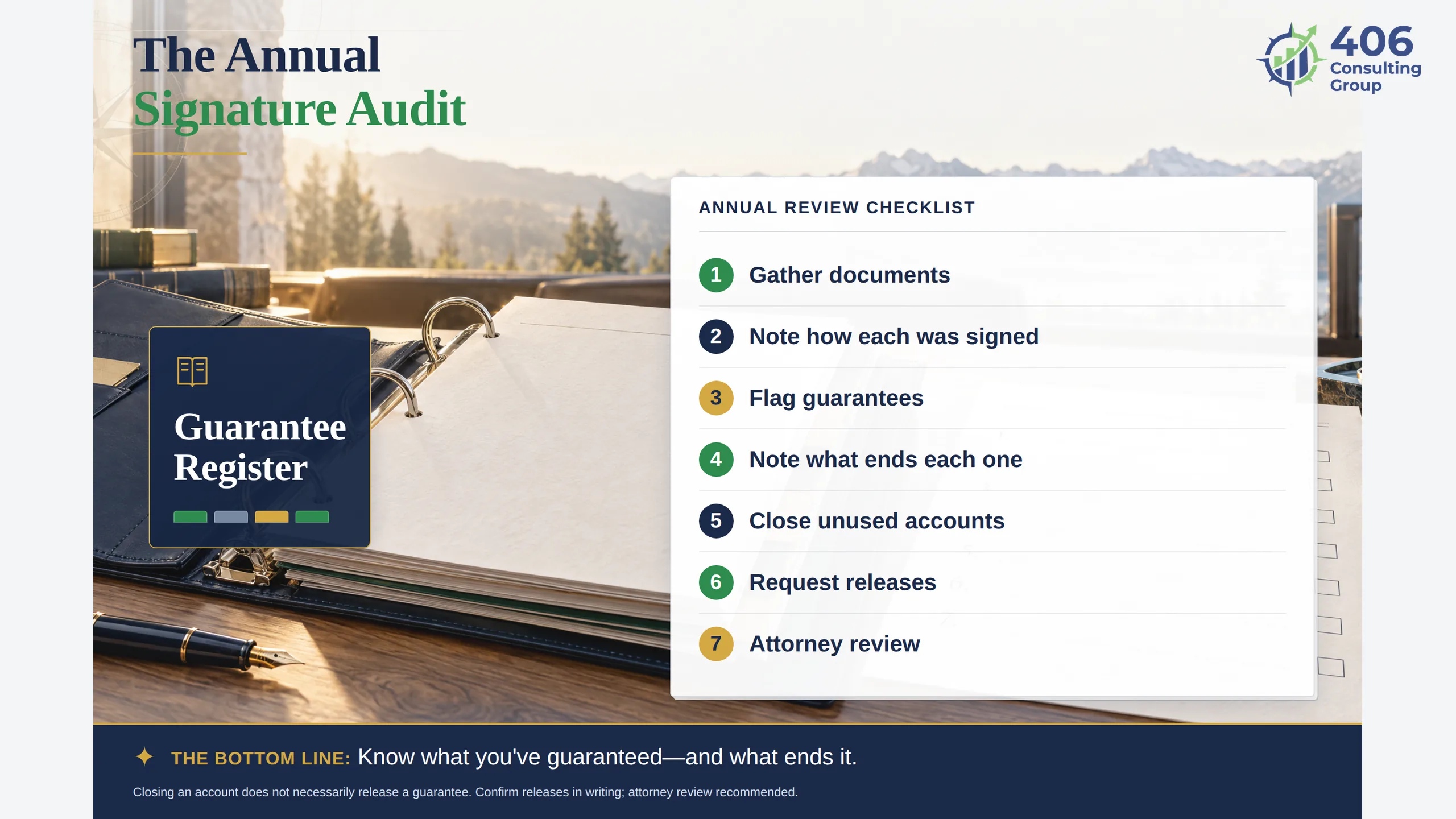
Do this once a year
9. The Signature Audit
Most owners can't say how many personal guarantees they've signed. An afternoon with the file cabinet fixes that. Build a simple list — a guarantee register — and keep it current.
- 1Gather every loan, line of credit, lease, credit application, and major contract.
- 2For each one, note who signed and how: company name, "By:", and title — or just a name.
- 3Mark every document with personal guarantee language, and whether it's unlimited or capped.
- 4Write down what ends each guarantee: payoff, a date, a performance target, or a written release.
- 5Close accounts you no longer use — and ask for the guarantee to be released in writing. Closing an account doesn't always end the guarantee.
- 6Ask for releases on guarantees that should have ended — especially after a refinance or paydown.
- 7Have your attorney review anything unclear, and fix your signature habits going forward.
A note on who to call.We're accountants and commercial loan analysts, not attorneys, and this isn't legal advice. Contract and guarantee rules vary by state. We help owners spot the exposure in their books and loan files and keep the records that support their protection — then we send them to a business attorney to review the contracts themselves.
FAQ: Signing for Your Business
How should I sign a contract for my LLC?
Write the LLC's exact legal name, then "By:" followed by your signature, your printed name, and your title, such as Member or Managing Member. That shows you are signing on behalf of the company in a representative capacity rather than for yourself.
Can I be personally liable if I sign a contract with my title?
Yes, in some cases. If the contract names you as a party, says you sign individually, or includes personal guarantee language, courts in several states have held owners personally liable even when they signed with a title. The text of the agreement matters as much as the signature block.
Is "Owner" an acceptable title when signing for an LLC?
It's better than nothing, but it's vague. Use a title that matches your entity and your operating agreement, such as Member, Managing Member, or Manager for an LLC, or President for a corporation. A precise title makes your representative capacity clearer.
What is a personal guarantee?
A personal guarantee is your promise to pay a business debt yourself if the business doesn't. It lets the creditor pursue your personal assets. Guarantees are common on loans, leases, and credit applications, and can be unlimited or capped at a set amount.
Do SBA loans require a personal guarantee?
Generally yes. SBA 7(a) loans typically require an unlimited personal guarantee from every owner of 20% or more of the business. Conventional bank loans also usually require guarantees, but the terms are more often negotiable.
Can a lender require my spouse to sign a personal guarantee?
Generally, under federal fair-lending rules, a lender can't require your spouse's guarantee if you qualify for the loan on your own. Jointly owned collateral or state property laws can change that, so ask the lender to explain why before your spouse signs anything.
Does a personal guarantee end when I sell my business?
Usually not automatically. A guarantee typically stays in place until the debt is paid or the lender releases you in writing. Make a written release of your guarantees part of any sale, refinance, or exit from the business.
Keep Reading
Protect What You've Built
Know What You've Signed — Before a Lender or Creditor Reminds You.
We'll help you inventory your loans, leases, and guarantees, keep books that show a truly separate company, and walk into your next loan with the financials to negotiate better terms.
The Signature Block
Copy this format
[COMPANY LEGAL NAME, LLC]
By: ______________
Name: [Your Name]
Title: [Member / Manager]
Heading to the Bank?
Better financials mean better guarantee terms.
About the Author
Carrie Anderson
Co-Founder, 406 Consulting Group
Carrie is a former corporate controller and the contracted commercial loan analyst a Montana community bank relies on. She has spread, packaged, and recommended 300+ commercial loans — so she reads guarantees and loan documents from the lender's side of the table.
Read the Full Story