
The Hidden Cost of Scaling a Construction Company.
You Pay for Every Step Before the Revenue Shows Up.
Revenue grows like a ramp. Costs grow in steps. What breaks at $2M, $5M, $10M, and $20M, what margin fade and working capital really cost, and why the goal is to become the least valuable person in your company.

It's December. You just closed the best year in your company's history — more jobs, more crews, the biggest backlog you've ever had. Your banker even called to congratulate you.
Then you open the bank statement. There's less cash than there was last December, when you did half the work. The line of credit is nearly maxed. And you're working more hours than you did when it was you and two guys in a truck.
Nobody lied to you about growth. They just didn't tell you that you pay for every step of it before the revenue shows up.
I spent a decade in operations and accounting at BP, and these days I spend a lot of my time inside contractors' books. The pattern is the same almost every time: the work isn't the problem. The hidden costs of getting bigger are — and they hit in a predictable order. If you know the order, you can pay those costs on purpose instead of by surprise.

By Jason Anderson
Co-Founder, 406 Consulting Group
Degreed accountant with 10+ years in tax and a decade of enterprise operations and accounting at BP — with a Six Sigma discipline for systems and job costing.
Quick Answer: What Are the Hidden Costs of Scaling a Construction Company?
When a construction company grows, revenue rises gradually but costs rise in steps — and you pay each step before the new revenue arrives. The four biggest hidden costs:
- →Overhead steps: your first project managers, an estimator, an office lead, software, a yard — all paid before they pay for themselves.
- →Margin fade: when the owner stops touching every job, gross margin quietly slips a few points. On $9 million, 3 points is $270,000 a year.
- →Working capital: receivables and retainage grow with revenue, so growth ties up cash you have to finance.
- →Owner dependence: if every decision runs through you, growth stops at your hours — and the company is worth less.
Table of Contents
Revenue Comes as a Ramp. Costs Come as Steps.
Revenue grows a job at a time — a little more each month if things go well. Costs don't work that way. You can't hire 40% of a project manager. You can't lease half a yard. The day you add one, your overhead jumps by the whole thing — and it sits there, fully paid, while the revenue slowly climbs up to meet it.
The ramp
Revenue: a few more jobs each month, if the estimates hold and the crews keep up.
The steps
Costs: a whole PM, a whole estimator, a whole truck, a whole yard — the day you add them.
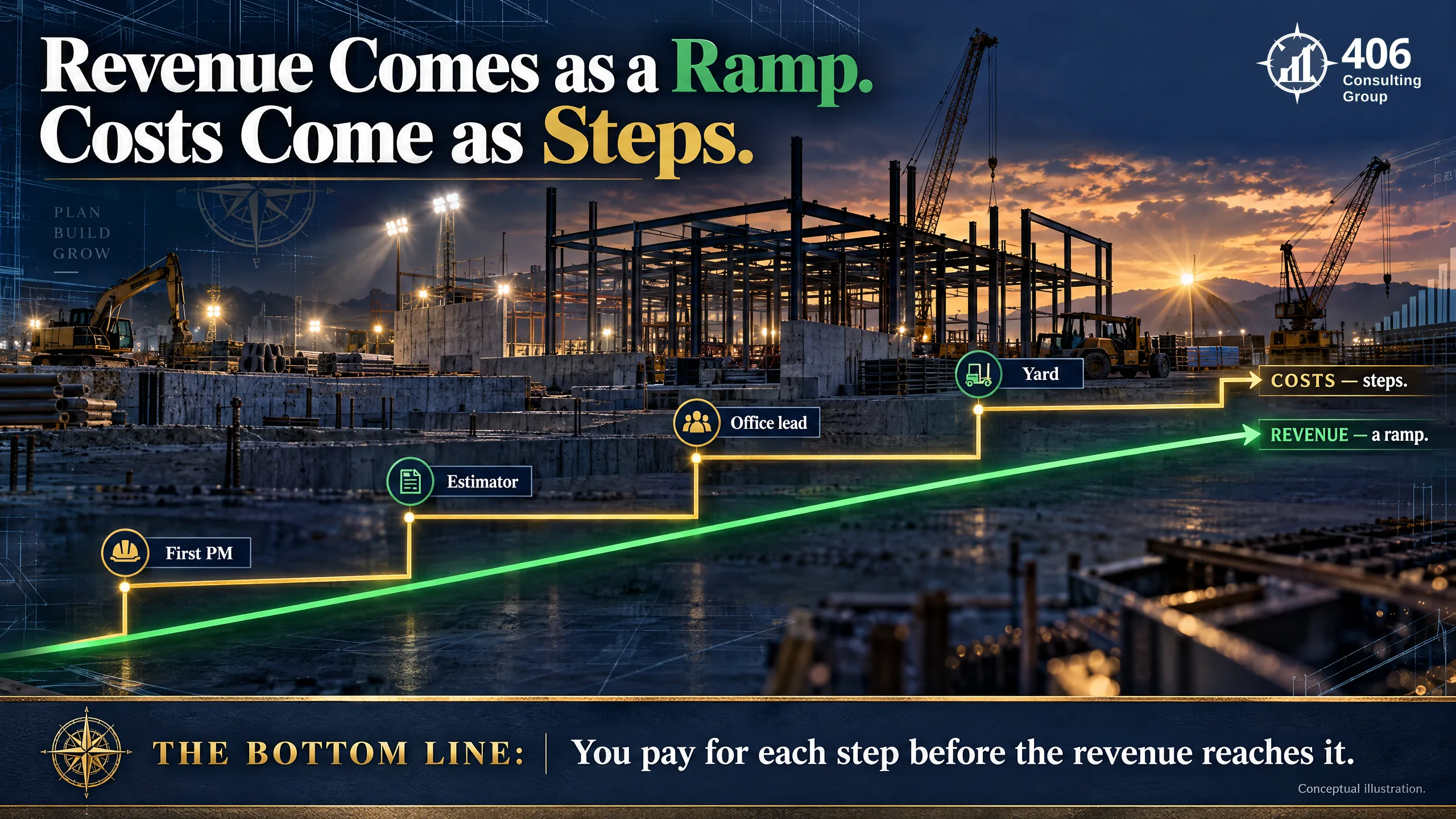
That gap between the step and the ramp is where growing contractors get squeezed. It's also why revenue alone tells you almost nothing about whether you're actually growing. We cover that bigger idea in Is Your Business Growing — or Just Getting Bigger? This article is the construction version: which steps, at what size, and in what order.
The Staircase: What Breaks at Each Size
Every contractor hits these at a slightly different size, but the order is remarkably consistent. The trick is to build what the next step needs before you get there.
| Roughly | What breaks | The hidden cost | Build this first |
|---|---|---|---|
| Up to ~$2M | The owner's hours. You sell, estimate, run jobs, and do the books at night. | Jobs underbid when you're tired; nobody knows which jobs made money. | Job costing on every job and real bookkeeping — not a shoebox. |
| ~$2M–$5M | Visibility. A foreman or first PM runs jobs you no longer see every day. | Margin fade and change orders that never get billed. | A written change-order process and a weekly job report. |
| ~$5M–$10M | Billing and cash. Bigger contracts, retainage, slower pay, more bonding. | Working capital eats the line of credit; sureties start asking for CPA-reviewed statements. | A monthly WIP schedule, a billing and approval workflow, and a 13-week cash forecast. |
| ~$10M–$20M | Decisions. Every approval still waits on the owner's phone. | Overhead creep and key-person risk — the company stalls when you're out. | A management layer with real authority, budgets by division, and CFO-level planning. |
| $20M+ | Whether the company can run without you. | A business a buyer — or your bank — sees as one person's job. | A second layer of leadership and numbers that run on a calendar, not on you. |
Revenue ranges are rough guides — a self-performing concrete company and a GC that subs everything hit these steps at very different sizes.
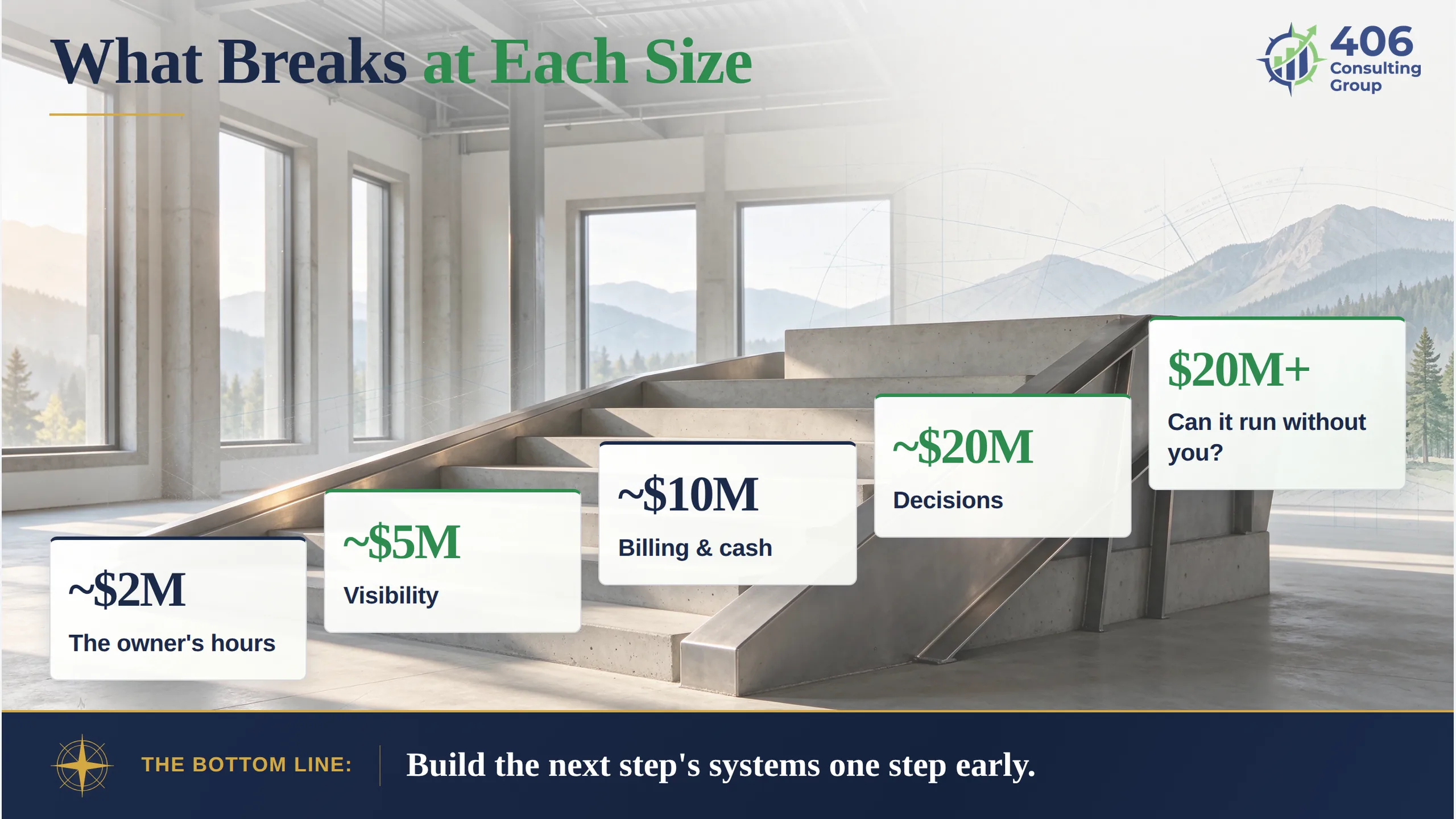
Notice the right-hand column is almost entirely systems and numbers — not more crews, not more equipment. The companies that climb this staircase well aren't the ones that win the most work. They're the ones that build the next step's systems one step early. We've watched it happen: a contractor we worked with grew from single-digit millions to about $40 million, and the billing and approval workflow we built is a big reason the cash kept up with the work. Carrie tells that story in full in From 5 Projects to 20+.
Margin Fade: The Cost Nobody Books
Overhead shows up on the P&L where you can see it. Margin fade doesn't. Nobody writes a check for it — it just leaks out of every job a little at a time, once the owner stops personally touching each one.
Estimates get thinner
One estimator pricing twice the bids spends half the time on each — and misses things.
PMs get stretched
A PM running six jobs instead of three catches problems a week later, after the rework.
Change orders slip
Extra work gets done on a verbal OK in the field and never makes it to an invoice.
Nobody owns the job's profit
The crew owns the schedule. The office owns the billing. Nobody owns the margin.
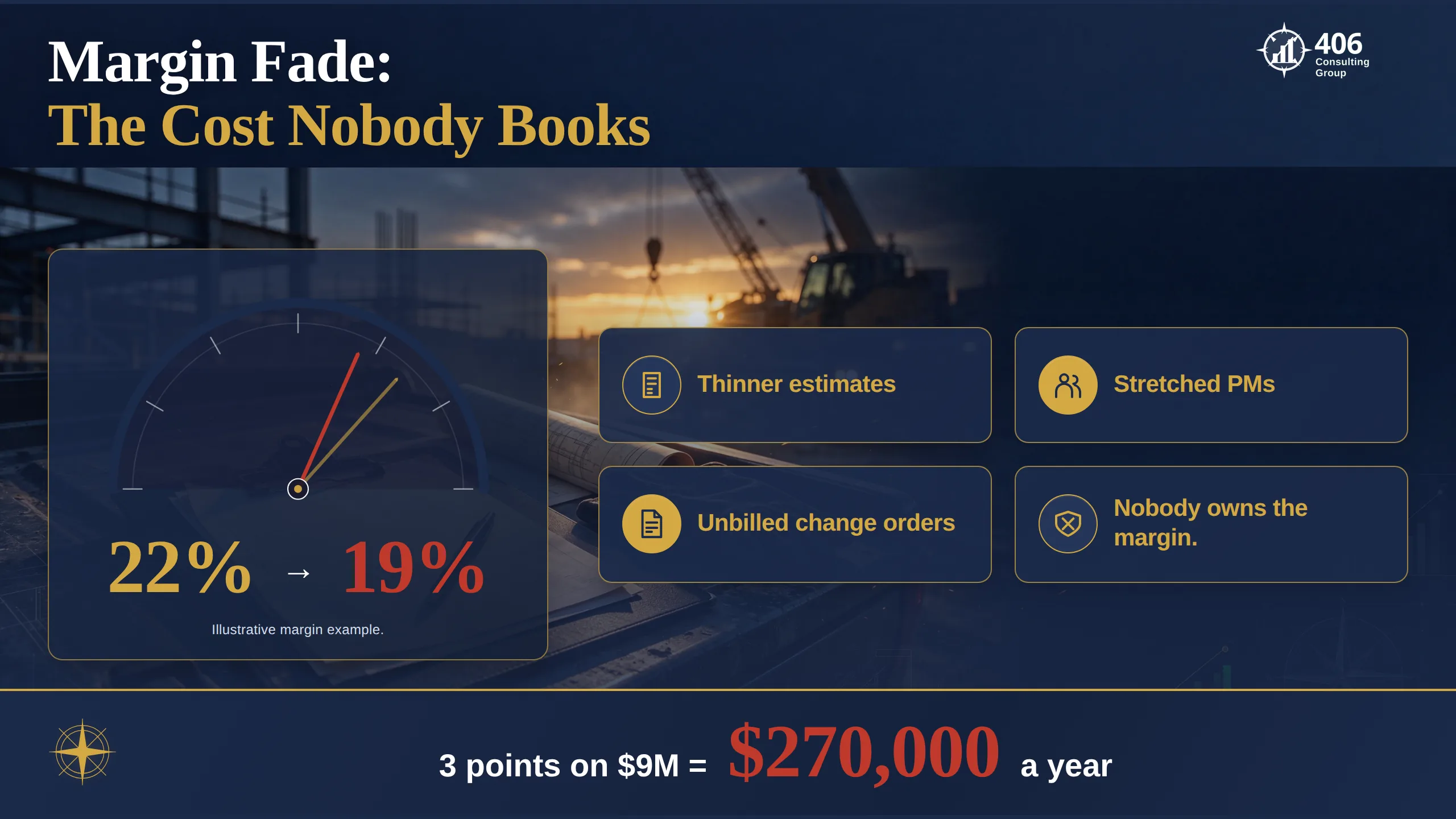
Three points of gross margin on $9 million is $270,000 a year.That's two project managers' salaries, gone — and it never shows up as a line item. It just shows up as “where did the money go?”
You catch margin fade the same way you catch anything else: by watching gross margin job by job, every month, on a WIP schedule. It's one of the 7 numbers every contractor should watch monthly for exactly this reason.
Swan Range Construction: $4M to $9M
Swan Range Construction is a made-up Flathead Valley contractor, but the math is the kind we walk through with owners all the time. Over three years they grow from $4 million to $9 million. Here's what it took:
| $4M year | $9M year | |
|---|---|---|
| Revenue | $4,000,000 | $9,000,000 |
| Gross margin | 22% | 19% |
| Gross profit | $880,000 | $1,710,000 |
| Overhead | $560,000 | $1,185,000 |
| Net profit | $320,000 (8.0%) | $525,000 (5.8%) |
| Cash tied up in receivables + retainage | ~$693,000 | ~$1,560,000 |
Where the extra $625,000 of overhead came from
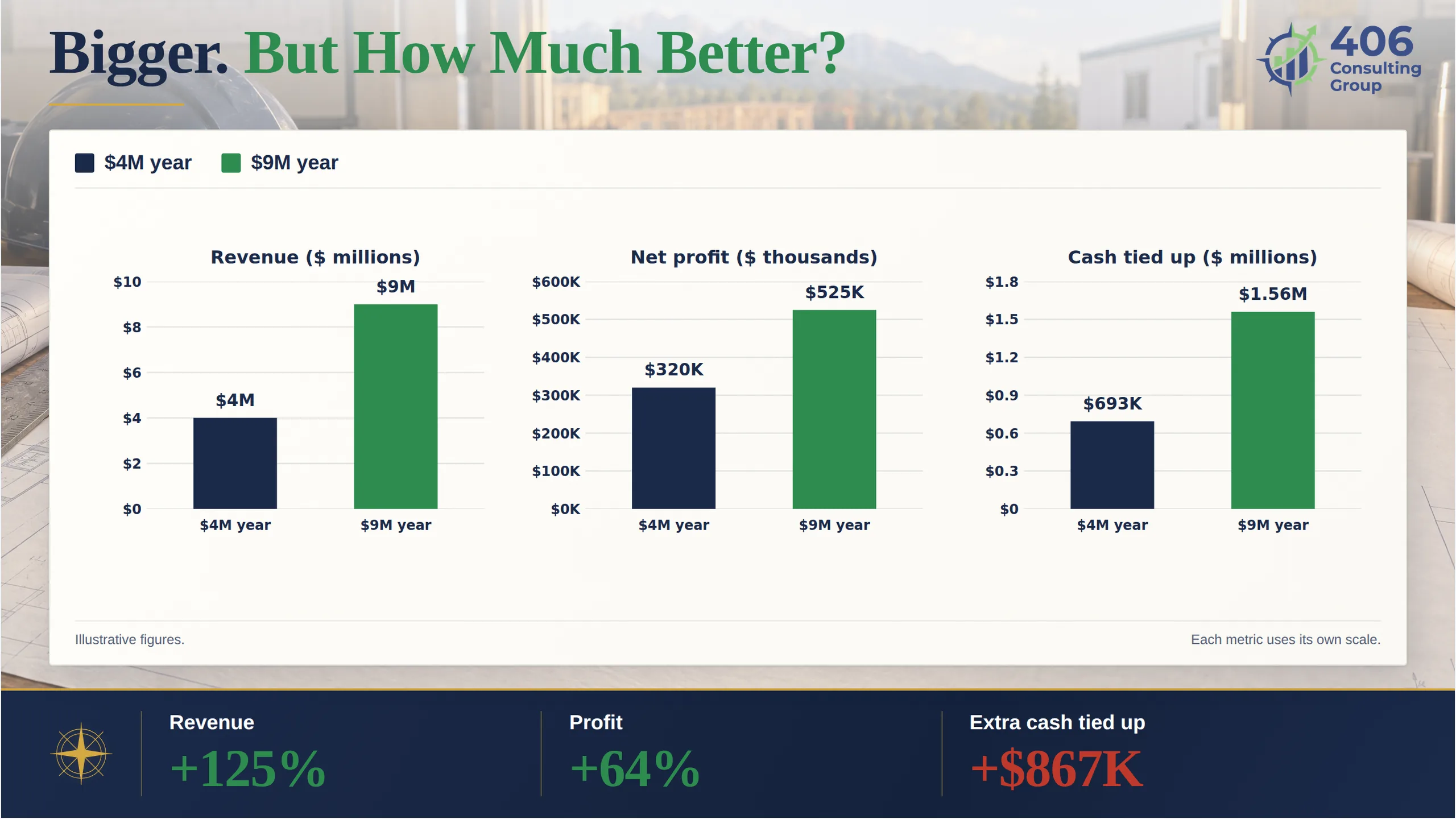
+125%
Revenue growth
+64%
Profit growth
+$867K
Extra cash tied up
Swan Range did grow — profit is up $205,000. But look at what it cost. Margin fade alone took $270,000: at their old 22%, the $9 million year would have made $795,000. And the cash tied up in receivables (about 45 days) and retainage (about 5% of a year's billing) went up by roughly $867,000 — more than a year and a half of the new, bigger profit, sitting in other people's bank accounts.
That's the hidden cost of scaling in one picture. Not a failure — a company that grew and is still short on cash, working harder, and carrying more risk than it did at $4 million. Every one of those costs was predictable. Most of them were avoidable.
The goal most owners have backwards
5. Become the Least Valuable Person in Your Company
Here's the idea I push on every owner who wants to grow: your goal is to become the least valuable person in your company. Not the least important — the least neededon a Tuesday. If the estimates, the customer relationships, the approvals, and the problem-solving all live in your head, you don't own a construction company. You own a very demanding job.
You're probably too valuable if…
- Only you can price a bid with any confidence
- Your best customers only call your cell
- Change orders and purchases wait until you answer your phone
- The bank relationship, the bonding relationship, and the key subs all run through you
- A two-week vacation means work stops — or you work the whole time
This matters for growth, because a company can't get bigger than the owner's calendar. And it matters even more for what the company is worth. A buyer — or a bank — looks at an owner-dependent contractor and sees risk: if you leave, the customers, the estimates, and the know-how may leave with you. So they pay less, or they want you tied to the business for years after the sale.
Illustrative only:say a buyer would pay 3 times profit for a contractor that depends on its owner, and 4 times profit for one that runs without them. On Swan Range's $525,000, that one difference is worth $525,000 to the owner — about what the company earns in a full year. Real multiples vary widely by trade, size, and market, but the direction never changes: the less the company needs you, the more it's worth.

How to start making yourself less valuable
Write down every decision you made last week
Most owners find a handful of decisions that come up over and over. Those are the first to hand off.
Turn the repeat decisions into rules
For example: a PM can approve change orders under $5,000 if they're signed before the work starts. A rule beats a phone call.
Put your estimating brain on paper
Your unit costs, your production rates, your markups — in a template someone else can use and you can check.
Introduce your customers to your PMs
On purpose, early, on the good jobs. The relationship should belong to the company, not to your cell number.
The people side of this is its own article — see You Can't Scale a Business on People Who Stopped Growing and Good Businesses Run on Processes, Not Heroes. To see what owner independence could do to your number, try our business valuation tool.
The Systems Tax: Field to Invoice
Somewhere between $3 million and $8 million, QuickBooks and a pile of spreadsheets stop keeping up. Not because the software is bad — because the processaround it was built for a company half your size. Here's what a change order looks like in a lot of growing contractors:
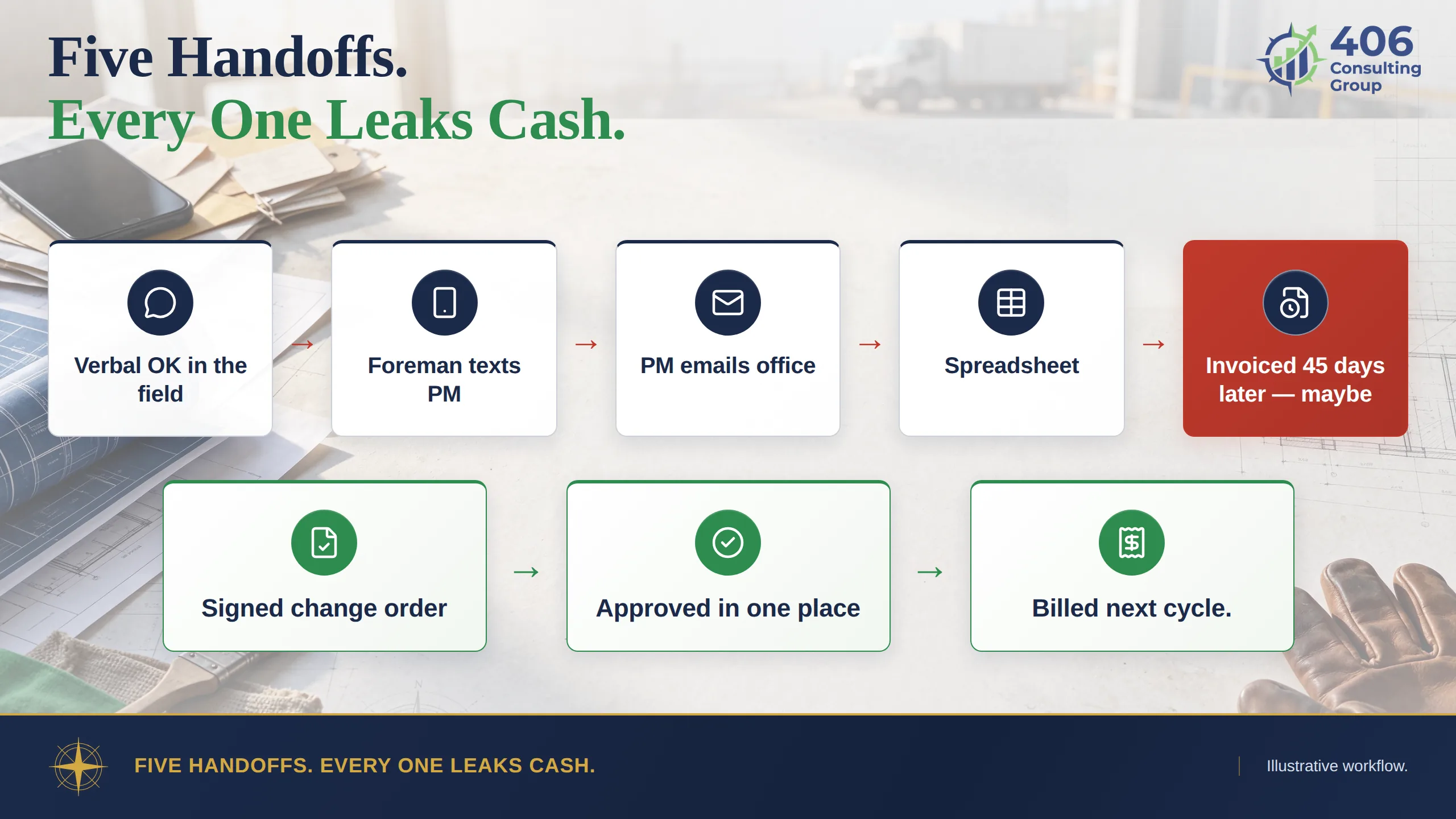
Five handoffs. Every one is a chance for the paperwork to die in someone's truck. This is where my process background comes in. You don't need a Six Sigma black belt to fix it — you need to do what Six Sigma does, in plain English:
Map it
Draw every step from the work being done to the invoice going out. Count the handoffs.
Measure one thing
Days from work done to invoice sent. Just that number, every month.
Cut the handoffs
Signed change order before the work, approved in one place, billed on the next cycle.
Don't boil the ocean. Pick the one flow that leaks the most cash — for most contractors, it's billing and change orders — and fix that first. That's exactly the kind of billing and approval workflow behind the $40 million growth story above. If billing is your bottleneck today, start with the construction invoicing scramble.
Growth You Have to Finance
Swan Range's extra $867,000 of tied-up cash had to come from somewhere: profit, the owner's savings, or the bank. For most contractors, it's the line of credit — which is why the line maxes out right in the middle of the best growth year they've ever had.
My co-founder Carrie works in commercial lending as a contracted loan analyst and has worked on more than 300 loans. Her point is simple: the bank usually sees the trouble before the owner does, because the bank is reading the WIP schedule and the receivables aging, not the backlog.
Underbillings growing
Work done but not yet billed — cash you've spent and can't collect yet.
Overbillings already spent
Cash collected ahead of the work, used to cover other jobs. It has to be earned back.
Receivables aging past 60 days
Often excluded from what you can borrow against — retainage usually is too.
A line that never comes back to zero
A sign the line is funding growth, not just smoothing timing.
Plan growth the way the bank will look at it: forecast the cash, not just the revenue, and line up financing before you need it. We walk a single big job month by month in Can You Afford a $3 Million Subcontract?, and the full fix-it sequence in the contractor turnaround playbook. If you'll need the bank for your next step, our loan readiness work gets your numbers ready before you ask.
Scale and Hope vs. Pay the Steps in Order
Two contractors, same size, same market, same chance at more work. Here's how each one plays it:
Scale and hope
- Hires for the headlines
- Finds out job margins at tax time
- Calls the bank when the line is already full
- Approves everything personally
- Ends up bigger, tired, and short on cash
Pay the steps in order
- Hires for signed work
- Sees margin by job every month
- Forecasts cash 13 weeks out and talks to the bank early
- Hands off decisions with clear rules
- Ends up bigger, more profitable, and worth more
This is a live question in the Flathead right now. Territory 1889 near Lakeside has contractors thinking about adding crews — but Flathead County approved only its Phase I final plat (79 lots) on October 29, 2026, and each later phase needs its own approval. The contractors who come out ahead will be the ones who staff up for signed work and build their systems first. Our Territory 1889 guide for contractors covers the project itself.
Your Next 90 Days, by Size
You don't have to build the whole staircase at once. Find your size and build the next step:
Under $2M
- Job costing on every job — labor, materials, subs, equipment
- Monthly books closed by the 15th
- Know your real overhead rate
$2M–$5M
- A signed change-order process, no exceptions
- A weekly one-page job report from every PM
- Gross margin by job, reviewed monthly
$5M–$10M
- A monthly WIP schedule
- A 13-week cash forecast
- A billing and approval workflow with one place to approve
$10M+
- Budgets by division or crew
- Written approval limits for your managers
- A plan for what the company looks like without you in it
Not sure where you fall? Our free financial maturity assessment takes about two minutes and shows you the weakest link to fix first. Thinking about your next hire? Run it through the hiring scenario calculator and the overhead rate calculator before you sign the offer letter.
How We Help Contractors Scale
We've operated businesses, not just booked them. My decade at BP was operations and accounting — the part of the business where the process either works or it doesn't. Carrie brings the controller's seat and the lender's seat. Together we build the steps of the staircase before you need them, and we're based in Columbia Falls, so the Flathead is our home market too.
What we set up for a growing contractor
What working with us looks like
Introductions & access
We meet your team and key people and get access to the systems your numbers live in.
First 30–60 days
We set your priorities for the next 30 and 60 days — for most growing contractors, that's job costing, WIP, and billing first — with a clear timeline of deliverables.
Beyond 60 days
We move into the steady monthly rhythm — WIP, cash forecasting, and reporting — while building toward the long-term goals we mapped together, including a company that runs without you.
See how we work with general contractors and specialty trades, or the level of support that fits your step: controller services or a fractional CFO. Local? Start with accounting in the Flathead Valley.
FAQ: Scaling a Construction Company
What are the hidden costs of scaling a construction company?
The biggest are step increases in overhead (project managers, estimators, office staff, software, and a yard, all paid before they pay for themselves), margin fade as the owner stops touching every job, more cash tied up in receivables and retainage, and owner dependence that caps growth and lowers the company's value. Revenue grows gradually, but these costs arrive in steps.
Why does profit margin drop when a construction company grows?
Usually because of margin fade. Estimators price more bids with less time each, project managers run more jobs at once, change orders get done on a verbal OK and never billed, and nobody owns each job's profit. A few points of gross margin on a larger revenue base adds up fast: three points on $9 million is $270,000 a year.
How much cash does a growing contractor need?
More than most owners expect, because receivables and retainage grow with revenue. In our illustrative example, a contractor growing from $4 million to $9 million with about 45 days of receivables and about 5% retainage ties up roughly $867,000 more cash — more than a year and a half of its new profit. Forecast cash, not just revenue, and line up financing before you need it.
When should a construction company hire a controller or CFO?
Often somewhere between $5 million and $10 million, when bigger contracts, retainage, bonding, and a monthly WIP schedule make billing and cash the bottleneck. CFO-level planning usually matters most from about $10 million up, when the company needs budgets by division and a management team that can make decisions without the owner. Every company is different, so build the next step a little before you reach it.
What does it mean to become the least valuable person in your company?
It means building a business that doesn't need the owner to function day to day. Estimating, customer relationships, approvals, and problem-solving live in systems and in a team, not in the owner's head. That lets the company grow past the owner's calendar, and it makes the company worth more, because buyers and lenders see less risk in a business that doesn't depend on one person.
What financial statements do sureties want as a contractor grows?
As bonding needs grow, sureties typically move from compiled financial statements to CPA-reviewed or audited statements, often along with a WIP schedule. Requirements vary by surety and bonding program, so it's worth asking your agent what your next bonding level will require and preparing a year ahead.
Should Flathead Valley contractors staff up for Territory 1889?
Only for signed work. Flathead County approved Territory 1889's Phase I final plat (79 lots) on October 29, 2026, and each remaining phase needs its own approval. The contractors who come out ahead will build their job costing, billing, and cash-forecasting systems first and add crews as contracts are signed, not as headlines appear.
Keep Reading
You'll Pay for Every Step Either Way
Pay for Them on Purpose.
We'll show you which step you're on, what the next one costs, and the systems to build before you get there — so your company gets better as it gets bigger, and worth more because it doesn't need you.
Swan Range: $4M → $9M
The hidden cost, by the numbers
Growing a Construction Company?
Build the next step before you need it.
About the Author
Jason Anderson
Co-Founder, 406 Consulting Group
Jason is a degreed accountant with 10+ years in tax and a decade of operations and accounting at BP. He builds the job costing, billing, and approval systems that let contractors grow without the cash — or the owner — falling behind.
Read the Full Story