
Territory 1889 Won't Just Need Homebuilders.
Here's Who Gets the Work — and Who Keeps It.
The house gets built once. It gets serviced forever. Which Flathead Valley trades and service businesses benefit from Territory 1889 near Lakeside, how to price premium service, and how recurring agreements beat Montana's winter cash hole.

It's a Tuesday in January. A homeowner in Scottsdale gets an alert on her phone: the furnace at the lake house is down, and it's eight below in Lakeside. Nobody has been inside since September. Her pipes are on a clock.
She doesn't call the company that framed the house. She doesn't call the developer. She calls the one local outfit she trusts to pick up, show up within the hour, and text her a photo of the thermostat when it's fixed. Whoever that is just became the most valuable vendor she has — and she'll pay them every month for the next twenty years.
The house gets built once. It gets serviced forever.
When people talk about Territory 1889 — Discovery Land's private community going in on the west shore of Flathead Lake near Lakeside — they talk about the construction. That's real, and we cover it in our Territory 1889 guide for contractors. But the bigger, longer opportunity belongs to the trades and service businesses that keep those homes running for decades after the builders leave. Most of them are already in the valley. Most of them will underprice it.

By Jason Anderson
Co-Founder, 406 Consulting Group
Degreed accountant with 10+ years in tax and a decade of enterprise operations and accounting at BP — with a Six Sigma discipline for systems and job costing.
Quick Answer: Which Businesses Will Benefit From Territory 1889?
Far more than homebuilders. Excavation, concrete, framing and finish trades, electricians, plumbers, HVAC, landscapers, snow removal, caretakers, cleaners, and property managers all have a role — first in the build, then in years of recurring service.
- →The build is a sprint. It comes in phase-sized waves — each phase needs its own county approval — and then it ends.
- →The service work is the business. Absentee owners of high-end homes pay for fast response, one phone call, and proof the job was done.
- →Recurring service agreements smooth Montana's seasonal cash swings and make your company worth more if you ever sell.
- →Price it right: know your true cost per crew-hour — drive time included — before you quote a luxury-response standard at regular rates.
Table of Contents
Two Economies: The Build and the Keep
Every contractor in the Flathead already knows a big development means work. The question that actually matters is which kind of work — because a community like this creates two very different economies, and they reward very different businesses.
The Build
- • Big contracts, big cash needs
- • Comes in waves, one approved phase at a time
- • Bid against everyone, including outside firms
- • Ends when the last lot is finished
The Keep
- • Smaller tickets, paid every month
- • Steady year-round, and it grows with every finished home
- • Won on trust and response time
- • Lasts as long as the houses stand

The build gets the headlines. The keep builds the better company. And the two aren't either/or — the trades that do well here use the build to earn the relationship, then turn it into a service contract.
Who Gets the Work, Trade by Trade
Here's how the opportunity looks for the trades in Lakeside, Somers, Bigfork, Polson, and Kalispell — the build-phase work, the recurring work that follows, and the money trap to watch for.
| Trade | During the build | After the build | The money trap |
|---|---|---|---|
| Excavation & site work | Roads, utilities, foundations, drainage | Repairs, drainage fixes, add-on projects | Equipment payments that don't stop when the phase pauses |
| Concrete | Foundations, flatwork, retaining walls | Patios, repairs, additions | Retainage and slow pay on large subcontracts |
| Framing & finish carpentry | Custom homes, clubhouse-scale work | Remodels and additions as owners change | Change orders done on a verbal OK |
| Electrical, low-voltage & security | Wiring, generators, smart-home, cameras | Service calls, system monitoring, upgrades | Pricing service calls like new-construction labor |
| Plumbing & HVAC | Radiant heat, boilers, fixtures | Maintenance agreements, winter emergencies | No service agreements — all calls are one-offs |
| Landscaping & irrigation | Installs, hardscape, native plantings | Weekly care, irrigation start-up and blow-outs | A summer-only business with winter overhead |
| Snow removal | Keeping roads and job sites open | Driveways and access all winter | Pricing per push when it barely snows |
| Caretaking & home watch | — | Weekly checks, opening and closing homes | Unbilled drive time and "quick favors" |
| Cleaning & property management | Construction clean-up | Turnovers, guest prep, vendor coordination | Taking every request at a flat monthly fee |
| Dock & marine | If and when the marina clears permitting | Seasonal dock and boat-lift service | Building capacity before the permit exists |
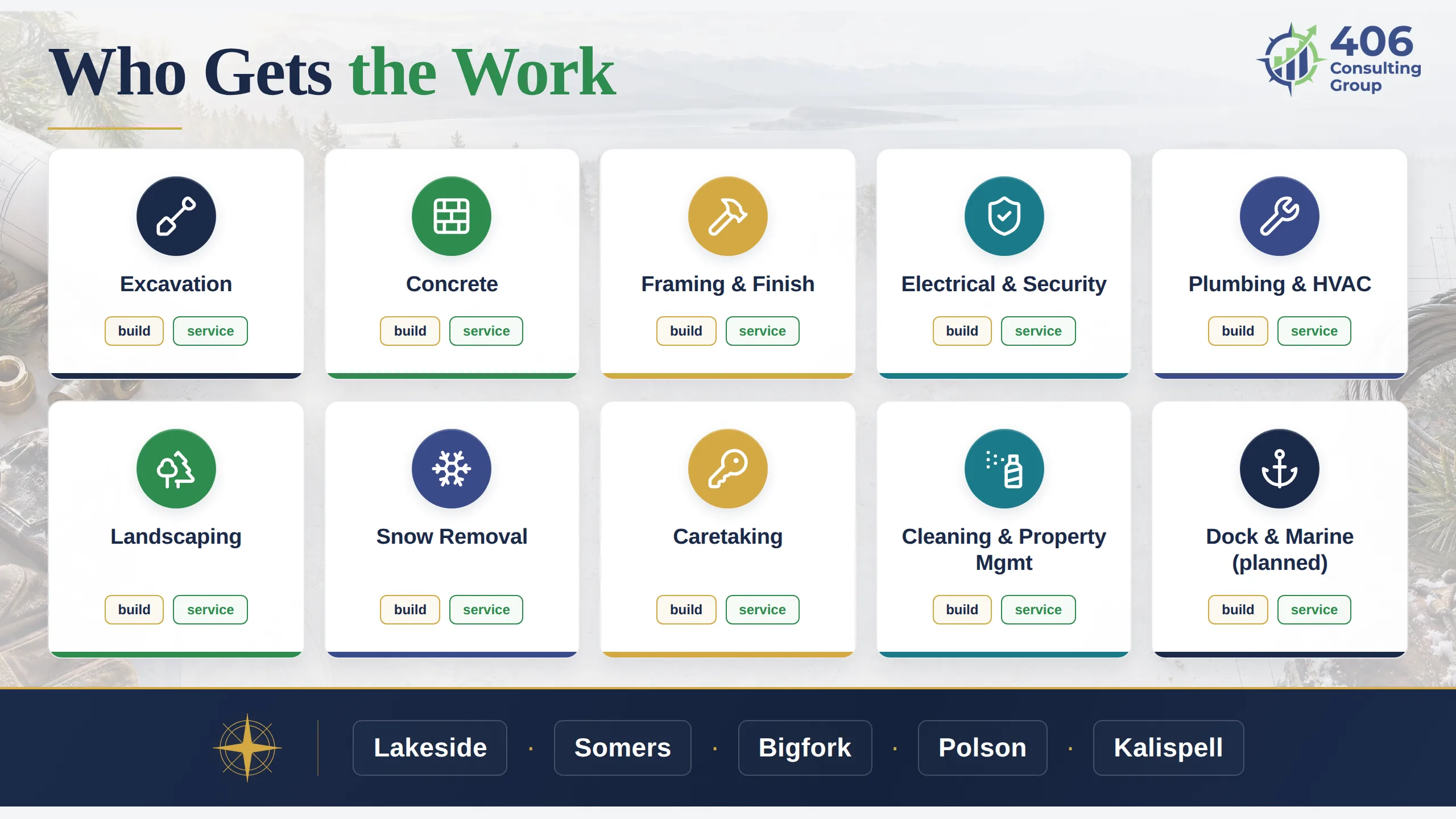
Notice the pattern in that last column. Almost none of the traps are about the work. They're about pricing, timing, and cash — which is exactly where a growing trade business gets hurt.
What Absentee Owners Actually Pay For
The owner of a high-end second home isn't shopping for the cheapest snowplow. They live somewhere else most of the year. What they're buying is not having to worry about the house. That comes down to three things:
One call
One number that handles it — or coordinates whoever does.
Fast response
Somebody on site within hours, not "we'll get you on the schedule."
Proof
A photo, a short report, an invoice that shows exactly what was done.
Here's the trap: a lot of good local trades deliver that standard and charge their regular rate for it. Being on call costs money. Dropping a scheduled job to cover an emergency costs money. Driving out for a 20-minute check costs money. If your price doesn't include those costs, the premium client is quietly paid for by your other customers — and by you.
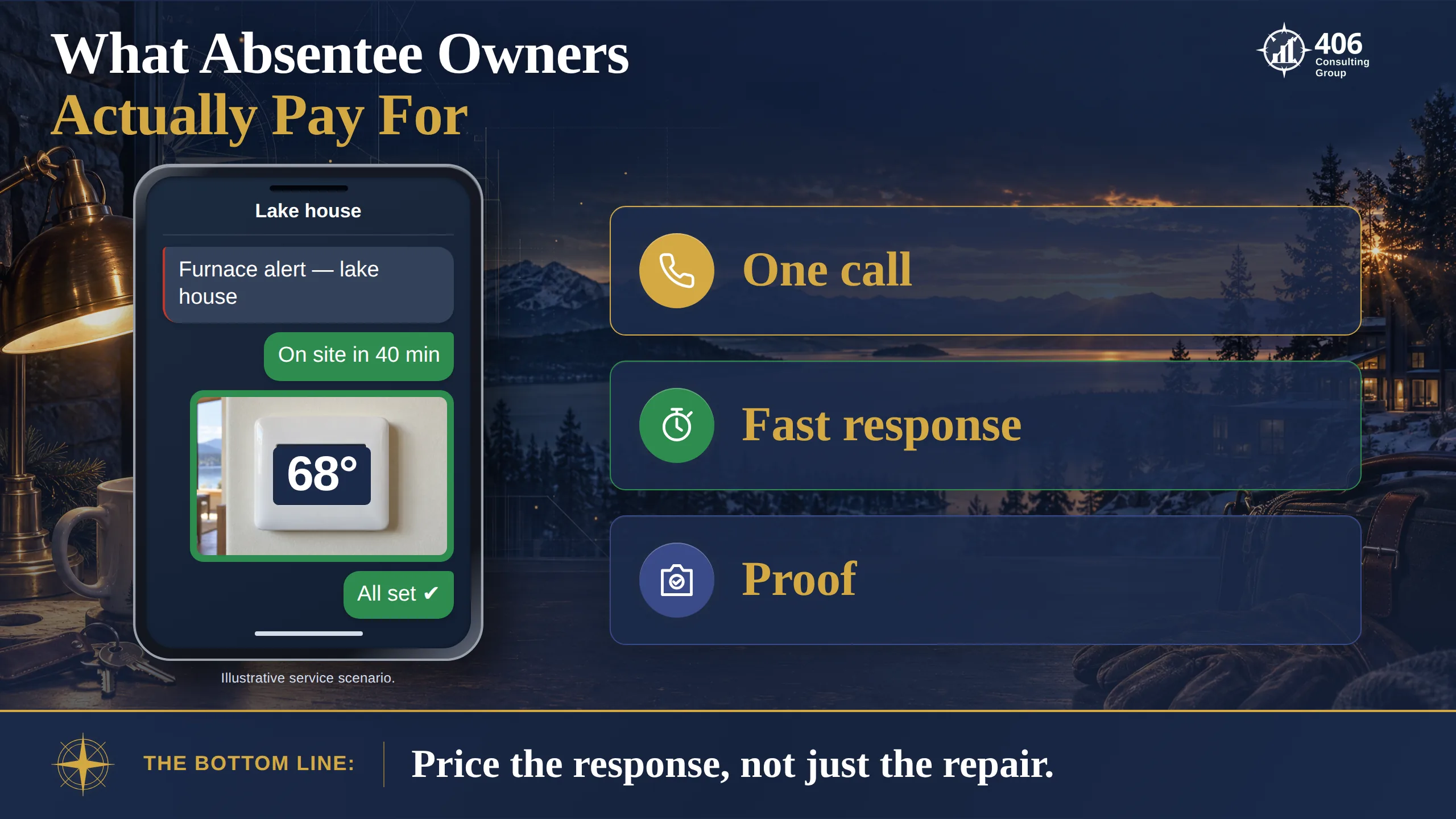
Charging Kalispell rates for a Territory 1889 response standard isn't a favor to the client. It's a donation. Price the response, not just the repair: an after-hours fee, a response-time guarantee built into a monthly retainer, and a trip charge that covers the drive.
Why Recurring Revenue Is Worth More
Two landscaping companies each bring in $1.1 million a year. One starts every January with an empty calendar. The other starts January with 25 homes on annual care agreements. Same revenue. Very different businesses.
You can plan
You know your base revenue before the season starts, so you can hire, buy equipment, and borrow with confidence.
The bank likes it
Contracted revenue is easier for a lender to underwrite than a pipeline of hoped-for jobs.
It smooths the seasons
Monthly billing on annual agreements keeps cash coming in when the grass stops growing.
It's worth more when you sell
Buyers pay more for revenue that shows up on its own than for revenue that depends on the owner hustling.
Common service agreements in a lake community: spring opening and fall closing, irrigation start-up and blow-out, seasonal HVAC and boiler maintenance, weekly home checks, and snow removal billed as a flat monthly fee instead of per push. Curious what recurring revenue does to the value of your company? Run your numbers through our business valuation tool.
The Montana Winter Hole, Month by Month
Meet Flathead Property Care: landscaping in the summer, snow removal in the winter, about $1.1 million a year. Their core crew, equipment payments, insurance, and shop cost about $45,000 a month, every month. Seasonal labor, fuel, and materials run about 45% of whatever they bring in. On paper they make about $70,000 a year.
The problem is when. From May through October they're profitable. From November through April, the fixed costs keep coming and the revenue doesn't. Here's how much summer cash the winter eats — first as a job-to-job business, then with $360,000 of the same revenue moved onto 25 annual agreements billed at $1,200 a month:
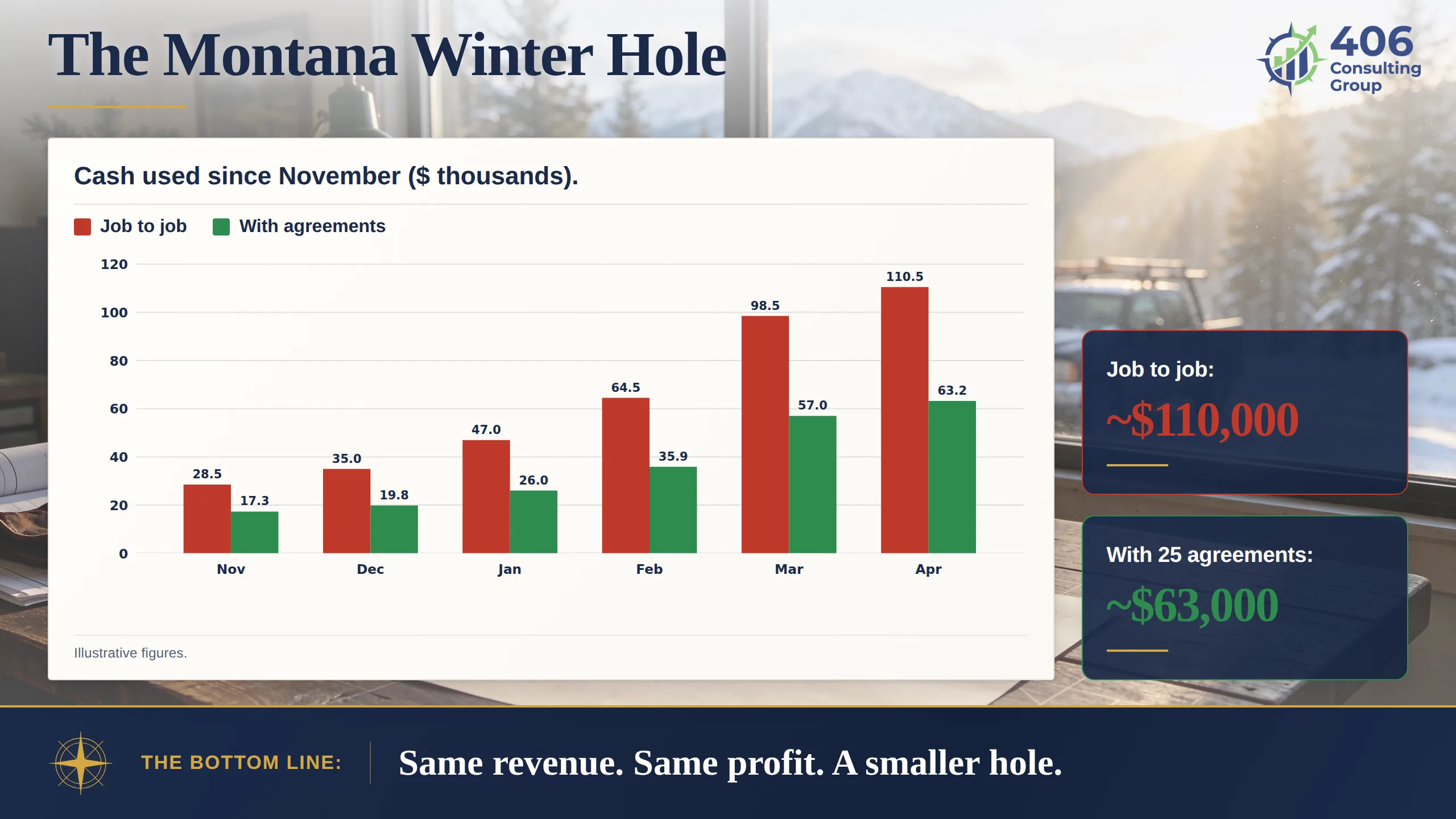
| By the end of | Job to job | With 25 agreements |
|---|---|---|
| Nov | −$28.5K | −$17.3K |
| Dec | −$35.0K | −$19.8K |
| Jan | −$47.0K | −$26.0K |
| Feb | −$64.5K | −$35.9K |
| Mar | −$98.5K | −$57.0K |
| Apr | −$110.5K | −$63.2K |
~$110,000
Winter cash hole, job to job
~$63,000
Same revenue, same profit, with agreements
Same company, same revenue, same annual profit — and a winter hole more than 40% smaller. Now picture the job-to-job version after a summer where the owner bought a new truck with “extra” cash. That's the March phone call to the bank nobody wants to make. We break down why this happens in why a profitable business can feel broke.
Know Your Cost per Crew-Hour
Ask most trade owners what a crew costs and they'll give you wages. Wages are maybe 60% of the real number. Here's a three-person crew, fully loaded:
Say you bill that crew at $185 an hour. Looks like $35 of profit an hour. Now send them on a one-off two-hour service call to a home in Lakeside with a 45-minute round trip you don't bill for:
One-off call
Billed: 2 hrs × $185 = $370
Cost: 2.75 hrs × $150 = $412.50
−$42.50
Four homes, routed together
Billed: 8 hrs × $185 = $1,480
Cost: 9.5 hrs × $150 = $1,425
+$55 — and better with a trip charge
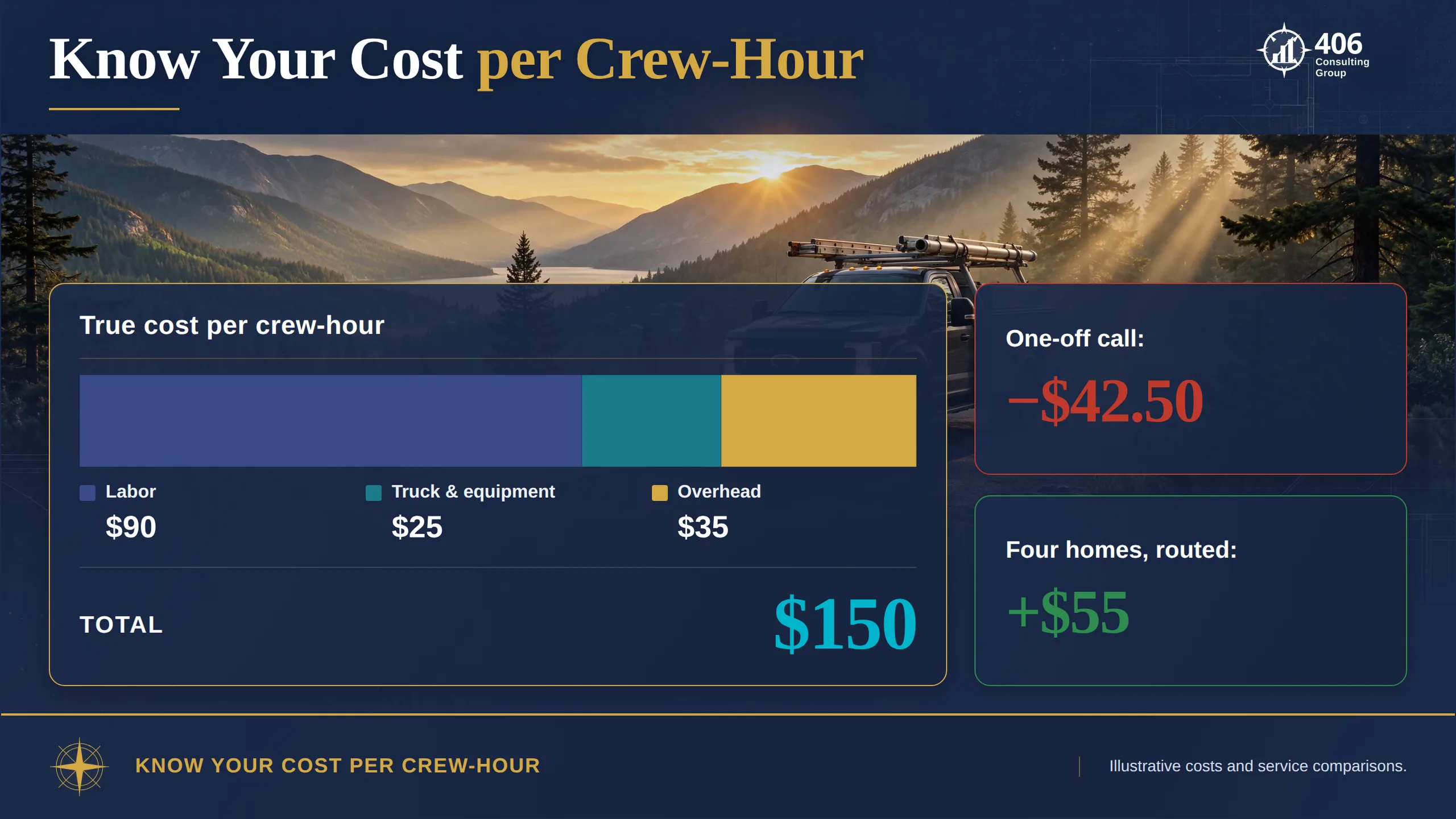
Same crew, same rate. One schedule loses money; the other makes it. That's why the busiest crew in the company is sometimes the one quietly losing the most. Clustering homes by area — Lakeside and Somers on Tuesdays, Bigfork on Thursdays — is one of the cheapest raises a service business can give itself.
You don't need a big system to start. Don't boil the ocean: pick one crew, track every hour for one month — on site, driving, waiting — and compare it to what you billed. Our overhead rate calculator and payroll burden calculator will get you to your real number, and why your busiest truck isn't your most profitable goes deeper.
Crews in a Valley With Expensive Housing
The hardest part of growing a trade business in the Flathead isn't finding work. It's finding people who can afford to live here and do the work to your standard. A big development pulls on the same labor pool you're already fishing in.
Know the loaded cost
Payroll taxes, workers' comp, and benefits often add 20–35% on top of wages. Price from the loaded number.
Keep the ones you have
Year-round work is a retention tool. Service agreements give crews a reason to stay through winter.
Don't hire ahead of the work
Territory 1889 is approved one phase at a time. Hire for signed work, not for headlines.
Before you add a crew, test it on paper with our hiring scenario calculator: what the new crew costs, how much work it needs to cover itself, and how long until it does.
Where local wins
8. Your Unfair Advantage: You're Already Here
On the big build packages, local trades will compete with larger outfits from Bozeman, Spokane, and beyond — companies with bigger balance sheets and bonding lines. Don't fight them where they're strong. Win where they can't follow you.
An out-of-town company can win a framing package. It can't be in Lakeside within the hour on a January night, every January, for twenty years. Response time is the one thing scale can't buy— and it's exactly what absentee owners pay for.
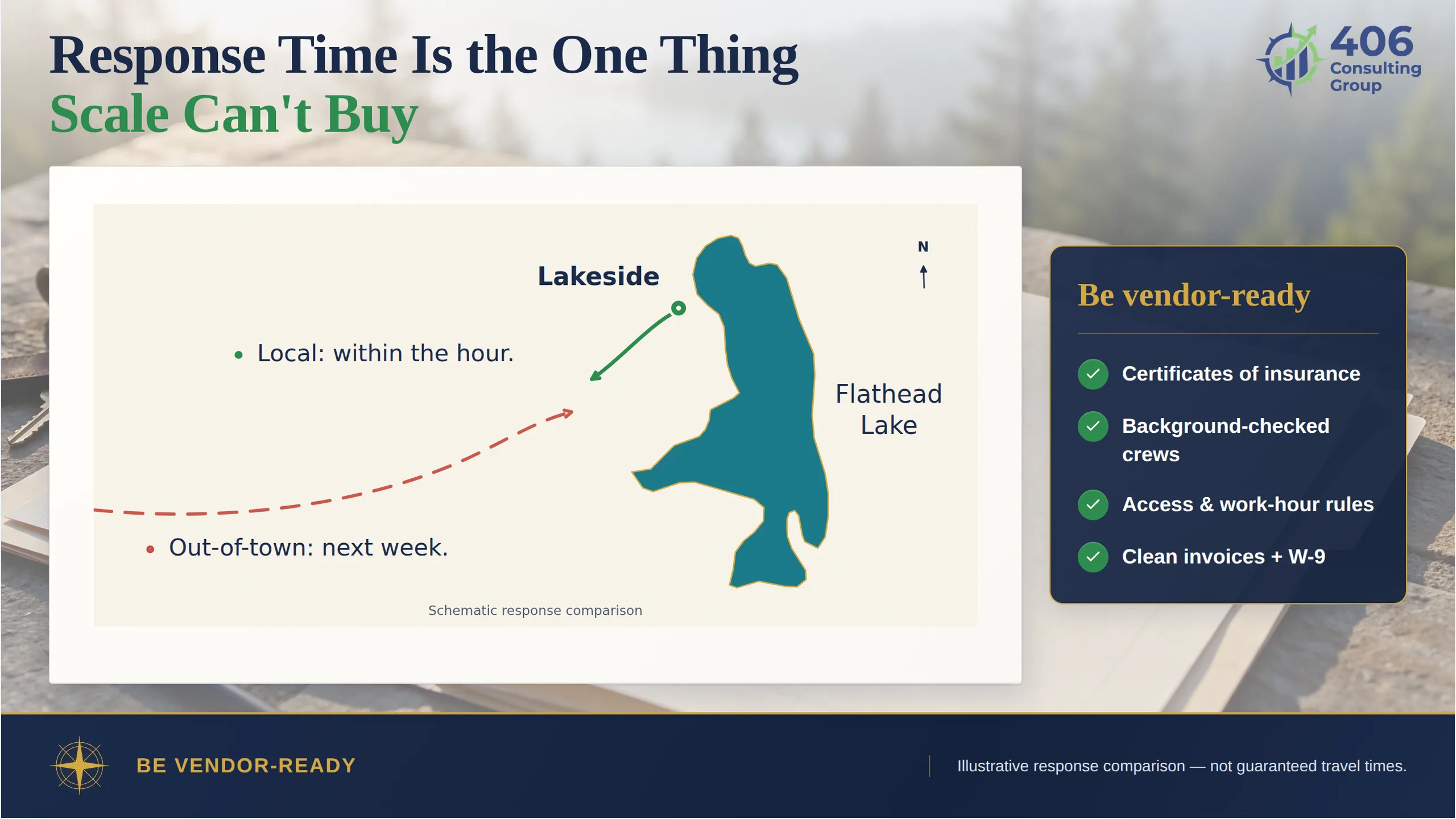
Be ready for what private communities typically ask of vendors
- Certificates of insurance — general liability, auto, and workers' comp — often naming the association
- Background-checked employees and clear crew identification
- Rules on access, work hours, parking, and noise
- Clean, professional invoices and a W-9 on file
Every community sets its own vendor rules. This is a general list, not a description of any specific community's requirements.
How We Help Trades Get Ready
I spent a decade in operations and accounting at BP — a business that lives or dies on logistics and margin per unit. That's the lens I bring to a trade business: not just “did we make money this year,” but which crew, which truck, which route, and which customer made it.
We've built this for real businesses. For a trucking client, we built an operating workbook that tracked the economics behind the work so the owner could see what was actually paying. And we've watched a contractor we worked with grow from single-digit millions to about $40 million — with the billing and approval workflow we built helping the cash keep up with the work. We're based in Columbia Falls, so this is our valley too.
What we set up for a trade or service business
What working with us looks like
Introductions & access
We meet your team and key people and get access to the systems your numbers live in.
First 30–60 days
We set your priorities for the next 30 and 60 days — for most trades, that's real crew costs and pricing first — with a clear timeline of deliverables.
Beyond 60 days
We move into the steady monthly rhythm — job costing, cash forecasting, agreement tracking — while working toward the long-term goals we mapped together.
Going after the build work too? Read You Do $5 Million a Year. Can You Afford a $3 Million Subcontract? before you sign anything big. And see how we work with specialty trades, landscape companies, and property managers — or start with accounting in the Flathead Valley.
FAQ: Territory 1889 and Local Trades
What businesses will benefit from Territory 1889?
Well beyond homebuilders: excavation, concrete, framing and finish carpentry, electrical and low-voltage, plumbing and HVAC, landscaping and irrigation, snow removal, caretaking and home watch, cleaning, and property management. Many get build-phase work first, then years of recurring service on the finished homes.
When will Territory 1889 create work for local trades?
In waves. Flathead County approved the Phase I final plat (79 lots) on October 29, 2026, and each of the remaining phases needs its own approval. Build-phase work will follow those approvals, and service work grows as homes are finished. Plan and hire for signed work, not for headlines.
How should I price service work for luxury vacation homes?
Price the response, not just the repair. Start from your true loaded cost per crew-hour, including drive time, then add for being on call: an after-hours fee, a trip charge, and a monthly retainer that guarantees a response time. Absentee owners pay for one call, fast response, and proof the work was done.
Why are service agreements better than one-off jobs?
Service agreements bring in predictable monthly revenue, smooth out seasonal cash swings, make it easier to plan hiring and borrowing, and make a company more valuable if the owner ever sells. Buyers and lenders both value revenue that shows up without the owner chasing it.
How do Montana landscaping and snow businesses handle the winter cash gap?
By planning for it. Fixed costs like equipment payments, insurance, and core crew keep coming all winter. A seasonal cash forecast shows how much summer cash winter will use, and annual agreements billed monthly can shrink that gap significantly without changing total revenue.
What is a fully loaded cost per crew-hour?
It is everything a crew really costs for one hour of work: wages plus payroll taxes, workers' comp, and benefits, plus truck and equipment costs, plus a share of overhead like insurance, office, and the owner's time. Payroll taxes, workers' comp, and benefits alone often add 20% to 35% on top of wages.
Can a small local trade business compete with larger out-of-town contractors?
Yes, especially on service work. Larger outside firms may win big build packages, but they can't match local response time year after year. Being close, reliable, and fast is exactly what absentee owners of high-end homes pay for.
Keep Reading
The Build Is the Sprint
The Service Contract Is the Business. Price It Like One.
We'll help you find your real cost per crew-hour, price premium service the right way, and build a cash plan that gets you through a Montana winter — before the work arrives.
The Build vs. the Keep
Two economies, one development
Run a Trade or Service Business?
Know your numbers before the work arrives.
About the Author
Jason Anderson
Co-Founder, 406 Consulting Group
Jason is a degreed accountant with 10+ years in tax and a decade of operations and accounting at BP. He builds the job costing, pricing, and cash-flow systems that show trade owners which crews, trucks, and customers actually make money.
Read the Full Story