
How to Start and Grow an HVAC Business
Into a Company That Runs Without You
Every HVAC business starts with one tech and a service van. Whether it becomes a real company — one that runs, grows, and could sell without you — comes down to pricing and one lever the other trades don't have: recurring maintenance-agreement revenue. Here's the blueprint, stage by stage. Part 3 of our Trades Growth Blueprint series.
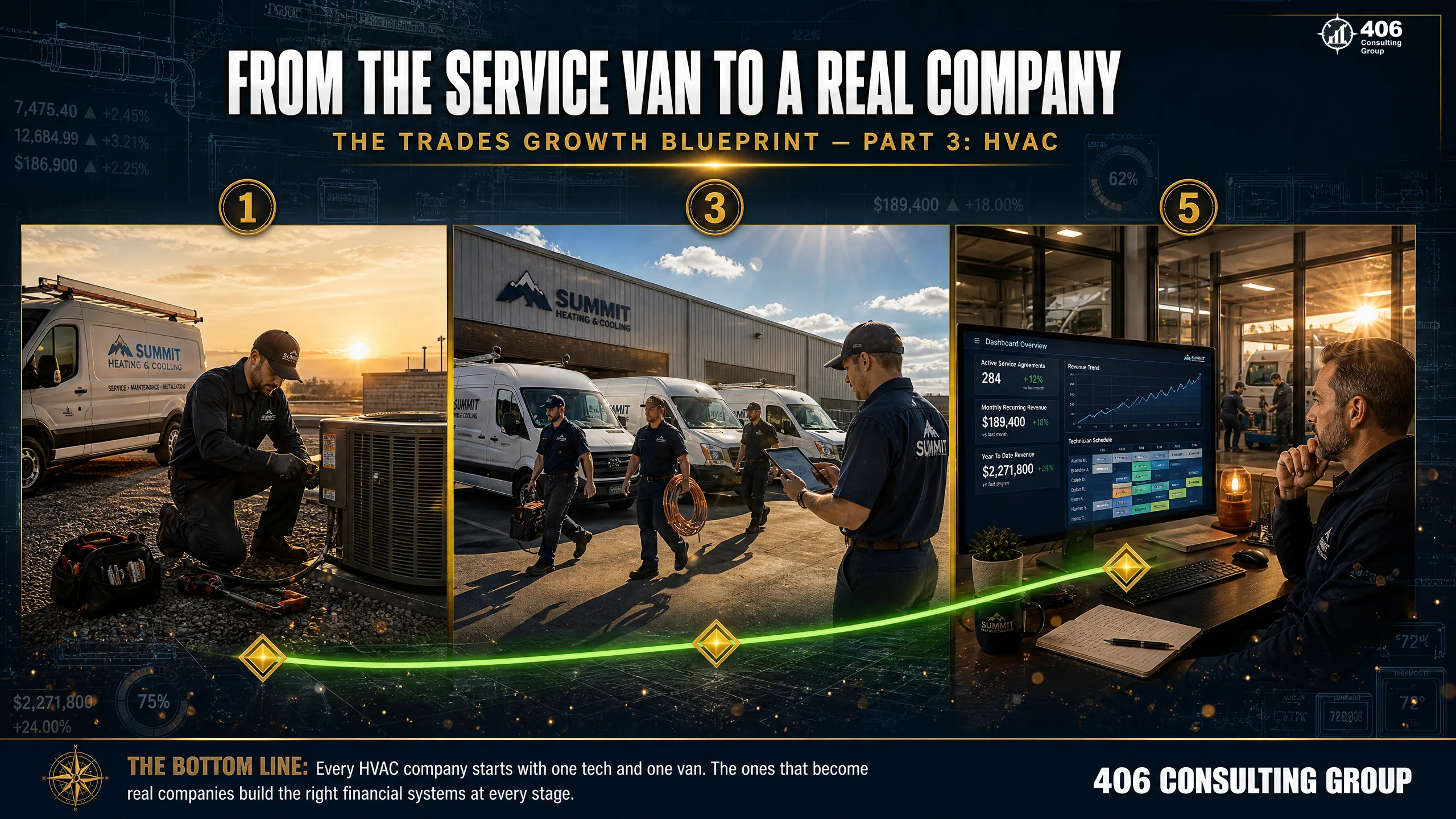
The Trades Growth Blueprint · Part 3: HVAC
An HVAC business usually starts with one good technician, a service van, and a phone that won't stop ringing when it's 95 degrees out. From there, the difference between a busy tech and a real company comes down to a few decisions most owners make by accident — how they price installs, whether they build recurring revenue, and whether they ever get out from behind the wheel of the van. This is how to grow an HVAC business into the second thing: a company that runs, and grows, without you.
HVAC has something plumbing and framing don't, and it changes everything: maintenance agreements. Recurring service contracts smooth the vicious summer-and-winter seasonality, feed a steady stream of repair and replacement work, and — done right — turn a feast-or-famine trade into a predictable, sellable business. Miss that lever and you're always at the mercy of the weather. The blueprint is the same five stages we use across trades, but the HVAC version wins or loses on recurring revenue and pricing.
This is Part 3 of our Trades Growth Blueprint series — the same playbook we ran for plumbing (Part 1) and framing (Part 2), now built for HVAC. We'll walk the five stages, the do's and don'ts at each, the order to take the hats off the owner, and where the right financial partner turns a seasonal scramble into a company you own instead of a job that owns you.
By Carrie Anderson — Co-Founder, 406 Consulting Group. Background in commercial banking and underwriting — 300+ loan reviews — plus advisory work with Montana trades businesses. I've seen which HVAC shops build into real, sellable companies and which stay a seasonal grind.
Quick Answer: The 5 Stages (HVAC)
- 1.Owner-Operator: one tech, a van, wearing every hat — service, sales, dispatch, books.
- 2.First Hires: add a tech and admin; start job costing; sell maintenance agreements from day one; outsource the books early.
- 3.The Squeeze: multiple techs, seasonal spikes, owner is the bottleneck; cash whipsaws.
- 4.Team, Systems & Recurring Revenue: managers, dispatch software, and a real base of service agreements.
- 5.The Real Company: runs without you, with recurring revenue that makes it sellable.
Table of Contents
The Blueprint at a Glance
The short answer: an HVAC business grows through five stages, and the owner's job at each is to work themselves out of a role — shedding hats and building systems — so the company depends on techs, managers, and recurring revenue instead of on one person. For HVAC specifically, the two things that must get built are accurate pricing (especially on installs) and a base of maintenance agreements.
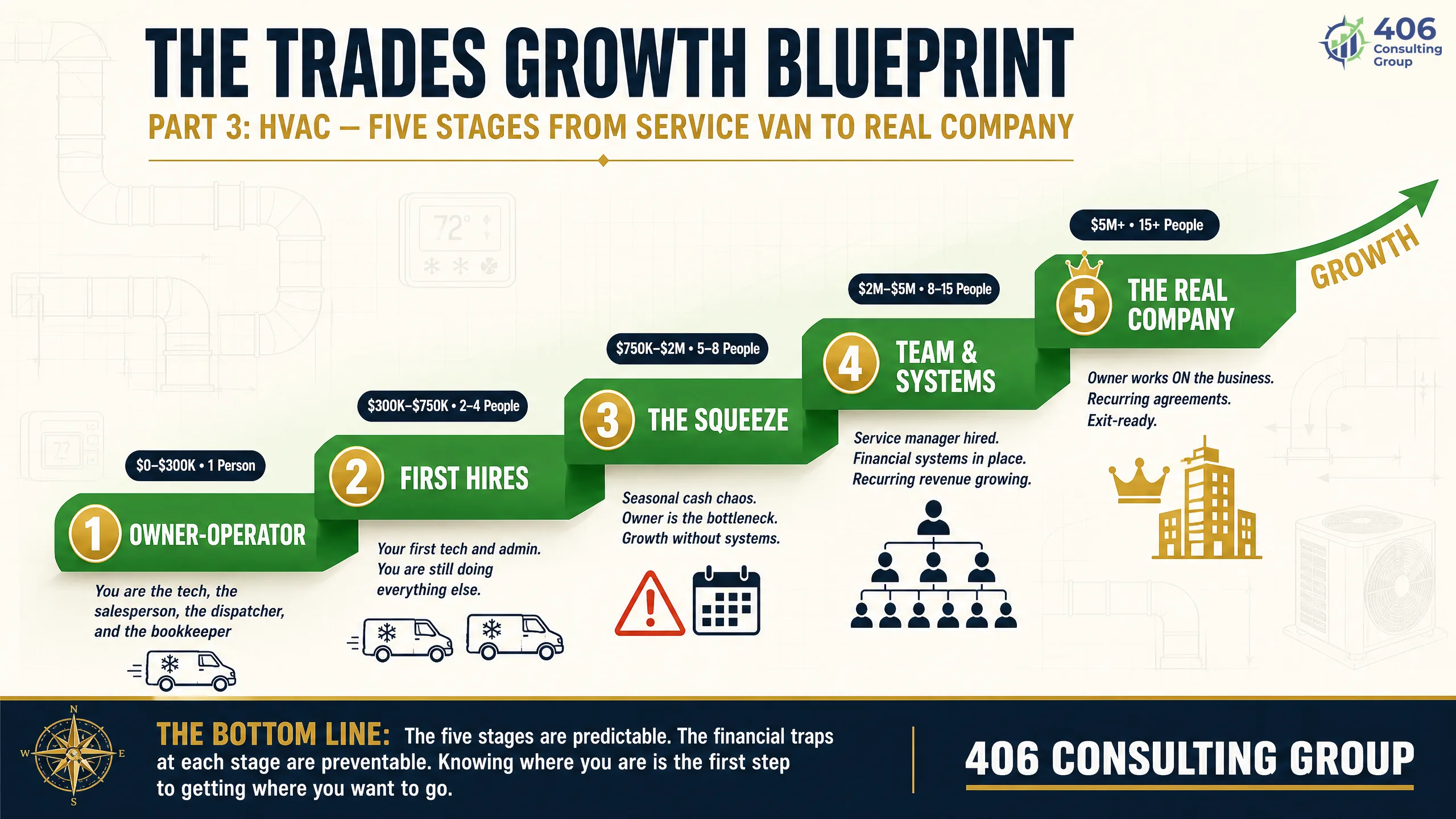
The stages aren't defined by revenue — they're defined by dependence and predictability. A one-van shop living call-to-call and a multi-truck company with thousands of maintenance agreements can post similar revenue and be worlds apart in how they run and what they're worth. What changes across the stages is who does the work, who sells the jobs, and how much of the revenue is predictable instead of weather-dependent.
The HVAC truth that runs through every stage: recurring revenue is the whole game. Every maintenance agreement you sell smooths your seasonality, generates future repair and replacement work, and adds to what the business is worth the day you sell it. An HVAC company built only on one-off calls and installs is always starting from zero — and always at the mercy of the next heat wave or cold snap.
Stage 1 — The Owner-Operator
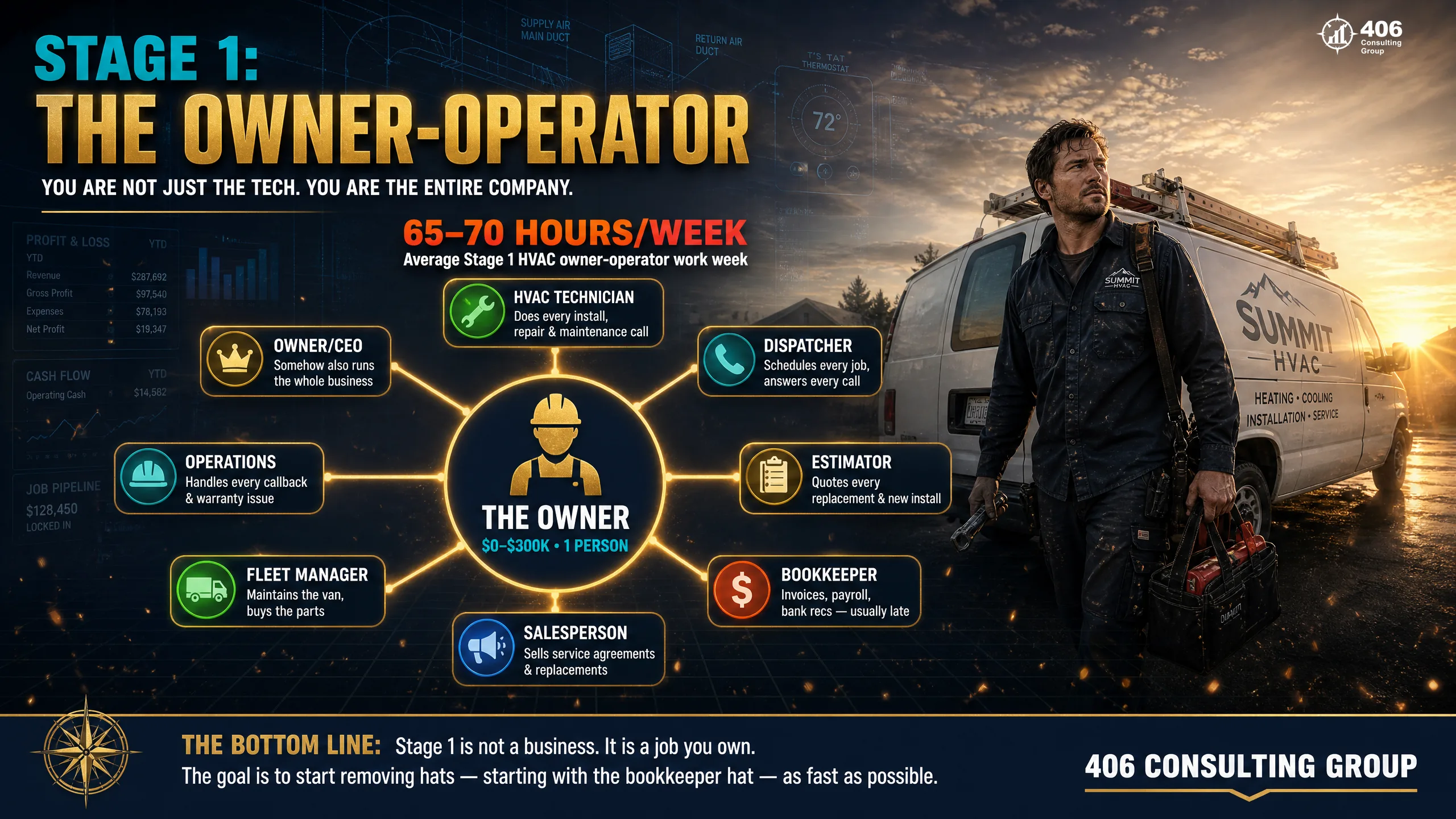
The short answer: at the start you're the technician, the salesperson, the dispatcher, the estimator, and the bookkeeper — running calls all day and quoting installs and doing invoices at night. That's normal. The goal at Stage 1 isn't to stop wearing hats; it's to build the foundation — pricing, job costing, and the habit of offering maintenance agreements — so you can start taking them off.
Do
- Get licensed, registered, insured, and set your entity up right
- Separate business banking from personal from day one
- Set up real bookkeeping and job costing immediately
- Price service and installs to cover true cost plus profit — not just to win the job
- Offer a maintenance agreement on every call, starting now
Don't
- Underprice installs to beat the other guy — it caps you at busy and broke
- Run the business out of your personal account
- Treat every dollar collected as profit (it isn't)
- Skip offering agreements because you're 'too busy' — that's the recurring revenue
- Cut corners on licensing, insurance, or workers' comp
The trap of Stage 1: living call-to-call, at the mercy of the weather, with nothing that carries over from one season to the next. Every maintenance agreement you sign at this stage is a brick in a foundation that eventually smooths your cash and builds your company's value. Skip them and you'll still be starting from zero at 55 years old.
Stage 2 — First Hires
The short answer: demand outgrows what you can run alone, so you add a tech (or two) and someone to answer phones and schedule. This is your first hat coming off. Done right — with training, pricing, and a growing book of maintenance agreements — it multiplies you; done wrong, it just multiplies the callbacks and the payroll.
Do
- Train techs to your standard — quality and callbacks make or break margin
- Set up payroll properly, with the right workers' comp codes
- Track job costing and margin by revenue type (service, install, agreements)
- Build the maintenance-agreement base deliberately — it's your recurring revenue
- Outsource the bookkeeping early; look at an S-corp once profit justifies it
Don't
- Hire before you know your true cost per call and per install
- Let a new tech's callbacks quietly eat your profit
- Pay under the table or fumble workers' comp classifications
- Keep doing your own books at midnight after a full day of calls
- Treat maintenance agreements as an afterthought
Shed the bookkeeping first — even though instinct says keep it to save money. Doing your own books after a day of service calls is the lowest-value, highest-cost use of your time, and it leaves your numbers late right when you need them to price and hire. Hand it off early for clean numbers and your evenings back. More on the hat order in Section 7.
Stage 3 — The Squeeze
The short answer: this is the make-or-break stage. You've got several techs, the phone is on fire every heat wave and cold snap, and you're the bottleneck for all of it — dispatching, selling replacements, quoting, and doing the money. Revenue spikes and craters with the seasons, and cash whipsaws with it. More demand at this stage amplifies the chaos; it doesn't fix it.
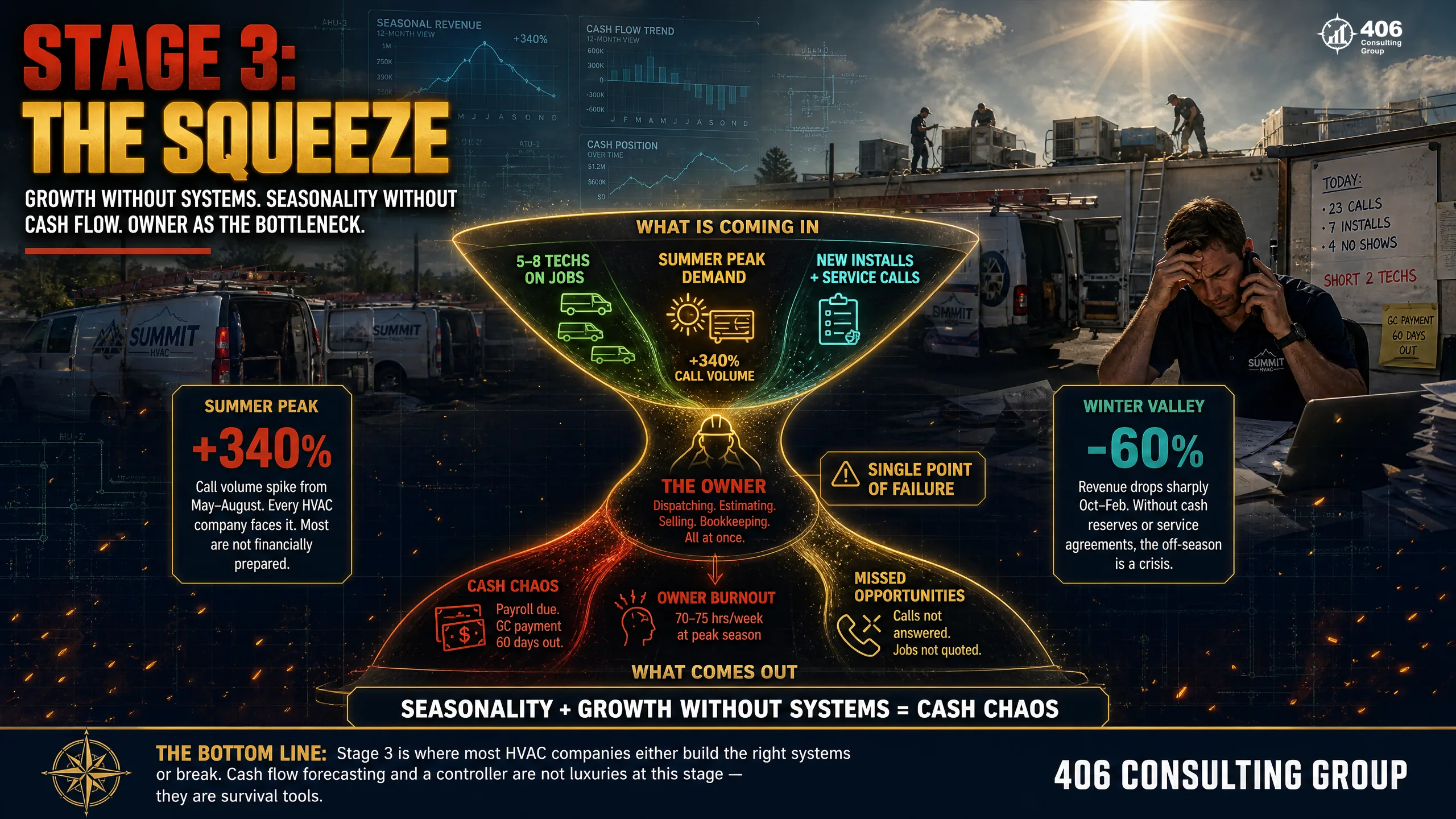
The HVAC Squeeze is especially punishing because of seasonality. You staff up and stock up for the peak, ride a brutal few months, then face a slow shoulder season with payroll still to cover. Owners who haven't built recurring revenue feel this hardest — and owners who fly blind on cash get caught every off-season. This is the same profit-versus-cash trap we break down in why a profitable business can be cash-poor.
Do
- Get controller-level financials and margin by revenue type
- Build a cash flow forecast around your seasonal peaks and valleys
- Push maintenance agreements hard — they flatten the seasonality
- Start handing dispatch and replacement sales to trained people
Don't
- Chase more volume as the fix — it deepens the seasonal cash swings
- Spend peak-season cash as if the slow months aren't coming
- Stay the only one who can sell a replacement or run dispatch
- Neglect the agreement base that would smooth all of this
Stage 4 — Team, Systems & Recurring Revenue
The short answer: this is where you deliberately build the company — a service manager, a dispatcher, install crews, dispatch/CRM software, and a real, growing base of maintenance agreements — plus controller-level reporting that shows margin by revenue type. For HVAC, this stage is defined by turning recurring revenue from a nice-to-have into a core engine.
Stage 4 is where an HVAC business becomes an organization. You promote or hire a service manager to run the techs, a dispatcher to own the schedule, and maybe a comfort advisor to sell replacements — so those hats leave the owner. You put in dispatch and CRM software, and you systematize the maintenance-agreement program: how they're sold, renewed, and serviced. And the money side grows up to controller-level reporting that shows you margin by service, install, and agreement — because those three make money very differently.
Why recurring revenue is the HVAC difference
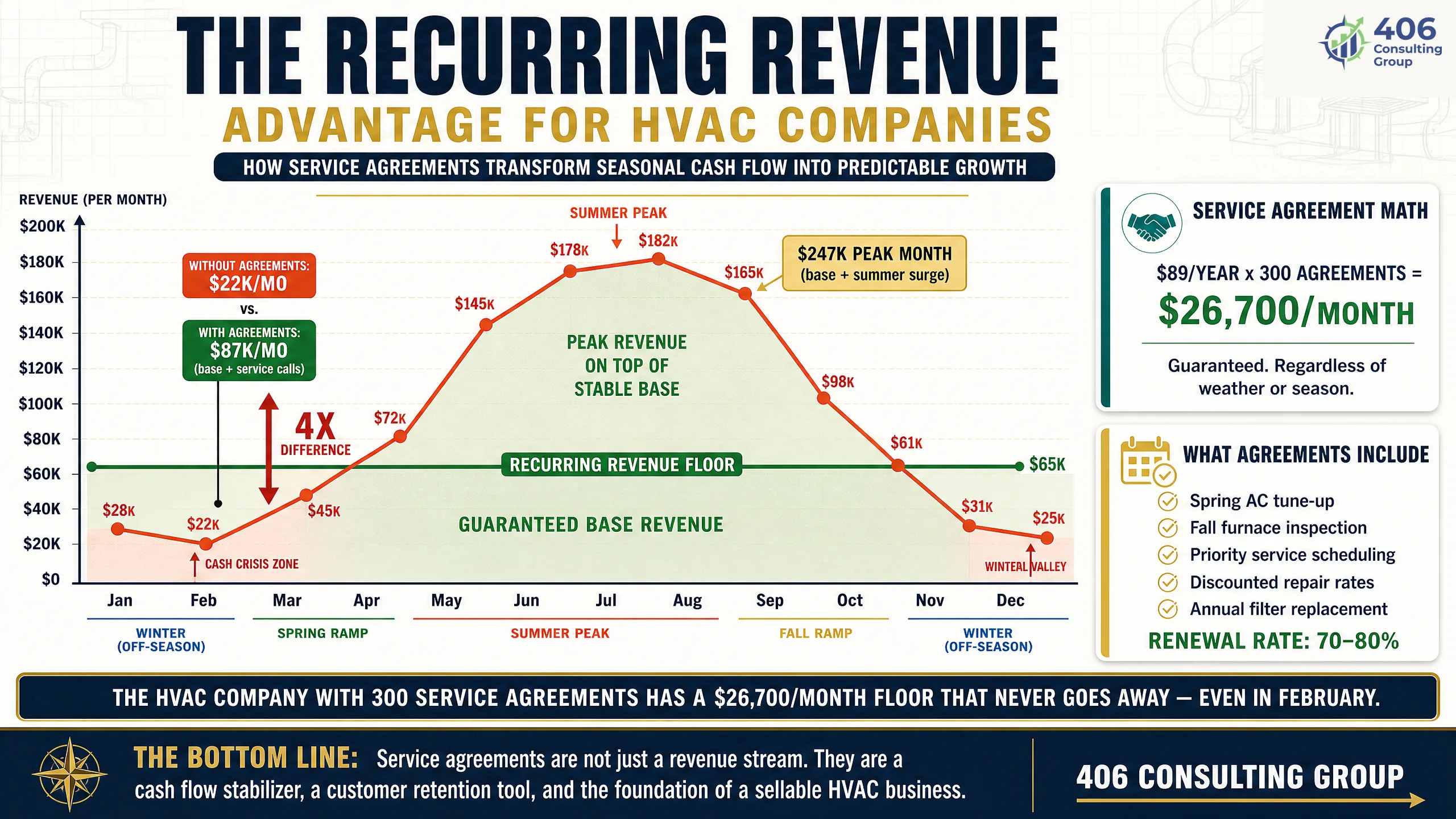
A maintenance agreement isn't just a tune-up subscription. It flattens your seasonality (steady revenue in the shoulder months), it's a pipeline (agreement customers are who you sell repairs and replacements to), and it's an asset (a book of agreements is exactly what raises the multiple when you sell). Two HVAC companies with identical revenue can be worth very different amounts — the one with a big, renewing agreement base is worth far more, because a buyer is buying predictable future revenue, not just last year's installs.
That's why we track agreements as a core metric, not a footnote — and why building the base is Stage 4's headline job.
Do
- Hire managers who replace you — service manager, dispatcher
- Systematize the maintenance-agreement program end to end
- Move to controller-level reporting with margin by revenue type
- Track agreement count, renewal rate, and revenue per tech
Don't
- Hire helpers who lean on you instead of managers who replace you
- Let the agreement base stagnate or renewals slip
- Blend all revenue into one number that hides the real margins
- Buy software the team never fully adopts
Stage 5 — The Real Company
The short answer: at Stage 5 the HVAC business runs without you. Service managers run the techs, a sales process sells replacements, dispatch runs the schedule, and a deep base of maintenance agreements makes revenue predictable year-round. You work ON the company — strategy, growth, key accounts — and the business could keep running, and be sold, without you.
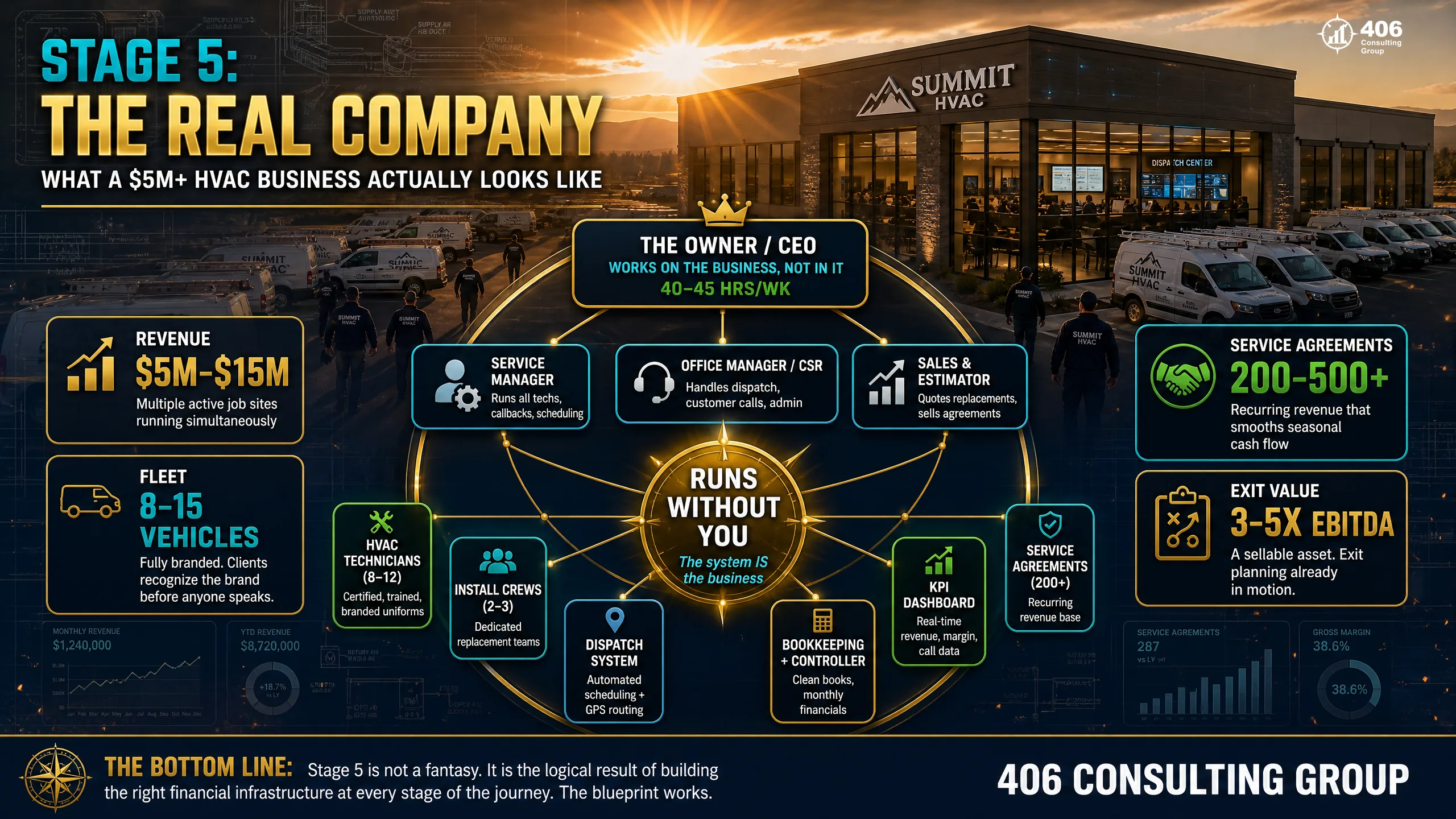
By now the financial function is CFO-level — cash flow forecasting across the seasons, margin and pricing strategy by revenue type, financing for growth or acquisitions, and the numbers behind every big decision — usually fractional long before a full-time CFO makes sense. And the recurring-revenue base you built is doing its job: smoothing the seasons and making the company genuinely valuable.
The two tests of a real company
You've arrived when two answers come easily. First: if you stepped away for a month in peak season, would the techs keep running and the replacements keep selling? Second: if you wanted to sell, is there a company to sell — a team, systems, and a book of maintenance agreements — or does it all leave with you? A Stage 5 HVAC business passes both, and the agreement base is often what makes the sale price a pleasant surprise.
That durability and recurring revenue are exactly what make a sale or succession possible — see the numbers side of succession planning.
The Owner's Hats: What to Take Off, and When
The short answer: growing an HVAC business is the process of taking hats off the owner in the right order. You start wearing all of them; you finish wearing one. The HVAC twist is that the sales hat — selling replacements and agreements — is high-value and worth systematizing early, because it's where the money and the recurring revenue come from.
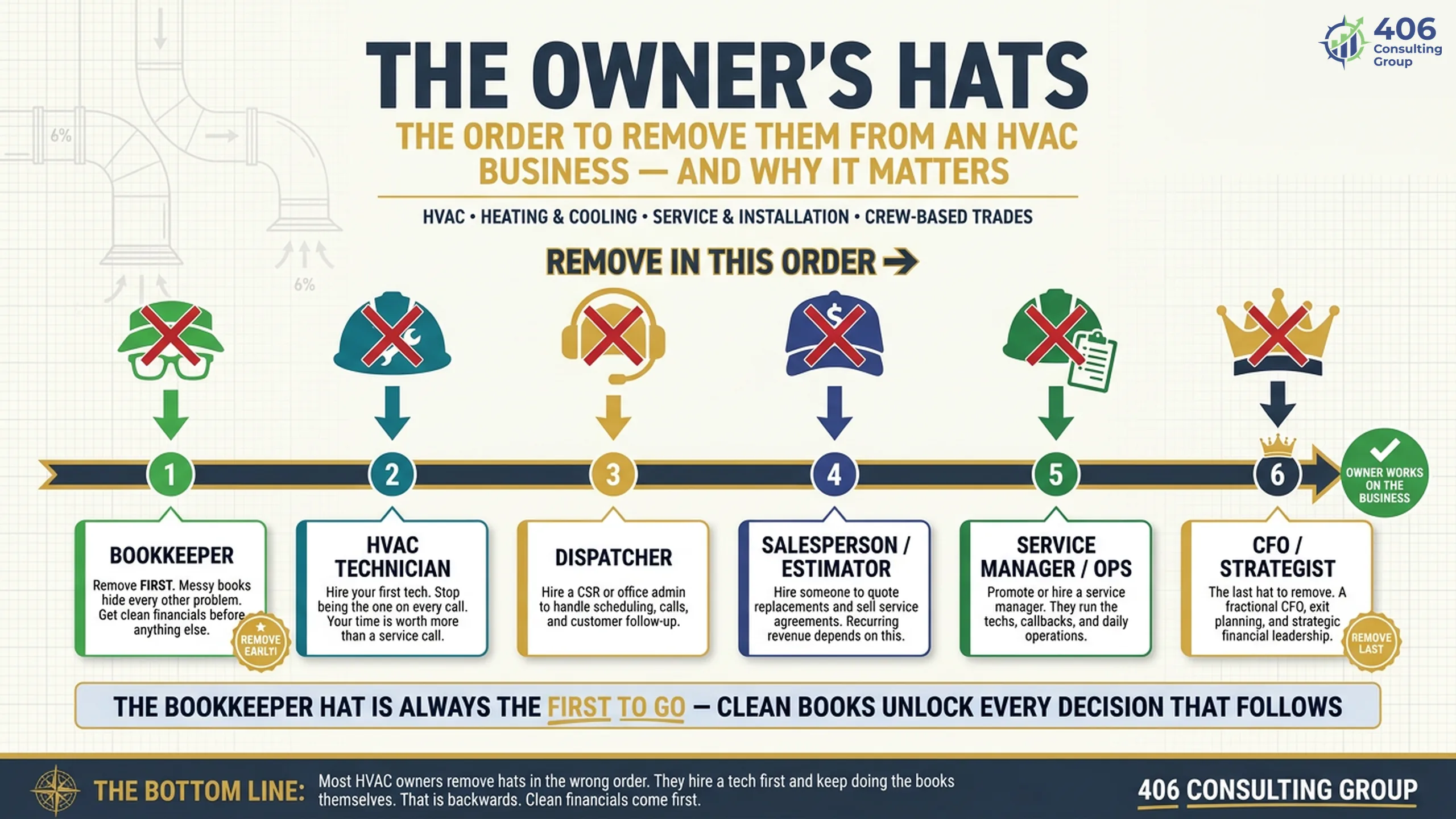
The Technician
Stage 2Stop being the only one running calls. Your first trained tech buys back the hours you need to build everything else — and proves the work can be done to your standard without your hands.
The Bookkeeper
Stage 2 (early!)One of the first to shed — cheap to hand off, and it gives you the clean, current numbers you need to price and hire. Doing your own books after a day of calls is the worst trade of your time there is.
The Dispatcher
Stage 2–3Scheduling techs and juggling emergency calls eats your day and doesn't need you. A dispatcher (and dispatch software) hands it off and makes it more consistent — especially in a heat wave.
The Salesperson / Estimator
Stage 4Selling replacements and maintenance agreements is high-value, so systematize it: a documented sales process and a comfort advisor let the business sell without you — and grow the recurring revenue.
The Service Manager / Operator
Stage 4–5A service manager who runs the techs and the day-to-day is what finally frees the owner from being the hub every call and every problem routes through.
The CFO / Strategist
Stage 5The last hat, often partly kept by the owner. But the heavy lifting — forecasting, pricing strategy, financing, and the numbers on the agreement base — comes from a fractional CFO long before you'd hire one full-time.
What Kills HVAC Businesses
The short answer: HVAC businesses rarely fail because the techs can't fix a furnace — they fail on seasonality, pricing, and the recurring revenue they never built. Here are the killers to watch for at every stage.
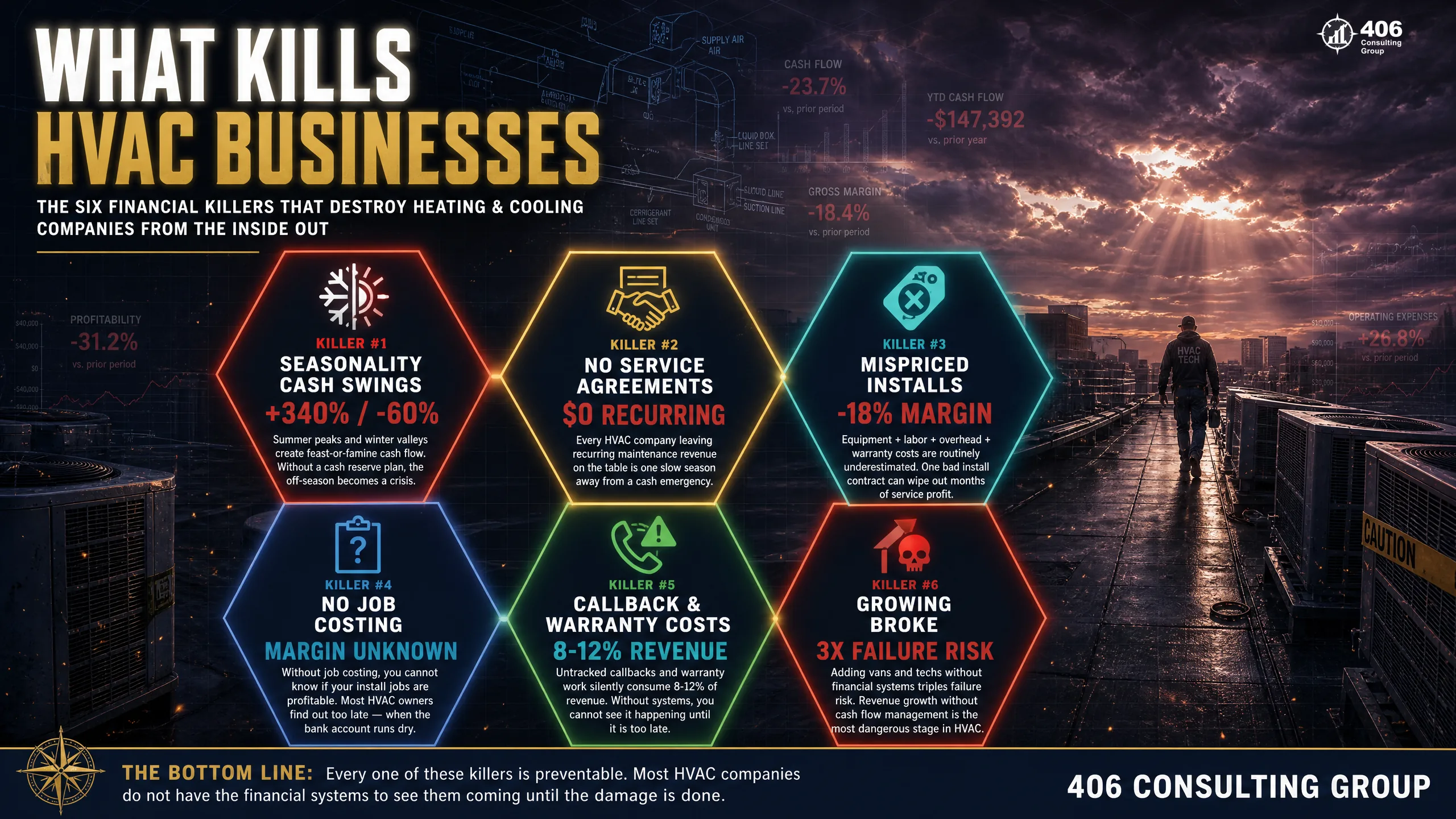
Seasonality cash swings
Feast in summer and winter, famine in the shoulder seasons — with payroll due year-round. Without reserves, forecasting, and recurring revenue, the off-season catches owners every time.
No maintenance agreements
The biggest missed opportunity in HVAC. No recurring revenue means no seasonality buffer, no built-in replacement pipeline, and a business worth far less when you sell.
Mispricing installs
Replacements are big-ticket and easy to underprice under competitive pressure. Get the pricing wrong and you move a lot of equipment for very little profit.
No job costing by revenue type
Service, install, and agreements have very different margins. Blend them into one number and you can't see what's actually making — or losing — money.
Callback and warranty costs
Undertrained techs and rushed installs generate callbacks that quietly destroy margin and reputation. What looks like a labor problem is a systems and training problem.
Growing broke
Staffing and stocking up for the peak, taking on more, and running out of cash before the season pays off — a fast-growing HVAC shop can go under in a good year.
Where a Partner Like 406 Comes In
The short answer: nearly every "do" in this blueprint is about the numbers and systems behind the HVAC work — pricing, margin by revenue type, seasonal cash, and the economics of the agreement base — and that's exactly where the right partner speeds up the journey. We meet an HVAC business at its stage and add the financial layer it needs, so the owner can keep shedding hats with confidence.
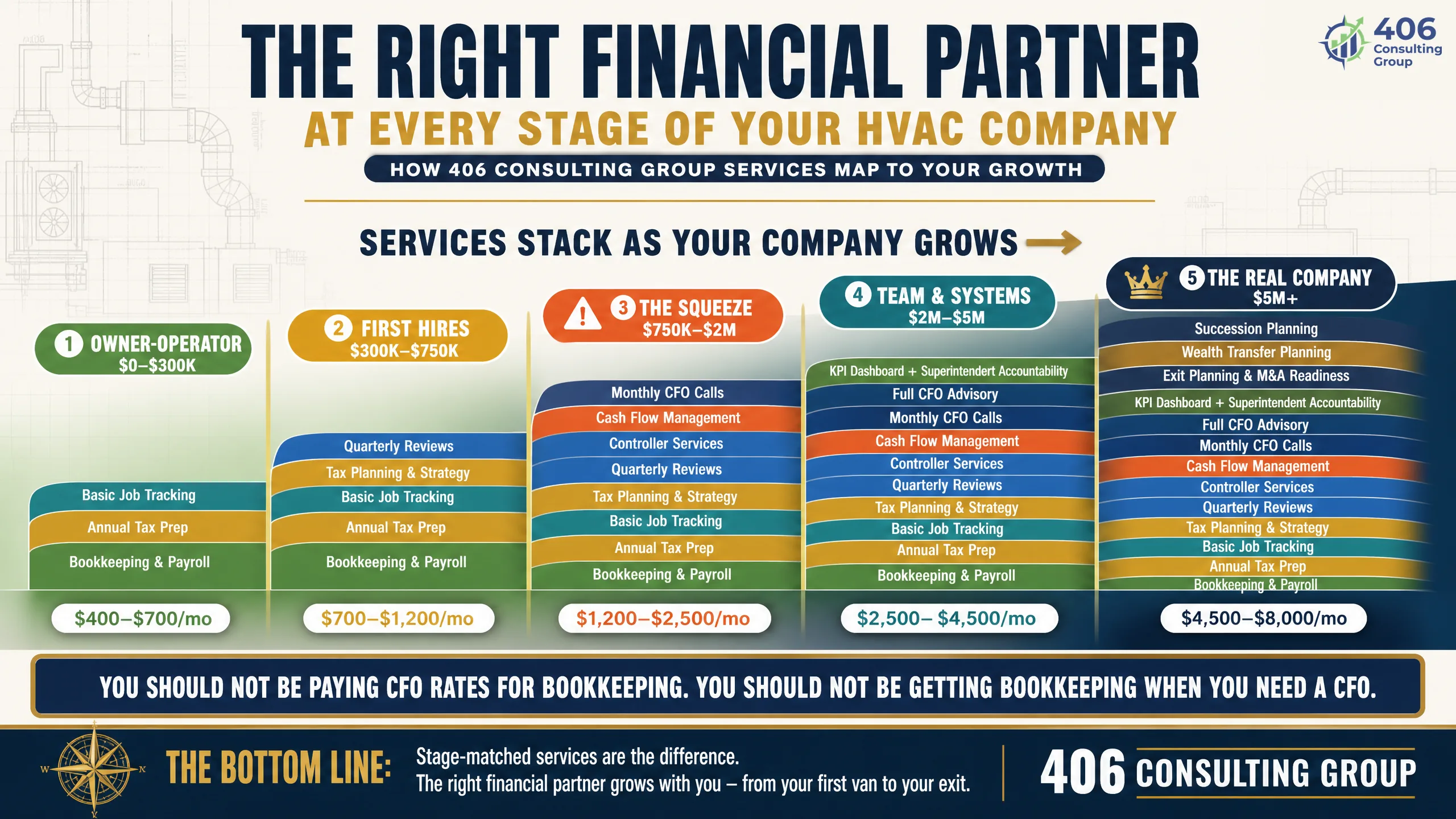
| Stage | What we bring |
|---|---|
| 1 — Owner-Operator | Bookkeeping and job costing from day one, entity setup, pricing that covers true cost |
| 2 — First Hires | Payroll (and workers' comp codes) done right, margin by revenue type, tax planning |
| 3 — The Squeeze | Controller-level reporting and a seasonal cash flow forecast |
| 4 — Team & Recurring Revenue | Whole-company systems and reporting on agreements, renewals, and margin |
| 5 — Real Company | Fractional CFO, pricing and growth strategy, and sale/succession readiness |
Our difference: we don't look at your systems through an accounting lens
Most firms would build you systems that make the books easier. Because of our business background, we look at how a system affects the whole company — the techs in the field, dispatch, your sales process, your customers — and design what's best for the entire operation, then make the financials support it. A dispatch or agreement-tracking system that only satisfies accounting is one your techs will work around. That whole-company view is what makes the systems actually stick — and it's why we can help an HVAC business climb the stages, not just keep its books.
See our business systems, CFO, and specialty trades services.
Your Next Step
The short answer: figure out honestly which stage you're in, then do the one or two things that move you to the next — usually shedding the next hat, tightening your pricing, and growing the maintenance-agreement base underneath it. An HVAC company gets built one deliberate stage at a time, and recurring revenue is what makes every stage easier than the last.
Whether you're a tech weighing your first hire or an owner stuck in the seasonal Squeeze, the path is the same shape: take the next hat off, put a system and clean numbers under it, price right, and build recurring revenue that carries you between seasons. Do that and a weather-dependent grind becomes a predictable, valuable company you own.
Not sure which stage you're in or what to fix next? Our free financial maturity assessment takes about eight minutes and points to your next move. When you're ready to build the plan, let's talk. And catch the rest of the series: the same blueprint for plumbing and framing businesses.
Frequently Asked Questions: Growing an HVAC Business
How do I grow an HVAC business beyond just myself?
By taking the hats off your head in the right order and building systems, a team, and recurring revenue underneath each one. Growth isn't just more calls — it's moving the work, the sales, and the numbers out of your head into trained people and processes. The path runs through five stages: owner-operator, first hires, the seasonal 'squeeze' where you're the bottleneck, building the team/systems/recurring revenue, and finally a real company that runs without you. In HVAC specifically, the two things that must get built are accurate pricing (especially on installs) and a base of maintenance agreements.
Why are maintenance agreements so important for an HVAC business?
Because they turn a seasonal, feast-or-famine trade into a predictable, valuable business. Recurring maintenance agreements smooth the summer/winter seasonality with steady revenue in the shoulder months, create a built-in pipeline for repairs and replacements (agreement customers are who you sell to), and — critically — raise what the business is worth when you sell, because a buyer is paying for predictable future revenue. Two HVAC companies with the same revenue can be worth very different amounts; the one with a large, renewing agreement base is worth far more.
Why is my HVAC business busy but not profitable?
Usually pricing and seasonality. Installs and replacements are easy to underprice under competitive pressure, so you move a lot of equipment for thin margin — and without job costing by revenue type (service vs. install vs. agreements), you never see which work actually makes money. Add the seasonal cash swings — staffing and stocking for the peak, then covering payroll through the slow months — and a business that looks busy and profitable can still run short of cash. The fixes are accurate pricing, job costing by revenue type, a seasonal cash forecast, and recurring revenue to flatten the swings.
What should I outsource first in an HVAC business?
Bookkeeping — earlier than most owners do. Doing your own books after a full day of service calls is the lowest-value, highest-cost use of your time, and it leaves your numbers late and unreliable exactly when you need them to price jobs and decide on hires. Outsourcing the books early frees your evenings and gives you clean numbers to manage on. Payroll is close behind once you have techs — and getting workers' comp class codes right matters a lot in the trades.
When should an HVAC business hire its first employee?
When you consistently have more profitable work than you can run yourself and your numbers show you can cover a loaded employee with margin to spare — not just when you're slammed during a heat wave. Before you hire, know your true cost per call and per install so you can price work that covers a fully loaded tech (wage plus taxes, workers' comp, vehicle, and overhead). Train to your standard, because callbacks from an undertrained tech can eat the margin the hire was supposed to add.
How do I build an HVAC business that can run without me?
Remove yourself as the single point of failure, stage by stage. Systematize pricing and the sales process so replacements and agreements don't depend on you, train techs and a service manager who run the work to your standard, put in dispatch and CRM systems, build reliable reporting so decisions don't depend on your memory, and grow a base of maintenance agreements that makes revenue predictable. Do this and the techs keep running calls and the sales keep happening whether you're there or not — which, combined with recurring revenue, is also what makes the business genuinely sellable.
How does 406 Consulting Group help HVAC and trades businesses grow?
We meet an HVAC business at its stage and add the financial and systems layer it needs — bookkeeping and job costing early, then payroll and tax planning, then controller-level reporting on margin by revenue type and a seasonal cash forecast, then fractional CFO, pricing strategy, and reporting on the agreement base. And we don't design systems from an accounting-only view: because of our business background, we look at how a change affects the whole company — the techs, dispatch, the sales process, and customers — and build the best-fit solution for the entire operation. That whole-company perspective helps an owner actually shed the hats and build an HVAC company that runs without them. Contact us to talk about your business and its next stage.
Helpful Resources
Related Tools & Resources
Growth & Advisory · Trades Growth Blueprint
Build an HVAC Company — Not Just a Busy Season.
406 Consulting Group helps HVAC businesses grow from one-van operator to a real company that runs without them — the pricing, job costing, seasonal cash strategy, recurring-revenue economics, and CFO leadership each stage needs, designed for the whole company, not just the books. Let's figure out your next stage.
The 5 Stages
The Trades Growth Blueprint
The HVAC Difference
Maintenance agreements = recurring revenue. They smooth seasonality, feed replacement work, and raise what your business is worth when you sell.
The Owner's Hats
The order to take them off
The Series
Trades Growth Blueprint
Ready for the Next Stage?
Build a company, not a busy season.
About the Author
Carrie Anderson
Co-Founder, 406 Consulting Group
Background in commercial banking and underwriting — 300+ loan reviews — plus advisory work with Montana trades businesses. Carrie helps HVAC owners turn a seasonal grind into a recurring-revenue company that runs, and sells, without them.
Read the Full Story