
How a Fractional CFO Can Transform
Your Helena, MT Company
Somewhere between $1M and $5M, most Helena companies outgrow running the finances by feel. A fractional CFO gives you senior financial leadership without the full-time salary — here are the five shifts that transform the business.

There's a moment most Helena business owners hit somewhere between $1 million and $5 million in revenue: the company is bigger than the way they're running the finances. The bookkeeper keeps the books, the CPA files the taxes, and yet nobody is answering the questions that actually decide whether the business thrives — where cash will be in 90 days, which work makes money, whether you can afford the next hire, and how to get the bank to say yes.
That gap is what a fractional CFO fills. And for a Helena, MT company, a fractional CFO is the way to get genuine, senior financial leadership — the kind that transforms how the business is run — without paying a full-time executive salary the business isn't ready for. You get the strategist a few days a month, focused on the decisions that move the needle.
This isn't about better bookkeeping. It's about what changes when someone finally owns the financial strategy of your business. In this guide we'll walk through what a fractional CFO actually is, why Helena companies hit the "CFO ceiling," and the Five Shifts — the concrete before-and-after transformations a fractional CFO drives. We'll follow one example throughout: a Helena professional-services firm doing about $2.5M a year with 18 employees, stuck at exactly this ceiling.
By Carrie Anderson — Co-Founder, 406 Consulting Group. Commercial banking and underwriting background (300+ loan reviews) plus CFO-level advisory for companies across Montana, including Helena and the surrounding Lewis and Clark County.
Quick Answer: What a Fractional CFO Changes
- →Senior financial leadership, part-time: CFO-level strategy for a few days a month on a monthly retainer — not a full-time salary.
- →It's not bookkeeping: a bookkeeper records the past, a controller makes it reliable, a CFO uses it to decide the future.
- →The Five Shifts: gut feel → real numbers, reactive → forecasted, blind → profitable-by-line, stuck → fundable, owner-dependent → systematized.
- →Cost in Montana: roughly $2,500–$5,000/month, versus $150K–$300K+ in salary for a full-time CFO.
- →Right time: when your books are clean but you still can't forecast, price, or borrow with confidence.
Table of Contents
What a Fractional CFO Actually Is (and Isn't)
The short answer: a fractional CFO — sometimes called a virtual CFO or an outsourced CFO — is an experienced chief financial officer who works with your company part-time, on a monthly retainer, instead of as a full-time employee. You get senior financial strategy — forecasting, margin analysis, financing, and growth planning — for the hours you actually need, usually a few days a month.
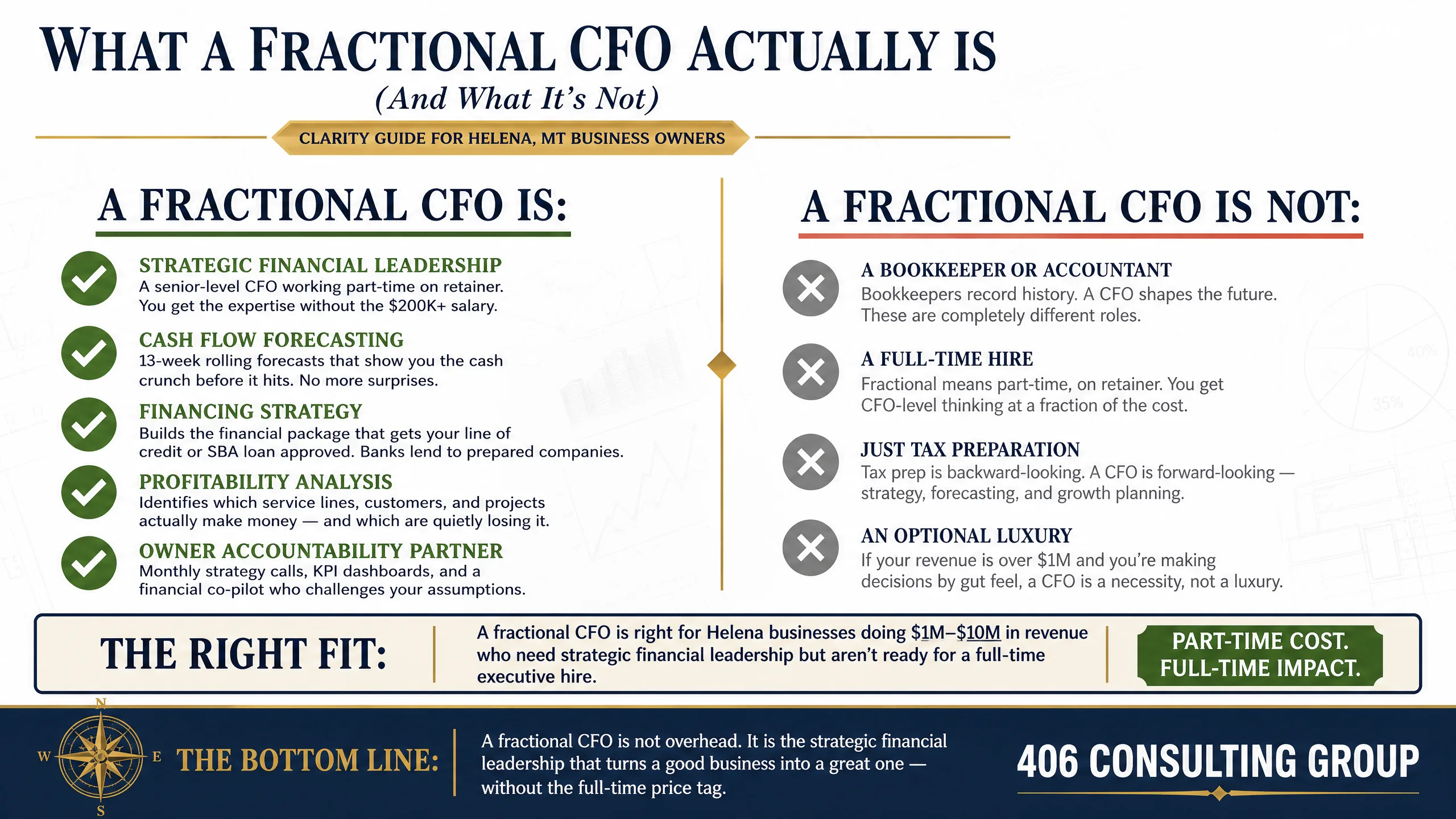
The most important thing to understand is what a fractional CFO is not. It's not a bookkeeper with a fancier title, and it's not just tax prep. Here's the distinction that clears up most of the confusion:
| Role | Owns | Answers |
|---|---|---|
| Bookkeeper | Recording transactions | What did we spend? |
| Controller | Making the numbers reliable | Are the numbers right? |
| CFO | Financial strategy & decisions | What should we do next? |
A growing company eventually needs all three. "Fractional" simply means you get the CFO function sized to your business — a few focused days a month rather than a $200,000 hire you can't yet justify. If you want the full breakdown of the bookkeeper-to-CFO progression, we cover it in controller services and CFO services.
Why Helena Companies Hit the CFO Ceiling
The short answer: growing companies hit a ceiling where the owner can no longer run the finances by instinct — the business has too many moving parts, and the decisions are too expensive to get wrong. In Helena, that ceiling shows up across the capital city's core sectors: professional services, government contractors, healthcare practices, nonprofits, and construction.
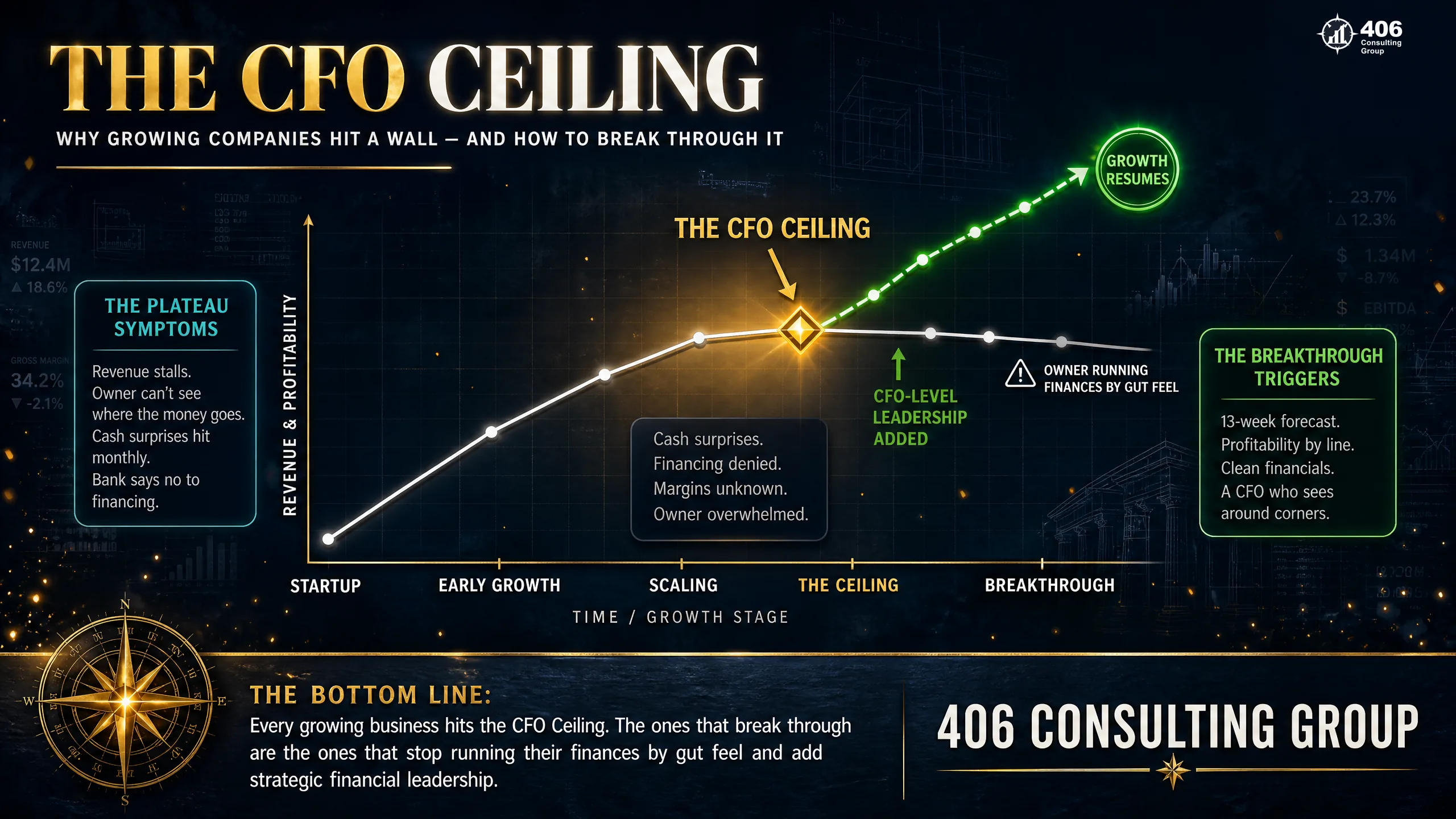
Helena's economy is unusual for Montana. As the state capital, it runs heavily on government, professional services, and healthcare — sectors full of firms that bill for time and expertise, win contracts and grants, and grow by adding people. Those are exactly the businesses where financial complexity outpaces the owner fastest: multiple service lines, project-based revenue, grant and contract compliance, and payroll as the biggest cost. The books can look fine while the owner quietly loses the thread on which work is actually profitable.
Signs you've hit the ceiling
Our example Helena firm — the $2.5M professional-services group — hit every one of these. Revenue was growing, the team was growing, and the owner was working more hours than ever while feeling less in control of the numbers. That's the ceiling. The Five Shifts are how a fractional CFO breaks through it.
The Five Shifts
The short answer: a fractional CFO transforms a company through five specific shifts — moving it from running on instinct to running on information. Here's the overview; the next five sections take each one in turn, with what it looks like for our Helena firm.
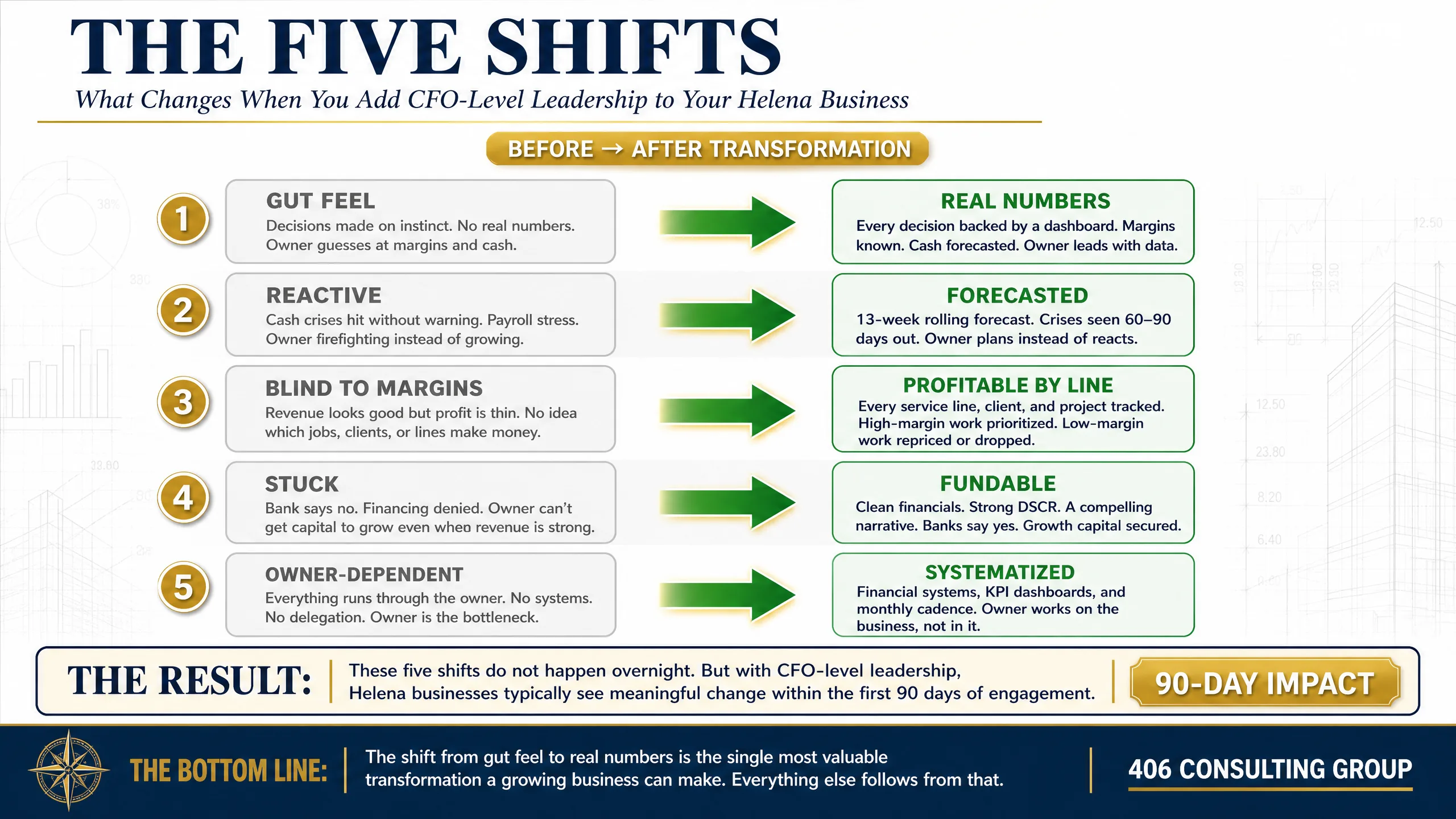
Gut feel → Real numbers
Reporting you can actually make decisions from, delivered on a schedule you can count on.
Reactive → Forecasted
A rolling cash flow forecast that shows what's coming, so you stop being surprised by your own bank account.
Blind → Profitable-by-line
Knowing exactly which services, clients, or projects make money — and which quietly lose it.
Stuck → Fundable
Financials and a story that get a bank, grantor, or investor to yes.
Owner-dependent → Systematized
Financial systems and rhythms that run without the owner holding it all in their head.
Shift 1: From Gut Feel to Real Numbers
The short answer: the first thing a fractional CFO does is turn your financial data into decision-grade information — a reporting package you can actually read and trust, delivered every month, not a pile of numbers you squint at once a year.
Most owners at the ceiling are making six- and seven-figure decisions on instinct, because the numbers they have are late, confusing, or untrustworthy. A CFO fixes the inputs first (often alongside a controller to tighten the monthly close), then builds the reporting layer on top: a clean profit and loss, a real balance sheet, the handful of KPIs that actually run your business, and budget-versus-actual so you can see where reality diverged from the plan.
The Helena firm, before & after
Before: the owner saw financials two months late and didn't fully trust them. After: a monthly reporting package landed by the 10th, with five KPIs the owner reviewed in fifteen minutes — utilization, realization, revenue per employee, gross margin, and cash. For the first time, the owner walked into the month knowing the score instead of guessing it.
Shift 2: From Reactive to Forecasted
The short answer: a fractional CFO builds a rolling cash flow forecast so you can see financial pressure coming weeks in advance — and act while you still have options, instead of reacting when the account runs dry.
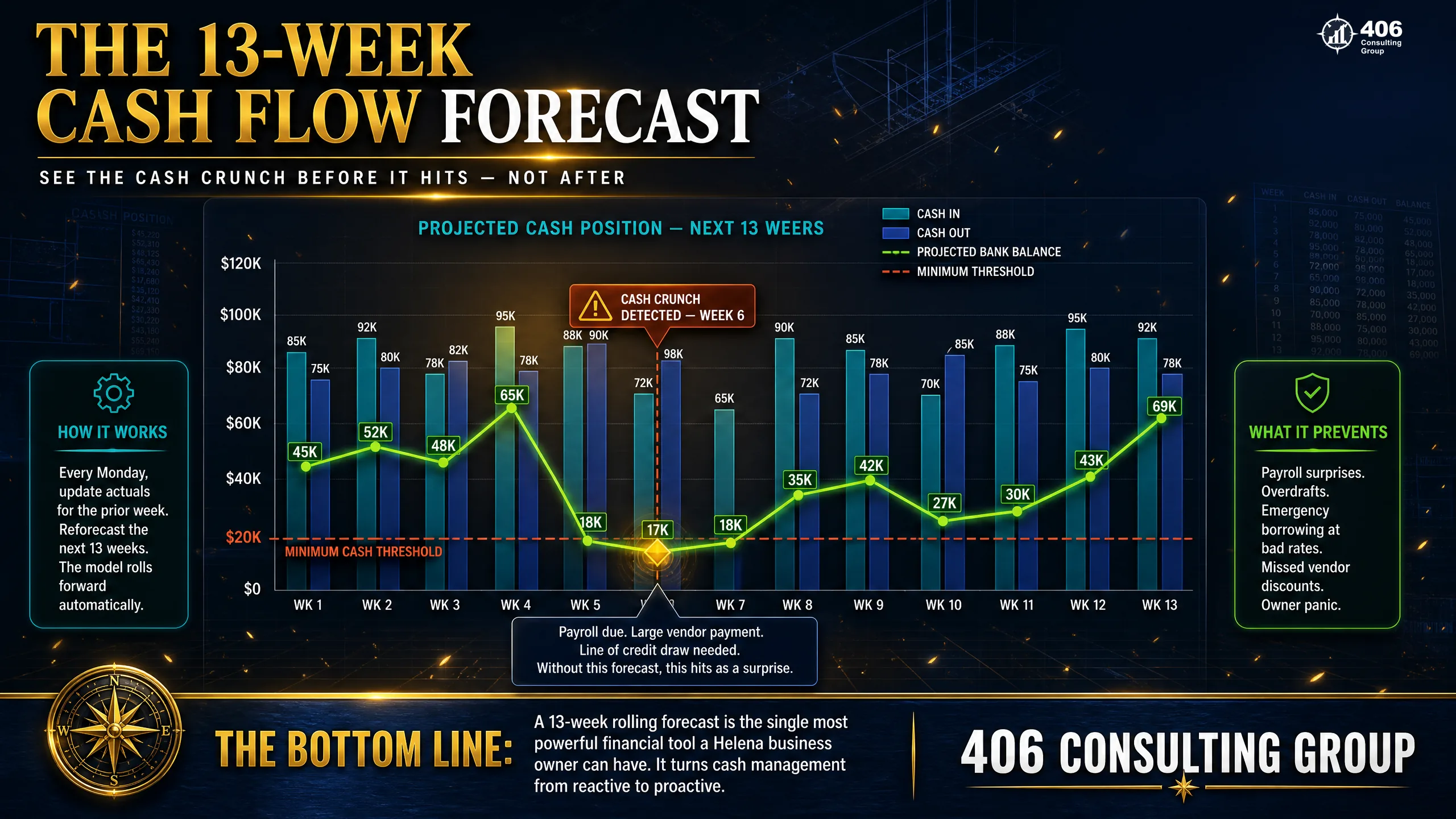
The single most valuable tool a CFO brings is the 13-week rolling cash flow forecast — a week-by-week projection of money in and money out. It's the difference between "I hope we're okay next month" and "we'll be tight the week of the 15th, so let's time that payment and accelerate two invoices." Profit can look great while cash quietly runs out; a forecast is how you stay ahead of the gap. (If that profit-vs-cash disconnect sounds familiar, we wrote a whole guide on why a profitable business can still be cash-poor.)
The Helena firm, before & after
Before: two near-misses on payroll in a profitable year, because a big client paid late and nobody saw it coming. After: a 13-week forecast flagged the same situation three weeks out, giving the owner time to draw on a line of credit and tighten collections — no drama, no scramble.
Shift 3: From Blind to Profitable-by-Line
The short answer: a fractional CFO shows you which parts of your business actually make money — by service line, client, or project — so you can do more of what's profitable and fix or fire what isn't. Most owners are flying blind here, and it's where the biggest gains hide.
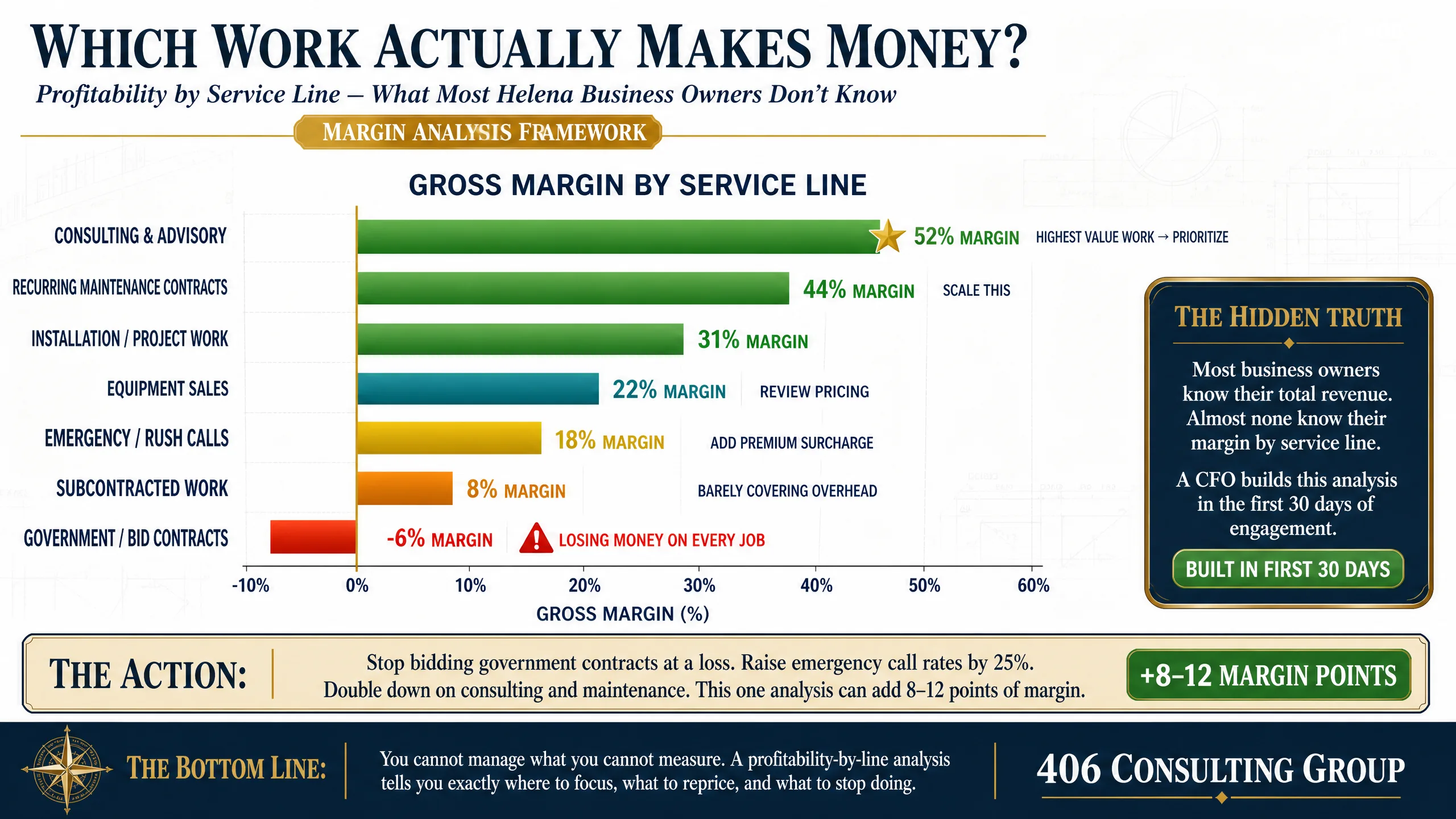
A total profit number hides more than it reveals. A company can be profitable overall while one service line or major client quietly runs at a loss, subsidized by the others. Until you break profitability down, you can't see it — so you keep chasing revenue that costs you money. A CFO builds the analysis that turns "we made money this year" into "this line earns 32%, that one earns 6%, and this big client is actually underwater once we count the hours."
The Helena firm, before & after
Before: three service lines, all assumed to be "fine." After: profitability analysis showed the newest line was running at a 4% margin while the core line ran 34% — the firm had been pouring its best people into its worst-returning work. Reprioritizing toward the high-margin line and repricing the low one added an estimated $95,000 to annual profit, with no new revenue required.
That's the recurring theme with this shift: the money was already in the business. It just couldn't be seen. (Illustrative figures.)
Shift 4: From Stuck to Fundable
The short answer: a fractional CFO makes your company fundable — building the financials, projections, and narrative that get a bank, grantor, or investor to yes. Most businesses that get turned down didn't have a business problem; they had a lender-package problem.
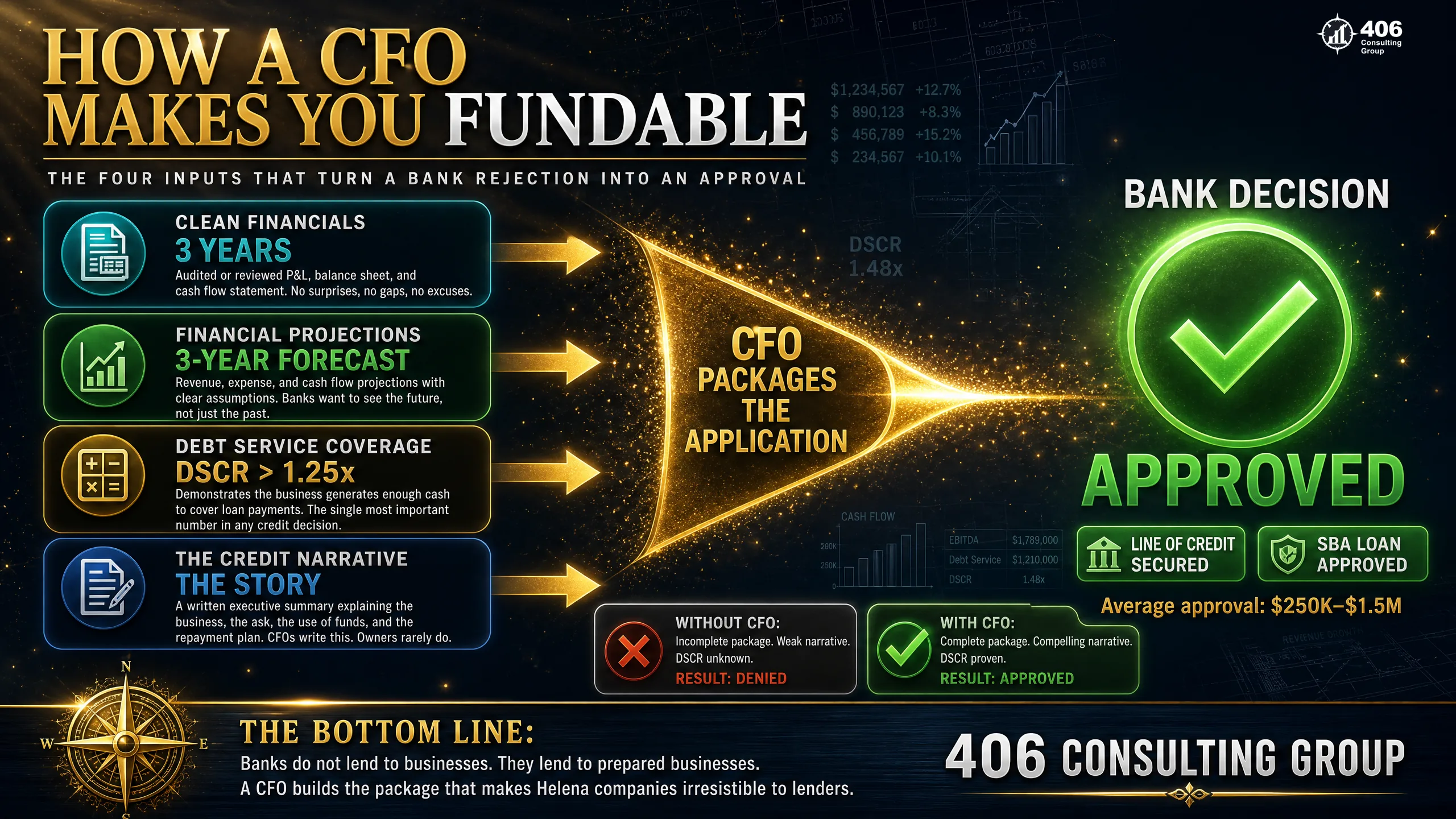
Banks and grantors underwrite the strength of your financial story, not just your numbers. A CFO prepares the package an underwriter actually wants: clean, credible financial statements, a two- or three-year projection, a debt-service-coverage calculation, and a narrative that answers the questions before they're asked. Having reviewed hundreds of these files from the lender's side of the desk, I can tell you the difference between an approval and a decline is very often just preparation. This is core CFO work.
The Helena firm, before & after
Before: a line-of-credit request stalled because the firm couldn't produce projections or a clean story. After: with a CFO-built package — statements, a 3-year forecast, and a DSCR that cleared the bank's threshold — the firm secured a $250,000 line of credit to smooth cash flow and fund growth. Same company, same numbers; a fundable presentation of them.
Shift 5: From Owner-Dependent to Systematized
The short answer: a fractional CFO installs the financial systems and rhythms that let the business run without the owner holding every number in their head — which is what finally gives the owner back time and options, including the option to eventually sell.
A business where only the owner understands the finances is fragile and hard to grow — and nearly impossible to sell for full value. A CFO builds the opposite: a monthly close and reporting rhythm, clear financial roles, documented processes, and a dashboard the leadership team can run from. The finances become a system the business owns, not a burden the owner carries.
The Helena firm, before & after
Before: every financial question routed through the owner, and the monthly numbers only existed because the owner chased them. After: a repeatable monthly close, a reporting package the leadership team reviewed together, and an owner who stopped being the company's spreadsheet. That's not just efficiency — it's what makes a business durable and, someday, sellable.
What the Transformation Is Worth
The short answer: for most companies at the ceiling, a fractional CFO pays for itself many times over — the engagement costs a fraction of a full-time hire, while the shifts it drives typically unlock far more in recovered margin, freed cash, and financing than the fee.
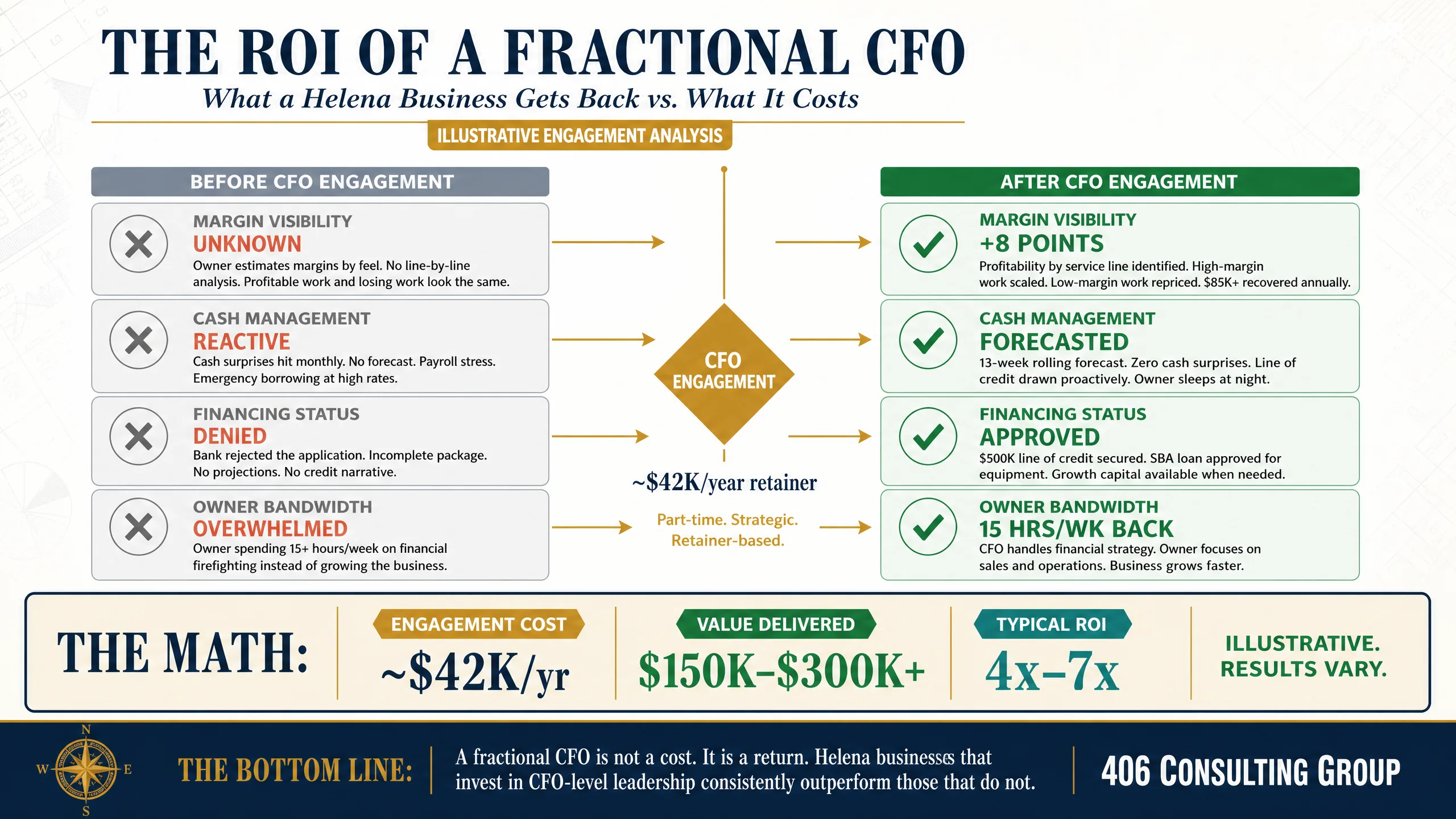
The Helena firm's first year
The investment
Fractional CFO engagement
~$3,500 / month
~$42,000 for the year
The return
+$95K profit from margin/pricing
+$250K line of credit secured
Payroll crises avoided; owner time returned
A ~$42,000 engagement that returned roughly $95,000 in recovered profit alone — before counting the financing, the avoided crises, and the owner's time. That's the math that makes fractional the obvious choice at this stage. (Illustrative figures; see our fractional CFO cost & ROI guide for the full breakdown.)
| Fractional CFO | Full-Time CFO | |
|---|---|---|
| Annual cost | ~$30K–$60K (retainer) | $150K–$300K+ salary + benefits |
| Commitment | Monthly, flexible | Full-time employee |
| Best for | ~$1.5M–$15M revenue | Larger / complex ($15M+) |
| Time to value | Weeks | Months (recruit + ramp) |
When Is the Right Time?
The short answer: the right time is when your books are clean but you still can't forecast cash, tell which work is profitable, or produce what a lender wants — or when a big decision is in front of you and you don't know if the numbers support it. Practically, that's most Helena companies in the $1.5M–$15M range.
Clear triggers to start
Maybe not yet
Not sure where you stand? Our free financial maturity assessment takes about eight minutes and tells you which layer of financial leadership your business needs next.
How a Helena Engagement Works
The short answer: a fractional CFO engagement is a monthly retainer with a defined rhythm — an upfront assessment, then a repeating monthly cycle of reviewing results, updating the forecast, and meeting to make decisions. It runs virtually, so a Helena company gets the same senior expertise as a big-city firm.
And this is genuinely how we work with everyone, not a concession for distance: even 70 to 80 percent of our own local clients never come into the office. The whole monthly cycle — reviewing results, updating the forecast, and meeting to decide — runs on secure cloud accounting and shared screens. For a Helena company, that means being in town or anywhere else in Montana makes no practical difference; you get the same senior CFO attention either way, because remote is simply how modern finance leadership is delivered now.
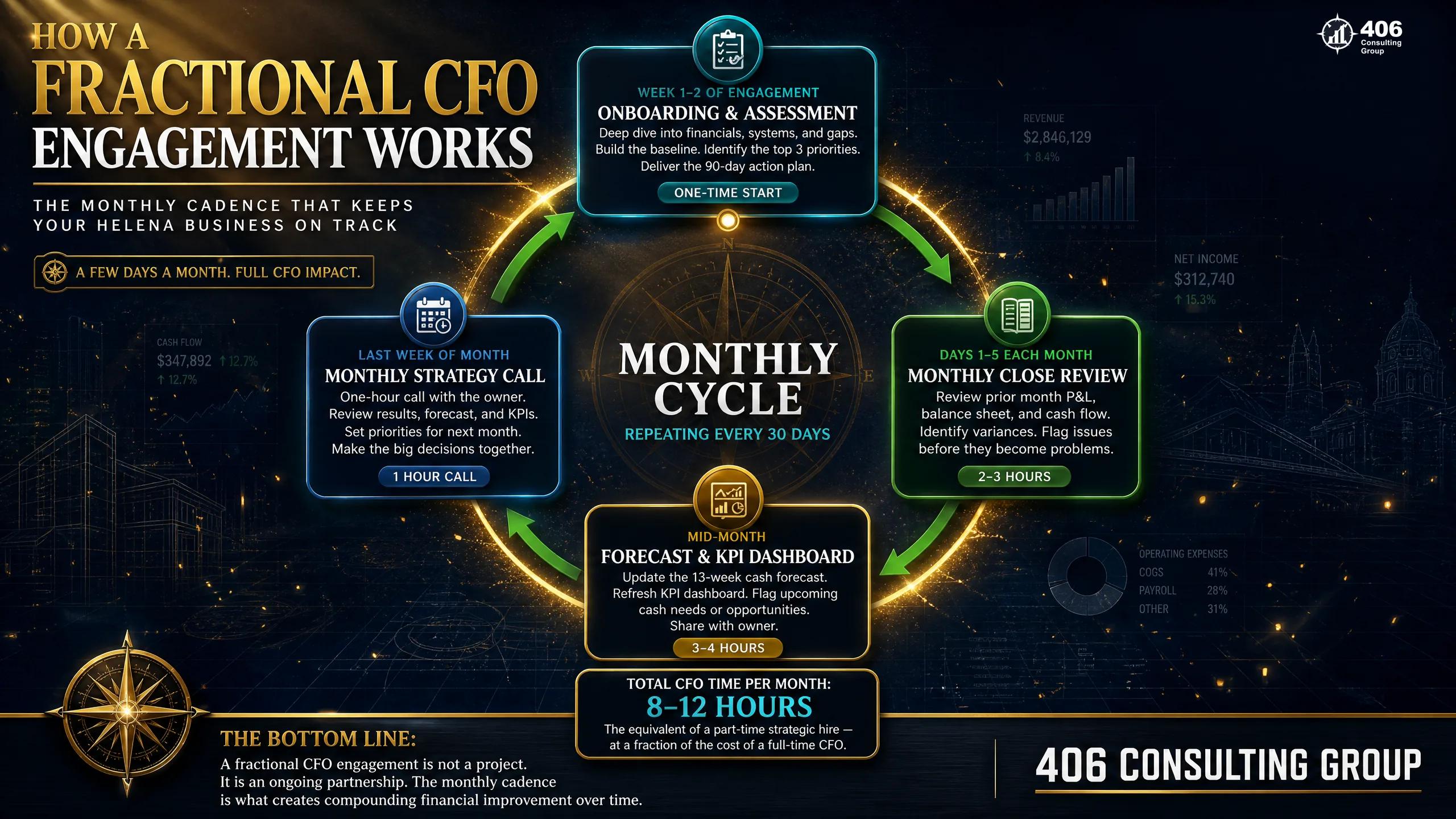
Assessment & priorities
We start by understanding the business, cleaning up what needs it, and identifying the two or three financial priorities that matter most right now.
Reporting & forecast stood up
We build the monthly reporting package, the KPI dashboard, and the rolling cash flow forecast — the instruments you'll run the business on.
The monthly rhythm
Each month: books reviewed, forecast updated, KPIs refreshed, and a strategy call to turn the numbers into decisions. A few focused days, every month.
Strategic projects as they arise
Financing, pricing overhauls, a big hire, an expansion, an exit — the CFO leads the financial side of the decisions that don't fit a monthly box.
That's the whole idea of fractional: senior financial leadership, sized and priced for where your Helena company actually is. If the Five Shifts describe a gap in your business, that's exactly the transformation we run — see our CFO services or start a conversation.
Frequently Asked Questions: Fractional CFO in Helena, MT
What is a fractional CFO?
A fractional CFO is an experienced chief financial officer who works with your company part-time, on a monthly retainer, instead of as a full-time employee. You get senior-level financial strategy — cash flow forecasting, margin and profitability analysis, financing and lender readiness, and growth planning — for the hours you actually need, typically a few days a month. It's the way a growing company gets true CFO leadership without committing to a full-time executive salary.
What does a fractional CFO do for a Helena business?
A fractional CFO drives five transformations: turning raw data into decision-grade reporting, building a rolling cash flow forecast, revealing profitability by service line or client, making the company fundable for banks and grantors, and installing financial systems so the business doesn't depend on the owner to hold every number. For Helena's professional-services firms, government contractors, healthcare practices, and nonprofits, that means finally being able to see which work makes money, plan cash confidently, and make big decisions on numbers instead of instinct.
How much does a fractional CFO cost in Helena, MT?
Most fractional CFO engagements in Montana run roughly $2,500–$5,000 per month, depending on the company's size, complexity, number of entities, and the scope of work. Engagements are structured as monthly retainers with defined deliverables, not open-ended hourly billing. Compare that to a full-time CFO at $150,000–$300,000+ in salary plus benefits, and the fractional model delivers senior expertise at a fraction of the cost — which is why it fits most businesses in the $1.5M–$15M revenue range.
Fractional CFO vs. full-time CFO — which does my business need?
For most Helena companies under about $15M in revenue, a fractional CFO is the better fit: you get senior financial leadership sized to your needs for a fraction of a full-time salary, with value in weeks instead of the months a full-time recruit takes to hire and ramp. A full-time CFO makes sense once the business is large or complex enough — multiple entities, sophisticated financing, a finance team to manage — to keep a senior executive fully occupied. Many companies use a fractional CFO for years before they ever need a full-time one.
When should a Helena company hire a fractional CFO?
The clearest time is when your books are clean but you still can't forecast cash, tell which work is profitable, or produce what a lender or grantor asks for — or when a major decision (a big hire, an expansion, a large contract, a sale) is in front of you and you can't tell if the numbers support it. Other triggers include cash always feeling tight despite being profitable, and being the only person in the company who understands the finances. Practically, most companies are ready in the $1.5M–$15M revenue range.
Is a fractional CFO the same as a bookkeeper or controller?
No — they're three different roles. A bookkeeper records transactions (what did we spend?). A controller makes the numbers reliable and closes the books (are the numbers right?). A fractional CFO uses those reliable numbers to drive strategy (what should we do next?) — forecasting, profitability analysis, financing, and growth decisions. A growing company typically needs all three working together. If your books aren't reliable yet, a controller usually comes before a CFO can add full value.
Does 406 Consulting Group provide fractional CFO services in Helena, MT?
Yes. 406 Consulting Group provides fractional CFO, controller, bookkeeping, payroll, and tax services for companies in Helena and across Montana and the greater Northwest. We work virtually — a monthly reporting package, a rolling cash flow forecast, profitability analysis, lender-ready financials, and a monthly strategy call. Carrie Anderson's commercial banking and underwriting background and Jason Anderson's operational finance experience are both directly relevant to the financial leadership Helena's professional-services, healthcare, and contractor businesses need. Contact us to talk through where your company is and what a fractional CFO engagement would look like.
Helpful Resources
Related Tools & Resources
Fractional CFO — Helena, MT
Ready to Break Through the CFO Ceiling?
406 Consulting Group gives Helena companies CFO-level financial leadership — forecasting, profitability analysis, lender-ready financials, and the monthly rhythm that runs the business on numbers, not instinct. Let's talk about the Five Shifts your company is ready for.
Fractional CFO Quick Reference
Helena, MT
The Five Shifts
The fractional CFO transformation
Hit the CFO Ceiling?
Get senior financial leadership, part-time.
About the Author
Carrie Anderson
Co-Founder, 406 Consulting Group
Background in commercial banking and underwriting — 300+ loan reviews — plus CFO-level advisory and tax strategy for Montana companies. Carrie helps Helena businesses break through the CFO ceiling with forecasting, profitability analysis, and lender-ready financials.
Read the Full Story