
Expert Bookkeeping Solutions
for Helena, MT Companies
Helena businesses lose thousands annually to bad bookkeeping — miscategorized contract revenue, missed Montana compliance deadlines, and financials that won't pass a lender's desk. Here's the complete professional bookkeeping guide for Montana's capital city.

Professional bookkeeping in Helena, MT isn't just about keeping clean records — it's about building the financial foundation that lets Montana's capital city businesses compete for state contracts, access commercial credit, and make growth decisions with real numbers instead of guesswork. Helena businesses lose thousands every year to bad books. Not because they aren't working hard. Because the financial infrastructure beneath them was never built right.
This guide covers what professional bookkeeping actually delivers for Helena companies — from state government vendors and St. Peter's Health-adjacent practices to professional service firms and Carroll College-area retailers. It explains the five-component Helena Financial Clarity System, the specific Montana compliance requirements every Helena business must meet, the real cost of handling books yourself, and exactly what to expect when you make the switch to a professional system.
Table of Contents
Why Helena Businesses Need Professional Bookkeeping Now
Helena is Montana's state capital and one of its most economically distinct cities. The dominant economic driver is state government — the Montana Legislature, executive branch agencies, the Supreme Court, and dozens of boards and commissions that collectively employ thousands and generate hundreds of millions in annual vendor and contractor spending. That economic reality creates a bookkeeping environment unlike any other Montana city: businesses here must often track revenue and expenses by contract, maintain records that can survive an agency audit, and manage the cash flow volatility that comes with government billing cycles.
$500K+
The complexity threshold
Above this revenue level, government contracting, multi-client billing, and Montana compliance requirements consistently outpace DIY bookkeeping systems.
10–15 hrs
Owner time lost monthly
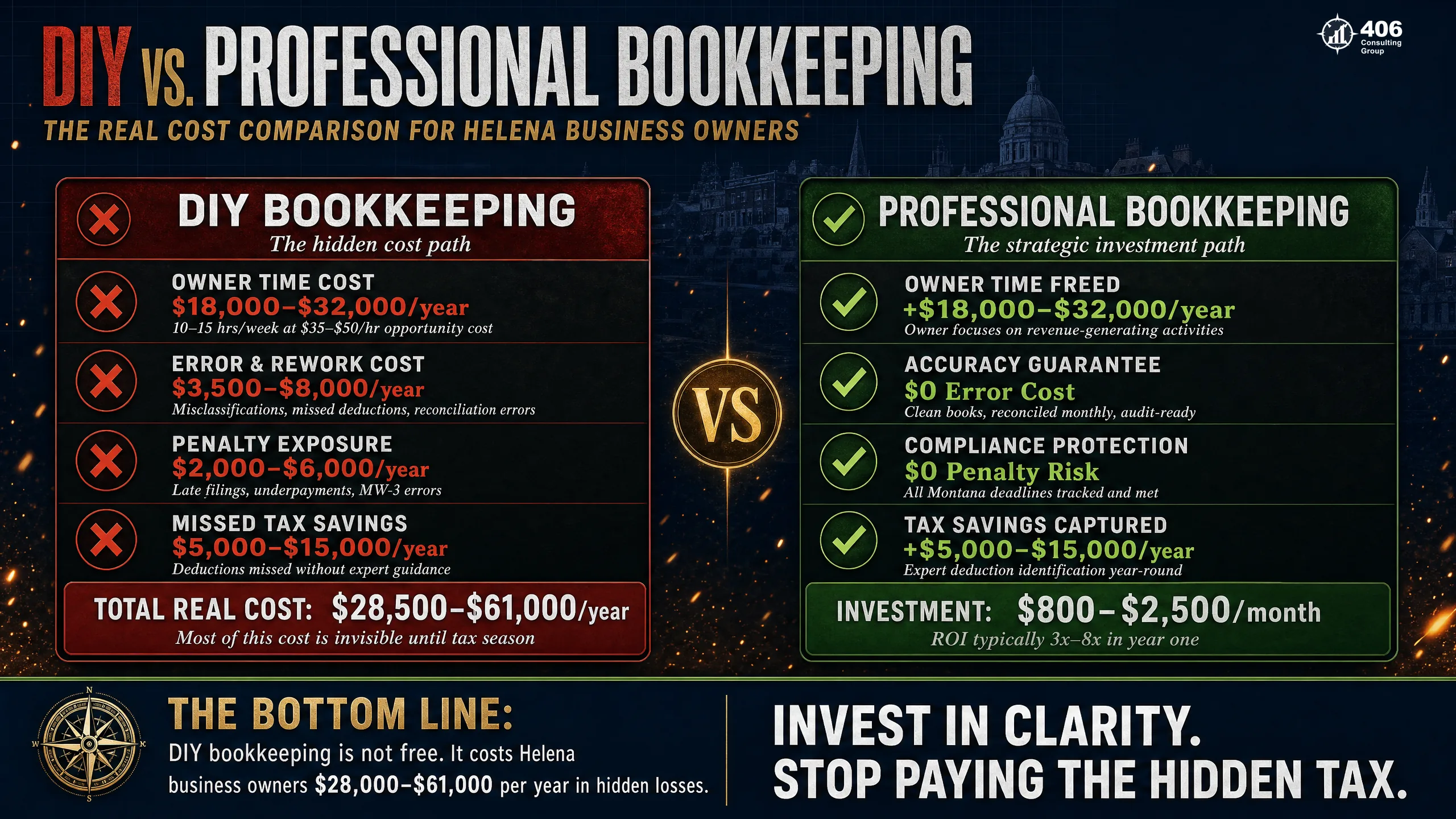
Helena business owners doing their own books spend an average of 10–15 hours per month — time worth $750–$1,500 at a $100/hr owner rate.
$3K–$12K
Average annual tax error cost
From miscategorized contract revenue, missed deductions, and wrong entity structure decisions made without current financial data.
Beyond government contracting, Helena's economy includes St. Peter's Health — the city's major regional hospital — Carroll College, a thriving professional services sector, a growing tourism economy anchored by Canyon Ferry Lake and the Gates of the Mountains Wilderness, and the retail and hospitality businesses that serve a city where state employees and their families make up a significant share of consumer spending.
Not sure what professional bookkeeping would cost for your specific situation? Use our Bookkeeping Cost Estimator to get a range based on your revenue level, industry, and complexity.
The Helena Pattern We See Repeatedly
A Helena consulting firm wins its second state agency contract. The owner is billing two agencies, managing two sets of deliverables, and trying to track expenses across both contracts in a single QuickBooks file with no project-level coding. By the time their CPA asks for year-end financials, no one can separate which expenses belong to which contract. The result: incorrect billing, a messy tax return, and an agency audit risk that didn't need to exist.
What Professional Bookkeeping Actually Delivers
The short answer: professional bookkeeping delivers financial clarity — the ability to see exactly where your business stands at any point in time and make decisions based on real numbers. But the specifics matter. Here's what a well-built bookkeeping system actually does versus what most Helena business owners think it does.
| What owners think bookkeeping is | What professional bookkeeping actually delivers |
|---|---|
| Data entry and receipt tracking | A living financial model that shows profitability, cash position, and tax exposure in real time |
| Something you do before tax season | A year-round system that captures every deduction and flags issues before they become problems |
| A record-keeping function | A decision-support tool — are you profitable on Contract A? Can you afford to hire? Should you buy the truck? |
| A cost center (the bookkeeper is an expense) | A profit protection system — most clients recover 2–4× the bookkeeping fee in tax savings and recovered billables alone |
| Something your CPA can fix at year-end | A real-time foundation — CPAs fix what they find; they can't recover what was never captured |
 Carrie Anderson, who spent years in commercial banking underwriting Montana business loans before joining 406 Consulting Group, puts it plainly: "The businesses that came to us for loans and got declined weren't necessarily unprofitable. They just couldn't prove it. Their books were either wrong or months behind. A bank can't approve a loan based on a promise — they need a current P&L, a clean balance sheet, and 12 months of bank statements that match."
The Helena Financial Clarity System
406 Consulting Group uses a five-component framework — the Helena Financial Clarity System — to build bookkeeping infrastructure for Helena businesses. Each component depends on the one before it. You can't have accurate tax-ready packaging if your records architecture is broken. You can't produce lender-ready reporting if your monthly close is weeks late.
Records Architecture
Chart of accounts, project coding, document flow
Montana Compliance Monitoring
State deadlines, payroll forms, estimated tax
Monthly Close Discipline
15-day close, bank rec, AR aging report
Tax-Ready Packaging
Year-round categorization, depreciation tracking
Lender-Ready Reporting
DSCR-ready financials, clean balance sheet
 Build these five components in order and you have a financial system that supports tax strategy, capital access, and growth decisions. Skip any one of them and the system has a gap that will surface at the worst possible moment — usually when you need financing, face an audit, or try to value the business for a sale or transition.
Component 1: Records Architecture
Records architecture is the structural foundation of your bookkeeping system — the chart of accounts, the project and class tracking setup, the document management process, and the transaction categorization rules that determine whether your financial reports tell the truth or just reflect noise.
For Helena businesses — particularly those with government contracts or multiple revenue streams — records architecture requires more careful design than a standard small business chart of accounts. A contractor billing three state agencies needs class tracking for each contract. A medical supply vendor invoicing both St. Peter's Health and a private practice needs revenue coded by customer type. A professional services firm needs time-coded expenses to support invoicing accuracy and profitability analysis by engagement.
Broken Records Architecture
- ✗Single-bucket revenue — all income in one account regardless of source
- ✗No project or class tracking — can't separate Contract A from Contract B
- ✗Miscategorized expenses — meals coded as supplies, equipment as repairs
- ✗No document management — receipts missing, invoices unmatched
- ✗Chart of accounts copied from a template with irrelevant categories
Proper Records Architecture
- ✓Revenue coded by contract, customer type, or service line
- ✓Class tracking by project — instant P&L by contract or engagement
- ✓Expense categories matched to tax Schedule C / corporate return categories
- ✓Document workflow: invoices, receipts, and contracts linked in accounting software
- ✓Chart of accounts reviewed and rebuilt for your specific business model
Helena Case Study: State Consulting Firm
A Helena management consulting firm was billing three state agencies under separate contracts. Their bookkeeper was entering all revenue into a single income account and all expenses into broad categories. When one of the agencies requested a billing audit, the firm couldn't produce a project-level cost report. We rebuilt their chart of accounts with class tracking by contract in 48 hours and produced a clean project P&L for each engagement going back 12 months. The audit passed. They now close books by the 12th of every month with contract-level profitability visible in real time.
Component 2: Montana Compliance Monitoring
Montana has its own tax and payroll compliance requirements that are separate from federal rules and that national bookkeeping services routinely get wrong. Helena businesses have an additional layer: state agency vendors and contractors may face audit exposure directly from agencies, not just from the Department of Revenue.
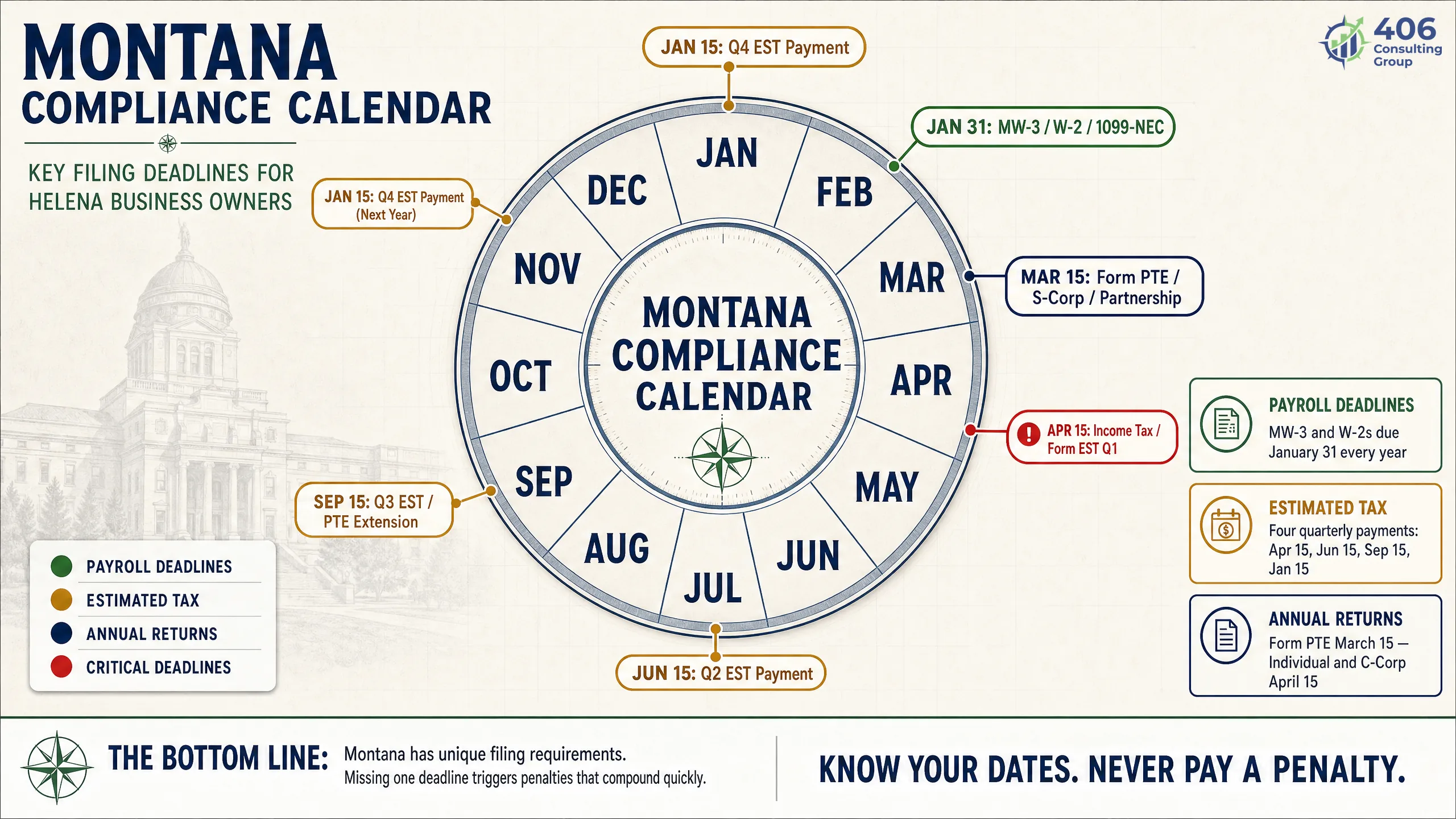
| Compliance Requirement | Montana Rule | Deadline / Frequency |
|---|---|---|
| Income Tax (individual/LLC) | 4.7% on first $20,500 net / 5.9% above | April 15 (with extension to Oct 15) |
| Estimated Tax Payments | Montana Form EST — quarterly if tax owed exceeds $500 | Apr 15 / Jun 15 / Sep 15 / Jan 15 |
| S-Corp / Partnership Return | Montana Form PTE (not federal Schedule K-1 alone) | March 15 (extension to Sep 15) |
| Payroll Withholding Deposit | Montana Form MW-1 — monthly or quarterly depending on size | 15th of month following quarter/month |
| Annual Payroll Reconciliation | Montana Form MW-3 with W-2s | January 31 |
| Unemployment Insurance | MT UI — taxable wage base $47,300/employee (2026) | Quarterly — 30 days after quarter ends |
| Workers' Compensation | Mandatory from day 1 of first employee — no exemption | Continuous coverage required |
| New Hire Reporting | Montana — 20 days from hire date | Per-hire within 20 days |
The Estimated Tax Trap for Helena Business Owners
Montana requires quarterly estimated tax payments (Form EST) when your total annual Montana tax liability will exceed $500. Most Helena sole proprietors and LLCs hit this threshold quickly. Missing an estimated payment triggers a penalty and interest — and the business owner who skipped three quarters in a row gets hit with a four-figure bill in April they weren't expecting. A proper bookkeeping system models your estimated liability monthly so you're never surprised. All current Montana forms and deadlines are at MTrevenue.gov.
Component 3: Monthly Close Discipline
A monthly close is exactly what it sounds like: every month, your books are closed, reconciled, and packaged into a management report within a defined window. Professional bookkeeping targets a 15-day close — books from March are fully reconciled and reported by April 15. DIY bookkeeping typically runs 45–90 days behind, which means you're making decisions based on Q1 data when Q2 is already half over.
What a 15-Day Close Produces
- ✓Bank and credit card reconciliation — every transaction verified
- ✓Accounts receivable aging — who owes you, for how long
- ✓Accounts payable schedule — what's due and when
- ✓Profit and loss statement — by entity and by project/contract
- ✓Balance sheet — assets, liabilities, equity at month-end
- ✓Cash flow summary — 30-day forward projection
- ✓Management package delivered to owner
Real Impact of the Monthly Close
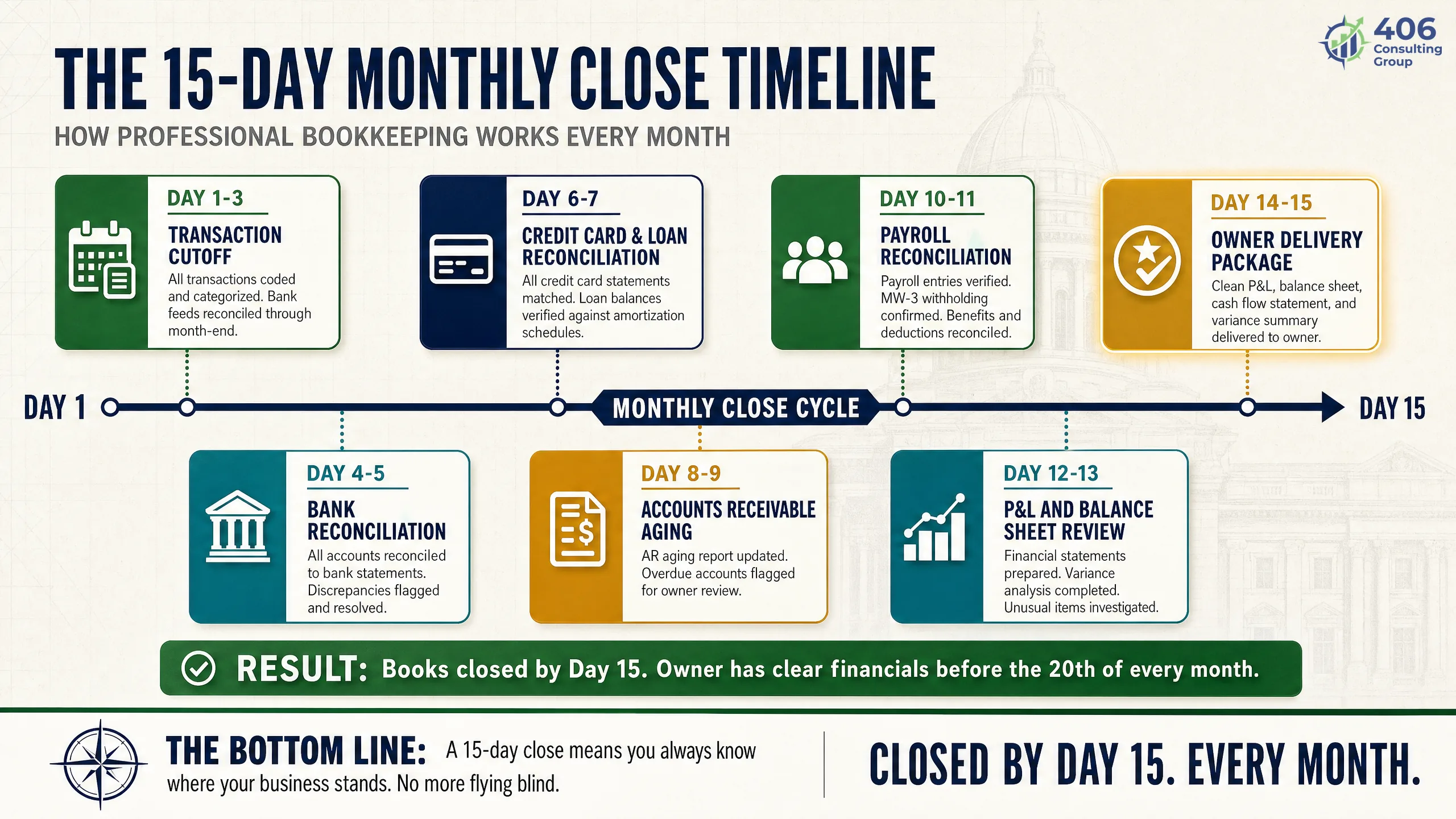 For Helena businesses with government contracts, the monthly close has an additional function: it generates the project-level cost data that agency billing requires. Without it, invoices are estimates. With it, invoices reflect real costs — which is both more accurate and more defensible if the agency audits the contract.
Component 4: Tax-Ready Packaging
Tax-ready packaging is the difference between handing your CPA a pile of bank statements in March and handing them a clean, categorized, reconciled set of financials that lets them actually do tax strategy instead of data cleanup. The average Helena business owner with disorganized books costs themselves $1,500–$3,500 in extra CPA fees each year — and more importantly, misses the deductions that a CPA can only find when they're not buried in cleanup.
Vehicle & Mileage
Standard mileage (70¢/mile, 2025) or actual expense method — both require a mileage log. We maintain it monthly.
Home Office Deduction
Simplified ($5/sq ft, max 300 sq ft) or actual — whichever maximizes the deduction based on your specific situation.
Section 179 & Bonus Depreciation
OBBBA (July 2025) permanently restored 100% bonus depreciation. Section 179 raised to $2.5M. We track eligible assets monthly.
Retirement Contributions
SEP-IRA (up to $70,000, 2025), Solo 401(k) ($23,500 employee + 25% employer match, 2025; $31,000 if age 50+), SIMPLE IRA — tracked and timed for maximum deduction.
Health Insurance Premiums
Self-employed health insurance deduction for sole proprietors and >2% S-Corp shareholders — often missed entirely in DIY systems.
State & Local Taxes
Montana income tax paid in prior year is deductible on federal return — tracked and categorized so your CPA captures it.
 Tax-ready packaging also includes S-Corp election modeling. Many Helena LLCs are paying self-employment tax (15.3%) on income that an S-Corp structure would shelter. If you're netting more than $60,000–$80,000 annually, the math usually favors an S-Corp — and our S-Corp Savings Calculator lets you run the numbers for your specific situation before making the decision. See our full Montana S-Corp tax benefits guide for the complete analysis.
Component 5: Lender-Ready Reporting
Lender-ready reporting is the final and most business-critical output of a well-built bookkeeping system. When a Helena business owner walks into a bank or SBA lender, they need to show financials that a commercial underwriter can evaluate — not QuickBooks reports that haven't been reconciled in four months.
Carrie Anderson reviewed commercial loan files for years in Montana banking before joining 406 Consulting Group. She knows exactly what underwriters look at — and what causes a decline even when the business is genuinely creditworthy. The most common lender-ready gaps in Helena businesses:
Balance sheet doesn't reconcile to bank statements
Monthly bank rec closes this gap. Any discrepancy flags immediately rather than building for months.
Accounts receivable includes uncollectible invoices inflating assets
AR aging review flags invoices over 90 days — those get written off or reserved, so the balance sheet reflects reality.
Owner draws coded incorrectly as expenses, understating profit
Draws go to equity accounts — not P&L. We reclassify and explain to the lender why adjusted profit differs from reported profit.
Debt service not tracked — lender can't calculate DSCR
DSCR (debt service coverage ratio) is the key underwriting metric. We track all loan payments monthly so DSCR is visible at any time.
Two years of financials unavailable or inconsistent
Lenders want 2–3 years. We maintain all historical data and can produce comparative statements on demand.
When Lender-Ready Matters Most
The moment a Helena business owner decides they want to borrow is the wrong time to start building lender-ready financials. By then you have 60–90 days of prep ahead of you. The businesses that access capital fastest are the ones whose books are lender-ready every month — not just when they need money.
Helena's Government Contractor Layer
Helena's status as Montana's state capital creates a bookkeeping layer that most other Montana cities don't have to the same degree. When a significant portion of your revenue comes from state government contracts, your bookkeeping system needs to support that relationship — and protect you if the agency ever audits your billing.
What State Contracting Adds to Your Bookkeeping
- 1Project-level cost tracking: Each contract needs its own revenue and expense tracking — agencies audit billing against actual costs.
- 2Invoice documentation: State invoices must typically reference deliverables or hours. Your books must support every line item.
- 3Prevailing wage compliance: Public works contracts trigger Montana prevailing wage rates — payroll records must reflect compliance.
- 4Retainage tracking: State contracts often hold back 5–10% retainage — your AR must reflect what's billed vs. what's collectible now.
- 5Contract closeout records: When a contract ends, the agency may audit final billing. You need records going back to the start.
The Contractor Risk Most Helena Firms Miss
State agencies routinely audit contractor invoices, especially on multi-year or high-value contracts. The audit isn't always adversarial — but it is specific. They will ask for payroll records, time logs, expense documentation, and proof that what was billed matches what was delivered.
Firms that fail audits don't always lose because they billed wrong. They lose because their records can't prove they billed right. A properly structured bookkeeping system makes audit response a paperwork exercise, not a crisis.

For Federal Contractors: DCAA Awareness
Helena businesses with federal contracts — particularly those working with agencies that flow through federal funding — may face Defense Contract Audit Agency (DCAA) standards. While DCAA compliance is its own discipline, a properly structured bookkeeping system using job cost accounting principles is the foundation for DCAA adequacy. We have experience setting up DCAA-aware cost accounting structures for Montana federal contractors — contact us if that's your situation.
Industry Spotlight: Healthcare and State-Adjacent Vendors
Two industries have specific bookkeeping needs in Helena that go beyond standard small business accounting: healthcare-adjacent vendors (medical supply, billing services, physical therapy, specialty practices, and other businesses in St. Peter's Health's vendor ecosystem) and professional service firms serving state agencies (IT consultants, HR services, training providers, environmental consultants).
Healthcare-Adjacent Vendors
St. Peter's Health ecosystem businesses
Revenue recognition complexity: Healthcare vendors often bill on net-30 to net-60 terms and deal with insurance reimbursement cycles. AR aging management is critical — accounts over 90 days need written-off or collected before they distort your balance sheet.
HIPAA records handling: If your bookkeeping includes any patient-related billing data, document management must be HIPAA-aware. Cloud accounting platforms with appropriate BAA agreements are required.
Equipment and supply tracking: Medical supply vendors need inventory accounting — COGS tracking against revenue. Without it, gross margin is invisible and pricing decisions are guesswork.
Contract pricing analysis: St. Peter's and other healthcare systems negotiate vendor pricing periodically. Your bookkeeping should show margin by product and contract — so you know which business to keep and which to reprice.
State-Adjacent Professional Services
IT, HR, training, consulting, environmental firms
Time-based billing: Professional service firms billing hourly or by deliverable need time tracking integrated with accounting — so invoices match actual costs and profitability per engagement is visible.
Multiple agency clients: A firm with contracts across three state agencies needs revenue segregated by client — both for billing accuracy and for visibility into which clients are most profitable.
Subcontractor 1099 management: If you use subcontractors on state work, 1099-NEC filing is required for payments over $2,000 (2026 OBBBA threshold) — with proper W-9 collection before work begins.
Reimbursable expense billing: Travel, materials, and other reimbursable expenses billed to agencies need clean documentation — both for billing accuracy and tax purposes.
Helena Case Study: IT Consulting Firm with Two Agency Contracts
A Helena IT consulting firm was billing two state agencies — one on a time-and-materials contract, one on a fixed-price deliverable. They had no way to see which contract was more profitable. After a full records architecture rebuild with class tracking by contract, they discovered that their fixed-price contract was operating at a 12% margin while their T&M contract was at 34%. They renegotiated the fixed-price contract at renewal — gaining $40,000 in additional annual revenue — and expanded their T&M work with the second agency. The data made the decision obvious. Without it, they would have continued treating both contracts the same.
Virtual vs. Local Bookkeeper in Helena
Helena business owners often ask whether they need a local bookkeeper — someone they can meet with in person — or whether a virtual firm can handle their finances just as effectively. The honest answer: for most Helena businesses, a Montana-based virtual firm with deep state-specific compliance knowledge delivers better service than a local generalist bookkeeper, and often at a lower cost.
Here is the part most owners don't expect: even among the clients close enough to visit us, something like 70 to 80 percent never do. Their bookkeeping runs start to finish through secure cloud software, an online document portal, and a standing monthly call. So for a Helena business, virtual isn't a compromise you accept in order to work with us — it is the identical process every client already experiences, and being in Helena versus anywhere else in Montana has zero bearing on the quality of your books.
| Criteria | Local Helena Bookkeeper | Montana-Based Virtual Firm (406 CG) |
|---|---|---|
| Montana compliance knowledge | Varies widely — depends on individual | Specialized — Form PTE, Form EST, MW-1, prevailing wage |
| Government contractor experience | Rarely — most focus on retail/service | Direct experience with MT agency contract structures |
| In-person availability | Yes — meetings in Helena | Video + portal — most clients prefer async |
| Technology stack | Often QuickBooks Desktop or manual | Cloud-first: QBO, Xero, Bill.com, Gusto |
| Scalability | Limited — one person, no backup | Team-based — coverage when your bookkeeper is out |
| Response time | Business hours, in-person oriented | Portal access 24/7, typical response within hours |
| Cost | $25–$45/hr often billed in arrears | Fixed monthly fee — predictable, budgetable |
| CPA coordination | Often siloed — owner bridges the gap | Direct CPA coordination — no owner relay required |
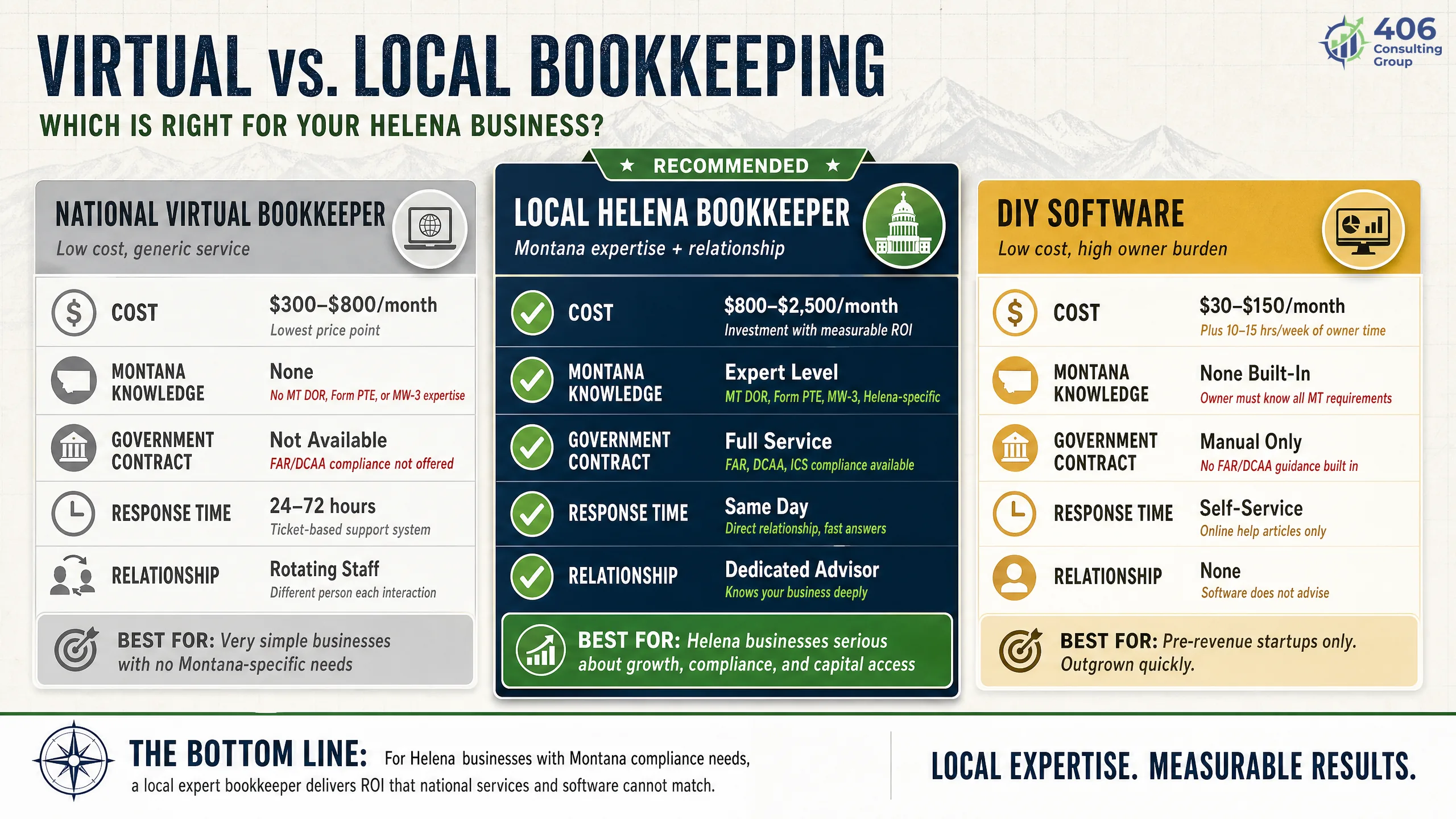 The one scenario where a local bookkeeper has a genuine advantage: businesses with high-volume physical receipts (a restaurant, a retail store with lots of cash transactions) where daily in-person processing matters. For the professional service firms, consultants, healthcare vendors, and contractors that make up most of Helena's business economy, virtual is the better option. For a broader Montana perspective, see our bookkeeping guides for Great Falls, Billings, and Missoula.
The Bookkeeper-to-Controller Upgrade Path
A bookkeeper records what happened. A controller interprets what it means and manages what happens next. The distinction matters when a Helena business reaches the point where keeping accurate records isn't enough — when the owner needs someone to manage cash flow actively, oversee financial operations, and produce the reporting that investors, lenders, and board members expect.
Stage 1: Bookkeeper
Under $2M
Record, reconcile, report
- ›Transactions are the main complexity
- ›One entity, one revenue stream
- ›Owner manages cash flow mentally
- ›CPA does tax strategy at year-end
Stage 2: Senior Bookkeeper
$2M–$5M
Bookkeeping + basic analysis
- ›Multiple revenue streams or contracts
- ›Payroll over 10 employees
- ›Basic KPI reporting needed
- ›Monthly close is a business requirement
Stage 3: Controller
$5M+ or multi-entity
Financial oversight + management
- ›Board or investor reporting required
- ›Multiple entities or locations
- ›Budget vs. actual tracking monthly
- ›Lender covenants to monitor
 406 Consulting Group offers both bookkeeping and controller services for Helena businesses — so when you hit the inflection point where a bookkeeper isn't enough, you don't have to restart with a new provider. We already know your business. We rebuild the function around your new requirements without losing the institutional knowledge we've built.
What to Expect in Your First 60 Days
Most Helena businesses that come to us have books that are months behind, miscategorized, or missing entire transaction classes. The first 60 days are a cleanup and rebuild — and then a transition into ongoing clean bookkeeping. Here's exactly what that looks like:
- ›Access granted to QuickBooks Online (or migration from desktop/Xero)
- ›Bank and credit card connections established
- ›Prior-period transactions reviewed — scope of cleanup defined
- ›Chart of accounts rebuilt for your business model
- ›Project/class tracking set up if government contracts or multiple revenue streams
- ›All prior-year and YTD transactions categorized
- ›Bank reconciliation completed for all open periods
- ›AR aging built — invoices matched to payments
- ›Miscategorized transactions corrected and documented
- ›Tax exposure for open year identified and flagged for CPA
- ›First management package delivered — P&L, balance sheet, AR aging
- ›Estimated tax liability calculated for current quarter
- ›Cash flow projection for next 30 days
- ›Owner walk-through: understanding your numbers, questions answered
- ›Ongoing workflow established — document submission, response times, reporting cadence

The 60-Day Outcome
By the end of the first 60 days, most Helena clients have clean books, a first management package, and a clear picture of their financial position — many for the first time. The cleanup typically surfaces $5,000–$20,000 in missed deductions and billing errors. Not because the prior bookkeeper was dishonest, but because disorganized records are leaky by nature.
Frequently Asked Questions
How much does professional bookkeeping cost in Helena, MT?
Professional bookkeeping in Helena, MT typically ranges from $400–$700/month for businesses under $750K in revenue, $700–$1,500/month for $750K–$3M, and $1,500–$2,500+/month for businesses over $3M or with multiple entities or government contracts. State contractors and government vendors often run at the higher end due to project-level tracking and audit-readiness requirements.
What's different about bookkeeping for Montana state contractors and government vendors?
Montana state contractors and government vendors need project-level bookkeeping — tracking revenue and expenses by contract to support billing, agency auditing, and program reporting. This requires a more detailed chart of accounts, class tracking in your accounting software, prevailing wage compliance if applicable, and retainage tracking for contracts that hold back payment. National bookkeeping services often miss these requirements entirely.
When should a Helena business upgrade from a bookkeeper to a controller?
A Helena business should consider upgrading from bookkeeping to controller services when revenue exceeds $3–5M, the business has multiple entities or revenue streams, a lender or investor is requesting GAAP-level financials, or internal cost overruns can't be tracked in real time. A controller adds management reporting, financial oversight, budget-to-actual analysis, and audit-ready close processes that a bookkeeper doesn't typically provide.
What Montana compliance requirements affect Helena small businesses?
Helena small businesses are subject to Montana income tax (4.7% on the first $20,500 of net income, 5.9% above that), quarterly estimated payments via Form EST, monthly or quarterly payroll withholding deposits (Form MW-1), and annual reconciliation (Form MW-3). S-Corporations file Montana Form PTE by March 15. Workers' compensation coverage is mandatory from the first day of employment. UI taxes apply on wages up to $47,300 per employee (2026).
Can a virtual bookkeeping firm handle Helena business finances as well as a local bookkeeper?
Yes — for most Helena businesses, a Montana-based virtual firm delivers better service than a local generalist bookkeeper. The key advantage is Montana-specific compliance expertise: Form PTE, Form EST, MW-1, prevailing wage reporting, and Montana DOR deadlines. Cloud accounting platforms allow real-time access to your books from anywhere. The only scenario where local has a genuine edge is high-volume physical receipt businesses like restaurants or retail with daily cash handling.
What happens in the first 60 days when I switch to professional bookkeeping?
The first 60 days include: (1) full historical cleanup of existing records, (2) chart of accounts rebuild for your specific business model, (3) integration of bank, payroll, and invoicing data, (4) your first clean monthly close with management package, and (5) a tax-readiness review to identify missed deductions and filing issues. Most Helena businesses have clean books within 45 days. The cleanup typically surfaces $5,000–$20,000 in missed deductions and billing errors.
Helena, MT
Clean Books. Montana Compliance. Financial Clarity.
406 Consulting Group builds the bookkeeping infrastructure Helena businesses need — from state contractor project tracking to monthly close discipline and lender-ready reporting. Every component of the Helena Financial Clarity System, built for your specific situation.
The Helena Financial Clarity System
5 components — build them in order
Records Architecture
Chart of accounts, project coding, document flow
Montana Compliance Monitoring
Form PTE, Form EST, MW-1, UI deadlines
Monthly Close Discipline
15-day close, bank rec, AR aging, management report
Tax-Ready Packaging
Year-round categorization, S-Corp modeling
Lender-Ready Reporting
DSCR-ready financials, clean balance sheet
Helena Bookkeeping Pricing
Foundation
Under $750K revenue
Professional
$750K–$3M revenue
Controller
$3M+ or government contracts
Related Guides