
Should I Incorporate in Delaware, Nevada, or Wyoming?
What Montana Business Owners Actually Need to Know
The internet says Delaware, Nevada, or Wyoming. Your formation service says pick one. Here is what they are not telling you — and why a Montana LLC with the right tax election is almost certainly the better answer.
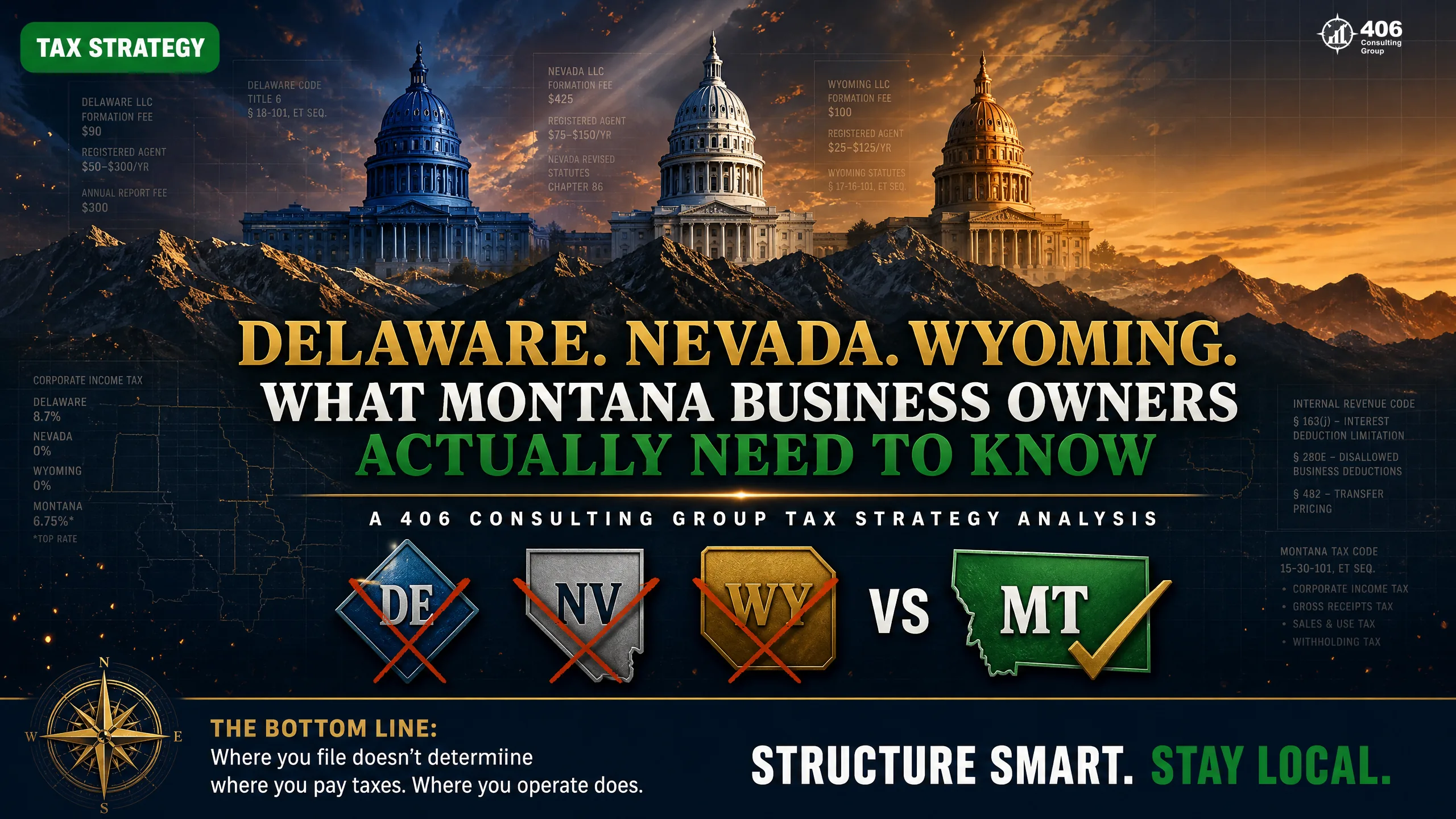
If you've searched “should I incorporate in Wyoming” or “best state to incorporate an LLC” in any small business forum, you already know what the internet says: Delaware, Nevada, or Wyoming. The advice is everywhere, it sounds sophisticated, and it comes with just enough truth mixed in to be convincing.
Here is what the internet is not telling you: for most Montana business owners, incorporating outside your home state costs more, creates more complexity, and delivers zero of the tax benefits you were promised. The people telling you to incorporate in Delaware are largely formation services collecting a fee. The YouTube creators are running affiliate links. Nobody in that conversation is asking whether it actually applies to you.
This guide gives you the honest answer — including the narrow cases where out-of-state incorporation genuinely makes sense, and the far more common case where the real tax savings are sitting in a completely different move.
By Carrie Anderson — Former Corporate Controller, contracted loan analyst on 300+ Montana commercial loan applications, and co-founder of 406 Consulting Group.
Quick Answer: Should You Incorporate in Delaware, Nevada, or Wyoming?
- →For 95% of Montana businesses: No. You still owe Montana taxes regardless of formation state. Out-of-state formation adds fees without reducing your tax bill.
- →For Delaware: Only if you are raising institutional venture capital or pursuing an IPO. Not relevant for most Montana SMBs.
- →For Wyoming: Only for asset protection via a holding LLC structure, or genuine privacy needs. Not a tax strategy.
- →The real move: A Montana LLC with an S-Corp election saves $8,000–$15,000/year in self-employment tax at $150K–$250K net profit. That is the actual tax strategy.
Table of Contents
The Pitch You've Been Hearing — And Why It Spreads
The Delaware/Nevada/Wyoming pitch follows a predictable script. It goes something like this: “The smartest businesses all incorporate in Delaware. Delaware has the most business-friendly courts and tax laws. Nevada has no state income tax. Wyoming has the strongest LLC protections in the country. You'd be leaving money on the table by forming in your home state.”
Every part of that pitch contains a grain of truth. And every part of it is missing the context that determines whether any of it applies to you. Here is why this advice spreads despite being wrong for most small business owners:
LegalZoom, Incfile, ZenBusiness
These are formation services. They make money when you file — not when you make the right choice. They have no incentive to tell you that a Montana LLC is probably the better answer. Their business model depends on you believing the out-of-state story.
YouTube and blog content
Most "best state to form an LLC" content is written to rank on Google, not to be accurate. The creator earns affiliate revenue from the formation service they recommend. The advice is generic, national, and completely divorced from your specific situation as a Montana business owner.
Reddit and forum advice
The people answering your questions are other business owners, not tax attorneys or CPAs who specialize in multi-state entity law. They formed in Wyoming and it didn't hurt them — so they recommend it. That is not analysis. It's anecdote.
Generic accountants
Many CPAs will simply file what you bring them. If you show up with a Wyoming LLC, they'll file it. They may not proactively flag that you still owe Montana taxes, still need a foreign qualification, and are paying two sets of annual fees for no benefit.
The Business Model Behind the Bad Advice
A $49 Wyoming LLC formation earns a formation service $40–$45 in margin. They also upsell registered agent service ($99–$199/yr), annual report filing ($99/yr), and operating agreement preparation ($99). The formation service has every financial incentive to make you believe Wyoming is the right answer. They have zero incentive to tell you that a $70 Montana LLC with a free operating agreement template might be all you need.
The Rule That Changes Everything: Nexus
There is one concept that, once you understand it, makes the entire Delaware/Nevada/Wyoming debate irrelevant for most Montana business owners. That concept is nexus.
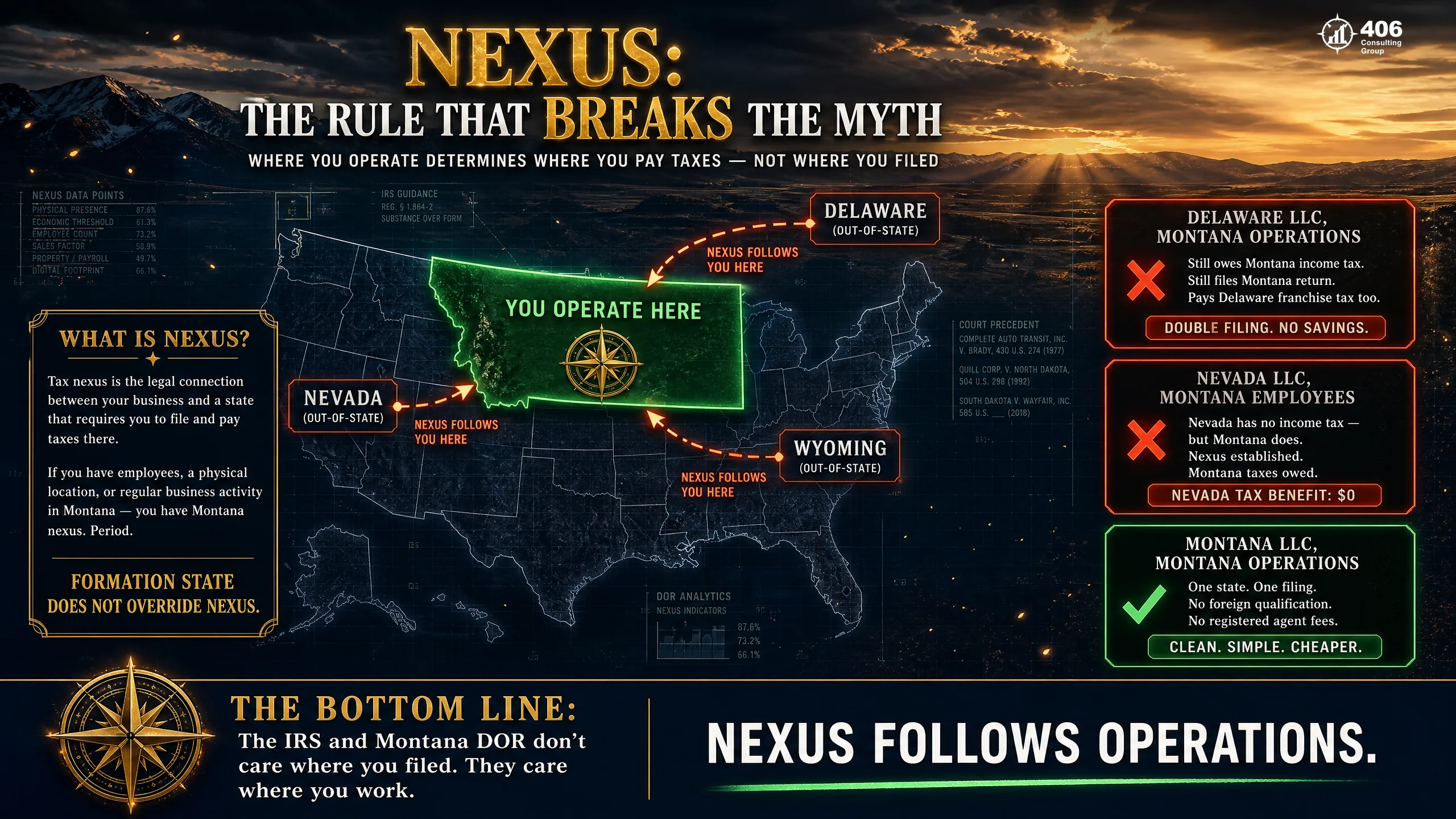
Nexus is the legal connection between your business and a state that requires you to pay that state's taxes and follow its laws. It is established by physical presence — employees, an office, a warehouse, a storefront — or by substantial economic activity. Here is the rule that formation service websites do not put in large type on their homepage:
If you operate in Montana, you pay Montana taxes.
It does not matter where you filed your formation paperwork.
This is not an interpretation or a gray area. It is how state tax law works in every state in the country.
A Wyoming LLC that operates in Montana has Montana nexus. It owes Montana income tax. It is subject to Montana regulations. The only thing that's changed is that now you also have Wyoming obligations — annual report, registered agent, filing fees — on top of everything Montana requires. You haven't avoided Montana. You've added Wyoming. Use our Multi-State Tax Nexus Finder to see exactly which states your business has nexus in.
What people believe
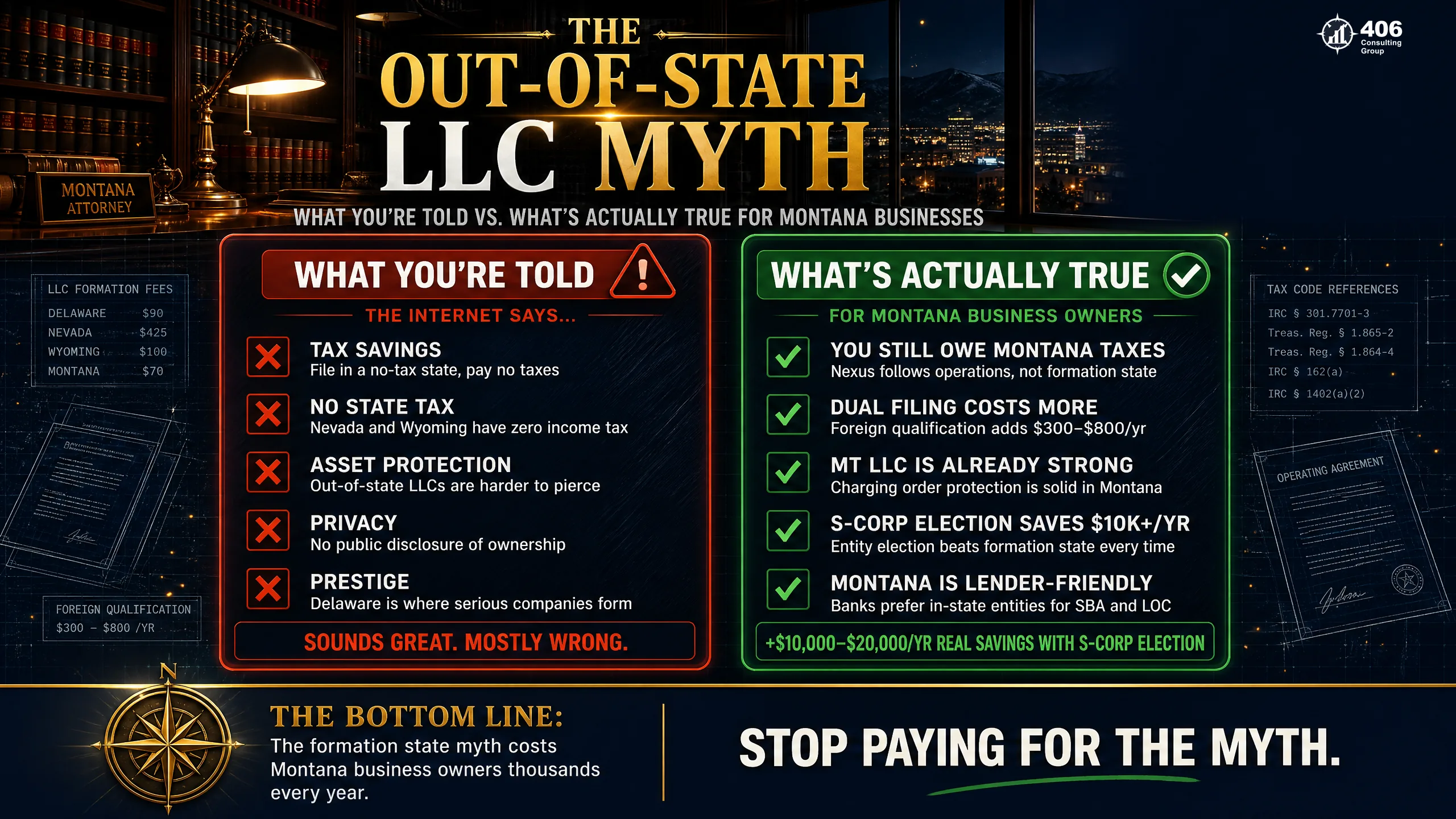
- ✗Wyoming has no income tax → I pay no income tax
- ✗Nevada has no corporate tax → my business pays no corporate tax
- ✗Delaware is more favorable → my business gets those favorable rules
- ✗Forming out of state reduces my tax burden
What is actually true
- ✓Wyoming has no income tax for Wyoming residents — you live in Montana
- ✓Nevada's tax advantages apply where business activity occurs
- ✓Delaware rules govern Delaware-registered disputes, not Montana ones
- ✓Forming out of state adds filing obligations, not removes them
What “Foreign Qualification” Actually Costs — The Step Nobody Mentions
Here is the step that formation service websites bury in fine print or skip entirely: if you form your LLC in Delaware, Nevada, or Wyoming and then operate in Montana, you are legally required to register as a foreign entity in Montana before conducting any business activity here. This is not optional. Operating as an unregistered foreign entity in Montana can void contracts and expose owners to personal liability.
Foreign qualification means you pay fees and maintain compliance in bothstates. You're not replacing Montana — you're adding another state on top of it. Here is what that actually costs across all four options:
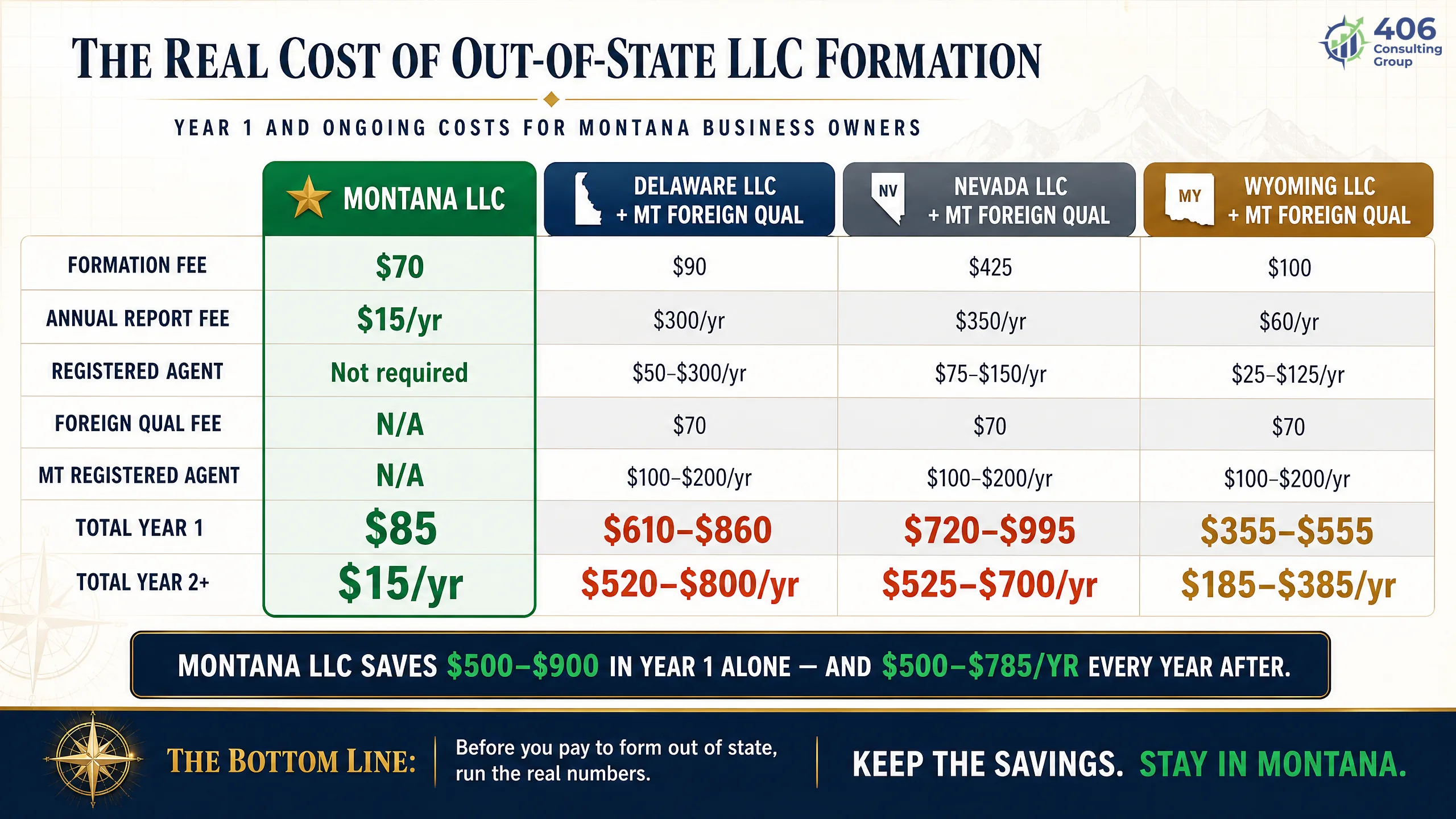
| Cost Item | Montana LLC | Delaware + MT | Nevada + MT | Wyoming + MT |
|---|---|---|---|---|
| Formation fee | $70 | $90 (DE) | $75 (NV) | $100 (WY) |
| Annual report fee | $20/yr | $300/yr (DE) | $200/yr (NV) | $60/yr (WY) |
| Home state registered agent | N/A | $100–$200/yr | $100–$200/yr | $50–$150/yr |
| MT foreign qualification | N/A | $70 | $70 | $70 |
| MT registered agent | N/A | $100–$200/yr | $100–$200/yr | $100–$200/yr |
| MT annual report | $20/yr | $20/yr | $20/yr | $20/yr |
| Year 1 total (est.) | $90 | $430–$630 | $365–$565 | $290–$490 |
| Year 2+ total (est.) | $20/yr | $520–$720/yr | $420–$620/yr | $230–$430/yr |
Carrie Anderson's Perspective — From the Lender's Side of the Table
Having analyzed and packaged 300+ commercial loan applications as a contracted analyst for a Montana community bank, Carrie Anderson has seen firsthand how out-of-state entity structures affect underwriting. When a loan application arrives with a Wyoming LLC operating in Montana, the underwriter has to understand the dual-state compliance structure, confirm the foreign qualification is current, and ensure the entity has legal standing to conduct business in Montana. It adds questions. Questions slow approvals. A clean Montana LLC with an S-Corp election — properly documented — is the structure that gets processed faster and approved more readily. The “asset protection” from the Wyoming formation often introduces more practical risk than it removes.
Delaware: When It Actually Makes Sense
Delaware is not a myth. It is genuinely the best choice for a specific type of business — and genuinely wrong for almost everyone else. Understanding the distinction matters, because Delaware formation is both the most commonly recommended and the most frequently misapplied.
Delaware's real advantages: The Delaware Court of Chancery is the most sophisticated business court in the United States. Its case law on corporate governance, fiduciary duty, and shareholder rights is the most developed in the country. Institutional venture capital funds, their attorneys, and their portfolio companies operate almost exclusively in Delaware because the legal framework is predictable and well-understood. Delaware also allows flexible equity structures — multiple classes of stock, complex waterfall provisions, preferred equity with liquidation preferences — that are required for Series A and later financing rounds.
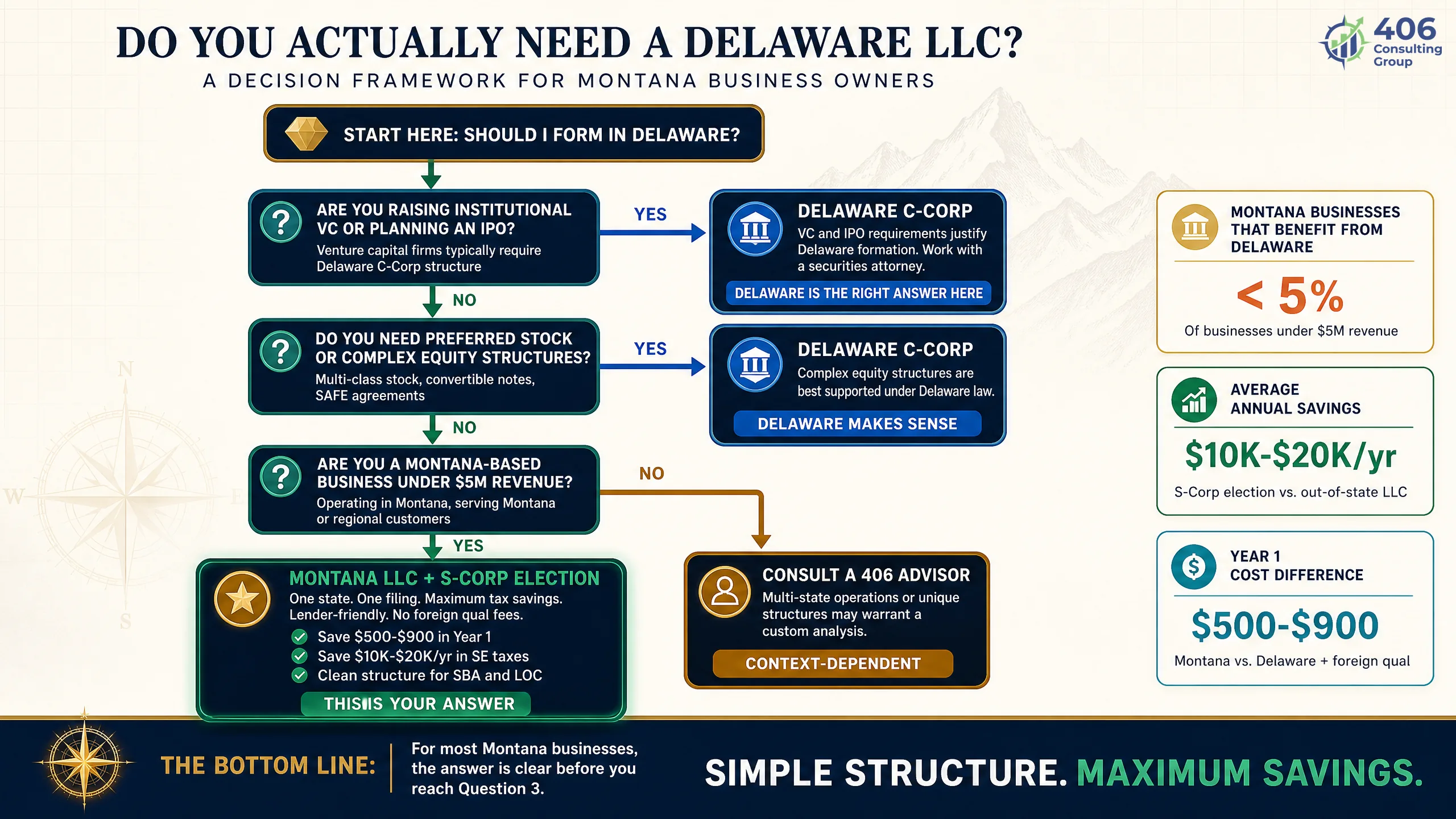
Delaware makes sense if you are:
- ✓Raising institutional venture capital (Series A or later)
- ✓Planning to issue preferred stock to investors
- ✓Targeting an IPO or SPAC transaction within 5 years
- ✓Pursuing QSBS (Section 1202) tax exclusion on gain
- ✓Building a company that will be acquired by a public company
- ✓Working with investors or attorneys who specifically require it
Delaware does NOT make sense if you are:
- ✗A Montana operating business with no plans to raise VC
- ✗A contractor, trade business, or service provider
- ✗A restaurant, retail store, or hospitality business
- ✗A professional services firm (accounting, law, consulting)
- ✗A family business or sole owner-operator
- ✗Anyone whose accountant or YouTube video told you to do it
The Hard Number
Delaware charges a minimum franchise tax of $300/year for corporations, calculated on either authorized shares or assumed par value capital — and the actual calculation can easily run $1,000–$5,000/year for a company with significant authorized share count. Add the registered agent, the Montana foreign qualification, and the dual annual report, and a Montana business owner pays $1,500–$6,000 per year in Delaware overhead. For a business that doesn't need Delaware, that's $1,500–$6,000 in pure waste.
Nevada: The Reality Behind the “No Tax” Promise
Nevada was a genuinely advantageous formation state in the 1990s and early 2000s, when inter-state tax enforcement was weaker and the combination of no corporate income tax and no personal income tax created real planning opportunities. Those days are over. Modern tax enforcement, economic nexus rules, and Montana's own tax collection machinery have closed the loopholes that made Nevada attractive.
Here is the critical distinction: Nevada's no-income-tax advantage applies to Nevada residents earning income in Nevada. A Montana business owner living in Montana, operating in Montana, earning income from Montana customers pays Montana individual income tax on that income regardless of where the LLC was formed. The Nevada formation does nothing to reduce that liability.
Nevada's actual cost structure — what the pitch leaves out:
Total Year 1 for a Montana business using Nevada: $665–$865. Year 2+: $620–$820/yr. All for no tax reduction on Montana-source income.
Why Nevada Advice Still Circulates
Nevada formation is still correct for one specific use case: a business owner who physically relocates to Nevada and establishes genuine Nevada residency and business domicile. If you move to Las Vegas and your business operates from Nevada, Nevada's no-income-tax structure applies. If you live in Kalispell and formed in Nevada last year because a YouTube video told you to — you are paying Nevada fees and Montana taxes, with no benefit from either.
Wyoming: The One Worth an Honest Conversation
Wyoming is the most legitimate of the three states for Montana-based asset protection planning — but for narrower and more specific reasons than most formation service websites describe. Wyoming does have genuine structural advantages in two areas: charging order protection and entity privacy. Understanding both clearly determines whether they apply to your situation.
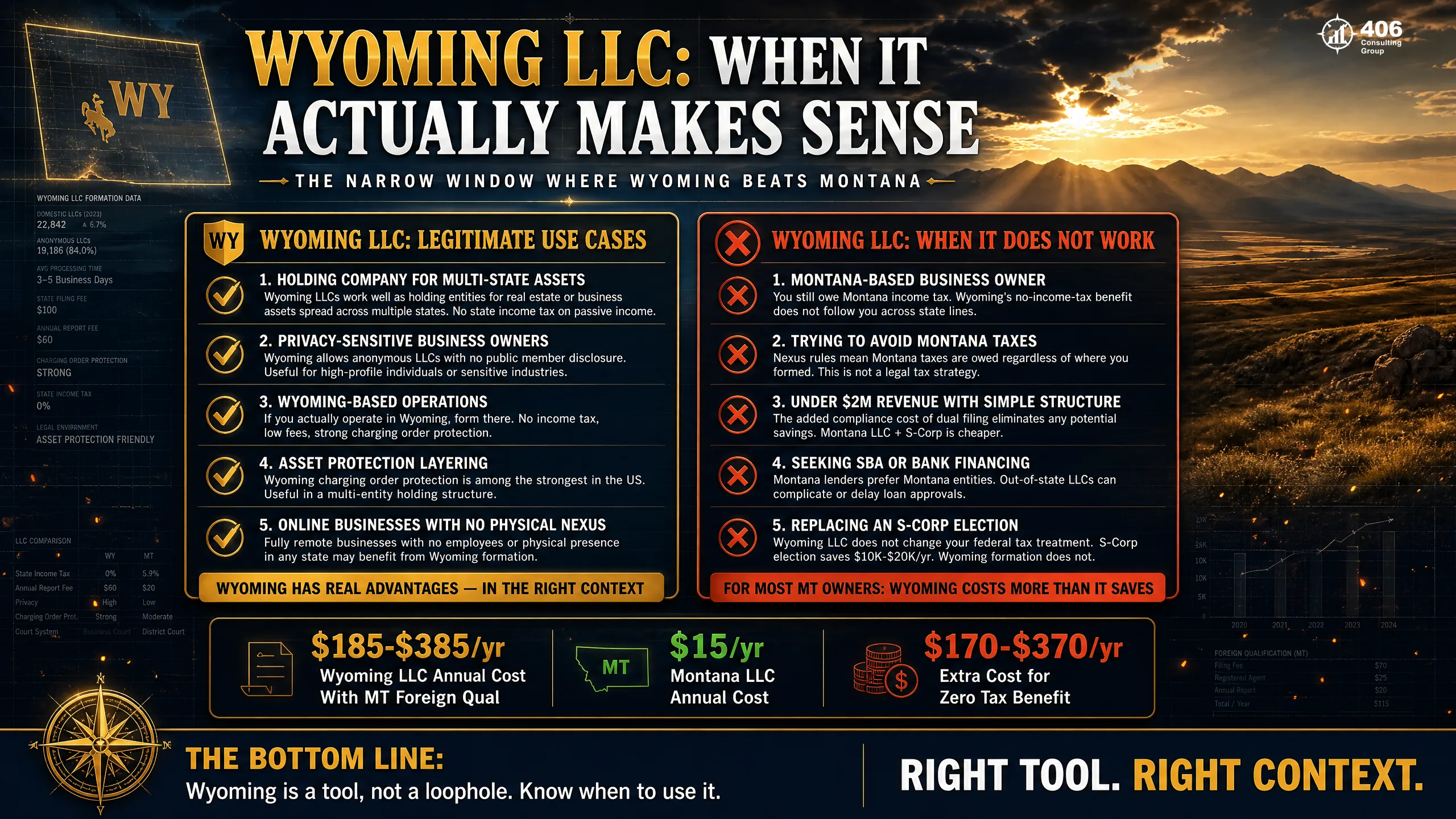
Charging Order Protection — Wyoming's Strongest Argument
Wyoming provides the most creditor-protective charging order statute in the country. A charging order limits a creditor's remedy against an LLC to receiving distributions — the creditor cannot foreclose on your LLC interest, force a sale of LLC assets, or vote your membership interest. In practice, this means a creditor who wins a judgment against you personally cannot simply take your LLC. Wyoming's charging order protection is exclusive and well-litigated, providing greater certainty than most states' equivalent statutes.
Relevant if: You have substantial personal liability exposure, operate in a high-litigation industry, or hold significant assets in the entity. Less relevant if: You already have adequate insurance coverage and operate a standard Montana business with typical liability risk.
Anonymous LLC — Wyoming's Privacy Structure
Wyoming allows LLCs to be formed without public disclosure of member names — the registered agent is listed publicly, but the actual ownership remains private in Wyoming's public records. This is a genuine privacy tool for business owners who have a legitimate need to keep ownership information off public databases: public figures, those with personal safety concerns, or operators who want to shield business relationships from competitors.
Relevant if: You have a specific, genuine privacy need. Less relevant if: Privacy sounds nice but you don't have a concrete reason to keep ownership confidential. Montana still requires foreign qualification that may include member disclosure.
The Structure That Makes Wyoming Work — When It Works
The most functional use of Wyoming for a Montana business owner is a two-entity structure: a Wyoming holding LLC (for asset protection and privacy) that owns a Montana operating LLC (which conducts the actual business and holds the bank accounts, contracts, and licenses). The Wyoming entity never directly operates in Montana — it simply holds membership interest in the Montana entity. This structure genuinely separates the asset protection function from the operating function without forcing the operating entity into dual-state compliance. It requires proper maintenance, appropriate inter-entity agreements, and ongoing legal and accounting support to preserve the protection — it is not a set-it-and-forget-it solution.
Montana's Overlooked Advantages
Montana is not a consolation prize. For a business operating in Montana, a Montana LLC is often the strongest formation choice — and the internet's collective failure to say so is part of what makes the Delaware/Nevada/Wyoming advice so misleading. Here is what Montana actually offers:
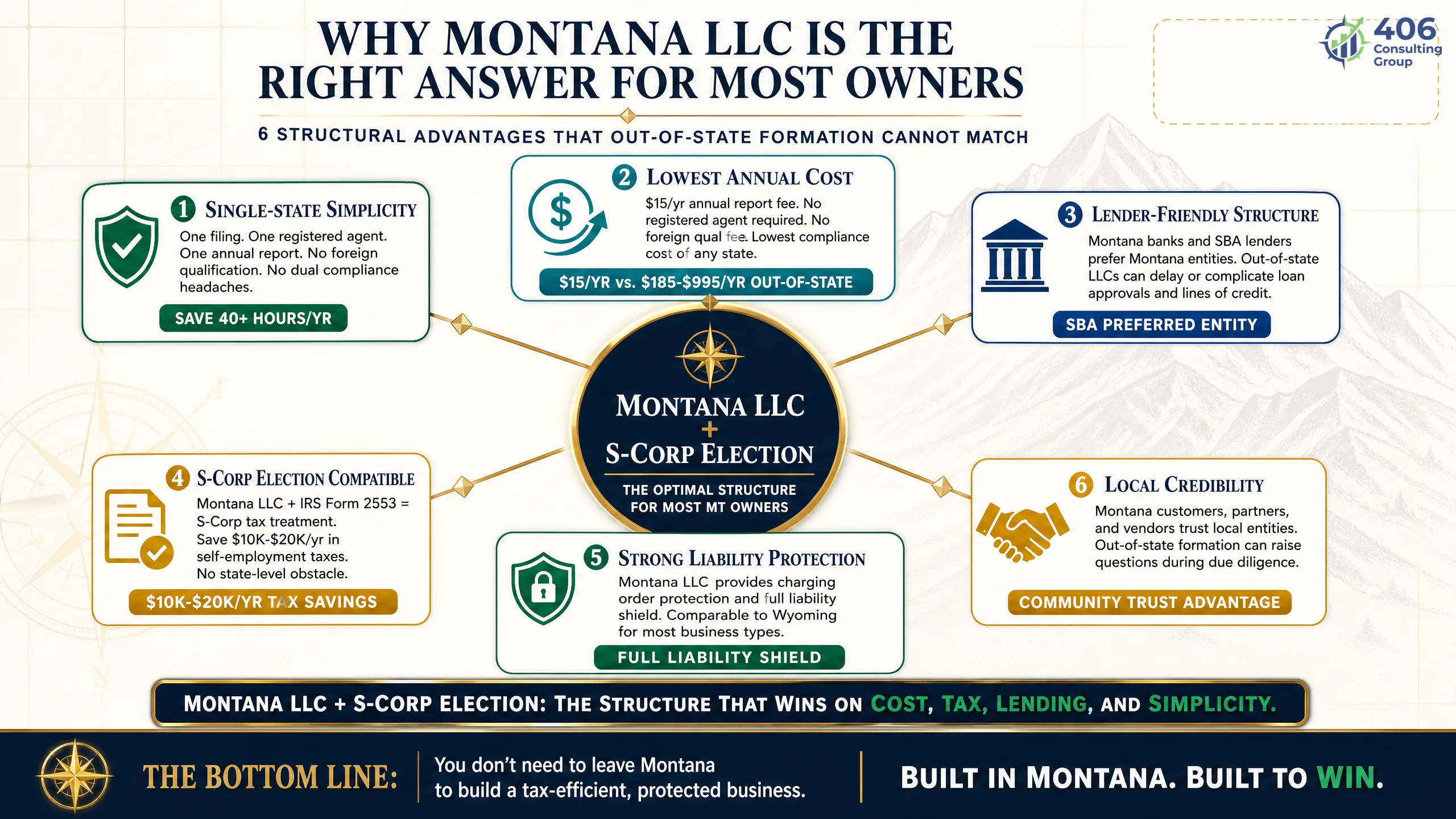
No Sales Tax
Montana is one of five states with no state sales tax. For product-based businesses, this is a real competitive and operational advantage — no sales tax collection, remittance, nexus tracking, or audit exposure. Most other states can't claim this.
Low Formation and Maintenance Cost
$70 to form. $20 annual report. No minimum franchise tax. No state business license at the state level. The total annual cost of a Montana LLC is $20 per year after formation — less than almost every alternative state.
Simpler Lender Relationships
Montana lenders — community banks, SBA lenders, credit unions — understand Montana LLCs. A clean Montana LLC with proper documentation gets through underwriting faster. Out-of-state entities require additional verification of foreign qualification status and legal standing to conduct business here.
Local Legal Framework
If you face a business dispute in Montana, you litigate in Montana under Montana law. An out-of-state formation may require the dispute to be resolved under that state's laws — adding complexity and cost for something that could have been handled in your backyard.
S-Corp Compatibility
A Montana LLC can elect S-Corp tax treatment with IRS Form 2553. The S-Corp election is where most Montana business owners find their real tax savings — not in formation state shopping. Montana S-Corps file Form PTE and shareholders receive pass-through treatment at Montana's 5.9% individual rate.
No Public Confusion or Dual Compliance
Operating under a Montana entity while doing business in Montana means one set of filings, one registered agent, one annual report. Out-of-state entities create two compliance tracks that must be maintained in parallel — and failure to maintain either can void your liability protection.
The Real Tax Strategy: S-Corp Election
Here is the move that most Montana business owners chasing tax savings in Delaware and Wyoming don't know about — or know about but haven't done. The S-Corp election. It doesn't require forming in another state. It doesn't require a formation service. It requires filing IRS Form 2553 and setting up payroll for the owner. And the savings are real.
As a sole proprietor or single-member LLC taxed as a disregarded entity, 100% of your net business profit is subject to self-employment tax: 15.3% on the first approximately $176,100 (2025 SS wage base), plus 2.9% Medicare on everything above. Elect S-Corp status and only the salary portion is subject to SE tax — the distribution is not. At $200,000 in net profit, that difference is $12,000–$15,000 per year in SE tax savings. Every year.
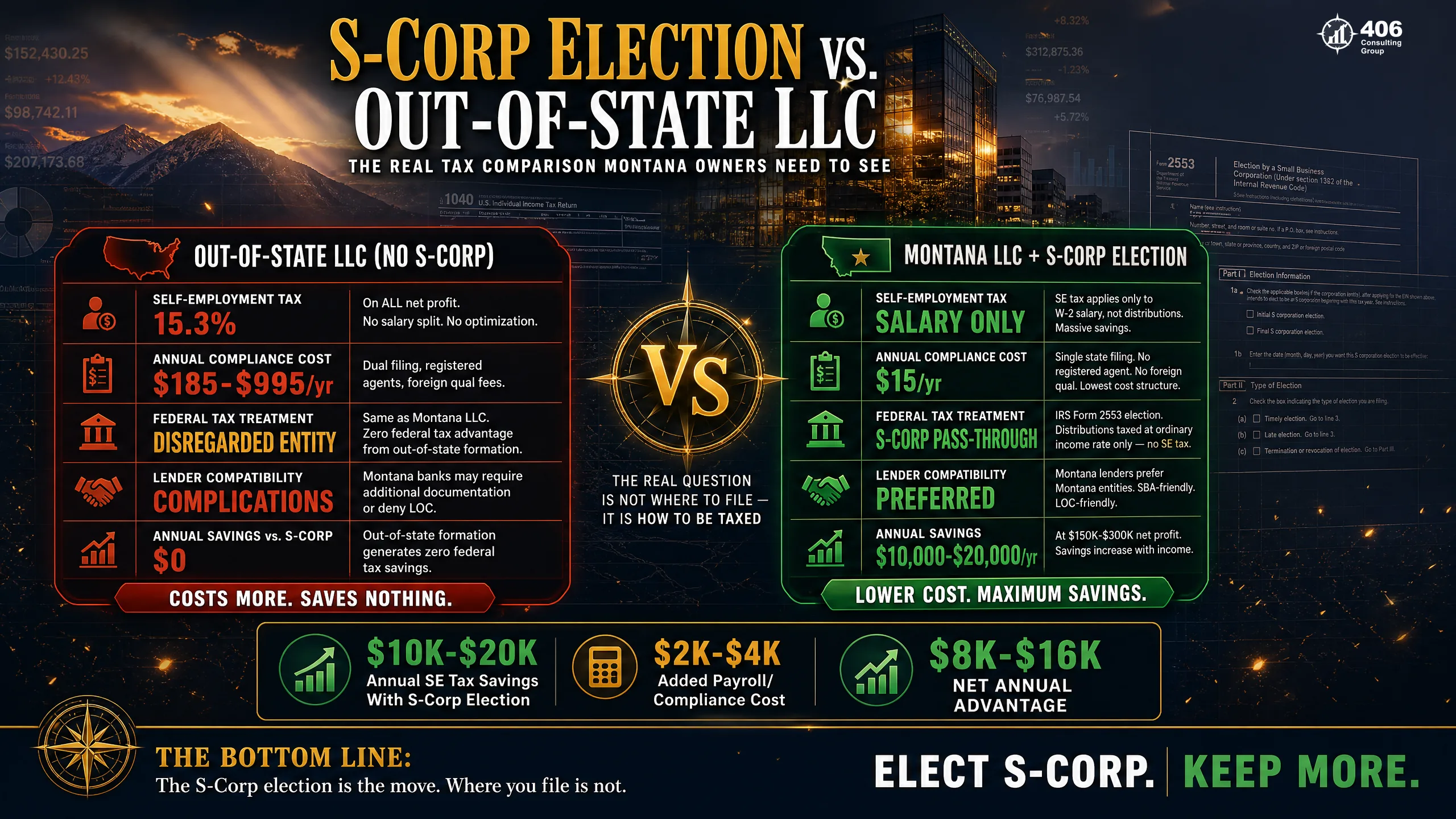
| Net Business Profit | Wyoming LLC Cost/yr | MT LLC — No S-Corp SE Tax | MT LLC + S-Corp SE Tax | Annual SE Tax Savings |
|---|---|---|---|---|
| $80,000 | $230–$430/yr (no tax benefit) | $11,304 | $7,949 | $3,355 |
| $120,000 | $230–$430/yr (no tax benefit) | $16,956 | $9,889 | $7,067 |
| $200,000 | $230–$430/yr (no tax benefit) | $27,050 | $12,713 | $14,337 |
| $300,000 | $230–$430/yr (no tax benefit) | $32,130 | $15,533 | $16,597 |
The Comparison Nobody Makes
A Wyoming LLC formation saves a $200,000 Montana business owner exactly $0 in taxes — because they still owe Montana taxes. It costs $230–$430 per year in ongoing compliance. An S-Corp election on a Montana LLC saves the same business owner $14,337 per year in SE tax. The formation service sells you the Wyoming story because they make money on it. Your accountant should be telling you the S-Corp story — because it's where the money actually is. Compare structures with our LLC vs. S-Corp Comparison, see the full guide on entity structure, or use our S-Corp Savings Calculator to run your specific numbers.
When Out-of-State Incorporation IS the Right Answer
In the interest of complete honesty: there are situations where forming outside Montana is the correct choice. They are specific and identifiable — not a default recommendation for anyone who wants to feel like they're doing smart business planning.
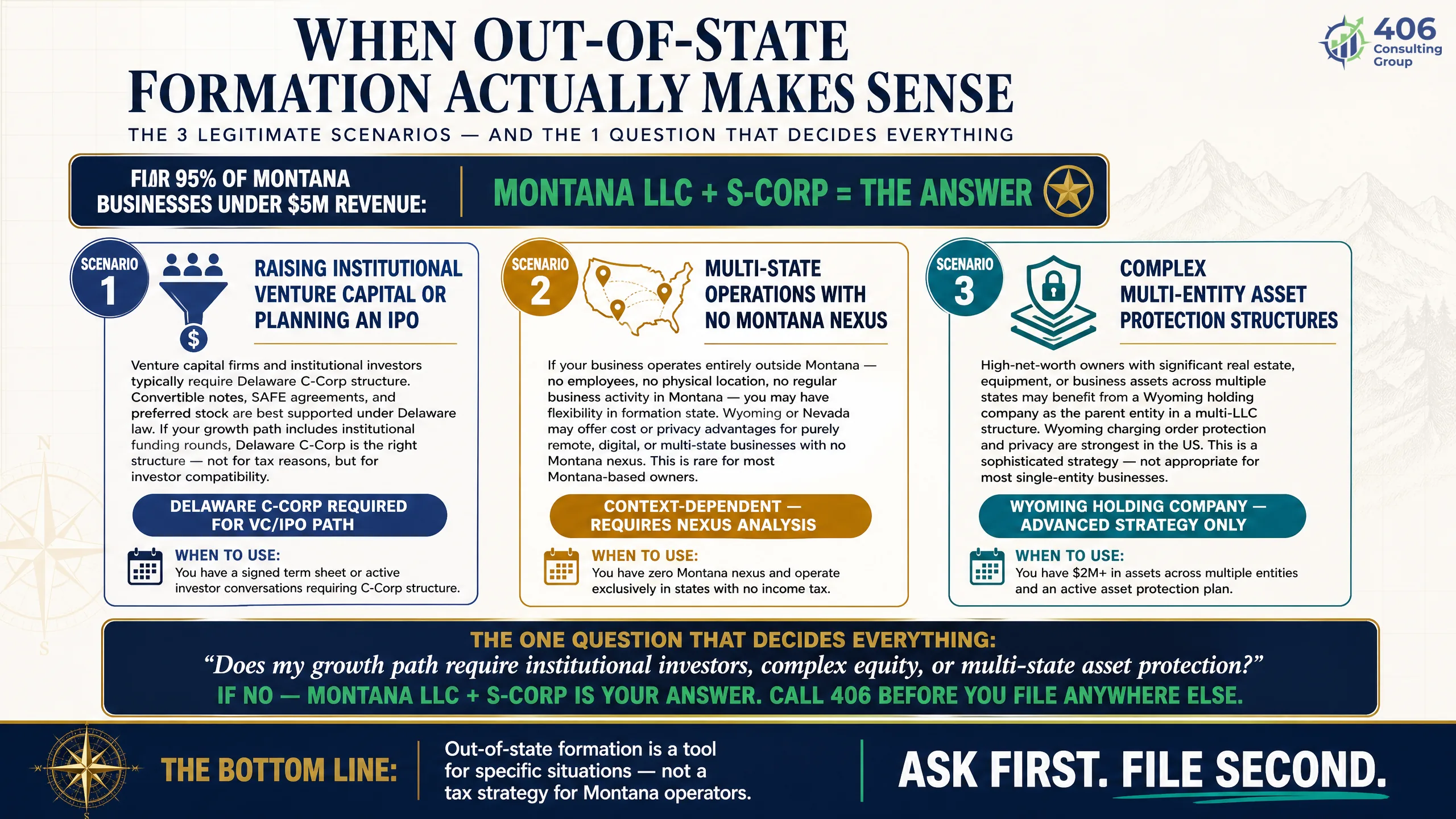
Delaware C-Corp
Makes sense when:
You are raising institutional venture capital, issuing preferred stock, or planning a public offering
Does NOT apply when:
You are a Montana operating business under $5M with no VC ambitions
Delaware is the required jurisdiction for institutional VC. If a VC term sheet is on your table, your attorney will tell you to be in Delaware. If no term sheet is on your table, this doesn't apply to you.
Wyoming LLC
Makes sense when:
You need maximum charging order protection, anonymous ownership, or a holding entity for multi-entity asset protection planning
Does NOT apply when:
You have standard Montana business liability exposure and adequate insurance
The Wyoming holding LLC / Montana operating LLC two-entity structure is legitimate planning — but it requires ongoing maintenance, proper inter-company agreements, and an advisor who understands multi-entity structures.
Any state
Makes sense when:
Your business operates entirely in that other state with no Montana nexus — employees, customers, and activity are there, not here
Does NOT apply when:
You live in Montana, your customers are in Montana, your operations are in Montana
If you are genuinely relocating the business to another state and establishing real presence there, you should form there. If you are living in Montana and filing paperwork in another state, you are still a Montana business.
New Mexico LLC
Makes sense when:
Privacy is a genuine, specific concern — New Mexico allows anonymous LLCs without registered agent public disclosure and has no annual report requirement
Does NOT apply when:
Privacy sounds appealing but you have no specific threat or reason
New Mexico is often overlooked in the formation state conversation but has practical privacy advantages. Not relevant for most businesses, but worth knowing exists if anonymity is genuinely required.
Five Questions to Answer Before You File Anywhere
Before you pay a formation service anything, answer these five questions honestly. The answers determine the right choice — and they will be more useful than any YouTube video on the subject.
Where does your business actually operate?
If you have employees, customers, or a physical location in Montana, you have Montana nexus. You owe Montana taxes. Forming elsewhere does not change this. Form in Montana.
Delaware
Not relevant unless you need VC
Nevada
Not relevant
Wyoming
Possibly, via holding structure
Montana
Yes — form here
Are you raising institutional venture capital in the next 12–24 months?
If yes, your investors will likely require a Delaware C-Corp. If no — or if you don't know what a term sheet looks like — this is not your situation. Form in Montana.
Delaware
Yes, if VC is coming
Nevada
No
Wyoming
No
Montana
Yes, in all other cases
Do you have substantial personal assets to protect beyond adequate insurance coverage?
If you have significant personal wealth, own real estate, or operate in a high-litigation industry, a Wyoming holding LLC structure may be worth the planning cost. If your primary liability coverage is an insurance policy, the Wyoming formation likely doesn't add meaningful protection.
Delaware
No
Nevada
No
Wyoming
Possibly — discuss with an attorney
Montana
Yes — plus adequate insurance
Is your net business profit above $60,000–$80,000 per year?
If yes, the S-Corp election on a Montana LLC is almost certainly worth more than any formation state benefit. This is where the real tax savings are. File the election before chasing formation state advantages that don't apply.
Delaware
Unrelated to this question
Nevada
Unrelated to this question
Wyoming
Unrelated to this question
Montana
Montana LLC + S-Corp election
Do you have a specific, concrete reason for privacy — not just a preference for it?
Public figures, those with personal safety concerns, and operators with genuine competitive confidentiality needs may have a real case for anonymous entity structures. If privacy sounds appealing but you can't identify a specific threat or reason, it's probably not a factor in your decision.
Delaware
No privacy benefit
Nevada
Some privacy, at high cost
Wyoming
Strong privacy option
Montana
No anonymity, but low profile in practice
The Bottom Line for 95% of Montana Business Owners
If you are a Montana business owner under $5M in revenue, doing business primarily in Montana, with no institutional VC raising planned — form in Montana. Elect S-Corp status when your net profit exceeds $60,000–$80,000. Use the money you would have spent on formation service fees, registered agents, and annual reports in three states to pay for proper accounting and tax strategy. That's where the money is.
If you have specific circumstances — high personal asset exposure, VC plans, genuine privacy needs — talk to an advisor who will give you a straight answer based on your actual situation. That is what 406 does. Not a service menu. Not a formation upsell. An honest assessment of what you need.
Frequently Asked Questions: Delaware, Nevada, and Wyoming LLCs for Montana Businesses
If I form my LLC in Wyoming, do I still owe Montana taxes?
Yes. If you live in Montana and your business operates in Montana — employees, customers, or physical presence here — you have Montana nexus regardless of where the LLC was formed. Nexus means Montana taxes apply. A Wyoming LLC operating in Montana owes Montana income tax, must register as a foreign entity in Montana, must maintain a Montana registered agent, and must file Montana annual reports. You have not avoided Montana. You have added Wyoming costs on top of it.
What is foreign qualification and why does it matter?
Foreign qualification is the registration process required when an entity formed in one state conducts business in another state. If you form your LLC in Wyoming and operate in Montana, Montana law requires you to register as a foreign entity before conducting any business here. Operating as an unregistered foreign entity in Montana can void contracts and expose owners to personal liability. Foreign qualification adds an initial filing fee ($70 in Montana), an annual registered agent fee ($100–$200/yr), and ongoing dual-state compliance obligations.
When does forming in Delaware actually make sense?
Delaware makes sense for businesses pursuing institutional venture capital, planning to issue preferred equity to investors, or targeting a public offering or SPAC transaction. Delaware's Court of Chancery is the most sophisticated business court in the country, and its case law on corporate governance and shareholder rights is required for institutional investors. For a Montana operating business with no VC plans, Delaware adds $1,500–$6,000 per year in compliance costs with no meaningful benefit.
Is there any legitimate reason to use a Wyoming LLC for a Montana business?
Yes — but for narrower reasons than most formation services describe. Wyoming has the strongest charging order protection statute in the country, limiting creditor remedies against LLC interests. Wyoming also permits anonymous member ownership. The structure that functions best for Montana businesses is a two-entity approach: a Wyoming holding LLC that owns a Montana operating LLC, where the Wyoming entity never directly operates in Montana. This requires proper maintenance, inter-entity agreements, and qualified legal support.
What is the S-Corp election and why does it matter more than formation state?
An S-Corp election (IRS Form 2553) changes how your LLC is taxed without changing its legal structure or formation state. As a disregarded entity, all net profit is subject to self-employment tax — 15.3% on income up to the Social Security wage base. With an S-Corp election, only the owner's salary is subject to SE tax; the remaining profit distributed as owner's draw is not. At $200,000 in net business profit, this difference is typically $13,000–$15,000 per year in self-employment tax savings.
How do I know if an S-Corp election makes sense for my business?
Generally, the S-Corp election becomes beneficial when your net business profit exceeds $60,000–$80,000 per year. Below that threshold, the cost of running payroll for the owner (typically $1,500–$3,000/yr) may offset the tax savings. Above it, the savings almost always exceed the cost. The S-Corp election requires paying yourself a reasonable salary for the work you perform in the business, running payroll, and filing an additional business tax return (Form 1120-S). Use the S-Corp Savings Calculator on our site to run your specific numbers — it takes about two minutes.
Quick Reference
Formation state vs. Montana — fast facts
Formation State Guide
Montana
Operating in Montana, under $5M, no VC plans
Delaware C-Corp
Raising institutional VC, issuing preferred stock, IPO path
Wyoming LLC
Holding company, max asset protection, anonymity need
Nevada
Physical relocation to Nevada + genuine NV domicile
Get the Honest Answer
No formation upsell. No generic advice.
Related Services
About the Author
Carrie Anderson
Co-Founder & Principal Analyst, 406 Consulting Group
Former Corporate Controller with 300+ commercial loans analyzed as a contracted analyst for a Montana community bank. Her work has been reviewed in KPMG and Wipfli environments. When she says out-of-state formation complicates loan underwriting, she has seen it happen — from the underwriter's side of the table.
Read the Full Story