
Trades & Construction Accounting in Austin, TX:
Build the Boom on Books You Can Trust
How you write a contract — lump-sum vs. separated — decides who owes Texas sales tax on your materials, and it's just the start. Job costing, WIP, certified payroll, and equipment: the accounting an Austin contractor really needs.

Austin is building at a pace few cities can match — towers downtown, subdivisions spreading into the Hill Country, tenant build-outs, remodels, and the electricians, plumbers, HVAC techs, concrete crews, and general contractors who make it all happen. It's a great time to run a trades or construction business here. It's also a brutal one to keep the books straight, because construction accounting is genuinely its own discipline, and Texas layers on contractor sales-tax rules that are among the most misunderstood in the state.
The single biggest trap: how you write your contracts — lump-sum versus separated — changes who owes sales tax on your materials and how you handle it, and whether a job is new construction or a repair/remodel changes the taxability again. Get it wrong and you either overpay on every job or build an audit liability. Add job costing, WIP, retainage, change orders, certified payroll, and equipment, and clean books for an Austin contractor are a specialized job. This guide walks all of it, delivered remotely.
By Jason Anderson — Co-Founder, 406 Consulting Group. Big-firm-trained accountant serving contractors and trades across the Mountain West and Southwest — job costing, WIP, and the Texas contractor tax rules that trip most builders up.
Quick Answer: Accounting for an Austin Contractor
- →Lump-sum vs. separated contracts decide who owes sales tax on materials — the most misunderstood rule in Texas construction.
- →New construction vs. repair/remodel (and residential vs. nonresidential) changes taxability again.
- →Job costing & WIP are how you know which jobs actually make money and bill them right.
- →Certified/prevailing wage, equipment (BPP), and bonding all shape a contractor's books in Texas.
- →Delivered remotely — from the office trailer or the truck, not a downtown appointment.
Table of Contents
Why Construction Accounting Is Its Own Discipline
A contractor's books look nothing like a retailer's or a software company's. Revenue comes in draws against long jobs, not clean monthly sales; costs are spread across labor, materials, subs, and equipment that have to be tied back to the right project; you bill in progress and hold retainage; change orders move the target mid-job; and a single mispriced bid can wipe out the margin on three good ones. Generic bookkeeping — a shoebox of receipts reconciled once a quarter — simply can't tell a builder what they need to know: which jobs make money, and whether the business as a whole is actually ahead.
In Texas, that complexity collides with contractor-specific tax rules most builders have never had explained to them. The way a contract is written determines who pays sales tax on materials; the type of work determines whether labor is taxable; equipment gets taxed annually as business personal property; and public jobs carry certified-payroll requirements. None of it is optional, and all of it flows through the books. For an Austin contractor riding a historic building boom, getting this right is the difference between growth that compounds and growth that quietly bleeds cash.
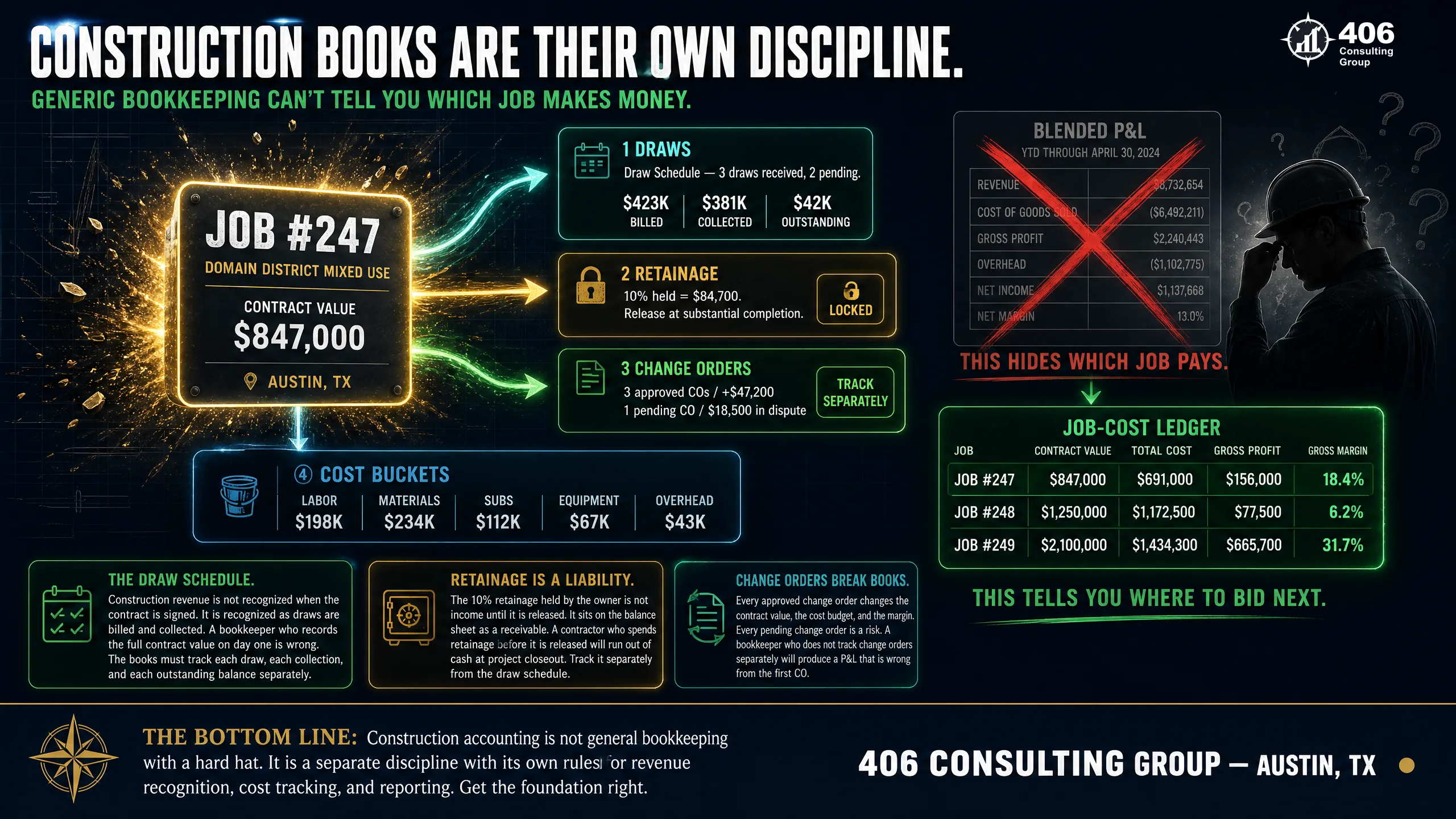
Start with the tax picture — because Texas's contractor rules are where builders lose the most money without realizing it.
The Texas Contractor Tax Picture
Texas has no state income tax, which is a real advantage — but a contractor still deals with several taxes, and the sales-tax rules for construction are the ones that bite. Here's the frame:
| Tax | What it means for a contractor |
|---|---|
| State income tax | None — but the franchise tax and sales/use tax still apply |
| Sales & use tax | Contractor treatment depends on contract type (lump-sum vs. separated) and work type — see below |
| Franchise (margin) tax | Construction is often COGS-heavy, so the COGS deduction usually applies |
| Business personal property | Annual county rendition on trucks, tools & equipment — real money for a builder |
| Payroll | No state withholding; public jobs may require certified/prevailing wage |
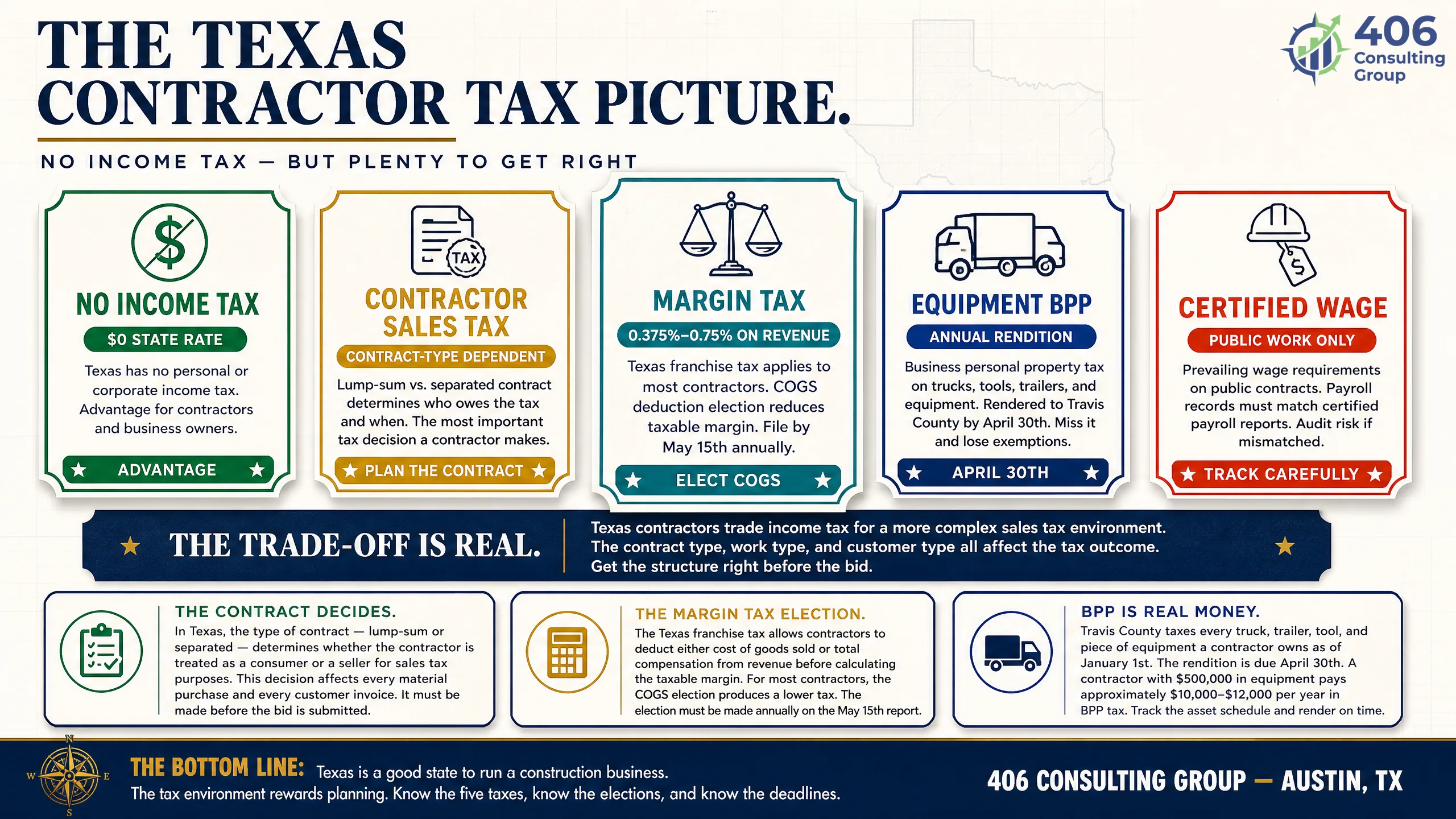
Confirm current rules with the Texas Comptroller — construction sales tax is nuanced enough that it's worth getting right with a pro. Let's take the piece that costs contractors the most.
The Big One: Lump-Sum vs. Separated Contracts
This is the rule that trips up more Texas contractors than any other. How you write the contract changes how sales tax on your materials works. Under a lump-sum contract — one price for the whole job, materials and labor together — the contractor is generally treated as the consumer of the materials, meaning you pay sales tax when you buy them and don't separately charge the customer tax. Under a separated contract — where you state materials and labor as separate line items — you're generally treated as a seller of the materials, meaning you can buy them tax-free for resale but must collect sales tax from the customer on the materials portion.
Neither is automatically "better," but choosing without understanding the consequence is how contractors overpay or under-collect — and an under-collection becomes your liability in an audit, not the customer's. The choice interacts with your markup, your customers, and the type of work, and it needs to be reflected consistently in how you bid, invoice, and record each job. This is squarely a set-it-up-deliberately-with-a-pro area, and it's the first thing we sort out for a construction client.

Why it's a books problem, not just a legal one
Your contract type has to flow through your bookkeeping — how materials are purchased (taxed or tax-free for resale), how tax is collected and remitted, and how each job is recorded. Books built for the wrong treatment quietly create exposure. Confirm your setup with the Texas Comptroller or a pro.
New Construction vs. Repair & Remodel
On top of the contract-type question, Texas treats the type of work differently. New construction — building new structures or making new additions — is generally treated one way, while repair, remodeling, and restoration can be treated differently, and the rules further distinguish residential from nonresidential property. In particular, labor to repair or remodel nonresidential real property is an area where taxability differs from new construction and from residential work — a distinction that catches a lot of remodelers.
For a builder doing a mix of ground-up projects, tenant finish-outs, and remodels — which describes most Austin contractors — that means the correct sales-tax treatment can vary job to job, even client to client. The books have to capture what kind of work each job is so the tax is handled right and consistently. It's detailed, it's easy to get wrong, and it's exactly the kind of thing a generic bookkeeper misses. Confirm specifics with the Comptroller or a professional, because these classifications carry real dollars.
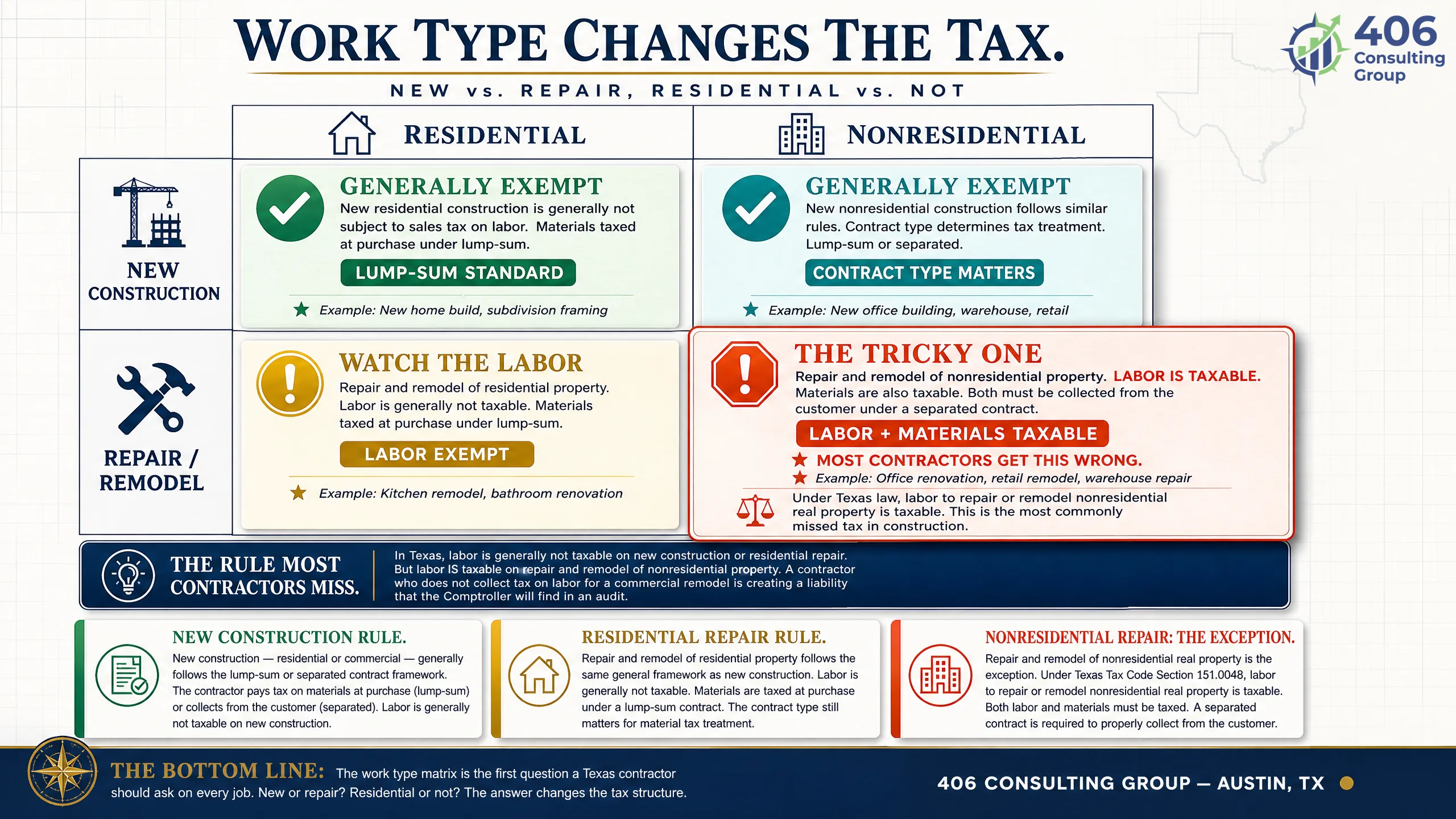
Between contract type and work type, Texas construction sales tax is a genuine specialty — and the number-one reason an Austin builder wants a construction-literate accountant.
Job Costing: Which Job Actually Makes Money
Ask a contractor which of their jobs is most profitable and too often the honest answer is a shrug. Job costing fixes that: tying every hour of labor, every material purchase, every subcontractor invoice, and every piece of equipment time to the specific project it belongs to, so you can see the real margin on each job instead of a company-wide blur. That visibility changes how you bid — you stop chasing the busy work that loses money and start winning more of the work that actually pays.
It's also the foundation everything else in construction accounting is built on. You can't produce an accurate WIP schedule, bill progress correctly, or know whether a change order is worth taking without job-level costs. For an Austin contractor scaling in a hot market, job costing is what keeps growth profitable rather than just bigger.

This is the heart of our contractor unit economics work — knowing which job, crew, or truck actually earns is the whole game.
WIP, Percentage-of-Completion, Retainage & Change Orders
Long jobs need construction-specific accounting that a generic setup doesn't have. A work-in-progress (WIP) schedule tracks each open job's costs, billings, and estimated cost-to-complete, revealing whether you're over- or under-billed — over-billing can mask that you've actually spent the money, and under-billing means you're financing the customer. Percentage-of-completion accounting recognizes revenue as a job progresses rather than all at the end, so your financials reflect reality month to month.
Then there's retainage — the portion of each payment the customer holds until completion, which ties up real cash and has to be tracked as its own receivable — and change orders, which quietly reshape a job's scope and margin and must be captured before they're forgotten and eaten. Together, WIP, POC, retainage, and change-order tracking are what turn a pile of job activity into financials you, your banker, and your bonding agent can actually trust.
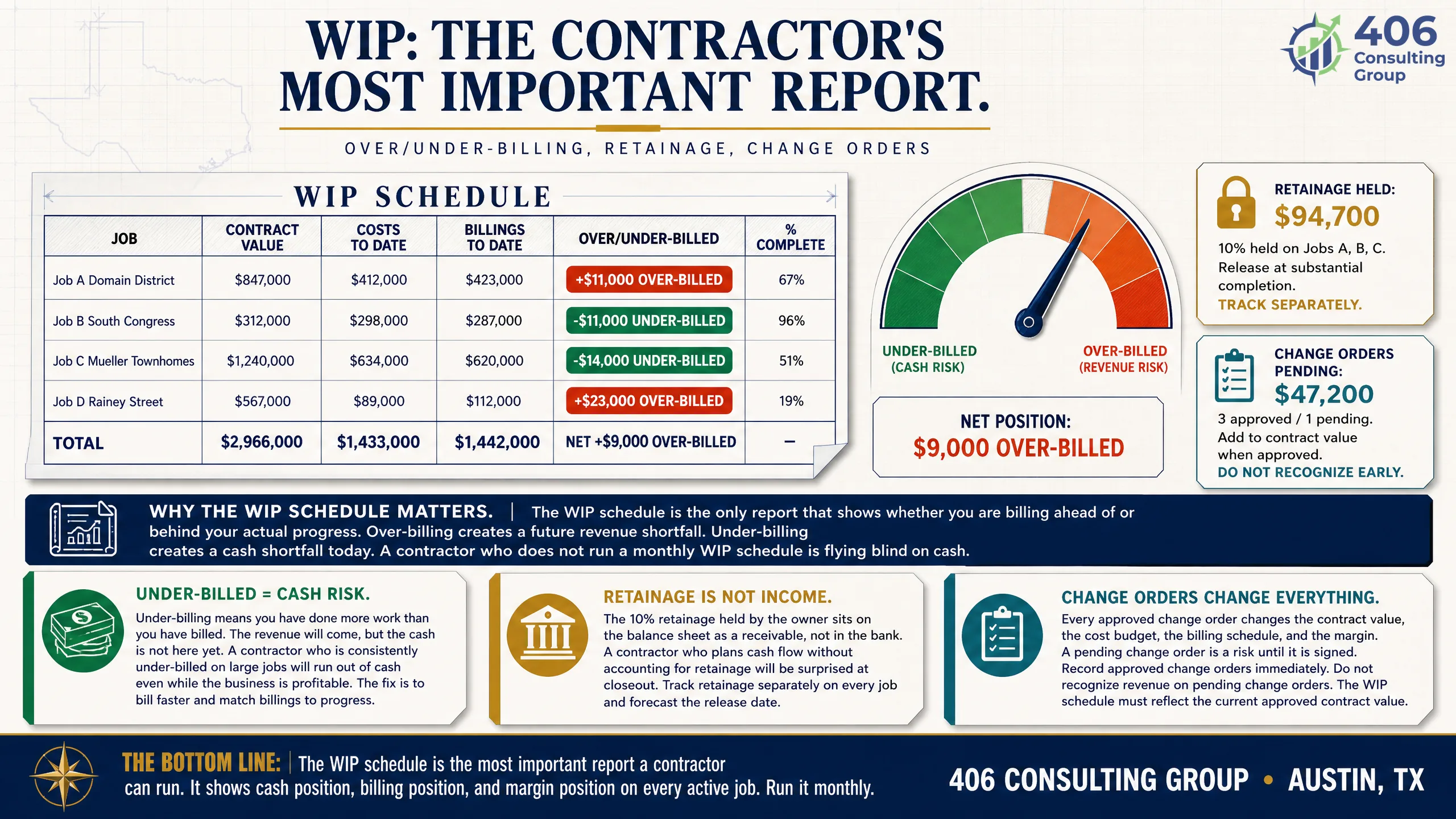
As jobs get bigger, this is also where a controller or CFO function earns its keep — the WIP schedule is the contractor's most important report.
Certified & Prevailing-Wage Payroll
Texas payroll is lighter than most states — no state income-tax withholding — but construction adds its own wrinkles. On public works (government-funded projects), contractors often face prevailing-wage requirements, and on federally funded work the Davis-Bacon Act requires paying set wage rates and filing certified payroll reports documenting exactly what each worker was paid. Getting certified payroll wrong on a public job can mean withheld payments or worse, so it's not a place to improvise.
Beyond that, construction payroll means tracking labor to jobs (which feeds job costing), handling a heavy mix of subcontractors and 1099s with correct worker classification, and managing workers' comp — which in Texas is optional but frequently required by general contractors and project owners before they'll let you on site. Handled well, payroll becomes a clean input to your job costs rather than a monthly scramble.
Our payroll work keeps all of this — certified payroll included — running quietly in the background.
Equipment, Depreciation & the BPP Rendition
Contractors are equipment-heavy, and in Texas that means the business personal property (BPP) tax is a real annual bill. Your trucks, trailers, tools, and machinery are generally subject to a county rendition each spring, where they're valued and taxed — so a clean, current fixed-asset schedule (what you own, what it cost, how it's depreciating) is what keeps you from over-reporting and overpaying on gear you've sold or worn out. It also feeds your federal depreciation strategy.
On the federal side, Section 179 and bonus depreciation can let you deduct a large share of equipment purchases in the year you buy — powerful for a growing contractor, though timing it against your multi-year income (and remembering that owning the asset drives the BPP bill) is worth planning rather than doing on reflex. Equipment utilization also belongs in job costing: idle iron is one of the quietest drains on a contractor's margin.

The planning side — depreciation timing and the margin tax — is covered in the Austin tax guide; the tracking that makes it work starts in the books.
Bonding, Licensing & Working Capital
As contractors take on bigger and public work, surety bonding becomes essential — and a surety underwrites your bonding capacity based directly on the strength and credibility of your financial statements and your WIP schedule. Clean, construction-grade books aren't just good hygiene; they literally determine the size and number of jobs you're allowed to take. A messy set of books can cap a capable builder's growth simply because the surety can't get comfortable.
Construction is also intensely working-capital hungry: you fund labor, materials, and payroll well before a draw clears, and retainage keeps a slice of your money parked until the end. A contractor can be profitable on paper and still run out of cash mid-project. Tracking cash, receivables, retainage, and a real forecast is what keeps a growing builder solvent — and it's where our loan-readiness and banking background helps you line up credit before you need it. (Licensing in Texas varies by trade and municipality — electricians, plumbers, and HVAC are state-licensed while general contracting rules differ locally, so confirm what applies to you.)
Bonding capacity and working capital both come back to the same thing: financials a lender or surety can trust.
Common Construction Bookkeeping Mistakes
A handful of avoidable mistakes cause most of the financial pain for Austin contractors.
Mishandling the contract-type sales tax
Treating a lump-sum job like a separated one (or vice versa) means overpaying on materials or under-collecting tax you'll owe in an audit.
No real job costing
Without costs tied to jobs, you can't tell which projects make money — so you keep bidding the ones that don't.
Ignoring the WIP schedule
Over- and under-billing hide the true state of every open job, and no surety will bond you without a clean WIP.
Forgetting the BPP rendition
Missing the annual equipment filing draws penalties; over-reporting means paying tax on gear you no longer own.
Losing change orders
Work performed but never captured as a change order is margin given away for free.
Every one is a setup-and-habit problem — and every one disappears once the books are built for construction and maintained on a monthly rhythm.
Local vs. a Great Remote Partner
A contractor's day is on the job site and in the truck, not sitting in an accountant's downtown office — which makes remote bookkeeping a natural fit, not a compromise. What actually matters is whether your accountant understands construction and Texas: job costing and WIP, the lump-sum-versus-separated sales-tax rules, certified payroll, the BPP rendition, and bonding. A generalist who's never built a WIP schedule is a real liability here, no matter how close their office is.
We work the way a modern contractor runs: cloud accounting and job-costing tools, receipts and time captured from the field on a phone, connected bank feeds, and a steady monthly close — so you get construction-literate books without leaving the site. Whether you're building downtown, out in the Hill Country, or across Central Texas, you get the same responsive, construction-savvy service.
Knowing construction and Texas is the variable that matters — not how close the office is to the job.
How to Get Started
Getting an Austin contractor's books in order is three steps.
Get the tax treatment right
Sort out your lump-sum vs. separated contract approach and how new-construction vs. repair/remodel work is taxed, and build it into how you bid and invoice.
Set up construction-grade books
Job costing, a WIP schedule, retainage and change-order tracking, a fixed-asset schedule for BPP, and certified payroll where public work requires it.
Run it monthly
Monthly close, WIP review, sales-tax filing, and job reporting — so you always know which jobs pay and whether the business is ahead.
Not sure where your books stand? Our Financial Maturity Assessment maps it out in about eight minutes.
FAQ: Austin Construction Accounting
How does sales tax work for contractors in Texas?
It depends on how your contract is written and what kind of work it is. Under a lump-sum contract (one combined price), the contractor is generally treated as the consumer of the materials — you pay sales tax when you buy them and don't separately charge the customer tax. Under a separated contract (materials and labor stated separately), you're generally treated as a seller — you can buy materials tax-free for resale but must collect sales tax from the customer on the materials. On top of that, new construction is treated differently from repair/remodel, and residential differs from nonresidential. It's genuinely nuanced, so confirm your setup with the Texas Comptroller or a professional.
What's a WIP schedule and why does my construction business need one?
A work-in-progress (WIP) schedule tracks each open job's costs incurred, amounts billed, and estimated cost to complete, which reveals whether you're over-billed or under-billed on every project. Over-billing can hide that you've already spent the money; under-billing means you're effectively financing the customer. It's also the report sureties and banks rely on most, so a clean WIP schedule directly affects your bonding capacity and access to credit. Along with percentage-of-completion revenue recognition, retainage tracking, and change orders, the WIP schedule is the backbone of real construction accounting.
Do I have to pay Texas property tax on my equipment and tools?
Generally, yes. Texas taxes business personal property — including contractors' trucks, trailers, tools, and machinery — through an annual rendition filed with your county appraisal district, where the property is valued and taxed. For an equipment-heavy contractor this can be a meaningful yearly bill, which is why keeping an accurate, current fixed-asset schedule matters: it keeps you from over-reporting and overpaying on equipment you've sold or retired, and it feeds your federal depreciation planning. Confirm deadlines and specifics with your county appraisal district.
What is certified payroll and when do I need it?
Certified payroll is a detailed report documenting the wages paid to each worker on certain public projects, filed to prove compliance with prevailing-wage requirements. On federally funded work, the Davis-Bacon Act requires paying set prevailing wage rates and submitting certified payroll reports; state and local public works can carry their own prevailing-wage rules. Getting it wrong on a public job can mean withheld payments or penalties, so it's important to have payroll set up to produce accurate certified reports before you take that work. Private jobs generally don't require it.
Can 406 Consulting Group do my Austin construction bookkeeping remotely?
Yes — and for a contractor who lives on the job site, remote is the natural fit. We run on cloud accounting and job-costing tools with receipts and time captured from the field, connected bank feeds, and a steady monthly close. What matters for a construction business is expertise in job costing, WIP, the Texas contractor sales-tax rules, certified payroll, the BPP rendition, and bonding-ready financials — not office proximity. We serve Austin and Central Texas contractors with the same construction-literate service whether you're downtown or out in the Hill Country.
Keep Reading
Trades & Construction — Austin, TX
Build the Boom on Books You Can Trust.
406 Consulting Group keeps Austin contractors clean and bondable — the Texas contract sales-tax rules, job costing, WIP, certified payroll, and equipment handled — delivered remotely, by a firm that knows construction.
Austin Construction Quick Reference
Austin, TX — Travis County
Contract Sales Tax Got You Guessing?
Job costing, WIP & certified payroll, handled.
About the Author
Jason Anderson
Co-Founder, 406 Consulting Group
Big-firm-trained accountant serving contractors and trades across the Mountain West and Southwest. Jason helps Austin builders get the Texas contract sales-tax rules right, run real job costing and WIP, handle certified payroll, and keep books strong enough to grow their bonding capacity.
Read the Full Story