
Trades & Construction Accounting in Casper, WY:
Build Through the Cycle on Books You Can Trust
Wyoming has no income tax — but a state-monopoly workers' comp fund, a consumer-pays-materials sales tax, and local-only licensing, all riding an energy cycle. The accounting a Casper contractor really needs.
Casper builds where the energy economy leads. Alongside the commercial, residential, and civic work of Wyoming's second city, a big share of the construction here serves the oil patch — facilities and pads, energy-sector buildings, and the mechanical, electrical, welding, earthwork, and general trades that follow the rigs. It's good work, and it moves with the commodity cycle. What makes the accounting distinctive is Wyoming's own setup: no income tax, but a sales/use tax you pay as the consumer of your materials, no statewide contractor license, and a workers' comp system unlike almost anywhere else in the country.
A few things surprise contractors here. Wyoming runs a state-monopoly workers' comp fund — you can't just buy coverage from any insurer — and construction rates aren't trivial. There's no statewide general-contractor license, so requirements are local. And on materials you're the consumer, paying sales/use tax at purchase rather than billing the customer. Add energy-cycle cash swings, job costing, WIP, and heavy equipment, and clean books here are their own discipline. This guide walks all of it — from a firm with real oil & gas roots — delivered remotely.
By Carrie Anderson — Co-Founder, 406 Consulting Group. Commercial banking and underwriting background — 300+ loan reviews — with deep oil & gas experience, serving contractors and energy-sector trades across the Mountain West.
Quick Answer: Accounting for a Casper Contractor
- →No state income tax, but a sales/use tax you pay as the consumer of your materials — it belongs in every bid.
- →Monopolistic workers' comp: Wyoming coverage comes through the state fund, not private carriers — a real quirk with real construction rates.
- →No statewide GC license — requirements are local/municipal; electrical is state-licensed, plumbing typically local.
- →Energy-cycle swings make job costing, WIP, and cash discipline matter more than in a steady market.
- →Delivered remotely, by a firm that actually knows the oil & gas business.
Table of Contents
Why Construction Accounting Is Its Own Discipline
Construction doesn't run on the tidy monthly rhythm ordinary bookkeeping assumes. Revenue lands in draws across jobs that stretch for months; costs sprawl over labor, materials, subs, and equipment that each have to be tied to a specific project; you bill in stages and the owner holds retainage; change orders keep shifting the scope; and one job bid a little thin can erase the profit from the last several. A back office that only sorts the bank feed and squares up at tax time can't tell a builder what matters most: is this job tracking to its estimate, and is the company, overall, actually making money?
In Casper, that discipline meets Wyoming's particular rules and the energy cycle riding underneath the whole market. The state's monopolistic workers' comp, the consumer-pays-materials sales tax, and local-only licensing all flow through the books — and when oil turns, a contractor's backlog and cash can swing hard in a single quarter. Handling all of it well is what separates an energy-country builder who compounds through the cycles from one who gets whipsawed by them.
Start with Wyoming's tax and licensing picture — it's low-tax, but it has features that catch contractors off guard.
The Wyoming Contractor Tax & Licensing Picture
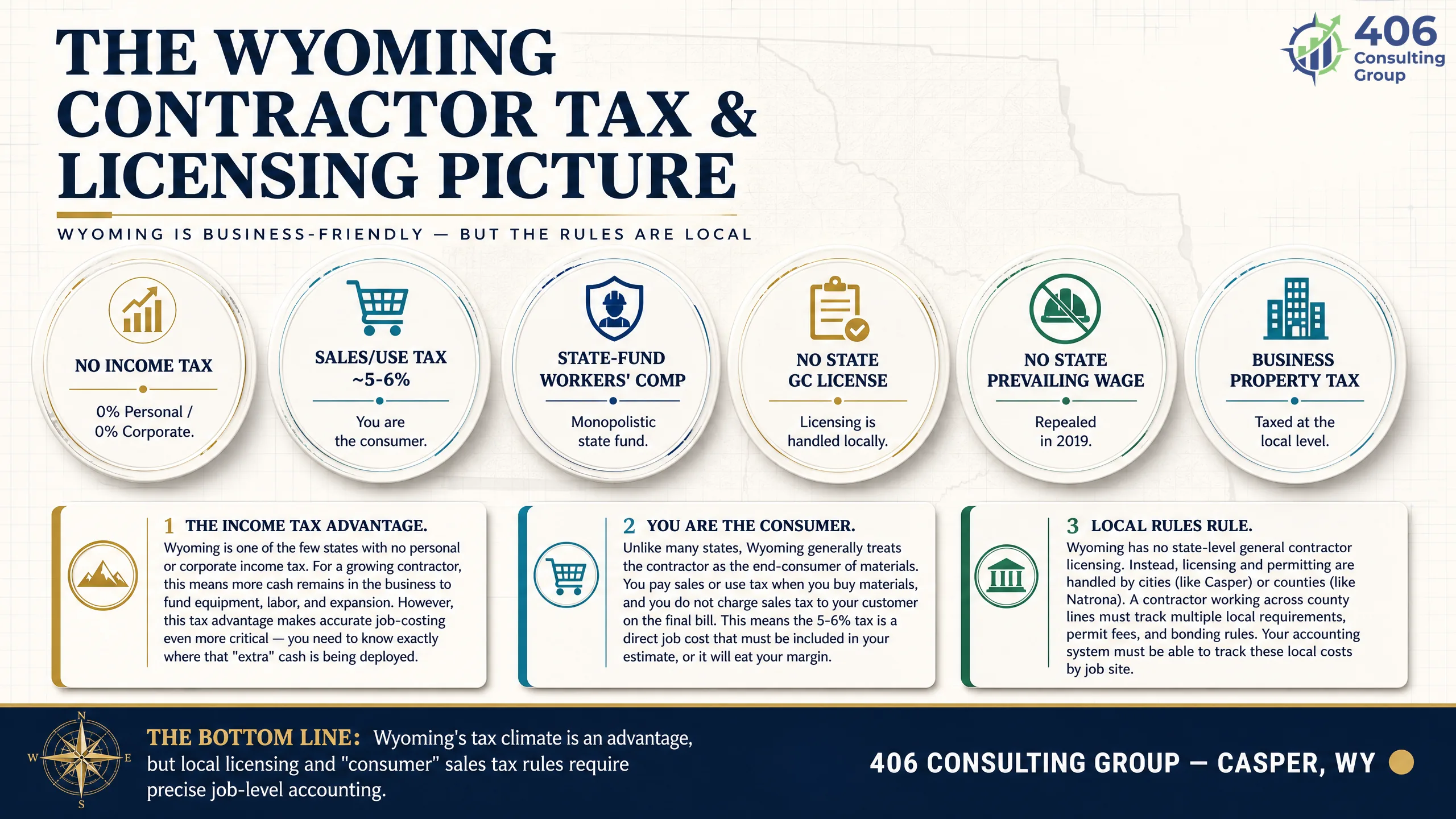
Wyoming is one of the lowest-tax states in the country, but "low tax" isn't "no rules." Here's the frame for a contractor:
| Item | What it means for a contractor |
|---|---|
| State income tax | None — no personal or corporate income tax in Wyoming |
| Sales & use tax | ~5–6% in the Casper area; on real-property work you're the consumer — pay tax on materials, don't bill the customer |
| Workers' comp | State-monopoly fund — coverage comes through Wyoming, not private insurers; construction rates are significant |
| Contractor license | No statewide GC license — requirements are local; electrical is state-licensed, plumbing typically local |
| Prevailing wage | No Wyoming state prevailing wage — only federal Davis-Bacon on federally funded jobs |
| Equipment | Business personal property is assessed by the county — track it |
Confirm current rates and rules with the Wyoming Department of Revenue. Three pieces deserve a closer look — the consumer rule, the workers' comp fund, and licensing.
Wyoming Sales/Use Tax: You're the Consumer
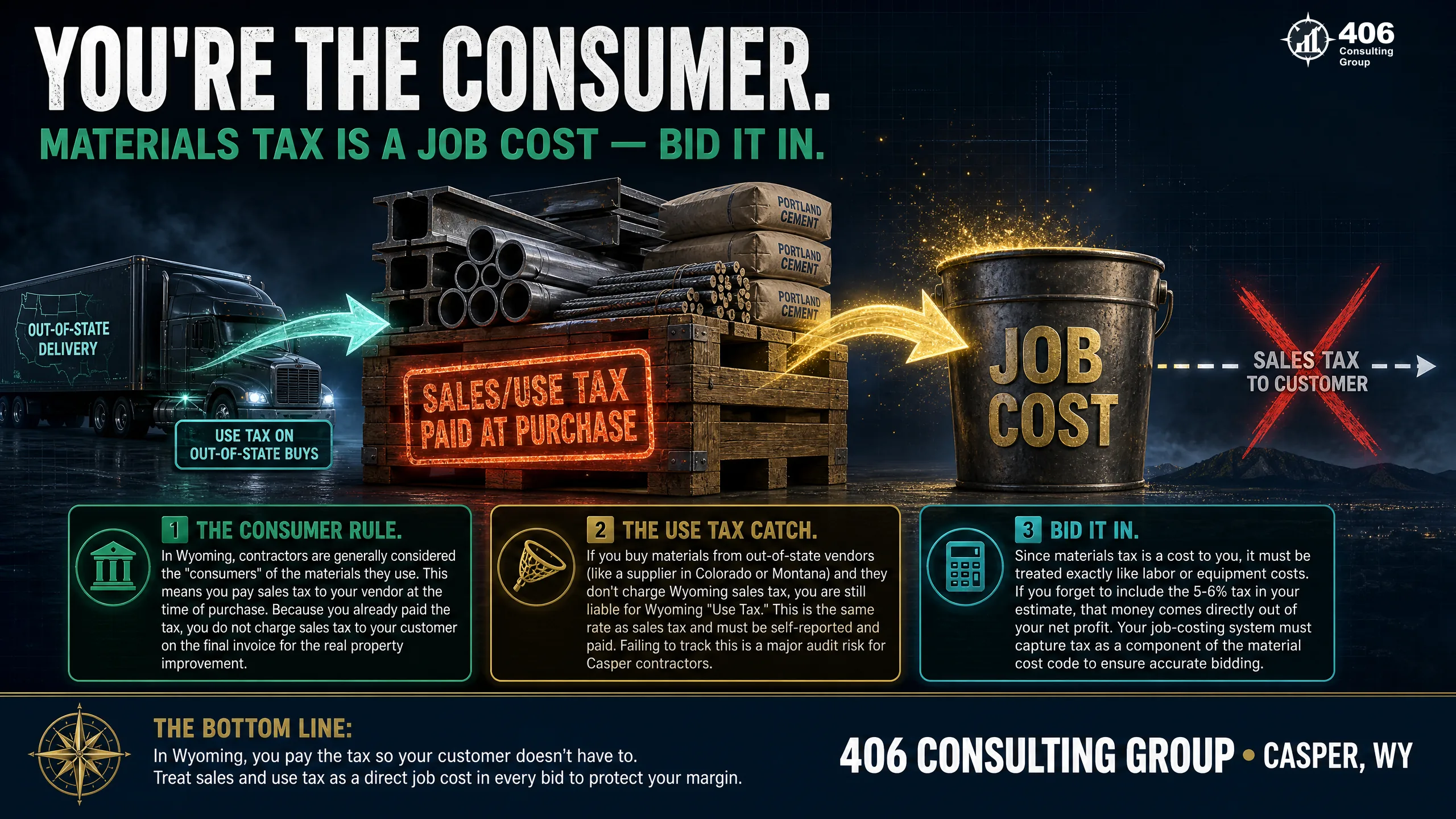
Wyoming has no income tax, so sales and use tax does a lot of the state's revenue work — and for a contractor, the key rule is how it lands on your materials. On a typical real-property improvement, Wyoming generally treats you as the consumer of the materials: you pay sales or use tax when you buy them, and you don't charge your customer sales tax on the construction itself. You're the end user of the steel, pipe, concrete, and fixtures, and the tax rides along in your cost — not a line you collect from the owner.
For the books, the consequences are practical. Materials tax is a job cost that has to be baked into every estimate at the taxed price, or you'll under-bid the work. Use tax comes into play when you bring materials in from out of state or pull them from inventory without Wyoming tax having been paid — easy to overlook when you're sourcing gear for an energy job from a supplier out of state. And rates vary a bit by county, so a job in one part of the basin can carry a slightly different rate than another. Getting all of this into the books keeps both your pricing and your compliance straight.
Confirm how the rule and use tax apply to your work — especially for out-of-state purchases — with the Wyoming Department of Revenue.
Wyoming's Monopolistic Workers' Comp Fund
This one genuinely surprises contractors moving in from other states. Wyoming is one of a small handful of monopolistic workers' comp states — meaning you generally can't buy workers' comp from a private insurer for covered Wyoming work; coverage comes through the state fund administered by Wyoming's Department of Workforce Services. For a construction employer, comp is mandatory, and the rates on hazardous trade work — welding, steel, excavation, energy-facility work — are meaningful line items, not rounding errors.
For the books, that means comp premiums flow through the state system on Wyoming payroll, they need to be tracked as a real cost of labor, and they belong in your job costing and your bids — a crew's true burdened cost includes that comp. It also complicates crews that cross state lines: work performed in a state with a private/competitive comp market follows different rules than Wyoming's monopolistic one, so multi-state contractors have to keep the two straight. Setting payroll and comp up correctly from the start keeps this from becoming a year-end mess.
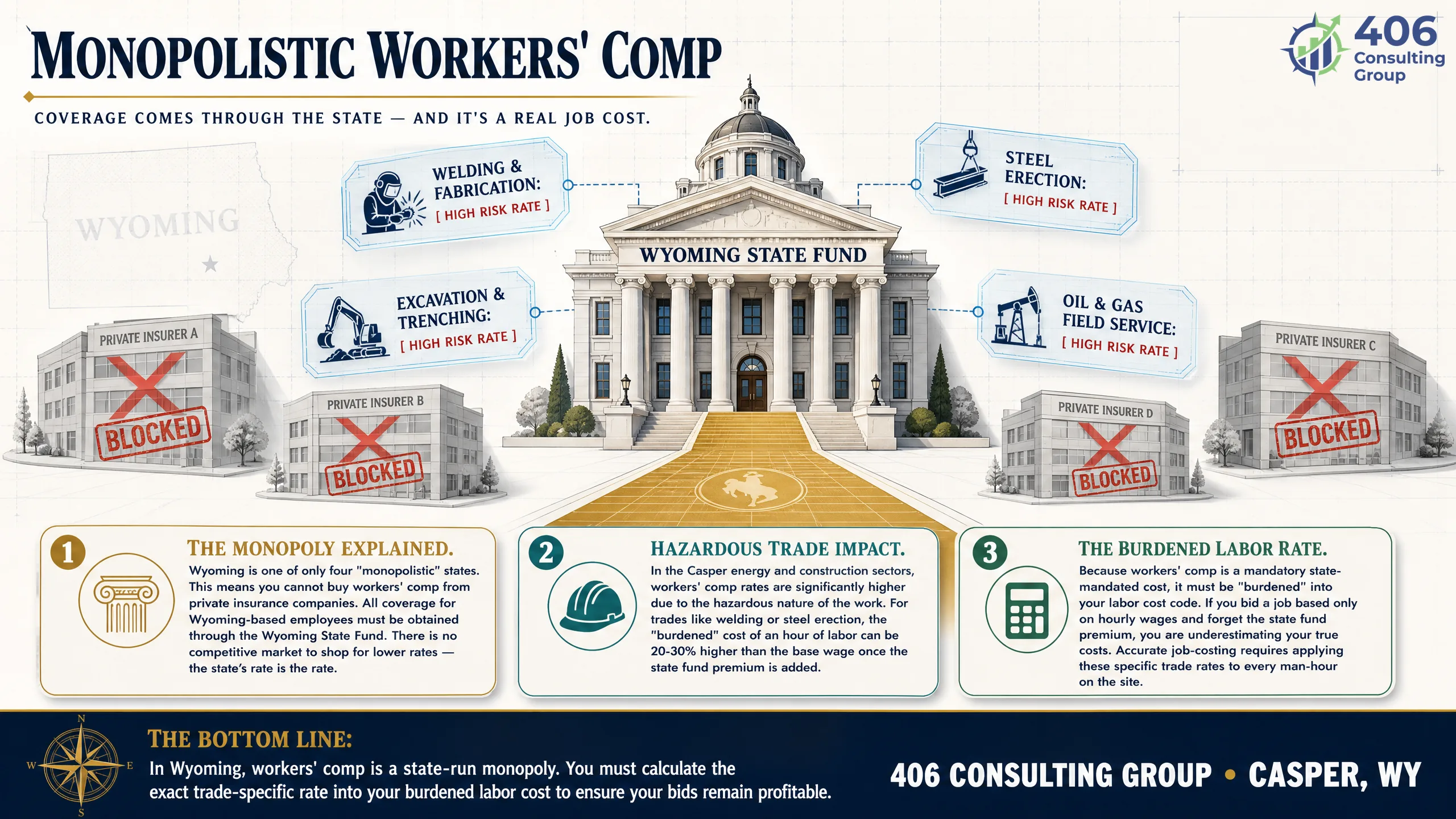
Confirm your coverage requirements and rates with Wyoming Workforce Services — comp is not optional, and it isn't a private-market purchase here.
No Statewide License — But Plenty to Get Right
Unlike Arizona, Oregon, or Idaho, Wyoming has no statewide general-contractor license. That doesn't mean anything goes — it means the requirements are local: Casper and other municipalities set their own contractor licensing or registration rules, so where you build determines what you need. Meanwhile the electrical trade is generally licensed at the state level, so electricians carry a state credential everywhere, while plumbing is typically licensed locally — which only reinforces that you have to know each jurisdiction's rules.
For a contractor, the practical takeaway is to know the licensing and any bonding or registration rules for each city or county you work in, and to keep the trade licenses your crews need current. Public-works jobs add their own bonding and compliance requirements on top. None of this is heavy compared with a full state licensing board, but it's easy to assume "no state license" means "no requirements" and get tripped up on a job in a jurisdiction with its own rules. Confirm local requirements with the city or county where you're building.
The books' role here is simple but real: licensing, registration, and bonding are recurring costs and obligations that belong in your financial picture, and your financials support the bonding larger public jobs require.
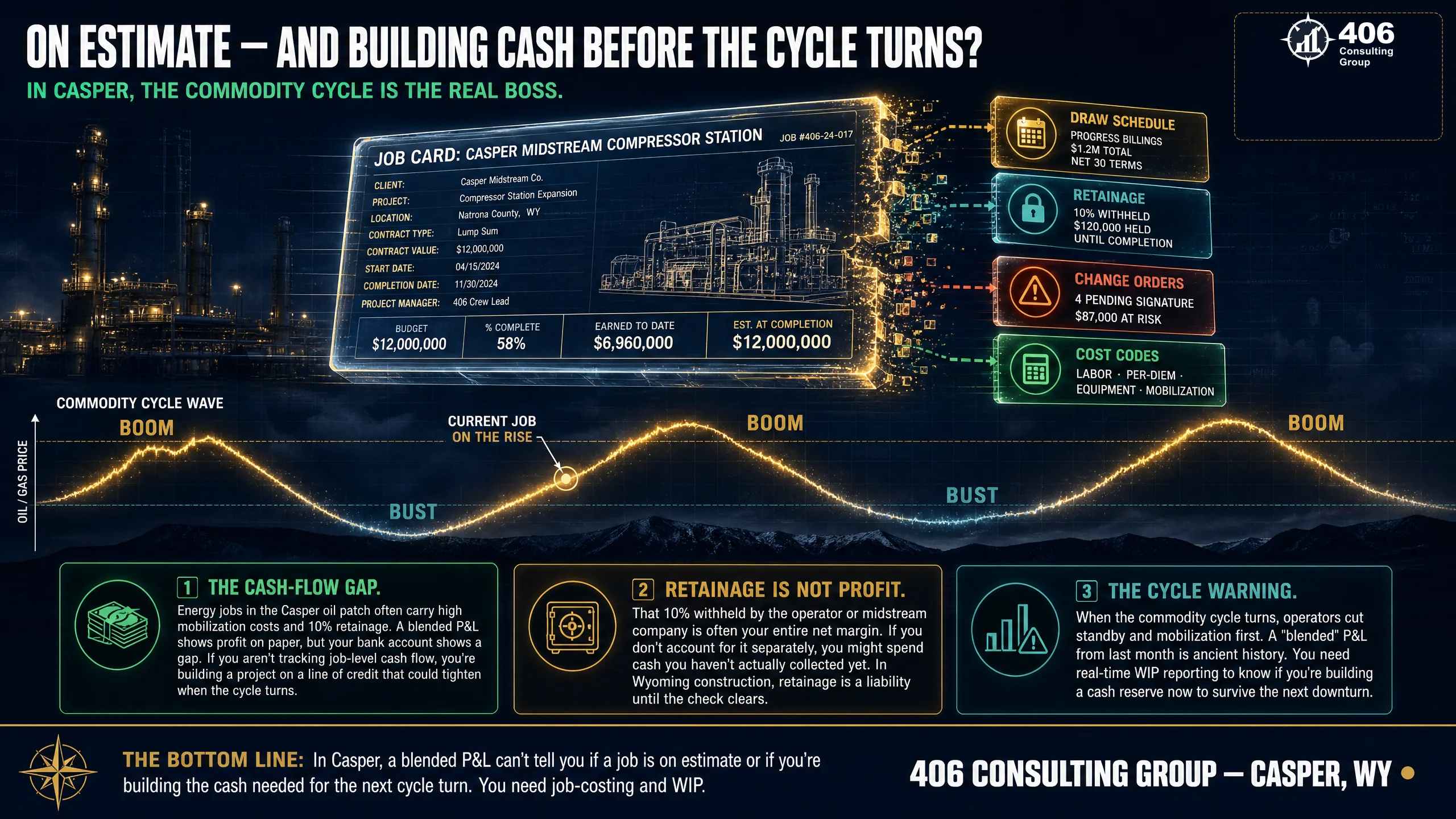
Building for the Oil Patch: Energy-Sector Work
A lot of Casper construction ultimately serves energy, and that shapes the books. Energy-sector work tends to be project-driven and cyclical — busy when prices are up, thin when they're not — so a contractor's revenue and backlog can swing hard with the commodity market. It often involves out-of-town crews, per-diem and lodging costs, mobilization to remote sites, and sometimes work under master service agreements with energy operators. Each of those is a cost or billing wrinkle that has to be captured accurately, or the margin on a fly-in, fly-out energy job disappears into untracked travel and standby time.
This is home ground for us. Beyond the accounting, we bring genuine oil & gas experience — we understand how energy work ebbs and flows, how operators pay, and how a contractor's costs behave on a remote job. That means books built for how energy-country construction actually runs, and cash discipline aimed at surviving the down part of the cycle so you're strong enough to pounce when it turns back up.
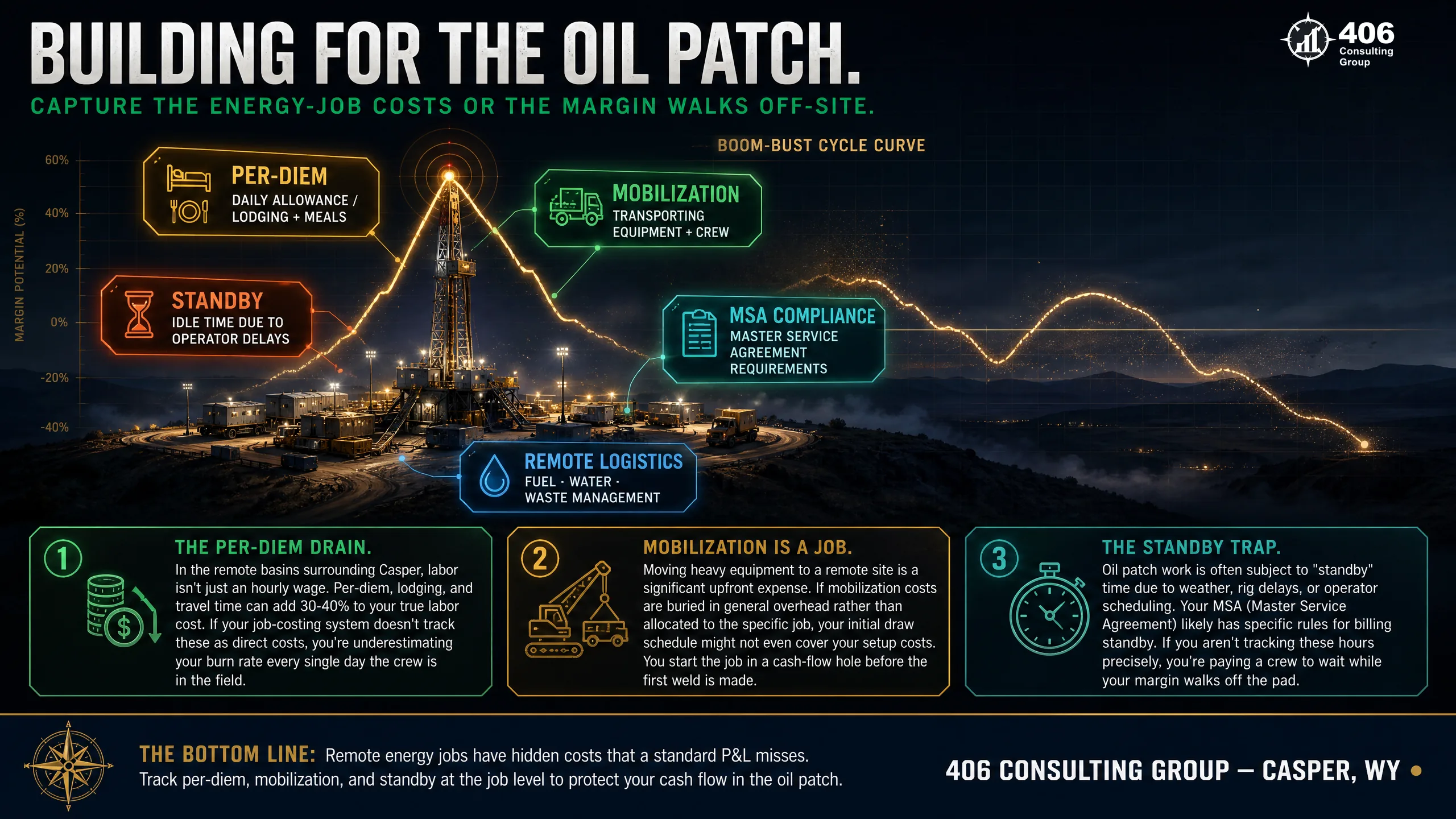
Managing cash across the boom and the bust is the difference between an energy-country contractor who lasts and one who doesn't.
Job Costing: Which Job Actually Makes Money
Ask a Casper contractor which job paid best last year and, more often than not, you'll get an educated guess. Job costing turns the guess into a fact by tying every labor hour (at its true burdened cost, comp included), every material invoice (at its taxed price), every subcontractor bill, and every piece of equipment time to the specific job it belongs to. On energy work especially — where travel, per-diem, standby, and mobilization can quietly swamp a job — per-job margin is the only way to know which work actually pays and which just keeps the crew busy at a loss.
It's also the bedrock the rest of construction accounting sits on: you can't produce an honest WIP schedule, bill progress correctly, or price the next energy job from real history without job-level costs. For a Casper contractor working a cyclical market, disciplined job costing is what keeps the busy years genuinely profitable instead of just loud.
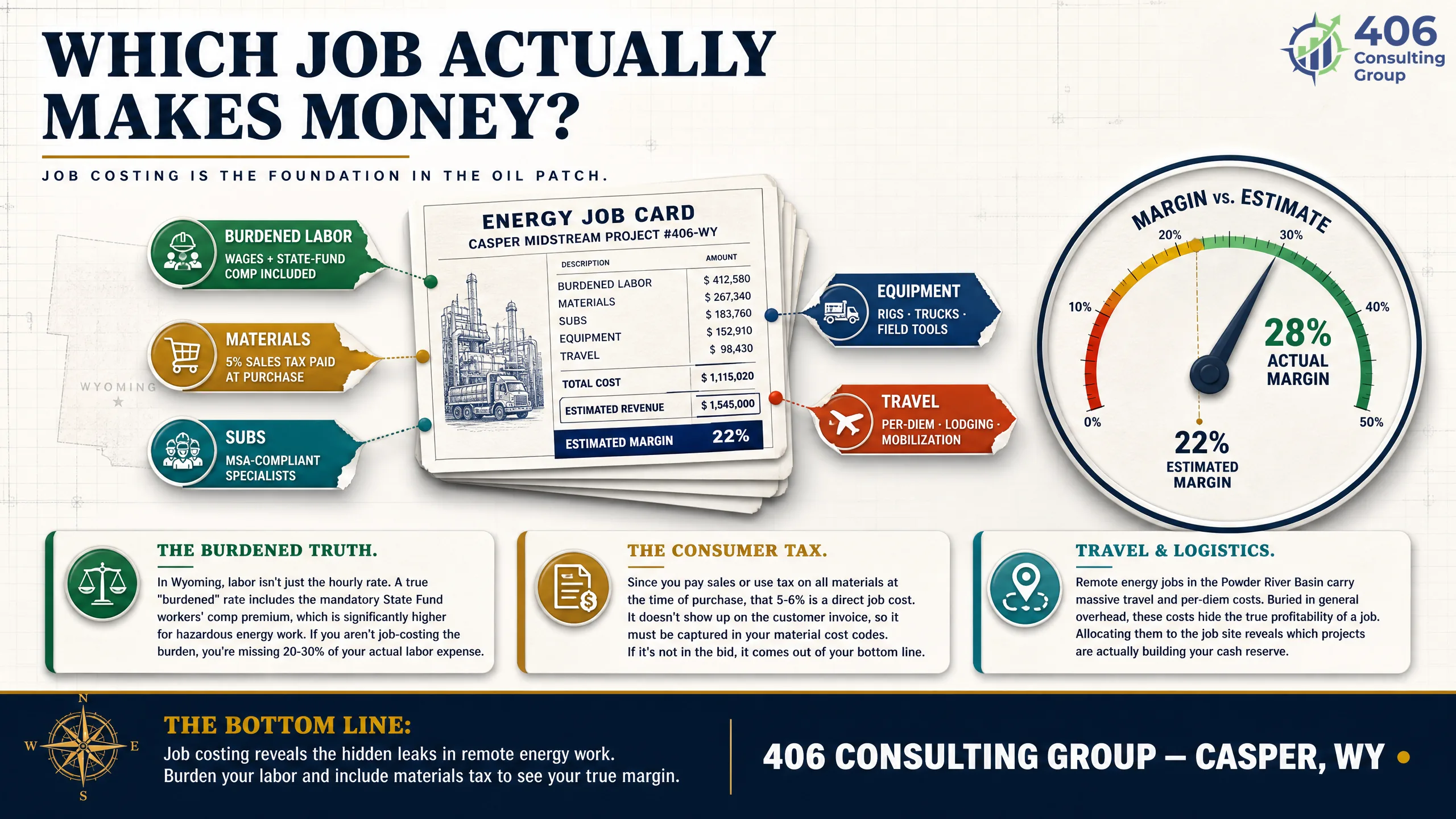
Pinpointing the jobs and crews that truly carry the business is the core of our contractor unit economics work — and job costing is what puts hard numbers behind the hunch.
WIP, Percentage-of-Completion, Retainage & Change Orders
Jobs that run for months need accounting a plain ledger can't deliver. A work-in-progress (WIP) schedule lines up each open job's costs, billings, and estimated cost-to-complete so you can see whether you're over- or under-billed — run ahead of the work and spent cash can masquerade as profit, run behind it and you're financing the owner out of your own pocket. Percentage-of-completion recognizes revenue as the job earns it instead of dumping it at the end, so each month's numbers reflect where things truly stand.
Then there's retainage — the portion held until completion, which locks up cash and needs its own receivable — and change orders, which reshape scope and margin and must be captured before they vanish into the job. In a cyclical energy market, that WIP discipline matters even more: it's what tells you, in real time, whether the current run of work is building cash or quietly burning it before the next downturn arrives.

As the jobs get larger, this is where a controller or CFO function takes over — a live WIP is the clearest read you'll get on where the business actually stands.
Equipment, Depreciation & Personal Property
Energy-country contractors run heavy iron, and it shapes the books two ways. Federally, Section 179 and bonus depreciation can let you write off a large share of a truck, loader, or welding rig in the year you buy it — powerful when you're gearing up for a busy cycle, though it's worth timing against your multi-year income rather than deducting on reflex, especially given how energy revenue swings. On the state side, Wyoming assesses business personal property through the county, so a clean fixed-asset schedule keeps you from paying on equipment you've sold or run into the ground.
That fixed-asset detail should feed job costing too, because equipment hours belong on the jobs that used them — and on remote energy work, an underused machine hauled to a distant site is an expensive kind of idle. Track what you own, what it costs to run, and where it's earning, and the equipment stops being a blind spot on the balance sheet.
The depreciation and low-tax-state planning live in the Casper tax guide; the tracking that powers it starts in the books.
Common Construction Bookkeeping Mistakes
A handful of avoidable errors cause most of the financial pain for Casper contractors.
Leaving materials tax out of the bid
Because you pay sales/use tax as the consumer, it's a job cost — omit it and every estimate comes in light.
Underestimating workers' comp
Wyoming's state-fund comp rates on hazardous trades are significant; leave them out of burdened labor and your job costs lie.
Assuming 'no state license' means no rules
Local licensing and bonding, plus state electrical licensing, still apply — a job in the wrong jurisdiction without them is a problem.
No real job costing on energy work
Travel, per-diem, standby, and mobilization quietly eat margin on remote jobs unless every cost lands on the job.
Ignoring the WIP schedule
Over/under-billing hides the true state of each job — dangerous in a cyclical market, and no surety will bond you without a clean WIP.
Each is a setup-and-habit problem — and each clears up once the books are built for Wyoming energy-country construction and run on a monthly rhythm.
Local vs. a Great Remote Partner
A Casper contractor's day runs from the shop to the site to a remote pad, not to an accountant's office — so a remote partner fits the work rather than fighting it. What decides whether it works is expertise: does your accountant understand Wyoming and energy-country construction — the consumer sales-tax rule, the state-fund workers' comp, local licensing, job costing on cyclical energy work, and WIP? Knowing the oil & gas business on top of that matters more than a nearby office, and it's exactly what a specialist brings and a local generalist usually can't.
Our setup is built for it: cloud accounting and job-costing software, receipts and hours captured from the field or the rig, connected bank feeds, and a monthly close you can rely on — Wyoming-literate, energy-savvy construction books with no trip to town required. In Casper, out in the basin, or across the state, the work and the expertise come through the same.
The real question isn't how close your accountant sits — it's whether they know Wyoming construction and the energy business. That's what we bring.
How to Get Started
Getting a Casper contractor's books in order is three steps.
Get the Wyoming pieces right
Build materials sales/use tax into estimates as a job cost, set up state-fund workers' comp correctly, and know the local licensing where you build.
Build construction-grade books
Job costing by phase (with burdened labor and travel), a WIP schedule, retainage and change-order tracking, a fixed-asset schedule, and certified payroll where federal work requires it.
Run it monthly
Monthly close, WIP review, sales/use-tax handling, and job reporting — so you know which jobs pay and whether you're building cash before the next cycle turns.
Not sure where your books stand? Our Financial Maturity Assessment maps it out in about eight minutes.
FAQ: Casper Construction Accounting
Do Wyoming contractors charge customers sales tax?
Generally not on real-property construction work. Wyoming treats a contractor improving real property as the consumer of the materials, so you pay sales or use tax when you buy the materials and don't charge the customer sales tax on the job itself. The tax is part of your cost, which means it has to go into your estimates and job costing at the taxed price — leave it out and you under-bid the work. Use tax also applies when you bring materials in from out of state or pull them from inventory without Wyoming tax paid, and rates vary a bit by county. Confirm how it applies to your specific work with the Wyoming Department of Revenue.
How does workers' comp work for contractors in Wyoming?
Wyoming is a monopolistic workers' compensation state, which means you generally can't buy comp from a private insurer for covered Wyoming work — coverage comes through the state fund administered by Wyoming's Department of Workforce Services. For construction, comp is mandatory, and the rates on hazardous trades like welding, steel, and excavation are meaningful costs, so they belong in your burdened labor rates and your job costing. It also matters for crews that cross state lines, since a state with a private/competitive comp market follows different rules than Wyoming's. Confirm your coverage and rates with Wyoming Workforce Services.
Do I need a contractor's license in Wyoming?
There's no statewide general-contractor license in Wyoming, so requirements are set locally — Casper and other municipalities have their own contractor licensing, registration, or bonding rules, and where you build determines what you need. The electrical trade is generally licensed at the state level, so electricians carry a state credential everywhere, while plumbing is typically licensed locally — and public-works jobs add their own bonding and compliance requirements. 'No state license' doesn't mean no requirements, so it's worth confirming the rules with each city or county where you work.
How does the energy cycle affect a Casper contractor's books?
A lot of Casper construction serves energy, so revenue and backlog can swing hard with commodity prices — busy in the ups, thin in the downs. That makes job costing and cash discipline more important than in a steady market: energy work often carries out-of-town crews, per-diem and lodging, mobilization to remote sites, and sometimes master service agreements, and those costs quietly erode margin if they aren't tracked to the job. A clean WIP schedule tells you in real time whether the current run of work is building cash or burning it, so you're strong enough to weather the next downturn and pounce when it turns back up.
Can 406 Consulting Group do my Casper construction bookkeeping remotely?
Yes — for a contractor who works from the shop, the site, and remote pads, remote bookkeeping is the natural fit. Everything runs on cloud accounting and job-costing software, with receipts and time captured from the field, connected bank feeds, and a dependable monthly close. What matters for a construction business is expertise in job costing, WIP, Wyoming's consumer sales-tax rule and state-fund workers' comp, local licensing, and the energy business — not office proximity. Our genuine oil & gas experience means we understand how energy-country work actually runs. We serve Casper and Natrona County contractors the same way whether you're in town or out in the basin.
Keep Reading
Trades & Construction — Casper, WY
Build Through the Cycle on Books You Can Trust.
406 Consulting Group keeps Casper contractors clean and compliant — Wyoming's consumer sales tax, state-fund workers' comp, local licensing, job costing, WIP, and heavy equipment handled — delivered remotely, by a firm that knows Wyoming and the energy business.
Casper Construction Quick Reference
Casper, WY — Natrona County
Comp & the Cycle Squeezing Margin?
Job costing, WIP & energy-savvy books, handled.
About the Author
Carrie Anderson
Co-Founder, 406 Consulting Group
Commercial banking and underwriting background — 300+ loan reviews — with deep oil & gas experience. Carrie helps Casper builders handle Wyoming's consumer sales tax and state-fund workers' comp, run real job costing and WIP on cyclical energy work, and keep books strong enough to ride the cycle.
Read the Full Story