
Trades & Construction Accounting in Cheyenne, WY:
Build the Capital on Books You Can Trust
Cheyenne builds data centers and federal jobs — so certified payroll is routine and high-stakes — on top of Wyoming's consumer sales tax and state-fund workers' comp. The accounting a Cheyenne contractor really needs.

Cheyenne builds a different mix than the rest of Wyoming. As the state capital and a fast-growing crossroads on the Front Range, its construction runs to data centers and mission-critical facilities, work at and around F.E. Warren Air Force Base, wind-energy projects, rail and warehouse-logistics jobs off the Union Pacific corridor, and the government, commercial, and residential building a growing capital needs. For the electricians, mechanical crews, concrete and steel trades, and general contractors chasing it, the pipeline is strong — and heavy on the kind of federal and mission-critical work that carries strict payroll rules.
The accounting reflects that mix. Wyoming's rules still apply — no income tax, a sales/use tax you pay as the consumer of your materials, the state-fund workers' comp, and no statewide contractor license — but Cheyenne adds a heavy dose of federal and prevailing-wage work, where certified payroll is non-negotiable, plus the large, MEP-intensive data-center jobs that live and die on job costing and WIP. This guide walks all of it, delivered remotely.
By Jason Anderson — Co-Founder, 406 Consulting Group. Big-firm-trained accountant serving contractors and trades across the Mountain West — job costing, WIP, certified payroll, and the Wyoming rules that decide whether a Cheyenne bid holds its margin.
Quick Answer: Accounting for a Cheyenne Contractor
- →Federally funded work (F.E. Warren, federal and publicly funded projects) makes Davis-Bacon certified payroll a routine, high-stakes part of the job here.
- →Data-center & MEP-heavy jobs are large and schedule-driven — job costing and WIP are what protect the margin.
- →Wyoming basics still apply: no income tax, consumer-pays-materials sales tax, state-fund workers' comp, no statewide GC license.
- →Bonding matters — public and large private jobs size your capacity off your financials and WIP.
- →Delivered remotely — the norm for a contractor whose office is the truck.
Table of Contents
Why Construction Accounting Is Its Own Discipline
Few businesses are as easy to misread from the books as a construction company. Profit doesn't arrive evenly — it's locked inside jobs that run for months, paid out in draws, dented by the retainage an owner holds back, and reshaped by change orders along the way, while the costs of labor, materials, subs, and equipment all have to find the right project. On Cheyenne's larger federal and data-center work the complexity compounds: the numbers only mean something if every cost lands on the job it belongs to. Books that merely sort transactions and reconcile at tax time can't answer the questions that actually run the company — is this job beating its estimate, and is the business ahead once every open job is counted?
In Cheyenne, that challenge comes with a specific flavor. A big share of the work is federal, mission-critical, or public — which means certified payroll and compliance are woven through daily operations, not a rare exception — and the marquee data-center projects are large and fast, where a small costing error scales into a big one. Layer Wyoming's own tax and workers'-comp rules underneath, and clean, construction-grade books aren't a nicety here; they're what let a contractor take on this caliber of work without getting buried by it.
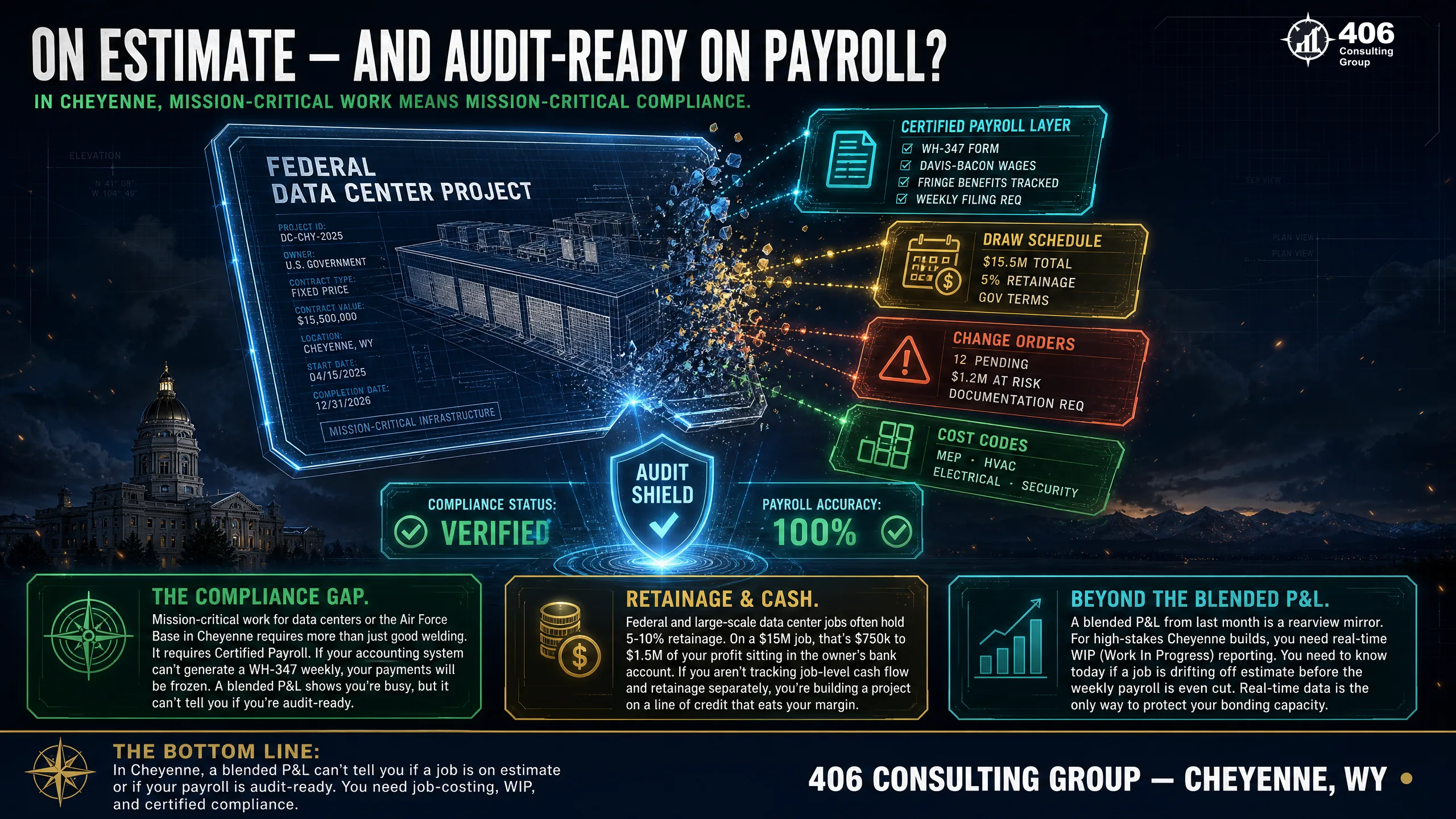
Start with Wyoming's tax and licensing frame, then the piece that most shapes the Cheyenne market: federal and mission-critical work.
The Wyoming Contractor Tax & Licensing Picture
Wyoming is a low-tax state, but it has a few features that shape a contractor's books. The short version:
| Item | What it means for a contractor |
|---|---|
| State income tax | None — no personal or corporate income tax |
| Sales & use tax | ~5–6% in the Cheyenne area; on real-property work you're the consumer of the materials |
| Workers' comp | State-monopoly fund — coverage runs through Wyoming, not private insurers |
| Contractor license | No statewide GC license; local rules apply, and electrical is state-licensed |
| Certified / prevailing wage | Federal Davis-Bacon on federal jobs — common here given the base and federal work |
| Equipment | Business personal property assessed by the county — track it |
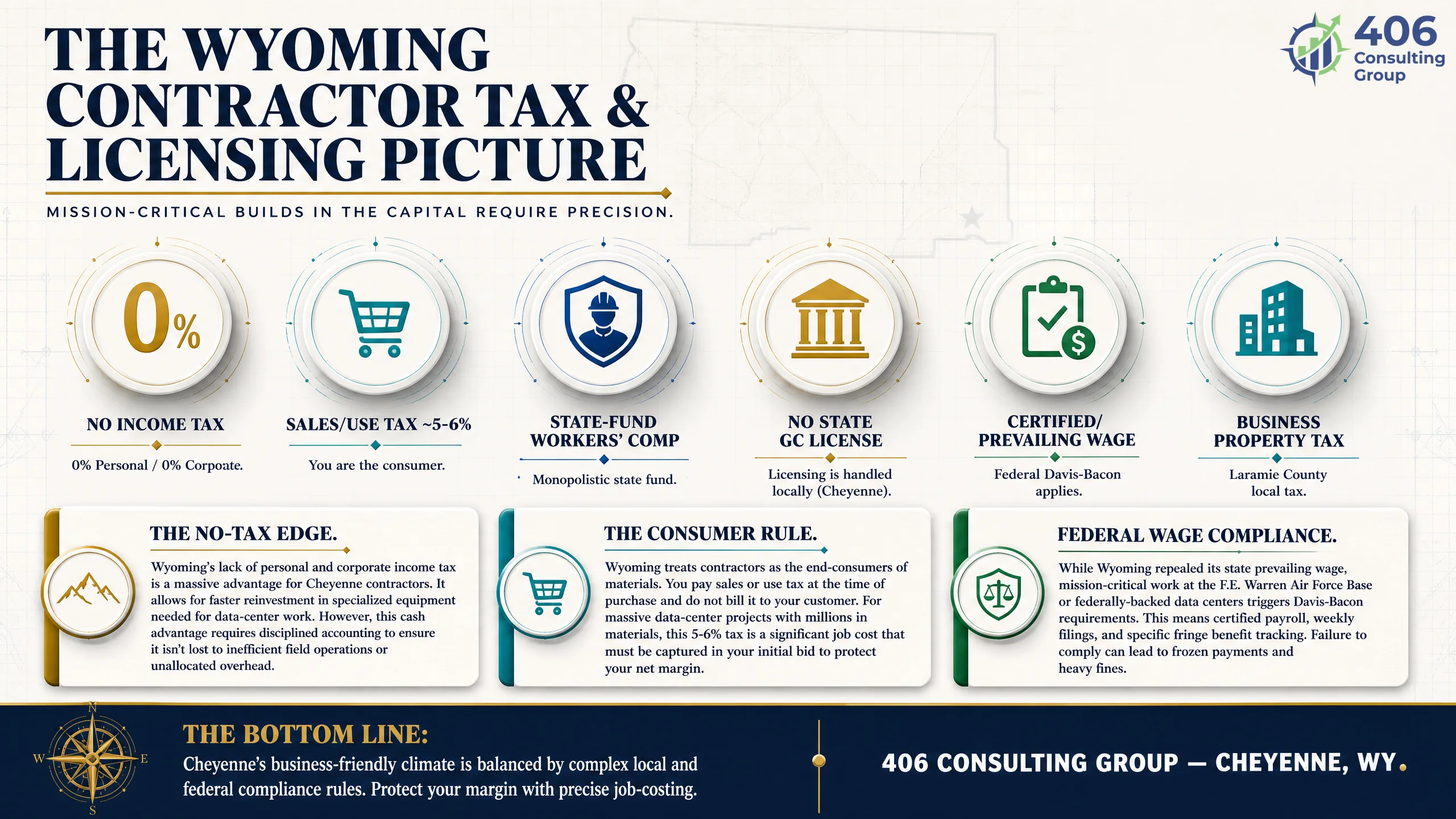
Confirm current rates with the Wyoming Department of Revenue. Now the feature that defines Cheyenne's construction market.
Data Centers, the Air Base & Federal Work
What sets Cheyenne apart from the rest of Wyoming is what gets built. The region has become a data-center hub, drawing large, MEP-intensive, schedule-driven projects with enormous electrical and mechanical scopes; F.E. Warren Air Force Base and other federal facilities generate a steady stream of military and federal construction; and public and institutional work rounds it out. That mix pushes one accounting requirement to the front: on federally funded work, the Davis-Bacon Act mandates paying set prevailing wage rates and filing certified payroll reports for every worker, every week — and mistakes can freeze your payments or trigger back-wage liability.
For a Cheyenne contractor, certified payroll isn't an occasional headache; it's a core capability. Your payroll has to produce accurate weekly certified reports with correct wage determinations and fringe handling, tie those labor costs back to the job, and keep the documentation auditors and prime contractors expect. The big data-center jobs add their own demands — heavy subcontractor coordination, large change orders, and tight schedules where a missed cost gets expensive fast. Books built for this kind of work are what let a contractor actually win and deliver it profitably.
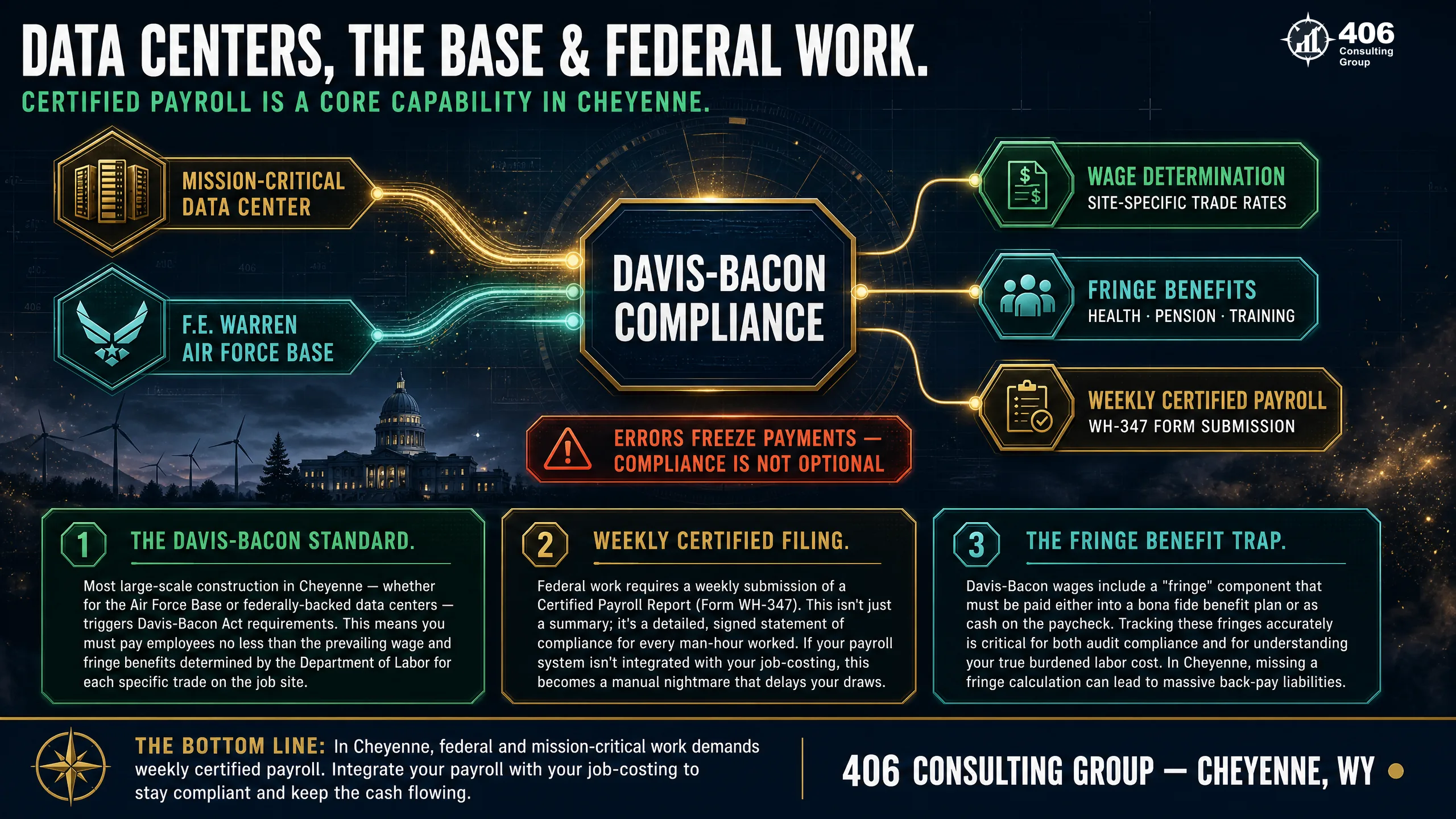
Confirm Davis-Bacon and wage-determination specifics for each federal job, since requirements follow the contract and the funding.
Wyoming Sales/Use Tax: You're the Consumer
With no income tax, Wyoming leans on sales and use tax — and for a contractor the key point is how it applies to materials. On real-property work, the state generally treats you as the consumer of what you install: you pay sales or use tax when you purchase the materials, and you don't add a sales-tax line to the customer's invoice for the construction itself. The tax is embedded in your cost rather than collected from the owner.
Practically, that makes materials tax a cost to bid — it has to sit in your estimates and job costs at the taxed amount, or you'll price low every time — and it brings use tax into play whenever you source materials or equipment from out of state without Wyoming tax paid, which is common on large data-center and federal jobs pulling specialized gear from national suppliers. Local rates vary a little across jurisdictions too. Capturing all of that in the books keeps both your bids and your compliance honest.
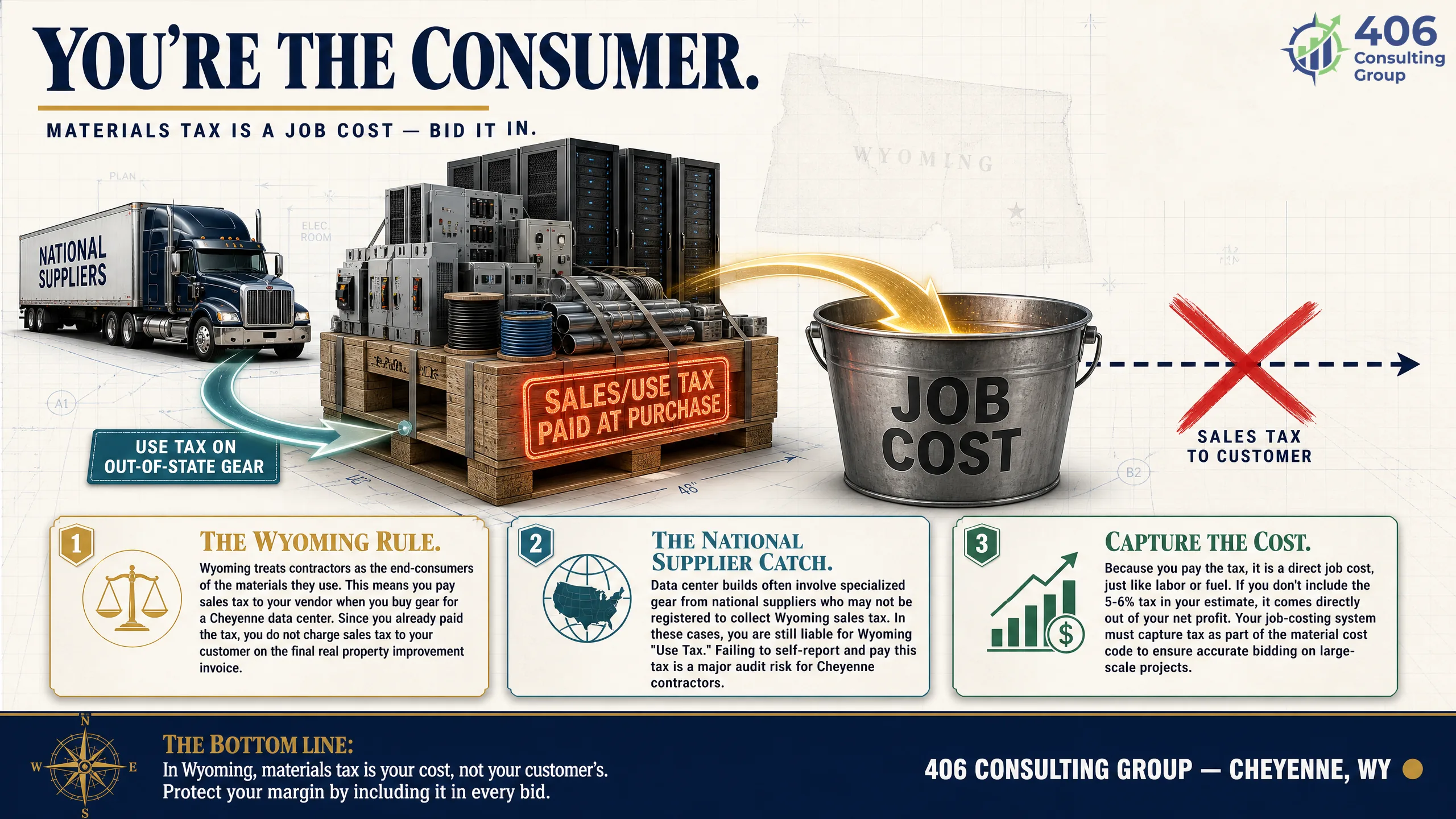
Confirm how the consumer rule and use tax apply to your out-of-state purchases with the Wyoming Department of Revenue.
Wyoming's State-Fund Workers' Comp
Wyoming handles workers' compensation differently than most states, and it catches newcomers out. It's a monopolistic state — for covered Wyoming work you obtain comp through the state fund (run by the Department of Workforce Services), not from a private insurer of your choice. Coverage is mandatory for construction employers, and the rates on higher-risk trade work are real money, not an afterthought.
For the books, comp premiums belong in your burdened labor rates and therefore in your job costing and bids — the true cost of a crew includes that coverage, and on prevailing-wage federal jobs the fringe and labor accounting has to line up cleanly with it. If you also staff jobs across a state line into a private-market comp state, the two systems follow different rules and have to be kept straight. Setting payroll and comp up correctly from the outset keeps this from turning into a reconciliation mess at year-end.
Confirm your coverage and rates with Wyoming Workforce Services — comp here isn't a private-market shopping decision.
Job Costing: Which Job Actually Makes Money
On the large, fast-moving jobs Cheyenne is known for, flying blind on cost is dangerous — a small percentage miss on a big data-center or federal contract is a lot of money. Job costing is the fix: every labor hour at its burdened cost (comp and fringe included), every material invoice at its taxed price, every subcontractor bill, and every equipment charge tied to the specific job and cost code. That's the only way to see the real margin on each project against its estimate — and on prevailing-wage work, it's also how you keep certified-payroll labor reconciled to the job.
It's the foundation the rest of construction accounting depends on: no accurate WIP, no correct progress billing, and no reliable read on a change order without job-level costs beneath them. For a Cheyenne contractor scaling into bigger federal and mission-critical work, job costing is what keeps that growth genuinely profitable rather than just busy and risky.
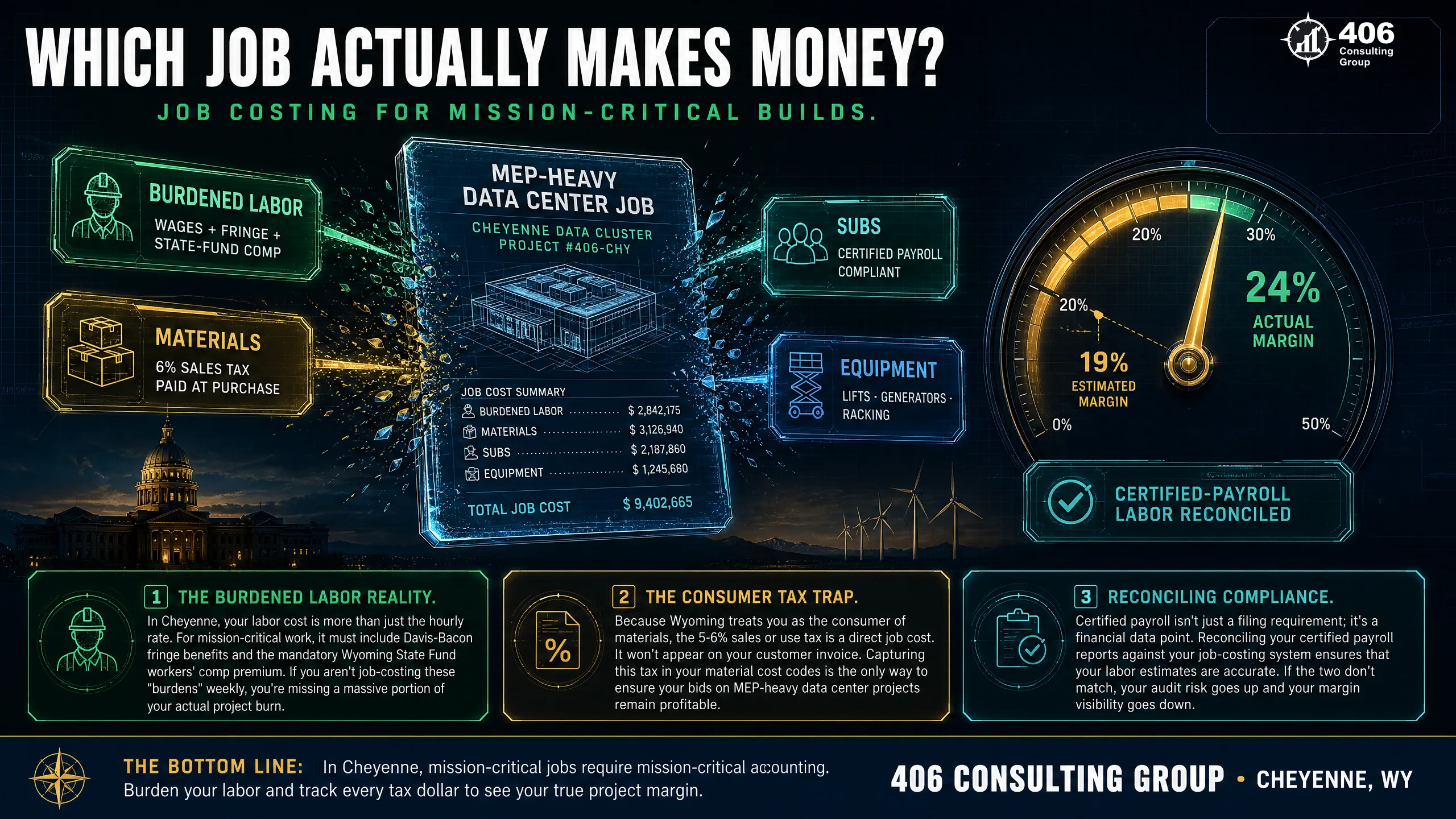
Seeing which jobs and crews genuinely drive profit is the whole aim of our contractor unit economics work — and job costing is the engine underneath it.
WIP, Percentage-of-Completion, Retainage & Change Orders
Long, large jobs demand accounting a basic ledger can't produce. A work-in-progress (WIP) schedule compares what each open job has cost, what you've billed it, and what it will still take to finish — and the gap tells you whether you're over- or under-billed. Billed ahead of the work, a healthy-looking bank balance can be money you've already committed; billed behind it, you're bankrolling the owner's project on your own dime. Percentage-of-completion then recognizes revenue as the job advances, so the statements move with reality instead of jumping at closeout.
Then there's retainage — often 5–10% held to the end, which locks up real cash and needs its own receivable — and change orders, which on big data-center and federal jobs can be substantial and must be captured and approved before the work is buried in the job. On projects this size, and for the surety bonding these jobs require, a clean WIP isn't optional: it's the report your bonding agent and bank scrutinize hardest before they'll back the next, bigger contract.
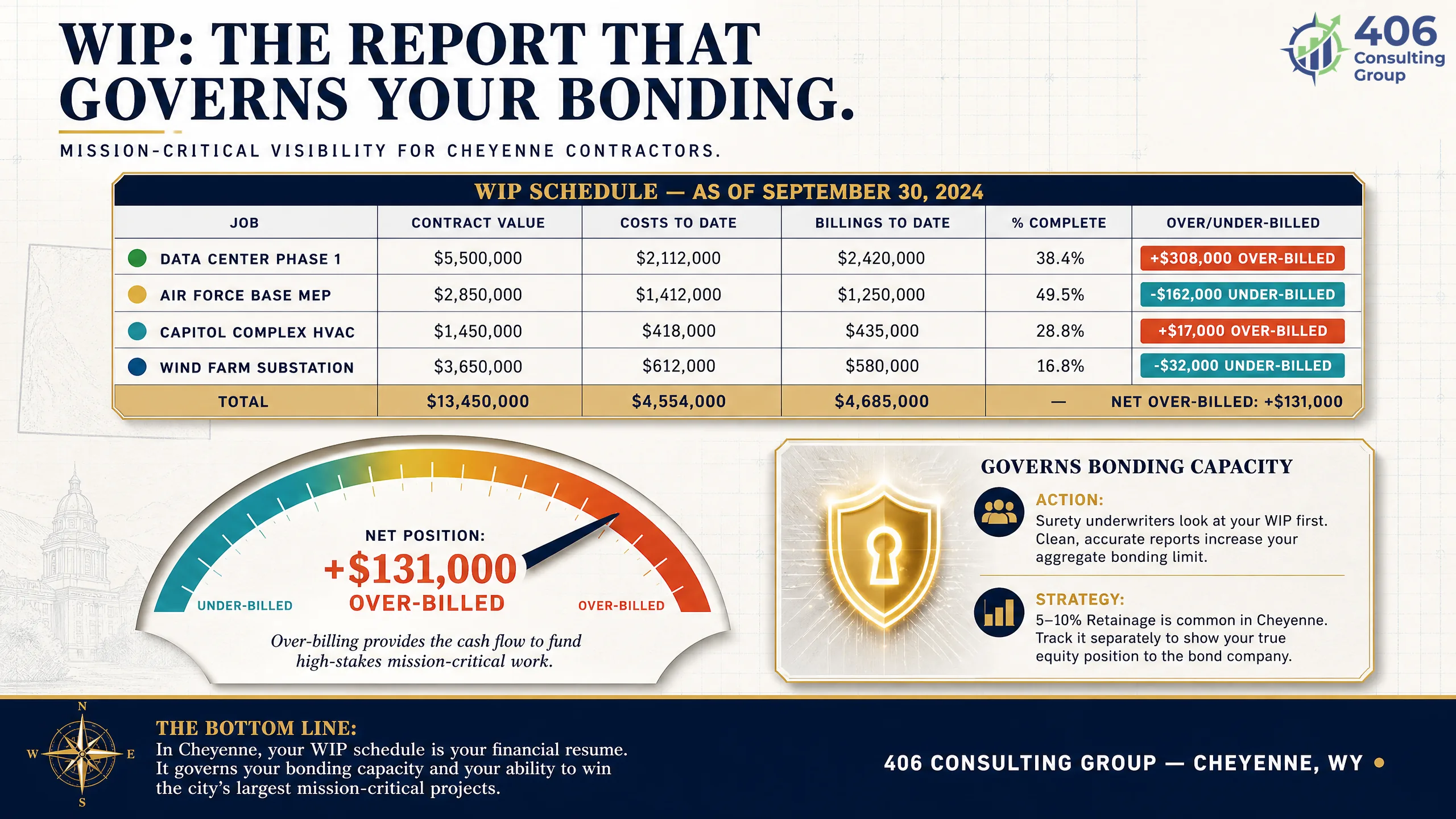
As the contracts scale, this is exactly where a controller or CFO function becomes essential — the WIP is the report that governs your bonding capacity.
Equipment, Depreciation & Personal Property
Your iron touches the books in two places. The federal one is depreciation: Section 179 and bonus can front-load the deduction on a truck, lift, or machine into its purchase year — handy when you're gearing up for a run of bigger jobs, but a call to make against your multi-year income, not a reflex toward the biggest write-off. The state one is business personal property, which Wyoming assesses through the county; a fixed-asset schedule that's actually current is what stops you paying tax on gear that's already been sold or scrapped.
That fixed-asset detail also belongs in job costing, because equipment hours should land on the jobs that used them — and on a schedule-driven data-center job, a machine tied up and underused is a cost you want to see, not discover later. Track what you own, what it costs to run, and where it's working, and the equipment stops hiding margin.

The depreciation and low-tax-state planning sit in the Cheyenne tax guide; the tracking that powers it starts in the books.
Common Construction Bookkeeping Mistakes
A handful of avoidable errors cause most of the financial pain for Cheyenne contractors.
Treating certified payroll as an afterthought
On federally funded jobs — common around the base and public work — it's weekly and exacting; wrong wage determinations or sloppy reports can freeze payments or create back-wage liability.
Leaving materials tax out of the bid
Sales/use tax you pay as the consumer is part of a job's cost — leave it out (or miss use tax on out-of-state gear) and the bid is short before you start.
Underestimating state-fund workers' comp
State-fund comp on hazardous trades is no rounding error; if it isn't in your burdened labor rate, your job margins are fiction.
No real job costing on big jobs
On a large data-center or federal contract, one untracked cost scales into a serious loss before it ever shows up on the P&L.
Ignoring the WIP schedule
Over- and under-billing mask where each job truly stands — and on contracts this size, no surety grows your bonding without a clean WIP.
Each is a setup-and-habit problem — and each clears up once the books are built for Wyoming's federal-and-mission-critical construction and run on a monthly rhythm.
Local vs. a Great Remote Partner
A Cheyenne contractor works from the shop to the site to a base gate, not from an accountant's lobby — so a remote partner suits the job. The thing that actually determines fit is depth in the work: can your accountant run certified payroll on federal and data-center jobs, apply the consumer sales-tax rule, handle state-fund comp, cost large MEP-heavy projects, and keep a bonding-grade WIP? That specialized knowledge, from wherever they're based, outperforms a local generalist who's never filed a certified payroll or built a WIP.
Our workflow is made for it — shared cloud accounting, field-captured receipts and hours, live bank feeds, certified-payroll handling, and a close that lands on schedule every month — so you get Wyoming-literate, federal-work-ready books without driving anywhere. Downtown, out by the base, or anywhere in Laramie County, the expertise reaches you all the same.
The deciding question is whether your accountant knows Wyoming construction and federal-work compliance — not how near their office is.
How to Get Started
Getting a Cheyenne contractor's books in order is three steps.
Nail the compliance pieces
Set up certified payroll for federal/data-center work, build materials sales/use tax into bids as a job cost, and get state-fund workers' comp right.
Build construction-grade books
Job costing by phase with burdened labor, a WIP schedule, retainage and change-order tracking, a fixed-asset schedule, and certified-payroll reporting.
Run it monthly
Monthly close, WIP review, sales/use-tax handling, and job reporting — so you know which jobs pay and can bond the next, bigger contract.
Not sure where your books stand? Our Financial Maturity Assessment maps it out in about eight minutes.
FAQ: Cheyenne Construction Accounting
Do Cheyenne contractors deal with certified payroll?
Often, yes — more than in much of Wyoming. Cheyenne's construction market is heavy on federal, military (F.E. Warren Air Force Base), and mission-critical work, and on federally funded projects the Davis-Bacon Act requires paying set prevailing wage rates and filing certified payroll reports for every worker, usually weekly. Getting the wage determinations, fringe handling, or reports wrong can freeze your payments or create back-wage liability, so payroll has to be set up to produce accurate certified reports and tie that labor to the job. Because the requirement follows the funding and the contract, confirm the specifics for each federal job.
Do Wyoming contractors charge customers sales tax?
Not on the construction itself. Wyoming makes the contractor the end user of the materials on real-property work, so the sales or use tax is something you pay when you purchase them — baked into your cost, not a line you bill the owner. The practical effect is that materials tax has to sit inside every estimate at its taxed amount, or your bids come in light. Use tax also surfaces when you source materials or specialized equipment from out-of-state suppliers with no Wyoming tax paid — routine on Cheyenne's data-center and federal jobs — and local rates vary a little by jurisdiction. Confirm the specifics with the Wyoming Department of Revenue.
How does workers' comp work for contractors in Wyoming?
Wyoming is one of the few monopolistic workers' comp states, so it isn't something you shop on the private market — coverage for Wyoming work runs through the state fund at the Department of Workforce Services, and it's mandatory for construction employers. Rates on higher-risk trades are real dollars, so they belong in your burdened labor and job costing, and on the federal prevailing-wage jobs common around Cheyenne that comp cost has to line up cleanly with your certified-payroll fringe accounting. Crews that also work across a state line into a private-market comp state follow that state's different rules. Check your coverage and rates with Wyoming Workforce Services.
Why does job costing matter so much on Cheyenne's data-center jobs?
Because the jobs are large, fast, and MEP-intensive, a small costing error scales into a big loss. Job costing ties every burdened labor hour, taxed material invoice, subcontractor bill, and equipment charge to the specific job and cost code, so you can see the real margin against the estimate while there's still time to act — and on prevailing-wage work it keeps certified-payroll labor reconciled to the job. It's also the foundation for an accurate WIP schedule, correct progress billing, and sound change-order decisions, all of which matter more the bigger the contract. Without it, you learn a job lost money only after it's over.
Can 406 Consulting Group do my Cheyenne construction bookkeeping remotely?
Yes — for a contractor who lives on the jobsite, remote is the natural fit. Everything runs on cloud accounting and job-costing software, with receipts and time captured from the field, connected bank feeds, certified-payroll handling, and a dependable monthly close. What matters for a construction business is expertise in job costing, WIP, certified payroll on federal and data-center work, Wyoming's consumer sales-tax rule and state-fund workers' comp, and bonding-ready financials — not office proximity. We serve Cheyenne and Laramie County contractors the same way whether you're in town, out toward the base, or across the region.
Keep Reading
Trades & Construction — Cheyenne, WY
Build the Capital on Books You Can Trust.
406 Consulting Group keeps Cheyenne contractors clean and compliant — certified payroll on federal and data-center work, Wyoming's consumer sales tax and state-fund comp, job costing, WIP, and bonding-ready financials — delivered remotely, by a firm that knows Wyoming construction.
Cheyenne Construction Quick Reference
Cheyenne, WY — Laramie County
Certified Payroll & Big Jobs?
Job costing, WIP & compliance, handled.
About the Author
Jason Anderson
Co-Founder, 406 Consulting Group
Big-firm-trained accountant serving contractors and trades across the Mountain West. Jason helps Cheyenne builders handle certified payroll on federal and data-center work, Wyoming's consumer sales tax and state-fund comp, run real job costing and WIP, and keep books bonding-ready.
Read the Full Story