
Trades & Construction Accounting in Helena, MT:
Build Montana's Capital on Books You Can Trust
No sales tax and no GC license — but registration, ICECs, and the routine prevailing-wage certified payroll and historic-rehab documentation that capital-city public work demands. The accounting a Helena contractor really needs.

Helena builds on a foundation few Montana cities share. As the state capital, it runs a steady base of government construction — the Capitol complex, state agency buildings, and Department of Transportation work — where most projects are public and carry the rules that come with public money. It's also a genuinely historic city, from Last Chance Gulch to the mansion district, so restoration and rehabilitation of protected buildings is a real line of work with accounting all its own. Add healthcare around St. Peter's and steady residential building, and the trades here work a mix weighted toward public and historic jobs. What makes the books their own discipline is Montana's particular setup — and, in the capital, one piece of it is everywhere.
Three Montana rules frame the work. There's no state sales tax, so the "consumer of your materials" question never arises. Montana issues no general-contractor license — it runs on contractor registration and Independent Contractor Exemption Certificates, while licensing electricians and plumbers at the state level. And Montana has its own prevailing-wage law, which in a government town like Helena is less an exception than the baseline — certified payroll is routine here. Layer on the documentation that public and historic work demands, plus job costing and WIP, and construction books in the capital are a discipline of their own. This guide walks all of it, delivered by a Montana firm.
By Jason Anderson — Co-Founder, 406 Consulting Group. A Montana firm with a commercial banking and underwriting background, serving contractors and trades across the state, from job costing and WIP to the public-work and prevailing-wage rules that decide whether a bid holds its margin.
Quick Answer: Accounting for a Helena Contractor
- →No state sales tax in Montana — no sales/use tax on your materials and no consumer-vs-retailer question to sort out.
- →No GC license — contractor registration with the Dept. of Labor & Industry, or an ICEC with no employees; electricians and plumbers are state-licensed.
- →Prevailing wage is the norm here — as the capital, most work is public, so Montana Little Davis-Bacon certified payroll is routine, not occasional.
- →Historic rehabilitation work carries its own accounting — segregated costs and documentation to support historic tax-credit programs.
- →Delivered by a Montana firm — statewide, and fluent in public-work and prevailing-wage compliance.
Table of Contents
Why Construction Accounting Is Its Own Discipline
Generic bookkeeping wasn't built for a contractor, and public work exposes the gap fast. Revenue arrives as draws on jobs that run for months; costs split among labor, materials, subs, and equipment that each belong to a specific project; owners hold retainage to the end; change orders keep moving the number; and one thin bid can erase the profit from several sound ones. Books that only sort the bank feed and reconcile at tax time can't tell a Helena contractor the two things that decide the year: is this job beating its estimate, and is the company as a whole making money?
Helena raises the bar with the kind of work it runs. Public projects demand certified payroll and documentation that will withstand review; historic rehabilitation demands cost records clean enough to support a tax-credit claim; and both expect a paper trail most residential jobs never generate. A state office renovation behaves nothing like a spec house, and each carries its own accounting weight. Getting the accounting, the registration, and Montana's tax and wage rules right is what lets a capital-city contractor take on public and historic work with confidence rather than exposure.
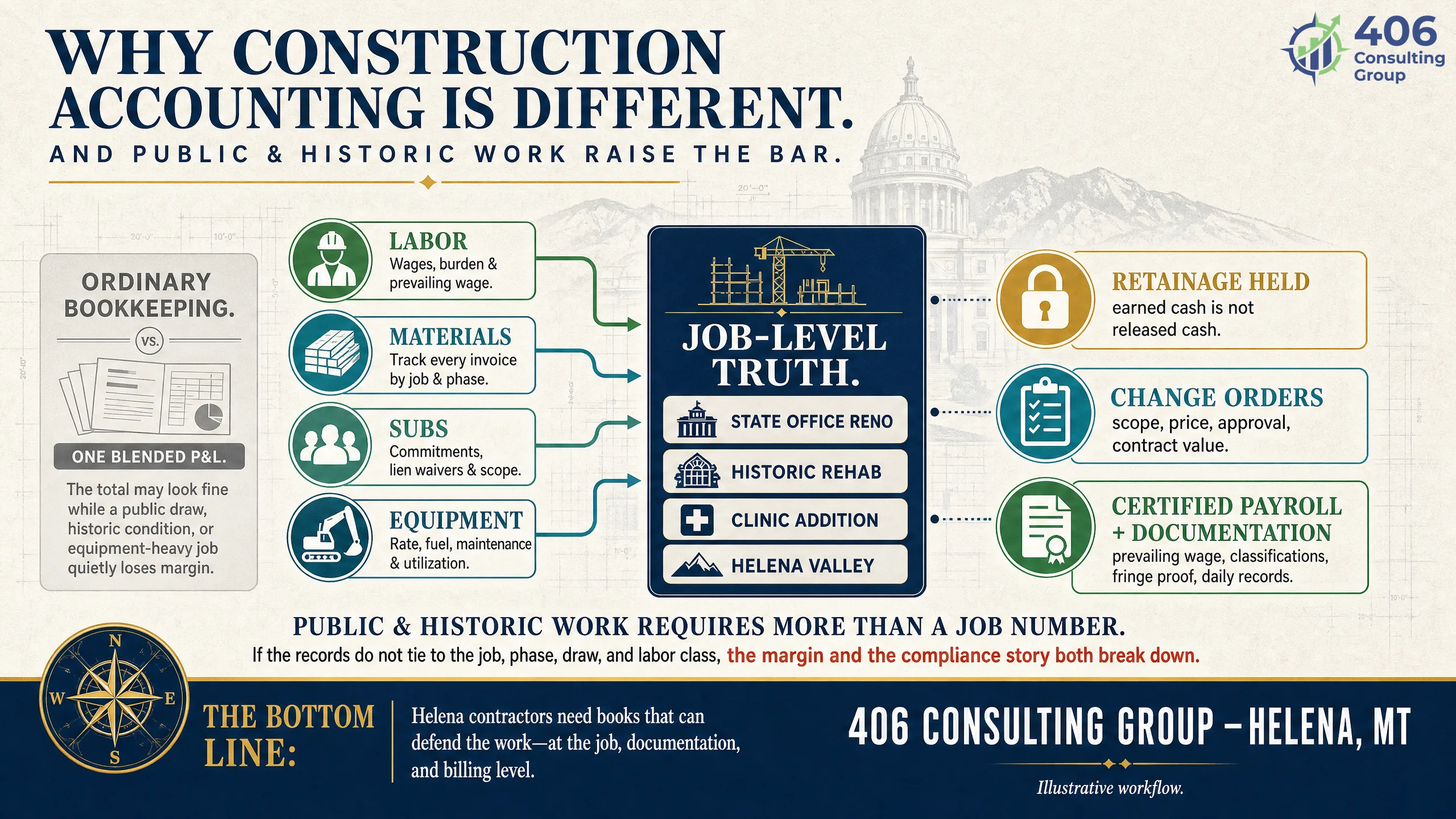
It starts with Montana's tax and registration frame — lighter than the sales-tax states in some ways, and, on prevailing wage in the capital, front and center.
The Montana Contractor Tax & Registration Picture
Montana is a category of one out West: no sales tax, no contractor license, but a prevailing-wage law of its own — and in the capital, that last one is everywhere. Here's the frame for a Helena contractor:
| Item | What it means for a contractor |
|---|---|
| Sales & use tax | No general sales tax in Montana — materials aren't taxed and you collect nothing; the only question is work or buying across a state line |
| State income tax | Pass-through profit is taxed by the state, topping out around 5.9% (verify current) |
| Contractor status | No exam to pass — register with the DLI when you employ crew, or hold an ICEC when you work alone |
| Trade licensing | The state licenses electricians and plumbers; every jurisdiction adds its own permits and inspections |
| Prevailing wage | Public work over a threshold owes Montana prevailing wage (Little Davis-Bacon) — routine in the capital — plus federal Davis-Bacon on federally funded jobs |
| Workers' comp | Required for employees, via a private carrier or the Montana State Fund — a competitive fund rather than a monopoly |
| Equipment | A business-equipment tax applies, but a large exemption (raised in recent years — verify) leaves many contractors owing little |
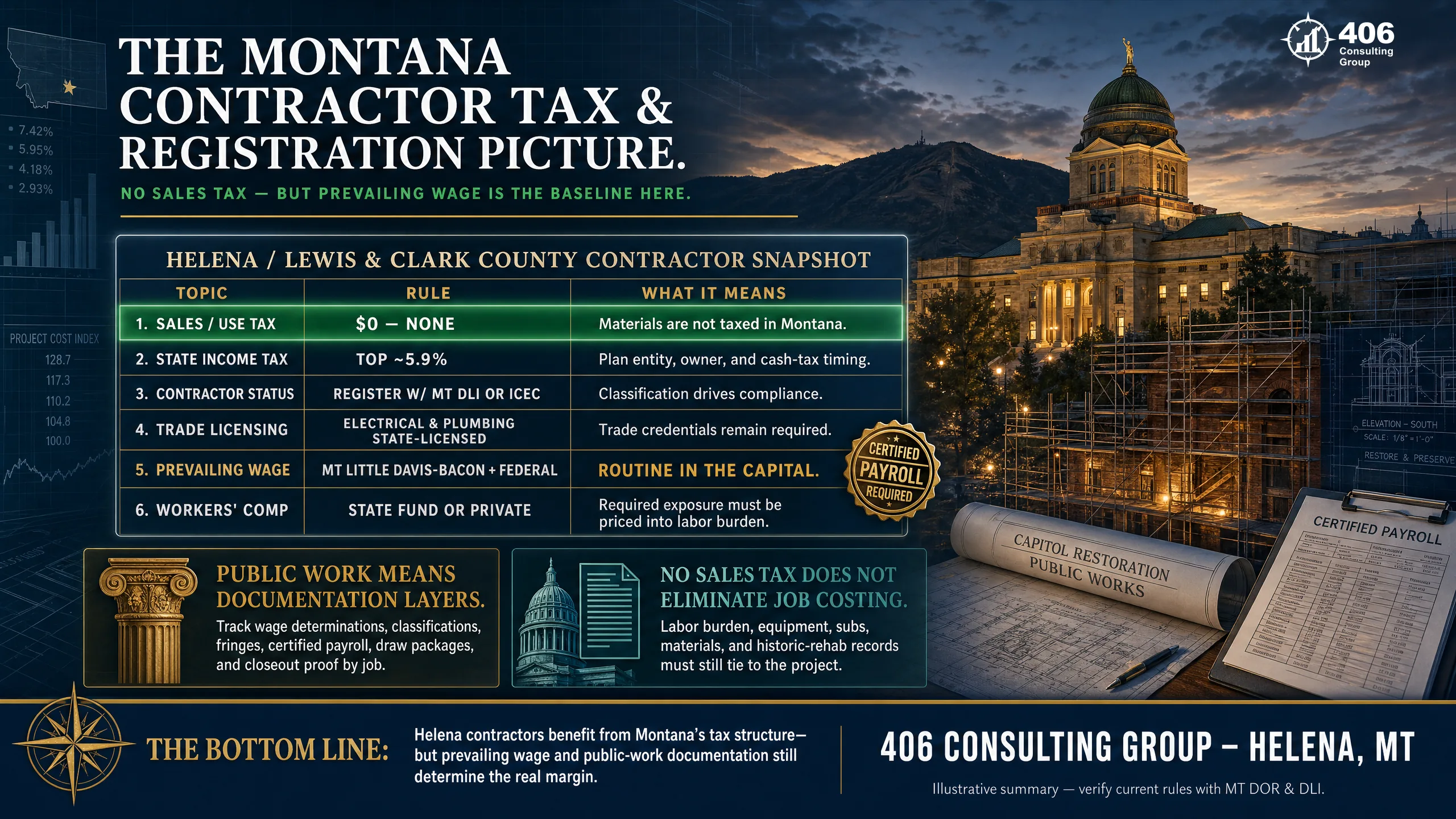
Verify current rates and rules with the Montana Department of Revenue and registration, licensing, and prevailing wage with the Montana Department of Labor & Industry. In a public-work town like Helena, prevailing wage isn't a corner case — build for it from the start.
Registration, ICECs & Trade Licensing (Not a GC License)
In place of a general-licensing exam, Montana asks contractors to register. A construction contractor with employees generally registers with the Department of Labor & Industry; a contractor with no employees usually carries an Independent Contractor Exemption Certificate (ICEC) that confirms they're truly independent and cover their own risk. On public work especially, that distinction gets scrutinized — prime contractors and agencies want to know their subs are properly registered or exempt — and it drives registration, workers' comp, and payroll all at once.
The licensed trades are separate: electricians and plumbers hold state licenses, and every jurisdiction adds permits and inspections, which run tighter on protected historic structures. For the books, registration, ICEC status, and trade licenses are standing obligations that bite if they lapse or a worker is misclassified — and on public and bonded jobs, your financial statements are part of what supports the bonding those contracts require. Confirm your specific registration, ICEC, and licensing requirements with the Montana Department of Labor & Industry.
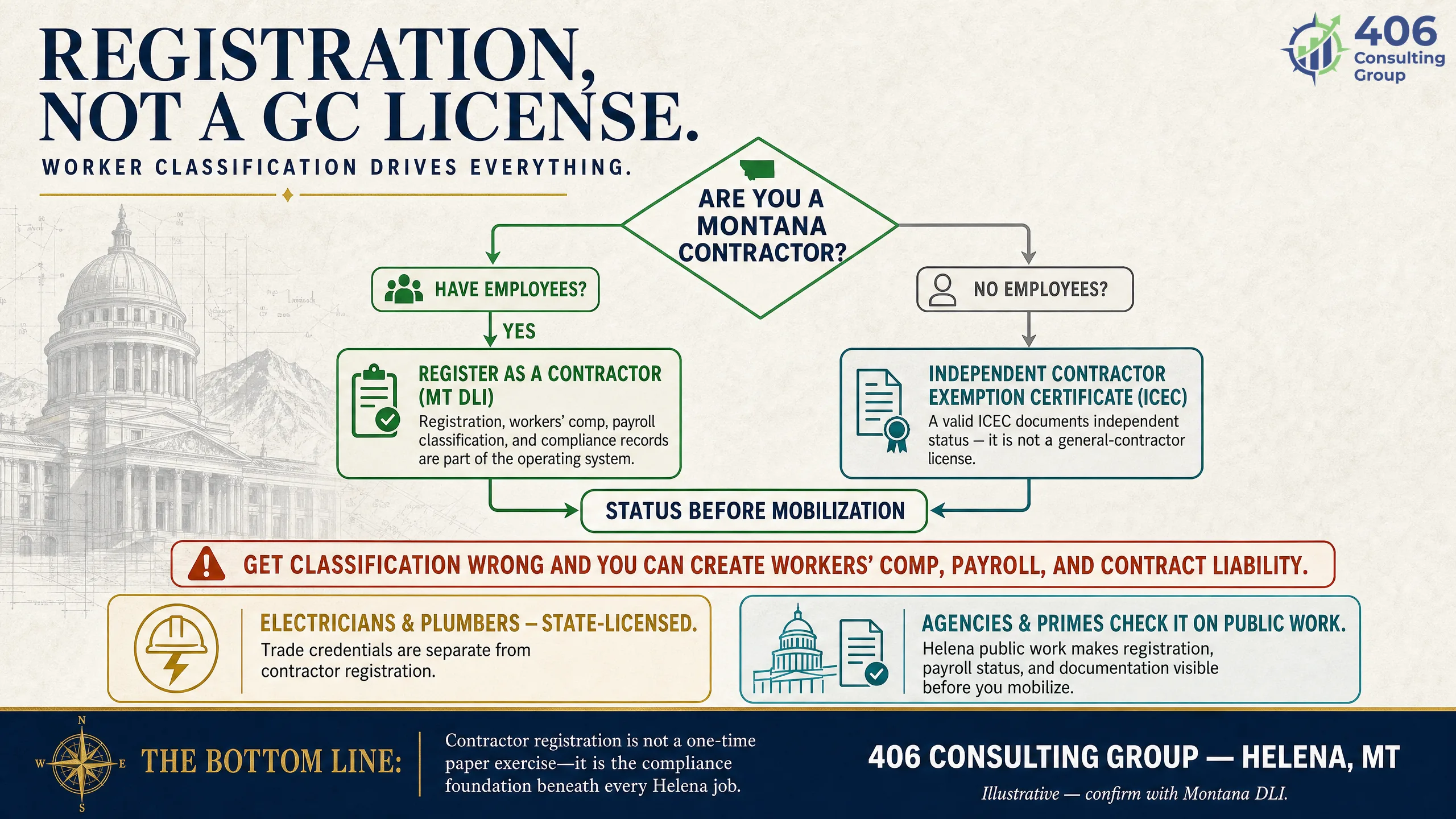
Get worker classification and registration right first — on the public work that fills a Helena schedule, agencies and primes check it, and it shapes everything downstream.
No Sales Tax: What That Actually Means for Materials
Montana is among the few states with no general sales tax, and it's a real advantage — including on the specialty and matching materials historic restoration often requires. There's no sales or use tax on your materials, no consumer-versus-retailer question to resolve, and no tax line to fold into a bid or remit to the state. Next to a contractor buying the same materials into a sales-tax state, one entire layer of cost and compliance is simply absent.
Two points still stand. First, no sales tax is no excuse for loose tracking — and on public and historic work the standard is higher, because every invoice may need to tie to a job, a phase, or a documented rehabilitation cost. Get the coding right and your job costing and any tax-credit substantiation both hold. Second, buying or working across a state line can pull you under another state's rules — materials ordered from or delivered into a sales-tax state can carry that state's tax — so cross-border purchases deserve a look. Within Montana, materials stay simple, which lets you spend your bookkeeping effort where it counts: costing, documentation, and WIP.

If you regularly buy or build across a state line, confirm how that state's tax reaches your work with the Montana Department of Revenue and the neighboring state's tax agency.
Building the Capital: Government, Historic Helena & Healthcare
Helena's construction market is shaped by its role as the seat of state government, and that shape is worth building your books around. Public and government work is the anchor — the Capitol complex, state agency offices, and Department of Transportation projects generate a steady, prevailing-wage-heavy pipeline that doesn't swing with the cycle the way a boom town does. Historic preservation is Helena's signature: restoring and rehabilitating protected buildings across the historic district is specialized work that can qualify for historic tax-credit programs when documented correctly. Healthcare around St. Peter's and steady residential fill in the rest. It's a stable, documentation-heavy runway rather than a gold rush.
Steadier work doesn't mean safer margins. Public jobs are competitively bid and unforgiving of a costing error; historic rehabilitation carries unpredictable conditions behind old walls that can eat a fixed price alive; and both require records that hold up to outside review. Taking on more of this work only strengthens the company if you can see the margin on each job and fund it between draws — which takes job costing, a live WIP schedule, and a cash forecast. In the capital, the contractors who thrive are the ones whose books are as disciplined as the work demands.

Steady growth still has to be profitable growth — and on public and historic work, that's decided in the records long before it shows up in the bank.
Job Costing on Public & Historic Work
On Helena's public and historic jobs, job costing does double duty: it tells you which work makes money, and it produces the documentation those jobs require. Every labor hour, material invoice, subcontractor bill, and equipment charge lands on the specific project — and, on historic rehabilitation, on the specific qualified cost — so each job's true margin stands on its own and the records will support a public-project audit or a historic tax-credit claim. When you can see that a competitively bid state renovation runs thin while a private restoration carries the company, you bid and chase work with far better judgment.
It's also the base the rest of your reporting stands on — a reliable WIP schedule, correct progress billing, and sound change-order decisions all need job-level costs beneath them, and on old buildings the change orders come fast when you open a wall. For a Helena contractor, disciplined job costing is what keeps public and historic work both compliant and profitable.
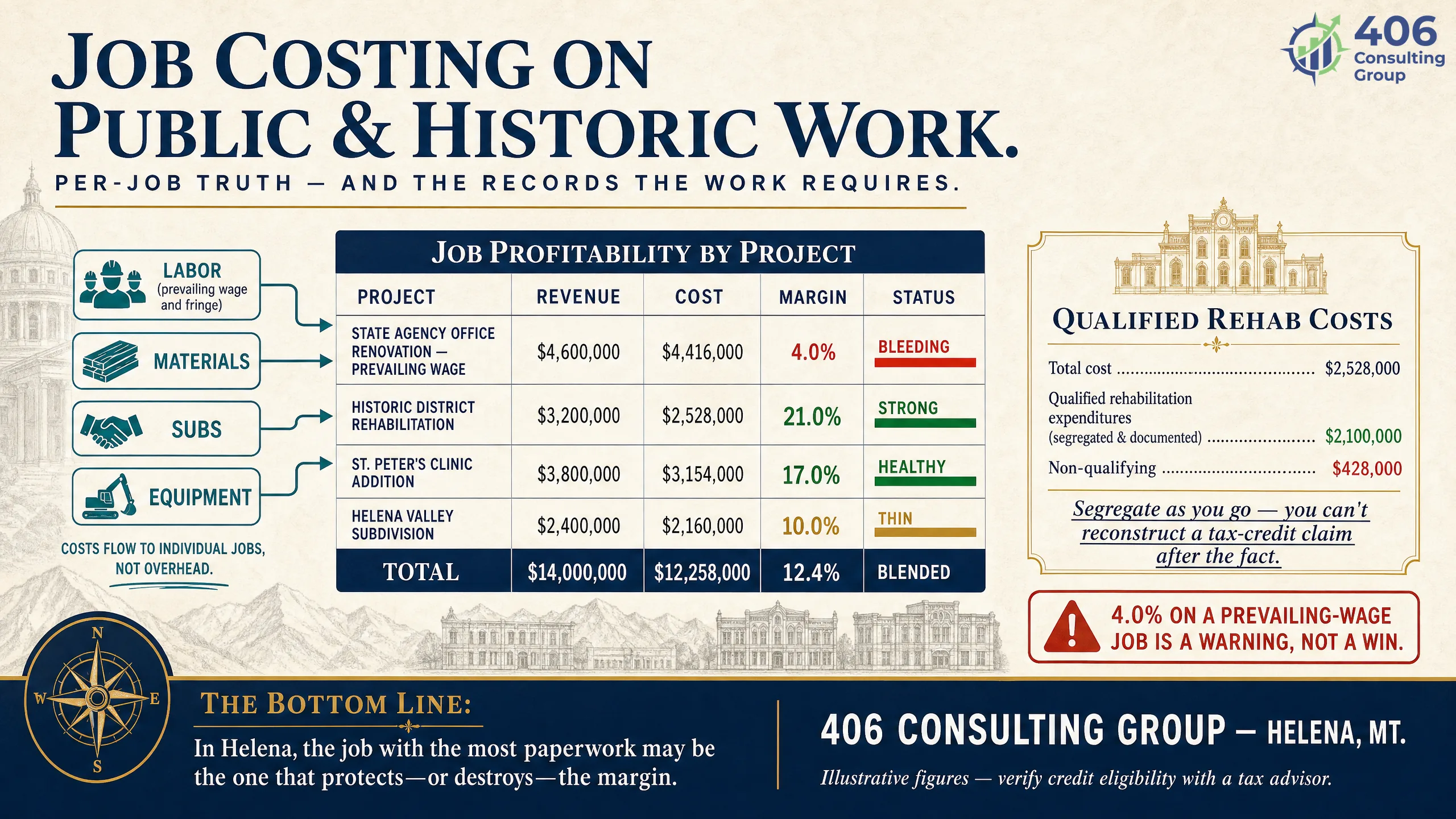
Sorting out which jobs and crews truly carry the business is the whole point of our contractor unit economics work — and job costing is what brings the answer into view.
WIP, Percentage-of-Completion, Retainage & Change Orders
Public and historic jobs that run for months need a report a plain ledger can't produce. A work-in-progress (WIP) schedule holds each open job's costs, billings, and estimated cost-to-complete together, and the relationship among them shows whether you're over- or under-billed. Slow public draws can leave you under-billed and floating the work, while an early mobilization payment can push you over-billed — cash that looks like profit but isn't earned yet. Percentage-of-completion ties revenue to how far the job has genuinely come, which keeps the monthly picture honest across a long public schedule.
Add retainage — common and often held long on public contracts, parked in its own receivable — and change orders, which are constant on historic rehabilitation once hidden conditions appear and must be logged and priced before the work proceeds. On the public and restoration jobs that fill a Helena schedule, that WIP discipline is what keeps a steady backlog from hiding a margin problem — and it's the first report your banker, surety, and the awarding agency will want.

As you scale, this is where a controller or CFO function earns its keep — and our Montana WIP and job-costing deep dive walks the mechanics job by job.
Payroll & Prevailing Wage in the Capital
In most towns prevailing wage is occasional; in Helena it's close to the baseline. Because so much work is state and local public construction, Montana's own Little Davis-Bacon — standard or heavy/highway rates plus certified payroll on public-works contracts above a dollar threshold — comes up on job after job, with federal Davis-Bacon layered on when federal funding is involved. That makes certified payroll a routine, weekly discipline rather than a special case: correct wage determinations, proper fringe handling, and accurate reports for every worker, because a mistake can hold up payment on a public contract and invite a compliance finding.
The rest is standard: Montana withholding beside federal, workers' compensation from a private carrier or the state-chartered Montana State Fund (a competitive fund, not a monopoly), and a mix of subcontractors and ICEC holders whose classification agencies and primes will check on public work. Built to produce certified payroll cleanly and tie every hour to the job, payroll becomes reliable data feeding your job costs instead of a weekly compliance scramble.
Our payroll work — Montana and federal certified payroll included — keeps all of it running quietly in the background.
Equipment, Depreciation & Montana's Business Equipment Tax
Equipment reaches the books from two directions. Federally, Section 179 and bonus depreciation can move much of a truck, lift, or machine into the year-of-purchase deduction — useful, but a decision to weigh against your multi-year income rather than a reflex. On the Montana side, the state assesses a business-equipment tax on machinery and equipment, with a substantial exemption — raised significantly in recent years, so verify the current threshold — that leaves many contractors owing little or nothing, while larger fleets should track it and confirm where they land.
A current fixed-asset schedule quietly does two jobs: it keeps depreciation and any business-equipment filing accurate, and — since a machine's hours belong to the job it worked — it routes those costs into job costing, so equipment left sitting reads as the expense it is instead of hiding in overhead. Know what you own, what each piece runs per hour, and where it's earning.

The depreciation strategy and Montana income-tax planning ride on disciplined books — see our Helena bookkeeping guide; the tracking that powers both starts here.
Common Construction Bookkeeping Mistakes
A handful of avoidable errors cause most of the financial pain for Helena contractors — and public and historic work makes several of them costly.
Underbuilding certified payroll
In a public-work town, certified payroll is weekly, not occasional — wrong wage determinations, fringes, or reports hold up payment and invite compliance findings.
Losing the historic tax-credit trail
Rehabilitation credits ride on documented, segregated costs; if qualified expenditures aren't tracked cleanly as the job runs, the credit is hard to substantiate later.
Underpricing hidden-condition risk
Old buildings hide surprises behind the walls; without tight job costing and prompt change orders, a fixed-price restoration can run away from you.
Treating no sales tax as loose tracking
Montana spares you the tax, not the documentation — public and historic jobs need every invoice tied to a job and phase, or costing and substantiation slip.
Neglecting the WIP schedule
On long public jobs with slow draws and held retainage, over- and under-billing hide where each job stands, and no surety grows bonding without a clean WIP.
Each is a matter of setup and habit — and each resolves once the books are built for Montana public and historic construction and run on a dependable monthly rhythm.
A Montana Firm for the Capital & Statewide
Helena has capable bookkeepers, but public and historic construction is a specialty, and Montana construction has its own rulebook — and the capital's compliance load raises the stakes on getting it right. What matters isn't whether your accountant is off Last Chance Gulch; it's whether they know contractor registration and ICECs, Montana and federal prevailing wage and weekly certified payroll, historic rehabilitation cost tracking, State Fund workers' comp, the business-equipment tax, and how to run a bonding-grade WIP. We're a Montana firm that lives in those rules, and we serve Helena contractors the same whether we're across town or across the state.
Our workflow suits a builder's day: cloud accounting and job-costing software, receipts and hours captured from the field, connected bank feeds, and a dependable monthly close — Montana-literate construction books without a trip to an office. From the Capitol complex to the historic district to the Helena Valley, you get a firm that already knows public-work compliance. If your jobs run east toward Bozeman, our Bozeman construction accounting guide is a companion to this one.
What decides it is whether your accountant genuinely knows public and historic Montana construction — and that expertise is exactly what a Montana firm is built to bring.
How to Get Started
Getting a Helena contractor's books squared away runs in three steps.
Get the Montana pieces right
Keep contractor registration or ICEC status and any electrical/plumbing licenses current, confirm worker classification, and set up workers' comp cleanly with a carrier or the State Fund.
Build books for public & historic work
Job costing by phase and qualified cost, a WIP schedule, retainage and change-order tracking, a fixed-asset schedule, and weekly certified payroll for prevailing-wage jobs.
Run it monthly
A genuine monthly close, WIP review, and job-level reporting — so you know which jobs pay and can fund and bond the next one.
Unsure where your books stand right now? Our Financial Maturity Assessment lays it out in about eight minutes.
FAQ: Helena Construction Accounting
Do I need a contractor's license in Montana?
No general-contractor license — Montana doesn't test for one; it registers contractors instead. If you employ crew, you generally register with the Department of Labor & Industry; if you work on your own, you'll usually carry an Independent Contractor Exemption Certificate (ICEC) that establishes you're truly independent and responsible for your own coverage. The wired and plumbed trades are licensed by the state, and every local jurisdiction runs its own permits and inspections. On the public jobs that make up so much of Helena's work, awarding agencies and prime contractors verify that your registration or ICEC is current, so square it away before you bid. Check the specifics for your situation with the Montana Department of Labor & Industry.
Does Montana have a sales tax on construction materials?
No — Montana is one of the few states with no general sales tax, so you don't pay sales or use tax on the materials you buy, and there's no consumer-versus-retailer question to manage. That's a genuine break, including on the specialty and matching materials historic restoration often calls for. Two caveats remain: no sales tax doesn't lower the documentation bar — on public and historic work every invoice may need to tie to a job, phase, or qualified cost — and buying or working across a state line can pull you into that state's tax rules. Confirm anything cross-border with the Montana Department of Revenue and the other state's tax agency.
Why does prevailing wage come up on almost every Helena job?
Because Helena is the state capital, and a large share of its construction is public — the Capitol complex, state agency buildings, Department of Transportation work, and locally funded projects. Montana's own prevailing-wage law, Little Davis-Bacon, applies to public-works contracts above a dollar threshold, requiring standard or heavy/highway rates and certified payroll for each worker; federal Davis-Bacon applies on top when federal money is involved. In a government town that makes certified payroll a routine weekly discipline rather than an occasional task, and errors can stall payment on a public contract. Because it follows the project and its funding, confirm the requirements job by job with the Montana Department of Labor & Industry.
How does accounting work on a historic rehabilitation project?
Documentation is everything. Rehabilitating a certified historic building can qualify for historic tax-credit programs, but the credit rides on qualified rehabilitation costs that are tracked cleanly and separated from non-qualifying work as the job runs — not reconstructed after the fact. In practice that means job costing that segregates eligible expenditures by phase, keeps invoices and change orders tied to the work, and produces records that will withstand review. The same discipline also protects your margin, since historic work carries hidden-condition risk that unpriced change orders can turn into a loss. Because federal and state historic-credit program rules and rates change, confirm current eligibility and requirements with your tax advisor and the applicable preservation office before relying on a credit.
Can 406 Consulting Group handle my Helena construction bookkeeping?
Yes — as a Montana firm, we know the compliance load Helena builders carry: contractor registration and ICECs, Montana and federal prevailing wage and weekly certified payroll, historic rehabilitation cost tracking, State Fund workers' comp, the business-equipment tax, and no sales tax on materials. Everything runs through cloud accounting and job-costing software, with receipts and hours captured from the field, connected bank feeds, and a dependable monthly close, so we serve Helena the same whether we're across town or across the state. What decides the outcome is expertise — job costing, WIP, and public-work compliance — and that's the ground a Montana firm is built on. From the Capitol complex to the historic district, you get a firm that already knows this work.
Keep Reading
Trades & Construction — Helena, MT
Build Montana's Capital on Books You Can Trust.
406 Consulting Group keeps Helena contractors clean and compliant — contractor registration, prevailing-wage certified payroll, historic-rehab cost tracking, job costing, and WIP handled — by a Montana firm that knows public work.
Helena Construction Quick Reference
Helena, MT — Lewis & Clark County
Building in the Capital?
Certified payroll, historic costs & WIP, handled.
About the Author
Jason Anderson
Co-Founder, 406 Consulting Group
A Montana firm with a commercial banking and underwriting background, serving contractors and trades statewide. Jason helps Helena builders keep prevailing-wage certified payroll and registration current, track historic-rehabilitation costs, and run real job costing and WIP on public and restoration work.
Read the Full Story