
Trades & Construction Accounting in Houston, TX:
Build the Gulf Coast on Books You Can Trust
Lump-sum or separated decides who owes Texas sales tax on materials — and new-build vs. plant turnaround changes it again. Job costing, WIP, certified payroll, and heavy equipment for Houston contractors.

Houston builds at industrial scale. Alongside the subdivisions and commercial towers, the Gulf Coast runs on refinery and petrochemical work, plant expansions, and the maintenance and turnaround contracts that keep those facilities running — plus the mechanical, electrical, instrumentation, civil, and specialty trades that serve all of it. It's a deep, lucrative market for a contractor. It's also one where the accounting is unforgiving, because construction is its own discipline and Texas's contractor sales-tax rules are among the most misread in the state.
The rule that costs Houston contractors the most: whether you write a job as lump-sum or separated changes who owes sales tax on your materials, and whether the work is new construction or repair/maintenance — the difference between building a new unit and servicing an existing plant — changes the treatment again. Miss it and you overpay on every job or carry a liability into an audit. Add job costing on big multi-crew jobs, WIP, retainage, certified payroll, and heavy equipment, and clean books here are a specialty. This guide covers all of it, delivered remotely.
By Jason Anderson — Co-Founder, 406 Consulting Group. Big-firm-trained accountant serving contractors and industrial trades across the Mountain West and Southwest — job costing, WIP, and the Texas contractor rules that decide whether a bid holds its margin.
Quick Answer: Accounting for a Houston Contractor
- →Lump-sum vs. separated contract decides whether you or the customer pays sales tax on materials — Texas's most-missed contractor rule.
- →New construction vs. repair/maintenance (think plant turnarounds vs. a new unit) changes the tax treatment again.
- →Job costing & WIP on large, multi-crew industrial and commercial jobs are how you protect margin and stay bondable.
- →Craft payroll, certified/prevailing wage, heavy equipment (BPP), and large bonds all shape the books at Houston's scale.
- →Delivered remotely — from the field trailer, not a downtown appointment.
Table of Contents
Why Construction Accounting Is Its Own Discipline
Contractor books run on a different clock than most businesses. Revenue lands in progress draws stretched across months-long jobs; costs sprawl across craft labor, materials, subs, rentals, and owned equipment that all have to be traced to the right project and cost code; you invoice partway through and the owner withholds retainage; scope shifts through change orders; and the profit on a big job can vanish in a single underestimated line. Ordinary bookkeeping — categorize the bank feed, reconcile once a quarter — can't tell an industrial or commercial contractor the things that actually matter: is this job tracking to its estimate, and is the company as a whole making money or just moving cash?
In Texas the discipline collides with contractor tax rules most builders were never walked through. Whether a contract is written lump-sum or separated changes who remits sales tax on materials; whether the work is a new build or maintenance on an existing facility changes it again; heavy equipment gets taxed yearly as business personal property; and public and federal jobs bring certified-payroll duties. All of it lives in the books. For a Houston contractor working the plants, the port, and the commercial market, getting it right is the line between growth that builds equity and growth that quietly drains the bank account.
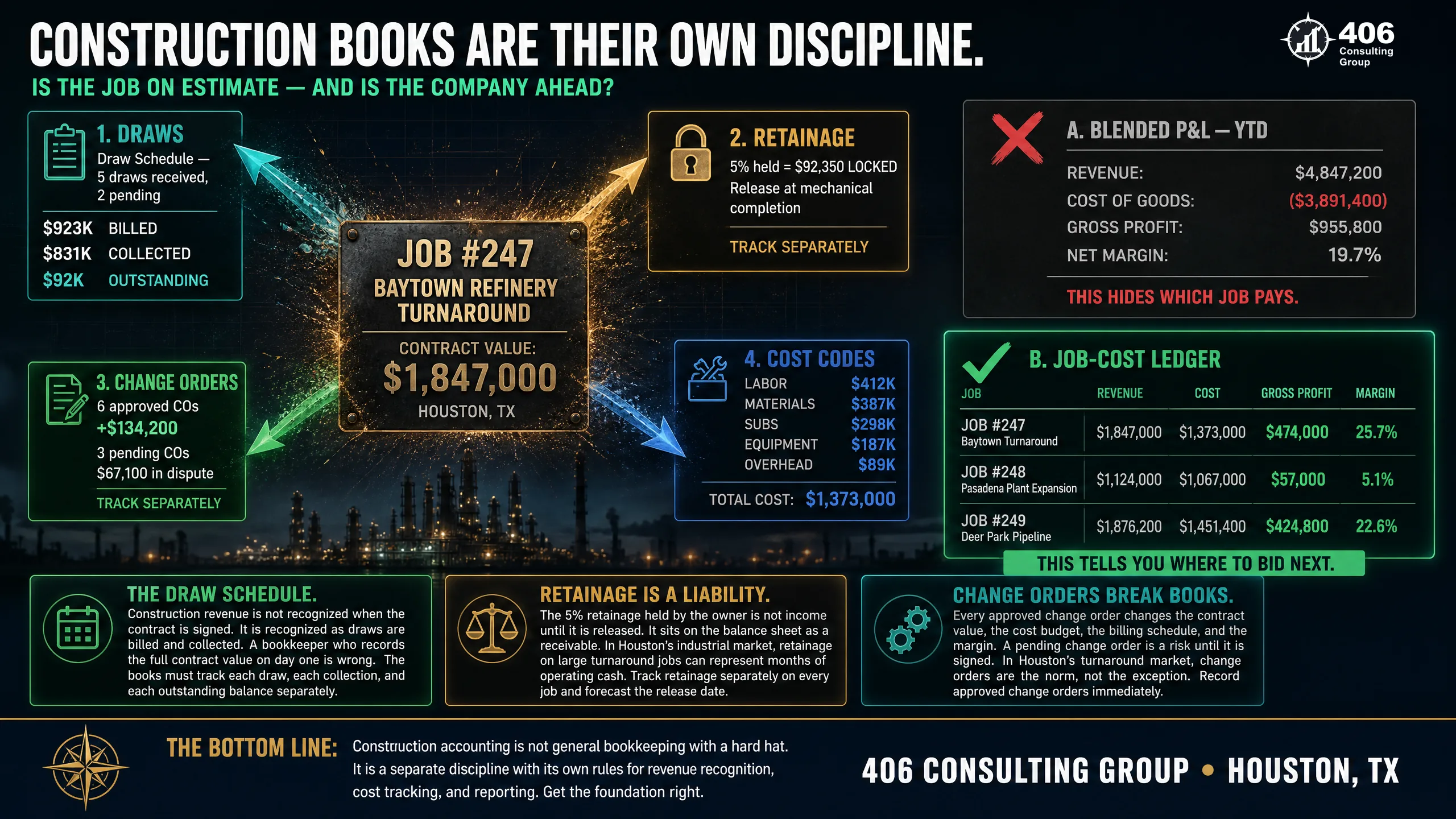
Start with the tax picture — Texas's contractor rules are where Houston builders quietly leak the most money.
The Texas Contractor Tax Picture
No state income tax is a genuine edge, but a Houston contractor still juggles several taxes — and the construction sales-tax rules are the ones with teeth:
| Tax | What it means for a contractor |
|---|---|
| State income tax | None — but the franchise tax and sales/use tax still apply |
| Sales & use tax | Treatment turns on contract type (lump-sum vs. separated) and work type (new vs. repair/maintenance) |
| Franchise (margin) tax | Construction is COGS-heavy, so the COGS deduction usually gives the better result |
| Business personal property | Annual county rendition on rigs, cranes, trucks & tools — a serious line for a heavy contractor |
| Payroll | No state withholding; industrial/public work often brings certified/prevailing wage |

Confirm current rules with the Texas Comptroller — construction sales tax has enough moving parts that it's worth setting up with a pro. Here's the piece that catches the most contractors.
Lump-Sum vs. Separated: Who Owes the Tax
Here's the distinction that decides who hands Texas the sales tax on your materials — and it comes down to how the contract is written. Quote a job as a single all-in price (a lump-sum contract) and Texas generally treats you as the end consumer of the materials: you pay the tax when you buy them and you don't bill the customer a separate tax line. Break the contract out with materials and labor stated separately (a separated contract) and you're generally treated as a reseller of the materials: you buy them tax-free with a resale certificate but then collect and remit sales tax from the customer on the materials portion.
On a large industrial or commercial job the dollars here are not trivial, and picking a contract format without understanding the tax consequence is how contractors either pad every bid with tax they didn't need to eat or fail to collect tax they'll later owe out of pocket — because an under-collection is the contractor's problem in an audit, not the customer's. The right format depends on your markup, your customer, and the work, and whichever you use has to flow consistently through how you buy, bill, and book each job. It's the first thing we straighten out for a construction client.

It has to live in the books, not just the contract
Your contract format dictates how materials get purchased (taxed, or tax-free for resale) and whether you collect tax from the customer — and the bookkeeping has to match, job by job. Books set up for the wrong format quietly manufacture audit exposure. Confirm your setup with the Texas Comptroller or a pro.
New Build vs. Repair, Maintenance & Turnarounds
The second axis is the type of work — and in Houston this one is everywhere, because so much of the market isn't new construction at all: it's keeping existing plants, facilities, and buildings running. Texas treats new construction differently from repair, remodeling, restoration, and maintenance, and it further separates residential from nonresidential property. That matters intensely for the industrial and commercial contractors who dominate the Gulf Coast, because a refinery turnaround, a unit repair, or a facility-maintenance contract sits on the repair/maintenance side of the line, while a new unit or a ground-up build sits on the other — and the sales-tax treatment isn't the same.
For a contractor whose work spans new capital projects, maintenance contracts, and remodels — which describes most established Houston firms — the correct treatment can shift from job to job. The books have to record what kind of work each job is so the tax is applied right and consistently across a mixed backlog. It's detailed, it's easy to fumble, and it's precisely what an out-of-market bookkeeper misses. Confirm the specifics with the Comptroller or a professional, because on plant-scale work these classifications carry real dollars.
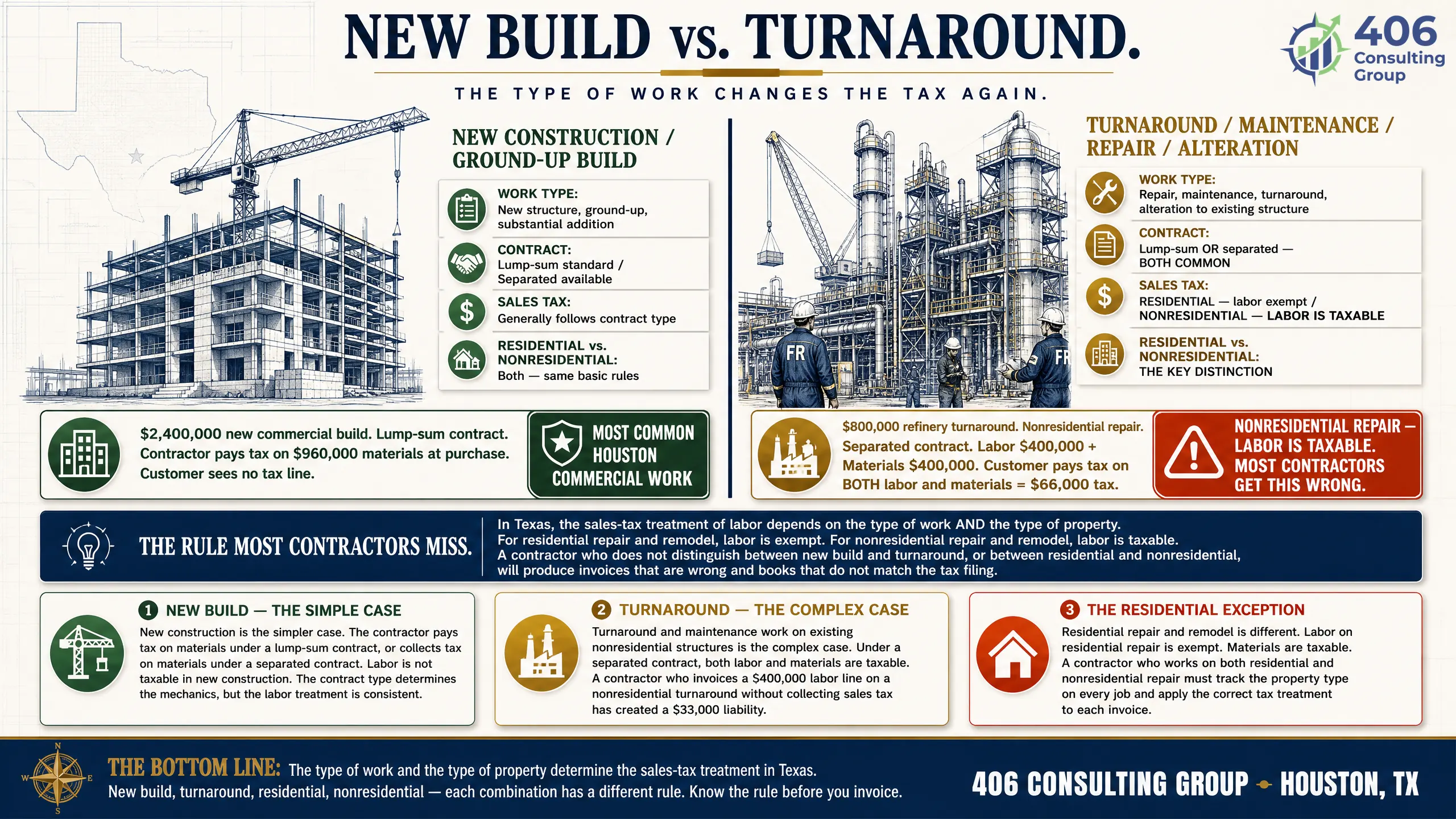
Between contract format and work type, Texas construction sales tax is a genuine specialty — and the number-one reason a Houston builder wants a construction-literate accountant rather than a generalist.
Job Costing on Big, Multi-Crew Work
The bigger the job, the more it hurts to fly blind on cost. On a multi-crew industrial or commercial project, dozens of workers, several trades, equipment, and a river of material invoices all hit at once — and without job costing that codes every one of those dollars to the right project and phase, you won't know a job is bleeding until it's already lost money. Done right, job costing shows the live margin on each project against its estimate, so you can catch an overrun while there's still time to manage it and bid the next one from real history instead of a hopeful guess.
It's also the base layer everything else in construction accounting stands on: no accurate WIP schedule, no correct progress billing, and no honest read on a change order without job-level costs underneath. For a Houston contractor scaling into larger contracts, disciplined job costing is what lets the company grow without the margin quietly slipping through the cracks.

It's the same principle our contractor unit economics piece is built on — at industrial scale, knowing your real cost per job and per crew is what keeps a big backlog profitable.
WIP, Percentage-of-Completion, Retainage & Change Orders
Jobs that span months need accounting a generic ledger can't provide. A work-in-progress (WIP) schedule lines up each open job's costs, billings, and estimated cost-to-complete so you can see whether you're over- or under-billed — bill ahead of the work and the extra cash can masquerade as profit you've in fact already spent; bill behind it and you're floating the owner's project out of your own pocket. Percentage-of-completion recognizes revenue as the job actually earns it rather than dumping it all at closeout, so each month's statements tell the truth.
Layer on retainage — the 5–10% an owner typically holds until the job closes, which parks a chunk of your money and has to be tracked as its own receivable — and change orders, which on plant and commercial work can rival the base contract in value and must be captured and billed before the work is done and forgotten. Together these turn a sprawling, multi-job backlog into statements you, your surety, and your bank can actually rely on.
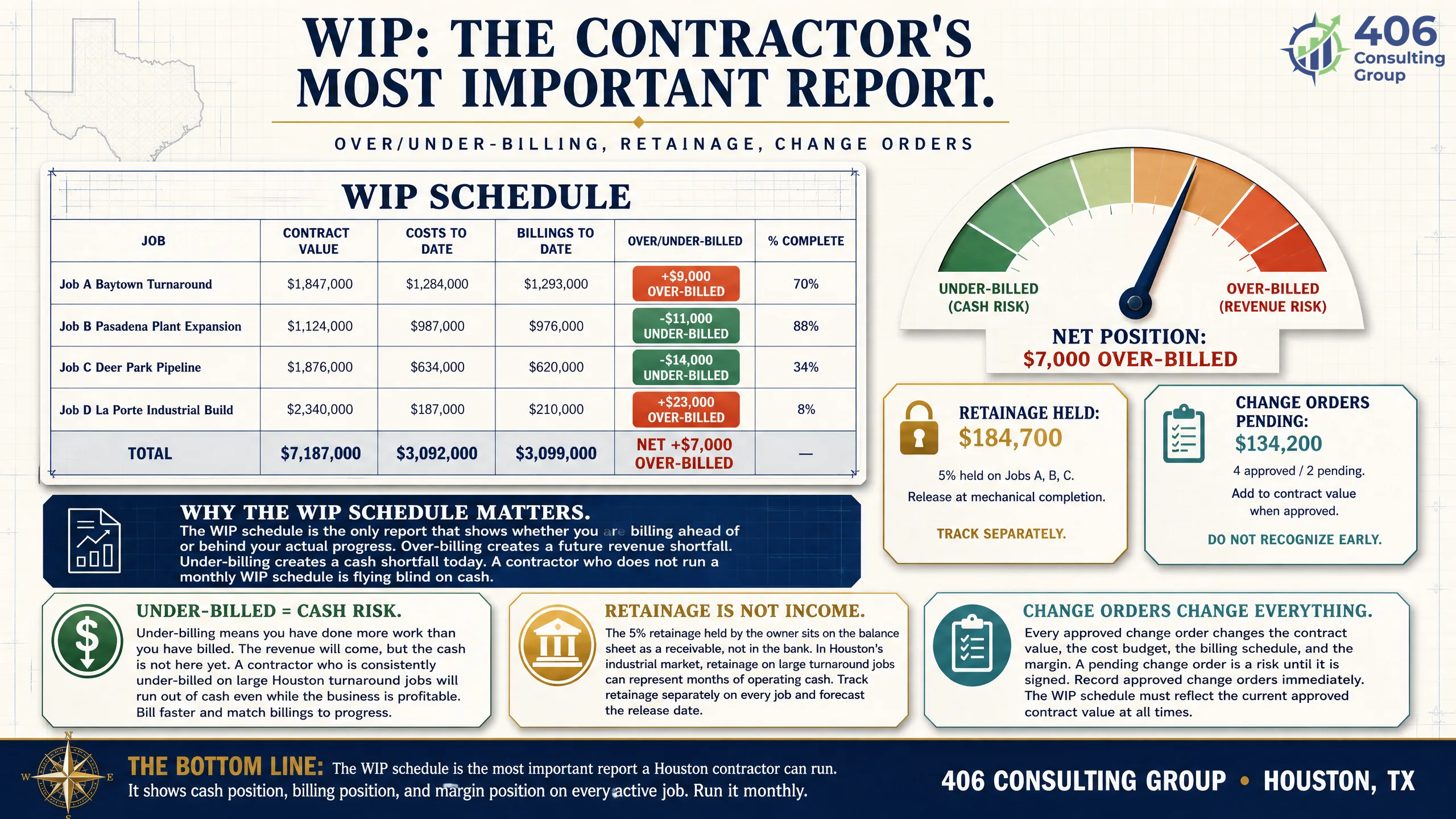
As the jobs and the backlog grow, this is where a controller or CFO function pays for itself — the WIP schedule is the contractor's single most important report.
Craft Labor, Certified & Prevailing-Wage Payroll
Texas keeps payroll relatively light — no state income-tax withholding — but Houston's scale adds its own demands. Big craft workforces mean payroll that has to feed job costing by worker, trade, and cost code, plus a heavy roster of subcontractors and 1099s where worker classification has to be right. On federally funded work, the Davis-Bacon Act requires paying set prevailing wage rates and filing certified payroll reports for every worker; some public projects carry their own prevailing-wage terms. On a large industrial or public job, botched certified payroll can freeze your payments, so it's not something to wing.
Workers' compensation adds another wrinkle: Texas is unusual in that it's technically optional, but in energy and heavy construction the plant owners and general contractors you work for almost always require coverage — and the class codes on high-risk craft work are significant. Set up properly, payroll becomes a clean feed into your job costs instead of a monthly scramble.
Our payroll work — certified payroll on public jobs included — keeps this running quietly in the background.
Heavy Equipment, Depreciation & the BPP Rendition
Heavy contractors carry heavy iron, and in Texas that gear shows up twice in the books. First, the business personal property (BPP) tax: cranes, rigs, trucks, trailers, and tooling are generally subject to an annual county rendition where they're valued and taxed — for an equipment-intensive Houston contractor this is a real yearly number, so a clean, current fixed-asset schedule keeps you from over-reporting and paying tax on machines you've sold or scrapped. Second, depreciation: Section 179 and bonus depreciation can pull a large share of an equipment purchase into the year you buy it, which is powerful when you're expanding a fleet — though it's worth timing against your multi-year income rather than deducting on autopilot.
That same fixed-asset detail should feed job costing, because equipment hours belong on the jobs that used them, and a machine sitting idle in the yard is one of the least-visible drains on a contractor's margin. Track what you own, what it costs to run, and where it's earning, and the equipment stops being a blind spot.
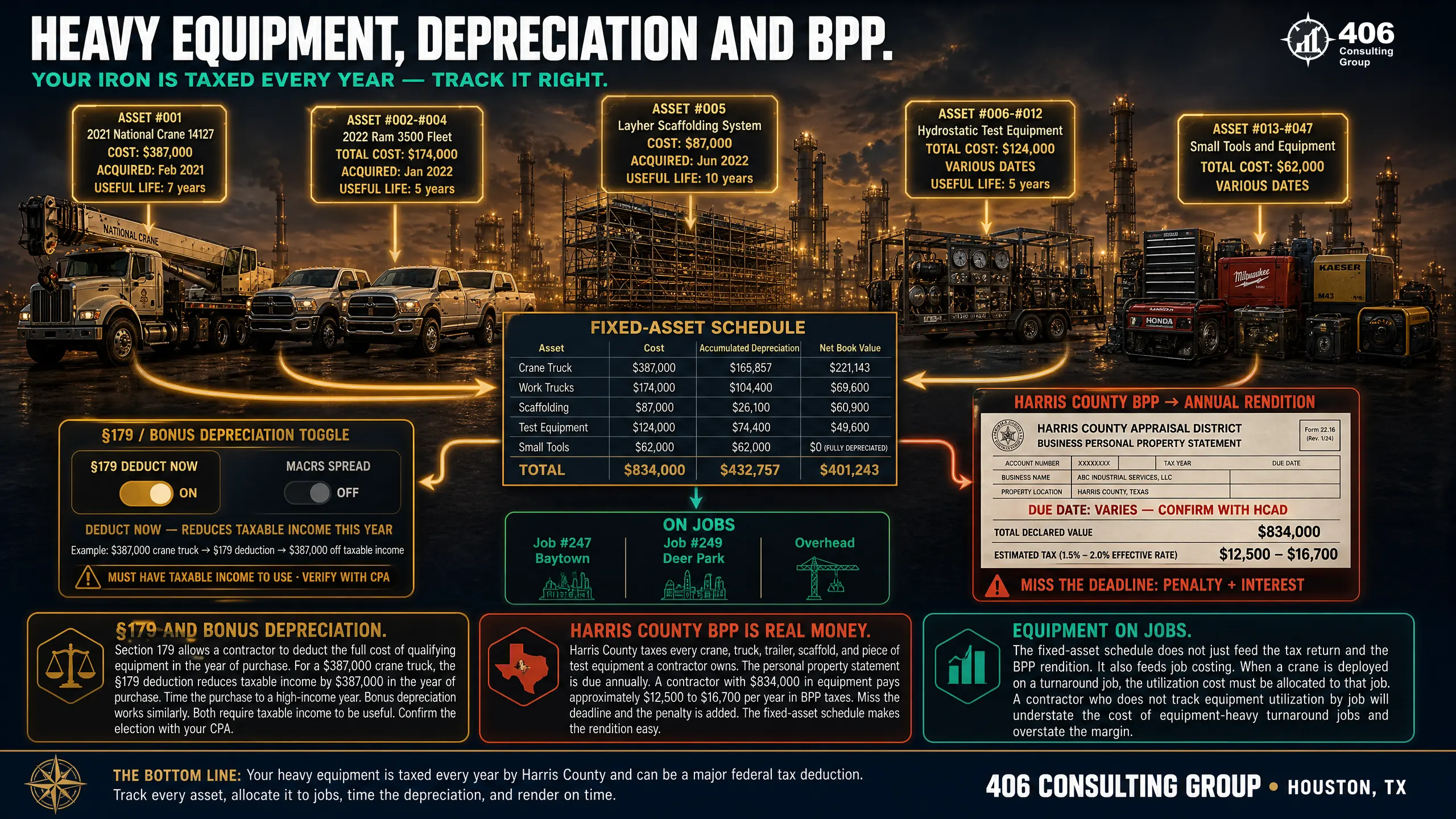
The depreciation-timing and margin-tax planning sit in the Houston tax guide; the tracking that makes both work starts in the books.
Bonding & Working Capital at Scale
The bigger the jobs, the more bonding governs what you can even bid — and a surety sizes your bonding program straight off the credibility of your financial statements and WIP schedule. On plant and public work, single bonds can run large, and your aggregate program caps how much work you can carry at once. Construction-grade books aren't paperwork here; they're the gate to the next tier of contracts. A strong contractor with weak books gets held back because the surety can't underwrite the risk, while one with a clean WIP and solid statements keeps getting more capacity.
And big jobs are ferociously working-capital hungry: you carry payroll for large crews, mobilize equipment, and buy materials weeks or months before a draw lands, while retainage sits unpaid until the end. It's entirely possible to be booking profit and still be starved for cash mid-project. Tracking cash, receivables, retainage, and a forward forecast is what keeps a growing contractor solvent — and having read financials from the lender's side of the table, we help you line up credit before the crunch and present the company the way a bank or surety needs to see it. Our loan-readiness work is built for exactly that.
Bonding capacity and working capital both come back to one thing: financials strong enough to earn a lender's and a surety's confidence.
Common Construction Bookkeeping Mistakes
A short list of avoidable errors accounts for most of the financial pain among Houston contractors.
Mishandling contract-type sales tax
Treating a lump-sum job like a separated one (or the reverse) means eating tax you didn't owe or under-collecting tax you'll pay for in an audit.
Misclassifying new vs. repair/maintenance work
Applying the wrong treatment across a mixed backlog of builds, turnarounds, and remodels invites both overpayment and exposure.
Running without job costing
On big multi-crew jobs, no cost codes means no early warning — you learn a job lost money only after it's over.
Neglecting the WIP schedule
Over/under-billing masks the true state of every open job, and no surety will extend your program without a clean WIP.
Skipping the BPP rendition — or over-reporting it
Miss the annual equipment filing and penalties follow; over-report and you pay tax on iron you no longer own.
Each one is a setup-and-habit problem — and each disappears once the books are built for Texas construction and run on a monthly rhythm.
Local vs. a Great Remote Partner
A contractor's world is the field, the plant gate, and the truck — not a chair in an accountant's lobby — so remote bookkeeping fits the way you already operate. What decides whether it works is expertise, not address: does your accountant understand construction and Texas — job costing and WIP, the lump-sum-versus-separated rules, new-versus-repair treatment, certified payroll, and bonding at scale? An accountant across town who's never assembled a WIP schedule is the real risk; a specialist who does it daily is the safeguard.
We run the way a modern contractor runs: cloud accounting and job-costing software, receipts and time captured from the field, connected bank feeds, and a dependable monthly close — Texas-literate construction books without you leaving the jobsite. Whether you're working the Ship Channel plants, building commercial across the metro, or running crews out past Harris County, the service is the same: responsive and construction-fluent.
Expertise in construction and Texas is the variable that counts — not how close the office sits to the job.
How to Get Started
Getting a Houston contractor's books in order is three steps.
Nail down the tax treatment
Settle your lump-sum vs. separated approach and how new-build vs. repair/maintenance work is taxed, and bake it into how you estimate and invoice.
Build construction-grade books
Job costing by phase and cost code, a WIP schedule, retainage and change-order tracking, a fixed-asset schedule for BPP, and certified payroll where public work requires it.
Run it monthly
Monthly close, WIP review, sales-tax filing, and job reporting — so you always know which jobs are winning and whether the company is ahead.
Not sure where your books stand? Our Financial Maturity Assessment maps it out in about eight minutes.
FAQ: Houston Construction Accounting
How does sales tax work for contractors in Texas?
Two variables drive it: your contract format and the nature of the work. On a lump-sum contract you're generally the consumer of the materials — you absorb the sales tax at purchase and bill the owner one number. On a separated contract you're effectively a reseller — materials come in tax-free on a resale certificate, then you collect and remit tax from the owner on the material line. Layered on that, a new capital build is taxed differently than repair, maintenance, or a plant turnaround, and nonresidential facilities have their own treatment. Across a backlog that mixes all of those, it's easy to misapply, so it's worth locking down with the Texas Comptroller or a pro.
Are refinery turnarounds and plant maintenance taxed like new construction?
Generally no — and that distinction matters a lot in Houston. Texas separates new construction from repair, maintenance, and restoration of existing property, so a plant turnaround, a unit repair, or a facility-maintenance contract typically falls on the repair/maintenance side rather than being treated like a ground-up build, and nonresidential work has its own rules. Because the tax treatment isn't the same, a contractor whose backlog mixes new capital projects with maintenance and turnaround work has to capture what kind of work each job is so the tax is applied correctly. The specifics get detailed, so it's worth confirming with the Comptroller or a professional.
What's a WIP schedule and why does my construction business need one?
It's the report that shows the true position of every open job — costs booked so far, how much you've billed, and the estimated cost still to come — which exposes whether each job is over- or under-billed. Bill ahead of the work and the surplus can look like profit you've already spent; bill behind it and you're quietly bankrolling the owner. Sureties and banks lean on the WIP more than any other statement, so on plant and commercial work a clean WIP is what sizes your bonding program and your access to credit. Paired with percentage-of-completion, retainage tracking, and change orders, it's the spine of industrial construction accounting.
Do I owe Texas property tax on my equipment?
Generally, yes — and for a heavy contractor it adds up. Texas taxes business personal property, so your cranes, rigs, trucks, trailers, and tooling are rendered each year to the county appraisal district, valued, and taxed. On a fleet-heavy Houston operation that's a real annual number, which is exactly why a current fixed-asset schedule earns its keep: it stops you rendering — and paying on — iron you've already sold or scrapped, and the same detail drives your Section 179 and bonus-depreciation planning. Confirm the filing deadline and specifics with your county appraisal district.
Can 406 Consulting Group do my Houston construction bookkeeping remotely?
Yes — when your office is the field trailer, remote bookkeeping is the natural fit, not a compromise. Everything runs on cloud accounting and job-costing software, with field-captured receipts and time, live bank feeds, and a dependable monthly close. For a construction business what counts is fluency in job costing, WIP, the Texas contractor sales-tax rules, certified payroll, the BPP rendition, and bonding-ready statements — none of which depends on a shared zip code. We serve Houston and Gulf Coast contractors the same way whether you're working the Ship Channel plants, building commercial downtown, or running crews out past Harris County.
Keep Reading
Trades & Construction — Houston, TX
Build the Gulf Coast on Books You Can Trust.
406 Consulting Group keeps Houston contractors clean and bondable — the Texas contract sales-tax rules, new-vs-repair treatment, job costing, WIP, certified payroll, and heavy equipment handled — delivered remotely, by a firm that knows construction.
Houston Construction Quick Reference
Houston, TX — Harris County & Gulf Coast
Contract Sales Tax Eating Your Bids?
Job costing, WIP & certified payroll, handled.
About the Author
Jason Anderson
Co-Founder, 406 Consulting Group
Big-firm-trained accountant serving contractors and industrial trades across the Mountain West and Southwest. Jason helps Houston builders get the Texas contract sales-tax rules right, run real job costing and WIP on large jobs, handle certified payroll, and keep books strong enough to grow their bonding program.
Read the Full Story