
Trades & Construction Accounting in Provo, UT:
Grow With the Valley on Books You Can Trust
Utah licenses contractors through DOPL — exam, education, and a bond — and makes you the consumer of your materials, all while Utah County builds at record pace. The accounting a Provo contractor really needs.

Utah County is one of the fastest-growing corners of the country, and Provo sits right at the heart of it. Two universities — BYU and, next door in Orem, UVU (the largest enrollment in the state) — feed a constant pipeline of student housing, apartments, and campus work. The southern end of Silicon Slopes keeps pushing tech offices and data-adjacent facilities down through Lehi, Vineyard, and Provo. And subdivisions climb the benches from Vineyard to Spanish Fork as families pour into "Happy Valley." For the trades chasing all of it, the work is there. What makes the books their own puzzle is Utah's specific setup: real state licensing, a sales/use tax that lands on your materials, a flat income tax, and workers' comp on top.
Two Utah rules catch new contractors off guard. The state licenses contractors directly — pre-license education, an exam, and a bond — so the license isn't a formality you file once; it's an ongoing obligation you have to protect. And on the materials you install, Utah generally treats you as the consumer: you pay the tax when you buy, rather than billing it to the homeowner or developer. Layer job costing, WIP, and equipment onto a market growing this fast, and construction books become a discipline in their own right. This guide walks through all of it — and we deliver it remotely.
By Carrie Anderson — Co-Founder, 406 Consulting Group. Commercial banking and underwriting background — 300+ loan reviews — serving contractors and trades across the Mountain West, from job costing and WIP to the state rules that decide whether a bid holds its margin.
Quick Answer: Accounting for a Provo Contractor
- →Utah licenses contractors through DOPL — pre-license education, an exam, and a bond — so the license is a recurring obligation, not a one-time filing.
- →You're the consumer of your materials: Utah sales/use tax is paid at purchase, and you don't add sales tax to a real-property job.
- →Flat ~4.5% income tax and workers' comp (private, competitive market — required) round out the Utah frame.
- →Utah County's growth — universities, Silicon Slopes south, and relentless housing — makes job costing and WIP more important, not less.
- →Delivered remotely — the natural fit for a contractor whose desk is the truck.
Table of Contents
Why Construction Accounting Is Its Own Discipline
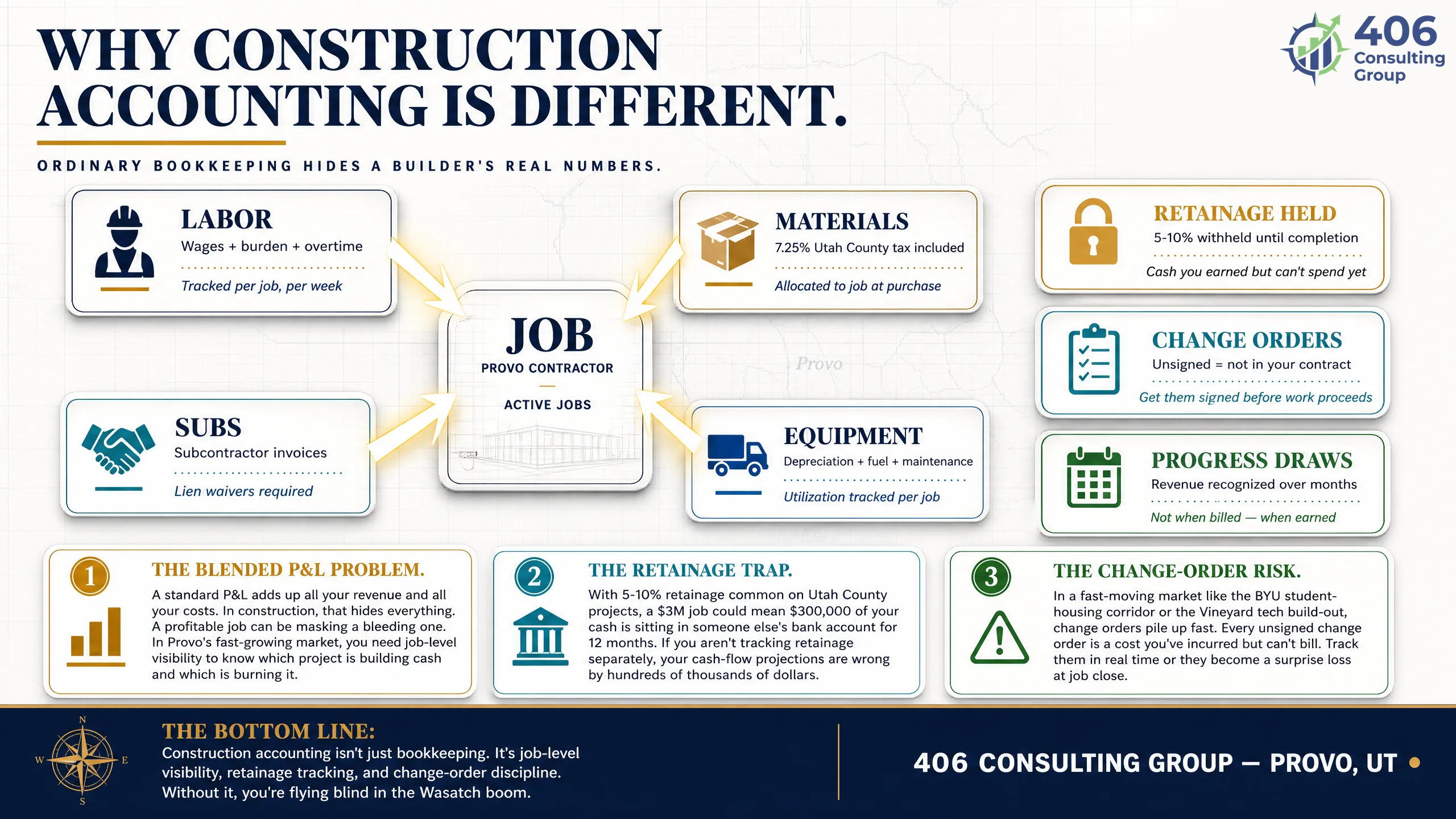
Run a contracting business through ordinary bookkeeping and the numbers you most need to see are exactly the ones that stay hidden. Revenue arrives as progress draws spread over jobs that take months; costs land in four different buckets — labor, materials, subs, equipment — that each have to be pinned to the right project; the owner sits on retainage; change orders keep rewriting the scope; and one underpriced bid can swallow the profit from three good ones. Books that only sort the bank feed and tidy up for April tell you nothing about the two questions that actually decide whether you make it: is this job beating its estimate, and is the company as a whole earning a profit?
In Provo, that puzzle sits on top of a county growing about as fast as any in the nation and a state that runs a serious contractor-licensing program. When you're bidding student housing near campus, tenant improvements for a Silicon Slopes tenant, and a subdivision out in Vineyard in the same month, the pace amplifies every weak spot in the books — a costing blind spot you could shrug off at a dozen jobs a year turns costly at forty. Getting the accounting, the DOPL license, and the Utah tax rules right is what lets a Utah County builder grow with the valley instead of getting buried under it.
It starts with Utah's tax and licensing frame — and in this state, the licensing piece carries more weight than newcomers expect.
The Utah Contractor Tax & Licensing Picture
Utah keeps taxes moderate and takes licensing seriously. Here's the frame a Provo contractor is working inside:
| Item | What it means for a contractor |
|---|---|
| State income tax | Flat rate, around 4.5% (verify current) on pass-through profit |
| Sales & use tax | ~7.25% in the Provo/Utah County area (verify); on real-property work you're the consumer of the materials |
| Contractor license | State-licensed through DOPL — experience, pre-license education, exam, and a bond |
| Prevailing wage | No Utah state prevailing wage — only federal Davis-Bacon on federally funded jobs |
| Workers' comp | Required; bought on the competitive private market (not a state-monopoly fund) |
| Equipment | Business personal property assessed by Utah County, with an exemption threshold — track it |
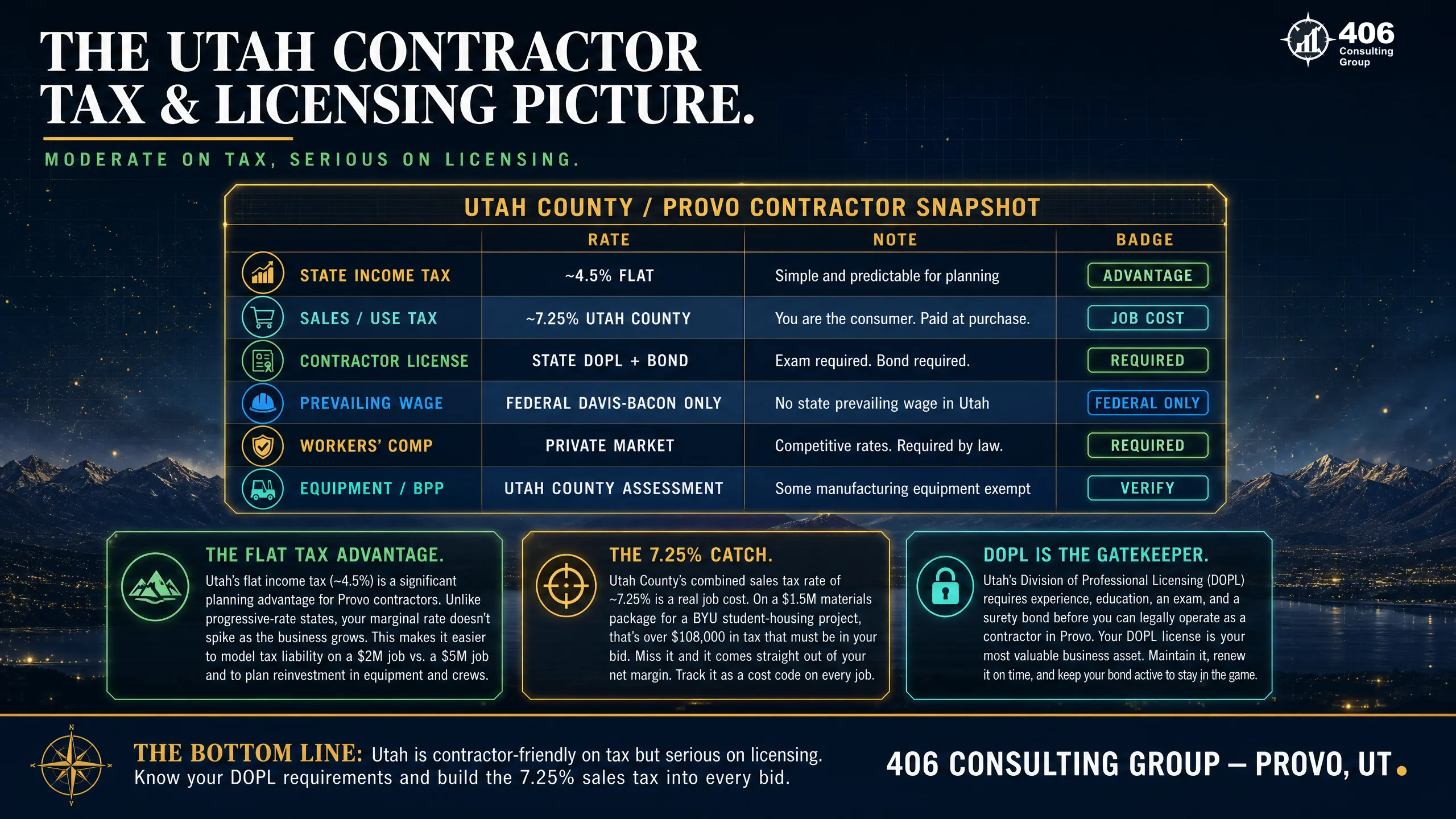
Verify current rates and rules with the Utah State Tax Commission and licensing with Utah DOPL. Licensing is what most often trips up a contractor new to the state, so begin there.
Utah Licensing: DOPL, the Exam & the Bond
Some states hand general licensing to individual cities; Utah does not. It runs a statewide contractor-licensing program through the Division of Professional Licensing (DOPL), and most construction work requires an active license in the correct classification. Earning one generally means documenting your experience, finishing a required pre-license education course, sitting an exam, and posting a license bond alongside insurance. The classifications — general building, general engineering, and the specialty trades — define what you're legally allowed to bid, so the license you hold sets the boundary of the work you can take.
On the accounting side, the license, the bond, and the insurance behind them are recurring costs and live obligations — and bidding outside your classification or letting the license lapse can stall payment and invite penalties. As you add classifications or step up to larger projects, licensing and bonding have to grow with you, and your financial statements are part of what a surety leans on to extend the bonding that bigger and public jobs demand. Because the specifics differ by license type, confirm your classification, education, and bond requirements directly with Utah DOPL.
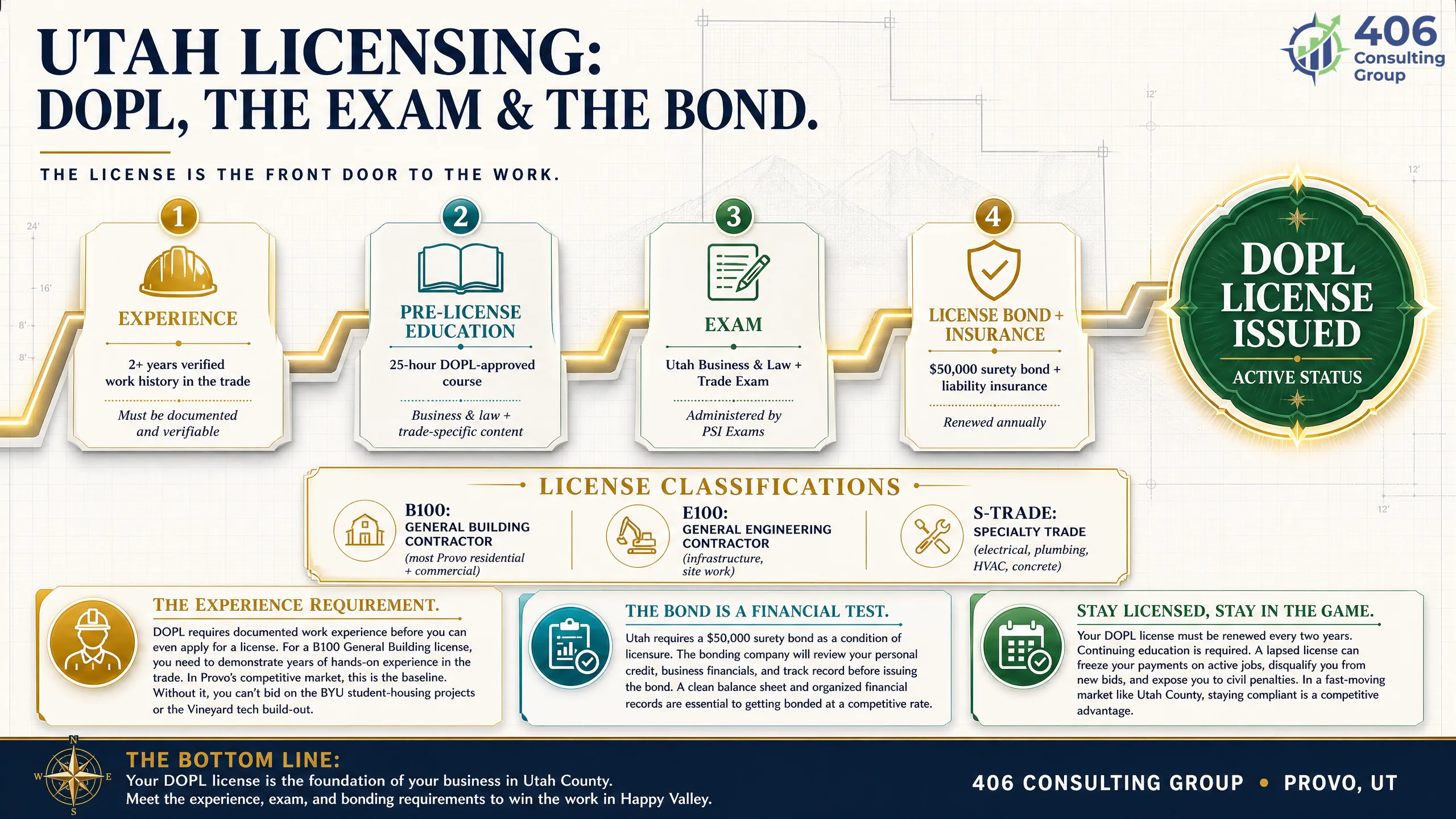
Here the license is the front door to every job — and keeping it and your bonding in good standing rests on organized financials underneath.
Utah Sales/Use Tax on Your Materials
A contractor handles Utah sales tax nothing like a retail store does. When your materials get built into real property, Utah generally treats you as the end consumer of them — you pay sales or use tax at the register when you buy, and you don't add a sales-tax line to the owner's bill for the construction. The tax on the framing lumber, the wire, the pipe, and the fixtures is simply part of what the job costs you, not a charge you collect and hand to the state the way a store collects it from a shopper.
That has two concrete effects on the books. First, materials tax has to sit inside your estimates and job costs at the real, tax-included price you paid — leave it out and every bid is quietly short. Second, use tax is the trap: it catches anything you bought with no Utah tax charged — a shipment from an out-of-state supplier, or stock pulled from your own inventory into a job — and Utah County projects that source from all over make it easy to overlook. If you also sell items over the counter without installing them, that retail side can be taxed like ordinary sales, so mixed operations need a clean line between the two. Set up cleanly, the tax becomes a predictable line in every job cost instead of a year-end surprise, and your bids keep their integrity.

If you both install and sell, confirm exactly how the consumer rule and use tax apply to your work with the Utah State Tax Commission.
Building Happy Valley: Silicon Slopes South, BYU & UVU
Utah County has a construction character all its own, and it's worth building your books around. Two big universities anchor a steady flow of student housing, apartments, and campus work in and around Provo and Orem. The southern reach of Silicon Slopes — Lehi and the Point of the Mountain down through Vineyard and Provo — keeps generating tech offices and the commercial and multifamily work that trails a young, fast-growing workforce. And on the old Geneva Steel ground, Vineyard has gone from empty acreage to one of Utah's fastest-growing cities in a handful of years. It adds up to a deep, durable runway of work — and, with it, sharp competition, tight labor, and climbing material costs.
The counterintuitive truth about a growth market is that it's where contractors most often lose money. High volume can paper over thin or negative margins right up until the cash runs dry. Saying yes to more work only builds a stronger company if you can actually see the margin on each job and fund the growth underneath it — which takes job costing, a live WIP schedule, and a cash forecast, not just a packed calendar. The Utah County builders who come out of this stretch bigger and healthier will be the ones whose books kept pace with the backlog.
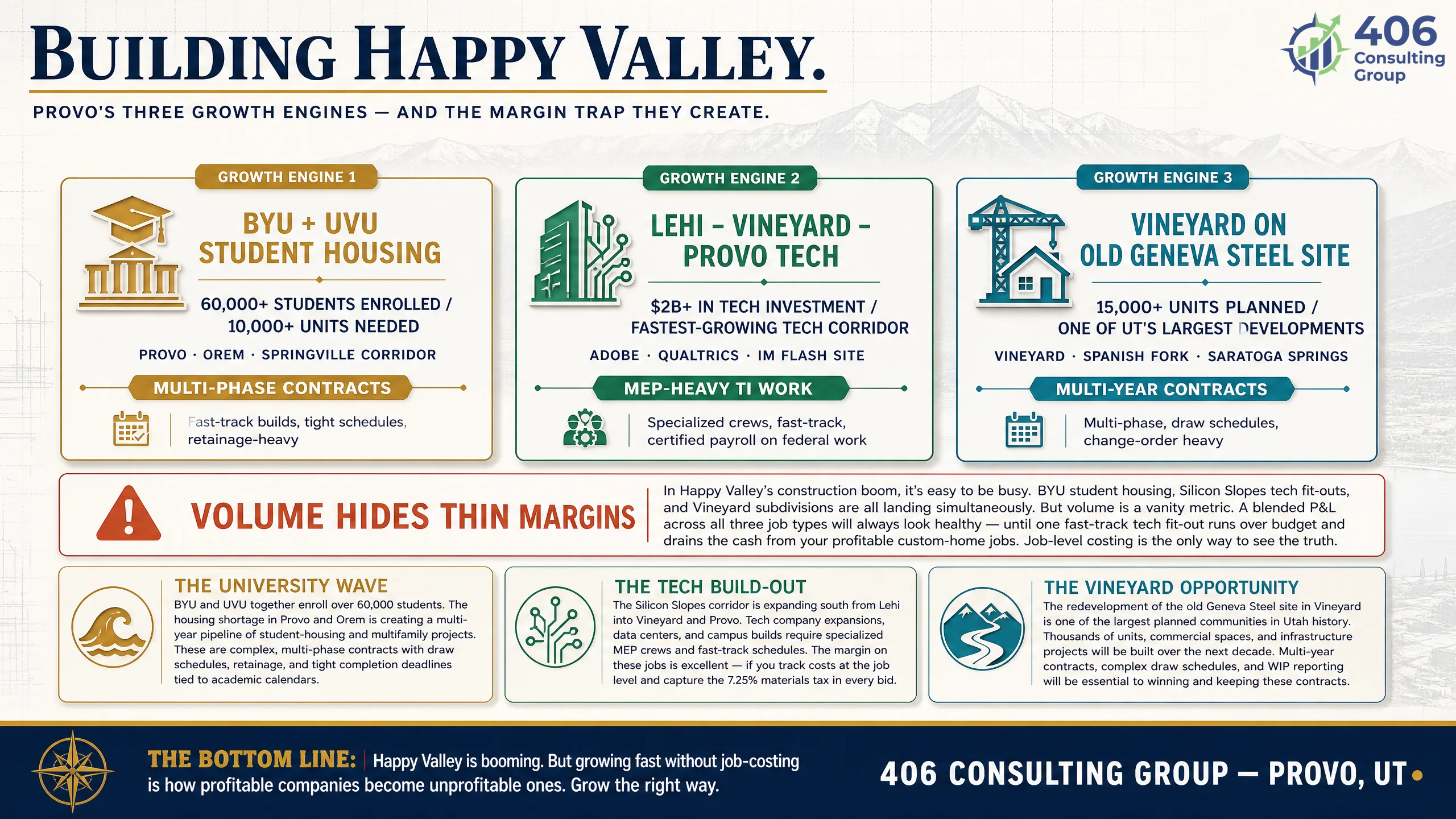
Growth only counts as good growth when it's profitable — and that's a bookkeeping question long before it's a sales one.
Job Costing: Which Job Actually Makes Money
When the phone won't stop ringing, the reflex is to keep saying yes — but without job costing you have no way to separate the jobs that build your company from the ones bleeding it dry. Job costing pins every labor hour, every material invoice at its taxed cost, every subcontractor bill, and every hour of equipment time to the exact project it belongs to, so each job's real margin stands on its own instead of dissolving into a company-wide average. The day you can see that a certain kind of near-campus apartment build runs razor-thin while your Vineyard subdivision work carries the business, you start bidding and chasing very differently.
It's also the bedrock the rest of your reporting stands on — an accurate WIP schedule, correct progress billing, and clear-eyed change-order calls all need job-level costs underneath them first. For a Provo contractor scaling into the valley's growth, nothing does more to keep that growth profitable rather than merely large than getting job costing right.
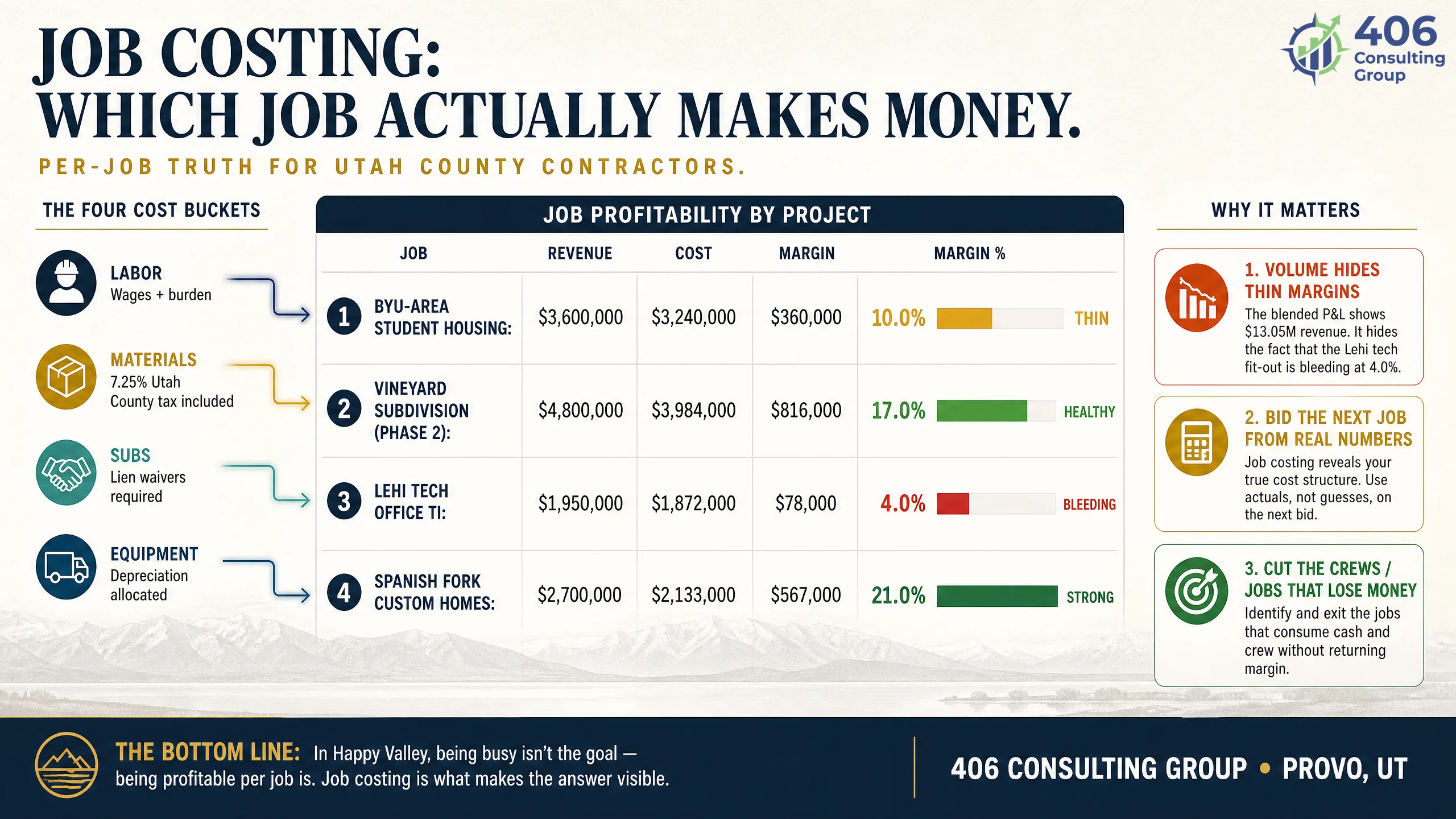
Working out which jobs and crews truly carry the business is the whole point of our contractor unit economics work — and job costing is what brings the answer into focus.
WIP, Percentage-of-Completion, Retainage & Change Orders
Jobs that stretch across months need a report a plain ledger simply can't produce. A work-in-progress (WIP) schedule lines up each open job's costs, billings, and estimated cost-to-complete side by side, and the gaps between them show whether you're over- or under-billed. Bill ahead of the work and the extra cash can flatter your bank balance while the costs are still coming; bill behind it and you're quietly financing the owner out of your own pocket. Percentage-of-completion ties recognized revenue to how far the job has genuinely progressed, so the monthly picture stays honest instead of lurching at the end.
Then add retainage — the slice the owner holds until the end, which ties up cash and belongs in its own receivable — and change orders, which move both scope and margin and have to be logged and priced before the work quietly folds into the job. In a growth market where you may be juggling more open jobs than ever, that WIP discipline is what stops a full schedule from masquerading as a profitable one — and it's the first report your banker and bonding agent will want to see.
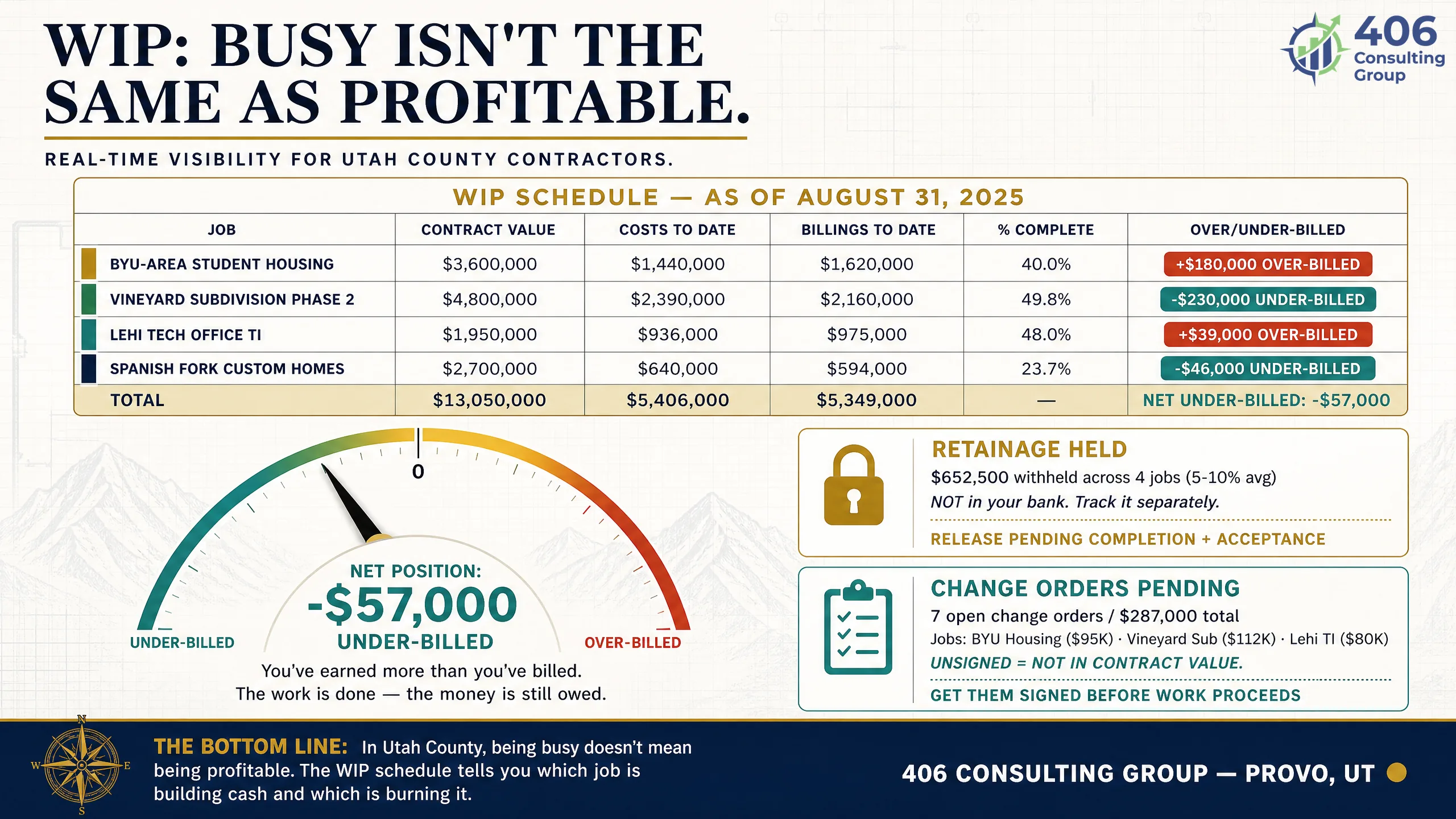
As you scale, this is the point where a controller or CFO function earns its keep — because the WIP is what turns a stack of open jobs into a single, honest read on where the company stands.
Payroll, Workers' Comp & Prevailing Wage
Utah construction payroll comes down to a few moving parts. Because the state levies a flat income tax, payroll carries Utah withholding next to the federal side. Workers' compensation is mandatory for employees, and Utah runs a competitive private market — you buy the coverage from a carrier rather than a single state fund — with class-code rates on the trades high enough that they belong in your burdened labor and your job costs. As for public works, Utah has no state prevailing-wage statute, so prevailing-wage and certified-payroll duties generally show up only through the federal Davis-Bacon Act on federally funded projects — which around Provo can mean work tied to the universities or federal grants.
Beyond the filings, construction payroll means routing every labor hour to a job so it feeds your costing, and managing a heavy load of subcontractors and 1099s with defensible worker classification — a spot that draws real scrutiny in a fast-moving trades market like Utah County's. Built cleanly, payroll turns into reliable data flowing straight into your job costs instead of a monthly fire drill.
Our payroll work — including certified payroll on federal jobs — keeps all of that running quietly in the background.
Equipment, Depreciation & Personal Property
Equipment hits the books from two angles at once. On the federal side, Section 179 and bonus depreciation can drop a big chunk of a truck, lift, or machine into the year-of-purchase deduction — useful as you gear up for the valley's growth, but a choice to weigh against your multi-year income rather than take on autopilot. On the Utah side, the county assesses business personal property, softened by a de minimis exemption that covers a threshold of equipment per taxpayer — so a smaller outfit may owe little, while a larger fleet should track it carefully and confirm where it lands.
A current fixed-asset schedule quietly earns its place two ways: it keeps depreciation and any personal-property filing accurate, and — because a machine's hours belong on the job that ran it — it pushes those costs into job costing, so a lift sitting idle reads as the expense it is rather than vanishing into overhead. Know what you own, what each piece costs to run, and where it's earning its keep.
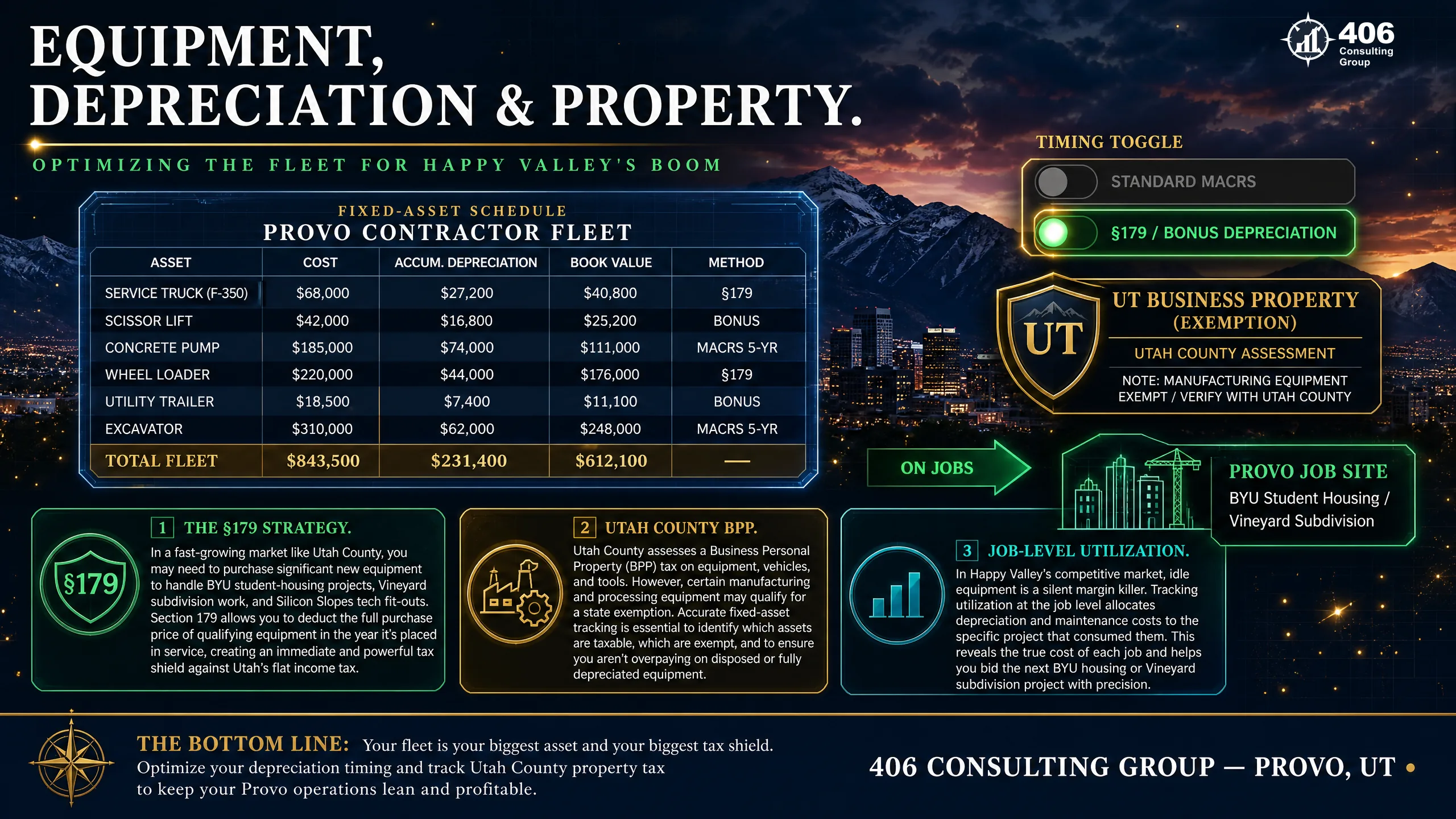
The depreciation strategy and Utah income-tax planning live in the Provo tax guide; the tracking that powers both starts in the books.
Common Construction Bookkeeping Mistakes
A short list of avoidable errors causes most of the financial pain for Provo contractors — and a fast market makes each one bite that much harder.
Bidding materials at the pre-tax price
Utah makes you the consumer, so the sales/use tax is real job cost — leave it off the estimate, or overlook use tax on an out-of-state order, and the bid is underwater before you break ground.
Letting the DOPL license or bond lapse
A license that's expired or the wrong classification for the work can stop a draw cold and stack penalties — treat renewal and bonding as part of the job pipeline, not afterthought paperwork.
Scaling with no job costing
When the calendar is packed, a losing job looks just like a winning one on the P&L; without per-job numbers you find the leak only after the cash is already gone.
Skipping the WIP schedule
Without it, over- and under-billing disguise where each job actually stands — and no surety extends Utah County-sized bonding on books that can't produce a clean WIP.
Loose 1099 and subcontractor classification
Provo's heavy sub mix in a hot market is exactly what draws a second look — reclassifying workers after the fact is slow, costly, and entirely avoidable.
Every one is a setup-and-habit problem — and every one clears up once the books are built for Utah construction and run on a steady monthly rhythm.
Local vs. a Great Remote Partner
A Provo contractor's day runs between the job site and the truck, not an accountant's lobby — so a remote partner already matches the shape of the business. The question that actually matters is expertise: can your accountant handle Utah construction — DOPL licensing and bonding, the consumer sales-tax rule, job costing across fast-moving campus, tech, and subdivision work, and a WIP schedule a surety will accept? A specialist who lives in those details, wherever their office sits, is worth far more than a generalist down the street who's never built a WIP or tracked a contractor's license obligations.
Our workflow is built around a builder's day: cloud accounting and job-costing software, receipts and hours captured straight from the field, connected bank feeds, and a monthly close you can count on — Utah-literate construction books with no drive across the valley. In Provo or Orem, out in Vineyard and Lehi, or south toward Spanish Fork, the same construction-savvy team and expertise are with you either way.
The thing that counts is whether your accountant genuinely knows Utah construction — where the office happens to be barely registers.
How to Get Started
Getting a Provo contractor's books in shape comes down to three steps.
Get the Utah pieces right
Keep your DOPL license, bond, and classification current, build materials sales/use tax into every bid as a job cost, and set up workers' comp cleanly with a private carrier.
Build construction-grade books
Job costing by phase, a WIP schedule, retainage and change-order tracking, a fixed-asset schedule, and certified payroll wherever federal work requires it.
Run it monthly
A real monthly close, WIP review, sales/use-tax handling, and job-level reporting — so you know which jobs pay and can fund and bond the next one.
Not sure where your books stand today? Our Financial Maturity Assessment maps it out in about eight minutes.
FAQ: Provo Construction Accounting
Do I need a contractor's license in Utah?
Almost always. Utah runs a statewide licensing program through the Division of Professional Licensing (DOPL), and nearly all construction in Utah County requires an active license in the correct classification — general building, general engineering, or one of the specialty trades. The path typically runs through an experience requirement, a mandated pre-license education course, an exam, and a posted license bond alongside insurance. Take work outside your classification, or let the license lapse, and you risk frozen payments and penalties — so as your Provo jobs grow, the license and bond have to grow with them. Because the exact requirements turn on your classification, verify yours directly with Utah DOPL.
Do Utah contractors add sales tax to a customer's job?
No — not on the real-property construction itself. In Utah, a contractor who installs materials into real property is the final consumer of them, which flips the usual retail logic: you pay the sales or use tax up front at purchase, and the owner never sees a sales-tax line on the build. So that tax rides inside your job cost and has to appear in your estimates at the taxed price. Where it bites is use tax — anything bought with no Utah tax charged, like an out-of-state order or material pulled from your own inventory. And if you run a retail counter alongside the contracting, those over-the-counter sales can be taxed like any store's. Check the specifics for your mix with the Utah State Tax Commission.
Is there prevailing wage or certified payroll in Utah?
No state prevailing wage in Utah. Those obligations surface only when the federal Davis-Bacon Act attaches to a federally funded project — around Provo, that often means work tied to the universities or to federal grant dollars. On a covered job you pay the published wage determinations and file certified payroll for every worker, usually weekly, and one bad report can stall your draw, so payroll has to be built to generate clean certified reports. Because it follows the funding, treat it as a project-by-project question. Workers' comp is a separate matter — required for Utah employees and purchased on the competitive private market, not through a state fund.
Why does job costing matter so much in a fast-growing market like Utah County's?
Because a growth market is the easiest place to lose money quietly. When the schedule is full, thin or negative margins hide inside the overall revenue until the bank balance forces the question. Job costing breaks that open: every labor hour, taxed material invoice, sub bill, and equipment charge lands on the job that incurred it, so each job's real margin is visible and you can separate the ones building the company from the ones draining it. It's also what an accurate WIP schedule, correct progress billing, and sensible change-order pricing all sit on top of. In a county growing as fast as Utah County, that per-job clarity is the difference between a bigger backlog making you stronger and it making you fragile.
Can 406 Consulting Group do my Provo construction bookkeeping remotely?
Yes — and for a contractor whose office is really the truck, remote is simply how the business already runs. Everything works through cloud accounting and job-costing software, with receipts and hours captured from the field, connected bank feeds, and a monthly close you can rely on. What decides the outcome for a Utah construction business is expertise — job costing, WIP, DOPL licensing, the consumer sales-tax rule, workers' comp, and bonding-ready financials — not how many miles away the office is. We support Provo and Utah County contractors the same whether you're near campus, out in Vineyard or Lehi, or south toward Spanish Fork.
Keep Reading
Trades & Construction — Provo, UT
Grow With the Valley on Books You Can Trust.
406 Consulting Group keeps Provo and Utah County contractors clean and compliant — DOPL licensing, Utah's consumer sales tax, job costing, WIP, and equipment handled — delivered remotely, by a firm that knows Utah construction.
Provo Construction Quick Reference
Provo, UT — Utah County
Growing Fast in Utah County?
Licensing, job costing & WIP, handled.
About the Author
Carrie Anderson
Co-Founder, 406 Consulting Group
Commercial banking and underwriting background — 300+ loan reviews — serving contractors and trades across the Mountain West. Carrie helps Utah County builders keep DOPL licensing and bonding current, handle Utah's consumer sales tax, run real job costing and WIP, and grow profitably through the valley's boom.
Read the Full Story