
Accounting for Nashville Small Business:
The Music City Playbook
The overview that ties it together — Tennessee's 'no income tax, but F&E' reality and the books-to-tax-to-CFO stack for a Nashville small business, delivered remotely.

Nashville is one of the fastest-growing business economies in the country — a healthcare-management powerhouse, the capital of the music and entertainment business, a booming tech and startup scene, and a tourism and hospitality engine that never really slows down. It's a phenomenal place to build a company. It's also a place where the accounting quietly trips people up, because Tennessee taxes differently than almost anyone expects: no personal income tax, but a Franchise & Excise tax on your entity, one of the highest sales-tax rates in the country with a real reach into services, and a separate business tax and county property tax on top.
This is the overview — the Music City playbook for getting your accounting right, from first clean books to a CFO-level view of a business built to scale. It ties together our deeper Nashville guides on bookkeeping, tax planning, and CFO & controller services — delivered remotely, by a firm that knows Tennessee cold.
By Carrie Anderson — Co-Founder, 406 Consulting Group. Commercial banking and underwriting background — 300+ loan reviews — plus advisory work with small businesses across the country, building financial systems that keep compliance clean and fund growth.
Quick Answer: Accounting for a Nashville Business
- →No personal income tax — but Tennessee collects via the Franchise & Excise tax, high sales tax, and a business tax.
- →Franchise & Excise: the entity-level tax that stands in for income tax — 6.5% on net earnings plus 0.25% on net worth; form an LLC or corp and it switches on (sole props & general partnerships exempt).
- →Sales tax ~9.25% in Nashville and it reaches services — a real compliance area, especially for software & entertainment.
- →Fast growth means job/segment costing and cash forecasting matter earlier than owners expect.
- →Delivered remotely across Nashville & Middle Tennessee — Tennessee expertise over office proximity.
Table of Contents
Running a Business in Nashville
Nashville's economy is deep and fast-moving. Healthcare and healthcare-management sit at the center — the region is a genuine national hub — but around it are the music and entertainment industry, a rising tech and startup ecosystem, a massive tourism and hospitality trade, logistics and distribution, and the construction racing to keep up with the people arriving. For a business owner, that's tremendous opportunity, paired with the reality of operating in a market that's growing faster than most owners' back offices can keep up with.
The companies that do well here treat accounting as infrastructure: clean books that speak Tennessee's tax language, planning that captures what the state and federal codes offer, and a financial view that scales with rapid growth instead of buckling under it. The ones that struggle usually have strong demand and a back office that never scaled — or never adjusted for how differently Tennessee taxes. This playbook is about being the first kind.

It starts with understanding what makes Tennessee different — and that's mostly how it taxes.
The Tennessee Tax Landscape
For most owners the surprise isn't the size of the tax bill — it's the shape of it. Tennessee skips the personal income tax and recovers the revenue from entities and spending instead, so the map below is the one every Nashville business should keep in front of it:
| Tax | The Tennessee reality |
|---|---|
| Personal income tax | None — no tax on wages; the Hall tax on investment income is repealed |
| Franchise & Excise tax | 6.5% excise on net earnings + 0.25% franchise on net worth (min $100), at the entity |
| Sales & use tax | ~9.25% in Nashville (7% state + local); reaches some services & digital goods |
| Business tax | A separate gross-receipts tax with a county/city business license |
| Property / payroll | County tangible-property tax; no state withholding; workers' comp generally required |
| County | Davidson County (Metro Nashville) |
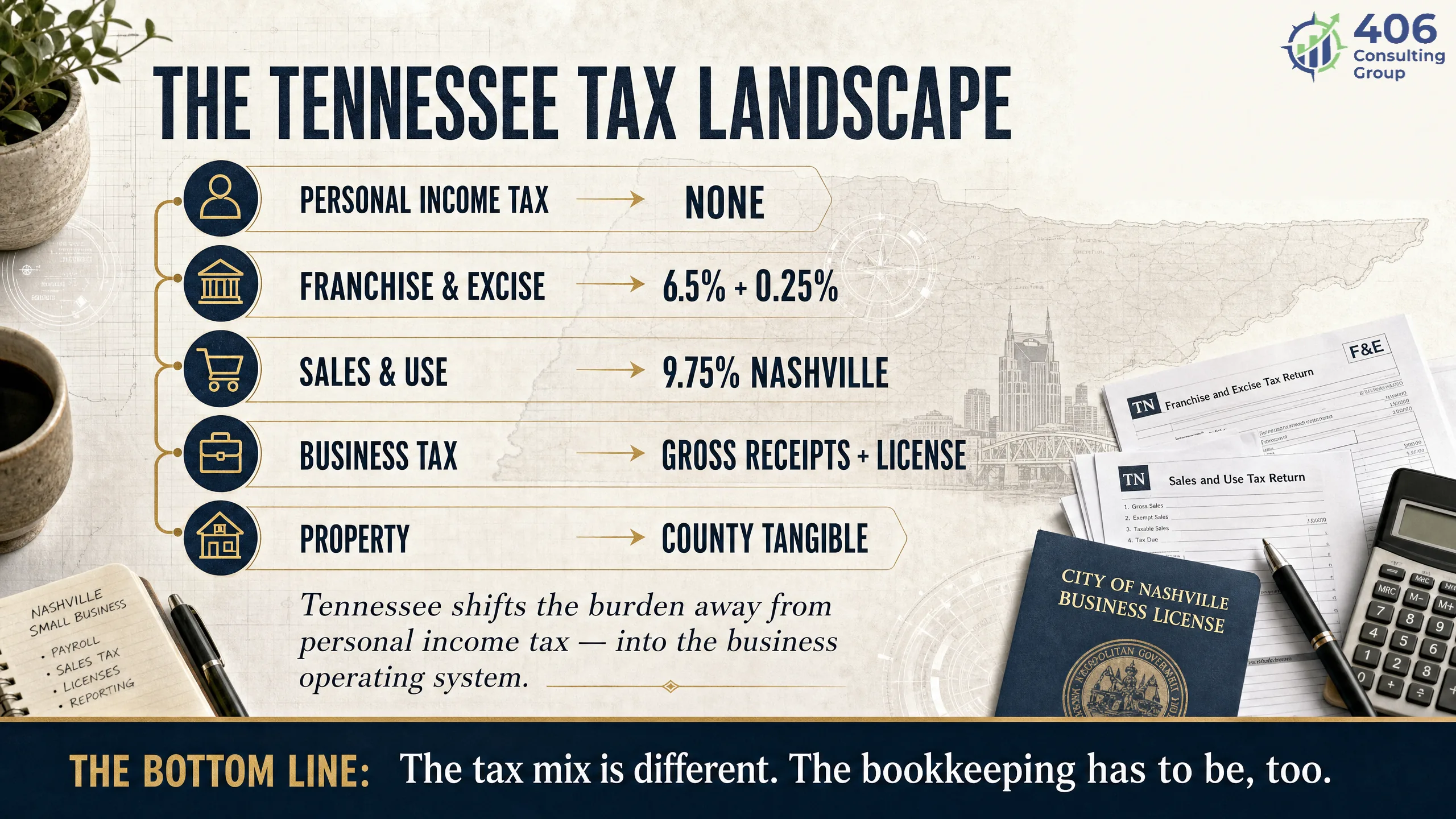
Confirm current rates and rules with the Tennessee Department of Revenueand your county assessor. The most important thing to internalize is that "no income tax" is only half the story.
"No Income Tax" Is Half the Story
The no-income-tax headline is real and valuable — but Tennessee simply collects elsewhere, and the pieces that replace it are exactly what a generic, out-of-state setup mishandles. The Franchise & Excise tax lands on the entity: 6.5% of net earnings plus 0.25% of net worth, switched on the moment you form an LLC or corporation (sole props and general partnerships are exempt). Sales tax runs about 9.25% in Nashville and reaches services and digital products owners assume are exempt. And a separate business tax, its license, and a county property tax round out a stack that quietly adds up.
Miss any of these and "no income tax" becomes surprise liabilities and penalties. Get them right — and manage the excise base, since deductions that lower net earnings cut both federal tax and the 6.5% excise — and Tennessee genuinely is a favorable place to operate. The difference is having books and planning built for how Tennessee actually works.
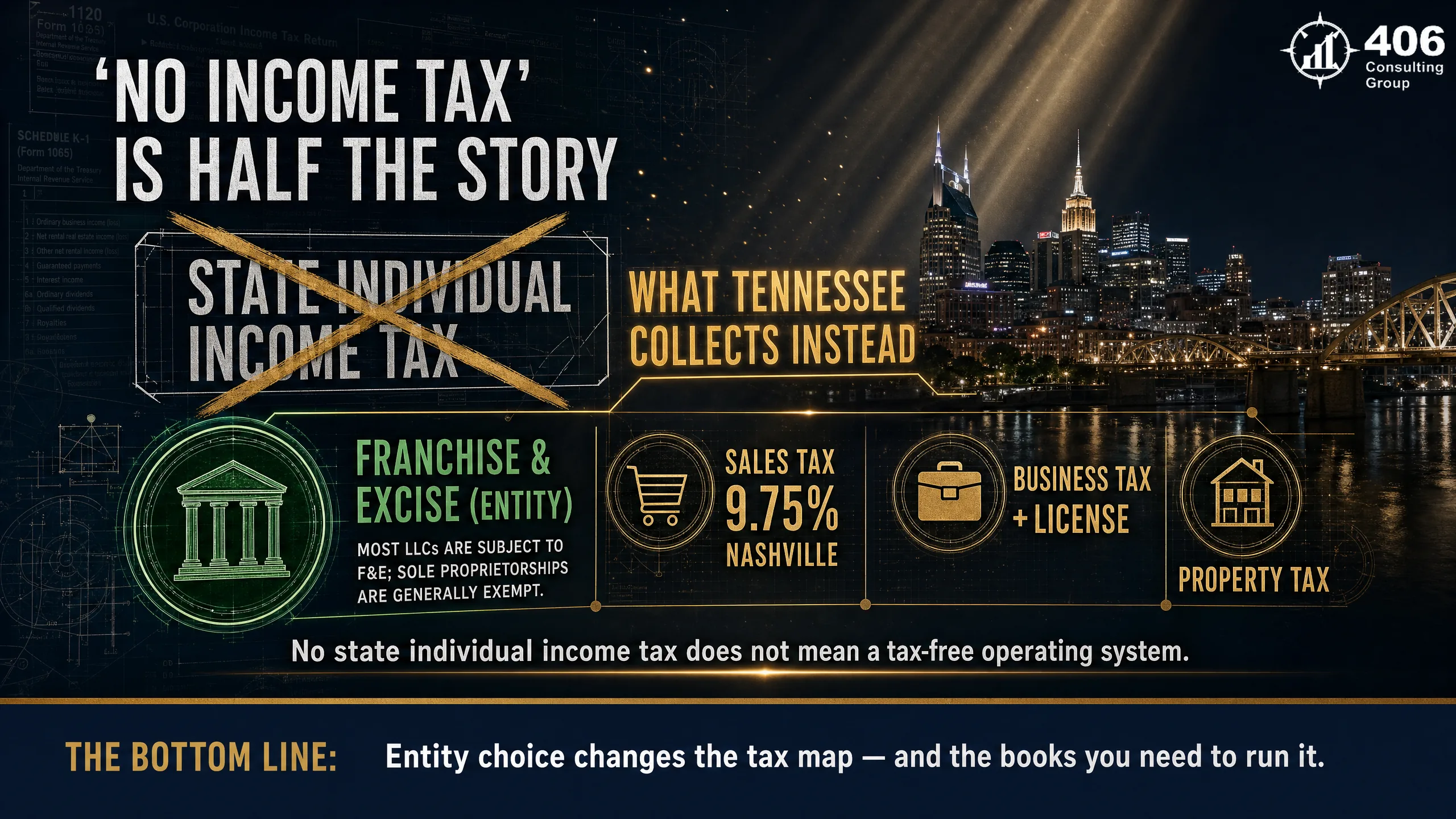
The full mechanics live in our bookkeeping and tax guides. It's the number-one reason a Nashville business wants a Tennessee-savvy accountant.
Nashville's Signature Industries
Two industries define Nashville, and each bends the finances a different direction. Healthcare and healthcare management is the region's economic anchor — large organizations built on slow-turning insurance receivables, layered related-entity ownership, and clinical payroll that dwarfs everything else, where the excise base can stretch across several entities and has to be planned across all of them at once rather than one return at a time. Music and entertainment runs on the opposite metabolism: income lands in lumpy project and royalty streams, the roster is mostly 1099, and there's a live question in every engagement over which creative, licensing, and digital services Tennessee actually decides to tax.
Getting either one right means books designed around how the business actually earns — not a generic template. That's where our whole-business background matters: we set up the chart of accounts, the entity structure, and the reporting to fit a healthcare group or a music company, then keep the Tennessee compliance clean underneath it.
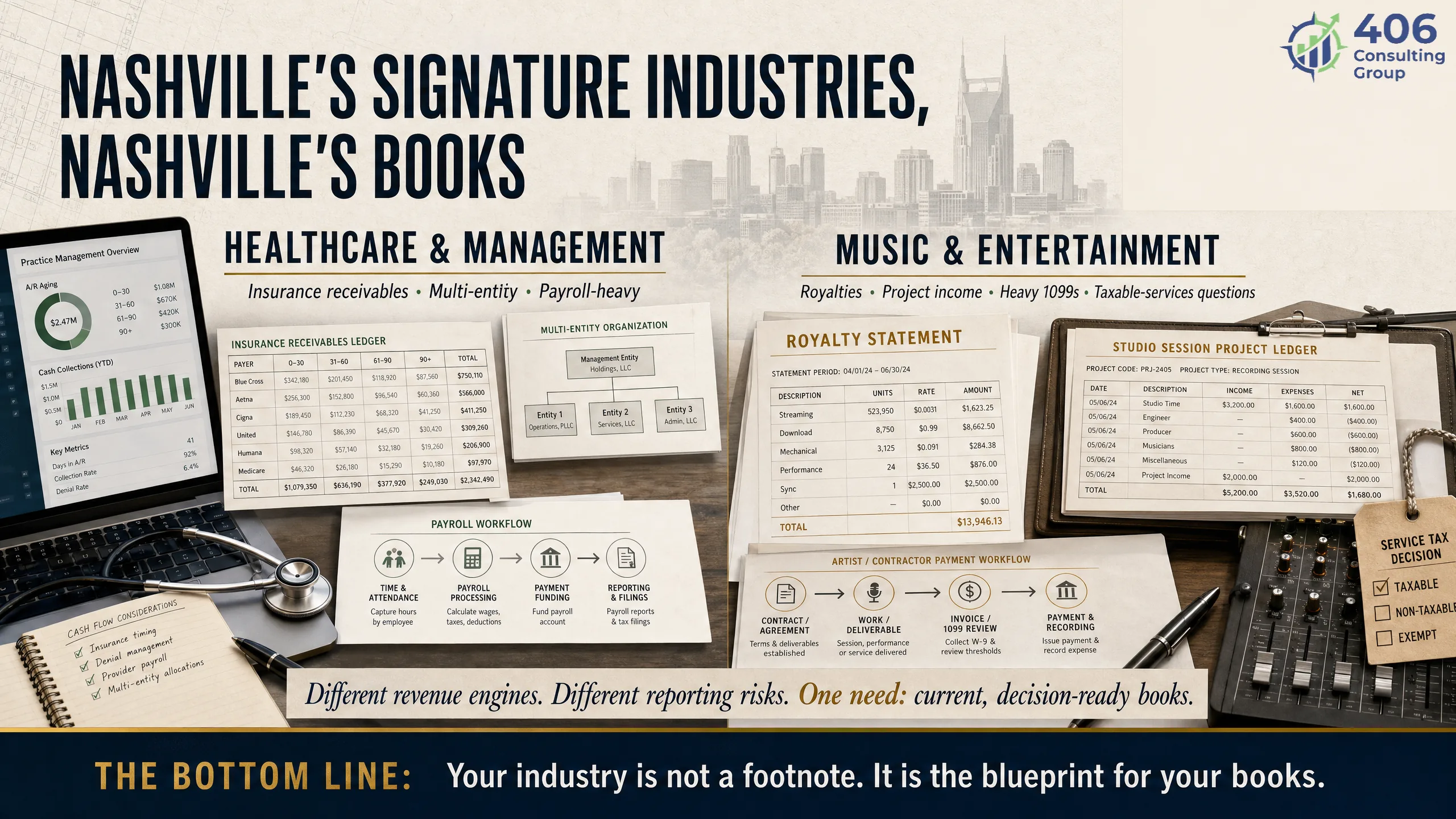
Which service lines, locations, or clients are quietly carrying the company — and which are just noise on the P&L? Segment-level reporting is how a Nashville owner finally sees it, and surfacing that answer is the whole point of our unit-economics work.
Tech, Hospitality & Beyond
Beyond healthcare and music, the Music City economy has real breadth, and every corner keeps its books a little differently. Tech and startups wrestle with when revenue can actually be recognized, sales tax on software sold into dozens of states at once, and a runway number the founders watch by the week. Hospitality and tourism turn on nightly sales reconciliation, tip and gratuity handling, perishable inventory, and collecting that ~9.25% tax correctly at the register. Construction and the trades carry job costing, use tax on the materials they consume, and mandatory workers' comp. And professional-services firms live or die on tracked time, tight billing, and knowing their true margin client by client.
The common thread across every Nashville segment: the Tennessee tax structure is the same backbone underneath, and the businesses that manage it well are the ones whose books are built for it and whose owners can see their numbers clearly.

Bookkeeping: The Foundation
Everything else sits on clean books. For a Nashville business that means a chart of accounts built for Tennessee — net earnings and net worth easy to read (because those drive F&E), sales tax tracked as a liability with taxable-versus-exempt detail, a fixed-asset schedule for the county property filing, and revenue separated cleanly for the business-tax classification. Add monthly reconciliation, sales-tax filing, payroll (lighter here, with no state withholding), and reliable financial statements, and you have the foundation every tax and strategy decision depends on.
The full detail — the F&E setup, the sales-tax and services rules, the business-tax and property filings, the common mistakes — lives in our Nashville bookkeeping guide. If your books are behind or built on a generic out-of-state template, that's the place to start.
Tax Planning: Where the Savings Are
Because there's no personal income tax, Tennessee planning lives in different places: the entity decision (a sole prop pays no F&E; an LLC or S-corp does — weighed against the federal S-corp self-employment savings), managing the excise base so deductions cut both federal tax and the 6.5% excise, capturing sales-tax exemptions while avoiding the taxable-services trap, and — because the federal return carries the income-tax weight — federal levers like QBI, depreciation, and retirement plans. There's no PTE/SALT workaround to chase here, which frees planning to focus where the dollars actually are.
Our Nashville tax-planning guide walks each move, and the S-Corp Calculator gives a first read on whether an election pays off for you.
When You Need a CFO or Controller
As a Nashville company grows — and in this market that happens fast — the financial function that worked at a couple million stops working. A controller keeps the books accurate and the close on time; a CFO adds forecasting, cash-flow planning, margin analysis, and capital strategy. Most companies don't need either full-time until roughly $15M+ in revenue — which is exactly why fractional exists, delivering senior expertise for a few thousand a month instead of a $200K+ salary.
The signals it's time — a slipping close, growth outrunning the books, financing or investor conversations, a second location or acquisition — and the full cost math are in our CFO & controller guide. In a fast-growth market, this need shows up sooner than owners expect.
The Whole-Company Systems View
What sets our work apart is that we don't look at accounting in a vacuum. The numbers are downstream of everything else the business does — how work gets scheduled and delivered, how operations feeds billing, how billing becomes cash. Fixing the finances for real usually means improving the whole-company process that produces them, and that cross-departmental lens is how a fast-growing company turns operational chaos into something that scales. It's also the climb we map in the Financial Maturity Ladder — from reactive books to a business run on real numbers.
We dig into it in the hidden cost of no systems— how the gaps a busy Nashville business shrugs off as "just how it is" quietly bleed margin, and why the fix usually pays for itself faster than owners expect.
Choosing an Accountant: Local vs. Remote
In a market this specialized, the wrong question is "who's nearby?" The right one is "who actually knows how Tennessee taxes and how my industry runs?" The F&E and entity decisions, the taxable-services rules, the business-tax and property filings, and the way a healthcare group or music company earns — those are where a Nashville business wins or loses on its accounting, and they're precisely what an out-of-state generalist gets wrong. Proximity buys you nothing here; the right expertise buys you everything.
That expertise reaches you over secure cloud accounting, live bank feeds, and a working rhythm of shared screens and standing calls — the same way most of our clients already run, many of whom we've never met in a lobby. Whether you're downtown, out in Williamson County, or anywhere across Middle Tennessee, the service is identical: close, responsive, and grounded in Tennessee.

Pick for what an accountant knows, not where they park. In Nashville, knowing Tennessee is the whole job.
A Roadmap by Stage
Where you focus depends on where you are. A rough Nashville roadmap:
Get the structure right
Choose an entity with the F&E cost in mind, register for sales and business tax, and set up Tennessee-ready books from day one.
Tighten books & tax planning
Monthly close and sales-tax filing on rhythm, plus managing the excise base, the sales-tax exemptions, and federal QBI and depreciation.
Add segment costing & a forward view
Margin by service line, client, or location, cash-flow forecasting against the Tennessee reserves, and a controller function as the close and decisions get bigger.
Bring in CFO-level strategy
Financing and investor readiness, capital strategy, and whole-company systems to scale without breaking.

Not sure where you land? Our Financial Maturity Assessment maps it in about eight minutes and points to what to build next.
FAQ: Nashville Small-Business Accounting
What makes accounting in Nashville different from other cities?
Mostly Tennessee's tax structure and Nashville's industry mix. Tennessee has no personal income tax, but it collects through the Franchise & Excise tax on your entity (6.5% of net earnings + 0.25% of net worth), one of the highest sales-tax rates in the country (~9.25% in Nashville) that reaches some services, and a separate business tax plus county property tax. Layer on Nashville's fast-growing healthcare, music, tech, and hospitality economy, and you get accounting where entity choice, the excise base, taxable-services rules, and segment costing all matter more than in a typical market. 'No income tax' is true, but it's only half the story.
What taxes does a Nashville small business pay?
Think of it as four buckets. First, the Franchise & Excise tax on your entity — 6.5% of net earnings plus 0.25% of net worth, $100 minimum — Tennessee's stand-in for the income tax it doesn't levy. Second, sales and use tax near 9.25% in Nashville, reaching further into services and digital products than most owners expect. Third, a separate gross-receipts business tax that carries its own license. Fourth, a county tangible-personal-property tax on your equipment. Payroll runs a touch lighter with no state income-tax withholding, but federal payroll taxes, Tennessee unemployment, and workers' comp (5+ employees, or any employee in construction) all still apply. Your county and the Tennessee Department of Revenue have the exact figures.
Do I need a local Nashville accountant?
What you need is an accountant who knows Tennessee and your industry — the Franchise & Excise tax and entity decision, the taxable-services rules, the business-tax and property filings, and how a healthcare, music, tech, or hospitality business runs — far more than one with a local office. A generalist who doesn't know Tennessee is actually a liability, since those are the areas a generic setup gets wrong. Modern accounting runs on secure cloud software, bank feeds, and screen-shares, so a great remote partner who knows the state cold serves you better than a nearby generalist. We work with Nashville and Middle Tennessee businesses entirely remotely.
When should a growing Nashville business get bookkeeping, tax, or CFO help?
Roughly by stage: get bookkeeping and Tennessee tax structure right from the start; layer in real tax planning (entity/F&E, managing the excise base, exemptions, federal levers) once you're established; add segment costing and cash-flow forecasting as you grow; and bring in a fractional controller or CFO as the close slips, growth outruns the books, or you seek financing or investment — usually well before the ~$15M revenue point where a full-time hire makes sense. Our Financial Maturity Assessment helps you place yourself and prioritize.
Can 406 Consulting Group handle all of this remotely?
Yes — bookkeeping, tax planning, and CFO/controller work, all delivered remotely to Nashville and Middle Tennessee businesses through secure cloud accounting and regular strategy conversations. What matters for a Tennessee business is expertise in the Franchise & Excise tax, the sales-tax and services rules, and your industry, not office proximity, and our commercial-banking background means we prepare your financials the way lenders and investors read them. Most of our own local clients never come into an office either.
The Nashville Playbook — Full Series
Accounting — Nashville, TN
The Music City Playbook, Handled.
406 Consulting Group gives Nashville businesses the whole stack — Tennessee-ready bookkeeping, tax planning, and fractional CFO & controller work — delivered remotely, by a firm that knows the F&E tax and how Nashville's industries run.
Nashville Accounting Quick Reference
Nashville, TN — Davidson County
The Whole Stack, One Firm
Bookkeeping, tax & CFO — Tennessee-savvy.
About the Author
Carrie Anderson
Co-Founder, 406 Consulting Group
Commercial banking and underwriting background — 300+ loan reviews — plus advisory work with small businesses across the country. Carrie helps Nashville owners build financial systems that keep Tennessee compliance clean, capture the planning that pays, and fund growth.
Read the Full Story