
Accounting for Phoenix Businesses:
The Maricopa County Playbook
Arizona's TPT, the country's most complex contractor rules, a flat 2.5% income tax, and a booming market — here's the whole accounting playbook for a Phoenix business, from clean books to a CFO-level view.

Phoenix is one of the best places in the country to build a business right now — and one of the trickiest to keep the books straight in. The metro is booming: construction everywhere, semiconductor and tech money flooding in, logistics and healthcare scaling fast, and new businesses starting every day to serve all of it. But underneath the growth sits Arizona's genuinely unusual tax system — the Transaction Privilege Tax instead of a normal sales tax, and contractor rules among the most complicated in the nation — plus the cash and systems strain that fast growth always brings.
This is the overview — the Maricopa County playbook for getting your accounting right, from first clean books to a CFO-level view of a scaling company. It ties together our deeper Phoenix guides on bookkeeping, tax planning, and CFO & controller services, and shows how the pieces fit — all delivered remotely.
By Jason Anderson — Co-Founder, 406 Consulting Group. Big-firm-trained accountant advising construction, trades, and growth companies across the Mountain West and Southwest.
Quick Answer: Accounting for a Phoenix Business
- →TPT, not sales tax: Arizona taxes the seller by business classification, with city rates layered on — get it set up right.
- →Contractors: prime-contracting vs. MRRA is one of the country's most complex tax areas — plan it before you bid.
- →Low flat income tax (~2.5%) with a valuable pass-through (PTE) election on top.
- →Fast growth means job costing, cash-flow forecasting, and systems matter earlier than owners expect.
- →Delivered remotely across Phoenix & Maricopa County — Arizona expertise over office proximity.
Table of Contents
Running a Business in Phoenix
The Valley's economy is broad and fast-moving. Construction and the trades are booming to house and build for the influx; a wave of semiconductor and tech investment is reshaping the region; logistics, healthcare, hospitality, and professional services scale alongside them. For a business owner, that's opportunity — and a rising tide of complexity as you grow into a bigger, faster market than most.
The businesses that thrive here treat their accounting as infrastructure, not an afterthought: clean books that speak Arizona's tax language, tax planning that captures what the state and federal codes offer, and a financial view that keeps pace with growth. The ones that struggle usually have great demand and a back office that never scaled with it. This playbook is about being the first kind.

It starts with understanding what makes Arizona different — and that's mostly the tax system.
The Arizona Tax Landscape
Arizona is friendly on income and unusual on transactions. Here's the high-level picture every Phoenix business should know:
| Tax | The Arizona reality |
|---|---|
| State income tax | Low flat rate (~2.5%) — one of the nation's lowest; verify current |
| Transaction Privilege Tax | Arizona's 'sales tax' — on the seller; ~8.6% combined in Phoenix; by classification; verify |
| Gross-receipts / B&O | None separate — TPT plays that role |
| PTE election | Pass-throughs can pay state tax at the entity level (SALT-cap workaround) |
| Use tax | Companion to TPT on untaxed purchases |
| County | Maricopa County; cities layer their own TPT |
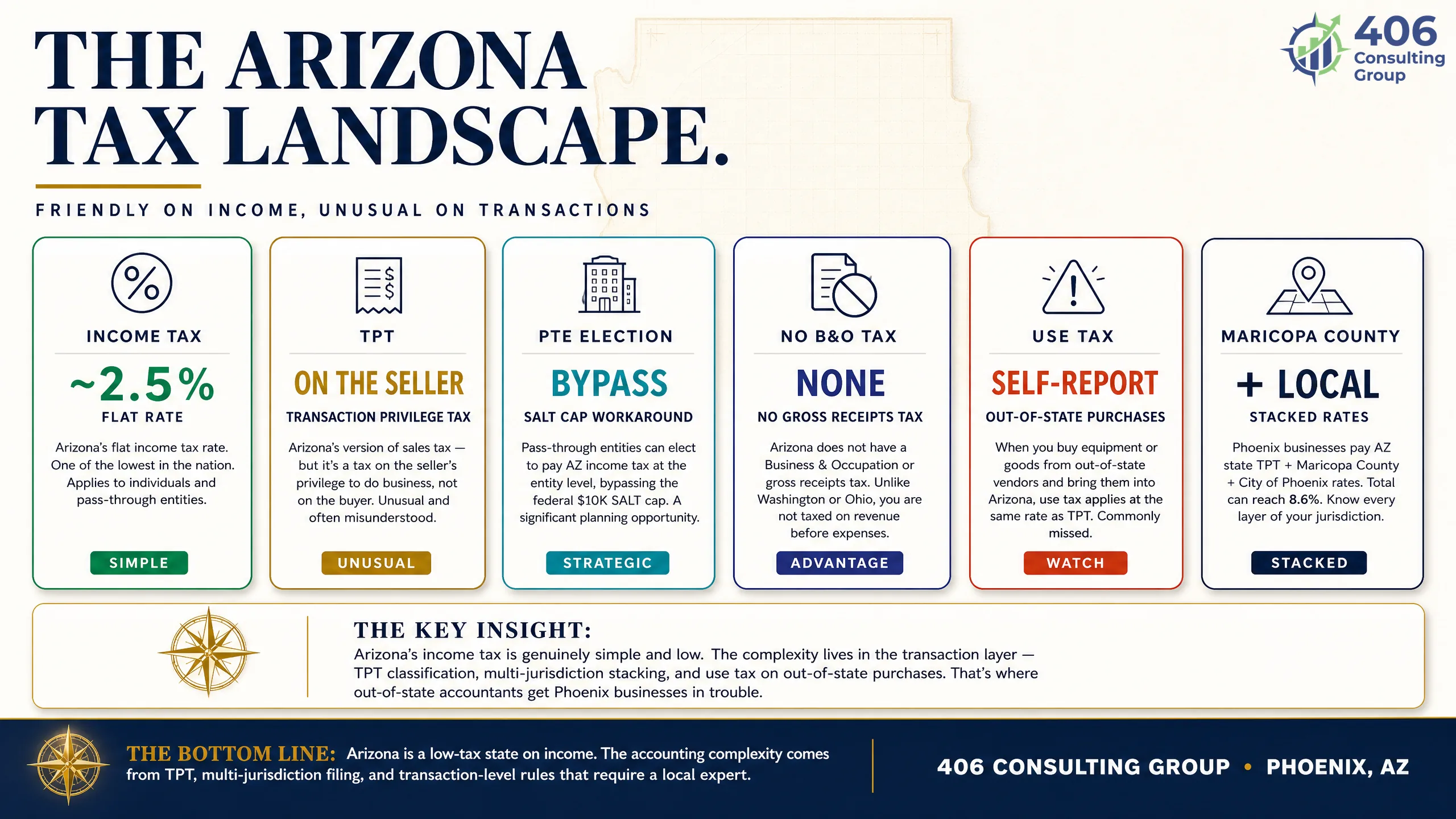
Confirm current rates and rules with the Arizona Department of Revenue. The single most important piece to understand is the TPT.
TPT: Arizona's Unusual Sales Tax
Arizona doesn't have a conventional sales tax; it has the Transaction Privilege Tax, which is legally a tax on the seller for the privilege of doing business in the state. Most businesses pass it through on the invoice like a sales tax, but the liability, filing, and risk are the business's — and TPT is organized into business classifications (retail, contracting, restaurant, commercial lease, and more), each with its own rules, with cities imposing their own TPT on top. That makes it easy for an out-of-state bookkeeper to mishandle and important to set up correctly from day one.
For contractors it's harder still: Arizona's rules split construction work into prime contracting (new construction and modification, taxed on gross receipts after a standard deduction) and MRRA (maintenance, repair, replacement, and alteration, where you generally pay TPT or use tax on materials at purchase) — completely different tax bases that should be understood before a job is bid. We go deep on both in the bookkeeping and tax guides.
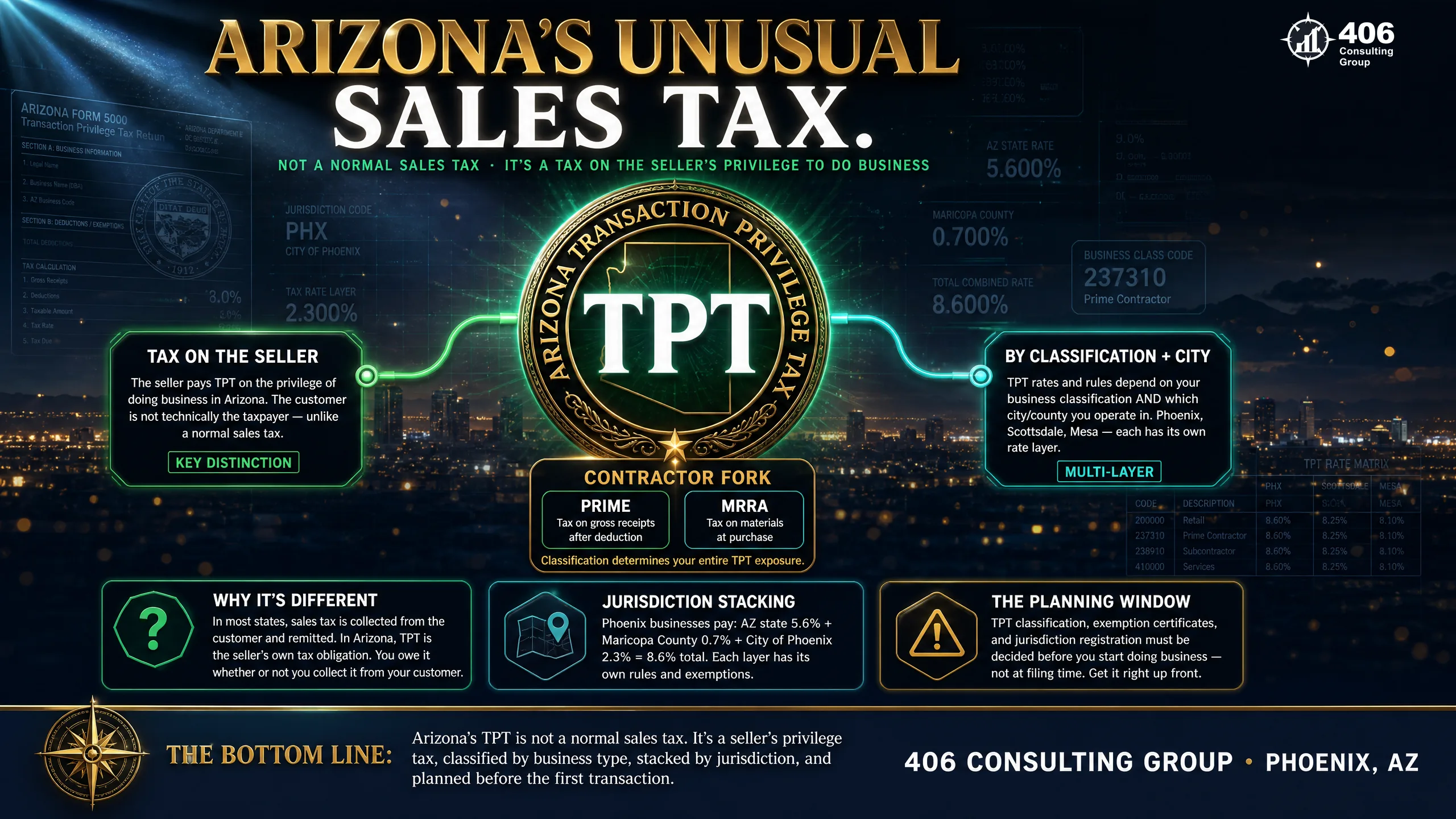
Get TPT right and it's a predictable cost; get it wrong and you either overpay quietly or build an audit liability. It's the number-one reason a Phoenix business wants an Arizona-savvy accountant.
The Construction & Trades Backbone
A huge share of Phoenix's economy is building the Valley — general contractors, trades, suppliers, and everyone who serves them. Construction accounting is its own discipline: job costing that ties labor, materials, subs, and equipment to each project; work-in-progress tracking; retainage and change orders; subcontractor 1099s; and, layered on top, the contractor TPT rules. Done right, a builder can see the true margin on every job and bid the next one on facts.
As contractors scale, the finance questions get bigger — WIP schedules, percentage-of-completion, and surety bonding capacity that depends on the strength of your financial statements. That's where a CFO or controller function earns its keep, and where our construction and banking experience matters most.
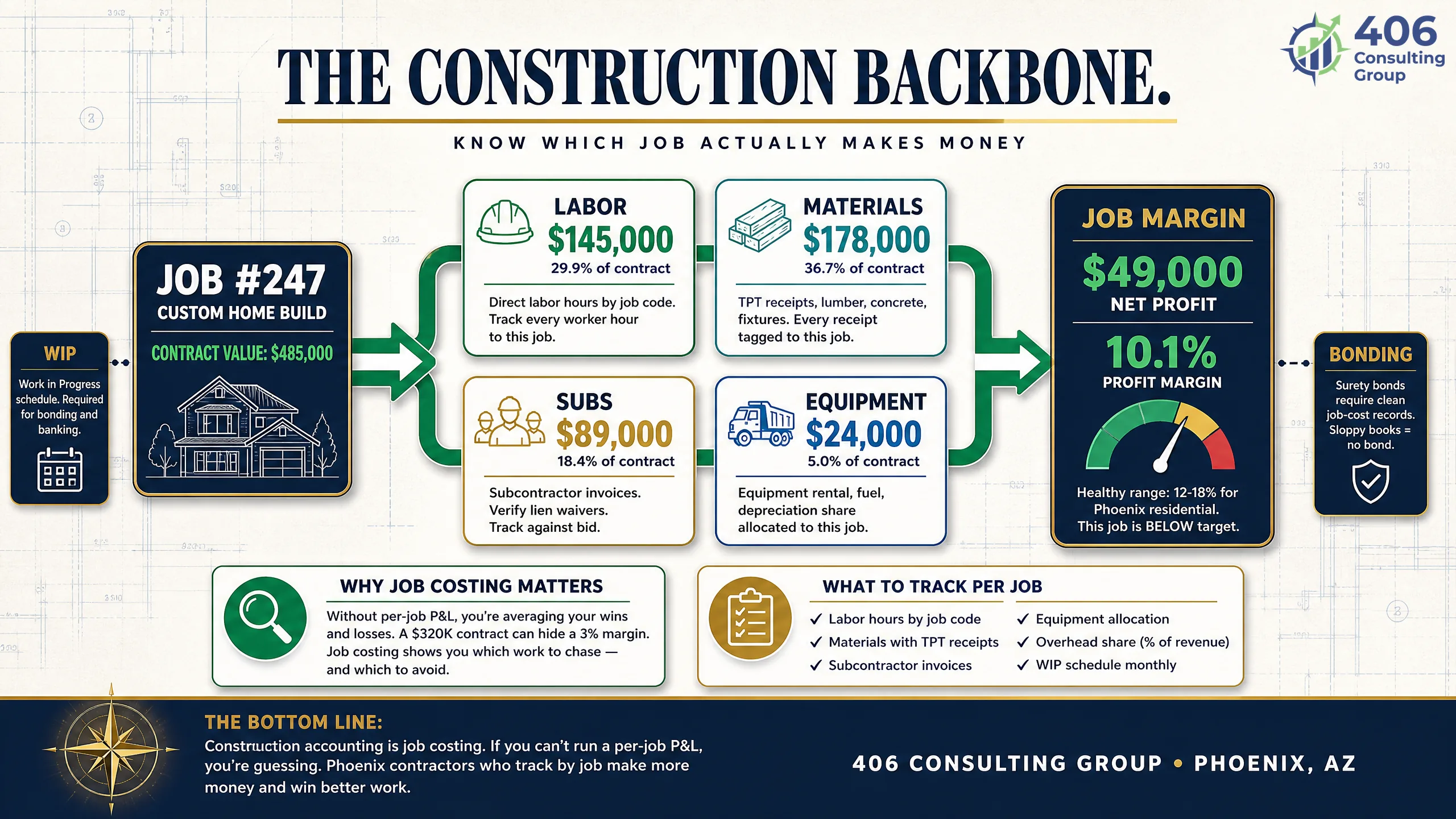
If you build in the Valley, dig into contractor unit economics — knowing which job actually makes money is the whole game.
The Growth Economy: Tech, Chips & Logistics
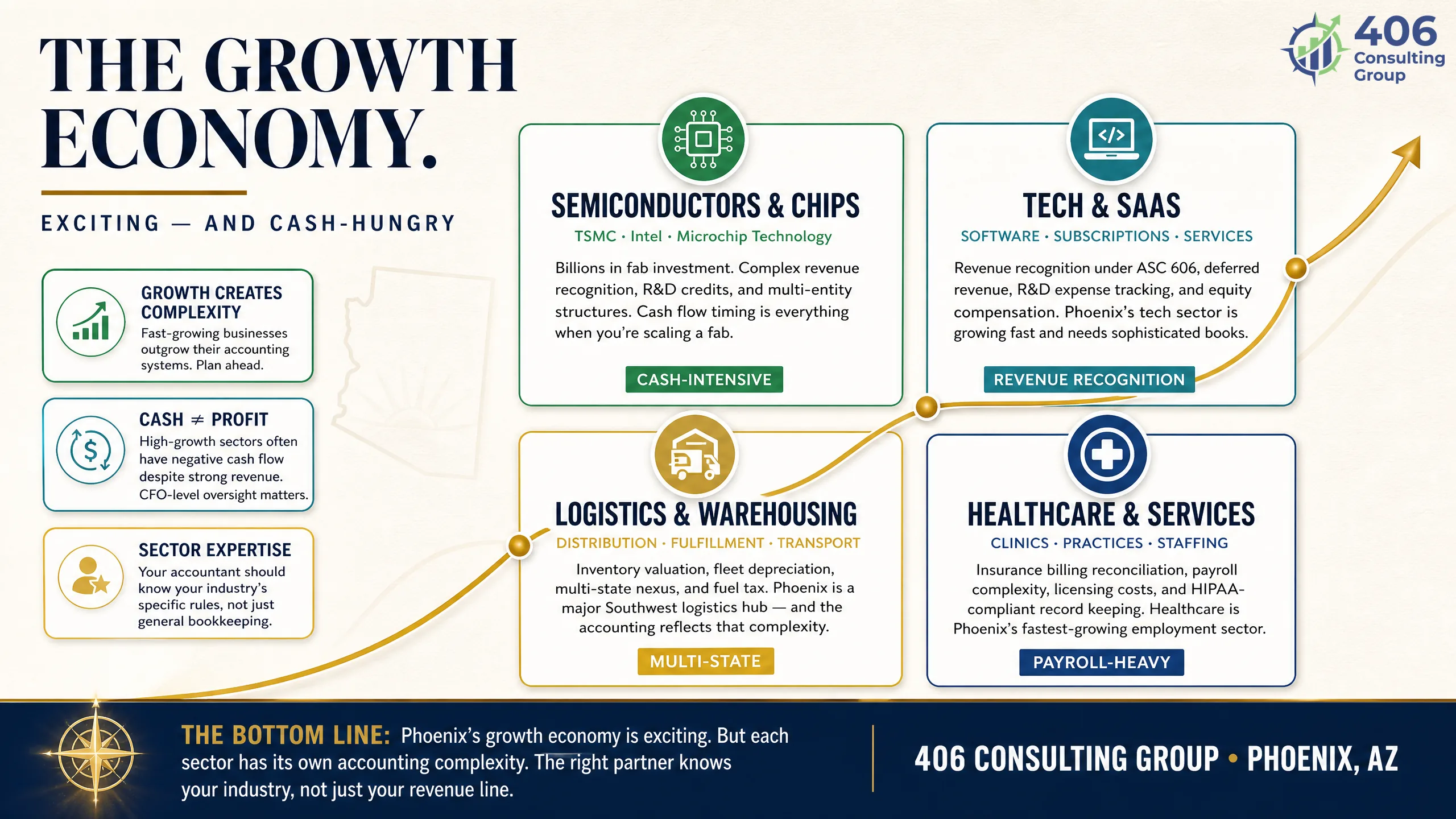
Beyond construction, Phoenix is drawing serious capital in semiconductors, tech, advanced manufacturing, and logistics — and the businesses growing around that wave have their own accounting needs: capital-asset and depreciation planning, multi-state nexus as they sell across lines, payroll for fast hiring, and the cash-flow discipline that scaling demands. Even a services or retail business riding the region's growth feels the pull on cash and systems that rapid expansion creates.
The common thread across every Phoenix segment: growth is exciting and cash-hungry, and the businesses that manage it well are the ones that see their numbers clearly and early.
Bookkeeping: The Foundation
Everything else sits on clean books. For a Phoenix business that means a chart of accounts built for Arizona — TPT tracked as a liability by classification and jurisdiction, job-costing structure for construction, and clean separation of the things Arizona taxes differently. Add monthly reconciliation, TPT filing (often monthly here), payroll, and reliable financial statements, and you have the foundation every tax and strategy decision depends on.
The full detail — the TPT setup, the contractor rules, the common mistakes — lives in our Phoenix bookkeeping guide. If your books are behind or built on a generic out-of-state template, that's the place to start.
Tax Planning: Where the Savings Are
Arizona's flat ~2.5% income tax makes the income line simple, so real tax planning happens elsewhere: the pass-through entity (PTE) election that works around the federal SALT cap, contractor TPT priced into bids, entity choice (S-corp) on a low flat rate, equipment and depreciation timing, and federal levers like the QBI deduction and quarterly estimates. The flat rate is the easy part; the planning around it is where a Phoenix business actually saves.
Our Phoenix tax-planning guide walks each move, and the S-Corp Calculator gives you a first read on whether an election pays off for you.
When You Need a CFO or Controller
As a Phoenix company grows, the financial function that worked at a couple million stops working. A controller keeps the books accurate and the close on time; a CFO adds forecasting, cash-flow planning, and capital strategy. Most companies don't need either full-time until roughly $15M+ in revenue — which is exactly why fractional exists, delivering senior expertise for a few thousand a month instead of a $200K+ salary.
The signals it's time — a slipping close, bigger jobs, growth straining cash, seeking financing or bonding — and the full cost math are in our CFO & controller guide. In a boom, this need shows up sooner than owners expect.
The Whole-Company Systems View
What sets our work apart is that we don't look at accounting in a vacuum. The numbers are downstream of everything else the business does — how sales hands off to operations, how the field reports hours, how job costing feeds billing, how billing becomes cash. Fixing the finances for real usually means improving the whole-company process that produces them, and that cross-departmental lens is how a growing company turns chaos into something that scales.
We explore the cost of skipping this in the hidden cost of no systems— the quiet price of operational chaos disguised as hustle, and why owners who feel they "can't afford" to fix it are usually the ones paying the most for it.
Choosing an Accountant: Local vs. Remote
For a Phoenix business, the thing that matters in an accountant isn't a local office — it's whether they truly understand Arizona: TPT and its classifications, the contractor rules, the PTE election, and construction finance. A generalist who doesn't know Arizona is a genuine liability here, because those are exactly the areas a generic setup gets wrong. A great remote partner who knows the state cold beats a nearby generalist every time.
And remote is simply how modern accounting works — secure cloud software, connected bank feeds, screen-shares, and a steady rhythm. The vast majority of our own local clients never come into an office; we work with Phoenix and Maricopa County businesses exactly as we do across the Mountain West. What you get is Arizona expertise delivered responsively, wherever you are in the Valley.

Expertise is the variable that matters. Distance isn't.
A Roadmap by Stage
Where you focus depends on where you are. A rough Phoenix roadmap:
Get the structure right
Choose an entity, register for TPT under the correct classifications, and set up Arizona-ready books from day one.
Tighten books & tax planning
Monthly close and TPT filing on rhythm, plus the PTE election, S-corp analysis, and depreciation planning.
Add job costing & a forward view
Job-level margin, cash-flow forecasting, and a controller function as the close and the decisions get bigger.
Bring in CFO-level strategy
WIP and bonding readiness, capital strategy, and whole-company systems to grow on purpose, not on luck.

Not sure where you land? Our Financial Maturity Assessment maps it in about eight minutes and points to what to build next.
FAQ: Phoenix Small-Business Accounting
What makes accounting in Phoenix different from other cities?
Mostly Arizona's tax system. Instead of a normal sales tax, Arizona has the Transaction Privilege Tax (TPT) — legally a tax on the seller, organized by business classification, with cities layering their own on top — and its contractor rules (prime contracting vs. MRRA) are among the most complex in the country. On top of that, Phoenix's fast growth means job costing, cash-flow forecasting, and systems matter earlier than in a slower market. The income tax itself is simple (a low flat rate around 2.5%), so the complexity — and the planning opportunity — is concentrated in TPT, the contractor rules, and scaling.
What taxes does a Phoenix small business pay?
A low flat state income tax (around 2.5% — confirm current), the Transaction Privilege Tax (TPT) that works like a sales tax at roughly 8.6% combined in Phoenix and is organized by classification, and a companion use tax; there's no separate gross-receipts or B&O tax because TPT fills that role. Pass-through owners can also make the PTE election to pay state tax at the entity level as a federal SALT-cap workaround. You'll also handle federal income tax and payroll, Arizona unemployment insurance, and workers' compensation. Confirm specifics with the Arizona Department of Revenue.
Do I need a local Phoenix accountant?
What you need is an accountant who knows Arizona — TPT and its classifications, the contractor rules, the PTE election, and construction finance — far more than one with a local office. A generalist who doesn't know Arizona is actually a liability, since those are the areas a generic setup gets wrong. Modern accounting runs on secure cloud software, bank feeds, and screen-shares, so a great remote partner who knows the state cold serves you better than a nearby generalist. We work with Phoenix and Maricopa County businesses entirely remotely.
When should a growing Phoenix business get bookkeeping, tax, or CFO help?
Roughly by stage: get bookkeeping and entity/TPT structure right from the start; layer in real tax planning (PTE election, S-corp analysis, depreciation) once you're established and profitable; add job costing and cash-flow forecasting as you grow fast; and bring in a fractional controller or CFO as the close slips, jobs get bigger, or you seek financing or bonding — usually well before the ~$15M revenue point where a full-time hire makes sense. Our Financial Maturity Assessment helps you place yourself and prioritize.
Can 406 Consulting Group handle all of this remotely?
Yes — bookkeeping, tax planning, and CFO/controller work, all delivered remotely to Phoenix and Maricopa County businesses through secure cloud accounting and regular strategy conversations. What matters for an Arizona business is expertise in TPT, the contractor rules, and construction finance, not office proximity, and our commercial-banking background means we also prepare your financials the way lenders and sureties actually read them. Most of our own local clients never come into an office either.
The Phoenix Playbook — Full Series
Accounting — Phoenix, AZ
The Maricopa County Playbook, Handled.
406 Consulting Group gives Phoenix businesses the whole stack — Arizona-ready bookkeeping, tax planning, and fractional CFO & controller work — delivered remotely, by a firm that knows TPT, construction, and banking.
Phoenix Accounting Quick Reference
Phoenix, AZ — Maricopa County
The Whole Stack, One Firm
Bookkeeping, tax & CFO — Arizona-savvy, remote.
About the Author
Jason Anderson
Co-Founder, 406 Consulting Group
Big-firm-trained accountant advising construction, trades, and growth companies across the Mountain West and Southwest. Jason helps Phoenix owners get TPT and the contractor rules right, plan tax around what actually moves the number, and build a financial function that scales with the boom.
Read the Full Story