
Tax Services in Tampa, FL:
No Income Tax Means Plan Federal
Florida has no personal income tax — so your real leverage is federal: the S-corp election, depreciation, retirement, and relocation cleanup. Plus the C-corp tax and Florida's own taxes most owners forget. The planning that moves the needle, delivered remotely.
People move businesses to Tampa partly for the weather and partly for four words: no state income tax. That's real — and it convinces owners there's no tax planning to do. The opposite is true. When Florida stops taxing your personal income, all of the leverage moves to your federalreturn, and Florida quietly keeps a few taxes of its own: a corporate income tax on one entity type, a county surtax, and transfer taxes on real estate. For the many companies relocating in from the higher-tax Northeast, there's also a cleanup project in the state they left. Plenty to plan around — just not where owners expect to look.
This guide walks the moves that actually cut a Tampa business's tax bill — the entity decision, the federal levers, Florida's own taxes, and the relocation cleanup — delivered remotely.
By Carrie Anderson — Co-Founder, 406 Consulting Group. Former commercial banker and multi-state advisor who helps Tampa owners plan proactively — federal strategy, entity choice, and the multi-state cleanup relocating companies need — with the whole financial picture in view.
Quick Answer: Tax Planning for a Tampa Business
- →With no personal income tax, your real tax leverage is federal — entity choice, depreciation, retirement, timing.
- →Florida taxes C-corporations at 5.5% — so being a C-corp is a real state-tax decision here; pass-throughs avoid it.
- →The S-corp election is a purely federal play in Florida — no state layer to complicate the SE-tax math.
- →Relocating from the Northeast? The biggest dollars are often in cleaning up nexus and filings in the state you left.
- →Planning is remote — and about 80% of our local clients run it entirely that way.
Table of Contents
No Income Tax Doesn't Mean No Planning
Here's the mental shift a Tampa owner has to make. In a state with an income tax, a lot of planning is about trimming the state bill. In Florida, there's no personal income tax — so every dollar of that leverage moves to the federal side. That's actually good news: the federal levers are the biggest ones anyway (entity choice, depreciation, retirement plans, timing), and they aren't muddied by a state income tax layer. The mistake is treating "no income tax" as "nothing to plan" and coasting into April, leaving the federal savings on the table — and overlooking the state taxes Florida does charge.
No personal income tax doesn't remove the planning — it concentrates it on the federal return, where the biggest levers live anyway.

Before the federal levers, though, there's one Florida decision that catches transplants off guard.
The C-Corp Trap in a No-Income-Tax State
"Florida has no income tax" is true for people and mostly true for businesses — with one exception that matters. Florida imposes a 5.5% corporate income tax on C-corporations. Sole proprietors, partnerships, and S-corporations generally owe no Florida income tax, but a business organized as a C-corp does, on top of the federal corporate tax. For an owner who relocated a C-corp to Florida expecting zero state tax, that's an unwelcome surprise — and for many small businesses it's a reason the pass-through structures (or an S-corp election) are the better fit. The entity choice, in other words, is a genuine Florida tax decision, not just a federal one.

Which points straight at the federal move most profitable owners should run.
The S-Corp Election Is Pure Federal Here
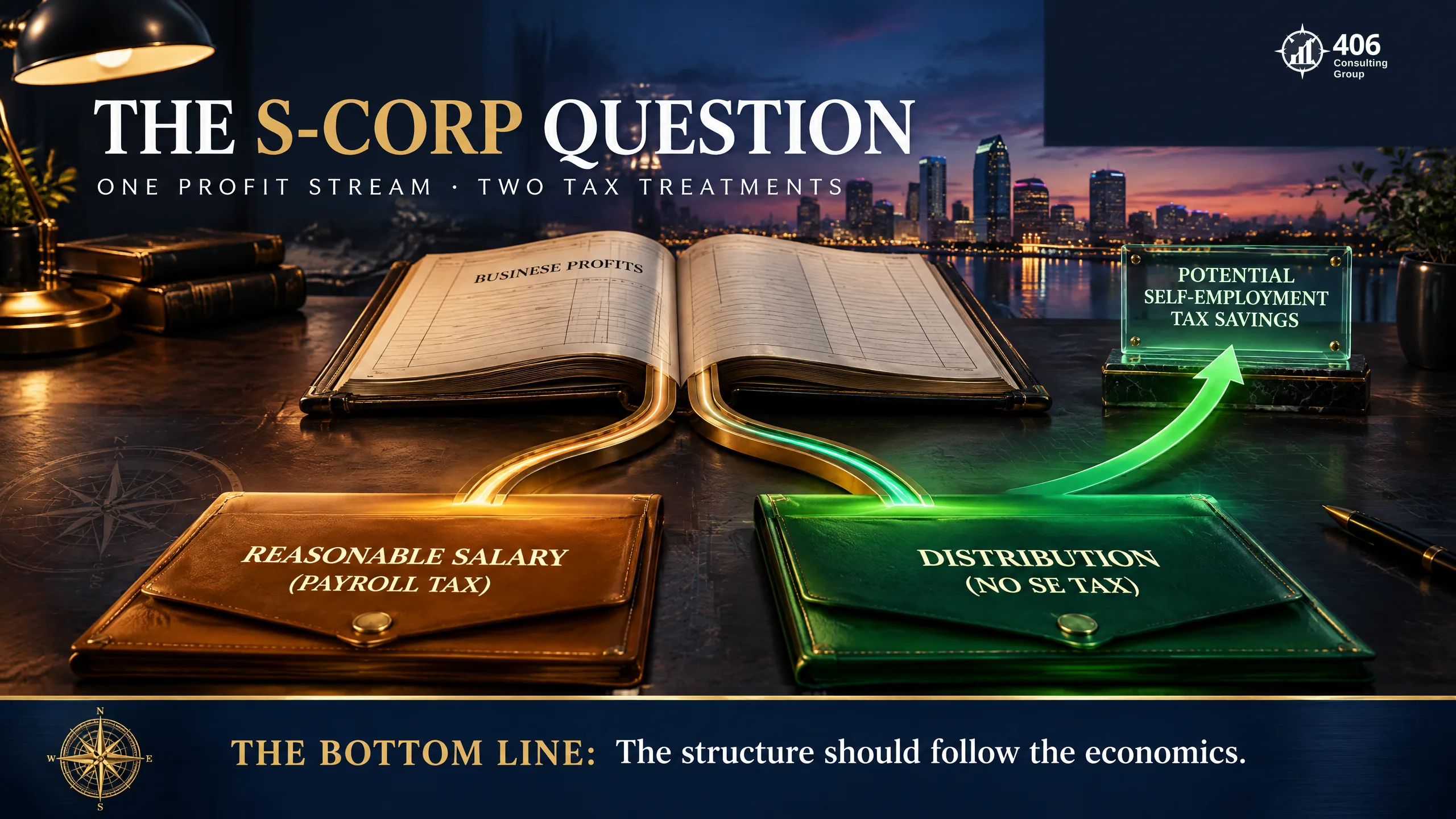
In many states, deciding whether to elect S-corp status means weighing federal savings against a state-level cost — a franchise tax, a net-worth tax, an extra state levy. In Florida, with no personal income tax and no state tax on the S-corp itself, the election is a clean federal play. Once profit consistently clears roughly $80,000–$100,000, electing lets you split profit into a reasonable salary and distributions, and the distributions escape the ~15.3% self-employment tax — often several thousand dollars a year, with no state offset eating into it. It's one of the simpler, cleaner wins available to a profitable Tampa owner.
See what the S-corp election would save you.
Because it's purely federal in Florida, the math is clean. Run your numbers with our free calculator, then read the full decision guide.
For the many businesses that arrive in Tampa from elsewhere, the biggest tax dollars are often somewhere else entirely.
Relocating to Florida? The Multi-State Cleanup
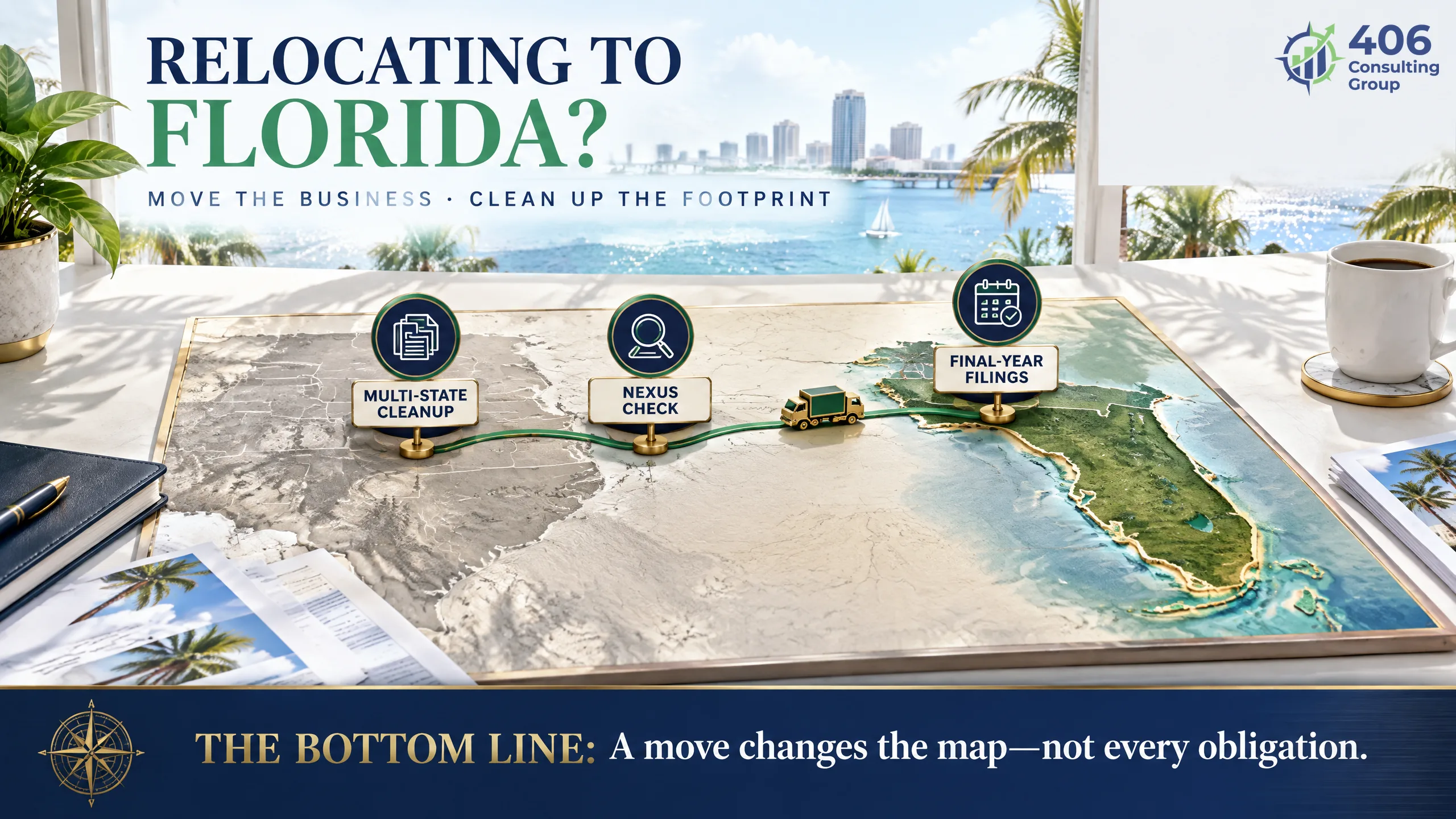
Tampa is a landing pad for companies and owners leaving the higher-tax Northeast, and the move creates a tax project most underestimate. Relocating doesn't automatically end your obligations in the state you left: if you still have employees, property, or enough sales there — or if you personally keep ties like a home or too many days there — you can retain nexus or even residency, and the filing (and tax) that come with them. High-tax states are known to challenge departures. Done wrong, you get taxed in two states at once; done right, you cleanly establish Florida residency, de-register the business where appropriate, and shut the door. For a relocating business or owner, that cleanup is frequently where the biggest dollars and risks sit.
Once you're settled in Florida, don't assume the state has no taxes to watch — it has a few specific ones.
Florida's Other Taxes People Forget
Beyond the C-corp tax, Florida funds itself with transaction and consumption taxes that catch newcomers:
Sales tax + county surtax
State 6% plus a discretionary county surtax — around 7.5% in Hillsborough County — with use tax owed on untaxed out-of-state purchases.
Documentary stamp tax
A tax on deeds and on written obligations like promissory notes — it surfaces on real estate deals and some financing, which matters in a property-heavy market.
Reemployment tax
Florida's unemployment tax on payroll (Form RT-6) — no state income-tax withholding, but this filing is real.
Tourist / bed taxes
Hospitality and short-term rental businesses collect local tourist development taxes on top of sales tax — easy to mis-handle.

Confirm specifics with the Florida Department of Revenue. With the state side handled, the recurring savings live on the federal side.
The Federal Levers That Move the Needle
With no personal income tax, these are where a Tampa owner's planning pays off:
Depreciation timing
Bonus depreciation and Section 179 accelerate write-offs on equipment and vehicles — powerful for capital-heavy Tampa trades, logistics, and medical businesses.
Retirement plans
A solo 401(k), SEP, or defined-benefit plan can shelter large amounts of income — often the single biggest federal lever for a profitable owner.
Entity & compensation
The S-corp election and a reasonable-salary strategy, tuned to your profit — clean in Florida with no state layer (unless you're a C-corp).
Income & expense timing
Accelerating or deferring income and deductions across a year-end to land in the lower-tax federal year.

None of these levers — federal planning, the entity decision, the relocation cleanup — require a face-to-face meeting.
Proactive Planning, Delivered Remotely
Tax planning is analysis and conversation — secure document exchange, screen-shares, and a plan made before year-end — none of which needs a Tampa address. The proof is in how our existing clients already work: roughly 80% of our local clients run the entire relationship remotelyand never set foot in the office. What matters for a Florida business is an advisor who knows the federal levers, the C-corp nuance, Florida's own taxes, and multi-state cleanup — and who is proactive all year, not one who happens to be nearby.
~80%
of our local clients are fully remote
Distance to Tampa isn't the point — expertise and a year-round plan are.
No income tax is a gift. Turning the federal side into money you keep is the work.
FAQ: Tampa Tax Questions
If Florida has no income tax, is there any tax planning to do?
Yes — arguably more focused planning, not less. With no personal income tax, all of your tax leverage moves to the federal return, where the biggest levers live anyway: the entity election, depreciation timing (bonus depreciation and Section 179), retirement plans, and income/expense timing. Florida also keeps a few taxes of its own — a 5.5% corporate income tax on C-corporations, sales tax plus a county surtax, documentary stamp tax, and reemployment tax on payroll. Treating 'no income tax' as 'nothing to plan' is the costly mistake; it just means the savings are federal, and they still require a proactive, year-round plan.
Does Florida really tax C-corporations?
Yes. Florida has no personal income tax, but it imposes a 5.5% corporate income tax on C-corporations. Sole proprietors, partnerships, and S-corporations generally owe no Florida income tax, so the exposure depends entirely on how your business is organized. For an owner who relocated a C-corp to Florida expecting zero state tax, this is an unwelcome surprise, and it's often a reason a pass-through structure or an S-corp election is the better fit. Because it turns on entity type, it's worth reviewing your structure with a professional and confirming with the Florida Department of Revenue.
I'm moving my business to Tampa from the Northeast — what tax cleanup do I need?
More than most owners expect. Relocating to Florida doesn't automatically end your obligations in the state you left. If your business keeps employees, property, or enough sales there — or if you personally retain ties like a home or spend too many days there — you can keep nexus or even residency, and get taxed in two states at once if it's handled poorly. High-tax states are known to challenge departures. A proper move includes cleanly establishing Florida residency, de-registering the business where appropriate, apportioning final-year income correctly, and documenting the change. For a relocating business or owner, this multi-state cleanup is frequently where the biggest tax dollars and risks sit.
What state taxes does a Tampa business actually pay?
No personal income tax — but several others. A C-corporation pays 5.5% Florida corporate income tax; all businesses collect and remit sales tax (6% state plus a discretionary county surtax, around 7.5% in Hillsborough County) and owe use tax on untaxed out-of-state purchases; payroll carries reemployment tax (Form RT-6); real estate and certain financing trigger documentary stamp tax; and hospitality or short-term-rental businesses collect local tourist development taxes. It's a genuinely light tax environment, but 'light' isn't 'none,' and the specific taxes reward someone who plans for them. Confirm current rates with the Florida Department of Revenue.
Can 406 Consulting Group handle my Tampa taxes remotely?
Yes — we provide proactive federal and Florida tax planning and preparation for Tampa and Florida businesses entirely remotely. What matters for a Florida business is expertise in the federal levers, the C-corp decision, Florida's own taxes (surtax, documentary stamp, reemployment), and multi-state cleanup for relocating companies — not office proximity. Around 80% of our own local clients already run the entire relationship remotely, and our commercial-banking and multi-state background means we plan taxes with your whole financial picture in view.
Florida Tax Levers
Where the savings live
Tampa Tax Planning
Federal-first, Florida-smart, remote.
About the Author
Carrie Anderson
Co-Founder, 406 Consulting Group
A former commercial banker and multi-state advisor, Carrie helps Tampa owners plan proactively — federal strategy, the entity decision, Florida's own taxes, and the multi-state cleanup relocating companies need — with the whole financial picture in view.
Read the Full Story