
CFO & Controller Services in Tampa, FL:
Grow on Purpose, Not by Accident
When growth outruns the books, you need a controller to make the numbers reliable and a CFO to turn them into strategy — a forecast built for Florida's seasons and storms, and financials that fund growth. Big-company firepower, delivered fractionally and remotely — the way 80% of our local clients already work.
Tampa is where businesses come to scale, and scaling has a way of outrunning the books. There's a point in a growing company's life where the monthly numbers show up late, don't quite reconcile, and can't answer the questions that now matter: which work is actually profitable, can we fund the next hire, can we cover the season and the storm, are we ready to borrow? That's no longer a bookkeeping problem. It's the moment a business needs a controller to make the numbers reliable and a CFOto turn them into strategy — the financial firepower that lets a company grow on purpose in one of the fastest-growing metros in the country.
This guide explains what those roles really do, where they fit on the path from chaos to strategy, and how a Tampa business gets that firepower fractionally— the controller-and-CFO thinking without a six-figure hire — delivered remotely.
By Jason Anderson — Co-Founder, 406 Consulting Group. Big-firm-trained accountant who builds the controller and CFO function for growing companies — reliable numbers, forecasting, and the financials that fund growth — designed from a whole-company view.
Quick Answer: CFO & Controller for a Tampa Business
- →A bookkeeper records history; a controller makes it reliable and on time; a CFO turns it into forward strategy.
- →You need them when growth outruns the books — late closes, no job-level profit, borrowing decisions.
- →In Florida, a CFO's forecast has to plan for seasonality and storm/insurance shocks, not just a straight-line year.
- →Fractional gets you the thinking without a $150K–$250K hire — usually well before a full-time role makes sense.
- →Remote by design — and about 80% of our local clients run it entirely that way.
Table of Contents
When Tampa Growth Outruns the Books
Growth is supposed to feel like winning, and often it feels like drowning instead. The signs are consistent: the monthly close slips later and later, you're making bigger decisions on gut instead of numbers, you can't say which jobs or clients actually make money, and when a lender asks for financials you scramble. None of that means the business is failing — it means it has outgrown the financial function that got it here. In a metro where the competition is well-capitalized and moving fast, that gap is where good companies stall.
Fast growth is where companies most often lose money — because volume hides thin margins until the cash runs short. Scaling without a real financial function is just scaling the risk.
Getting there starts with understanding three roles most owners blur into one.
Bookkeeper vs. Controller vs. CFO
These three roles get lumped together, but they do different jobs — and knowing which one you're missing is half the battle.
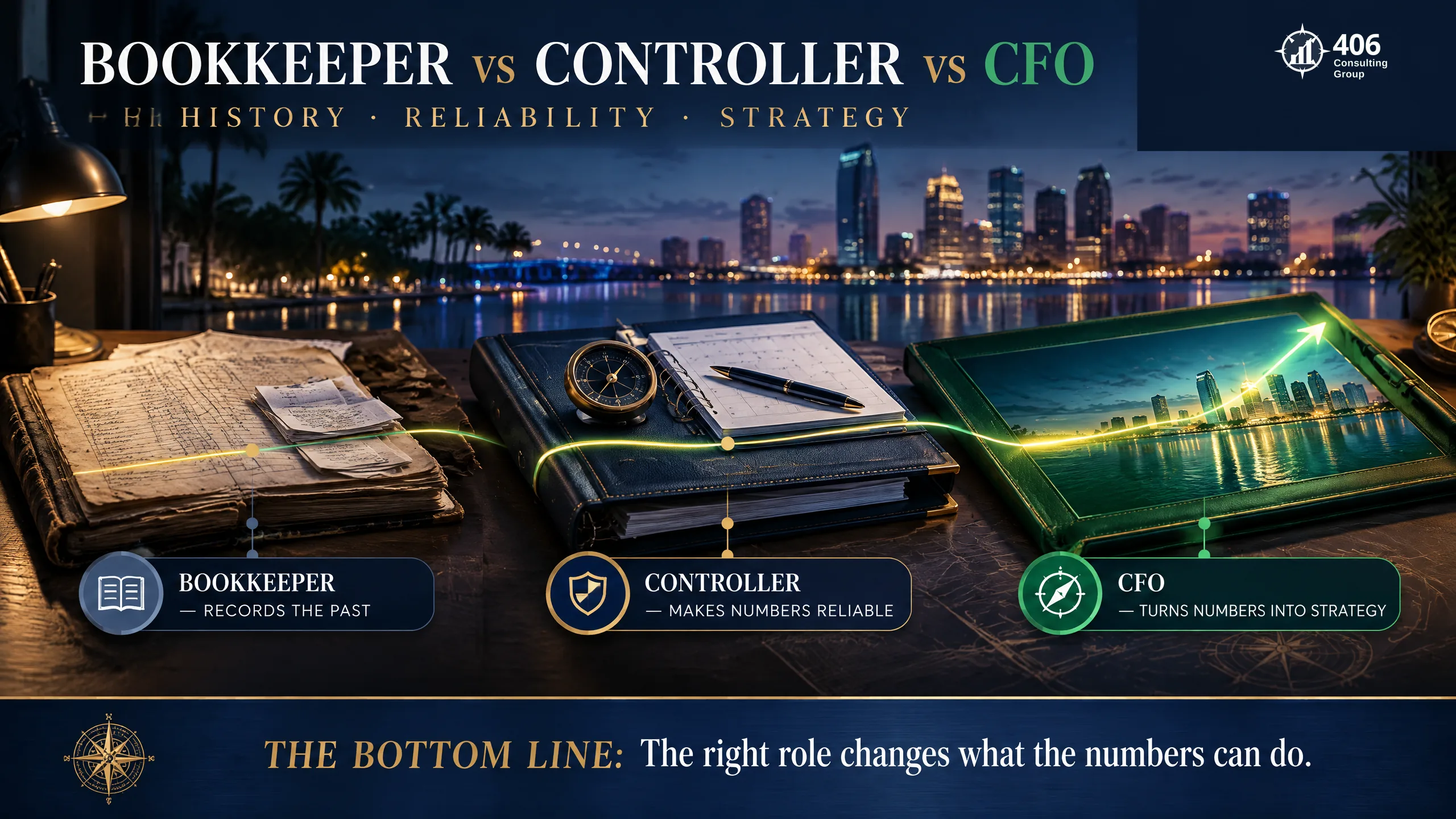
Bookkeeper
Records what happened — transactions, reconciliations, categorized and clean. The foundation, looking backward.
Controller
Makes the numbers reliable and on time — a real monthly close, job costing, and reporting you can trust.
CFO
Turns reliable numbers into forward strategy — forecasting, pricing, margins, capital, and growth decisions.
Those roles aren't random — they map to a clear progression a business climbs as it matures.
The Financial Maturity Ladder
We think about this as a ladder with four rungs. Chaos: books are behind and reactive, and you're flying blind. Compliance: clean and current, but only looking backward — fine for filing, not for decisions or a lender. Control: reliable, timely numbers you can actually run the business on — the controller's rung. Strategy: finance becomes a forward tool for growth, pricing, and capital — the CFO's rung. Most Tampa businesses that feel stuck are sitting at Compliance, trying to make fast-growth decisions with backward-looking books.

Our Financial Maturity Ladderarticle walks the whole framework. Climbing from Compliance to Control is a controller's job — so let's look at what that involves.
What a Controller Actually Does
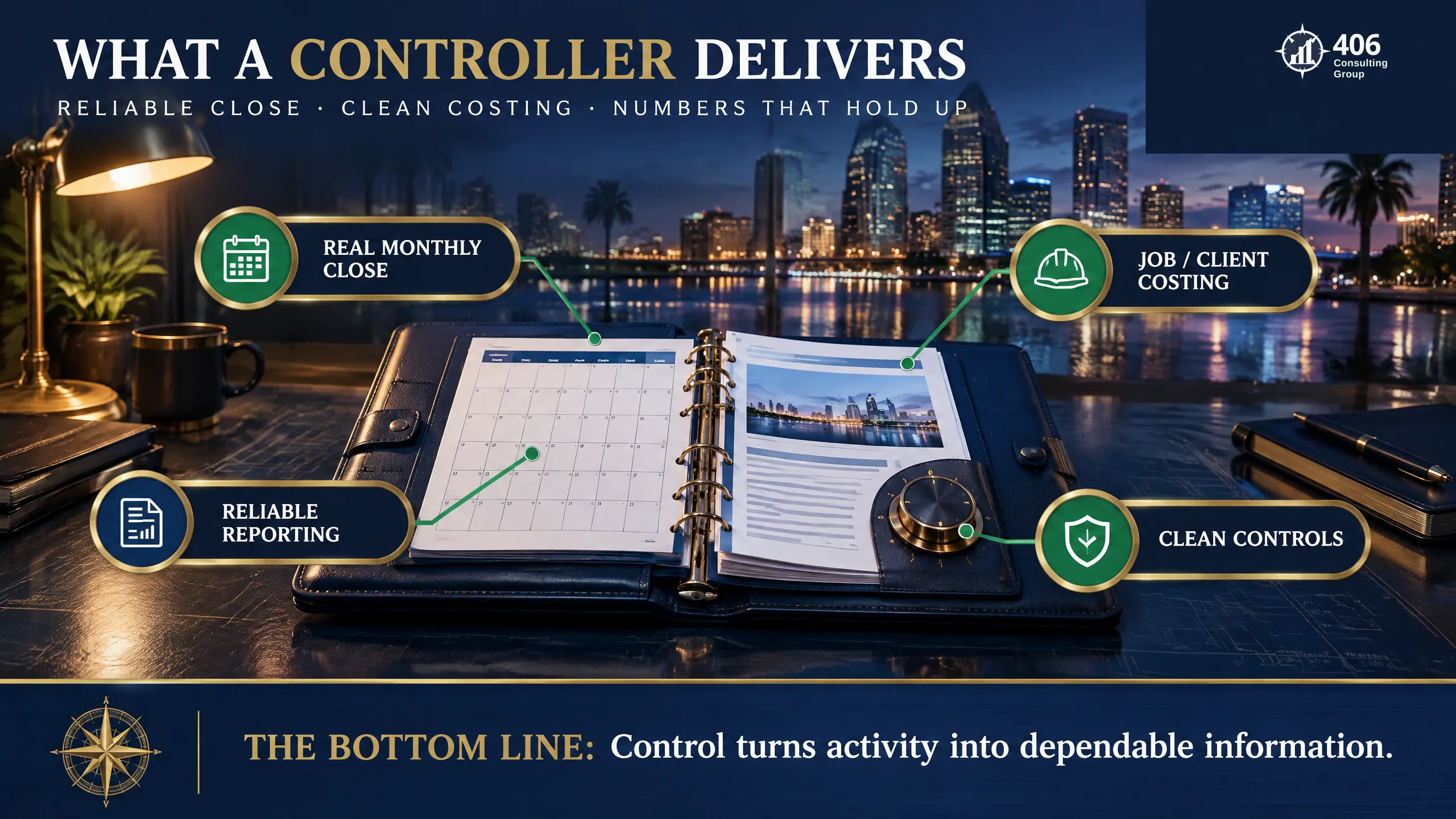
A controller takes your books from "eventually accurate" to reliable and on time: a real monthly close that lands on a predictable date, numbers that reconcile and hold their story, and reporting built for decisions rather than just filing. For Tampa's many project and construction businesses, it means proper job costingand a WIP schedule so you know true margin by project. The controller is who makes the number you look at trustworthy — and you can't make a good strategic decision, or pass a lender's review, on numbers you don't trust.
Once the numbers are reliable, the CFO can do the work that changes the trajectory of the business.
What a Fractional CFO Actually Does
Where a controller makes the numbers reliable, a CFO makes them useful for the future: cash-flow forecasting so you see the tight months before they arrive, pricing and margin analysis so you know which work and clients to chase, capital strategyfor financing growth or an acquisition, and the modeling behind big decisions. In a growth market like Tampa, a CFO is the person who turns good performance into a fundable plan — the difference between wanting to scale and being able to afford it.

In Florida specifically, one CFO deliverable does double duty — it plans your growth and your resilience.
Forecasting for Seasons and Storms
The single most valuable thing a CFO builds is a cash-flow forecast — a rolling, forward view of the money coming in and going out. In Florida it earns its keep twice over. First, seasonality: tourism-exposed businesses see revenue swing hard across the year, and a forecast turns those swings from a scramble into a plan. Second, storm and insurance shock: hurricane season, spiking property-insurance premiums, and the possibility of a slow month after a storm all mean a Tampa business needs a cash cushion sized on purpose, not by luck. A CFO's forecast is how you fund growth andkeep a reserve for the season the weather doesn't cooperate.
A profitable business can still run out of cash — and in Florida, a season or a storm can force the issue. A forecast is how you see it coming and hold the reserve to ride it out.

We go deep on the cash side in Profitable On Paper, Broke in the Bank. Forecasting also connects straight to funding your growth.
Fueling Growth in a Boom Metro
Tampa is a growing business and banking center, which means the capital to fund your next phase is within reach — but only to businesses whose numbers can earn it. A bank, an SBA lender, a bonding company, or an investor reads your financials to decide whether to back you, and each reads them a particular way. Clean, credible, well-presented numbers, plus a forecast that shows you can service the debt, are the difference between a confident yes and a slow no. Because of our commercial-banking background, we prepare your financials the way lenders actually read them — we've sat on their side of the table — so your growth plan is one a lender competes to fund.

The full story on reading the money people around you is in Whose Side Is Your Banker Really On? The natural question is whether a growing business can afford this kind of leadership.
Fractional vs. Full-Time: The Economics
A full-time controller runs well into six figures, and an experienced CFO can cost $200,000 or more with benefits — real money most growing Tampa businesses can't justify, and often don't yet need full-time. Fractionalsolves it: you get the controller and CFO expertise at the level your business actually needs, for a fraction of the cost of the hires, scaling up as you grow. It's how a company doing a few million in revenue gets the financial leadership of a much larger one — usually well before a full-time hire makes sense.
Full-time hire
A controller plus a CFO can run $300K+ all-in with benefits — before you're big enough to keep them busy.
Fractional
The same expertise at the level you need, for a fraction of the cost — scaling up only as the business does.

And because it's fractional and remote, where you're located stops mattering at all.
Remote by Default — Even for Locals
A fractional controller or CFO is delivered remotely by design — the work is analysis, forecasting, and strategy conversations, all of which happen over shared screens and regular calls on live cloud data. If that sounds like a compromise, consider how our own clients work: around 80% of our local clients run the entire relationship remotelyand never come into the office. What matters is the expertise and the whole-company view — plus knowing how lenders read financials — not an in-town office. Getting started is simple: a look at where you stand on the ladder, and a plan to climb the next rung.
Ready to scale on purpose?
Let's make your numbers reliable, build the forecast — for the season and the storm — and turn finance into a tool for growth and funding, fractionally, at the level your Tampa business actually needs.
For the full Tampa picture — bookkeeping, tax, and the small-business overview — see the rest of our Tampa accounting series.
FAQ: Tampa CFO & Controller Services
What's the difference between a bookkeeper, a controller, and a CFO?
A bookkeeper records what happened — transactions, reconciliations, clean categorized books looking backward. A controller makes those numbers reliable and on time: a real monthly close, job costing, and reporting you can trust to make decisions. A CFO turns reliable numbers into forward strategy — cash-flow forecasting, pricing and margin analysis, capital strategy, and the modeling behind big decisions. Most growing Tampa businesses have a bookkeeper and are missing the controller and CFO layers, which is why they feel like they're flying blind — and why they aren't ready when a growth or financing opportunity appears.
When does a Tampa business need a controller or CFO?
When growth has outrun the books. The classic signs: the monthly close keeps slipping, you're making big decisions on gut instead of numbers, you can't say which jobs or clients are actually profitable, and you scramble when a lender asks for financials. That usually starts well before a business can justify a full-time hire — which is why most companies bring in a fractional controller first (to make the numbers reliable) and add fractional CFO strategy as the decisions get bigger, often long before the roughly $10M+ revenue point where full-time roles start to make sense.
How does a CFO help a Florida business handle seasonality and hurricanes?
Through a cash-flow forecast built for Florida's realities rather than a straight-line year. For tourism-exposed businesses, revenue swings hard by season, and a rolling forecast turns those swings into a plan — funding the slow months from the strong ones on purpose. For storm and insurance risk, a CFO sizes a cash reserve deliberately, models the impact of a slow month after a hurricane, and plans for the reality that Florida property-insurance premiums are large and volatile. The goal is to fund growth while keeping enough resilience that a season or a storm doesn't become a crisis.
What is a fractional CFO and how much does it cost?
A fractional CFO is an experienced CFO who works with your business part-time, giving you senior financial leadership at the level you actually need without a full-time salary. A full-time controller plus CFO can run $300,000 or more all-in with benefits; fractional delivers the same expertise for a fraction of that, scaling up as you grow. The exact cost depends on scope — a monthly controller close is different from active CFO forecasting and capital work — but the whole point is getting big-company financial firepower at a small-company price, delivered remotely.
Can 406 Consulting Group provide CFO and controller services remotely?
Yes — fractional controller and CFO work is delivered remotely by design, because it's analysis, forecasting, and strategy conversations over shared screens and regular calls on live cloud data. In fact, about 80% of our own local clients run the whole relationship remotely and never come into the office. We serve Tampa and Florida businesses this way, our commercial-banking background means we prepare your financials the way lenders read them, and we design your financial systems from a whole-company, cross-departmental view so the numbers connect to how the business really runs.
The Four Rungs
Where does your business stand?
Tampa CFO & Controller
Fractional, remote, growth-ready.
About the Author
Jason Anderson
Co-Founder, 406 Consulting Group
Jason builds the controller and CFO function for growing companies — reliable numbers, forecasting for seasons and storms, and the financials that fund growth — delivered fractionally and remotely.
Read the Full Story