
Trades & Construction Accounting in Missoula, MT:
Build Western Montana on Books You Can Trust
No sales tax and no GC license — but registration, ICECs, and the Montana and federal prevailing wage that public, campus, and healthcare work demand. The accounting a Missoula contractor really needs, from a Montana firm.

Missoula builds on a broad base. The University of Montana anchors a steady flow of campus and student-housing work; two hospital systems make healthcare one of the region's biggest and most consistent construction drivers; Missoula's role as western Montana's commercial and government hub — including a large federal footprint led by the U.S. Forest Service's Northern Region headquarters — keeps institutional and public work moving; and the Bitterroot Valley to the south, from Lolo to Hamilton, keeps demanding new housing. For the trades chasing all of it, the pipeline is wide and varied. What makes the accounting its own puzzle is Montana's particular setup, which looks nothing like the sales-tax states around it.
Three Montana rules shape the books. There's no state sales tax, so the "consumer of your materials" question that dominates an Idaho or Washington job never comes up. Montana issues no general-contractor license — it runs on contractor registration and Independent Contractor Exemption Certificates, while licensing electricians and plumbers at the state level. And Montana has its own prevailing-wage law, which — given how much public, campus, and healthcare work moves through Missoula — puts certified payroll front and center. Add job costing, WIP, and equipment, and construction books here are a discipline of their own. This guide walks all of it, delivered by a Montana firm.
By Jason Anderson — Co-Founder, 406 Consulting Group. A Montana firm with a commercial banking and underwriting background, serving contractors and trades across the state, from job costing and WIP to the Montana rules that decide whether a bid holds its margin.
Quick Answer: Accounting for a Missoula Contractor
- →No state sales tax in Montana — no sales/use tax on your materials and no consumer-vs-retailer question to work out.
- →No GC license — contractor registration with the Dept. of Labor & Industry, or an ICEC with no employees; electricians and plumbers are state-licensed.
- →Prevailing wage matters here — Missoula's campus, healthcare, and public work means Montana Little Davis-Bacon and federal Davis-Bacon certified payroll come up often.
- →State income tax (top rate ~5.9%, verify), workers' comp (State Fund or private), and a business-equipment tax with a sizable exemption round out the frame.
- →Delivered by a Montana firm — statewide and fluent in the rules Missoula builders work under.
Table of Contents
Why Construction Accounting Is Its Own Discipline
Standard bookkeeping falls short for a contractor, and the reasons pile up fast. Revenue comes in as draws on jobs that last months; costs split across labor, materials, subs, and equipment that each have to attach to the right project; owners hold retainage until the end; change orders keep shifting the number; and one thin bid can erase the profit from several good ones. Books that only categorize the bank feed and reconcile at tax time can't tell a Missoula builder the two things that matter most: is this job beating its estimate, and is the company as a whole actually making money?
Missoula sharpens that in its own way. A market split across university, healthcare, public, and Bitterroot residential work means very different job types under one roof — an institutional build with certified-payroll requirements runs nothing like a spec house in Lolo — and each carries its own accounting demands. When you're moving among them, weak books get expensive quickly. Getting the accounting, the registration, and Montana's tax and wage rules right is what lets a Missoula contractor grow across that range of work instead of getting tangled in it.
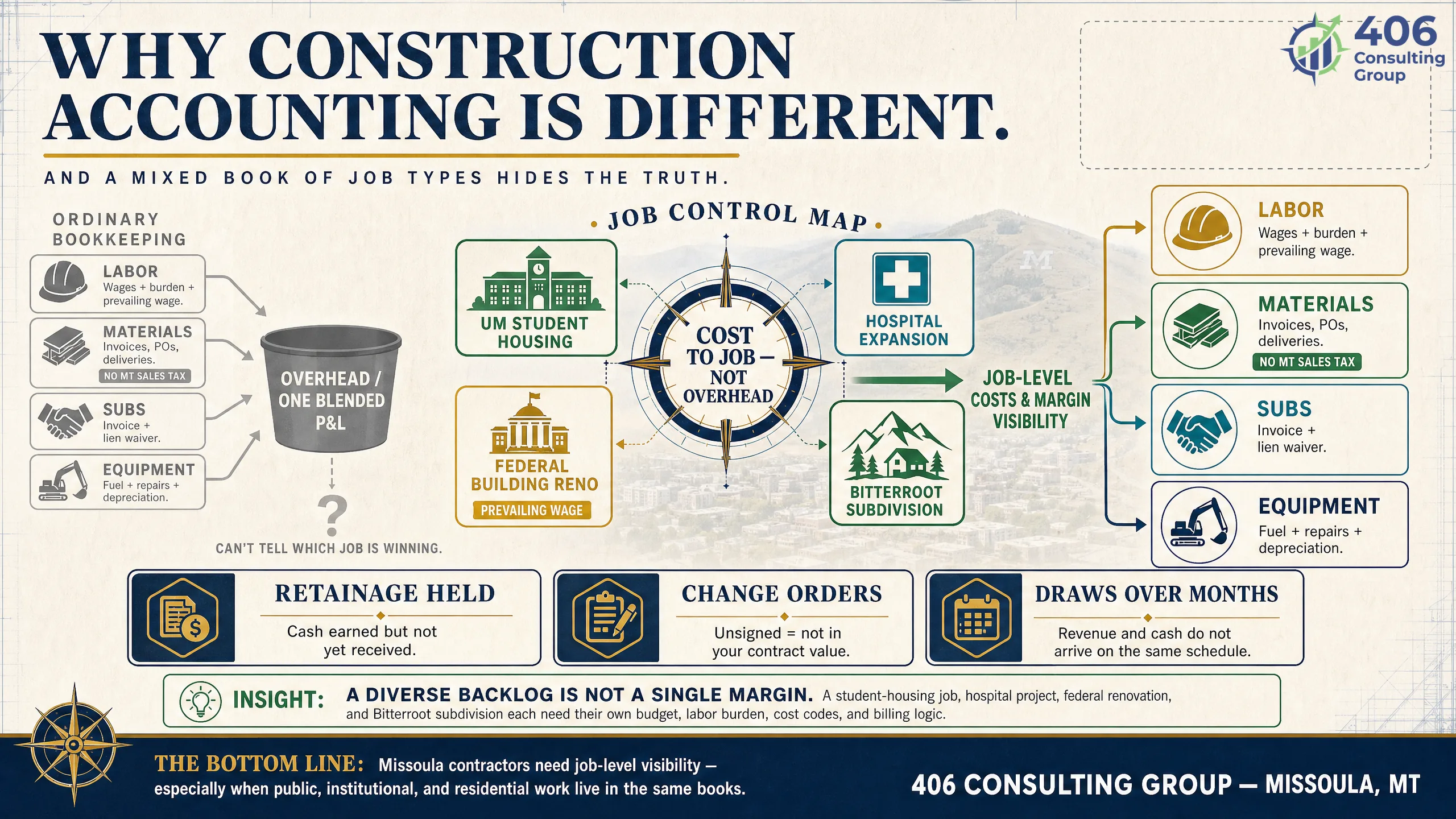
It starts with Montana's tax and registration frame — lighter than the sales-tax states in some ways, and, on prevailing wage, stricter than you'd expect.
The Montana Contractor Tax & Registration Picture
Montana breaks the Western pattern: no sales tax, no contractor license, yet a prevailing-wage law of its own. For a Missoula contractor, the frame looks like this:
| Item | What it means for a contractor |
|---|---|
| Sales & use tax | Montana levies no general sales tax — materials carry none, with nothing to collect or remit; cross-state purchases are the only wrinkle |
| State income tax | A state income tax reaches pass-through profit at a top rate around 5.9% (verify current) |
| Contractor status | No license exam; you register with the DLI once you have employees, or hold an ICEC while you don't |
| Trade licensing | The state licenses electricians and plumbers; count on local permits and inspections besides |
| Prevailing wage | Public-works jobs above a set amount owe Montana prevailing wage (Little Davis-Bacon); federal Davis-Bacon applies to federal projects |
| Workers' comp | Compulsory for employees, through a private carrier or the Montana State Fund — a competitive fund, not a state monopoly |
| Equipment | The state's business-equipment tax applies, though a sizable exemption (recently increased — verify) clears many contractors entirely |
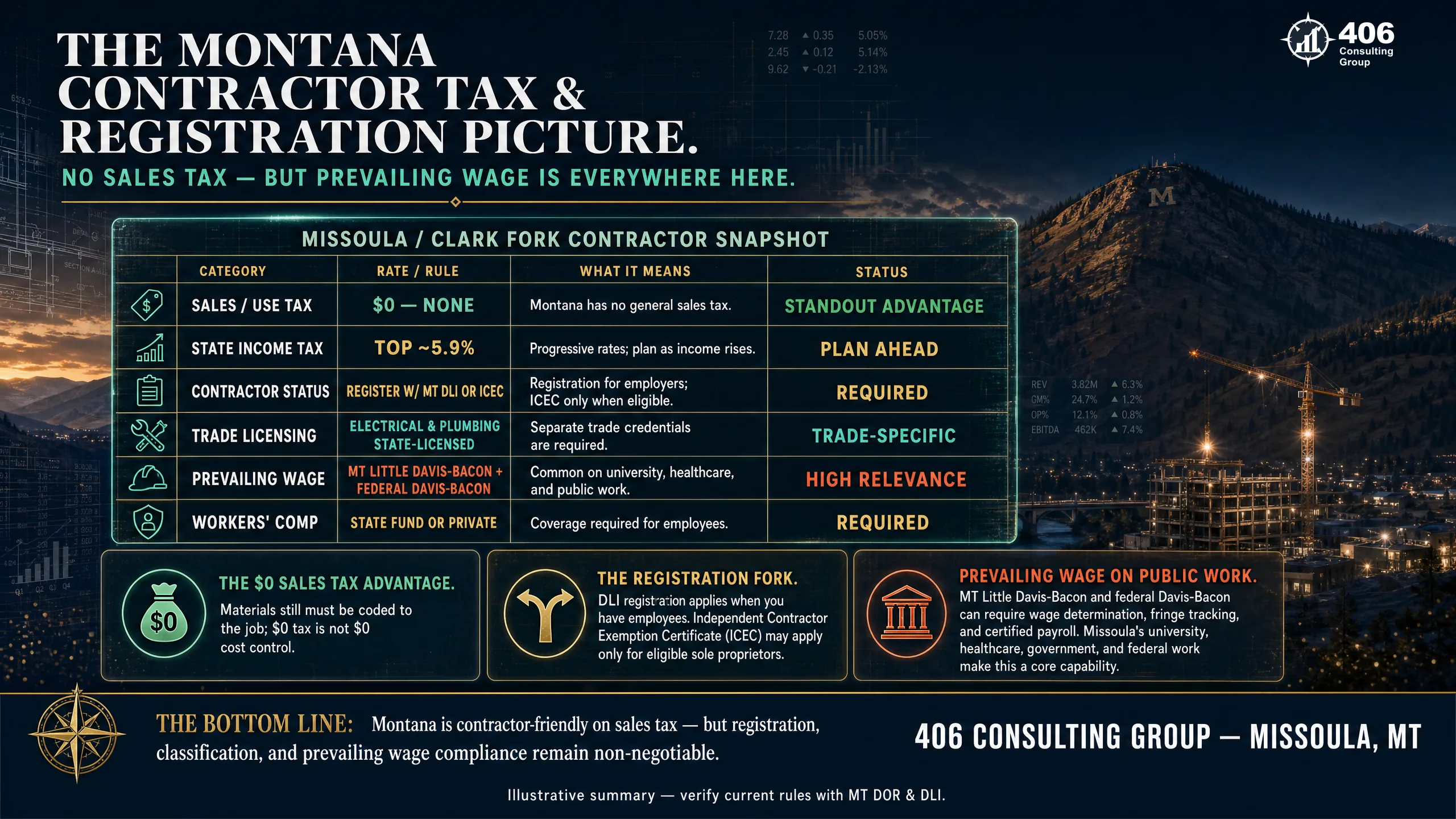
Verify current rates and rules with the Montana Department of Revenue and registration, licensing, and prevailing wage with the Montana Department of Labor & Industry. In a public-work-heavy town like Missoula, prevailing wage is the piece to get straight early.
Registration, ICECs & Trade Licensing (Not a GC License)
Montana doesn't put contractors through a general-licensing exam. It asks for registration instead: a construction contractor with employees generally registers with the Department of Labor & Industry, and a contractor operating with no employees typically holds an Independent Contractor Exemption Certificate (ICEC) that establishes they're genuinely independent and responsible for their own coverage. Whether the people on your jobs are employees or true independents is the hinge the whole system turns on — it decides registration, workers' comp, and payroll at the same time.
The licensed trades are separate: electricians and plumbers hold state licenses, and local jurisdictions add permits and inspections of their own. On the books, registration, ICEC status, and trade licenses are standing obligations with real teeth if they lapse or a worker is misclassified — and on the bonded, public, and institutional jobs common in Missoula, your financial statements are part of what backs your bonding. Confirm your specific registration, ICEC, and licensing requirements with the Montana Department of Labor & Industry.
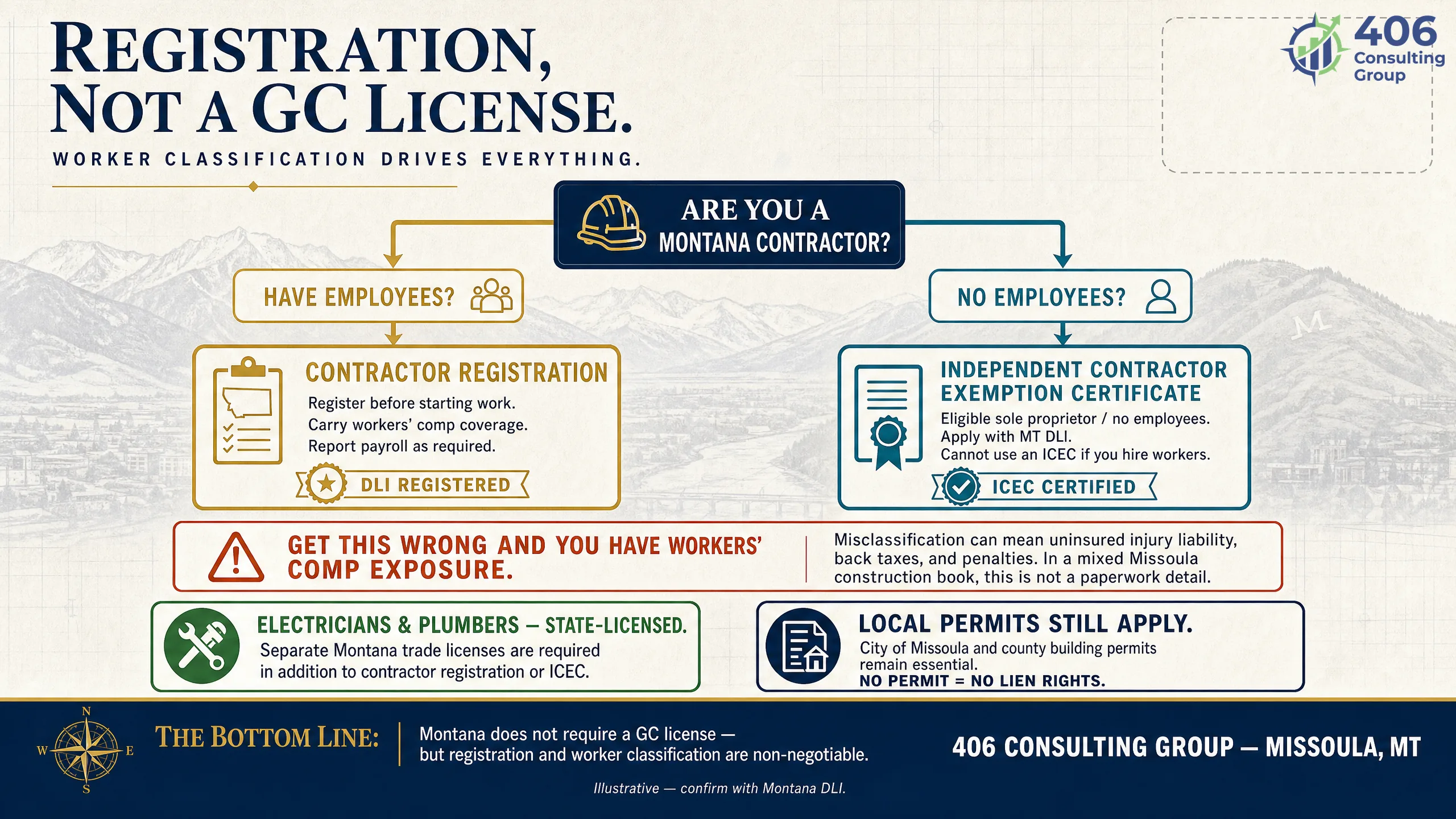
Settle worker classification and registration first — in Montana it feeds everything downstream, and it matters even more where public work and its payroll rules are involved.
No Sales Tax: What That Actually Means for Materials
Montana is one of a small group of states with no general sales tax, and it's a real advantage for a contractor. There's no sales or use tax on your materials, no consumer-versus-retailer determination to make, and no separate tax line to build into a bid or send to the state. Set against a builder just across the line in Idaho or Washington, one whole layer of cost and compliance simply isn't part of the job.
Two points still hold. First, no sales tax is no license for sloppy material tracking — each invoice still has to land on the right job at its real cost, or your job costing drifts and your bids quietly weaken; the rigor is the same with or without the tax. Second, buying or working across a state line can pull you under another state's rules — materials ordered from or delivered into a sales-tax state, or a job across the border in Idaho, may carry that state's sales or use tax — so cross-border activity deserves a look. Within Montana, though, materials stay simple, which lets you aim your bookkeeping effort at what actually decides a job: costing and WIP.
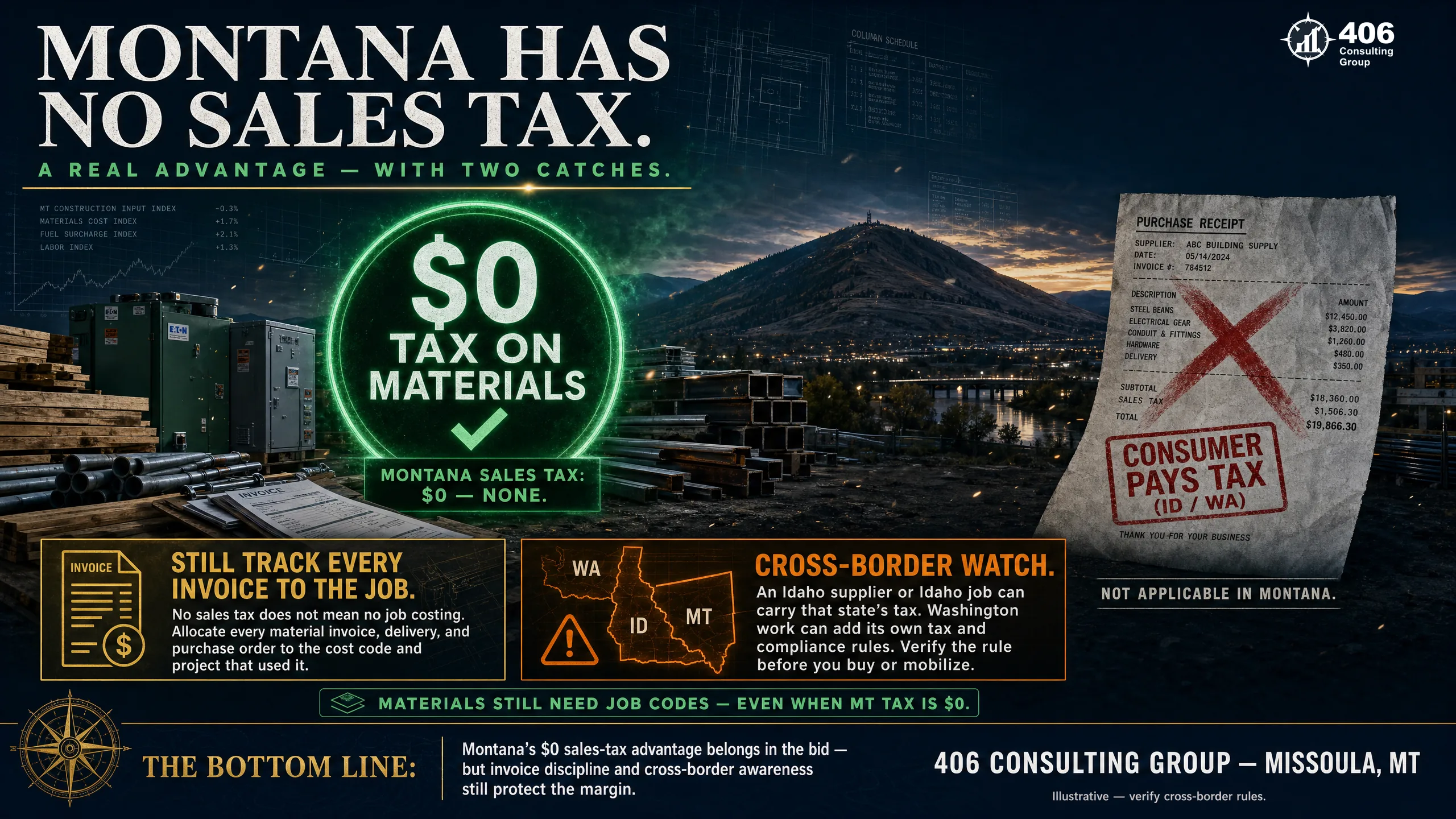
If you regularly buy or build across the Idaho line, confirm how that state's tax reaches your work with the Montana Department of Revenue and the neighboring state's tax agency.
Building Missoula: The University, Healthcare & the Bitterroot
Missoula's construction market is unusually diversified, and that shape is worth building your books around. The University of Montana keeps campus, student-housing, and related commercial work in motion. Healthcare — two competing hospital systems and the clinics around them — is a large, steady source of institutional building. Missoula's standing as western Montana's regional and government hub, with a notable federal presence, adds public and institutional projects that come with their own compliance. And the Bitterroot Valley — Lolo, Florence, Stevensville, Hamilton — drives ongoing residential and subdivision demand. It's a deep, mixed runway, paired with tight labor and rising material and land costs.
Steady, diversified growth is still growth — and growth is where contractors most often lose money, because a full and varied backlog can hide thin margins on any one job until the cash runs short. Taking on more work only strengthens the company if you can read the margin on each job and fund the work between draws, which takes job costing, a live WIP schedule, and a cash forecast. The Missoula builders who come out of this stretch stronger will be the ones whose books kept pace with a busy, mixed schedule.
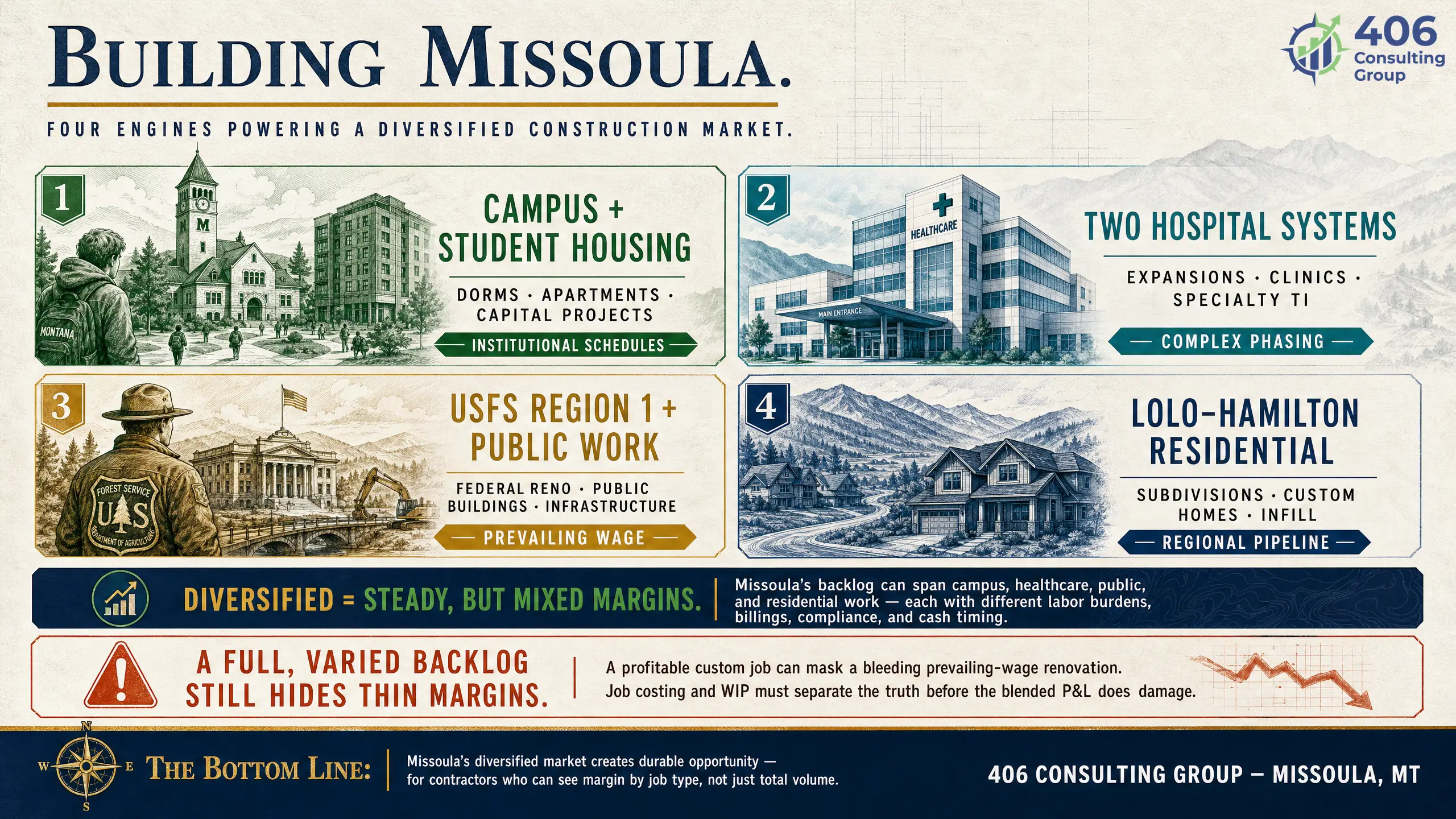
Growth only counts when it's profitable — and across a mix of job types, that's a bookkeeping question long before it's a sales one.
Job Costing: Which Job Actually Makes Money
When your work spans institutional builds, healthcare fit-outs, and Bitterroot homes, averages lie — and only job costing tells the truth. It attaches every labor hour, every material invoice, every subcontractor bill, and every hour of equipment time to the job that incurred it, so each project's real margin stands on its own rather than melting into a company-wide number. When you can see that your prevailing-wage institutional work runs at a different margin than your residential jobs, you learn which work to chase and how to price it — instead of guessing across job types that behave nothing alike.
It's also the base the rest of your reporting stands on — an accurate WIP schedule, correct progress billing, and sound change-order decisions all require job-level costs underneath them. For a Missoula contractor working a mixed book, job costing is the single habit that keeps a varied, growing schedule genuinely profitable.
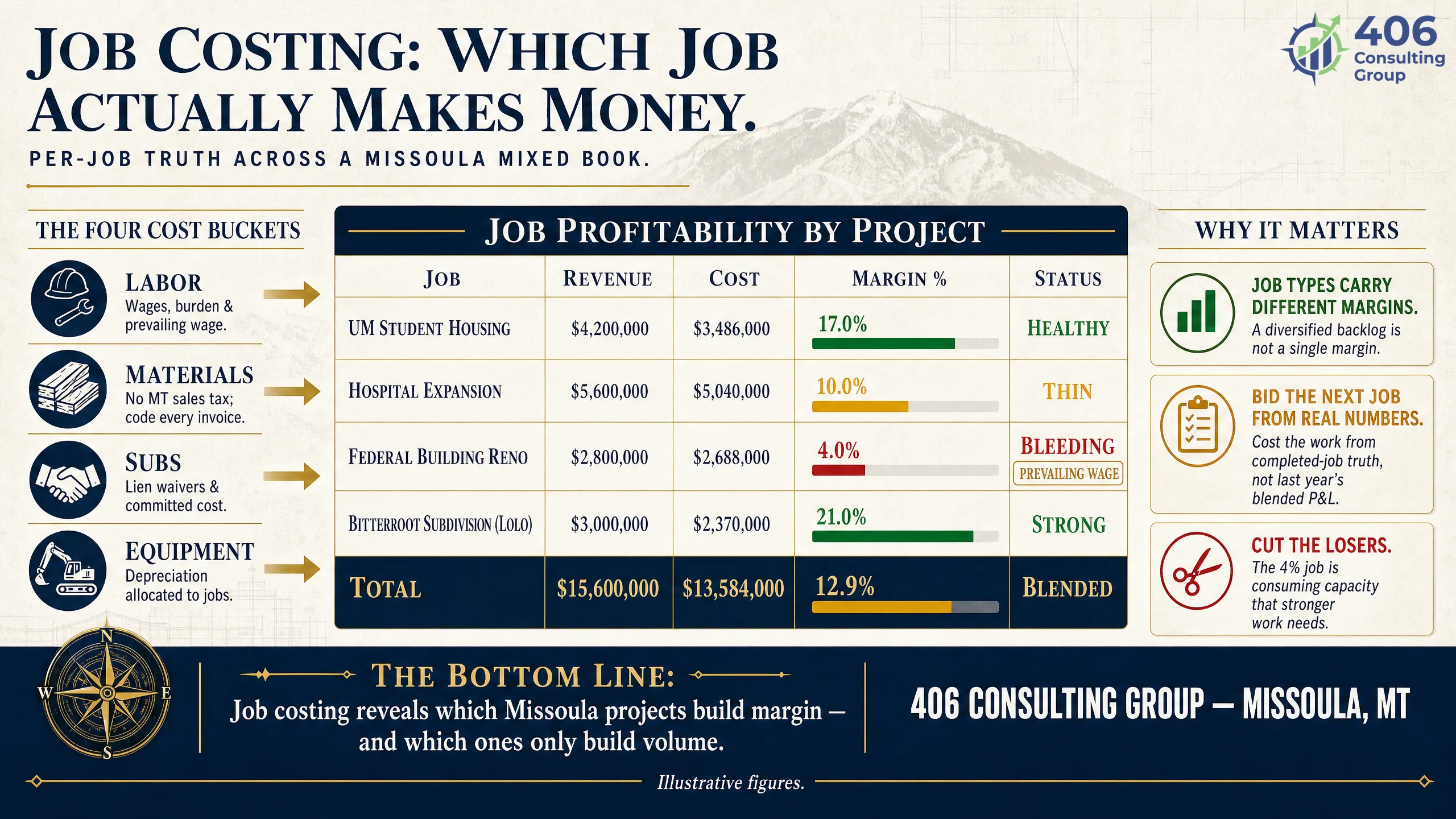
Sorting out which jobs and crews truly carry the business is the whole point of our contractor unit economics work — and job costing is what brings the answer into view.
WIP, Percentage-of-Completion, Retainage & Change Orders
Jobs that span months — and the larger institutional ones can span far longer — need a report a plain ledger can't produce. A work-in-progress (WIP) schedule brings each open job's costs, billings, and estimated cost-to-complete into one view, and the differences among them reveal whether you're over- or under-billed. Bill ahead of the work and the extra cash flatters your position while costs are still landing; bill behind it and you're financing the owner. Percentage-of-completion ties revenue to how far the job has genuinely come, so the monthly numbers stay honest across a long institutional timeline.
Add retainage — held to the end, parked in its own receivable, and often larger on public and institutional contracts — and change orders, which move scope and margin and must be logged and priced before the work is absorbed. On the campus, healthcare, and public jobs that fill a Missoula schedule, that WIP discipline is what keeps a busy calendar from masking a margin problem — and it's the first report your banker, surety, and project owners will want to see.
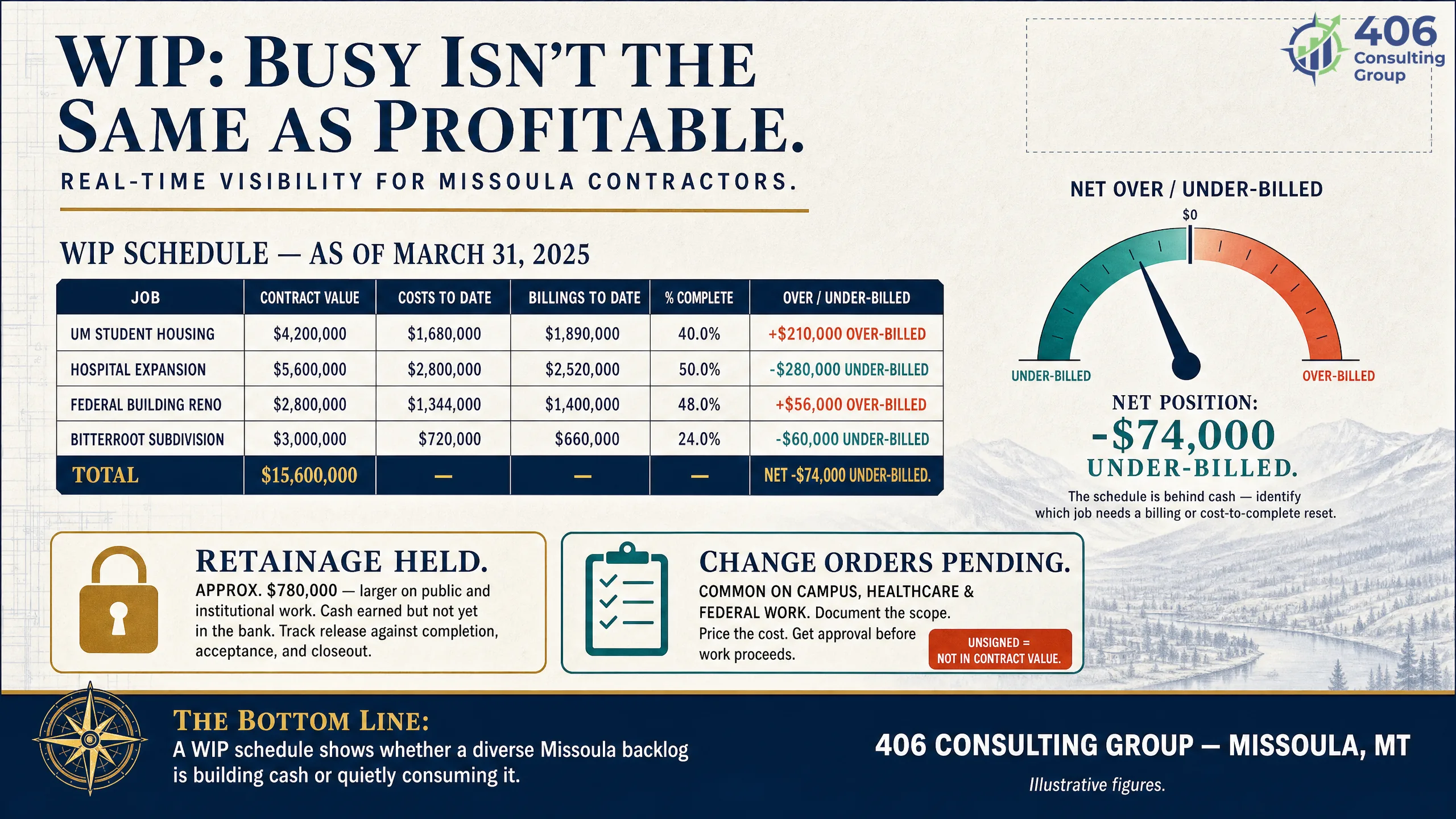
As you scale, this is where a controller or CFO function earns its keep — and our Montana WIP and job-costing deep dive walks the mechanics job by job.
Payroll, Prevailing Wage & Institutional Work
Payroll is where Missoula's market really shows up in the books. Because so much local work is public, campus, and healthcare, both prevailing-wage regimes come into play more than in most Montana towns. Montana's own Little Davis-Bacon covers public-works contracts above a dollar threshold with standard or heavy/highway rates and certified payroll; on federally funded projects — and Missoula's federal footprint makes these common — federal Davis-Bacon applies on top. Getting wage determinations, fringes, or the weekly certified reports wrong can freeze a draw, so payroll has to be built to produce accurate certified reports and tie that labor back to the job.
The rest is standard but still exacting: Montana withholding alongside federal, workers' compensation through a private carrier or the state-chartered Montana State Fund (a competitive fund, not a monopoly) at class-code rates that belong in your burdened labor, and a heavy mix of subcontractors and ICEC holders that has to be classified defensibly. Set up cleanly, payroll becomes reliable data flowing into your job costs rather than a monthly scramble.
Our payroll work — Montana and federal certified payroll included — keeps all of it running quietly in the background.
Equipment, Depreciation & Montana's Business Equipment Tax
Equipment shows up in two different places in the accounting. Federally, Section 179 and bonus depreciation can move much of a truck, loader, or machine into the year-of-purchase deduction — useful, but a decision to weigh against your multi-year income rather than take by reflex. On the Montana side, the state assesses a business-equipment tax on machinery and equipment, with a substantial exemption — raised significantly in recent years, so verify the current threshold — that leaves many contractors owing little or nothing while larger fleets should track it and confirm where they stand.
A clean, current fixed-asset schedule pulls its weight two ways: it keeps depreciation and any business-equipment reporting straight, and — since a machine's hours belong on the job that used them — it feeds job costing, so a rig sitting idle reads as the cost it is rather than dissolving into overhead. Know what you own, what each piece costs to run, and which job it's on.

The depreciation strategy and Montana income-tax planning ride on disciplined books — see our Missoula bookkeeping guide; the tracking that powers both starts here.
Common Construction Bookkeeping Mistakes
A handful of avoidable errors cause most of the financial pain for Missoula contractors — and a mixed book of institutional and residential work makes several of them easy to hit.
Underestimating prevailing-wage payroll
Campus, healthcare, and federal jobs bring Montana and federal certified payroll; wrong rates, fringes, or reports freeze draws and build liability fast.
Pricing one margin across job types
Institutional, healthcare, and residential work carry different true margins — without job costing you bid them all on a company average and lose on the hard ones.
Treating no sales tax as loose tracking
Montana spares you the tax, not the discipline — every material invoice still has to land on the right job at real cost, or costing and bids drift.
Blurring employee vs. ICEC status
Whether a worker is an employee or a true independent drives registration, comp, and payroll — get it wrong and Montana can unwind it at real cost.
Neglecting the WIP schedule
On long institutional jobs with big retainage, over- and under-billing hide where each job stands, and no surety grows bonding without a clean WIP.
Each is a matter of setup and habit — and each resolves once the books are built for Montana construction and run on a dependable monthly rhythm.
A Montana Firm, Working Across the State
Missoula has capable bookkeepers, but construction is a specialty and Montana construction has its own rulebook — and Missoula's public and institutional slant raises the stakes on getting it right. What matters isn't whether your accountant is downtown; it's whether they know contractor registration and ICECs, Montana and federal prevailing wage and certified payroll, State Fund workers' comp, the business-equipment tax, and how to run real job costing and a bonding-grade WIP. We're a Montana firm that lives in those rules, and we serve Missoula and Bitterroot contractors the same whether we're across town or across the state.
Our workflow suits a builder's day: cloud accounting and job-costing software, receipts and hours captured from the field, connected bank feeds, and a dependable monthly close — Montana-literate construction books without a trip to an office. From the university district and the hospital corridors to Lolo and down the Bitterroot, you get a firm that already knows Montana construction. For the broader bookkeeping picture, our Missoula construction accounting guide pairs with this one.
In the end it comes down to whether your accountant truly understands Montana construction — and that expertise is exactly what a Montana firm is built to bring.
How to Get Started
Getting a Missoula contractor's books squared away runs in three steps.
Get the Montana pieces right
Keep contractor registration or ICEC status and any electrical/plumbing licenses current, confirm worker classification, and set up workers' comp cleanly with a carrier or the State Fund.
Build construction-grade books
Job costing by phase, a WIP schedule, retainage and change-order tracking, a fixed-asset schedule, and certified payroll for Montana and federal prevailing-wage work.
Run it monthly
A genuine monthly close, WIP review, and job-level reporting — so you know which jobs pay and can fund and bond the next one.
Unsure where your books stand right now? Our Financial Maturity Assessment lays it out in about eight minutes.
FAQ: Missoula Construction Accounting
Do I need a contractor's license in Montana?
Not a general-contractor license — Montana doesn't run that exam. It requires registration instead: a construction contractor with employees generally registers with the Department of Labor & Industry, while a contractor with no employees usually holds an Independent Contractor Exemption Certificate (ICEC) establishing they're genuinely independent and cover their own risk. Electricians and plumbers are the exception, holding state licenses, and local jurisdictions add their own permits and inspections. Because worker classification sets registration, workers' comp, and payroll all at once, it pays to settle it early — especially on the public and institutional jobs common in Missoula. Confirm your specific requirements with the Montana Department of Labor & Industry.
Does Montana have a sales tax on construction materials?
Montana has no general sales tax — it's one of only a handful of states without one — so a contractor pays no sales or use tax on materials and never faces the consumer-or-retailer determination that a job in Idaho or Washington forces. A real cost and compliance break. That said, two things still apply. The absence of tax doesn't relax the need to code materials accurately — an invoice on the wrong job, or at the wrong amount, still throws off your costing and your bids. And a purchase or job that reaches into a sales-tax state can bring that state's tax rules with it, so keep an eye on anything sourced or built across the line. For cross-border specifics, check with the Montana Department of Revenue and the relevant state's tax agency.
Why does prevailing wage come up so often on Missoula jobs?
Because Missoula's construction market leans heavily toward public, university, and healthcare work, and those are exactly the projects prevailing wage attaches to. Montana has its own prevailing-wage law — Little Davis-Bacon — covering public-works contracts above a dollar threshold with standard or heavy/highway rates and certified payroll for each worker; on federally funded jobs, and Missoula has a sizable federal presence, federal Davis-Bacon applies on top. That means certified payroll turns up far more often here than on a purely residential book, and wrong rates or reports can stall payment. Because the requirement follows the project and its funding, confirm it job by job with the Montana Department of Labor & Industry.
Why does job costing matter so much on a mixed book of work?
Because institutional, healthcare, and residential jobs carry genuinely different margins, and a company-wide average hides that. Job costing ties every labor hour, material invoice, subcontractor bill, and equipment charge to a specific job, so you can see the real margin on each and tell which types of work build your business from which quietly drain it. It's also the foundation for an accurate WIP schedule, correct progress billing, and sound change-order pricing. For a Missoula contractor moving among very different job types, that per-job clarity is what turns a busy, varied schedule into a reliably profitable one rather than a guessing game.
Can 406 Consulting Group handle my Missoula construction bookkeeping?
Yes. Being a Montana firm, we come in already fluent in what a Missoula builder deals with: contractor registration and ICECs, both the Montana and federal prevailing-wage regimes and their certified payroll, State Fund or private workers' comp, the business-equipment tax, and the no-sales-tax rules on materials. The mechanics run in the cloud — job-costing software, field-captured receipts and hours, linked bank feeds, and a monthly close you can count on — which is why distance doesn't change the service: a campus job, a hospital fit-out, or a subdivision down in Lolo all get the same attention. In the end it's expertise, not proximity, that decides whether construction books hold up — job costing, WIP, and Montana compliance — and that's what a Montana firm brings by default.
Keep Reading
Trades & Construction — Missoula, MT
Build Western Montana on Books You Can Trust.
406 Consulting Group keeps Missoula and Bitterroot contractors clean and compliant — contractor registration, Montana and federal prevailing wage, job costing, WIP, and equipment handled — by a Montana firm that knows Montana construction.
Missoula Construction Quick Reference
Missoula, MT — Missoula County
Building in Missoula?
Prevailing wage, job costing & WIP, handled.
About the Author
Jason Anderson
Co-Founder, 406 Consulting Group
A Montana firm with a commercial banking and underwriting background, serving contractors and trades statewide. Jason helps Missoula builders keep registration and certified payroll current — Montana and federal — run real job costing and WIP, and stay profitable across a mixed book of institutional and residential work.
Read the Full Story