
Accounting for Belgrade Contractors & Trades:
The Numbers Behind a Business That Scales
A contractor can be booked solid and still not know which jobs make money. Here's the financial playbook every Belgrade GC and trade shares — job costing, WIP, retainage, subs vs. employees, and cash — plus what's specific to your trade, from a Montana firm that speaks contractor.

Here's a scene that plays out all over Belgrade and the Gallatin Valley: a contractor is booked solid, crews are running, invoices are going out — and the owner still can't answer the one question that matters. Are we actually making money, and on which jobs? The bank account says one thing one week and another the next. A job that felt like a winner turns out to have quietly lost money. And nobody can say for sure, because the books were built to file a tax return, not to run a construction business.
That's the gap this guide is about. Whether you're a general contractor pulling the whole project together or a specialty trade — excavation, concrete, framing, electrical, plumbing, HVAC — your business shares a set of money problems that a normal small-business accountant simply isn't built for. Job costing, work-in-progress, retainage, subs versus employees, equipment, and the cash whiplash of a job-based business: get these right and you can scale on purpose; get them wrong and growth just makes the problems bigger.
Below is the Trades Financial Playbook — the shared mechanics every contracting business needs handled, a trade-by-trade look at what's specific to yours, and how the pieces (clean books, smart taxes, and real financial leadership) fit together. It's the hub of our Belgrade work, so we'll point you to the deeper guides as we go.
By Carrie Anderson — Co-Founder, 406 Consulting Group. Commercial banking and underwriting background — 300+ loan reviews, including construction lending and the financials behind bonding. Carrie helps Gallatin Valley contractors and trades get the job costing, cash discipline, and reporting that scaling actually requires.
Quick Answer: What Contractor Accounting Really Requires
- →Job-based, not period-based: the trades live or die by per-job profit, which generic bookkeeping never shows.
- →Job costing & WIP tell you which jobs make money and keep your financials — and your banker — honest.
- →Subs vs. employees is a compliance landmine — misclassification is one of the costliest mistakes a contractor makes.
- →Cash timing — draws, retainage, and equipment create the "busy but broke" trap that catches growing crews.
- →Books, tax, and CFO work together — and a construction-savvy remote partner beats a local generalist.
Table of Contents
Why the Trades Are Financially Different
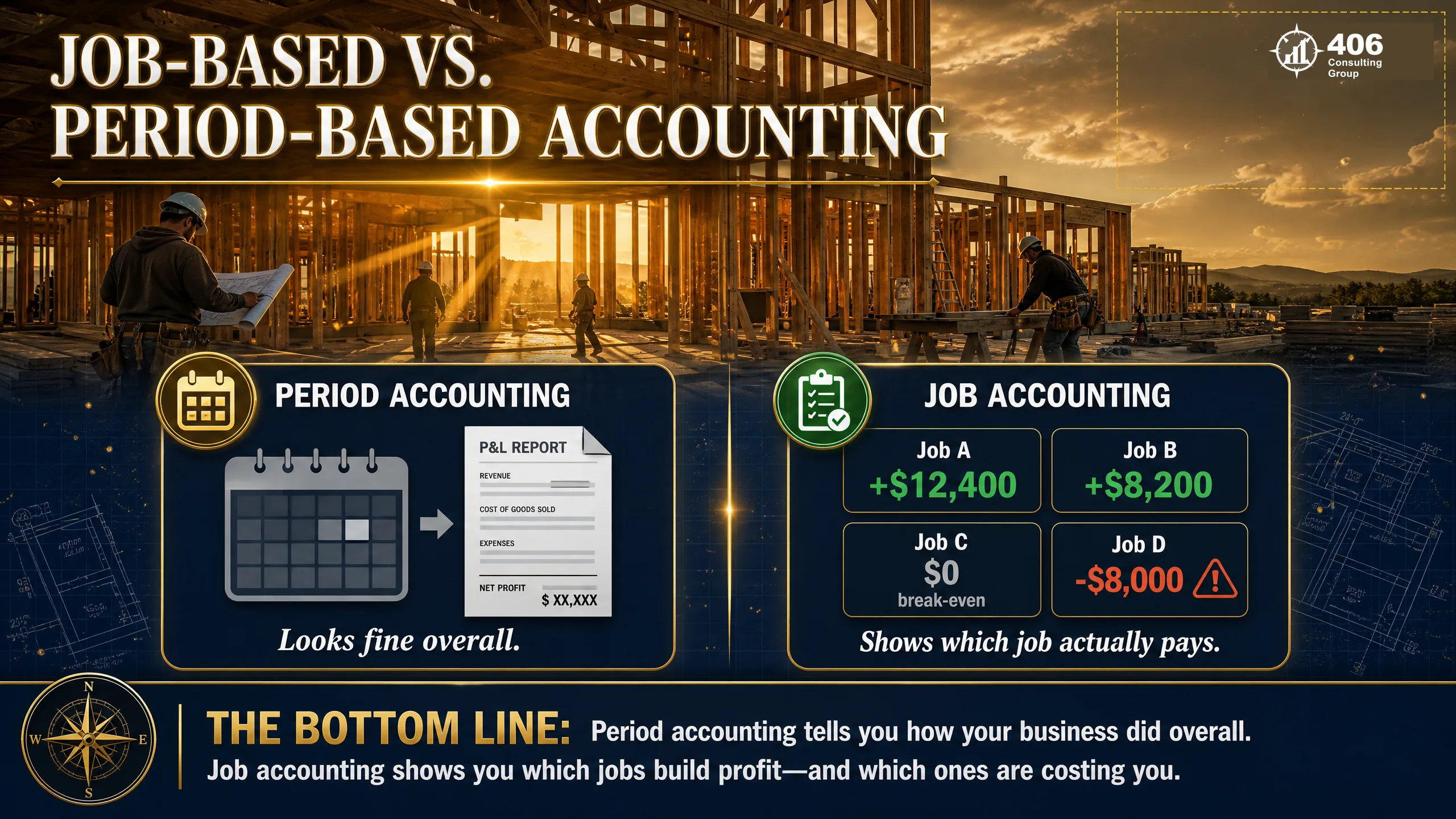
The short answer: most businesses think in time periods — this month's sales, this month's expenses — but a contractor's real unit of profit is the job. A retail shop can read last month's P&L and know how it did. A contractor can have a great month on paper while a single job is silently bleeding, and the monthly statement will never tell them which one.
That one difference cascades into everything. Revenue arrives in draws and gets held back as retainage. Costs pile up on materials and crews weeks before the money comes in. Some workers are employees and some are subs, with very different rules. Equipment is a huge cash outlay that shows up on the books in a way that rarely matches how you actually paid for it. A generic bookkeeper who treats a framing company like a coffee shop will produce technically-correct books that are operationally useless.
The rest of this playbook is the fix — the specific disciplines that turn "we think we did okay" into knowing your numbers job by job. It builds on clean, current books, so if yours are behind, start with our Belgrade bookkeeping guide.
Job Costing: Which Jobs Actually Make Money
The short answer: job costing means capturing every dollar of labor, materials, equipment, and overhead against the specific job it belongs to — so you know each job's true margin, not just your overall bank balance. It's the single most important accounting discipline in the trades, and the one most growing contractors don't have.
Picture a Belgrade concrete contractor running four pours in a month. Overall, the month looks fine. But job costing reveals the truth: two jobs cleared a healthy margin, one broke even, and one lost $8,000 because the bid missed on labor hours and a material price jumped mid-job. Without job costing, that owner bids the next job the same way and repeats the loss. With it, they see the leak, fix the estimate, and stop taking work that doesn't pay.
Done well, job costing feeds three things: accurate bids (because you know what work really costs), better margins (because you catch overruns while the job is live), and a clean audit trail for taxes and financing. It's the foundation the rest of this list stands on. We go deep on the mechanics in our guide to WIP and job costing for contractors.

WIP & Retainage: The Numbers Banks Ask For
The short answer: a work-in-progress (WIP) schedule shows how far along each job is and whether you've billed ahead of or behind the work you've actually done — and retainage is the slice of every invoice (commonly 5–10%) a customer holds back until the job is substantially complete. Together they explain why a profitable contractor can still be starved for cash.
The WIP schedule is where over- and under-billing shows up. Bill ahead of your progress and you're "overbilled" — that cash isn't really earned yet, and spending it like profit is how contractors dig holes. Bill behind and you're "underbilled" — you've done work you haven't been paid for, quietly financing your customer. A real WIP schedule catches both, and it's the first document a bank or bonding company asks to see when you want a line of credit or a bigger bond.
Retainage is the other cash trap. On a $200,000 job with 10% retainage, $20,000 sits unpaid until the end — even though you've already covered the labor and materials to earn it. Across several jobs, retainage alone can tie up more cash than a growing contractor has to spare. Planning for it isn't optional; it's the difference between making payroll and sweating it.

This is exactly where a controller and a fractional CFO earn their keep. We cover who does what — and when you need each — in our Belgrade CFO & controller guide.
Subs vs. Employees: The Classification Trap
The short answer: whether a worker is a subcontractor (1099) or an employee (W-2) isn't your choice — it's determined by how the work is controlled and performed, and getting it wrong is one of the most expensive mistakes a contractor can make. The trades run on a mix of both, which is exactly why the line gets blurry and audits find so much money.
The temptation is obvious: pay someone as a 1099 sub and you skip payroll taxes, workers' comp, and unemployment insurance. But if that person works set hours, uses your tools, and takes direction like an employee, they likely areone in the eyes of the IRS and the state — and if you're caught, you're on the hook for back payroll taxes, penalties, interest, and potentially unpaid workers' comp premiums. In construction, where a single injury claim on an uncovered "sub" can be catastrophic, this is not a corner to cut.
The workers' comp piece owners miss
Even for legitimate subs, if they don't carry their own workers' comp coverage, your policy — and your premium audit — can end up treating them as your employees. Collecting certificates of insurance from every sub, every year, isn't paperwork for its own sake; it's what keeps a year-end comp audit from turning into a five-figure surprise. Clean books and a payroll process built for the trades keep this straight.
The fix is boring and reliable: classify correctly from the start, run real payroll for employees, collect insurance certificates from subs, and keep the documentation. It's a core part of what our bookkeeping and payroll work handles for contractors.
Equipment & Cash Timing: Busy but Broke
The short answer: the trades are cash-intensive in a way few other small businesses are — big equipment outlays, payroll that runs ahead of collections, and seasonal swings all conspire to make a profitable contractor feel broke. Managing the timing, not just the profit, is what keeps the doors open.
Equipment is the biggest lever. A $65,000 excavator or a new work truck is a major cash decision, and how you handle it — buy, finance, or lease — changes both your cash flow and your taxes. Buying outright with a well-timed purchase can unlock a large Section 179 deduction; financing preserves cash but adds a payment; leasing keeps you flexible. The right answer depends on your cash position and your tax year, which is why equipment decisions belong in a planning conversation, not a dealership parking lot. We cover the tax side in our Belgrade tax guide.
Then there's seasonality. Montana winters slow site work, excavation, and concrete to a crawl, while the summer building season demands cash for materials and crews all at once. A contractor who spends the flush summer like it lasts all year gets caught short by February. The fix is a rolling cash-flow forecast and a line of credit set up before you need it — the tools that turn a feast-or-famine cycle into something you can actually plan around.

If "profitable on paper but always tight on cash" sounds familiar, that's a specific, fixable problem — we break it down in Profitable But No Cash.
The Trade-by-Trade View
The playbook is shared, but every trade has its own financial fingerprint. Here's what tends to matter most for the businesses building the Gallatin Valley.
| Trade | What drives the numbers | Where money leaks |
|---|---|---|
| General contractor | Managing subs, draws, and the whole project budget | Sub costs and change orders that outrun the contract |
| Excavation / site | Equipment-heavy; fuel, machines, and hauling | Idle equipment and underbid dirt work |
| Concrete | Material price swings and tight labor windows | Bids that miss on labor hours or material spikes |
| Framing | Labor-driven, fast-moving, crew productivity | Crew hours not tracked to the job; lumber waste |
| Mechanical (elec/plumbing/HVAC) | Mix of project work and service calls; parts inventory | Untracked truck stock and unbilled service time |
Different leaks, same underlying fix: cost every job, track labor to the work, and watch cash across the season. A general contractor lives or dies on managing subcontractor costs and change orders; a mechanical contractor has to capture truck stock and every billable service hour. The mechanics of scaling any of them into a business that runs without you are the same, which is why we wrote full growth blueprints for the plumbing, framing, and HVAC trades.

How the Pieces Fit: Books, Tax & CFO
The short answer: contractor accounting isn't one service, it's a stack — clean job-costed books at the base, proactive tax planning on top, and financial leadership steering the whole thing. Each layer depends on the one beneath it, and the biggest wins come from having them work together instead of buying them piecemeal from three disconnected people.
Bookkeeping & payroll
Job-costed, current books and correctly classified payroll — the foundation everything else reads from.
Bookkeeping services →Tax planning
Entity structure, equipment timing, and estimates handled all year — so a good season isn't erased by an April surprise.
Tax services →Controller & CFO
WIP reporting, cash forecasting, bonding readiness, and growth strategy — turning reliable numbers into decisions.
CFO services →Here's our real differentiator: because our background is in running whole businesses — not just accounting — we design your financial systems around how they affect operations, hiring, and cash across the whole company, not just the ledger. A change to how you bill or classify labor ripples into payroll, taxes, and bonding, and we build it to fit all of them at once. Not sure which layer you need first? Our Financial Maturity Assessment maps it in about eight minutes.
Working With a Remote Construction-Savvy Partner
The short answer: for a contractor, the thing that actually matters is whether your accountant understands construction — job costing, WIP, retainage, bonding — not whether their office is in Belgrade. A construction-savvy firm working with you remotely will serve you far better than a local generalist who treats your framing company like a retail store.
It's worth saying plainly that this is how we run every relationship, not just the distant ones: even 70 to 80 percent of our own local contractors never set foot in the office. WIP reviews, job-cost check-ins, and equipment-timing calls all happen over a shared screen looking at live cloud data. For a Belgrade builder, remote isn't second best — it's the standard workflow, and whether your shop is in Belgrade or on the far side of Montana makes no difference to the construction-savvy service you get.
Think about how the work actually happens. Your crews are on jobsites, not in an accounting office, and your numbers live in cloud software you can both see in real time. The valuable moments — reviewing a WIP schedule before a bank meeting, deciding how to handle an equipment purchase, checking whether a job is tracking to its bid — happen over a screen share with live data, not across a desk. Nobody needs to drive to your shop to tell you a job is running over; they need to know construction and be watching.
That's how we work with contractors across Montana: secure cloud accounting, construction-specific expertise, and a standing rhythm of check-ins so problems surface while there's still time to fix them. For a Belgrade or Gallatin Valley builder, the deciding question isn't proximity — it's whether your partner actually speaks contractor.
How to Get Started
You don't have to fix everything at once. The path from "I think we're okay" to knowing your numbers is three steps.
Get the books job-costed and current
Everything reads from here. If your books aren't tracking cost by job, that's step one — and where we usually start with a contractor.
Add WIP, tax, and cash planning
Layer in a WIP schedule, proactive tax moves, and a cash-flow forecast that accounts for retainage and the season.
Steer with real numbers
Use reliable, job-level data to bid better, manage cash, get bonding-ready, and grow on purpose instead of by luck.
Wherever you are in that path, we can meet you there — and build the rest around how your whole business actually runs.
FAQ: Belgrade Contractor & Trades Accounting
Why do contractors need a specialized accountant instead of a regular bookkeeper?
Because construction is job-based, not period-based. A regular bookkeeper can produce accurate monthly statements that still tell a contractor nothing about which jobs make money. Contractor accounting requires job costing, work-in-progress (WIP) schedules, retainage tracking, correct sub-vs-employee handling, and cash management around draws and seasonality — none of which a generic small-business setup captures. A framing company run on coffee-shop books will look fine on paper while individual jobs quietly lose money.
What is job costing and why does it matter so much?
Job costing captures every dollar of labor, materials, equipment, and overhead against the specific job it belongs to, so you know each job's true profit margin rather than just your overall bank balance. It matters because contractors can look busy and profitable overall while individual jobs lose money — and only job costing reveals it. Good job costing produces accurate bids, better margins (you catch overruns while the job is live), and a clean trail for taxes and financing.
What is a WIP schedule and does my bank really need it?
A work-in-progress (WIP) schedule shows how far along each job is and whether you've billed ahead of (overbilled) or behind (underbilled) the work actually completed. It's essential for accurate financials, and yes — it's typically the first document a bank or bonding company asks for when you want a line of credit or a larger bond. Overbilling can make you look flush with cash that isn't really earned yet; a real WIP schedule keeps your financials and your financing honest.
How do I know if a worker should be a 1099 sub or a W-2 employee?
It's determined by how the work is controlled, not by preference. If you set someone's hours, provide their tools, and direct how they do the work, they're likely an employee (W-2), even if you'd rather pay them as a 1099 sub. Misclassification is one of the costliest contractor mistakes: getting caught means back payroll taxes, penalties, interest, and potential workers' comp exposure. Also collect a certificate of insurance from every legitimate sub, or your workers' comp audit may treat them as your employees anyway.
Why is my construction business profitable but always short on cash?
Because in the trades, profit and cash are on different clocks. You pay for materials and crews weeks before you collect, customers hold back retainage (commonly 5–10%) until a job is substantially complete, equipment eats large chunks of cash, and Montana's seasonality bunches your spending into the building season. Even a genuinely profitable contractor can be starved for cash. The fix is a rolling cash-flow forecast built around your draw and retainage timing, plus a line of credit set up before you need it.
Can 406 Consulting Group work with my Belgrade contracting business remotely?
Yes. We work with contractors and trades across Belgrade, the Gallatin Valley, and Montana through secure cloud accounting — bookkeeping and payroll, tax planning, and fractional controller and CFO services. What matters for a contractor is construction expertise (job costing, WIP, retainage, bonding), not office proximity, and we review your live numbers over screen shares on a regular rhythm. A construction-savvy remote partner serves a builder far better than a local generalist who treats the business like retail.
Which trades does 406 Consulting Group work with?
General contractors and the specialty trades building the Gallatin Valley — excavation and site work, concrete, framing, and mechanical trades like electrical, plumbing, and HVAC. The shared financial playbook (job costing, WIP, retainage, subs vs. employees, cash timing) applies to all of them, and we tailor it to each trade's specifics — from managing subcontractor costs and change orders for a GC to capturing truck stock and billable service hours for a mechanical contractor. Because our background is in running whole businesses, we design the financial systems around how they affect the entire operation.
Keep Reading — The Belgrade Series
Contractor & Trades Accounting — Belgrade, MT
Know Your Numbers, Job by Job.
406 Consulting Group gives Belgrade and Gallatin Valley contractors job-costed books, construction-smart tax planning, and the controller and CFO leadership to scale — from a Montana firm that actually speaks contractor. Let's build the financial system your growth needs.
Contractor Accounting Quick Reference
Belgrade, MT
The Trades Financial Playbook
Building in Belgrade?
Job-costed books to CFO strategy, handled.
About the Author
Carrie Anderson
Co-Founder, 406 Consulting Group
Commercial banking and underwriting background — 300+ loan reviews, including construction lending and the financials behind bonding. Carrie helps Gallatin Valley contractors and trades get the job costing, cash discipline, and reporting that scaling actually requires.
Read the Full Story