
CFO & Controller Services for Nampa, ID:
Financial Leadership for Makers & Producers
A growing Nampa maker can be profitable and still gasping for cash — because it's frozen in inventory and owed to the state. Here's how a controller and a fractional CFO deliver real COGS, margin visibility, cash forecasting, and equipment-financing readiness, delivered remotely across Idaho.

A Nampa maker that's growing well eventually runs into a problem that has nothing to do with demand: the owner can't see clearly enough to steer. Orders are up, the crew is bigger, there's more inventory on the floor and more equipment on the books — and the monthly numbers arrive late, don't quite reconcile, and can't answer the questions that now decide everything. Which product line actually earns? Is cash tight because we're unprofitable or because it's tied up in inventory? Can we afford the next machine, and will the bank finance it? That's not a bookkeeping problem anymore. It's a financial-leadership gap.
That gap is what a controller and a fractional CFO fill. A controller makes your numbers reliable — a real monthly close, clean financials, inventory and cost of goods that tie out. A fractional CFO uses those numbers to manage cash across inventory and the Idaho tax set-asides, sharpen product margins, get you financing-ready for equipment, and steer growth. Together they turn a busy, growing Nampa producer into one that scales on purpose — without the cost of two senior full-time hires.
This guide covers what each role does for a maker or producer, when you need them, what they cost, and how a firm delivers it remotely. It builds on the layers beneath it — our Nampa bookkeeping and tax guides — so if those aren't handled yet, start there.
By Jason Anderson — Co-Founder, 406 Consulting Group. Background in large-scale operational finance at BP before building financial infrastructure for Northwest businesses, where inventory, cost accounting, cash forecasting, and equipment-financing decisions are everyday work.
Quick Answer: Controller & CFO for a Nampa Maker
- →Controller: owns the monthly close, clean financials, and inventory/COGS that tie out.
- →CFO: owns cash-flow strategy, product margins, financing readiness, and growth decisions.
- →Inventory is the maker's cash trap: profit can be real while cash sits frozen on the shelf.
- →Idaho set-asides: a forecast has to reserve the sales tax you hold and the income tax you'll owe.
- →Fractional gives you both roles for ~$4,000–$8,000/month — a fraction of full-time salaries — delivered remotely.
Table of Contents
Controller vs. CFO: The 30-Second Difference
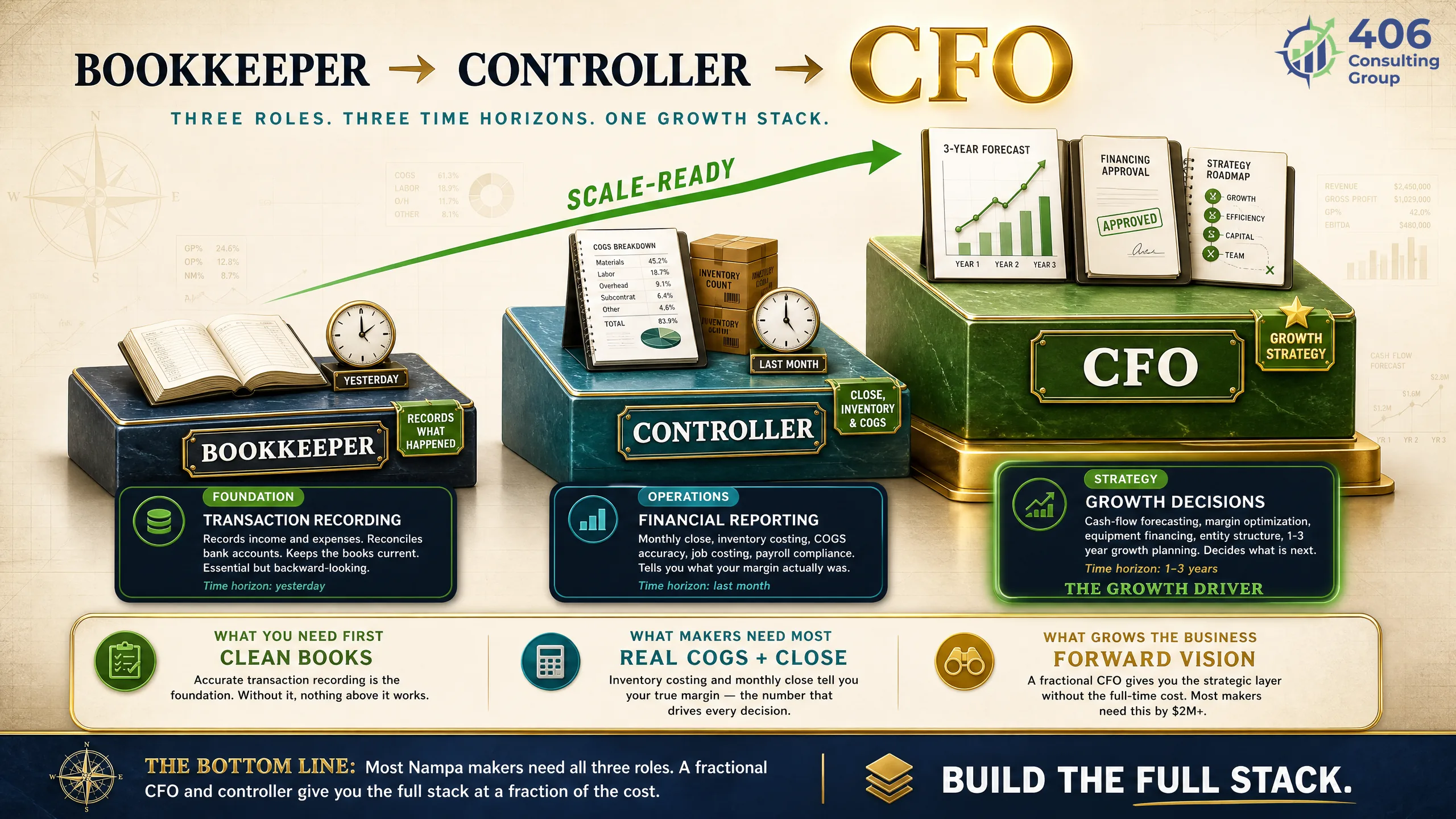
The short answer: a controller makes your numbers accurate and on time; a CFO uses those numbers to make better decisions about cash, margin, financing, and growth. A bookkeeper records what happened, a controller makes it reliable, and a CFO decides what to do about it — and a growing maker eventually needs all three.
| Bookkeeper | Controller | CFO | |
|---|---|---|---|
| Owns | Transactions | The close, inventory & COGS | Financial strategy |
| Time horizon | Yesterday | Last month | Next 1–3 years |
| Answers | What did we spend? | Are the numbers right? | What should we do next? |
Want the full "which role, and when" breakdown with a revenue-and-complexity ladder? We go deep in our controller-vs-CFO guide. This article is about what these roles do for a growing Nampa maker specifically.
Why Growing Nampa Makers Hit a Ceiling
The short answer: a maker hits a financial ceiling when growth outpaces the owner's ability to run the numbers by feel — more products, more inventory, more equipment, and decisions too expensive to get wrong. The books that carried you to $1M can't steer you through $5M, and for a producer the wall usually shows up as cash: you're growing, but there's never any money.
The symptoms are consistent: the monthly close slips late; inventory and COGS don't tie out, so you can't trust your margins; cash is tight even in busy months because it's frozen in materials and finished goods; a financing conversation for a new machine stalls because the financials aren't clean; and every real decision still routes through the owner. None of that is a failure of effort — it's the predictable point where a growing maker needs a real finance function, not just accurate bookkeeping.

Pushing through takes reliable reporting and real cash, inventory, and margin management — the controller and CFO functions. The framework below is how they fit together.
The Growth-Ready Finance Framework
Financial leadership for a growing maker comes down to five layers, each building on the one before. Get them in order and growth stops draining cash and starts building a business you can actually plan and fund.
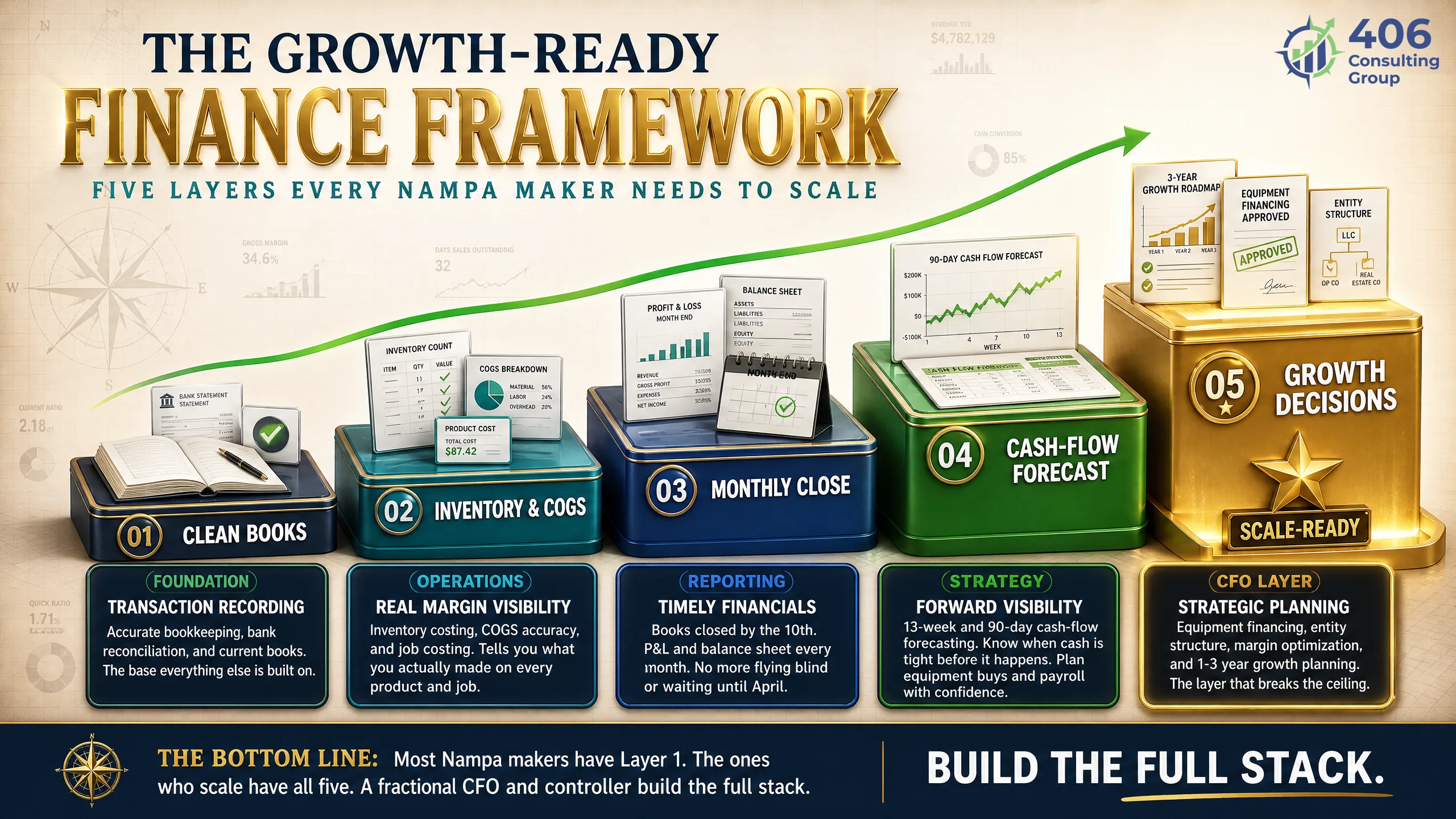
Clean books with real COGS
An accurate monthly close where inventory and cost of goods tie out — the foundation everything reads from.
Controller reporting
Financials you can trust, on time, with product- and line-level detail to see what's actually happening.
Cash-flow forecasting
A rolling forecast that accounts for inventory, payroll, growth, and the Idaho sales- and income-tax set-asides.
Margin & financing readiness
Real product margins and bank-ready financials, so you can price right and finance equipment.
CFO growth strategy
Turning reliable numbers into decisions — capacity, hiring, equipment, and expansion, made on facts.
The first two layers are controller work; the last three are where a CFO earns their keep. Here's what each role delivers.
What a Controller Delivers
The short answer: a controller makes your numbers trustworthy and timely, so you can run the business on facts instead of guesses. For a growing Nampa maker, that means a fast, accurate monthly close where inventory and COGS actually tie out — the foundation for knowing your real margins.
Concretely, a controller owns the monthly close; keeps inventory and cost of goods accurate; builds reporting that shows performance by product or line; keeps the books clean enough to trust for financing and tax; and puts internal controls in place so cash and inventory are handled safely as the operation grows. The payoff is simple: reliable numbers, on time, every month — the prerequisite for every decision above it.
For many makers, strong controller support is the first step up from bookkeeping — we cover that transition in when to upgrade from bookkeeping to a controller. Our controller services are built for exactly this.
What a Fractional CFO Delivers
The short answer: a CFO turns reliable numbers into decisions — managing cash across inventory and taxes, sharpening product margins, securing equipment financing, and steering growth. This is the role that keeps a growing maker from running out of cash while the P&L looks fine.
For a growing Nampa maker, a fractional CFO builds a cash-flow forecast that accounts for inventory, payroll, growth, and Idaho's tax set-asides; analyzes product and line margins so you know what to run more of and what to fix or drop; gets you financing-ready and structures the right debt for equipment; and models the big decisions — a new line, a major hire, a capacity expansion — before you commit. They give the owner a true partner on the numbers, so the business isn't steered by one person's gut.

That's the difference between growing and scaling. Our fractional CFO services bring that leadership without a full-time hire.
Cash Flow, Inventory & the Idaho Set-Asides
The short answer: cash-flow forecasting is the CFO discipline that matters most to a maker, because your cash has three big claims on it that a bank balance hides — inventory you've paid for but not sold, the sales tax you're holding for Idaho, and the income tax you'll owe on profit. A forecast that ignores those will tell you that you can spend money you can't.
Inventory is the maker's signature cash trap: every dollar in raw materials and finished goods on the shelf is a dollar not in the bank, and growth makes it worse — more sales means more inventory to fund first. Layer on Idaho's set-asides (collected sales tax is a liability, and income tax comes due on profit) and you can see why a producer can be genuinely profitable and still gasping for cash. A real forecast reserves for all three and still shows the runway to fund payroll and the next order.
If "profitable on paper but always tight on cash" is your life, that's a specific, fixable problem — we break it down in Profitable But No Cash.
Inventory & Margin Management
The short answer: for a maker, the two numbers that decide whether growth builds wealth or just burns cash are inventory turns and product margin. A CFO gives you both — how fast inventory converts to cash, and what each product actually earns after true cost — so you scale the right things.
Slow-moving inventory quietly ties up the cash you need to grow; a product line you assumed was a winner can be barely breaking even once real materials, labor, and overhead are counted. With reliable COGS and margin analysis, you push the lines that pay, reprice or cut the ones that don't, manage inventory so cash isn't frozen, and make purchasing and production decisions on data. For a Nampa producer on thin margins, finding two points of margin or one extra inventory turn is often worth more than chasing the next big order.
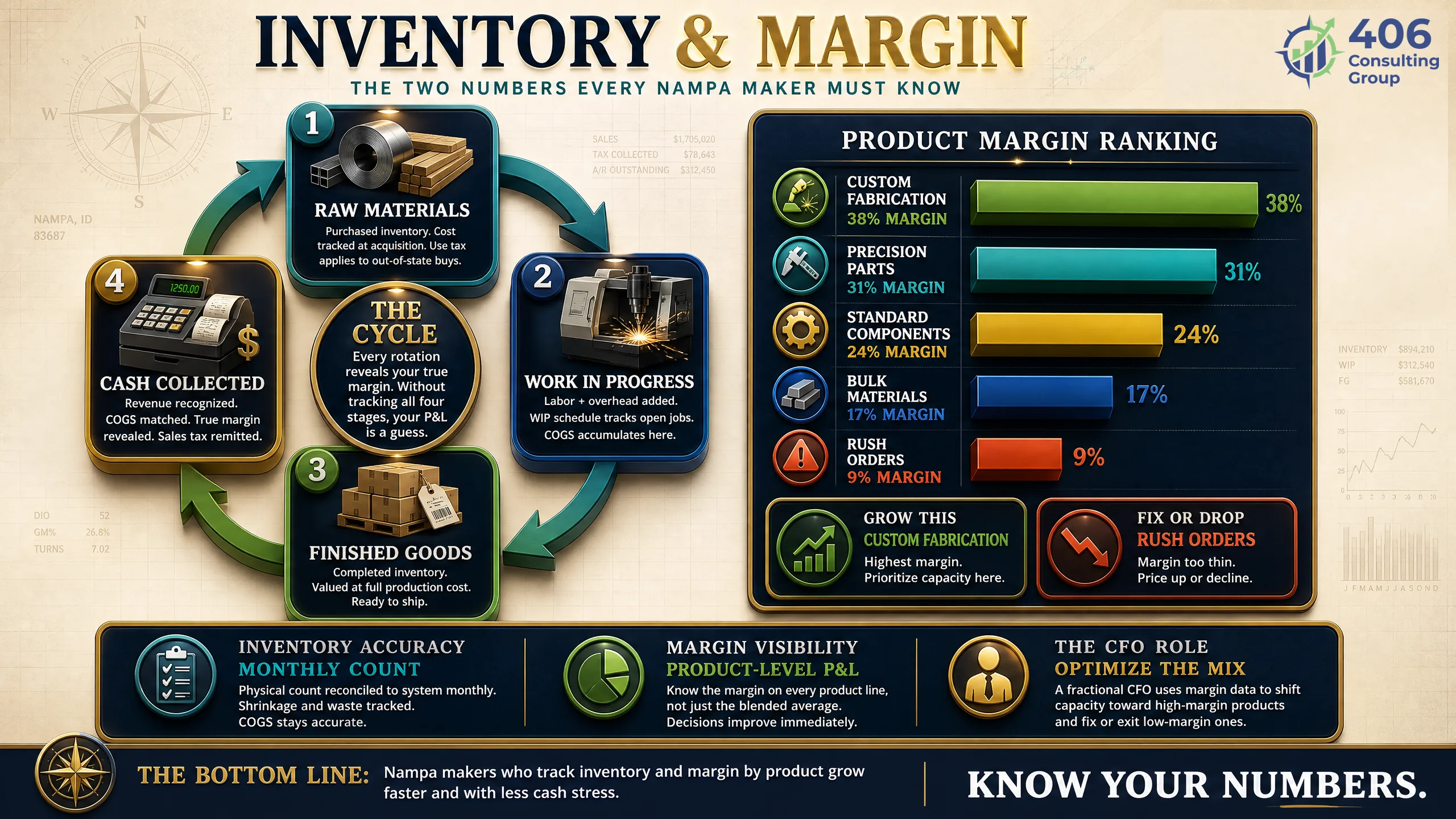
This work leans entirely on clean, correctly costed books — another reason the controller layer comes first.
Financing & Equipment-Loan Readiness
The short answer: makers grow on capital — a new machine, a line expansion, a bigger building, a working-capital line to fund inventory — and banks lend to businesses that can show clean, credible financials. Getting financing-ready before you need the money is one of the highest-return things a CFO does.
A lender wants reliable financial statements, a realistic forecast, and an owner who can speak to the numbers. A fractional CFO makes sure your financials hold up to underwriting, builds the projection the bank asks for, and helps you choose the right structure — an equipment loan, a lease, or a line of credit for inventory — arranged from a position of strength rather than a scramble. The buy-vs-finance and new-vs-used calls also carry tax and cash consequences; we break those down in new vs. used equipment.
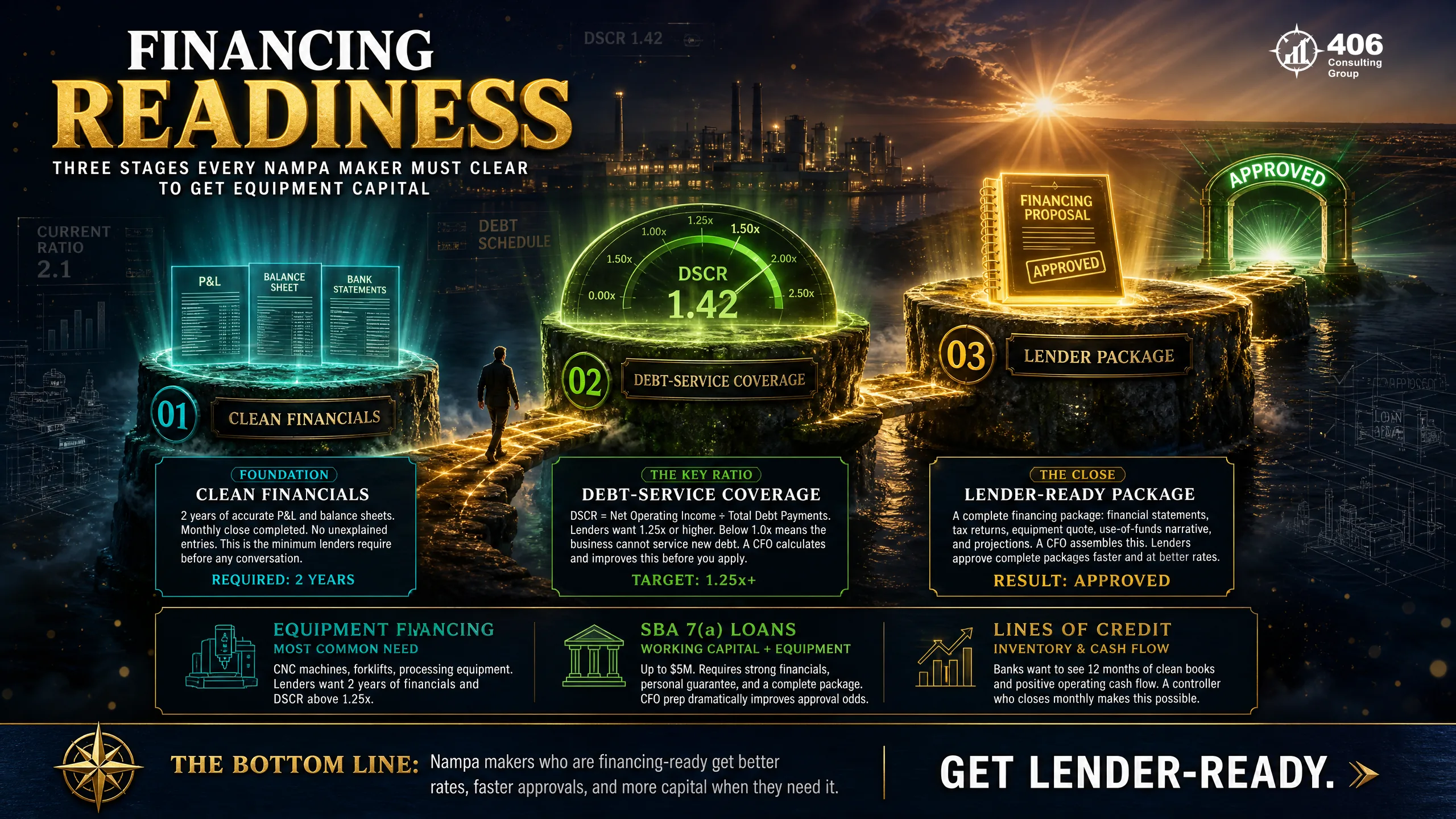
Curious what a lender actually scrutinizes? We break it down in what banks look at for a commercial loan.
Signs It's Time
The short answer: you're ready for controller or CFO support when the decisions have gotten bigger than your reporting can safely inform. A few clear signals for a maker:
Your books close late or inventory won't tie out
You can't trust COGS or margins when you need them to decide. (Controller.)
You can't tell which products actually make money
Revenue is up but real margins are a mystery. (Controller → CFO.)
Cash is tight despite growth
It's frozen in inventory, and the tax set-asides keep surprising you. (CFO.)
A machine or expansion needs financing
You're deciding on a big equipment purchase or a loan on instinct. (CFO.)
Everything runs through you
You're the only one who understands the numbers, and there's no system behind it. (Both.)
Not sure which you need? Our Financial Maturity Assessment points you to the right layer in about eight minutes.
Fractional vs. Full-Time: The Cost Math
The short answer: most growing makers need senior financial leadership long before they can justify — or keep busy — a full-time controller or CFO. That's exactly why fractional fits: you get the expertise scaled to your business, for a fraction of a full-time salary.

| Role | Fractional (monthly) | Full-time (all-in / year) |
|---|---|---|
| Controller | ~$2,500–$6,000 | $85K–$120K + ~25% benefits |
| Fractional CFO | ~$2,500–$5,000 | $150K–$300K+ + benefits |
| Both, coordinated | ~$4,000–$8,000 | $235K–$420K+ |
Fractional is dramatically more cost-effective until a business reaches the scale (generally $15M+) that keeps a full-time hire busy 40 hours a week — a level most growing makers can wait to reach while getting the leadership they need now.
Remote & How to Get Started
The short answer: what a growing maker needs from a controller or CFO is expertise — reliable reporting, inventory and margin discipline, cash forecasting, financing savvy, and knowledge of Idaho's taxes — not someone physically in Nampa. A great remote partner beats a local generalist, and the work is a natural fit for remote delivery.
And it's genuinely how this works now — even for clients down the road. Roughly 70–80% of our own local clients never come into the office; the high-value moments — a monthly review, a cash and inventory forecast, an equipment-financing decision, a margin analysis — happen over a screen share with live numbers. Secure cloud accounting means we see your books the same day you do, so a Nampa maker gets the same responsive financial leadership our in-town clients do. And because our background is in running whole businesses, we look at how each decision affects the whole operation — production, purchasing, and cash — not just the ledger.
Get the books reliable
Clean, current books where inventory and COGS tie out are the foundation. If yours are behind, that's where we start.
Build the forecast & reporting
Stand up controller reporting and a cash-flow forecast that accounts for inventory, growth, and the Idaho set-asides.
Steer with the numbers
Use reliable reporting to manage margin, get financing-ready for equipment, and make growth decisions on facts.
Wherever you are in that path, we can meet you there — and build the finance function around how your whole operation actually runs.
FAQ: CFO & Controller Questions
What's the difference between a controller and a CFO for a maker?
A controller owns the accounting function — a fast, accurate monthly close, clean financial statements, inventory and COGS that tie out, and internal controls. Their focus is making the numbers reliable and on time. A CFO owns the finance function — using those numbers to forecast cash across inventory and taxes, analyze product margins, secure financing, and plan growth. A growing maker needs both: the controller produces trustworthy numbers, and the CFO turns them into strategy.
Does my growing Nampa business need a controller or a CFO first?
Usually a controller first. If your books close late, inventory and COGS don't tie out, or you can't tell which products make money, you need reliable reporting before anything else — that's controller work. Add a CFO once the numbers are solid but you need cash-flow forecasting, margin and pricing analysis, equipment-financing readiness, or help with big growth decisions. Many makers are well served by controller-level support for a while, then layer in CFO strategy as decisions get bigger.
How much do CFO and controller services cost in Nampa, ID?
Fractional pricing typically runs about $2,500–$6,000 per month for a controller and about $2,500–$5,000 per month for a fractional CFO, depending on complexity and scope. A coordinated engagement covering both often runs roughly $4,000–$8,000 per month. Compare that to full-time salaries — $85K–$120K for a controller and $150K–$300K+ for a CFO, plus roughly 25% in benefits — and fractional is dramatically more cost-effective until a business reaches the scale (generally $15M+) that keeps a full-time hire busy year-round.
Why is my maker business profitable but always short on cash?
Because a maker's cash has claims a P&L doesn't show. Every dollar of inventory — raw materials and finished goods on the shelf — is cash you've spent but not yet recovered, and growth makes it worse because more sales require more inventory funded up front. On top of that, in Idaho you're holding sales tax for the state and will owe income tax on profit. A CFO builds a cash-flow forecast that reserves for inventory and both taxes, which is how a profitable producer stops running tight.
Can a fractional CFO help us finance a new machine?
Yes — equipment-financing readiness is one of the highest-return things a fractional CFO does for a maker. Banks lend to businesses that can show clean, credible financial statements, a realistic forecast, and an owner who can speak to the numbers. A CFO makes sure your financials hold up to underwriting, builds the projection the lender asks for, and helps you choose the right structure — equipment loan, lease, or line of credit — from a position of strength, ideally before you urgently need it, which means better terms.
Does 406 Consulting Group provide CFO and controller services in Nampa, ID?
Yes. 406 Consulting Group provides fractional CFO, controller, bookkeeping, payroll, and tax services to makers, producers, and growing businesses in Nampa, Canyon County, and across Idaho. We specialize in the financial leadership a scaling maker needs — reliable reporting with real COGS, inventory and margin management, cash-flow forecasting, equipment-financing readiness, and knowledge of Idaho's taxes — and we work remotely through secure cloud accounting. In fact, roughly 70–80% of our own local clients never come into the office. Because our background is in running whole businesses, we look at how each decision affects the entire operation.
Keep Reading — The Nampa Series
CFO & Controller — Nampa, ID
Grow the Output, Not the Cash Crunch.
406 Consulting Group gives growing Nampa makers the controller foundation and CFO strategy — reliable COGS, inventory and margin management, cash forecasting, and equipment-financing readiness — delivered remotely across Idaho. Let's build the finance function your growth needs.
Finance Leadership Quick Reference
Nampa, ID — Canyon County
The Growth-Ready Finance Framework
Scaling a Maker in Nampa?
Inventory, margin, cash & financing, handled.
About the Author
Jason Anderson
Co-Founder, 406 Consulting Group
Background in large-scale operational finance at BP before building financial infrastructure for Northwest businesses. Jason helps growing Nampa makers get real COGS and margins, forecast cash across inventory, and finance equipment on solid numbers instead of instinct.
Read the Full Story