
CFO & Controller Services for Spokane Valley, WA:
Financial Leadership for a Growing Business
A growing Spokane Valley business eventually can't be steered by feel — the numbers arrive late and can't answer what now matters. Here's how a controller and a fractional CFO deliver reliable reporting, cash-flow forecasting, margin analysis, and financing readiness, delivered remotely across Washington.

A Spokane Valley business that's growing well eventually runs into a problem that has nothing to do with sales: the owner can't see clearly enough to steer. Revenue is up, the team is bigger, there are more moving parts — and the monthly numbers arrive late, don't quite reconcile, and can't answer the questions that now matter. Which product line actually makes money? Can we afford the next hire, the bigger building, the new equipment? Are we ready if the bank asks for financials? That's not a bookkeeping problem anymore. It's a financial-leadership gap.
That gap is exactly what a controller and a fractional CFO fill. A controller makes your numbers reliable — a real monthly close, clean financials, reporting you can trust. A fractional CFO uses those numbers to manage cash, sharpen margins, get you financing-ready, and steer growth decisions. Together they turn a busy, growing Spokane Valley company into one that scales on purpose instead of by momentum — without the cost of two senior full-time hires.
This guide covers what each role does for a growing commercial or industrial business, when you need them, what they cost, and how a firm delivers it remotely. It builds on the layers beneath it — our Spokane Valley bookkeeping and tax guides — so if those aren't handled yet, start there.
By Jason Anderson — Co-Founder, 406 Consulting Group. Background in large-scale operational finance at BP before building financial infrastructure for businesses across the Northwest, where cash forecasting, financing decisions, and margin analysis are everyday work.
Quick Answer: Controller & CFO for a Growing Business
- →Controller: owns the monthly close, clean financials, and reporting you can trust.
- →CFO: owns cash-flow strategy, margin and pricing, financing readiness, and growth decisions.
- →Growth is the trigger: more revenue and more moving parts outrun books that used to be enough.
- →Fractional gives you both roles for ~$4,000–$8,000/month — a fraction of full-time salaries.
- →Delivered remotely across Washington — even most of our local clients never come to the office.
Table of Contents
Controller vs. CFO: The 30-Second Difference
The short answer: a controller makes your numbers accurate and on time; a CFO uses those numbers to make better decisions about cash, margin, financing, and growth. A bookkeeper records what happened, a controller makes it reliable, and a CFO decides what to do about it — and a growing business eventually needs all three.
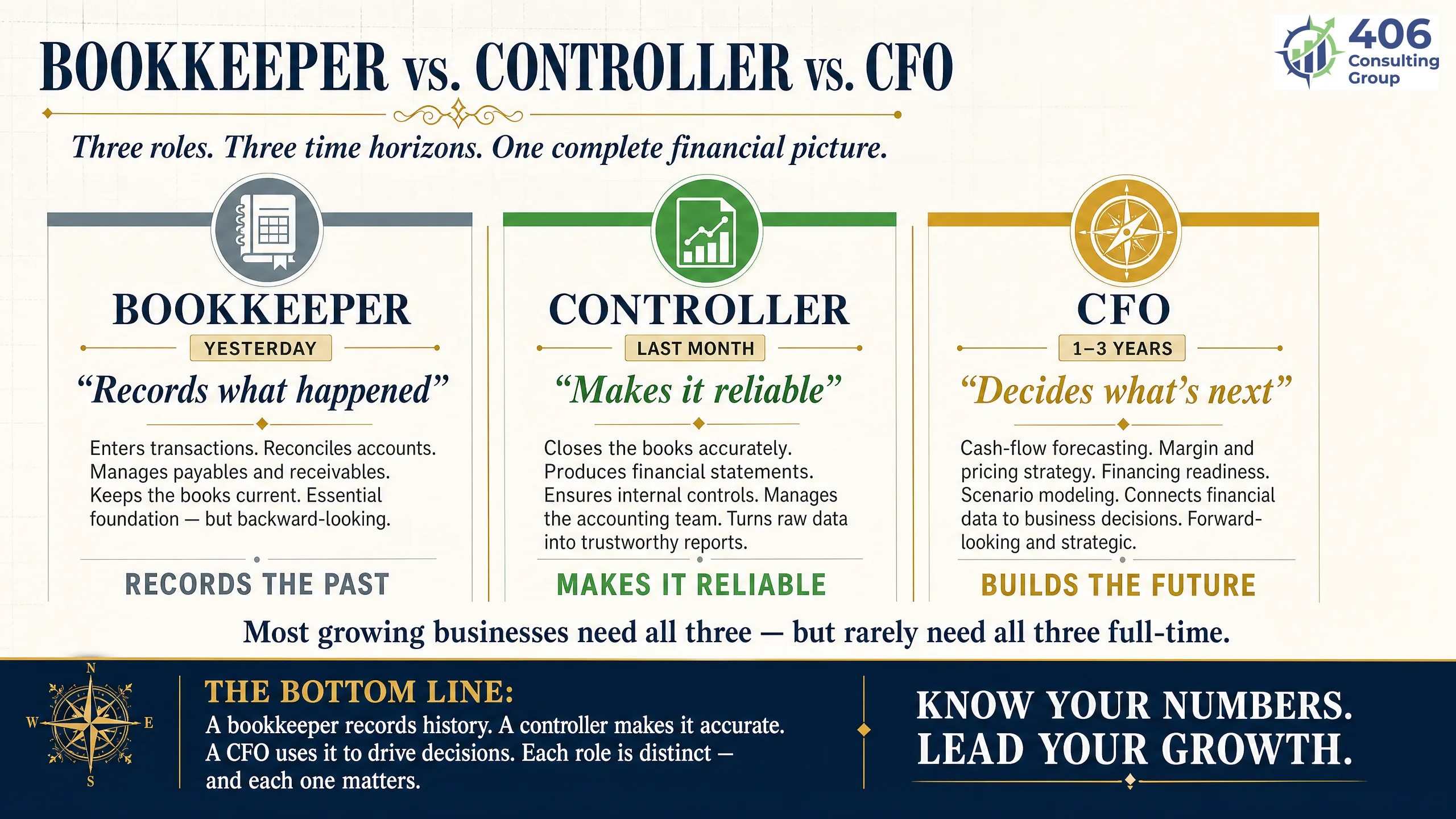
| Bookkeeper | Controller | CFO | |
|---|---|---|---|
| Owns | Transactions | The close & reporting | Financial strategy |
| Time horizon | Yesterday | Last month | Next 1–3 years |
| Answers | What did we spend? | Are the numbers right? | What should we do next? |
Want the full "which role, and when" breakdown with a revenue-and-complexity ladder? We go deep in our controller-vs-CFO guide. This article is about what these roles do for a growing Spokane Valley business specifically.
Why Growing Businesses Hit a Ceiling
The short answer: a business hits a financial ceiling when growth outpaces the owner's ability to run the numbers by feel — too many products, customers, and employees, and decisions too expensive to get wrong. The books that carried you to $1M can't steer you through $5M.
The symptoms are consistent: the monthly close slips later and later; you can't tell which lines or jobs actually make money; cash feels tight even in good months; a financing conversation stalls because the financials aren't clean; and every real decision still routes through the owner because no one else has the numbers. None of that is a failure of effort — it's the predictable point where a growing business needs a real finance function, not just accurate bookkeeping.

Pushing through takes reliable reporting and real cash and margin management — the controller and CFO functions. The framework below is how they fit together.
The Growth-Ready Finance Framework
Financial leadership for a growing business comes down to five layers, each building on the one before. Get them in order and growth stops being a source of financial stress and becomes something you can actually plan and fund.
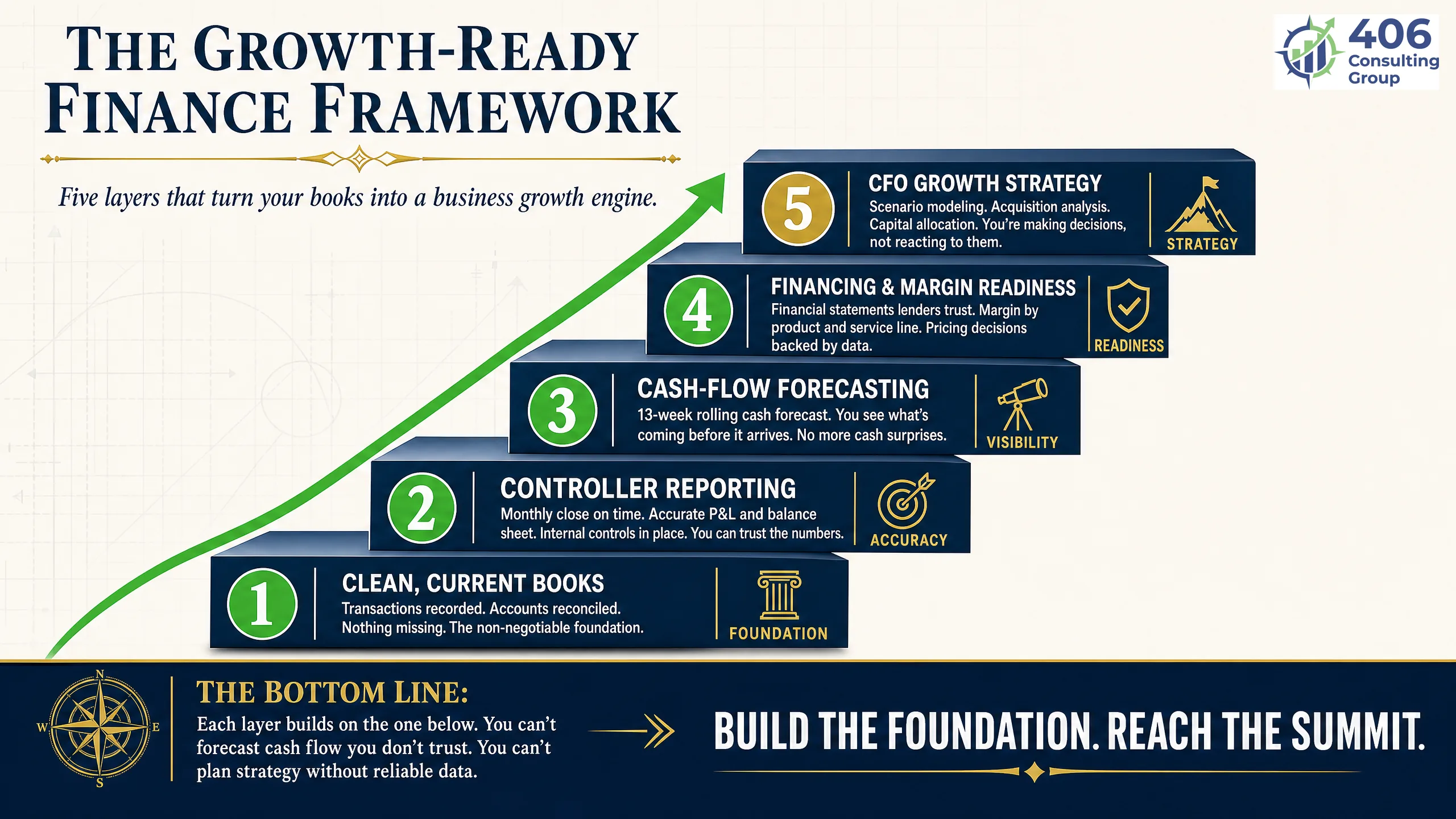
Clean, current books
An accurate monthly close with revenue tracked by line and by B&O classification — the foundation.
Controller reporting
Financials you can trust, on time, with the reports to see what's actually happening in the business.
Cash-flow forecasting
A rolling forecast that accounts for growth, payroll, and the sales-tax and B&O remittances coming due.
Financing & margin readiness
Bank-ready financials and real margin visibility, so you can fund growth and price it right.
CFO growth strategy
Turning reliable numbers into decisions — hiring, expansion, and capital, made on facts.
The first two layers are controller work; the last three are where a CFO earns their keep. Here's what each role delivers.
What a Controller Delivers
The short answer: a controller makes your numbers trustworthy and timely, so you can run the business on facts instead of guesses. For a growing Spokane Valley business, that means a fast, accurate monthly close and reporting that finally answers "how are we really doing?"
Concretely, a controller owns the monthly close; builds financial reporting that shows performance by product, service line, or location; keeps the books clean enough to trust for financing and tax (including correct B&O classification); and puts internal controls in place so cash is handled safely as the team grows. The payoff is simple: reliable numbers, on time, every month — the prerequisite for every decision above it.
For many businesses, strong controller support is the first step up from bookkeeping — we cover that transition in when to upgrade from bookkeeping to a controller. Our controller services are built for exactly this.
What a Fractional CFO Delivers
The short answer: a CFO turns reliable numbers into decisions — managing cash, sharpening margins, securing financing, and steering growth. This is the role that keeps growth from outrunning the bank account and makes sure expansion actually pays.
For a growing Spokane Valley business, a fractional CFO builds a cash-flow forecast that accounts for payroll, growth, and Washington's excise obligations; analyzes margins so you know which lines to push and which to fix or drop; gets you financing-ready and helps structure the right debt for expansion; and models the big decisions — a new location, a major hire, a capital purchase — before you commit. They give the owner a true partner on the numbers, so the business isn't steered by one person's gut.

That's the difference between growing and scaling. Our fractional CFO services bring that leadership without a full-time hire.
Cash Flow & the Washington Wrinkle
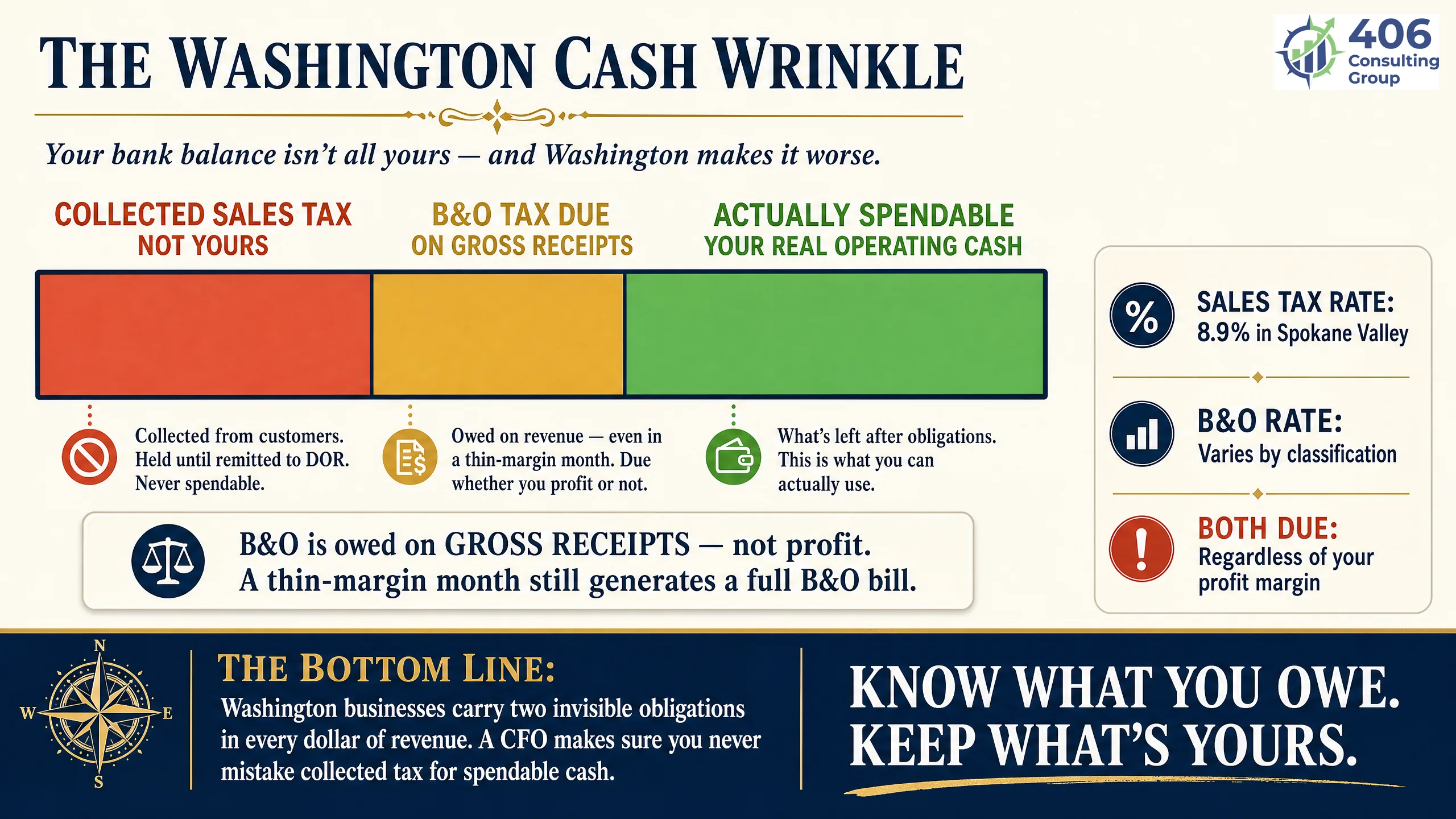
The short answer: cash-flow forecasting is the CFO discipline that matters most to a growing business, and in Washington it has a specific wrinkle — a chunk of the cash in your account isn't yours. Collected sales tax and the B&O you'll owe are both real claims on that balance, and a forecast that ignores them overstates what you can actually spend.
Growth makes this sharper. As revenue climbs, so do the sales tax you're holding and the B&O due on gross receipts — and because B&O is on revenue, not profit, it keeps coming even in a thin-margin stretch. A real forecast treats collected sales tax as the liability it is, sets aside the B&O, and still shows you enough runway to fund payroll and growth. That's how a growing Washington business avoids the "we were up all year and still ran tight" trap.
If "profitable on paper but always tight on cash" sounds familiar, that's a specific, fixable problem — we break it down in Profitable But No Cash.
Financing & Banking Readiness
The short answer: growth usually needs capital — a line of credit, an equipment loan, a building — and banks lend to businesses that can show clean, credible financials. Getting financing-ready before you need the money is one of the highest-return things a CFO does.
A lender wants reliable financial statements, a realistic forecast, and an owner who can speak to the numbers. A fractional CFO makes sure your financials hold up to underwriting, builds the projection the bank will ask for, and helps you approach financing from a position of strength — arranging the line of credit while things are good rather than scrambling when cash is tight. That readiness often makes the difference between an approval and a decline, and between good terms and expensive ones.

Curious what a lender actually scrutinizes? We break it down in what banks look at for a commercial loan.
Margin & Pricing
The short answer: growing revenue without knowing your margins is how businesses get bigger and less profitable at the same time. A CFO gives you margin visibility — by product, service line, customer, or location — so you know what's actually making money and can price accordingly.
It's common for a business to have a few lines quietly carrying the rest, or a "big" customer who's barely profitable once you account for the true cost to serve them. Without margin analysis, an owner chases revenue that doesn't build the bottom line. With it, you push what pays, fix or reprice what doesn't, and make pricing decisions on data instead of what a competitor charges. For a growing Spokane Valley business, that clarity often finds more profit than the next chunk of new sales would.
Margin work leans on clean, correctly categorized books — another reason the controller layer comes first.
Signs It's Time
The short answer: you're ready for controller or CFO support when the decisions have gotten bigger than your reporting can safely inform. A few clear signals:
Your books close late or you don't trust them
You can't get reliable numbers when you need them to decide. (Controller.)
You can't tell which lines make money
Revenue is up but you can't see where the profit actually comes from. (Controller → CFO.)
Cash is tight despite growth
Good months still feel tight, and sales tax and B&O keep surprising you. (CFO.)
A financing or big decision is looming
A loan, a building, a major hire you're deciding on instinct. (CFO.)
Everything runs through you
You're the only one who understands the numbers, and there's no system behind it. (Both.)
Not sure which you need? Our Financial Maturity Assessment points you to the right layer in about eight minutes.
Fractional vs. Full-Time: The Cost Math
The short answer: most growing businesses need senior financial leadership long before they can justify — or keep busy — a full-time controller or CFO. That's exactly why fractional fits: you get the expertise scaled to your business, for a fraction of a full-time salary.
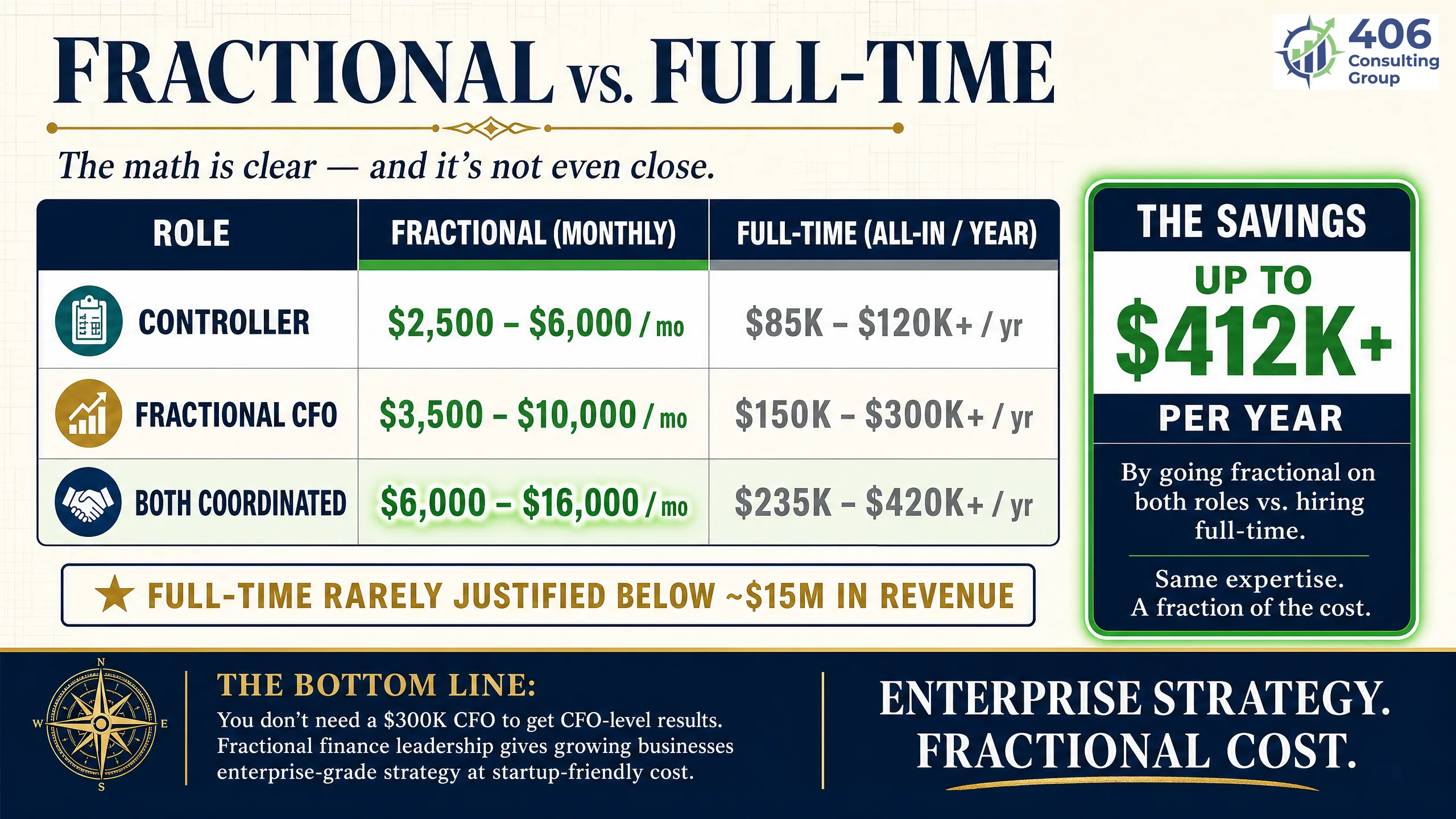
| Role | Fractional (monthly) | Full-time (all-in / year) |
|---|---|---|
| Controller | ~$2,500–$6,000 | $85K–$120K + ~25% benefits |
| Fractional CFO | ~$2,500–$5,000 | $150K–$300K+ + benefits |
| Both, coordinated | ~$4,000–$8,000 | $235K–$420K+ |
Fractional is dramatically more cost-effective until a business reaches the scale (generally $15M+) that keeps a full-time hire busy 40 hours a week — a level most growing businesses can wait to reach while getting the leadership they need now.
Remote & How to Get Started
The short answer: what a growing business needs from a controller or CFO is expertise — reliable reporting, cash and margin discipline, financing savvy, and knowledge of Washington's tax structure — not someone physically in Spokane Valley. A great remote partner beats a local generalist, and the work is a natural fit for remote delivery.
And it's genuinely how this works now — even for clients down the road. Roughly 70–80% of our own local clients never come into the office; the high-value moments — a monthly review, a cash forecast, a financing decision, a pricing analysis — happen over a screen share with live numbers. Secure cloud accounting means we see your books the same day you do, so a Spokane Valley business gets the same responsive financial leadership our in-town clients do. And because our background is in running whole businesses, we look at how each decision affects the whole operation — not just the ledger.
Get the books reliable
Clean, current, correctly classified books are the foundation. If yours are behind, that's where we start.
Build the forecast & reporting
Stand up controller reporting and a cash-flow forecast that accounts for growth and WA excise obligations.
Steer with the numbers
Use reliable reporting to manage margin, get financing-ready, and make growth decisions on facts.
Wherever you are in that path, we can meet you there — and build the finance function around how your whole business actually runs.
FAQ: CFO & Controller Questions
What's the difference between a controller and a CFO?
A controller owns the accounting function — a fast, accurate monthly close, clean financial statements, reporting, and internal controls. Their focus is making the numbers reliable and on time. A CFO owns the finance function — using those numbers to forecast cash, analyze margins, secure financing, and plan growth. A growing business needs both: the controller produces trustworthy numbers, and the CFO turns them into strategy. A bookkeeper records transactions, a controller makes them reliable, and a CFO decides what to do about them.
Does my growing Spokane Valley business need a controller or a CFO first?
Usually a controller first. If your books close late, you can't fully trust them, or you can't tell which lines make money, you need reliable reporting before anything else — that's controller work. Add a CFO once the numbers are solid but you need cash-flow forecasting, margin and pricing analysis, financing readiness, or help with big growth decisions. Many businesses are well served by controller-level support for a while, then layer in CFO strategy as decisions get bigger.
How much do CFO and controller services cost in Spokane Valley, WA?
Fractional pricing typically runs about $2,500–$6,000 per month for a controller and about $2,500–$5,000 per month for a fractional CFO, depending on complexity and scope. A coordinated engagement covering both often runs roughly $4,000–$8,000 per month. Compare that to full-time salaries — $85K–$120K for a controller and $150K–$300K+ for a CFO, plus roughly 25% in benefits — and fractional is dramatically more cost-effective until a business reaches the scale (generally $15M+) that keeps a full-time hire busy year-round.
How does a CFO help a Washington business with cash flow?
A CFO builds a rolling cash-flow forecast that reflects reality — including the Washington wrinkle that collected sales tax and the B&O you'll owe are claims on your account, not spendable cash. As you grow, those obligations grow with revenue (B&O is on gross receipts, not profit), so a forecast that treats sales tax as a liability and sets aside B&O keeps a growing business from the 'up all year but still tight' trap, while still showing enough runway to fund payroll and growth.
Can a fractional CFO help us get a loan or line of credit?
Yes — financing readiness is one of the highest-return things a fractional CFO does. Banks lend to businesses that can show clean, credible financial statements, a realistic forecast, and an owner who can speak to the numbers. A CFO makes sure your financials hold up to underwriting, builds the projection the bank asks for, and helps you arrange financing from a position of strength — ideally before you urgently need the money, which leads to better terms and higher approval odds.
Does 406 Consulting Group provide CFO and controller services in Spokane Valley, WA?
Yes. 406 Consulting Group provides fractional CFO, controller, bookkeeping, payroll, and tax services to growing businesses in Spokane Valley and across Washington. We specialize in the financial leadership a scaling business needs — reliable reporting, cash-flow forecasting, margin analysis, financing readiness, and knowledge of Washington's B&O and sales-tax structure — and we work remotely through secure cloud accounting. In fact, roughly 70–80% of our own local clients never come into the office. Because our background is in running whole businesses, we look at how each decision affects the entire operation.
Keep Reading — The Spokane Valley Series
CFO & Controller — Spokane Valley, WA
Scale on Purpose, Not by Momentum.
406 Consulting Group gives growing Spokane Valley businesses the controller foundation and CFO strategy — reliable reporting, cash-flow forecasting, margin analysis, and financing readiness — delivered remotely across Washington. Let's build the finance function your growth needs.
Finance Leadership Quick Reference
Spokane Valley, WA — Spokane County
The Growth-Ready Finance Framework
Scaling in Spokane Valley?
Reporting, cash, margin & financing, handled.
About the Author
Jason Anderson
Co-Founder, 406 Consulting Group
Background in large-scale operational finance at BP before building financial infrastructure for businesses across the Northwest. Jason helps growing Spokane Valley owners get reliable reporting, forecast cash, and steer growth decisions on real numbers instead of instinct.
Read the Full Story