
The Conversation You're Avoiding:
The Real Cost of the Employee You Won't Deal With
Every owner has one — the employee everyone works around, the review that's a year overdue. Looking away feels kind. It's quietly costing you your best people. Here's the fix.
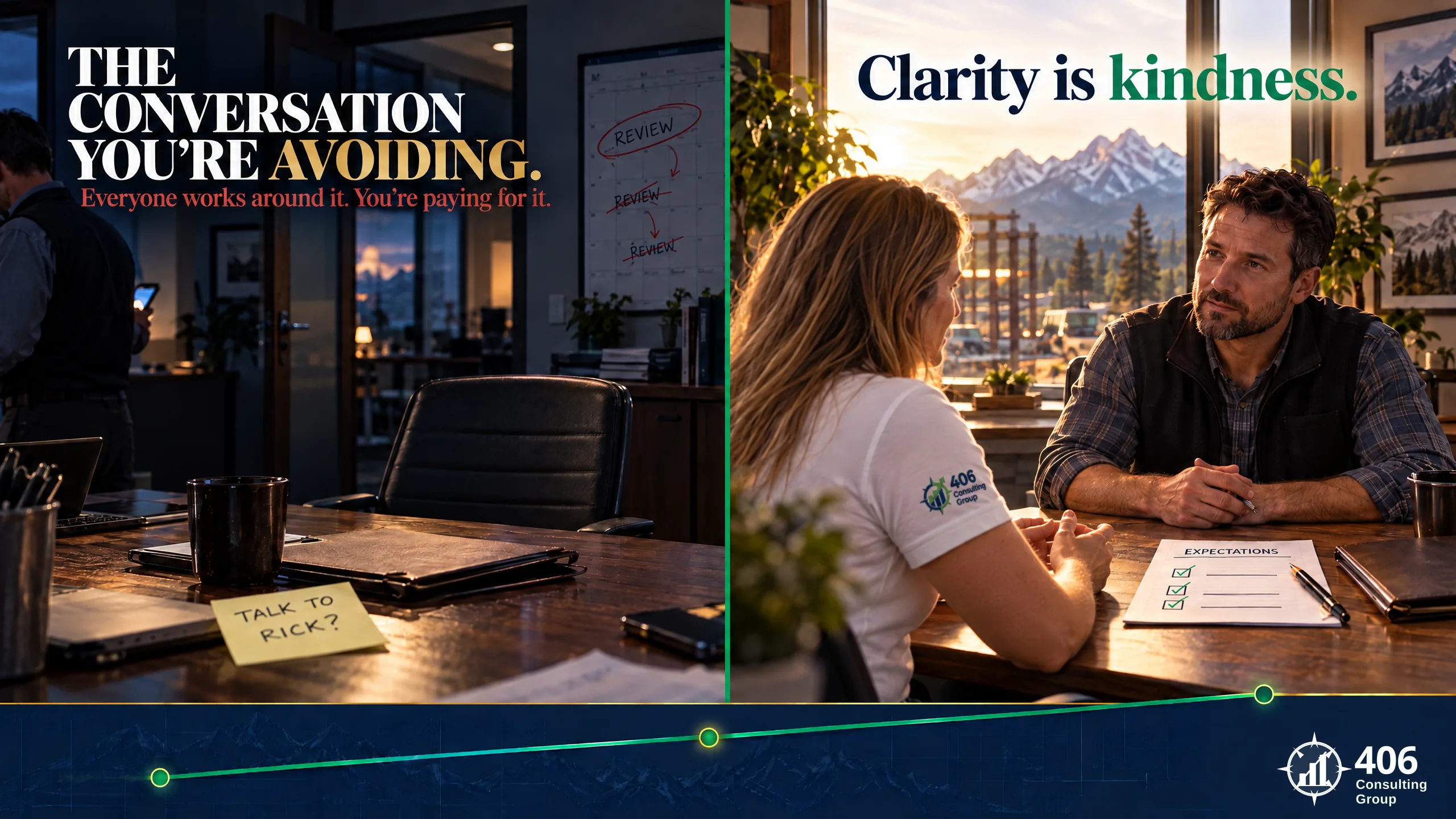
Every owner has one. The employee the whole team quietly works around. The review that's been “coming up” for a year. The conversation you rehearse in the truck and then don't have. Looking away feels like the kind thing to do — you don't want the conflict, you don't want to be unfair, and honestly, you're busy. But avoidance isn't neutral. While you wait, it's costing you the one thing you can't afford to lose: your best people and your own standards.This is about the hardest part of running a business — the people part — and why it's really the same problem as every other one we fix.

By Jason Anderson
Co-Founder, 406 Consulting Group
Degreed accountant with 10+ years in tax and a decade of enterprise operations and accounting at BP — with a Six Sigma discipline for systems and job costing.
The people and figures below are illustrative, to show how the fix works — not real individuals or a guarantee. Your situation and timeline depend on your team and your business.
Quick answer
What's the real cost of avoiding a hard conversation with an employee?
Far more than the discomfort you're dodging. When an owner avoids addressing a difficult or underperforming employee, the cost shows up everywhere else: your best people burn out and leavebecause they're carrying the dead weight, your standards quietly slide to whatever the weakest link tolerates, and you become the bottleneck for everything that person should be handling. The hard conversation is a one-time cost. Avoiding it is a recurring one.
The fix isn't a single dramatic confrontation — it's a rhythm: clear expectations in writing, regular reviews instead of an annual ambush, documentation, and a real chance to improve before a decision. And because owners put this off for years, the thing that actually makes it happen is accountability — a partner who holds you to the conversation you keep rescheduling. See where your business stands with our free maturity assessment.
The conversation you keep rescheduling
Picture Dana, who owns a 35-person Montana services company. She has a long-tenured employee — call him Rick — who was great five years ago and has slowly become the person everyone routes around. Work gets re-checked behind him. Two of her best younger employees have quietly asked to be moved off his projects. Dana knows. She's known for over a year. And every time she blocks out an hour to finally talk to him, something “more urgent” comes up, and she's a little relieved it did.
That relief is the trap. The conversation never gets easier by waiting — it gets harder, because now there's a year of unaddressed drift behind it. Meanwhile the real damage isn't Rick. It's what Dana's best people are learning: that performance doesn't matter here, because the owner won't deal with the person who proves it.
Why owners look away (it's not weakness)
Avoiding the hard conversation isn't a character flaw. It's a predictable result of three things being missing — the same three things missing from every process that runs on a scramble:
No clear standard
Expectations live in your head, never written down — so “underperforming” feels like an opinion, not a fact you can point to.
No cadence
There’s no regular review, so feedback only happens when you’re already furious — which makes it feel like an attack.
No accountability
No one holds you to having the conversation, so the urgent always wins and “next week” becomes next year.
Notice the pattern — no standard, no cadence, no accountability. It's the exact shape of the invoicing scramble, just pointed at a person instead of an invoice. The people problem isn't a different kind of problem. It's a systems problem wearing a human face.
What looking away actually costs
“It's not worth the drama” is the most expensive sentence an owner says. Here's the bill, and most of it never shows up as a line item:
Illustrative cost of one unaddressed employee — a 35-person company
$50K–$150K / yr
in lost productivity, re-work, the drag on everyone around them, and — the big one — the cost of a good employee quitting because nothing changed.
Your best people leave
High performers won’t carry dead weight forever. When they see it tolerated, the strongest ones — the ones with options — go first.
Standards reset downward
The whole team recalibrates to what you allow. The weakest tolerated performance quietly becomes the new normal.
You become the bottleneck
Work you can’t trust to that person routes back to you. The business leans harder on you, not less — the opposite of scaling.
A bad hire or a wrong-fit employee is one of the most expensive things in a business — you can put real numbers on it with our hiring scenario calculator and payroll burden calculator. The point isn't to fire faster. It's to stop paying, silently, for a decision you keep not making.
Avoiding it isn't kind. It's the opposite.
Here's the reframe that changes everything: the owner who avoids the conversation tells themselves they're being considerate. But think about it from Rick's side. He's been underperforming for a year and no one has told him. He has no idea he's on thin ice, no chance to fix it, and no honest picture of where he stands. That isn't kindness. Clarity is kindness. The cruelest thing you can do to an employee is let them fail quietly while you plan around them.
And the math is brutal when you lay it out plainly: you're risking your two best people, your standards, and your own time — to avoid one uncomfortable hour. Said out loud, the trade is absurd. The conversation isn't the risk. Not having it is.
The fix: make feedback a rhythm, not an ambush
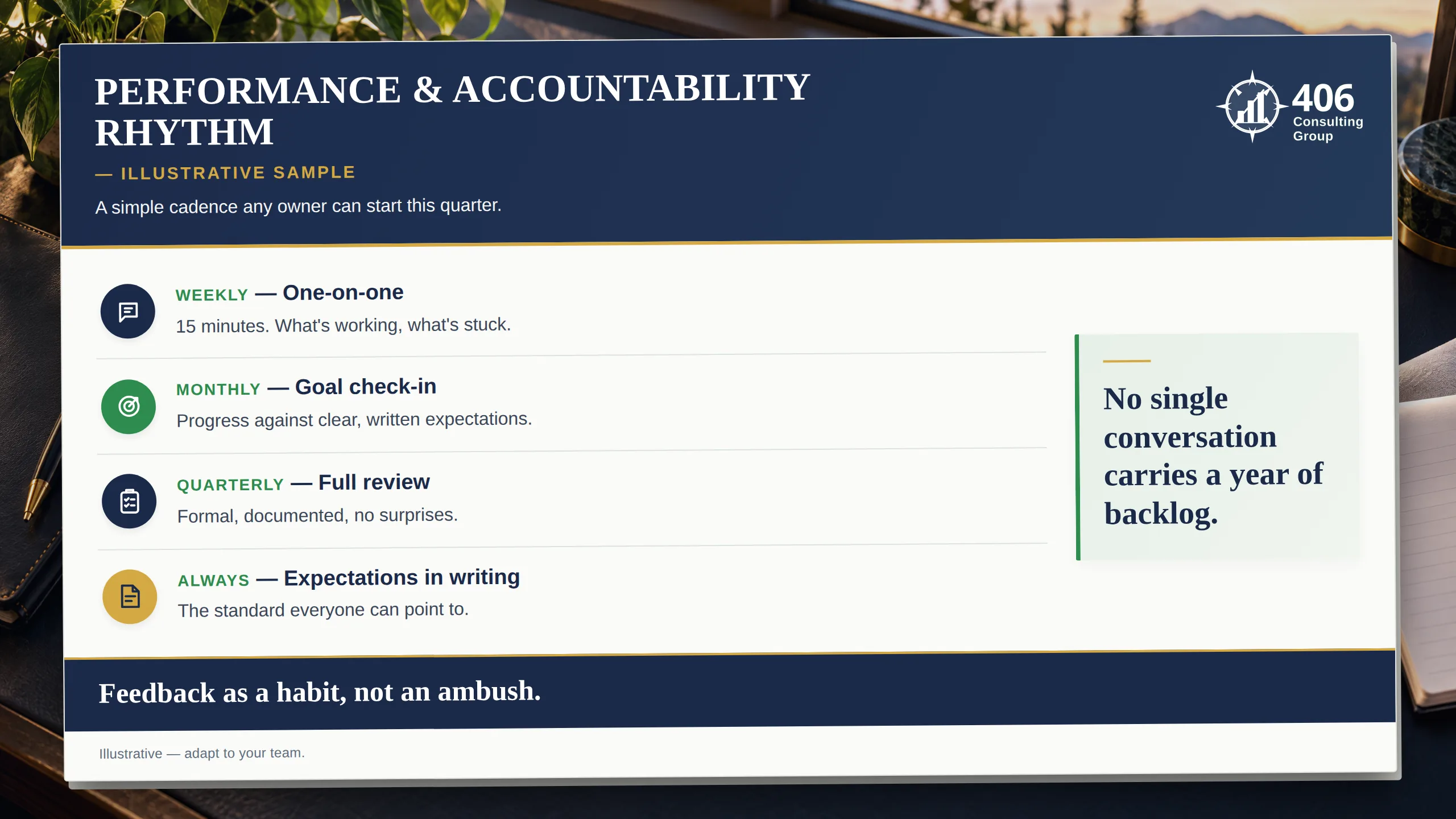
The reason the conversation feels so heavy is that it's a once-a-year (or once-a-crisis) event. The fix is to make it small and regular instead of rare and explosive — a cadence. When feedback happens on a schedule, no single conversation has to carry a year of backlog, and “how you're doing” stops being a threat and becomes a habit.
This is the same discipline we bring to the numbers, applied to people: define the standard, make it visible, check it on a cadence, and act on what you see. It's processes, not heroes — getting expectations out of your head and into a system, so the business doesn't depend on you being in a confronting mood. Building that rhythm is exactly what our systems work does.
How to actually run the hard conversation
When it's time, structure takes the fear out of it. You're not winging an emotional confrontation — you're running a process:
Put the standard in writing
Name the specific gap between what’s expected and what’s happening — behaviors and results, not personality. Facts you can point to, not feelings.
Say it plainly and early
Direct, respectful, and without the year of stored-up frustration. They can’t fix what no one has clearly told them.
Give a real, time-bound chance
A clear plan, concrete milestones, and a date. Most people rise to a clear bar — and the ones who won’t, reveal it quickly.
Document, then decide
Keep a simple record. If it turns around, you’ve kept a good employee. If it doesn’t, you can part ways cleanly and fairly — for both of you.
None of this is about being harsh. It's about being clear — which is the only version of this that's actually fair to everyone, including the employee. For more on the specific damage a tolerated problem does, see the real cost of a toxic employee and why you can't scale on people who stopped growing.
Why you still won't do it alone — and what fixes that
Here's the uncomfortable truth, and it's the whole point of this series. You already know most of the above. Knowing what to do was never the problem. Doing it — on a date, when the day-to-day is screaming for your attention — is the problem. A plan you set for yourself and no one checks is a plan that quietly dies, whether it's a 90-day financial roadmap or a promise to finally talk to Rick.
On your own
- • “I'll deal with it next week” — every week
- • No one asks whether the conversation happened
- • The urgent crowds out the important, again
- • A year later, same problem, more resentment
With a partner in your corner
- • A standing review of the people side, not just the P&L
- • Someone who asks: did you have the conversation?
- • Help building the review rhythm so it sticks
- • A quarter later, it's handled — for real
That's the accountability difference we make the case for in why the score is the easy part. A good advisor isn't just an analyst — they're the person who asks the question you've been avoiding, and keeps asking until it's done.
People, performance, and profit are the same conversation
Most firms would tell you the employee issue isn't their lane — “we just do the books.” We don't see it that way. A tolerated performance problem shows up in your margins, your capacity, and your ability to ever step back from the business. We look at your company as one connected system — how people, process, and cash actually move together — because the resistance that stalls a business is almost always a people-and-systems problem before it's a numbers problem.
That's what advisory and fractional CFO work really are at 406: not just reporting the numbers, but sitting beside you on the decisions that move them — including the hard ones about people. A business that runs on clear standards and gets the right people in the right seats is also the business that can one day run — or sell — without you.
Where to start
You don't have to fire anyone this week. Start smaller: write down the standard, put a real review rhythm on the calendar, and name the one conversation you've been avoiding. Then — this is the part that actually works — tell someone who'll hold you to it.
Stop planning around the problem. Deal with it — with backup.
Take the free Financial Maturity Assessment to see where your business — people and numbers — really stands. Then talk to a founder about building the rhythm, and having a partner who holds you to the conversations that matter.
Who You’re Actually Working With
Two founders who’ve sat on both sides of your financials
We've run teams and built the systems that hold people to a standard — not just booked the payroll. The hard people calls are part of the whole-company view we bring. You aren’t handed off to a junior bookkeeper. You work directly with the people whose names are on the door — and their backgrounds are exactly the ones a growing business needs in its corner.

Carrie Anderson
Co-Founder · The Lender’s Eye
A former corporate controller and the contracted commercial loan analysta Montana community bank relies on — she has spread, packaged, and recommended 300+ commercial loans. She knows exactly how a bank reads your financials to decide what you can borrow — because she’s the one doing that analysis. That’s why our clients’ books come out lender-ready, not just tax-ready.

Jason Anderson
Co-Founder · The Operator’s Eye
A degreed accountant with 10+ years in tax and a decade of enterprise operations and accounting at BP, with a lifelong discipline for process, efficiency, and Six Sigma— made practical, not academic. He builds the job costing, tax strategy, and systems that let a company actually see where its money goes and scale without the wheels coming off.
Both spent years in the oil & gas industry, and both design financial systems from a whole-company view— not just an accounting lens. You get a firm that reads your numbers like a lender and builds systems like an operator.
Meet the teamFAQ
What's the real cost of avoiding a hard conversation with an employee?
Far more than the discomfort. When you avoid addressing an underperforming or difficult employee, your best people burn out and leave because they're carrying the slack, your standards slide to whatever the weakest link tolerates, and you become the bottleneck for work you can't trust to that person. The hard conversation is a one-time cost; avoiding it is a recurring one that often runs into tens of thousands of dollars a year in lost productivity, re-work, and turnover of your good people.
How do I start a performance conversation with a long-term employee?
Structure takes the fear out of it. Put the specific gap in writing (behaviors and results, not personality), say it plainly and early before a year of frustration builds up, give a clear and time-bound chance to improve with concrete milestones, and document it. Most people rise to a clear bar, and the ones who won't reveal it quickly — so you can part ways cleanly and fairly. The goal is clarity, not confrontation.
How often should I do employee reviews?
More often and less formally than once a year. An annual review is an ambush — it forces a whole year of feedback into one tense meeting. A better rhythm is short, regular one-on-ones (weekly or biweekly), a monthly check-in on goals, and a more substantial quarterly review. When feedback is a habit instead of an event, no single conversation has to carry a backlog, and performance issues get caught while they're still small.
Is it kinder to just avoid the conversation?
No — it's the opposite. An employee who's underperforming and has never been told has no idea they're at risk, no honest picture of where they stand, and no chance to fix it. Letting someone fail quietly while you plan around them isn't kindness; clarity is kindness. A direct, respectful conversation gives them something avoidance never can: a real chance to succeed.
Why can't I just handle the employee issue myself?
You can, and you know roughly how. The problem was never knowing what to do — it's doing it on a date when the day-to-day is screaming for your attention. A plan you set for yourself and no one checks tends to die. That's why accountability matters: a partner who helps build the review rhythm and actually asks whether the conversation happened turns good intentions into a handled situation. It's the same reason a financial plan works better with someone holding you to it.
This article is general business and operational education, not legal, HR, or employment-law advice for your specific situation. Employment decisions carry legal considerations that vary by state and circumstance; consult qualified counsel before acting. The people and figures here are illustrative.
In one line
Avoiding the hard employee conversation isn't kind — it costs you your best people. A review rhythm fixes it, and a partner who holds you to it is what makes it actually happen.
Start here