
Fix Your Weakest Link First:
Why Trying to Improve Everything at Once Fails
Most owners write a 14-item fix-it list and move nothing. A business improves one constraint at a time — find the single weakest link, fix that first, then move up together.

Most owners trying to improve their business do the natural thing: they make a list of everything that's wrong and try to fix all of it. Better books, better hiring, better marketing, better systems, better cash flow — all at once, starting Monday. Three months later, the list looks the same, everyone's exhausted, and nothing actually moved. The problem isn't effort or will. It's strategy. A business doesn't improve across the board at once — it improves one constraint at a time. The highest-return move you can make is to find your single weakest link and fix that first.

By Jason Anderson
Co-Founder, 406 Consulting Group
Degreed accountant with 10+ years in tax and a decade of enterprise operations and accounting at BP — with a Six Sigma discipline for systems and job costing.
The example business and figures below are illustrative, to show how the principle works — not a specific client or a guarantee. Your weakest link and timeline depend on your situation.
Quick answer
Why fix one weak area first instead of improving everything at once?
Because a business behaves like a chain: its overall strength is set by its weakest link, not its average. Spreading your energy across ten things at once means none of them gets enough to actually change — and the one area that's truly holding you back keeps holding you back. Improving a part that isn'tthe constraint produces almost no gain; it's polishing a strength while the real bottleneck leaks.
The disciplined move is to find the one area that caps everything above it, concentrate your effort there until it's no longer the constraint, and then move to the next one. It's faster, cheaper, and far more likely to stick. A financial maturity assessment is one quick way to see which area is actually your weakest link.
The improvement list that never moves
Here's the scene we see constantly. A motivated owner — let's stay with Summit Builders, a $20M commercial GC — sits down over a weekend and writes the list: fix the late books, tighten job costing, hire a project manager, redo the website, renegotiate with suppliers, build a cash forecast, deal with the foreman everyone avoids. Fourteen items. All real. All worth doing. Monday morning, they start pushing on all fourteen.
By spring, nothing's finished. A little progress on eight fronts evaporates the moment a busy week hits. The owner concludes they need to work harder or hire more. They don't. They need to do less, on purpose — pick the one thing that's actually capping the business, and go all in on it first.
A business is a chain, not an average
Pull on a chain and it breaks at exactly one spot — the weakest link — no matter how strong every other link is. A business works the same way. Your capacity to grow is capped by your single biggest constraint, not by the average of how you're doing. Nine strong links and one weak one is a weak chain.
Your business is only as strong as…
Five strong links can't compensate for one weak one — the weak one sets the limit for all of them.
This is the Theory of Constraints in plain English: every system has one bottleneck that limits the whole, and the only way to raise the whole system's output is to work on that bottleneck. Work anywhere else and you're busy, not better. Sun Tzu said it as a general: don't divide your force across the whole front — concentrate it at the decisive point.
Why improving a strength feels productive and changes nothing
Here's the trap: we gravitate to the work we're already good at, because it's satisfying. The contractor who loves operations keeps optimizing the schedule while the books stay a month late. The owner who loves sales lands more work the broken billing process can't keep up with. It feels like progress — you're doing real work — but you're tuning the engine on a truck with a flat tire. The car doesn't go faster until you fix the tire.
Effort spent on anything that isn't the constraint delivers almost nothing to the bottom line, because the constraint is still there, still capping the output. That's not a reason to work harder. It's a reason to aim better.
How to find your actual weakest link
The honest answer is that most owners already suspect what it is — it's the thing you avoid thinking about, the area that gives you a little knot in your stomach at 2 a.m. But to make it concrete, score your business area by area and look for the lowest one that also touches the most. When we score Summit Builders, it's not even across the board:
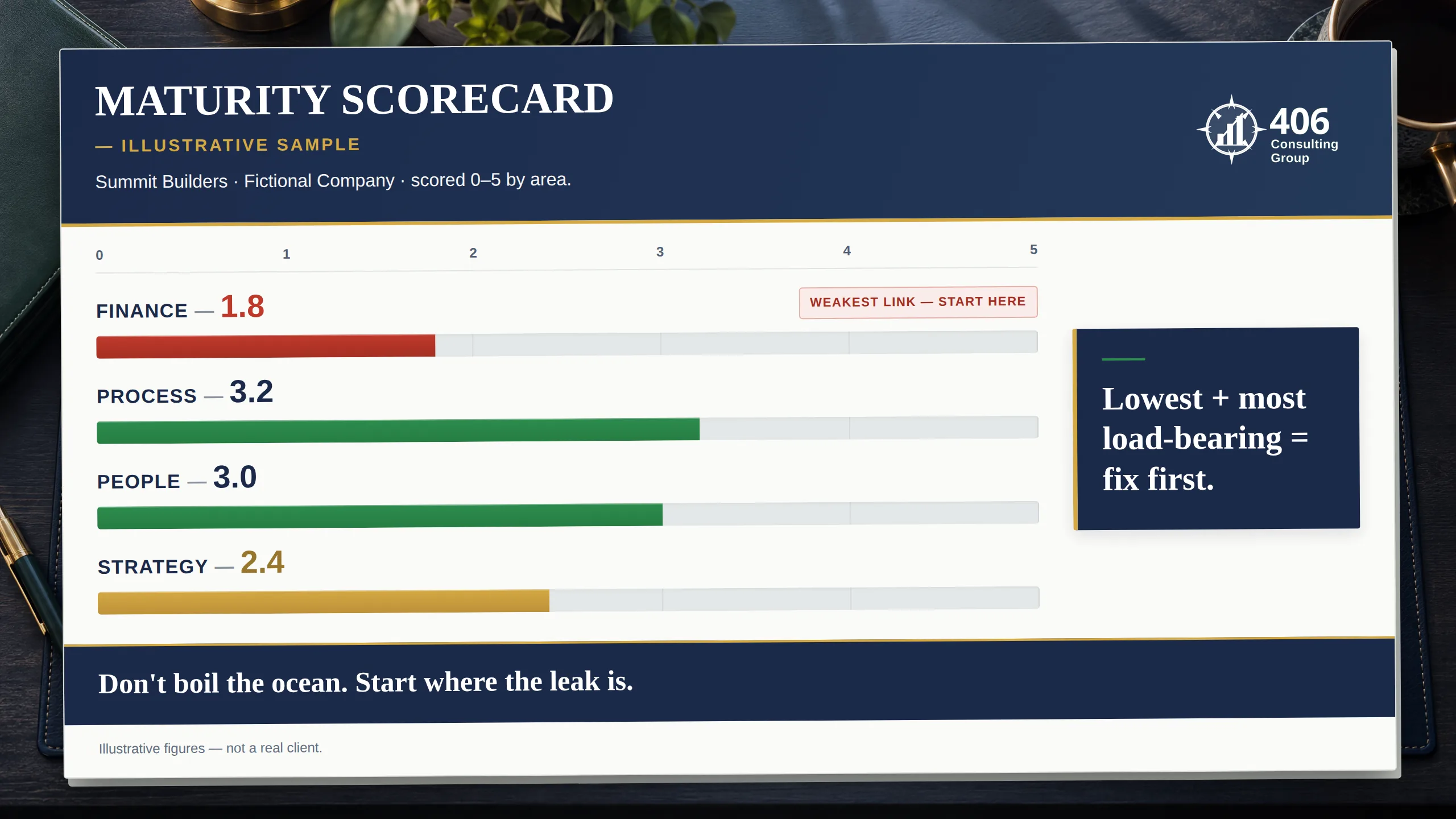
The lowest score isn't automatically the answer — you want the one that's both weak and load-bearing, the area whose gaps are dragging on everything else. For Summit, that's the financial function: late books and a billing scramble are starving cash and hiding which jobs actually make money. Fix that, and sales, ops, and growth all breathe easier. A quick maturity assessment or our controller & CFO readiness score will point you at it in a couple of minutes.
Concentrate, then advance
Once you know the constraint, the move is simple to say and hard to do: pour your focus into that one area until it's no longer what's holding you back — then, and only then, move to the next weakest link. One constraint at a time, in sequence, each fix making the next one easier.
Scatter (what most do)
- • A little effort on 14 fronts at once
- • Nothing gets enough to actually change
- • First busy week wipes out the progress
- • Exhausted, and the list looks the same
Concentrate (what works)
- • All-in on the one true constraint
- • It actually gets fixed — and stays fixed
- • The whole system moves up with it
- • Then repeat on the next weakest link
This is the thirty-years-of-process version of the same advice: don't boil the ocean. Start where the leak is, make that one thing repeatable and reliable, and let the win fund and fuel the next one. It's also how maturity actually works — you climb the financial maturity ladder one rung at a time, not all at once.
What a weakest link looks like in real life
The principle is universal, but the constraint is specific to each business. Two from businesses like yours:
For many contractors, it's billing.
A profitable, busy builder is always short on cash because invoicing is a monthly scramble. That one broken process caps the whole business — see the construction invoicing scramble.
For many owners, it's one person.
A single underperforming or difficult employee everyone works around quietly caps the team's output and drives the best people out — see the conversation you're avoiding.
Different symptoms, same disease: one load-bearing weakness, left unaddressed, holding back an otherwise strong business. The fix is never “do everything.” It's “find the one, and start there.”
Knowing the weakest link isn't enough
Here's the catch, and it's the thread running through this whole series. Even owners who identify their constraint drift back to scattering — the shiny new problem, the fire of the day, the work they enjoy more. Focus is a discipline, and discipline erodes without someone holding the line. That's the real job of a good advisor: not just helping you find the weakest link, but keeping you on it — through the quarter, past the distractions — until it's genuinely fixed.
That's the argument we make in why the score is the easy part: a sequenced plan that fixes the weakest link first, and a partner who makes sure you actually do it. A controller or fractional CFO who knows your numbers is often the person best placed to name the real constraint — and keep you aimed at it.
Where to start
Don't start with the fourteen-item list. Start with one honest question: what's the one area that, if it were genuinely handled, would make everything else easier? That's your weakest link. Put your focus there this quarter, and get someone to hold you to it.
Find your weakest link. Fix that one first.
Take the free Financial Maturity Assessment to see which area is actually capping your business. Then talk to a founder about a sequenced plan — and a partner who keeps you focused on the one thing that moves the needle.
Who You’re Actually Working With
Two founders who’ve sat on both sides of your financials
Finding the one constraint that's capping a business — and keeping the focus there until it's fixed — is the heart of how we work: whole-company, sequenced, and accountable. You aren’t handed off to a junior bookkeeper. You work directly with the people whose names are on the door — and their backgrounds are exactly the ones a growing business needs in its corner.

Carrie Anderson
Co-Founder · The Lender’s Eye
A former corporate controller and the contracted commercial loan analysta Montana community bank relies on — she has spread, packaged, and recommended 300+ commercial loans. She knows exactly how a bank reads your financials to decide what you can borrow — because she’s the one doing that analysis. That’s why our clients’ books come out lender-ready, not just tax-ready.

Jason Anderson
Co-Founder · The Operator’s Eye
A degreed accountant with 10+ years in tax and a decade of enterprise operations and accounting at BP, with a lifelong discipline for process, efficiency, and Six Sigma— made practical, not academic. He builds the job costing, tax strategy, and systems that let a company actually see where its money goes and scale without the wheels coming off.
Both spent years in the oil & gas industry, and both design financial systems from a whole-company view— not just an accounting lens. You get a firm that reads your numbers like a lender and builds systems like an operator.
Meet the teamFAQ
Why fix one weak area first instead of improving everything at once?
Because a business behaves like a chain — its overall strength is set by its weakest link, not its average. Spreading your energy across many fixes at once means none gets enough to actually change, while the one area truly holding you back keeps holding you back. Concentrating on the single constraint until it's resolved, then moving to the next, is faster, cheaper, and far more likely to stick.
What is the Theory of Constraints in simple terms?
It's the idea that every system has one bottleneck that limits the output of the whole, so the only way to improve the overall system is to work on that bottleneck. Improving anything that isn't the constraint produces almost no gain. For a business, it means finding the one area capping your growth and focusing there, rather than trying to improve everything evenly.
How do I figure out what my weakest link is?
Score your business area by area — finance, process, people, strategy — and look for the lowest score that also touches the most. Often it's the thing you already avoid thinking about. The goal is to find the weakness that's also load-bearing: the one whose gaps drag on everything else. A maturity assessment is a quick, structured way to surface it in a couple of minutes.
Isn't it better to keep improving the things we're already good at?
No — that's the most common trap. We gravitate to the work we enjoy and are good at because it's satisfying, but effort spent on an area that isn't the constraint delivers almost nothing to the bottom line. It feels productive while changing little — like tuning the engine on a truck with a flat tire. Fix the constraint first; then your strengths actually pay off.
Once I know my weakest link, how do I keep from getting distracted?
That's the hardest part, and it's where most improvement efforts fail. Focus is a discipline that erodes without accountability — the fire of the day and the shiny new problem always compete for attention. The reliable fix is a sequenced plan and a partner (often a controller or fractional CFO who knows your numbers) who keeps you aimed at the one constraint through the quarter until it's genuinely resolved.
This article is general business and financial education, not accounting, tax, legal, or investment advice for your specific situation. The example business and all figures are illustrative. Your weakest link, results, and timeline depend on your business.
In one line
A business is only as strong as its weakest link. Stop trying to fix everything at once — find the one constraint capping your growth, fix it first, then move to the next.
Start here