
What a Fractional CFO
Actually Does — Kalispell, MT
Most Kalispell business owners think a fractional CFO is a fancy bookkeeper. They are not. Here is what one actually delivers for growing businesses in the Flathead Valley — and the seven signs your business needs one now.

In This Guide
- 1The Bookkeeper Ceiling
- 2What a Fractional CFO Actually Does
- 3CFO vs. Controller vs. Bookkeeper
- 4The Flathead Growth Framework
- 5Monthly Deliverables: What You Actually Receive
- 6The Seven Triggers That Say It’s Time
- 7What It Costs — and What You Get Back
- 8Industries in the Flathead Valley That Benefit Most
- 9The Virtual Advantage
- 10How to Evaluate a Fractional CFO
- 11Case Study: Flathead Valley Contractor — Before and After
- 12Frequently Asked Questions
The Bookkeeper Ceiling
A fractional CFO provides part-time, executive-level financial leadership to businesses that need strategic financial management but cannot yet justify a full-time CFO on payroll. For most Kalispell businesses, that gap sits between $800K and $3M in revenue.
The bookkeeper ceiling is the point where a growing business outgrows its financial infrastructure. Your bookkeeper is accurate — the books close every month, reconciliations are clean, and the QuickBooks file is organized. But you still cannot answer the questions that actually matter: Where will cash be in 90 days? Which jobs are profitable and which are bleeding margin? If you needed a line of credit today, could you qualify?
That gap is not a bookkeeping problem. It is a leadership problem. And a fractional CFO is how you solve it without adding a $150,000 salary to overhead.
What the ceiling looks like in practice:
- Owner is making $200K+ decisions based on gut feel because the numbers are not in a usable form
- The business has multiple revenue streams with no visibility into which one is actually profitable after labor and overhead
- A bank asked for a cash flow projection and the owner had to stall two weeks to produce something credible
- Payroll has grown past 8–10 employees and the owner is not sure if the business can sustain current headcount through a slow season
- A line of credit was denied — or offered at half the requested amount — because the financials did not tell a clear story
The Flathead Valley economy is concentrated in construction, hospitality, healthcare services, and professional services — industries that hit CFO-level complexity earlier than most because of cash flow volatility, labor intensity, and capital requirements. The bookkeeper ceiling shows up at $800K in these industries. In some cases, earlier. If your business is still building its bookkeeping foundation, see our complete guide to bookkeeping in Kalispell, MT before evaluating CFO services.
What a Fractional CFO Actually Does
The short answer: a fractional CFO is your financial decision partner. They do not record transactions. They do not prepare your tax return. They do not audit your books. They use the financial data your bookkeeper and controller produce to help you make better business decisions — and they build the systems and models that make those decisions possible.
What a fractional CFO does NOT do
- Bookkeeping or data entry
- Prepare or file your tax return
- Run payroll
- Audit your financial statements
- Replace your bookkeeper or CPA
What a fractional CFO actually does
- Cash flow forecasting — 13-week rolling model
- Financial analysis and variance reporting
- Lender relationship and package preparation
- Margin analysis by job, product, or service line
- Budget creation and monthly actuals review
- Financial modeling for major business decisions
- Oversight of bookkeeper and controller
Most Kalispell business owners who say they are “too small for a CFO” are actually saying they do not need more bookkeeping. They are right. But they do need someone who can look at the numbers and say: “Your receivables are aging past 60 days in Q3 every year. Here is what that means for payroll in October, and here is how to fix it.”
The core distinction: A bookkeeper records what happened. A controller makes sure what happened is reported accurately. A CFO uses what happened to prevent the bad outcome that is coming — and position you to capture the opportunity you do not know about yet. Those are three fundamentally different jobs.
Fractional CFO vs. Controller vs. Bookkeeper
These three roles are often confused — and sometimes conflated into one overloaded hire. Here is what each role actually owns, and what it costs:
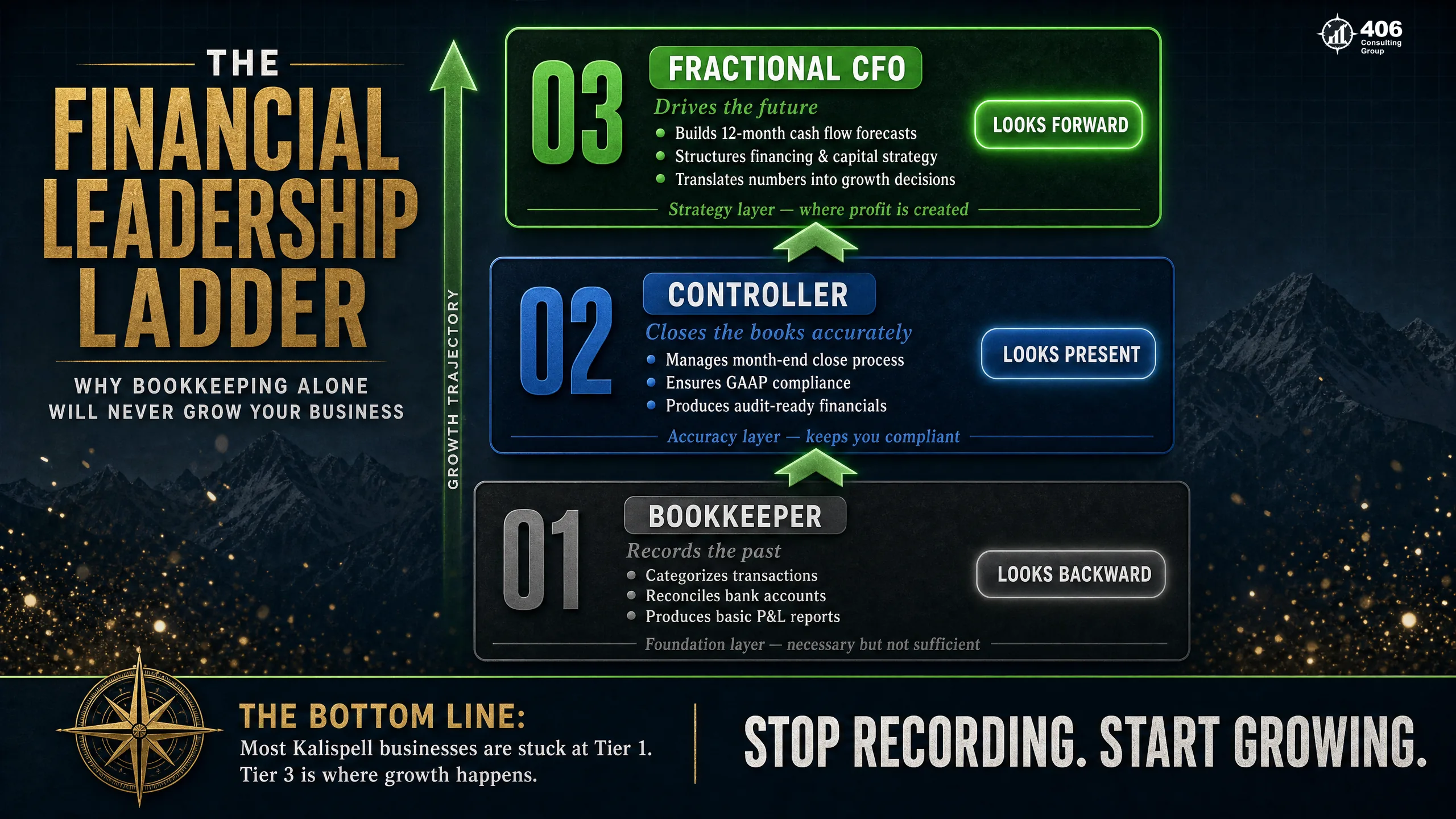
| Function | Bookkeeper | Controller | Fractional CFO |
|---|---|---|---|
| Records daily transactions | ✓ | ✓ | — |
| Closes books monthly | Sometimes | ✓ | — |
| Prepares financial statements | — | ✓ | Reviews |
| Analyzes variances vs. budget | — | Limited | ✓ Core function |
| Cash flow forecasting | — | Sometimes | ✓ Core function |
| Lender & investor relations | — | — | ✓ |
| Strategic financial decisions | — | — | ✓ |
| Margin & pricing strategy | — | — | ✓ |
| Oversees bookkeeper/controller | — | — | ✓ |
| Typical time commitment | Full-time | Full-time or PT | 8–20 hrs/month |
| Typical annual cost | $40K–$60K | $65K–$95K | $30K–$72K (fractional) |
Most growing Kalispell businesses need all three — but not all three full-time at the same revenue level. A common stack at $1M–$3M: a part-time bookkeeper ($500–$1,500/month), a fractional controller ($1,500–$3,000/month), and a fractional CFO ($2,500–$5,000/month). Total: roughly $4,500–$9,500/month for complete financial leadership — compared to $350,000+ in fully-loaded salary and benefits for three full-time hires (per BLS occupational wage data).
If a CFO engagement reveals an S-Corp election could reduce your self-employment tax, see our Montana S-Corp tax benefits guide for the full break-even analysis and Montana-specific filing requirements.
The Flathead Growth Framework
The Flathead Growth Framework is the four-pillar operating model used with every Kalispell and Flathead Valley CFO engagement. Each pillar represents a domain where CFO-level leadership changes what is possible. A business with all four operating well does not just survive — it can scale, borrow, and position for an exit on its own terms.
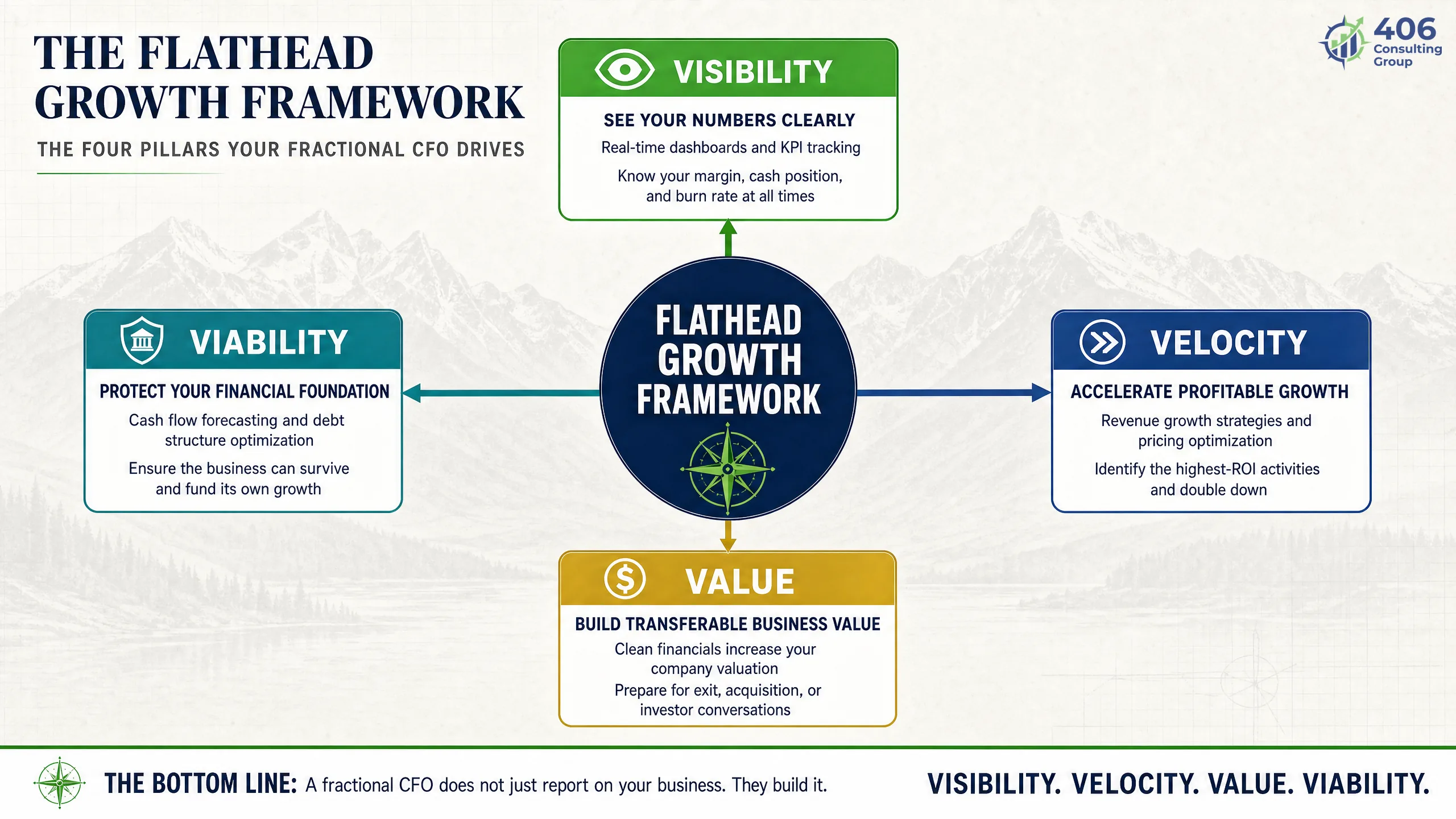
Visibility
- Monthly financials delivered within 10 days of close
- Variance analysis against budget — every line, not just revenue
- KPI dashboard tailored to your business model
- Owner receives one clear picture each month, not a raw data dump
Velocity
- 13-week rolling cash flow forecast — updated monthly
- Seasonal cash gap modeling (critical for Flathead construction and hospitality)
- 90-day decision horizon so you see the squeeze before it arrives
- Payroll sustainability model — can we sustain current headcount?
Value
- Gross margin by service line, job type, or product category
- Labor burden vs. billing rate — where you are profitable per hour
- Overhead recovery rate analysis
- Pricing model review — are you priced for your actual cost structure?
Viability
- Debt service coverage ratio (DSCR) — calculated before the bank asks
- Current ratio and working capital position
- Lender-ready financial package preparation
- Bonding capacity analysis for contractors and construction firms
Kalispell businesses with strong seasonality — construction companies with a May–October build season, hospitality operators with a July–August peak — benefit most from the Velocity pillar. The 13-week cash flow model catches a payroll crunch in November before it becomes an emergency loan in October.
Monthly Deliverables: What You Actually Receive
One of the clearest signs of a weak fractional CFO engagement is vagueness about deliverables. “We meet monthly and I review your financials” is not a CFO engagement — it is a check-in. Here is what a structured engagement actually produces each month:
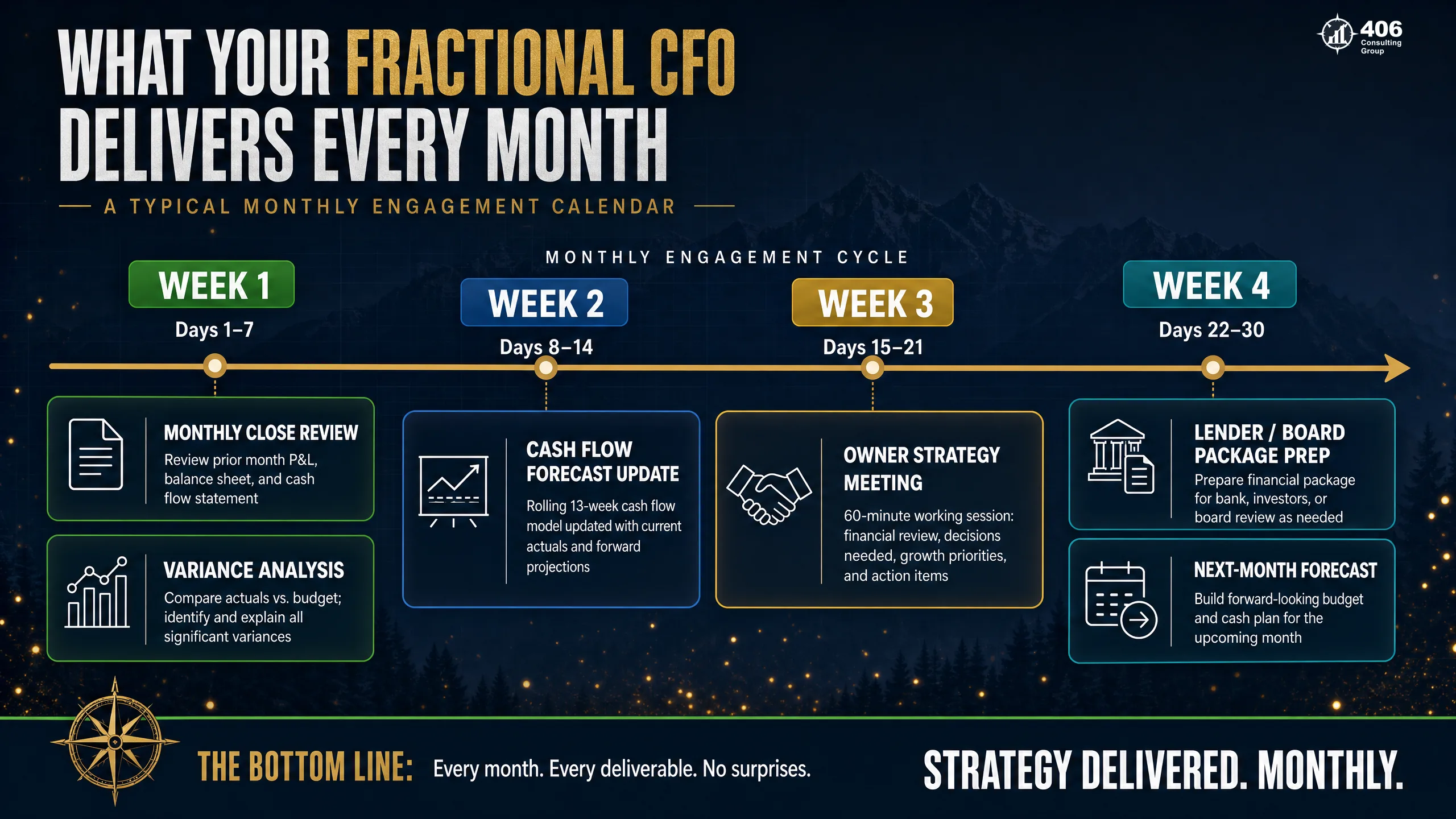
By the 10th of each month
- Prior month financials reviewed and variance-flagged
- KPI dashboard updated with actuals vs. plan
- Material discrepancies flagged to owner before the monthly call
Mid-month
- 13-week cash flow forecast updated with actuals
- 90-day cash position projection reviewed
- Payroll sustainability check if headcount has changed
Monthly strategy call (45–60 min)
- Variance walkthrough — what happened vs. what we expected
- Upcoming decisions requiring financial modeling (new hire, equipment, contract pricing)
- 30/60/90-day horizon review — what are we watching?
- Open items and lender or banking updates
As needed
- Lender package preparation and covenant tracking
- Annual budget creation and revision
- New hire financial impact modeling
- Equipment financing analysis
- Entity structure review (S-Corp election, LLC restructuring)
The Seven Triggers That Say It's Time
Most Kalispell business owners do not hire a fractional CFO because they decided it was time — they hire one because something forced the issue. Here are the seven most common triggers. If two or more apply to your business, the conversation should happen now.
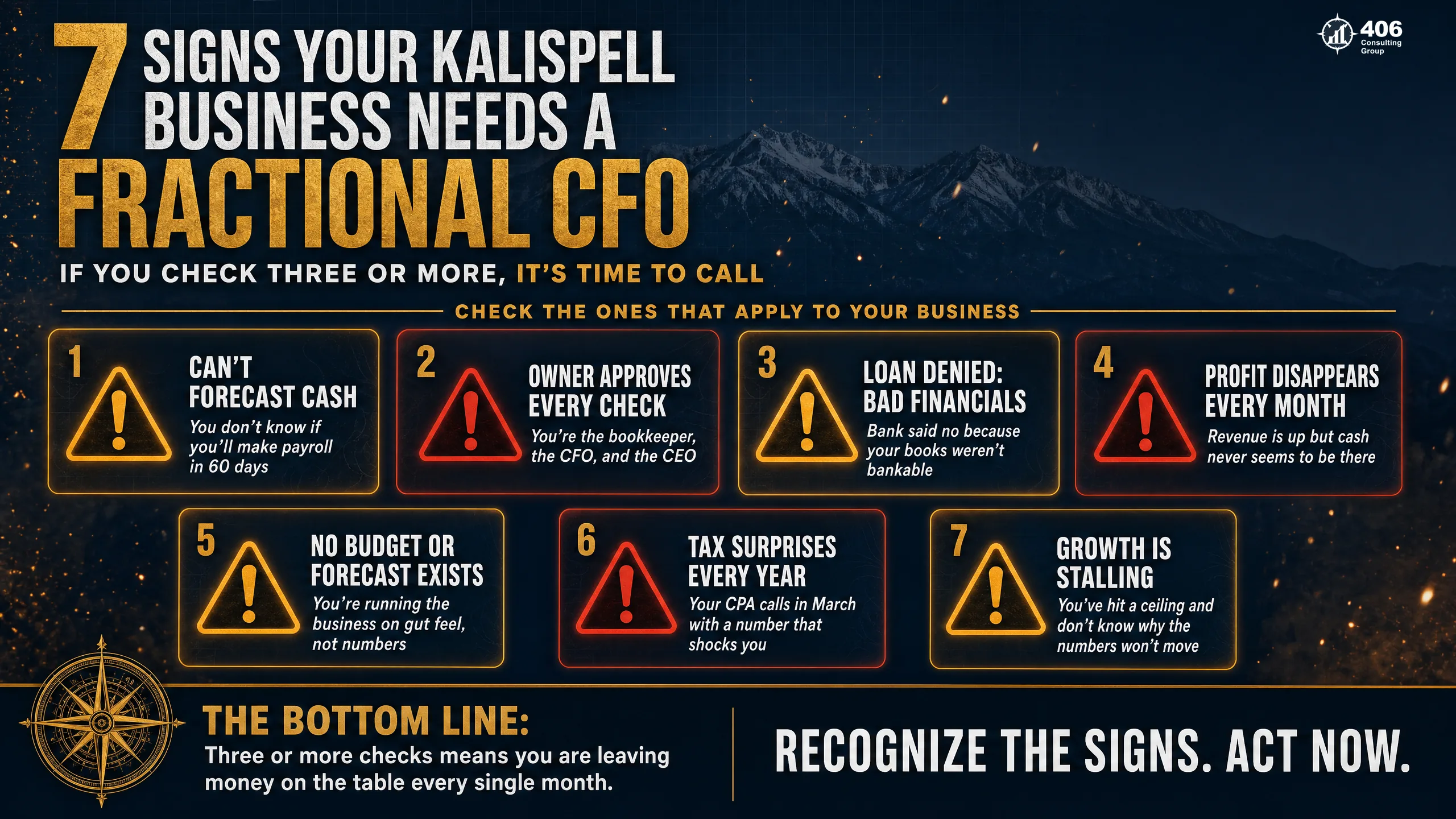
You cannot answer where you will be financially in 90 days
If the honest answer is "I am not sure — it depends on whether those invoices come in," you do not have a cash flow model. That is a core CFO deliverable. Without it, every major decision is made blind.
You are making major purchases or hires based on gut feel
A new truck, a fourth employee, a piece of equipment — these decisions need a cash flow model and a payroll sustainability check. Making them based on "we had a good month" is how businesses end up cash-strapped in November.
Your line of credit application was denied or came in short
Banks rarely explain their reasoning clearly. The underlying cause is almost always the same: the financials did not tell a coherent story. A CFO prepares lender packages that pass underwriting. Most businesses that were denied a LOC had a package problem, not a business problem.
Payroll has grown past the point of informal management
Once you have 8–12 employees with seasonal fluctuations, payroll sustainability becomes a forecasting problem. A CFO models it against your cash position so you know what headcount you can sustain before you make the hire.
Multiple revenue streams with no idea which is most profitable
If you have three service lines and cannot identify which one earns the most after labor, overhead, and direct costs — you are running blind. Margin analysis by line is CFO-level work that changes pricing and resource allocation decisions immediately.
Owner time is being spent on financial admin instead of the business
If you are spending 10+ hours per month on financial questions your numbers cannot answer — reconciling gut feel against QuickBooks, building your own cash flow spreadsheet — that is a direct cost to the business. Your time has a measurable value.
A major opportunity is in front of you and you cannot confirm it pencils
A large contract, an acquisition, a new location — these require financial modeling before you commit. A fractional CFO builds the model, stress-tests the assumptions, and tells you whether the opportunity adds margin or just adds revenue.
Preparing for a loan or line of credit? See what banks actually evaluate in a commercial loan application. For year-round tax and financial planning, our Q4 tax planning guide and year-end financial checklist cover the decisions a fractional CFO would drive each quarter.
What It Costs — and What You Get Back
Fractional CFO pricing for a Kalispell small business typically ranges from $2,000 to $6,000 per month depending on revenue complexity, number of entities, hours required, and scope of deliverables. Most engagements for businesses in the $800K–$3M range land between $2,500 and $4,500 per month.
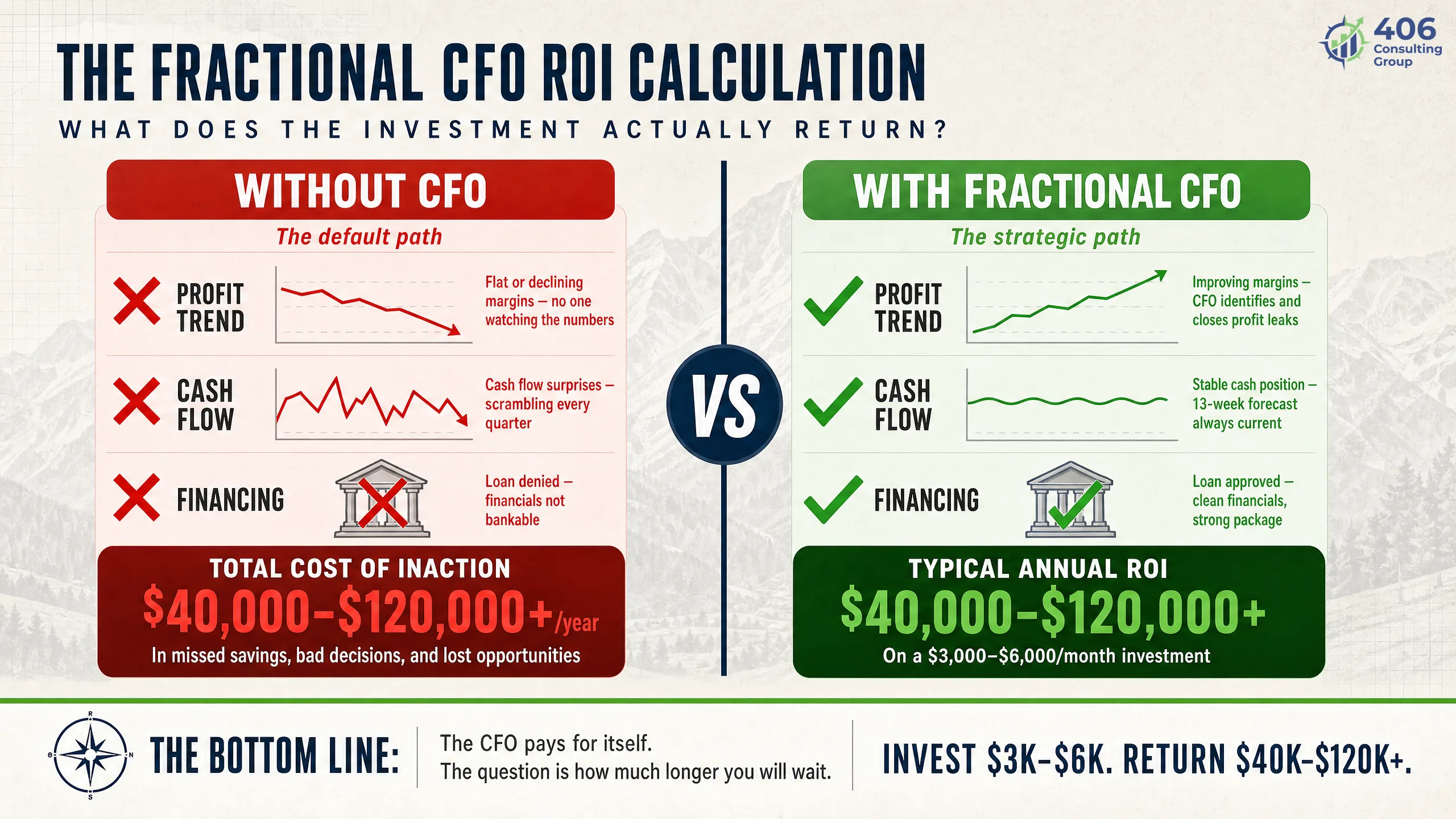
The ROI calculation is not complicated — but you have to look at all the inputs. Most business owners only count the monthly retainer. Here is a fuller picture for a $1.5M Kalispell business:
ROI Example — $1.5M Kalispell Business, 12-Month Engagement
The margin improvement line is the one that surprises owners most. A 2% improvement on $1.5M is $30,000 — which nearly covers the entire annual retainer on its own. Margin work (pricing review, overhead recovery, labor burden analysis) is standard CFO scope. It is not a bonus deliverable; it is the job.
For a deeper look at pricing tiers and what drives cost up or down, see our guide on what a fractional CFO actually costs and what ROI to expect.
Industries in the Flathead Valley That Benefit Most
The Flathead Valley economy is concentrated in industries that hit CFO-level complexity earlier than most — due to cash flow volatility, capital intensity, and labor complexity. Here is how each maps to the Flathead Growth Framework:
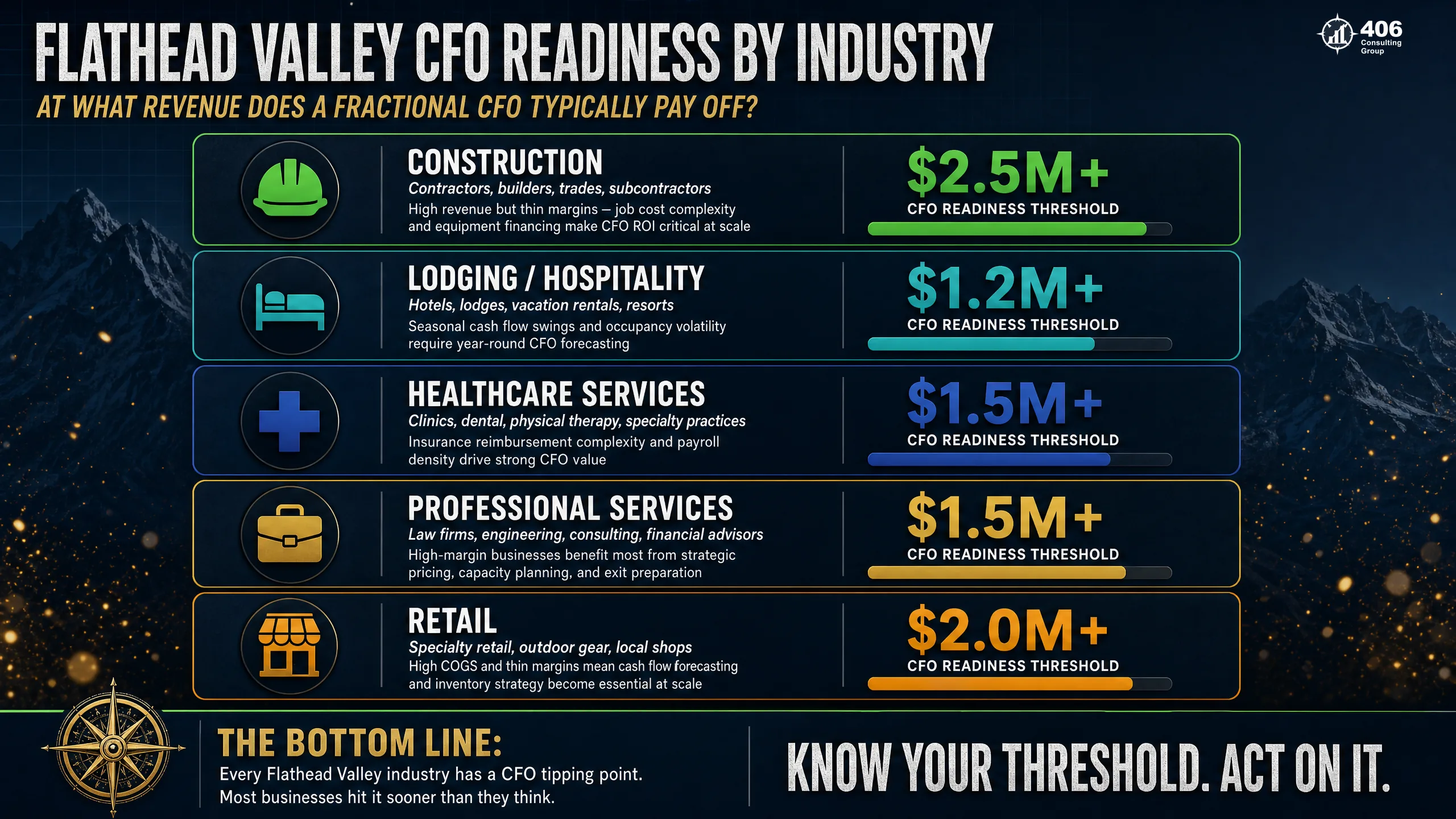
Construction & Contractors
CFO threshold: $800K+- Job costing and WIP schedule management — without them, margin disappears before you realize it
- Bonding capacity calculation — a CFO-prepared financial package can increase your bonding limit
- Seasonal cash flow modeling — cash is tight in March every year; a CFO sees it coming in October
Lodging & Hospitality
CFO threshold: $600K+- Revenue per available room (RevPAR) and occupancy rate analysis
- Debt service coverage on property financing — most lodging operators carry significant debt
- Seasonal revenue peak modeling — July/August cash should not have to carry February without a plan
Healthcare & Medical Services
CFO threshold: $700K+- Payer mix analysis — what percentage of revenue comes from each payer and what the net collection rate is
- Revenue cycle oversight — ensuring billing captures what is earned
- Compliance cost tracking and provider compensation modeling
Professional Services
CFO threshold: $900K+- Utilization rate and billing rate analysis — which service lines earn after non-billable time
- Partner and owner compensation modeling for multi-owner firms
- Capacity modeling — when to hire the next producer vs. grow utilization first
Retail & E-Commerce
CFO threshold: $500K+- Inventory turnover ratio and carrying cost analysis
- Gross margin by product category — not all SKUs earn equally
- Lease cost as a percentage of revenue — the most common margin leak in retail
The Virtual Advantage
Kalispell has excellent local accountants and bookkeepers. It does not have a large supply of experienced fractional CFOs — people who have built cash flow models for growing businesses, prepared lender packages that passed underwriting, and managed seasonal cash volatility at scale. The pool in a market of roughly 26,000–28,000 people is thin.
Virtual CFO services close that gap. A CFO does not need to be physically present in Kalispell to review your monthly financials, build a 13-week cash flow model, or prepare your lender package. What they need is familiarity with Montana-specific issues — the DOR, Montana's business tax structure, the regional lending market, and the industries that dominate the Flathead Valley economy.
What matters for a Kalispell CFO engagement
- Montana tax structure and DOR requirements
- Flathead Valley industry knowledge
- Montana lending market familiarity (First Interstate, Glacier Bank, SBA Montana)
- Montana bonding market for contractors
- Responsive communication — async and on-call
- Clear monthly deliverables you can hold them to
What does not matter
- Same time zone (async tools handle this)
- In-person office presence
- Local name recognition
- A physical office address in Kalispell
406 Consulting Group works entirely virtually with Kalispell and Flathead Valley clients. Documents through a secure portal, monthly strategy calls via video, and responsive communication between sessions. The model works because the work is financial — and financial data travels just fine.
How to Evaluate a Fractional CFO
Hiring a fractional CFO is a significant commitment — typically $2,500–$5,000/month with a 6-month minimum. Candidate quality varies widely. Here are five questions to ask before signing anything, and two signals that say walk away.
Q1: How many current clients do you have at my revenue level, and in my industry?
Why it matters: A fractional CFO working with 15 clients at $200K each has a very different model than one working with 6 clients at $1M–$3M. Industry familiarity matters — construction cash flow modeling is different from healthcare payer mix analysis.
Q2: What specific deliverables will I receive each month — in writing?
Why it matters: Vague answers ("I will review your financials and meet with you") are a red flag. You should receive a defined list: which reports, which models, which meetings, within what timeframe.
Q3: Have you built a 13-week cash flow model for a business in my industry before?
Why it matters: Cash flow forecasting is the core CFO deliverable. If they have not done it recently for a similar business, you are the learning engagement.
Q4: Can you give me an example of a financial decision you helped a client make in the last 90 days?
Why it matters: Strong CFOs have specific recent examples: "We modeled a second-location expansion and the numbers said wait 9 months." Vague answers suggest they are primarily reactive, not advisory.
Q5: How do you handle communication between monthly calls?
Why it matters: Business decisions do not wait for the monthly call. You need a CFO with a clear async communication policy — email response time, what warrants same-day response, and how they handle urgent financial questions.
Two red flags — walk away if you see either:
- They cannot name specific monthly deliverables. "Financial guidance and strategic support" is not a deliverable.
- They bill exclusively by the hour with no defined scope. Open-ended hourly billing incentivizes time, not outcomes.
Case Study: Flathead Valley Contractor — Before and After
The following is a composite based on a typical CFO engagement profile for a Flathead Valley general contractor in the $1.2M–$1.8M revenue range. Specific numbers represent the outcomes commonly achieved in an 18-month engagement.
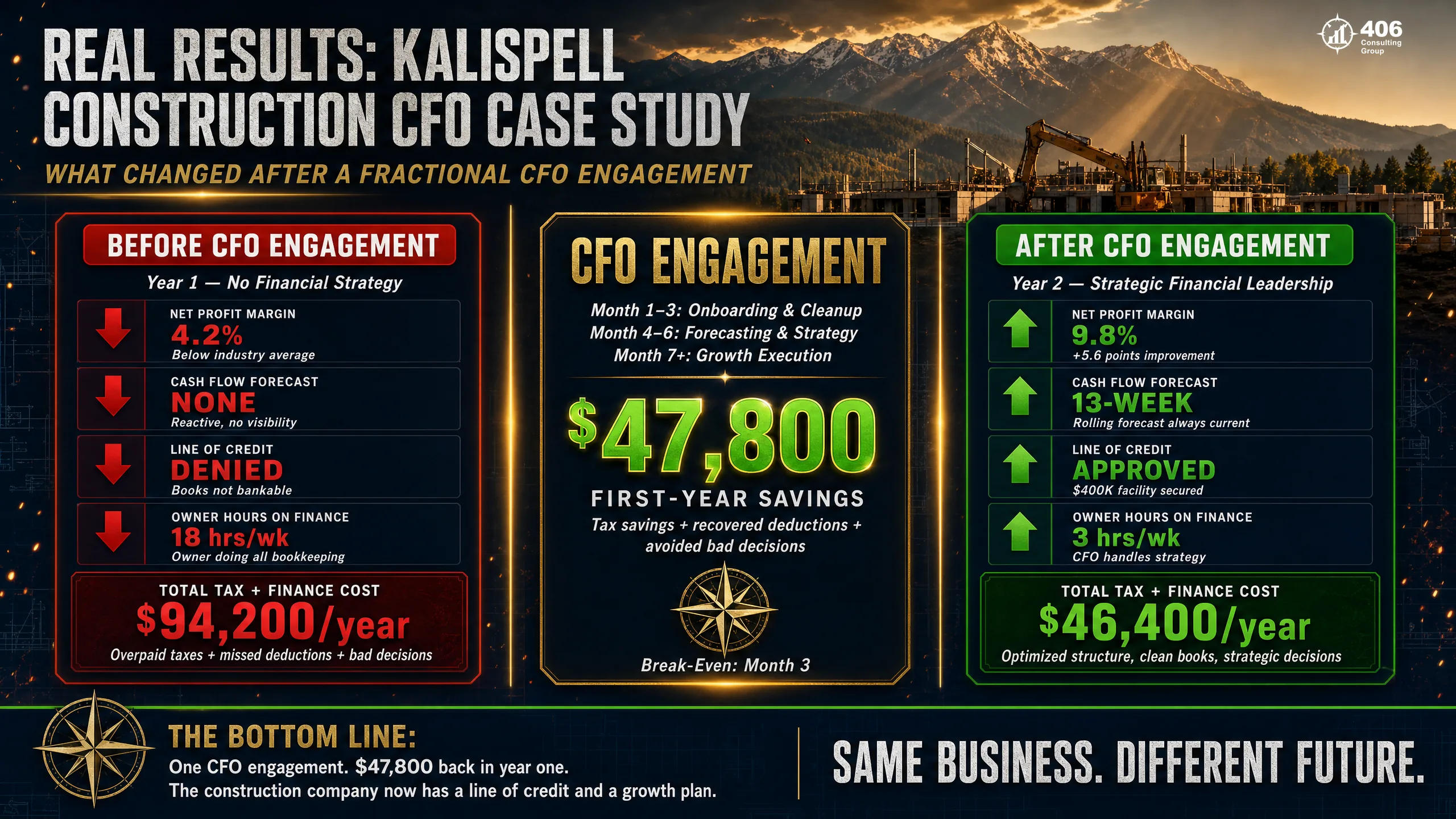
Month 1 — Starting State
Month 18 — After Engagement
The four decisions that drove the 18-month outcome:
- Job costing by project type revealed residential remodels carried a 6% higher gross margin than commercial work — the owner shifted bidding strategy accordingly
- The 13-week cash flow model identified a predictable September/October cash squeeze caused by late-paying commercial clients; a net-30 enforcement policy implemented in March eliminated it
- The lender package took three weeks to build correctly — clean financials, a DSCR calculation, and a two-year projection. The LOC closed 60 days later
- The owner stopped doing weekend QuickBooks reconciliation. That time went into estimating, which drove the revenue increase
Frequently Asked Questions
What does a fractional CFO do on a daily or weekly basis?
A fractional CFO does not work daily — that is the point. They work 8–20 hours per month on your business, concentrated on high-value financial analysis and decision support. In a typical week they might review updated cash flow data, respond to a financial question you flagged, and prepare for the monthly strategy call. The cadence is structured but not constant.
How is a fractional CFO different from a bookkeeper or accountant?
A bookkeeper records what happened. An accountant ensures it is reported correctly and filed. A fractional CFO uses the data those two produce to help you make forward-looking decisions — cash flow forecasting, margin analysis, lender relationships, and financial modeling for major decisions. These are three fundamentally different jobs, and a growing business eventually needs all three.
How much does a fractional CFO cost for a small business in Kalispell?
Most fractional CFO engagements for Kalispell businesses in the $800K–$3M revenue range cost between $2,500 and $4,500 per month. Pricing depends on revenue complexity, number of entities, hours required, and scope. Engagements are typically structured as monthly retainers — not hourly billing — so scope and deliverables are defined upfront.
When should a Kalispell business hire a fractional CFO?
The clearest trigger is when you cannot answer basic forward-looking financial questions: Where will cash be in 90 days? Which service line is most profitable? Can we afford this hire? Other triggers: a LOC application was denied, payroll has grown past informal management, or a major opportunity is in front of you and you do not know if the numbers support it.
Can a fractional CFO help us get a business loan or line of credit?
Yes — and this is one of the clearest ROI cases for hiring one. Banks underwrite based on the strength of your financial story, not just your numbers. A CFO prepares the package: clean financials, a two-year projection, a DSCR calculation, and a narrative that answers the questions an underwriter will ask. Most businesses denied a LOC had a lender package problem, not a business problem.
How do I know if I need a controller or a CFO?
A controller ensures your books close accurately and on time — they own the historical record. A CFO uses that record to drive forward decisions. If your books close late or your financials are unreliable, you probably need a controller first. If your financials are clean but you cannot forecast, model, or borrow — you need a CFO. Many businesses in the $1M–$3M range benefit from both, fractionally.
Does 406 Consulting Group provide fractional CFO services in Kalispell, MT?
Yes. 406 Consulting Group provides fractional CFO, controller, and bookkeeping services for Kalispell and Flathead Valley businesses. We work entirely virtually — monthly strategy calls, secure document portal, and responsive async communication. Jason Anderson’s background in BP financial strategy and extensive work with Montana small businesses across construction, professional services, and hospitality is directly relevant. Contact us to discuss what a CFO engagement looks like for your business.
Contents
- 1The Bookkeeper Ceiling
- 2What a Fractional CFO Does
- 3CFO vs. Controller vs. Bookkeeper
- 4The Flathead Growth Framework
- 5Monthly Deliverables
- 6The Seven Triggers
- 7Cost & ROI
- 8Industries That Benefit Most
- 9The Virtual Advantage
- 10How to Evaluate
- 11Case Study
- 12FAQ
Related Articles
Not sure where your business stands financially? Take our free financial maturity assessment — it identifies the gaps a fractional CFO would address first.
External Resources
Kalispell, MT
Ready for Financial Leadership That Pays for Itself?
406 Consulting Group provides fractional CFO, controller, and bookkeeping services for Kalispell and Flathead Valley businesses. We use the Flathead Growth Framework — every engagement, every month.